fMRI vs. EEG vs. fNIRS: A Neuroimaging Modality Guide for Cognitive Research and Drug Development
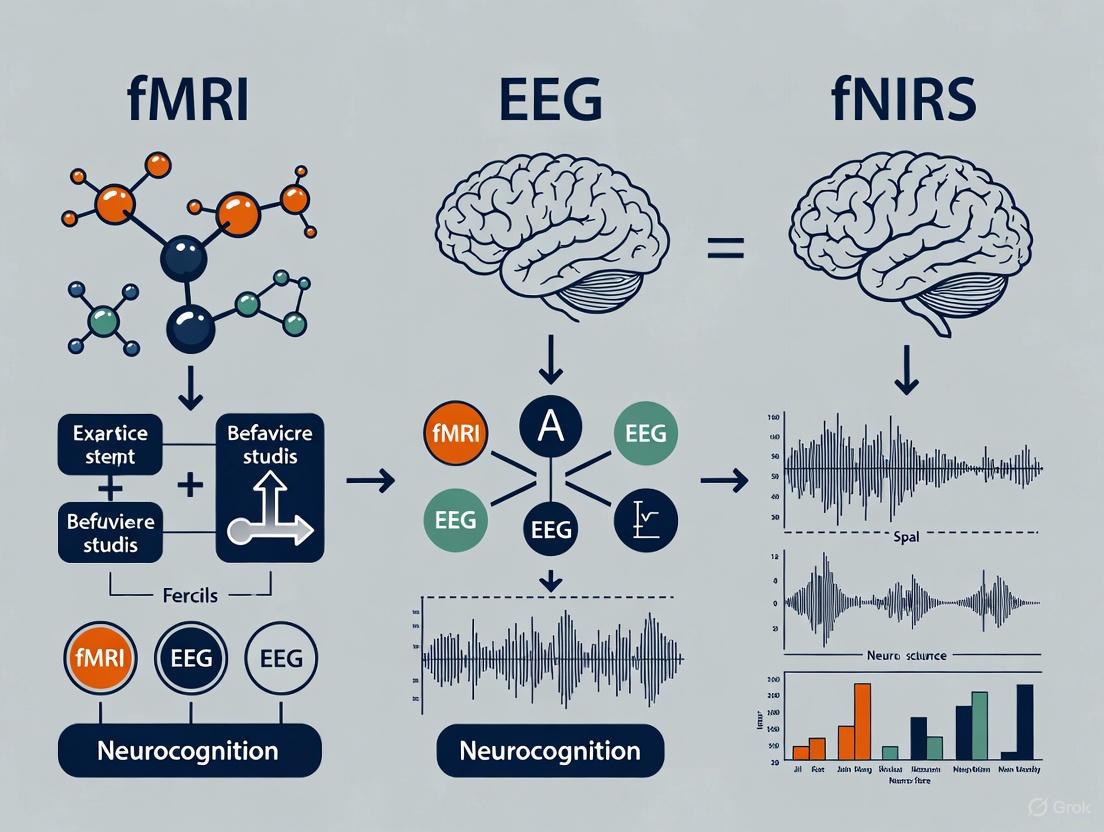
This guide provides a comprehensive comparison of functional Magnetic Resonance Imaging (fMRI), Electroencephalography (EEG), and functional Near-Infrared Spectroscopy (fNIRS) for researchers and professionals in neurocognition and drug development.
fMRI vs. EEG vs. fNIRS: A Neuroimaging Modality Guide for Cognitive Research and Drug Development
Abstract
This guide provides a comprehensive comparison of functional Magnetic Resonance Imaging (fMRI), Electroencephalography (EEG), and functional Near-Infrared Spectroscopy (fNIRS) for researchers and professionals in neurocognition and drug development. It covers the foundational principles, spatial-temporal resolution, and physiological basis of each technique. The article details methodological applications across clinical and cognitive domains, explores troubleshooting and data optimization strategies, and offers a direct comparative analysis to guide modality selection. By synthesizing current evidence and multimodal trends, this resource aims to inform robust study design, enhance data interpretation, and accelerate translational research in neuroscience.
Core Principles and Technical Foundations of fMRI, EEG, and fNIRS
Modern neuroimaging relies on measuring signals that act as proxies for neuronal activity. The three primary signals are the Blood-Oxygen-Level-Dependent (BOLD) signal from functional magnetic resonance imaging (fMRI), electrical potentials from electroencephalography (EEG), and hemodynamic signals from functional near-infrared spectroscopy (fNIRS). The BOLD signal, a cornerstone of fMRI, is an indirect reflection of neuronal activity that measures changes in blood oxygenation [1]. It is primarily determined by the change in paramagnetic deoxyhemoglobin, which results from the combination of changes in oxygen metabolism, cerebral blood flow, and cerebral blood volume [1] [2]. EEG, in contrast, directly measures the brain's electric fields through voltage potentials recorded on the scalp, reflecting the macroscopic activity of the brain surface [3] [4]. fNIRS occupies a middle ground, measuring hemodynamic changes by quantifying oxygenated and deoxygenated hemoglobin concentrations using near-infrared light [5] [6]. Understanding the physiological origins, temporal and spatial characteristics, and relationships between these signals is fundamental to interpreting neuroimaging data and selecting the appropriate modality for specific research questions in cognitive neuroscience and drug development.
Physiological Origins and Mechanisms
The BOLD Signal in fMRI
The BOLD signal detected in fMRI reflects complex physiological processes coupled to underlying neuronal activity. It originates from changes in the magnetic properties of blood based on its oxygenation level. Deoxygenated hemoglobin (HbR) is paramagnetic, meaning it is attracted to an external magnetic field, while oxygenated hemoglobin is diamagnetic and repelled from an applied magnetic field [6]. This difference creates magnetic field inhomogeneities that affect the MRI signal, with higher deoxyhemoglobin concentrations leading to signal reduction [2]. The classic positive BOLD response observed during functional activation represents a decrease in deoxyhemoglobin, indicating an overoxygenation of the active brain region [2]. This hyperoxygenation results from a localized increase in cerebral blood flow (CBF) that exceeds the oxygen demands of the tissue, delivering oxygenated blood in surplus [2].
Neurovascular coupling is the active process linking neuronal activity to orchestrated increases in local blood flow [2]. This response begins rapidly (within ~500 ms of stimulus onset) but peaks 3-5 seconds later due to the physical limitations of vascular dilation and blood flow changes [2]. The BOLD signal is therefore an indirect and delayed measure of neuronal activity, influenced by multiple physiological variables including the efficiency of the hemodynamic response and unique properties of the neural circuit being studied [6]. Key temporal features of the BOLD response include the initial dip, the main positive response, and the post-stimulus undershoot, each reflecting different aspects of the underlying neurovascular and metabolic dynamics [1].
Electrical Potentials in EEG
Electroencephalography measures electrical potentials generated by the summed postsynaptic potentials of pyramidal neurons in the cerebral cortex [4]. When these neurons fire synchronously, their electrical fields summate enough to be detectable through the skull and scalp by electrodes. These signals offer a direct measurement of neural electrical activity with millisecond temporal resolution, allowing for real-time tracking of brain dynamics [3]. The EEG signal represents a macroscopic measure of the brain's surface electrical activity, capturing inherent and periodic electrical impulses generated by clusters of brain cells [3].
The electrical signals recorded by EEG are characterized by their complexity, susceptibility to noise, nonlinearity, and significant variation across individuals based on factors such as age, psychology, and testing environment [3]. Unlike hemodynamic methods, EEG provides a direct window into neural processing but with limited spatial resolution due to the blurring effect of the skull and scalp on electrical field propagation. The signal pattern obtained represents the spontaneous biological potential of the brain, which has been shown to reflect the macroscopic activity of the brain surface [3].
Hemodynamic Signals in fNIRS
Functional near-infrared spectroscopy measures hemodynamic changes associated with neural activity by exploiting the differential absorption properties of biological chromophores, primarily oxygenated (HbO) and deoxygenated hemoglobin (HbR) [5] [6]. fNIRS relies on the relative transparency of biological tissues to near-infrared light (650-950 nm wavelengths) and the fact that HbO and HbR absorb this light differently [5]. By emitting light at specific wavelengths and measuring the intensity of light that reaches detectors placed on the scalp, fNIRS can quantify changes in hemoglobin concentrations in the cortical tissue beneath [7].
The hemodynamic response measured by fNIRS shares a common physiological origin with the BOLD signal, as both are governed by neurovascular coupling [8]. During neuronal activation, increased metabolic demands trigger changes in cerebral blood flow, volume, and oxygen consumption, altering the relative concentrations of HbO and HbR [5]. Typically, activation produces an increase in HbO and a decrease in HbR, similar to the oxygenation changes underlying the BOLD signal [7]. The fNIRS signal is contaminated by various physiological noises, including cardiac pulsation, respiratory cycles, and low-frequency Mayer waves, which must be accounted for in signal processing [5].
Table 1: Fundamental Properties of Neuroimaging Signals
| Property | BOLD (fMRI) | Electrical Potentials (EEG) | Hemodynamics (fNIRS) |
|---|---|---|---|
| What is Measured | Changes in deoxyhemoglobin concentration via magnetic susceptibility | Scalp voltage potentials from postsynaptic neuronal activity | Changes in HbO and HbR concentrations via light absorption |
| Physiological Basis | Neurovascular coupling; blood oxygenation | Direct neuronal electrical activity | Neurovascular coupling; blood volume and oxygenation |
| Primary Source | Hemodynamic response to neural activity | Synchronous firing of pyramidal neurons | Hemodynamic response to neural activity |
| Key Contributors | Cerebral blood flow, cerebral blood volume, oxygen metabolism | Ion channel activity, synaptic transmission | Cerebral blood flow, blood volume, oxygen metabolism |
| Typical Temporal Resolution | 1-3 seconds | Milliseconds | 0.1-1 second |
| Typical Spatial Resolution | 1-3 mm (excellent) | 1-2 cm (poor) | 1-3 cm (moderate) |
| Depth Sensitivity | Whole brain | Cortical surface | Superficial cortex (1-3 cm) |
Measurement Principles and Methodologies
fMRI and BOLD Signal Acquisition
Functional MRI utilizing the BOLD contrast requires a high-field magnet (typically 1.5-7 Tesla) to create a strong static magnetic field [6]. When hydrogen protons in the brain are exposed to this field, they align with it. Application of radiofrequency pulses at specific frequencies displaces these protons, and as they return to equilibrium, they emit detectable signals [6]. The T2* relaxation rate, sensitive to local magnetic field inhomogeneities caused by deoxyhemoglobin, provides the contrast mechanism for detecting brain activation [2]. Active regions exhibit decreased deoxyhemoglobin, reduced magnetic field distortion, longer T2* relaxation, and higher signal intensity [6].
Experimental paradigms for fMRI typically involve block designs or event-related designs, with the BOLD response modeled using a hemodynamic response function (HRF) that captures its characteristic delay and shape [1]. The canonical HRF is often modeled as a linear combination of two Gamma functions to characterize the positive response and subsequent undershoot [5]. Advanced physiological models incorporate additional parameters to account for variations in response timing, dispersion, and baseline across different brain regions and subjects [1] [5].
EEG Signal Acquisition and Processing
EEG acquisition involves placing multiple electrodes (typically 16-256) on the scalp according to standardized systems like the 10-20 system [3]. These electrodes measure voltage fluctuations between recording sites and a reference electrode. Modern EEG systems can be categorized as invasive (with electrodes implanted directly into the brain) or non-invasive (with electrodes placed on the scalp surface), with non-invasive approaches being most common in human research [3]. Portable EEG systems have gained popularity recently, offering greater flexibility albeit sometimes with reduced signal quality compared to research-grade systems [3].
EEG signal processing follows a well-established pipeline [3] [9]:
- Preprocessing: Application of filters (high-pass to remove DC components, low-pass to remove high-frequency noise), artifact correction (especially for ocular movements), and often segmentation of data into epochs time-locked to events of interest.
- Feature Extraction: Transformation of signals into informative features using time-domain analysis (mean, standard deviation, entropy), frequency-domain analysis (Fourier transform, wavelets), or synchrony measures (coherence, correlation) between channels.
- Feature Selection: Optional step to identify the most relevant features using techniques like principal component analysis or genetic algorithms.
- Classification/Analysis: Application of statistical methods or machine learning classifiers to identify patterns related to cognitive states or experimental conditions.
fNIRS Signal Acquisition and Processing
fNIRS systems emit near-infrared light at specific wavelengths (typically 760 and 850 nm) through sources placed on the scalp and measure the intensity of light that reaches detectors at known distances (usually 3 cm) [5] [7]. The differential absorption at these wavelengths allows for calculation of changes in HbO and HbR concentrations using the modified Beer-Lambert law [5]. Systems can be continuous wave (measuring light intensity), frequency domain (measuring amplitude decay and phase shift), or time-resolved (measuring temporal point spread function), with continuous wave systems being most common due to their lower cost and complexity [5].
fNIRS processing typically involves [5] [7]:
- Conversion of raw intensity to optical density and then to hemoglobin concentration changes.
- Quality control using metrics like signal-to-noise ratio and scalp coupling index to identify and remove poor-quality channels.
- Filtering to remove physiological noise (cardiac, respiratory) and drift, often using bandpass filters (e.g., 0.02-0.08 Hz for resting-state studies).
- Artifact correction for motion and systemic physiological effects using methods like principal component analysis or targeted regression.
- Hemodynamic response modeling using general linear models with canonical response functions, sometimes with adaptive filtering techniques to account for inter-subject variations.
Figure 1: Signaling Pathways from Neuronal Activity to Measurable Signals. Solid lines represent hemodynamic pathways with slower temporal response; dashed line represents direct electrical measurement with millisecond resolution.
Comparative Analysis of Signals
Spatial and Temporal Characteristics
The three neuroimaging signals exhibit complementary strengths and limitations in their spatial and temporal characteristics. EEG provides excellent temporal resolution in the millisecond range, allowing precise tracking of neural dynamics as they unfold [3] [4]. However, its spatial resolution is limited (approximately 1-2 cm) due to the blurring effect of the skull and scalp on electrical field propagation [6]. In contrast, fMRI offers high spatial resolution (1-3 mm) and whole-brain coverage, enabling detailed localization of brain activity [6] [7]. This comes at the cost of poor temporal resolution (1-3 seconds) due to the slow nature of the hemodynamic response [2]. fNIRS occupies an intermediate position with moderate spatial resolution (1-3 cm) and better temporal resolution (0.1-1 second) than fMRI, but is limited to measuring superficial cortical regions [5] [7].
The BOLD signal's spatial specificity is influenced by the vascular architecture, with larger veins potentially draining blood from active areas and creating spatial mislocalization [2]. Recent high-resolution fMRI techniques have improved localization by focusing on the initial dip or capillary-level signals [1]. fNIRS signals originate from the cortical surface, with penetration depth limited to approximately 1-3 cm, restricting measurement to superficial cortex [7]. EEG sources can be localized to deeper structures using inverse modeling techniques, though with considerable uncertainty [3].
Relationship Between Signals
The relationship between electrical and hemodynamic signals is governed by neurovascular coupling—the process that links neuronal activity to subsequent changes in blood flow and oxygenation [2] [8]. Studies combining EEG and fMRI have demonstrated a correlation between electrical activity features (such as band power) and the BOLD signal, though this relationship varies across brain regions and frequency bands [8]. Similarly, simultaneous fNIRS-EEG studies show that hemodynamic changes generally follow electrical activity with a characteristic delay of several seconds [8].
The correspondence between fNIRS and fMRI signals has been systematically investigated. Research indicates that the fMRI BOLD signal shows the highest temporal correlation with fNIRS-measured deoxygenated hemoglobin (HbR), as both are sensitive to deoxyhemoglobin concentrations [7]. However, some studies report similar correlations with oxygenated hemoglobin (HbO) or total hemoglobin (HbT) [7]. A multimodal assessment of spatial correspondence found that all fNIRS chromophores (HbO, HbR, HbT) could identify motor-related activation clusters in fMRI data, with no statistically significant differences in spatial correspondence between them [7].
Table 2: Practical Comparison for Research Applications
| Characteristic | fMRI/BOLD | EEG | fNIRS |
|---|---|---|---|
| Spatial Resolution | 1-3 mm (High) | 1-2 cm (Low) | 1-3 cm (Moderate) |
| Temporal Resolution | 1-3 s (Slow) | <10 ms (Very Fast) | 0.1-1 s (Moderate) |
| Depth Penetration | Whole brain | Cortical, some deep sources | Superficial cortex (1-3 cm) |
| Portability | No (Scanner environment) | Yes (Portable systems available) | Yes (Highly portable) |
| Tolerance to Motion | Low (Requires head stabilization) | Moderate (Sensitive to muscle artifacts) | High (Tolerates some movement) |
| Physiological Noise Sources | Cardiac, respiratory, low-frequency drift | Ocular, muscle, cardiac, line noise | Cardiac, respiratory, Mayer waves, skin blood flow |
| Best Applications | Localization of function, connectivity mapping | Temporal dynamics of processing, event-related potentials, brain-computer interfaces | Ecological validity, clinical populations, long-term monitoring |
| Key Limitations | Expensive, scanner environment, low temporal resolution | Poor spatial resolution, sensitive to artifacts | Limited depth penetration, lower spatial resolution than fMRI |
Experimental Protocols and Methodologies
Protocol for Multimodal fMRI-fNIRS Motor Task Study
A representative experimental protocol for assessing spatial correspondence between fMRI and fNIRS hemodynamic responses involves asynchronous recording during motor tasks [7]:
Participants: 9 healthy volunteers with no neurological history (mean age 28.5 ± 3.3; 2 female).
Paradigm: Block design combining motor execution and imagery:
- 17 blocks total (9 Baseline, 4 Motor Action, 4 Motor Imagery)
- Block duration: 30 seconds
- Total run duration: 8 minutes 30 seconds
- During Motor Action blocks: Participants execute bilateral finger tapping sequence
- During Motor Imagery blocks: Participants imagine the same sequence without movement
fMRI Acquisition:
- 3T Siemens Magnetom TimTrio scanner with 12-channel head coil
- High-resolution MPRAGE structural sequence (176 slices, 1×1×1 mm voxels)
- EPI functional sequence (26 slices, 3×3 mm in-plane resolution, TR=1500 ms, TE=30 ms)
fNIRS Acquisition:
- NIRSport2 continuous wave system (16 sources, 15 detectors, 54 channels)
- Wavelengths: 760 nm and 850 nm
- Sampling rate: 5.08 Hz
- Intra-optode distance: 30 mm with 8 short-distance detectors (8 mm) for extracerebral signal regression
Analysis:
- fMRI preprocessing includes slice timing correction, motion correction, spatial smoothing (6 mm FWHM), and normalization to Talairach space.
- fNIRS processing includes quality control (SNR < 15 dB leads to channel pruning), conversion to optical density, motion correction, and bandpass filtering.
- General Linear Model analysis for both modalities with subject-specific regressors.
- ROI definition for primary motor and premotor cortices based on individual activation maps.
- Spatial correspondence assessment through overlap analysis of activation clusters.
Protocol for Simultaneous EEG-fNIRS Structure-Function Study
An investigation of structure-function relationships using simultaneous EEG-fNIRS recordings [8]:
Participants: 18 healthy subjects (28.5 ± 3.7 years) from open dataset.
Experimental Conditions:
- 1-minute resting state sessions
- 30 trials of 10-second left and right hand motor imagery tasks
EEG Acquisition:
- 30 electrodes according to international 10-5 system
- Sampling rate: 1000 Hz (downsampled to 200 Hz)
fNIRS Acquisition:
- 36 channels (14 sources, 16 detectors) with 30 mm inter-optode distance
- Standardized 10-20 system placement
- Sampling rate: 12.5 Hz (downsampled to 10 Hz)
- Wavelengths: 760 nm and 850 nm
Preprocessing:
- EEG: Filtering, artifact removal, source reconstruction using individual head models
- fNIRS: Optical density transformation, quality control (SCI < 0.7 leads to exclusion), bandpass filtering (0.02-0.08 Hz for resting state), motion artifact rejection using GVTD metric, physiological noise removal using PCA
Analysis Framework:
- Structural connectome from ARCHI database projected onto Desikan-Killiany atlas.
- Functional connectivity matrices computed for both EEG and fNIRS.
- Graph Signal Processing approach to quantify structure-function coupling.
- Structural-decoupling index calculation to measure regional (dis)alignment.
- Comparison across modalities, brain states, and intrinsic functional networks.
Figure 2: Experimental Workflow for Multimodal Neuroimaging Studies. Common processing pipeline showing modality-specific steps for fMRI, EEG, and fNIRS data.
The Scientist's Toolkit: Essential Research Reagents and Materials
Table 3: Essential Research Materials and Their Functions
| Item | Function/Purpose | Example Specifications |
|---|---|---|
| High-Field MRI Scanner | Generates BOLD contrast images through strong magnetic fields and radiofrequency pulses | 3T Siemens Magnetom TimTrio with 12-channel head coil [7] |
| Continuous Wave fNIRS System | Measures hemodynamic changes via near-infrared light absorption | NIRSport2 (NIRx) with 760/850 nm wavelengths, 5.08 Hz sampling [7] |
| High-Density EEG System | Records electrical potentials from scalp with high temporal resolution | 30-electrode setup following 10-5 system, 1000 Hz sampling [8] |
| Structural Imaging Sequence | Provides high-resolution anatomical reference for functional data localization | MPRAGE sequence: 1×1×1 mm voxels, 176 slices [7] |
| Canonical Hemodynamic Response Function | Models expected BOLD/fNIRS response shape for statistical analysis | Two Gamma functions with 6 parameters (response/undershoot delays, dispersions, scaling, baseline) [5] |
| General Linear Model (GLM) Framework | Statistical framework for identifying task-related activation | Includes experimental paradigm, motion parameters, physiological noise regressors [5] [7] |
| Graph Signal Processing Tools | Analyzes structure-function relationships through network neuroscience approaches | Structural-decoupling index for quantifying regional coupling [8] |
| Short-Distance Detectors | Regresses superficial physiological noise in fNIRS signals | 8 mm separation optodes for measuring extracerebral signals [7] |
Understanding the physiological origins and characteristics of BOLD signals, electrical potentials, and hemodynamic responses is crucial for designing robust neuroimaging studies and accurately interpreting brain function. Each signal provides unique insights into brain activity with complementary strengths and limitations. The BOLD signal offers excellent spatial resolution but poor temporal characteristics, electrical potentials provide millisecond temporal resolution but limited spatial localization, and fNIRS hemodynamic signals balance portability and ecological validity with moderate spatiotemporal resolution. Multimodal approaches that combine these signals are increasingly valuable for advancing our understanding of brain function in both basic research and clinical applications. By leveraging their complementary strengths and accounting for their distinct physiological origins, researchers can develop more comprehensive models of brain function relevant to cognitive neuroscience and drug development.
Spatial resolution stands as a defining parameter in non-invasive neuroimaging, fundamentally shaping the scientific questions researchers can investigate and the clinical applications they can develop. The quest for higher spatial resolution drives technological innovation while simultaneously presenting unique methodological challenges that vary significantly across imaging modalities. In the context of comparing functional magnetic resonance imaging (fMRI), electroencephalography (EEG), and functional near-infrared spectroscopy (fNIRS), understanding spatial resolution extends beyond simple voxel size or electrode density to encompass the complex interplay between physiological signal origins, technological constraints, and analytical approaches. Each modality captures distinct facets of neural activity through different biophysical mechanisms, resulting in characteristic spatial resolution profiles that make them uniquely suited for specific research paradigms and clinical applications. This technical guide provides a comprehensive analysis of spatial resolution across these three prominent neuroimaging techniques, examining how each modality bridges the gap from whole-brain mapping to precise cortical surface localization, with particular emphasis on their implications for neurocognitive research and drug development.
Fundamental Spatial Resolution Characteristics by Modality
The spatial resolution of neuroimaging techniques varies by orders of magnitude, directly influencing the scale of neural phenomena that can be reliably investigated. Table 1 provides a quantitative comparison of the core spatial resolution characteristics across fMRI, EEG, and fNIRS.
Table 1: Spatial Resolution Characteristics of Major Neuroimaging Modalities
| Parameter | fMRI | EEG | fNIRS |
|---|---|---|---|
| Typical Spatial Resolution | 1-3 mm (7T); 3-3.5 mm (3T) [10] [11] | 5-9 mm (cortical source imaging) [12] | 1-3 cm [13] |
| Whole-Brain Coverage | Yes (standard) | Yes (with high-density systems) | Limited (superficial cortical regions) [13] |
| Penetration Depth | Full brain (cortical and subcortical) | Cortical, with volume conduction | Superficial cortex (2-3 cm) [13] [14] |
| Spatial Specificity to Neural Activity | High with high-resolution fMRI [11] | Moderate (limited by volume conduction) | Moderate (confounded by superficial hemodynamics) [13] |
| Primary Spatial Constraint | Signal-to-noise ratio, physiological noise [11] | Skull conductivity, inverse problem | Light scattering, absorption properties [14] |
The fundamental differences in spatial resolution stem from the distinct biophysical principles each modality exploits. fMRI measures blood oxygenation level-dependent (BOLD) signals, reflecting hemodynamic changes coupled to neural activity through neurovascular coupling [11]. EEG captures post-synaptic electrical potentials generated by synchronized pyramidal neurons [15], while fNIRS employs near-infrared light to measure concentration changes in oxygenated and deoxygenated hemoglobin in superficial cortical vessels [13] [14].
Technical Foundations of Spatial Resolution
fMRI: From Standard to High-Resolution Imaging
The spatial resolution of fMRI has dramatically improved with technological advances, particularly through the development of ultra-high field systems (7T and above). While "standard" fMRI resolution at 3T is typically defined as ~3-3.5 mm isotropic voxels, high-field systems enable "high resolution" (1-2 mm isotropic) and "ultra-high resolution" (better than 1 mm) imaging [10]. These advances are driven primarily by increased signal-to-noise ratio (SNR) and contrast-to-noise ratio (CNR) at higher field strengths [10].
The implementation of high-resolution fMRI presents significant technical challenges, including limited SNR, increased sensitivity to motion and distortion, and the need to maintain temporal resolution and whole-brain coverage [11]. Parallel imaging techniques with multi-channel radio frequency coils help mitigate these constraints by reducing acquisition times, with acceleration factors of R=4 readily achievable at 7T [10]. High-resolution fMRI begins to reveal the vascular and metabolic heterogeneity of the cortex, as relevant features (pial and intracortical vessels, cortical layers) become distinct at finer spatial scales [11]. This increased resolution necessitates more sophisticated BOLD models that incorporate additional compartments to account for laminar differences in neurovascular coupling and vascular architecture [11].
EEG: Source Imaging and the Inverse Problem
The spatial resolution of scalp EEG is substantially improved through cortical source imaging, which solves the inverse problem of estimating intracranial source activity from scalp potentials [12]. The accuracy of EEG source localization depends on multiple factors including sensor density, source localization algorithms, forward head models, and noise levels [12]. Validation studies comparing EEG source locations with fMRI activations in the primary visual cortex demonstrate mean localization errors of approximately 7 mm, sufficient to discriminate cortical activation changes corresponding to less than 3° visual field changes [12].
The spatial resolution of EEG is fundamentally constrained by the blurring effect of the skull and other tissues, which act as a volume conductor that spatially smears the intrinsically high-resolution neural electrical activity [15]. High-density EEG systems (128-256 channels) combined with realistic head models derived from structural MRI significantly improve spatial accuracy, but the technique remains limited in its ability to resolve deeply located sources or precisely distinguish adjacent neural populations with similar activation timecourses.
fNIRS: Physiological and Technical Constraints
fNIRS spatial resolution is primarily limited by light scattering in biological tissues, which causes measured signals to represent spatially blurred hemodynamic changes. The typical spatial resolution of 1-3 cm is sufficient to distinguish broad functional areas but inadequate for mapping columnar or laminar organization [13]. Depth sensitivity represents another major constraint, with near-infrared light penetration typically limited to the superficial cortex (2-3 cm depth), making fNIRS unsuitable for investigating subcortical structures [13] [14].
The spatial sampling of fNIRS is determined by the arrangement of sources and detectors on the scalp, with optimal separation typically around 3 cm to balance sensitivity to cerebral versus extracerebral signals [14]. Short-separation detectors (8 mm source-detector distance) are increasingly employed to measure and regress out superficial hemodynamic contributions, improving specificity to cerebral signals [14]. The modified Beer-Lambert law provides the fundamental principle for converting light attenuation measurements into hemoglobin concentration changes, though this approach yields relative rather than absolute quantification in continuous-wave systems [14].
Methodological Approaches for Enhanced Spatial Localization
Cortical Surface-Based Analysis of fMRI Data
Surface-based analysis represents a powerful approach for enhancing the functional specificity of fMRI data by leveraging anatomical constraints. This method involves interpolating fMRI data onto computational models of the cortical surface derived from high-resolution structural MRI [16]. The geodesic Voronoï diagram approach automatically defines interpolation kernels around each vertex of the cortical surface, following the highly convoluted anatomy of the cortex while avoiding mixing signals across sulci [16]. This method demonstrates greater robustness to anatomical/functional misregistration and position of vertices within the gray matter compared to spherical interpolation approaches [16].
Surface-based analysis provides several advantages for neuroimaging: (1) increased detection sensitivity by constraining analysis to cortical gray matter; (2) facilitation of intersubject alignment using cortical folding patterns; (3) enabling direct comparison with MEG/EEG source reconstruction performed on the same surface [16]. This approach is particularly valuable for high-resolution fMRI studies investigating laminar-specific processes or conducting multimodal integration with electrophysiological techniques.
Experimental Protocol: Cortical Surface-Based fMRI Analysis
Application Context: This protocol is designed for researchers seeking to implement cortical surface-based analysis of fMRI data to enhance spatial localization and facilitate multimodal integration, particularly with EEG/MEG.
Required Materials and Software:
- High-resolution T1-weighted anatomical MRI (1 mm isotropic)
- fMRI EPI volumes (standard resolution: 3-3.5 mm isotropic; high-resolution: 1-2 mm isotropic)
- Cortical surface extraction software (FreeSurfer, BrainVISA)
- fMRI processing pipeline (SPM, FSL, AFNI)
- Multimodal integration tools (Brainstorm, MNE-Python) [8] [16]
Step-by-Step Procedure:
- Anatomical Data Processing:
- Segment T1-weighted MRI to identify gray/white matter boundary
- Reconstruct cortical surface models (mid-thickness, pial, white surfaces)
- Apply surface inflation and spherical registration for intersubject alignment
fMRI Preprocessing:
- Perform standard volume-based preprocessing (motion correction, distortion correction, temporal filtering)
- Co-register functional volumes to anatomical data using boundary-based registration
Surface Interpolation:
- Define interpolation kernels using geodesic Voronoï diagrams around each surface vertex
- Project fMRI data (raw timeseries or statistical maps) onto surface vertices
- Verify interpolation quality and check for residual anatomical/functional misregistration
Surface-Based Analysis:
- Perform statistical analysis on surface-mapped data
- Apply surface-based spatial smoothing (typically 5-10 mm FWHM)
- Implement multiple comparison correction using random field theory or permutation testing
Multimodal Integration (Optional):
- Co-register EEG sensor positions to anatomical MRI
- Use same surface for EEG source reconstruction and fMRI visualization
- Compare spatial patterns of activation across modalities [16]
Validation and Quality Control:
- Compare surface-based results with standard volume-based analysis
- Verify that activation clusters respect sulcal boundaries
- Check for systematic biases in surface reconstruction across subjects
- Assess robustness to anatomical/functional misregistration [16]
Multimodal Integration for Enhanced Spatial Resolution
Complementary Strength Paradigms
Integrating multiple neuroimaging modalities leverages their complementary spatial and temporal resolution characteristics to overcome individual limitations. The combination of fMRI and fNIRS capitalizes on fMRI's high spatial resolution and whole-brain coverage with fNIRS's superior temporal resolution, portability, and lower motion sensitivity [13]. Similarly, simultaneous EEG-fNIRS recording exploits EEG's millisecond temporal resolution for capturing neural dynamics alongside fNIRS's better spatial resolution and robustness to electrical noise [15].
Three primary methodological approaches exist for multimodal integration:
- EEG-informed fNIRS analysis: Using EEG-derived features to constrain or interpret fNIRS signals
- fNIRS-informed EEG analysis: Incorporating hemodynamic information to guide EEG source reconstruction
- Parallel fNIRS-EEG analyses: Analyzing datasets separately then combining results at the group level [15]
The theoretical foundation for EEG-fNIRS integration rests on neurovascular coupling - the physiological relationship between neural electrical activity and subsequent hemodynamic responses [15]. This coupling enables built-in validation of identified activity through simultaneous measurement of both processes, though with important considerations for their differential temporal and spatial characteristics.
Spatial Alignment and Co-registration Methods
Accurate spatial alignment between modalities is essential for meaningful multimodal integration. This typically involves:
- Coregistering EEG electrodes and fNIRS optodes by spatially aligning them to an anatomical MRI template using digitized positions relative to known scalp landmarks [8]
- Mapping all functional data (EEG source reconstructions, fNIRS channels, fMRI activations) to a common coordinate system (e.g., Desikan-Killiany atlas) [8]
- Employing graph signal processing tools to analyze structure-function relationships across modalities within the same anatomical framework [8]
The Voronoï-based interpolation method previously described provides an optimal approach for projecting volumetric fMRI data to the cortical surface, creating a common spatial support for comparing fMRI results with EEG/MEG source reconstructions [16].
Visualization of Multimodal Integration Framework
Spatial Integration Framework for Multimodal Neuroimaging
The Scientist's Toolkit: Essential Research Reagents and Materials
Table 2: Essential Materials and Analytical Tools for High-Resolution Neuroimaging Research
| Tool/Category | Specific Examples | Function/Purpose |
|---|---|---|
| fMRI Analysis Packages | SPM, FSL, AFNI, FreeSurfer | Preprocessing, statistical analysis, and cortical surface reconstruction of fMRI data |
| EEG Source Imaging Tools | Brainstorm, MNE-Python, FieldTrip | EEG forward modeling, source reconstruction, and connectivity analysis |
| fNIRS Processing Software | HOMER3, NIRS Toolbox, AtlasViewer | Optical data processing, hemoglobin calculation, and visualization on brain models [14] |
| Multimodal Integration Platforms | Brainstorm, SPM, AFNI | Co-registration of multimodal data and integrated analysis |
| High-Density EEG Systems | 128-256 channel EEG caps with active electrodes | High spatial sampling for improved source localization accuracy [12] |
| fNIRS Hardware Configurations | Continuous-wave (CW), frequency-domain (FD), time-domain (TD) systems | Measurement of hemodynamic responses with varying depth sensitivity and quantification capabilities [14] |
| Ultra-High Field MRI Scanners | 7T, 9.4T, and higher field systems | Enhanced SNR and spatial resolution for submillimeter fMRI [10] [11] |
| Head Model Resources | ICBM, Colin27, MNI templates | Standardized anatomical references for source reconstruction and spatial normalization |
Implications for Neurocognitive Research and Drug Development
The spatial resolution characteristics of fMRI, EEG, and fNIRS have profound implications for their application in neurocognitive research and pharmaceutical development. In basic cognitive neuroscience, the choice of modality involves careful trade-offs between spatial resolution, temporal resolution, and experimental flexibility. fMRI provides unparalleled spatial specificity for mapping cognitive processes across distributed brain networks, while high-density EEG offers millisecond temporal resolution for tracking rapid neural dynamics. fNIRS occupies a unique niche with its balance of reasonable spatial sampling, good temporal resolution, and tolerance for movement, making it suitable for ecologically valid paradigms and special populations [13] [15].
In drug development, these modalities serve complementary roles in establishing target engagement, pharmacodynamic biomarkers, and mechanistic insights. fMRI provides detailed spatial information on drug effects across brain circuits, particularly valuable for compounds targeting specific neuroanatomical systems. EEG offers sensitive measures of neuronal population activity with temporal precision suited for capturing acute drug effects on neural oscillations and event-related potentials. fNIRS shows growing promise for clinical trials due to its practicality for repeated measurements, patient tolerance, and ability to monitor cortical responses during functional tasks in more naturalistic settings [15].
The emerging approach of multimodal integration holds particular promise for advancing both basic neuroscience and therapeutic development. By combining spatial precision from fMRI with temporal precision from EEG, researchers can achieve more comprehensive characterization of neural processes disrupted in neurological and psychiatric disorders. Similarly, combining fNIRS with EEG provides a portable platform for assessing both electrical and hemodynamic aspects of brain function in clinical populations and real-world environments [15] [8]. These integrated approaches potentially offer more sensitive biomarkers for tracking disease progression and treatment response, ultimately accelerating the development of novel therapeutics for brain disorders.
Temporal resolution refers to the precision with which a neuroimaging technique can measure the timing of neural events. In cognitive neuroscience research, capturing the rapid dynamics of brain activity is essential for understanding how neural processes unfold in real time during task performance. The core challenge lies in balancing the capture of fast electrical events with the slower metabolic changes that accompany neural activity. Functional magnetic resonance imaging (fMRI), electroencephalography (EEG), and functional near-infrared spectroscopy (fNIRS) approach this challenge differently, each with distinct advantages and limitations stemming from their fundamental operating principles [17] [18] [19].
These techniques measure different physiological phenomena: EEG directly detects electrical activity from neuronal firing, while fMRI and fNIRS measure hemodynamic responses (changes in blood flow and oxygenation) that are indirectly linked to neural activity through neurovascular coupling. This fundamental difference explains their vastly different temporal resolution characteristics, which in turn determines their suitability for various research questions in neurocognition and drug development [20].
Core Principles and Measurement Techniques
Electroencephalography (EEG): Capturing Electrical Potentials
EEG measures electrical activity generated by the synchronized firing of neuronal populations directly from the scalp surface. This technique captures voltage fluctuations resulting from ionic current flows within neurons, providing a direct window into the brain's electrical signaling with millisecond temporal resolution [19] [20]. This exceptional temporal sensitivity allows researchers to track neural events almost as they occur, making EEG ideal for studying rapid cognitive processes such as attention, perception, and decision-making. However, the electrical signals measured by EEG are distorted as they pass through the skull and scalp, resulting in limited spatial resolution on the order of centimeters [19] [21].
The quantitative analysis of EEG data typically involves examining power spectral density across different frequency bands: delta (0.5-4 Hz), theta (4-7 Hz), alpha (8-12 Hz), beta (13-30 Hz), and gamma (30-150 Hz) [20]. These frequency-specific patterns provide valuable biomarkers for cognitive states and neurological conditions. In stroke recovery research, parameters like the Power Ratio Index (ratio of slow-wave to fast-wave activity) and Brain Symmetry Index have emerged as prognostic markers for motor recovery [20].
Functional Magnetic Resonance Imaging (fMRI): Tracking Blood Flow Changes
fMRI measures brain activity indirectly through the Blood-Oxygen-Level-Dependent (BOLD) contrast, which exploits different magnetic properties of oxygenated and deoxygenated hemoglobin [17]. When neurons become active, local blood flow increases disproportionately to oxygen consumption, leading to a decrease in deoxygenated hemoglobin that serves as the basis for the BOLD signal. This hemodynamic response unfolds over several seconds, peaking typically 4-6 seconds after neural activity onset [17].
The BOLD response provides excellent spatial resolution (millimeters) and whole-brain coverage, including deep subcortical structures [17] [19]. However, this comes at the cost of poor temporal resolution (1-5 seconds) due to the slow nature of hemodynamic processes [19] [21]. This temporal lag means fMRI cannot capture rapid neural dynamics directly, though its high spatial precision makes it invaluable for localizing function and identifying networks. The technique requires expensive equipment, confines participants to a scanner environment, and is highly sensitive to motion artifacts [17].
Functional Near-Infrared Spectroscopy (fNIRS): Monitoring Hemodynamic Responses Optically
fNIRS operates on similar physiological principles as fMRI, measuring changes in oxygenated hemoglobin (HbO) and deoxygenated hemoglobin (HbR) concentrations in the brain [17] [18]. However, instead of magnetic properties, fNIRS utilizes the different absorption characteristics of hemoglobin to near-infrared light (650-1000 nm) [17]. When near-infrared light is projected through the scalp and skull, the intensity of diffusely refracted light provides information about relative hemoglobin concentration changes [18].
fNIRS occupies a middle ground temporally, with better temporal resolution than fMRI (typically 0.01-0.1 seconds or 10-100 Hz) but worse than EEG [18] [19]. This improved temporal sampling allows better characterization of the hemodynamic response function and greater tolerance for movement artifacts compared to fMRI [17] [22]. The spatial resolution of fNIRS is limited to superficial cortical regions (∼1-3 cm depth) due to rapid light scattering in biological tissue [18] [22]. Unlike fMRI, fNIRS does not provide structural anatomical information and requires co-registration with other imaging modalities for precise localization [17].
Table 1: Technical Specifications of Major Neuroimaging Modalities
| Parameter | EEG | fNIRS | fMRI |
|---|---|---|---|
| Temporal Resolution | Milliseconds (0.001-0.005 s) [19] [21] | 10-100 Hz (0.01-0.1 s) [18] [19] | 1-5 seconds [19] [21] |
| Spatial Resolution | Centimeters (limited below cortical surface) [19] [21] | Millimeters (limited to cortical surface) [18] [21] | Millimeters (not limited to cortical areas) [19] [21] |
| Depth Penetration | Cortical surface | 1-3 cm (cortical regions only) [18] [22] | Whole brain including deep structures [17] |
| Measured Signal | Electrical activity from synchronized neuronal firing [20] | Hemodynamic response (HbO/HbR concentration changes) [17] [18] | Hemodynamic response (BOLD signal) [17] |
| Primary Strength | Excellent temporal resolution for tracking rapid neural dynamics [19] [20] | Good balance between temporal resolution and portability [17] [22] | Excellent spatial resolution and whole-brain coverage [17] [19] |
Quantitative Comparison of Temporal Resolution
The temporal characteristics of neuroimaging modalities directly determine the types of neural phenomena they can effectively capture. EEG's millisecond precision enables researchers to track the precise timing of cognitive processes, such as the sequence of neural events during visual perception or motor planning [20]. This fine temporal grain is essential for studying event-related potentials (ERPs) that unfold within hundreds of milliseconds after stimulus presentation.
In contrast, fMRI's temporal resolution of 1-5 seconds is sufficient to track general changes in brain activity across tasks but cannot resolve rapid neural sequences [19] [21]. The sluggish BOLD response integrates neural activity over time, making it difficult to determine whether activated areas are engaged simultaneously or sequentially. This limitation is particularly problematic for studying complex cognitive processes that involve rapidly switching between neural networks.
fNIRS offers an intermediate temporal solution with sampling rates typically between 10-100 Hz (0.01-0.1 seconds) [18] [19]. While still tracking the relatively slow hemodynamic response, this improved temporal sampling allows better characterization of the hemodynamic response function onset and shape compared to fMRI. The higher sampling rate also provides greater robustness to physiological noise and motion artifacts [22].
Table 2: Temporal Resolution Implications for Experimental Design
| Aspect | EEG | fNIRS | fMRI |
|---|---|---|---|
| Ideal Study Types | Sensory processing, rapid cognitive tasks, sleep studies, epilepsy monitoring [20] | Naturalistic tasks, developmental studies, clinical populations, movement-based paradigms [17] [18] | Localization studies, network connectivity, deep brain structures, anatomical correlation [17] [19] |
| Temporal Constraints | Can resolve events separated by <100 ms | Can resolve events separated by 1-2 seconds | Requires 4-6 seconds between events for BOLD response |
| Neurovascular Coupling | Does not measure hemodynamic response | Directly measures hemodynamic response with better temporal sampling than fMRI | Measures hemodynamic response with delay of 4-6 seconds |
| Artifact Sensitivity | Sensitive to ocular, muscle, and electrical artifacts [19] | Moderately sensitive to motion artifacts [22] | Highly sensitive to motion artifacts [17] |
Experimental Protocols and Methodologies
Protocol 1: Multimodal fNIRS-EEG for Motor Tasks
A sophisticated approach to leveraging the complementary strengths of different temporal resolutions involves simultaneous multimodal recordings. A 2023 study published in Scientific Reports demonstrated this through simultaneous fNIRS-EEG recordings during motor execution, observation, and imagery tasks [23].
Experimental Setup: Participants were fitted with a 24-channel continuous-wave fNIRS system (Hitachi ETG-4100) embedded within a 128-electrode EEG cap (Electrical Geodesic, Inc.) [23]. The fNIRS system measured changes in oxygenated hemoglobin (HbO) and deoxygenated hemoglobin (HbR) concentration at two wavelengths (695 nm and 830 nm) with a sampling rate of 10 Hz. EEG data was collected simultaneously with millisecond temporal resolution. Optodes were positioned over sensorimotor and parietal cortices to target the Action Observation Network [23].
Task Design: The experiment included three conditions: (i) Motor Execution - participants grasped and moved a cup with their right hand; (ii) Motor Observation - participants observed an experimenter performing the same action; (iii) Motor Imagery - participants mentally rehearsed the action without physical movement [23]. Each condition was triggered by audio cues with randomized trial sequences.
Data Fusion and Analysis: Researchers employed structured sparse multiset Canonical Correlation Analysis (ssmCCA) to fuse fNIRS and EEG data, identifying brain regions consistently detected by both modalities [23]. This multimodal approach revealed activation in the left inferior parietal lobe, superior marginal gyrus, and post-central gyrus across all three conditions - findings that were not fully apparent in unimodal analyses.
Protocol 2: fNIRS for Postural Change Studies
fNIRS's tolerance to motion artifacts makes it particularly suitable for studying brain dynamics during physical movement. A systematic review published in Physiology & Behavior in 2024 detailed methodologies for investigating cerebral hemodynamics during postural changes [22].
Experimental Design: Studies typically involve participants changing position from supine or sitting to standing while fNIRS monitors cerebral oxygenation changes in parallel with continuous blood pressure monitoring [22]. This design allows researchers to investigate cerebral autoregulation - the brain's ability to maintain stable blood flow despite blood pressure fluctuations.
fNIRS Configuration: Most studies used continuous-wave fNIRS systems with source-detector distances of 3-4 cm, providing penetration depth of approximately 2-3 cm into the cerebral cortex [22]. Measurements focused on prefrontal and motor cortices, analyzing HbO and HbR concentration changes relative to baseline.
Data Interpretation: The review found that 58% of studies reported a positive correlation between brain oxygenation changes and blood pressure changes following postural changes, while 39% found no correlation [22]. These variable findings highlight the complexity of neurovascular coupling and the importance of standardized protocols for comparing results across studies.
Technical Workflows and Signaling Pathways
The fundamental relationship between neural activity and its measurable manifestations follows a predictable temporal sequence. The diagram below illustrates the complete signaling pathway from initial neural firing to the detectable signals measured by each neuroimaging technique:
The experimental workflow for designing studies that account for these temporal characteristics follows a structured process:
The Scientist's Toolkit: Essential Research Materials
Implementing temporally-sensitive neuroimaging research requires specific technical equipment and analytical tools. The following table details essential solutions for researchers designing experiments focused on temporal dynamics:
Table 3: Research Reagent Solutions for Temporal Neuroimaging
| Tool Category | Specific Examples | Function in Research |
|---|---|---|
| fNIRS Systems | Hitachi ETG-4100 [23], NIRSIT [24], Kernel Flow [19] | Measures hemodynamic responses with better temporal sampling than fMRI; suitable for naturalistic tasks and movement paradigms [17] [24] |
| EEG Systems | High-density 128-channel EEG [23], Quantitative EEG (qEEG) platforms [20] | Captures millisecond electrical activity; enables analysis of event-related potentials and neural oscillations [19] [20] |
| Multimodal Integration Tools | Structured sparse multiset CCA (ssmCCA) [23], Integrated fNIRS-EEG source localization [20] | Fuses data from multiple modalities to leverage complementary temporal and spatial resolution [20] [23] |
| Temporal Analysis Software | Brain Symmetry Index calculators [20], Hemodynamic response function modeling tools [17] | Quantifies temporal characteristics of neural signals; identifies abnormalities in neural timing and coordination [17] [20] |
| Experimental Paradigms | Motor execution/observation/imagery tasks [23], Postural change protocols [22] | Creates controlled conditions for studying temporal dynamics of specific cognitive and motor processes [22] [23] |
Temporal resolution represents a fundamental consideration in selecting neuroimaging modalities for neurocognitive research and drug development. EEG provides unparalleled millisecond precision for tracking rapid neural dynamics but offers limited spatial resolution. fMRI delivers detailed spatial mapping of brain activity but suffers from poor temporal resolution due to the slow hemodynamic response. fNIRS occupies a middle ground with better temporal sampling than fMRI while maintaining good tolerance for movement and naturalistic environments.
The future of temporal resolution in neuroimaging lies in multimodal approaches that simultaneously leverage the complementary strengths of different techniques. By combining EEG's millisecond precision with fNIRS's hemodynamic monitoring or fMRI's spatial resolution, researchers can overcome the limitations of individual modalities. These integrated approaches, supported by advanced data fusion algorithms, will continue to advance our understanding of brain dynamics across temporal scales from milliseconds to seconds - ultimately enhancing both basic cognitive neuroscience and applied clinical research.
This technical guide provides a detailed comparison of functional Magnetic Resonance Imaging (fMRI), Electroencephalography (EEG), and functional Near-Infrared Spectroscopy (fNIRS) across the critical dimensions of portability, cost, and operational complexity. These specifications are pivotal for selecting the appropriate neuroimaging tool in neurocognitive research and drug development.
The table below synthesizes the core technical specifications for fMRI, EEG, and fNIRS to facilitate direct comparison.
Table 1: Key Technical Specifications for fMRI, EEG, and fNIRS
| Specification | fMRI | EEG | fNIRS |
|---|---|---|---|
| Portability & Tolerance to Motion | Non-portable; requires strict head immobilization in a scanner [13] [25]. | High portability; lightweight, wearable wireless systems available [26] [27]. Tolerant to some motion, but susceptible to artifacts from muscle and eye movement [27]. | High portability; wearable, wireless formats ideal for real-world settings [25] [27]. Highly tolerant to subject movement [27]. |
| Spatial Resolution | High (millimeter-level); whole-brain coverage, including subcortical structures [13]. | Low (centimeter-level); limited by skull conductivity and signal dispersion [26] [27]. | Moderate; better than EEG but confined to the cortical surface (up to ~2-2.5 cm depth) [13] [25] [27]. |
| Temporal Resolution | Low (seconds); constrained by the slow hemodynamic response (0.33-2 Hz) [13]. | Very High (milliseconds); ideal for tracking fast neural dynamics [26] [27]. | Low (seconds); also limited by the hemodynamic response [13] [27]. |
| Operational Complexity & Key Hardware | Very High; requires a shielded room, superconducting magnet, high-performance gradients, and dedicated RF coils. Needs specialist operation [28]. | Moderate; requires electrode application (gel or dry), amplifiers, and a data acquisition system. Setup is straightforward [27]. | Moderate; requires optode placement on the scalp with minimal skin preparation. Systems are generally user-friendly [27]. |
| Approximate Cost | Very High (millions of USD); includes high purchase price, installation, and maintenance. | Low to Moderate; generally lower cost, with consumer-grade devices becoming very affordable [27]. | Moderate; generally higher than EEG, especially for high-density systems [27]. |
Core Operational Principles and Experimental Workflows
Fundamental Operational Principles
Each technique measures a distinct physiological correlate of brain activity, which dictates its specifications and applications.
- fMRI: Measures changes in blood oxygenation (BOLD signal) related to neural activity [13] [28]. This requires a powerful magnet to detect subtle magnetic property changes in blood.
- EEG: Measures the electrical potential generated by the synchronized firing of populations of cortical neurons [26] [27].
- fNIRS: Uses near-infrared light to measure changes in oxygenated (HbO) and deoxygenated hemoglobin (HbR) concentrations in the superficial cortex, providing an indirect measure of neural activity via neurovascular coupling [13] [25].
The diagram below illustrates the core operational principles and the physiological signals each modality captures.
Figure 1: Signal pathways for EEG, fNIRS, and fMRI.
Representative Experimental Protocol: A Multimodal fNIRS-EEG Study
Combining modalities like fNIRS and EEG leverages their complementary strengths. The following is a generalized protocol for a simultaneous fNIRS-EEG experiment, such as one investigating a motor imagery task [8] [29].
Table 2: Research Reagent Solutions and Essential Materials
| Item | Function |
|---|---|
| Integrated fNIRS-EEG Cap | A helmet or cap with pre-defined openings and holders to co-register EEG electrodes and fNIRS optodes, ensuring precise spatial alignment [26]. |
| fNIRS System | Emits near-infrared light and detects returning light to calculate HbO and HbR concentration changes [13] [25]. |
| EEG System | Amplifies and records electrical potentials from the scalp via electrodes [26] [27]. |
| Synchronization Hardware/Software | A shared clock or trigger system (e.g., TTL pulses) to temporally align fNIRS and EEG data streams with millisecond precision [26] [29]. |
| Task Presentation Software | Presents visual or auditory cues to the participant to elicit specific brain states (e.g., rest vs. motor imagery) [25]. |
Procedure:
- Participant Preparation & Setup: Fit the participant with the integrated fNIRS-EEG cap according to the international 10-20 system for positioning. For EEG, ensure good electrode-scalp contact using electrolyte gel or with dry electrodes. For fNIRS, ensure optodes have firm but comfortable contact with the scalp [26] [27].
- Hardware Synchronization: Initiate both the fNIRS and EEG systems and establish a synchronization protocol (e.g., via a shared trigger from the task presentation computer) to ensure temporal alignment of the acquired data [26] [29].
- Data Acquisition:
- Record a baseline period (e.g., 1-minute resting state) [8].
- Present the task paradigm. For a motor imagery task, this involves cueing the participant to imagine moving their left or right hand without actual movement for a set period (e.g., 10 seconds), interspersed with rest periods [8].
- Acquire data simultaneously from both fNIRS and EEG throughout the session.
- Data Preprocessing:
- EEG: Apply filters (e.g., 0.5-40 Hz), remove artifacts (e.g., ocular, muscle), and re-reference the data [8].
- fNIRS: Convert raw light intensity to optical density, then to HbO and HbR concentrations. Apply bandpass filtering (e.g., 0.01-0.1 Hz) to remove physiological noise (heart rate, respiration) and motion artifacts [8].
- Data Fusion & Analysis: Employ analysis techniques such as:
- General Linear Model (GLM): Model the brain response to the task conditions for each modality separately [25].
- Data-Driven Fusion: Use methods like joint Independent Component Analysis (jICA) or canonical correlation analysis (CCA) to identify coupled patterns of electrical and hemodynamic activity [29].
The workflow for this type of experiment is summarized below.
Figure 2: fNIRS-EEG experimental workflow.
Interpretation Guidelines and Strategic Selection
Matching the Tool to the Research Question
The choice of neuroimaging modality should be driven by the specific requirements of the research question.
- Choose EEG when the primary interest is in the timing of neural processes with millisecond precision. It is ideal for studying event-related potentials (ERPs), rapid cognitive processes, and for brain-computer interfaces (BCIs) where speed is critical [27].
- Choose fNIRS when the research requires localization of cortical activity in naturalistic or mobile settings. Its tolerance to motion makes it suitable for studies involving social interaction, rehabilitation exercises, or child development [13] [25] [27].
- Choose fMRI when the highest possible spatial resolution and whole-brain coverage are non-negotiable. It is indispensable for mapping deep brain structures and establishing detailed functional networks in highly controlled environments [13] [28].
- Choose a Multimodal Approach (e.g., fNIRS-EEG) when a comprehensive picture of brain activity is needed, combining excellent temporal resolution with good spatial localization for cortical processes. This is highly valuable for advanced BCI and investigating neurovascular coupling [26] [29].
Operational and Cost Considerations
Strategic decision-making must also account for practical constraints.
- fMRI entails the highest operational complexity and cost, limiting its use for large-scale studies or longitudinal monitoring outside dedicated facilities.
- EEG and fNIRS offer lower barriers to entry in terms of cost and operational demands. Their portability enables longitudinal studies, fieldwork, and clinical bedside monitoring, which is challenging with fMRI [27].
- Integration Challenges: While combining EEG and fNIRS is powerful, it introduces challenges such as hardware compatibility, avoiding sensor interference on the scalp, and developing complex data fusion pipelines [26] [29].
Inherent Strengths and Limitations of Each Modality
Understanding the intricate functions of the human brain requires multimodal neuroimaging approaches that leverage the complementary strengths of individual techniques. Functional Magnetic Resonance Imaging (fMRI), Electroencephalography (EEG), and functional Near-Infrared Spectroscopy (fNIRS) represent three cornerstone modalities in contemporary neuroscience research, each with distinct technical principles and performance characteristics [13] [15]. These differences translate into specific advantages and limitations that determine their suitability for various research scenarios, particularly in drug development and clinical neuroscience applications. This technical guide provides a comprehensive comparison of these modalities, detailing their inherent strengths and limitations to inform experimental design and methodology selection in neurocognition research.
Technical Specifications and Performance Characteristics
Table 1: Core technical characteristics of fMRI, EEG, and fNIRS
| Parameter | fMRI | EEG | fNIRS |
|---|---|---|---|
| Spatial Resolution | 1-3 mm (high) [13] | ~Centimeters (low) [15] [30] | 1-3 cm (moderate) [13] |
| Temporal Resolution | 0.33-2 Hz (slow) [13] | Millisecond-scale (very high) [15] | Up to 10+ Hz (moderate) [31] |
| Penetration Depth | Whole brain (high) [13] | Cortical surfaces (high) [15] | Superficial cortex (2-3 cm) (limited) [13] [17] |
| Portability | No (stationary) [13] [17] | Yes (high) [15] [17] | Yes (high) [13] [17] |
| Measurement Basis | BOLD signal (HbR) [13] [17] | Electrical potentials [15] | HbO and HbR concentrations [13] [15] |
| Key Measured Signal | Hemodynamic (indirect) [13] | Neuroelectrical (direct) [15] | Hemodynamic (indirect) [13] |
Table 2: Practical considerations for research implementation
| Consideration | fMRI | EEG | fNIRS |
|---|---|---|---|
| Cost | Very high [17] | Low [15] [17] | Moderate [17] |
| Setup Time | Lengthy [17] | Moderate [17] | Quick [17] |
| Subject Tolerance | Low (claustrophobia, noise) [13] [17] | High [17] | High [13] [17] |
| Motion Artifact Sensitivity | Very high [13] [17] | High [15] | Moderate [13] [15] |
| Population Suitability | Limited (metal implants, obesity) [17] | Broad (all populations) [17] | Broad (including infants) [13] [17] |
| Naturalistic Paradigm Suitability | Very low [13] | Moderate [15] | High [13] [31] |
Detailed Strengths and Limitations
Functional Magnetic Resonance Imaging (fMRI)
Strengths:
- High Spatial Resolution: fMRI provides unparalleled spatial resolution (1-3 mm) for localizing neural activity across the entire brain, including deep subcortical structures such as the hippocampus, amygdala, and thalamus [13]. This whole-brain coverage enables comprehensive investigation of network interactions [13].
- Established Gold Standard: As a well-validated technique, fMRI serves as the reference modality for hemodynamic measurement, with extensive standardized protocols and analytical pipelines [17].
Limitations:
- Poor Temporal Resolution: The hemodynamic response measured by fMRI lags behind neural activity by 4-6 seconds, with a typical sampling rate of 0.33-2 Hz, making it unsuitable for capturing rapid neural dynamics [13].
- Restricted Experimental Environment: The requirement for subjects to remain motionless within the scanner confines research to highly controlled laboratory settings, limiting ecological validity [13] [17].
- Exclusion Criteria and Participant Burden: The strong magnetic field excludes participants with metal implants, and the loud, confined environment can cause discomfort, making it challenging for certain populations (e.g., children, claustrophobic individuals) [17].
Electroencephalography (EEG)
Strengths:
- Excellent Temporal Resolution: EEG captures neuroelectrical activity directly with millisecond precision, enabling the study of fast neural oscillations, event-related potentials, and real-time brain dynamics [15] [20].
- High Portability and Cost-Effectiveness: Modern EEG systems are lightweight, portable, and relatively affordable, facilitating research in diverse settings including clinical environments and naturalistic contexts [15] [17].
- Broad Population Applicability: With no exclusion criteria related to metal implants and better tolerance by participants, EEG can be used with virtually any population, including infants and patients with medical devices [17].
Limitations:
- Poor Spatial Resolution: The blurring effect of the skull and scalp on electrical signals results in spatial resolution on the centimeter scale, making precise source localization challenging without advanced inverse modeling techniques [15] [30].
- Vulnerability to Artifacts: EEG signals are highly susceptible to contamination from muscle activity, eye movements, and other physiological sources, requiring sophisticated preprocessing and artifact removal methods [15].
Functional Near-Infrared Spectroscopy (fNIRS)
Strengths:
- Optimal Balance for Ecological Applications: fNIRS offers a favorable trade-off between spatial resolution (1-3 cm) and temporal resolution (typically ~10 Hz), along with robustness to motion artifacts, making it ideal for studying brain function in real-world contexts and during movement [13] [31] [17].
- Portability and Participant Flexibility: fNIRS systems are increasingly portable and wireless, allowing measurements at bedside, in homes, or during rehabilitation exercises [13] [31]. The silent operation prevents auditory interference with tasks [17].
- Comprehensive Hemodynamic Measurement: Unlike fMRI which primarily measures the BOLD signal (related to deoxygenated hemoglobin), fNIRS quantifies both oxygenated (HbO) and deoxygenated (HbR) hemoglobin concentration changes, providing a more complete picture of hemodynamic activity [31] [17].
Limitations:
- Superficial Measurement Depth: Near-infrared light penetration is limited to approximately 2-3 cm, restricting measurement to the cortical surface and preventing assessment of subcortical structures [13] [17].
- Lower Spatial Resolution Than fMRI: While offering better spatial resolution than EEG, fNIRS cannot match the precise localization capabilities of fMRI [13] [17].
- Sensitivity to Extracerebral Contamination: fNIRS signals can be confounded by systemic physiological noise from scalp blood flow, requiring careful signal processing to isolate brain-specific activity [13] [31].
Multimodal Integration Approaches
Integrating multiple neuroimaging modalities leverages their complementary strengths to overcome individual limitations. The synergy between fMRI, EEG, and fNIRS enables more comprehensive investigation of brain function through advanced data fusion techniques.
Figure 1: Signaling pathways and multimodal integration of EEG, fNIRS, and fMRI. The diagram illustrates how different modalities capture distinct aspects of neural activity and how their integration enables comprehensive brain mapping.
Methodological Frameworks for Integration
Synchronous Data Acquisition: Simultaneous recording of multiple modalities during experimental tasks requires careful technical coordination to minimize interference. For EEG-fMRI integration, specialized equipment resistant to electromagnetic interference is essential [13]. Similarly, combined EEG-fNIRS systems leverage their compatibility to capture complementary electrical and hemodynamic information concurrently [15] [32].
Asynchronous Data Integration: Data collected separately can be combined through spatial co-registration and analytical fusion techniques. This approach is particularly valuable when technical constraints prevent simultaneous acquisition, such as combining high-resolution fMRI with portable fNIRS for longitudinal monitoring [13].
Joint Source Reconstruction: Advanced computational algorithms utilize the spatial precision of hemodynamic modalities (fMRI or fNIRS) to constrain the inverse problem in EEG source localization. This approach significantly enhances the spatiotemporal resolution of neural activity mapping beyond what any single modality can achieve [30].
Experimental Protocols and Methodologies
Protocol for Multimodal fNIRS-EEG in Motor Recovery Assessment
This protocol exemplifies a multimodal approach for assessing post-stroke motor function recovery, combining the temporal precision of EEG with the hemodynamic monitoring capabilities of fNIRS [20].
Participant Preparation and Setup:
- EEG Cap Placement: Apply a 30-electrode cap according to the international 10-5 system, ensuring impedance levels below 5 kΩ for optimal signal quality [8].
- fNIRS Optode Configuration: Position fNIRS sources and detectors to cover motor cortical areas (primary motor cortex, supplementary motor area) with an inter-optode distance of 30 mm to ensure adequate penetration depth [20] [8].
- 3D Digitization: Record the precise positions of EEG electrodes and fNIRS optodes relative to cranial landmarks (nasion, inion, preauricular points) for accurate spatial coregistration [8].
Data Acquisition Parameters:
- EEG: Sample at 1000 Hz with a bandpass filter of 0.1-100 Hz [8].
- fNIRS: Use wavelengths of 760 nm and 850 nm, sampling at 12.5 Hz [8].
- Task Paradigm: Implement a block design with alternating rest (30s) and motor execution/imagery (30s) epochs, repeated for 10 cycles [20].
Data Processing Pipeline:
- EEG Processing:
- Apply bandpass filtering (0.5-45 Hz) and notch filtering (60 Hz)
- Remove ocular and muscular artifacts using independent component analysis (ICA)
- Compute quantitative EEG (qEEG) parameters: Power Spectral Density (PSD), Brain Symmetry Index (BSI), and Phase Synchrony Index [20]
fNIRS Processing:
Multimodal Integration:
- Extract task-related hemodynamic responses from fNIRS and event-related synchronization/desynchronization from EEG
- Perform correlation analysis between EEG power bands and fNIRS hemoglobin concentrations to assess neurovascular coupling [20]
Protocol for fNIRS-fMRI Validation Studies
This protocol describes methodology for validating fNIRS measurements against the gold standard of fMRI, particularly for localizing activation in specific regions of interest [13] [17].
Experimental Design:
- Task Selection: Implement block-design motor tasks (e.g., finger tapping) or cognitive paradigms known to reliably activate target regions (e.g., supplementary motor area) [17].
- Simultaneous Acquisition: Collect fMRI and fNIRS data concurrently during task performance, ensuring fNIRS optodes are MRI-compatible and properly positioned within the scanner environment [13].
- Motion Minimization: Implement strict head restraint procedures to minimize movement artifacts in both modalities [13].
Data Analysis and Correlation:
- fMRI Processing: Preprocess BOLD data (motion correction, spatial normalization, smoothing) and generate statistical parametric maps of activation [13].
- fNIRS Analysis: Process hemodynamic signals and reconstruct cortical activation maps using anatomical co-registration [13].
- Spatial Correspondence Assessment: Quantify the spatial overlap between fMRI and fNIRS activation foci using dice coefficients or correlation metrics [17].
The Scientist's Toolkit: Essential Research Reagents and Materials
Table 3: Essential materials and solutions for multimodal neuroimaging research
| Item | Function/Purpose | Application Notes |
|---|---|---|
| MRI-Compatible EEG System | Records neural electrical activity within MRI scanner environment. | Essential for simultaneous EEG-fMRI; requires specialized electrodes and amplification systems resistant to electromagnetic interference [13]. |
| MRI-Compatible fNIRS System | Measures hemodynamic responses during fMRI acquisition. | Utilizes fiber-optic cables and non-magnetic components; enables direct correlation of fNIRS and BOLD signals [13]. |
| Conductive EEG Gel | Ensures optimal electrical conductivity between scalp and electrodes. | Reduces impedance for high-quality signal acquisition; choice between wet or saline-based gels depends on recording duration [20]. |
| fNIRS Optode Holders | Secures optical sources and detectors in precise configurations on scalp. | Customizable arrangements target specific cortical regions; compatible with EEG caps for multimodal studies [31] [8]. |
| 3D Digitizer | Records precise spatial coordinates of EEG electrodes and fNIRS optodes. | Critical for accurate anatomical co-registration; enables mapping measurements to standard brain atlas spaces [8]. |
| Structural MRI Scan | Provides individual anatomical reference for source localization. | T1-weighted images facilitate precise mapping of functional data to brain anatomy; essential for EEG and fNIRS source reconstruction [30] [8]. |
Figure 2: Experimental design decision workflow for modality selection. This diagram provides a logical framework for choosing the most appropriate neuroimaging modality based on specific research requirements.
fMRI, EEG, and fNIRS each offer unique capabilities for investigating brain function, with inherent trade-offs between spatial resolution, temporal resolution, portability, and practical implementation. fMRI remains unparalleled for precise spatial localization of deep brain activity, while EEG excels at capturing millisecond-scale neural dynamics. fNIRS provides an optimal balance for studying cortical function in naturalistic environments. The future of neurocognitive research lies in multimodal approaches that strategically combine these techniques to overcome their individual limitations, ultimately providing more comprehensive insights into brain function in health and disease. For drug development professionals, understanding these complementary strengths enables more informed decisions when designing studies to evaluate neurotherapeutic efficacy across different temporal and spatial scales of brain activity.
Selecting the Right Tool: Application-Based Methodology in Research and Clinics
Ideal Use Cases for Each Modality in Cognitive and Clinical Neuroscience
Cognitive and clinical neuroscience relies on a suite of non-invasive neuroimaging techniques to decipher the relationship between brain function, cognition, and behavior. No single modality perfectly captures the brain's intricate dynamics; each offers a unique lens with specific strengths and limitations. Functional Magnetic Resonance Imaging (fMRI), Electroencephalography (EEG), and functional Near-Infrared Spectroscopy (fNIRS) are three pivotal technologies that form the backbone of modern brain research [33] [34] [35]. Understanding their ideal use cases is paramount for designing robust experiments, interpreting findings accurately, and advancing both fundamental knowledge and clinical applications. This guide provides a technical comparison of these modalities, detailing their core principles, optimal applications, and experimental protocols to inform researchers and drug development professionals.
Technical Specifications and Core Principles
Comparative Analysis of Neuroimaging Modalities
The following table summarizes the fundamental technical characteristics of fMRI, EEG, and fNIRS, which dictate their suitability for various research scenarios.
Table 1: Technical comparison of key neuroimaging modalities.
| Feature | fMRI | EEG | fNIRS |
|---|---|---|---|
| Primary Signal | Blood-Oxygen-Level-Dependent (BOLD) response [34] | Postsynaptic electrical potentials [33] | Concentration changes in oxygenated (HbO) and deoxygenated hemoglobin (HbR) [35] |
| Spatial Resolution | High (millimeters) [33] [13] | Low (centimeters) [33] | Moderate (1-3 cm) [13] |
| Temporal Resolution | Low (seconds) [13] | High (milliseconds) [33] | Moderate (seconds) [36] |
| Depth Penetration | Whole brain (cortical & subcortical) [13] | Superficial (cortical) | Superficial (cortical) [13] |
| Portability | Low (fixed scanner) | High (increasingly portable) [37] | High (portable/wearable) [35] [13] |
| Tolerance to Movement | Low | Moderate (with artifact correction) [38] | High [35] |
| Key Strength | Localizing neural activity with high spatial precision; whole-brain coverage. | Capturing rapid neural dynamics (oscillations, ERPs). | Naturalistic settings, long-term monitoring, clinical populations. |
| Primary Limitation | Indirect, slow signal; expensive; loud and restrictive environment. | Poor spatial localization; sensitive to artifacts. | Superficial coverage only; susceptible to scalp hemodynamics. |
Signaling Pathways and Physiological Basis
The physiological processes measured by each modality are distinct, forming the basis of their unique profiles. The following diagram illustrates the fundamental signaling pathways from neural activity to the measured signal for fMRI, EEG, and fNIRS.
Diagram 1: Signaling pathways for fMRI, EEG, and fNIRS.
Ideal Use Cases and Clinical Applications
Functional Magnetic Resonance Imaging (fMRI)
fMRI excels in providing a high-resolution spatial map of brain activity, making it ideal for pinpointing the neural circuits involved in specific processes.
- Mapping Cognitive Function: fMRI is the gold standard for non-invasively localizing higher-order cognitive functions like memory, attention, and decision-making across the entire brain, including deep structures like the hippocampus and amygdala [34] [13]. Its high spatial resolution allows researchers to distinguish activity in adjacent brain regions.
- Resting-State Functional Connectivity (rs-fMRI): This method assesses spontaneous low-frequency fluctuations in the BOLD signal while a participant is at rest. It has become a primary tool for identifying large-scale brain networks, such as the Default Mode Network, and investigating how connectivity is altered in neurological and psychiatric disorders [34] [39].
- Presurgical Mapping: In clinical practice, fMRI is used to map eloquent cortical areas (e.g., motor, sensory, language) relative to a planned surgical lesion or resection, helping neurosurgeons minimize postoperative deficits [39].
- Translational Biomarker: fMRI is increasingly used as a biomarker in CNS drug discovery to demonstrate target engagement and evaluate the mechanistic effects of novel therapeutics on brain circuitry, thereby helping to de-risk clinical development [39].
Electroencephalography (EEG)
EEG's supreme temporal resolution makes it the modality of choice for studying the brain's fast-paced electrical dynamics.
- Studying Neural Oscillations and Event-Related Potentials (ERPs): EEG is unparalleled for capturing brain rhythms (e.g., alpha, beta, gamma) and time-locked responses to stimuli (ERPs) that are critical for understanding perceptual, cognitive, and motor processes on a millisecond scale [33] [37].
- Diagnosing and Monitoring Epilepsy: EEG is a cornerstone in the clinical diagnosis and classification of epilepsy, capable of detecting interictal spikes and ictal activity (seizures) [40] [38].
- Brain-Computer Interfaces (BCIs) and Neurofeedback: The real-time nature of EEG signals makes them ideal for BCIs, allowing users to control external devices through brain activity, and for neurofeedback training, where individuals learn to self-regulate their brain rhythms [36] [38].
- Assessing Cognitive States and Disorders: Quantitative EEG (qEEG) can reveal abnormalities in power spectra and coherence associated with conditions like learning disabilities, attention-deficit/hyperactivity disorder (ADHD), and delirium, aiding in diagnosis and monitoring [40].
Functional Near-Infrared Spectroscopy (fNIRS)
fNIRS balances portability with reasonable spatial resolution, opening up research possibilities in naturalistic and clinical settings.
- Naturalistic and Ecological Studies: fNIRS's portability and motion tolerance allow for brain imaging during real-world activities, such as social interactions, walking, and driving simulation, providing insights into brain function in contexts that mimic daily life [35] [13].
- Neurodevelopment and Pediatric Populations: The silent, non-invasive, and comfortable nature of fNIRS makes it particularly suitable for studying brain function in infants and children, who may be intimidated by or unable to remain still in an MRI scanner [35].
- Clinical Rehabilitation: fNIRS is used to monitor cortical reorganization and the effects of rehabilitation in patients recovering from stroke or traumatic brain injury, often at the bedside or during therapy sessions [35] [36].
- Longitudinal Monitoring and Hyperscanning: Its ease of use facilitates long-term studies and "hyperscanning," where brain activity is recorded from multiple individuals simultaneously to study social interaction and interpersonal neural synchrony [35] [41].
Experimental Protocols and Methodologies
Protocol for an fMRI Study on Cognitive Task Activation
This protocol outlines a standard event-related fMRI study designed to localize brain regions involved in a working memory task.
1. Participant Preparation: Screen for MRI contraindications (e.g., metal implants, claustrophobia). Instruct the participant on the task and emphasize the importance of minimizing head movement. 2. Data Acquisition: Acquire a high-resolution T1-weighted anatomical scan. For functional scans, use a T2*-weighted echo-planar imaging (EPI) sequence sensitive to the BOLD signal (e.g., TR=2000 ms, TE=30 ms, voxel size=3x3x3 mm). Participants perform a working memory task (e.g., n-back task) in the scanner, where stimuli are presented in an event-related design. 3. Preprocessing: Preprocess data using tools like SPM or FSL. Steps include slice-timing correction, realignment (motion correction), co-registration of functional and anatomical images, spatial normalization to a standard template (e.g., MNI), and spatial smoothing. 4. Statistical Analysis: Model the BOLD response for different trial types (e.g., high load vs. low load) using a General Linear Model (GLM). Contrast maps are generated to identify voxels with significantly greater activity during high memory load conditions. Group-level analysis is performed using random-effects models.
Protocol for a Quantitative EEG (qEEG) Study in Cognitive Disorders
This protocol describes using qEEG to identify abnormal spectral patterns in a clinical population, such as patients with Mild Cognitive Impairment (MCI).
1. Participant Preparation: Prepare the scalp by light abrasion to achieve electrode impedances below 5 kΩ. Use a high-density EEG cap (e.g., 64-128 channels) positioned according to the international 10-20 system. 2. Data Acquisition: Record EEG data in resting-state conditions (eyes-open and eyes-closed) for at least 5 minutes each. Additionally, record data during a cognitive task (e.g., auditory oddball paradigm) if needed. Sampling rate should be at least 500 Hz. 3. Preprocessing and Artifact Removal: Apply a band-pass filter (e.g., 0.5-70 Hz) and a notch filter (50/60 Hz). Identify and remove artifacts from eye blinks, eye movements, and muscle activity using automated algorithms (e.g., ICA) and manual inspection. 4. Quantitative Analysis: Segment cleaned data into epochs. For spectral analysis, compute the power spectral density for standard frequency bands (delta, theta, alpha, beta, gamma). Calculate metrics like absolute and relative power, and coherence between electrode pairs. Compare these metrics between patient and control groups using statistical tests.
Protocol for a Multimodal EEG-fNIRS Neurofeedback Study
This protocol details a cutting-edge multimodal approach for motor imagery-based neurofeedback, relevant for motor rehabilitation [36].
1. System Setup and Participant Preparation: Use a custom cap that integrates both EEG electrodes and fNIRS optodes over the sensorimotor cortices. For EEG, focus on electrodes over C3 and C4. For fNIRS, place sources and detectors to cover the primary motor cortex. 2. Signal Acquisition and Real-Time Processing:
- EEG: Record signals (e.g., 250 Hz sampling rate) and extract features like sensorimotor rhythm (SMR) power (12-15 Hz) or event-related desynchronization (ERD) in the beta band (16-24 Hz) from the contralateral motor cortex.
- fNIRS: Record signals and calculate concentration changes in HbO and HbR in the motor cortex. 3. Neurofeedback Calculation: In real-time, compute a fused neurofeedback score combining the EEG feature (e.g., beta ERD) and the fNIRS feature (e.g., increase in HbO). This score can be a weighted average or a more complex integration. 4. Feedback Presentation: Provide the participant with a visual feedback signal (e.g., a ball moving on a screen) that corresponds to the computed multimodal NF score. Instruct the participant to perform motor imagery (e.g., imagining moving their left hand) to control the feedback object.
The workflow for this integrated experimental setup is visualized below.
Diagram 2: Workflow for a multimodal EEG-fNIRS neurofeedback experiment.
The Scientist's Toolkit: Essential Research Reagents and Materials
Table 2: Key materials and solutions for neuroimaging experiments.
| Item | Function | Example Use Case |
|---|---|---|
| High-Density EEG Cap | Holds electrodes in standardized positions (10-20 system) for recording electrical activity. | Cognitive ERP studies, epilepsy monitoring [37]. |
| Electrolyte Gel | Ensures stable electrical conductivity between the scalp and EEG electrodes, reducing impedance. | Any EEG recording session [40]. |
| fNIRS Optode Cap | Holds light sources (LEDs/lasers) and detectors at fixed distances on the scalp. | Motor cortex studies during movement, infant social cognition [35] [41]. |
| MRI-Compatible EEG System | Specially designed equipment that operates safely inside the MRI scanner without causing artifacts or heating. | Simultaneous EEG-fMRI studies investigating epileptiform activity or sleep [33]. |
| Electromagnetic Shielding | Creates a Faraday cage to block environmental electrical noise from contaminating sensitive EEG signals. | High-quality EEG/MEG recordings [38]. |
| Anatomical Atlas Software | Provides standardized brain coordinates (e.g., MNI space) for spatial normalization and group analysis. | fMRI and fNIRS source modeling and group-level statistics [33] [13]. |
| Independent Component Analysis (ICA) | A computational algorithm for separating artifacts (e.g., eye blinks, heartbeats) from neural signals in EEG data. | Preprocessing of EEG data to improve signal quality [38]. |
fMRI, EEG, and fNIRS are powerful and complementary tools in the cognitive and clinical neuroscientist's arsenal. The choice of modality is not a matter of which is superior, but which is most appropriate for the specific research question at hand. fMRI provides an unparalleled view of the brain's spatial organization, EEG captures its rapid temporal dynamics, and fNIRS enables study in real-world contexts. The future of neuroimaging lies in the intelligent integration of these multimodal technologies, leveraging their combined strengths to achieve a more holistic and profound understanding of the human brain in health and disease. For drug development and clinical research, this multimodal approach is crucial for developing sensitive biomarkers and validating therapeutic efficacy.
fMRI for Deep Brain Structures and Precise Spatial Localization
Functional Magnetic Resonance Imaging (fMRI) has been a cornerstone of neuroimaging since its inception in the early 1990s, providing unparalleled capability for visualizing deep brain structures with high spatial precision [13]. This non-invasive technique detects changes in blood oxygenation levels—known as the Blood Oxygen Level Dependent (BOLD) signal—to indirectly map neural activity across the entire brain, including both cortical and subcortical regions [13]. The ability to localize brain activity with millimeter-level precision has established fMRI as an indispensable tool in cognitive neuroscience, clinical research, and pharmaceutical development [13].
Within the landscape of neuroimaging technologies, fMRI occupies a unique position, particularly when compared to other modalities like EEG and fNIRS. While EEG provides superior temporal resolution in the millisecond range, its spatial resolution remains limited. Conversely, fNIRS offers greater portability but is confined to monitoring superficial cortical regions due to the limited penetration depth of near-infrared light [13] [26]. fMRI bridges this gap by providing comprehensive whole-brain coverage, enabling researchers to simultaneously examine multiple brain areas and network connections [13]. This capability is especially valuable for investigating neurological and psychiatric disorders and for conducting longitudinal studies of brain function [13].
Table 1: Key Spatial and Temporal Characteristics of Major Neuroimaging Modalities
| Modality | Spatial Resolution | Temporal Resolution | Deep Brain Coverage | Primary Signal Origin |
|---|---|---|---|---|
| fMRI | High (millimeter level) | Moderate (0.33-2 Hz) | Full coverage of cortical and subcortical structures | Hemodynamic (BOLD response) |
| fNIRS | Moderate (1-3 cm) | Good (up to 10 Hz) | Superficial cortical regions only | Hemodynamic (HbO/HbR concentration) |
| EEG | Low | Excellent (millisecond) | Limited indirect inference | Electrical neuronal activity |
| MEG | Moderate | Excellent (millisecond) | Cortical coverage with limited depth | Magnetic neuronal activity |
Fundamental Principles of fMRI Spatial Localization
The Physiological Basis of the BOLD Signal
The foundational principle underlying fMRI's spatial localization capability is the neurovascular coupling mechanism—the close relationship between neural activity and subsequent changes in cerebral blood flow, volume, and oxygenation [8]. When a brain region becomes active, it triggers a complex cascade of physiological events: increased neuronal firing leads to elevated metabolic demands, which in turn causes a disproportionate increase in cerebral blood flow to the active area [8]. This hemodynamic response typically lags behind the initial neural activity by approximately 4-6 seconds, representing a fundamental temporal constraint of the technique [13].
The BOLD signal specifically detects changes in the ratio of oxygenated to deoxygenated hemoglobin. As oxygenated hemoglobin is diamagnetic and deoxygenated hemoglobin is paramagnetic, these differences create subtle magnetic field distortions that fMRI can detect [13]. The resulting signal provides an indirect but spatially precise map of neural activity patterns throughout the brain. Advanced biophysical modeling approaches, such as the parametric feedback inhibitory control (pFIC) model, have further enhanced our understanding of the neural correlates underlying these hemodynamic signals by quantifying excitatory and inhibitory synaptic gating, recurrent connections, and excitation/inhibition balance [42].
Spatial Resolution and Whole-Brain Coverage
fMRI's exceptional spatial resolution stems from the fundamental physics of magnetic resonance imaging. By applying gradient magnetic fields along different axes, fMRI can spatially encode signals from voxels (three-dimensional pixels) typically measuring 1-3 mm³ in size [13]. This fine-grained spatial sampling enables researchers to distinguish functional activation in adjacent brain structures, such as differentiating responses in the hippocampus versus the amygdala—a capability not feasible with other non-invasive functional imaging techniques like EEG or fNIRS [13] [26].
The comprehensive whole-brain coverage of fMRI is equally crucial for deep brain structure investigation. While surface-based techniques like fNIRS are limited to the outer cortex, fMRI can simultaneously capture activity from subcortical structures including the thalamus, basal ganglia, hippocampus, and brainstem [13]. This complete coverage is particularly valuable for investigating distributed neural networks and understanding how deep brain structures interact with cortical regions to support complex cognitive functions and behaviors [8].
Table 2: fMRI Capabilities for Visualizing Specific Deep Brain Structures
| Brain Structure | fMRI Visualization Capability | Functional Significance | Research Applications |
|---|---|---|---|
| Hippocampus | High resolution detailed mapping | Memory formation and consolidation | Alzheimer's disease, cognitive aging |
| Amygdala | Precise spatial localization | Emotional processing, fear responses | Anxiety disorders, PTSD, depression |
| Thalamus | Distinct subnuclei identification | Sensory relay, consciousness | Sleep disorders, chronic pain |
| Basal Ganglia | Structural differentiation possible | Motor control, reward learning | Parkinson's disease, addiction |
| Hypothalamus | Challenging due to size but feasible | Homeostasis, autonomic functions | Eating disorders, sleep regulation |
Technical Methodologies for Precision Mapping
Experimental Design and Paradigms
Precision mapping of deep brain structures requires carefully crafted experimental designs that target specific neural systems. The block design approach presents stimuli in extended periods of activation alternating with control conditions, providing robust statistical power for detecting BOLD signal changes in deep structures [43]. Event-related designs offer greater flexibility by presenting discrete trials in randomized sequences, allowing for analysis of hemodynamic responses to individual stimuli [44]. Recent methodological innovations have demonstrated that precision networks can be estimated using task data alone, revealing that correlation matrices from task data show strong similarity to those derived from resting-state data [45].
The emerging approach of using naturalistic stimuli—such as dynamic videos or ecologically valid tasks—has shown promise for enhancing the real-world relevance of fMRI findings while maintaining spatial precision [46]. Marks and Goard (2021) demonstrated that brain responses to naturalistic stimuli continuously evolve in a dynamic manner, unlike responses to artificial stimuli which remain stable over time [46]. This paradigm shift toward ecological validity is particularly relevant for drug development research, where understanding brain function in contexts resembling real-world conditions can enhance translational potential.
Data Acquisition Parameters and Optimization
Optimizing acquisition parameters is essential for maximizing spatial resolution while maintaining sufficient signal-to-noise ratio for deep brain structures. Key parameters include voxel size, repetition time (TR), echo time (TE), and field strength. Reducing voxel dimensions enhances spatial specificity but decreases signal strength, creating a fundamental trade-off that must be balanced based on research objectives [43]. The use of high-field scanners (3T and above) provides improved signal-to-noise ratios, enabling finer spatial resolution for mapping small subcortical structures [42].
Advanced acquisition techniques such as multiband acceleration allow simultaneous imaging of multiple slices, reducing TR and increasing temporal resolution while preserving spatial coverage [42]. For pharmacological fMRI studies, these parameter optimizations are particularly critical, as they enable detection of subtle drug-induced changes in BOLD signal within deep brain structures that may be primary targets of therapeutic compounds.
Statistical Analysis and Thresholding Methods
The analysis of fMRI statistical parametric maps involves sophisticated approaches to distinguish true neural activation from noise. The most prevalent methods include type I error control thresholding, false discovery rate (FDR) control, and posterior probability thresholding [44]. Comparative studies have revealed that posterior probability thresholding generally provides the highest power for detecting true activations, while type I error control thresholding offers the most conservative protection against false positives [44]. FDR control represents an intermediate approach that adapts to the properties of the statistic image [44].
Recent methodological innovations have incorporated graph signal processing frameworks to analyze the relationship between structural connectivity and functional activation patterns [8]. This approach allows researchers to quantify how closely functional activity aligns with the underlying structural connectome, providing insights into the fundamental organization of brain networks [8]. For drug development applications, these advanced analytical techniques can reveal how pharmacological interventions alter both localized activation and distributed network dynamics.
Diagram 1: fMRI Experimental and Analysis Workflow
Advanced Applications and Integrative Approaches
Multimodal Integration with EEG and fNIRS
The integration of fMRI with complementary neuroimaging techniques represents a powerful approach for overcoming the inherent limitations of any single modality. Simultaneous fMRI-EEG recording combines fMRI's exquisite spatial resolution with EEG's millisecond temporal resolution, enabling researchers to link precisely localized brain activity with rapid neural dynamics [26]. This integrated approach is particularly valuable for investigating epilepsy networks, where fMRI can identify the spatial extent of pathological networks and EEG can capture the temporal dynamics of seizure activity [26].
Similarly, combined fMRI-fNIRS approaches leverage the synergistic potential of both hemodynamic measurement techniques [13]. While fMRI provides high spatial resolution for deep brain structures, fNIRS offers superior temporal resolution, portability, and resilience to motion artifacts [13]. This multimodal strategy facilitates validation of fNIRS signals against the established gold standard of fMRI, while also extending neuroimaging to more naturalistic settings and populations that may be incompatible with the MRI environment [13]. The integration methodologies can be categorized into synchronous and asynchronous detection modes, with synchronous acquisition providing temporal precision for analyzing the relationship between neural activity and hemodynamic responses [13].
Structure-Function Relationships and Network Analysis
fMRI plays a pivotal role in elucidating the relationship between brain structure and function, particularly through the analysis of large-scale brain networks. Using the mathematical framework of graph signal processing, researchers can characterize how functional activation patterns align with the underlying structural connectome [8]. Studies comparing fMRI with EEG have revealed that structure-function coupling varies between electrical and hemodynamic networks, with fMRI showing stronger coupling in sensory regions and greater decoupling in association cortices [8].
The investigation of intrinsic neural timescales (INT) represents another advanced application of fMRI for understanding temporal hierarchy across brain regions [42]. INT describes the duration over which neural activity in a specific brain region correlates with itself, with longer timescales typically observed in higher-order association areas that integrate information over extended periods [42]. This temporal hierarchy aligns with spatial gradients observed in functional connectivity, forming a fundamental principle of brain organization that can be precisely mapped with fMRI [42].
Latency Structure Analysis and Temporal Dynamics
While fMRI is predominantly valued for its spatial precision, advanced analytical approaches can also extract temporal information from BOLD signals. Latency structure analysis examines the time lag or delay in intrinsic brain activity between different regions, revealing patterns of information propagation across large-scale networks [42]. This approach has demonstrated that segregated networks exchange information through systematic propagation of intrinsic activity on a macroscopic scale [42].
Principal component analysis applied to latency structures has identified three major eigenvectors that explain approximately 88% of temporal variance in resting-state fMRI data [42]. These eigenvectors map onto fundamental axes of brain organization, including somatomotor-visual/frontoparietal, sensory-transmodal, and limbic-control dimensions [42]. For drug development applications, these temporal dynamics offer additional biomarkers for assessing how pharmacological interventions alter both the spatial and temporal characteristics of brain network function.
Diagram 2: fMRI BOLD Signal Pathway
Table 3: Essential Resources for fMRI Research on Deep Brain Structures
| Resource Category | Specific Tools/Software | Primary Function | Application Context |
|---|---|---|---|
| Statistical Analysis Packages | SPM, FSL, AFNI | Statistical parametric mapping, GLM implementation | Activation detection, group analysis |
| Biophysical Modeling | pFIC model | Estimate neural parameters from BOLD signals | Linking hemodynamics to excitatory/inhibitory balance |
| Connectivity Analysis | Brainstorm, GSP Toolbox | Graph-based analysis of network organization | Structure-function coupling, network dynamics |
| Data Preprocessing | MNE-Python, FSL MELODIC | Motion correction, artifact removal | Data quality assurance, noise reduction |
| Multimodal Integration | NIRSite, EEGLAB | Co-registration of fMRI with EEG/fNIRS | Cross-modal validation, comprehensive mapping |
fMRI remains the preeminent neuroimaging technology for investigating deep brain structures with high spatial precision, offering comprehensive whole-brain coverage that surpasses the capabilities of surface-based techniques like fNIRS and EEG. Its millimeter-level resolution enables researchers to differentiate functionally distinct subcortical nuclei and map distributed networks spanning cortical and subcortical regions. While the temporal resolution of fMRI is constrained by the hemodynamic response latency, ongoing methodological innovations in experimental design, data acquisition, and statistical analysis continue to enhance its sensitivity and specificity.
The future of fMRI in neurocognition research and drug development lies in multimodal integration, combining its spatial precision with the temporal resolution of EEG and the ecological validity of fNIRS. Advanced analytical approaches including graph signal processing, latency structure analysis, and biophysical modeling are further expanding the information that can be extracted from BOLD signals. For researchers and pharmaceutical developers, these technological advances translate to enhanced capability for identifying therapeutic targets, evaluating drug efficacy, and understanding the neural mechanisms underlying both normal cognition and pathological states.
EEG for Capturing Rapid Neural Oscillations and Event-Related Potentials (ERPs)
Electroencephalography (EEG) is a non-invasive neuroimaging technique that measures the brain's electrical activity from the scalp, offering unparalleled temporal resolution in the millisecond range. This capability makes it uniquely suited for capturing rapid neural dynamics, including event-related potentials (ERPs) and neural oscillations, which are crucial for understanding the temporal sequence of cognitive processes. Within the triad of common non-invasive neuroimaging techniques—fMRI, EEG, and fNIRS—EEG occupies a critical niche. While functional Magnetic Resonance Imaging (fMRI) provides high spatial resolution by measuring the hemodynamic response, and functional Near-Infrared Spectroscopy (fNIRS) offers a compromise with better portability and motion tolerance, EEG remains the gold standard for tracking the fast-evolving electrical signatures of neural communication [47] [48]. This technical guide details the principles, methodologies, and applications of EEG for probing the neural substrates of cognition, framing it within a comparative neuroimaging context for researchers and drug development professionals.
Neural Foundations of EEG Signals
Origin and Physiological Basis
The electrical activity recorded via EEG originates primarily from the postsynaptic potentials of cortical pyramidal neurons. When thousands of these neurons fire synchronously and are oriented perpendicularly to the scalp, their summed electrical fields generate signals large enough to be detected by scalp electrodes [49] [47]. These signals are categorized into two primary phenomena: ongoing oscillatory activity and transient event-related potentials (ERPs).
ERP components are stereotyped brain responses time-locked to specific sensory, cognitive, or motor events. They are characterized by their polarity (positive or negative), latency, scalp distribution, and sensitivity to experimental manipulations. The extraction of ERPs from the continuous EEG signal relies on signal averaging across multiple trials, which helps to cancel out background noise and unrelated neural activity, thereby isolating the consistent voltage changes evoked by the event of interest [49].
Key EEG Oscillatory Bands and ERP Components
Table 1: Key Neural Oscillation Frequency Bands in EEG Research
| Band Name | Frequency Range (Hz) | Primary Cognitive Correlates |
|---|---|---|
| Delta | 0.5 - 4 | Deep sleep, unconscious processing |
| Theta | 4 - 8 | Memory encoding, meditative states |
| Alpha | 8 - 13 | Relaxed wakefulness, inhibition |
| Beta | 13 - 30 | Active thinking, focus, motor control |
| Gamma | > 30 | Sensory binding, high-level processing |
Table 2: Core Event-Related Potential (ERP) Components
| Component | Typical Latency (ms) | Functional Significance | Key Brain Regions |
|---|---|---|---|
| P100 | ~100 | Early visual processing | Occipital cortex |
| N200 | ~200 | Stimulus discrimination | Frontocentral |
| P300 (P3) | ~300 | Attention, context updating | Parietal, frontal |
| N400 | ~400 | Semantic processing | Temporal, parietal |
| Late Positive Component (LPC) | 400-800 | Memory encoding/retrieval | Parietal |
Research demonstrates that these oscillatory and evoked responses are sensitive to cognitive demands. For instance, the P300 component is larger for attended versus ignored stimuli, while the N400 component is enhanced for semantically incongruous words (e.g., "He spread the warm bread with socks") compared to congruous endings [49] [50]. Furthermore, neural oscillations in the theta and alpha ranges have been closely linked to memory performance, with theta-alpha oscillations potentially supporting the binding of information across large-scale networks including the prefrontal cortex and medial temporal lobe structures [50].
Experimental Design and Protocol
Core Paradigms for Eliciting ERPs and Oscillations
Designing a robust EEG experiment requires careful selection of paradigms known to elicit specific neural signatures. Below are detailed protocols for two foundational paradigms.
Semantic Incongruity (N400) Paradigm:
- Purpose: To probe neural mechanisms of semantic processing and language comprehension.
- Stimuli: Sentences presented one word at a time on a computer screen.
- Design: Approximately 75% of sentences are semantically appropriate (e.g., "It was his first day at work"), while 25% contain a semantic incongruity at the final word (e.g., "He spread the warm bread with socks") [49].
- Task: Participants may passively read or perform a task, such as judging sentence meaningfulness.
- EEG Analysis: The brain's response to the final word is compared between congruous and incongruous conditions. The key metric is the N400 component, a negative voltage deflection peaking around 400ms post-stimulus, which is typically larger for incongruous words [49].
Auditory Oddball (P300) Paradigm:
- Purpose: To assess attention and context updating.
- Stimuli: A series of frequent "standard" sounds (e.g., a 1000 Hz tone, 80% probability) and rare "deviant" or "target" sounds (e.g., a 2000 Hz tone, 20% probability).
- Design: Sounds are presented in a random sequence with a fixed inter-stimulus interval (e.g., 1-2 seconds).
- Task: Participants are instructed to press a button upon hearing the target tone or to mentally count the targets.
- EEG Analysis: The ERP response is averaged separately for standard and target stimuli. The key component is the P300, a positive deflection maximal over parietal scalp sites around 300ms post-stimulus, which is significantly larger for the rare targets [49].
Workflow for an EEG Experiment
The following diagram illustrates the standard workflow for conducting an EEG experiment, from setup to data interpretation.
Data Acquisition and Pre-processing
Acquisition Best Practices
High-quality data acquisition is paramount. Key considerations include:
- Electrode Placement: Use the International 10-20 system or high-density arrays for consistent electrode positioning. Including electrodes for recording eye movements (EOG) and heartbeats (EKG) is crucial for artifact removal [51] [52].
- Impedance: Keep electrode-scalp impedance below 5-10 kΩ to ensure a strong signal-to-noise ratio.
- Sampling Rate: Sample data at a minimum of 500 Hz to adequately capture neural dynamics; higher rates (e.g., 1000 Hz) are preferable for high-frequency oscillations.
- Recording Conditions: Collect data in both eyes-closed and eyes-open conditions to capture different functional brain states. Recordings should be conducted in a shielded, quiet room to minimize environmental electrical noise [52].
Pre-processing Pipeline
Raw EEG data contains neural signals of interest mixed with various biological and technical artifacts. A standardized pre-processing pipeline is essential.
Table 3: Essential Steps in the EEG Pre-processing Pipeline
| Processing Step | Description | Common Tools/Methods |
|---|---|---|
| Import & Resampling | Import raw data; downsample if needed to reduce file size. | EEGLAB, FieldTrip |
| Filtering | Apply band-pass filter (e.g., 0.1-40 Hz for ERPs; 1-100 Hz for oscillations). | Zero-phase FIR filters |
| Bad Channel Removal | Identify and interpolate channels with excessive noise. | Visual inspection, statistical measures |
| Re-referencing | Re-reference data to a common average or linked mastoids. | Average reference, REST |
| Artifact Removal | Remove artifacts from eye blinks, muscle activity, and heartbeats. | ICA, SSP, Regression |
| Epoching | Segment data into time windows around events of interest (e.g., -200 to 800 ms). | Epoch extraction |
| Baseline Correction | Remove DC offsets by subtracting the mean amplitude of the pre-stimulus period. | Linear baseline correction |
A critical step is artifact removal. Independent Component Analysis (ICA) is a widely used, powerful method for identifying and separating sources of artifact, such as blinks and saccades, from brain signals [51] [52]. Furthermore, it is well-recognized that scalp EEG signals do not directly indicate the locations of active neuronal populations. Therefore, for studies aiming to make inferences about brain connectivity or the neural generators of observed signals, EEG source imaging is a recommended subsequent step. This process uses a head model and spatial algorithms to project the scalp-recorded signals back to their likely origins in the brain cortex [51].
The Scientist's Toolkit
Table 4: Essential Research Reagents and Materials for EEG Experiments
| Item | Specification / Example | Primary Function |
|---|---|---|
| EEG Amplifier & Cap | 32-128 channel systems, Ag/AgCl electrodes | Signal acquisition and transduction. |
| Conductive Gel / Paste | Electro-gel, SignaGel | Ensures low impedance electrical contact between electrode and scalp. |
| Stimulus Presentation Software | PsychoPy, E-Prime, Presentation | Precisely controls and times the delivery of experimental stimuli. |
| Data Acquisition Software | ActiView, Neuroscan Acquire, EMOTIVPro | Records and stores synchronized EEG and event marker data. |
| Pre-processing & Analysis Toolkit | EEGLAB, FieldTrip, MNE-Python | Provides a suite of algorithms for filtering, artifact removal, and analysis. |
| Normative Database (for QEEG) | Neuroguide | Allows comparison of individual EEG metrics to an age-matched normative population [52]. |
Analytical Approaches
Analysis of Event-Related Potentials (ERPs)
After epoching and averaging, ERP analysis focuses on quantifying component amplitude (in microvolts, µV) and latency (in milliseconds, ms). The primary approach is to measure the mean amplitude or peak amplitude within a predefined time window specific to the component of interest (e.g., 250-500 ms for P300) at a set of representative electrodes [49] [50]. These values are then submitted to statistical analyses, such as repeated-measures ANOVA, to test experimental hypotheses.
Time-Frequency and Connectivity Analysis
To analyze neural oscillations, time-frequency decomposition (TFD) is applied to the epoched data. Methods like the wavelet transform or Hilbert transform quantify signal power within specific frequency bands as it changes over time, revealing event-related synchronization (ERS; power increase) or desynchronization (ERD; power decrease) [50].
Functional connectivity analysis examines the statistical dependencies between signals from different brain regions, providing insights into network dynamics during cognitive tasks. A variety of metrics exist, each with pros and cons.
It is crucial to note that connectivity metrics applied to scalp-level EEG can detect spurious connections due to volume conduction (the blurring of electrical signals as they pass through the skull). Therefore, performing connectivity analysis on source-localized data is strongly recommended for more accurate results [51].
Comparative Analysis with Other Modalities
Table 5: Positioning EEG alongsIDE fMRI and fNIRS
| Feature | EEG | fMRI | fNIRS |
|---|---|---|---|
| Primary Signal | Electrical neuronal activity (postsynaptic potentials) | Hemodynamic response (BOLD) | Hemodynamic response (HbO/HbR) |
| Temporal Resolution | Excellent (Milliseconds) | Poor (Seconds) | Poor (Seconds) |
| Spatial Resolution | Poor (Centimeters) | Excellent (Millimeters) | Moderate (Centimeters) |
| Depth Sensitivity | Superficial cortex | Whole brain | Superficial cortex (1-2 cm) |
| Portability / Tolerance | Moderate (Portable systems exist) | Low (Scanner environment) | High (Wearable, motion-tolerant) [47] |
| Best Use Cases | Rapid cognitive processes (ERP), Neural oscillations, Sleep staging | Localization of function, Deep brain structures, Structural anatomy | Naturalistic studies, Long-term monitoring, Populations that cannot tolerate fMRI (e.g., children) [47] [48] |
EEG's unique temporal resolution has solidified its role in fundamental and applied neurocognitive research. It provides critical insights into the neural timing of cognitive processes, from early sensory perception (indexed by components like P100) to higher-order cognition like semantic integration (N400) and memory updating (P300) [49] [50] [53]. Furthermore, its utility extends to clinical populations, including infants and minimally verbal individuals, where behavioral measures are difficult to obtain [49].
In conclusion, EEG is an indispensable tool for capturing the brain's rapid electrophysiological activity. When integrated within a multimodal neuroimaging framework—complementing the spatial precision of fMRI and the ecological validity of fNIRS—EEG empowers researchers to construct a more complete and dynamic picture of brain function, from millisecond-scale neural computations to the organization of large-scale brain networks. This comprehensive guide provides the foundational knowledge and methodological protocols necessary for the rigorous application of EEG in cutting-edge neurocognitive research and drug development.
fNIRS for Naturalistic Settings, Pediatrics, and Long-Duration Monitoring
Functional near-infrared spectroscopy (fNIRS) has emerged as a pivotal neuroimaging technology that addresses critical methodological gaps in cognitive neuroscience research. As a non-invasive optical imaging technique, fNIRS detects changes in cerebral blood oxygenation related to neural activity by utilizing near-infrared light (650-950 nm) to measure concentration changes in oxygenated hemoglobin (HbO) and deoxygenated hemoglobin (HbR) in the cerebral cortex [13] [54]. The fundamental principle underlying fNIRS is the relative transparency of biological tissues to near-infrared light, allowing photons to penetrate the skull and be absorbed by chromophores in the brain, primarily hemoglobin [54]. The modified Beer-Lambert law is then applied to quantify changes in hemoglobin concentration based on the intensity of light detected after it passes through cortical tissues [55]. This hemodynamic response is intricately linked to neural activity through neurovascular coupling, the physiological mechanism whereby neural activity triggers localized changes in cerebral blood flow [55].
The positioning of fNIRS within the landscape of neuroimaging tools is particularly significant when compared to established modalities like functional magnetic resonance imaging (fMRI) and electroencephalography (EEG). While fMRI provides high spatial resolution for visualizing deep brain structures and EEG offers millisecond-level temporal resolution for capturing electrical neural dynamics, fNIRS occupies a unique middle ground with complementary strengths [13] [56]. Its portability, tolerance to movement artifacts, and flexibility for use in naturalistic environments make it uniquely suited for studying brain function in real-world contexts, pediatric populations, and during extended monitoring periods where traditional neuroimaging techniques face significant limitations [13] [54] [57]. This technical guide explores the specific advantages, applications, and methodological considerations for employing fNIRS in these specialized research domains.
Core Technical Advantages of fNIRS
Comparative Analysis with fMRI and EEG
The practical utility of fNIRS becomes evident when directly compared with other neuroimaging modalities across key technical parameters. The following table summarizes the distinctive profile of fNIRS against fMRI and EEG:
Table 1: Technical Comparison of fNIRS with fMRI and EEG
| Feature | fNIRS | fMRI | EEG |
|---|---|---|---|
| What It Measures | Hemodynamic response (HbO/HbR) | Blood Oxygen Level Dependent (BOLD) signal | Electrical activity of neurons |
| Spatial Resolution | Moderate (2-3 cm) | High (3 mm) | Low (6-9 cm) |
| Temporal Resolution | Low (0-10 Hz) | Very Low (0-2 Hz) | Very High (>1,000 Hz) |
| Portability | High | Very Low | High |
| Tolerance to Motion | Strong | Weak | Weak |
| Tolerance to Electromagnetic Interference | Strong | Weak | Weak |
| Depth of Measurement | Outer cortex (1-2.5 cm) | Whole brain | Cortical surface |
| Setup Complexity | Moderate | Very High | Moderate |
| Naturalistic Environment Suitability | High | Very Low | Moderate |
Key Advantages for Specific Applications
fNIRS offers several distinctive technical advantages that make it particularly suitable for naturalistic settings, pediatric research, and long-duration monitoring. Its portability and operational flexibility enable brain imaging outside traditional laboratory environments, including schools, clinics, and real-world settings [54]. fNIRS systems are compatible with various environments and can be used even while infants are held in their parents' arms, significantly expanding the scope of possible research paradigms [54].
The technology's superior motion tolerance compared to fMRI and EEG makes it ideal for studying active behaviors, developmental populations, and rehabilitation exercises where complete stillness is impractical [13] [56]. This robustness against movement artifacts allows for more ecologically valid experimental designs that capture brain function during natural movements and interactions.
fNIRS provides a favorable balance between spatial and temporal resolution for studying cortical hemodynamics. While its temporal resolution (seconds) is slower than EEG's millisecond precision, it surpasses fMRI's hemodynamic measurement capabilities and offers better spatial localization than EEG for surface cortical areas [13] [56].
The non-invasive and silent operation of fNIRS reduces participant anxiety and discomfort, which is particularly advantageous for vulnerable populations like children, individuals with neurodevelopmental disorders, and elderly patients [54]. Unlike fMRI, fNIRS does not involve loud scanner noises or confined spaces that can cause distress.
Furthermore, fNIRS supports long-duration continuous monitoring without the time constraints typical of fMRI sessions, enabling researchers to track brain activity patterns over extended periods relevant to learning, therapeutic interventions, and natural behavioral cycles [54]. This capability for prolonged assessment is further enhanced by the technology's compatibility with other modalities including EEG, fMRI, and virtual reality systems, facilitating comprehensive multimodal investigation of brain function [13] [57] [48].
fNIRS in Naturalistic Research Settings
Methodological Approaches and Experimental Paradigms
The application of fNIRS in naturalistic research settings has revolutionized our ability to study brain function under ecologically valid conditions. Traditional laboratory-based tasks often lack the contextual richness of real-world environments, limiting the generalizability of findings. fNIRS addresses this limitation through its compatibility with immersive technologies and tolerance for movement, enabling researchers to develop experimental paradigms that better simulate real-life situations [57]. One innovative approach involves integrating fNIRS with cave automatic virtual environment (CAVE) systems, where participants engage in tasks while surrounded by projected virtual scenes. This configuration maintains experimental control while providing enriched contextual information that more closely resembles natural environments [57].
Naturalistic fNIRS paradigms often employ task designs that incorporate realistic scenarios, such as simulated driving, classroom activities, or social interactions. These paradigms typically contrast task conditions with baseline measurements to isolate cognitive processes of interest. For instance, a study on inhibitory control might compare brain activation during response inhibition trials (No-Go) versus automatic response trials (Go) within a virtual environment [57]. The experimental setup must carefully balance ecological validity with methodological rigor, ensuring that tasks engage targeted cognitive functions while maintaining sufficient control for meaningful interpretation of hemodynamic responses.
Signaling Pathway in Naturalistic Paradigms
The following diagram illustrates the signaling pathway from stimulus presentation to fNIRS data acquisition in naturalistic research settings:
Diagram: fNIRS Signaling in Naturalistic Paradigms
Implementation Considerations and Best Practices
Successful implementation of fNIRS in naturalistic settings requires careful attention to several methodological considerations. Optode placement and stability are critical factors, as movement in naturalistic paradigms can potentially displace sensors. Researchers should utilize secure head caps and regularly monitor signal quality throughout the recording session. Additionally, environmental controls must be established to manage ambient light exposure, which can interfere with fNIRS signals, particularly in brightly lit real-world environments [55].
Task design for naturalistic fNIRS studies should incorporate appropriate baseline conditions that account for the multisensory richness of the environment. For example, in virtual reality paradigms, baseline measurements might include periods of immersion in the virtual environment without specific cognitive demands. Data quality checks should be implemented throughout acquisition, including visual inspection of raw signals and assessment of motion artifacts [55]. Advanced preprocessing pipelines incorporating motion correction algorithms, bandpass filtering (typically 0.01-0.5 Hz), and artifact removal techniques are essential for extracting meaningful hemodynamic responses from noisy naturalistic data [55].
fNIRS in Pediatric Populations
Applications in Developmental Disorders
fNIRS has emerged as a particularly valuable tool for pediatric neurodevelopmental research, offering distinct advantages for studying young populations who often struggle to remain still in traditional neuroimaging environments [54]. The technique's portability, tolerance to movement, and non-invasive nature make it ideally suited for examining brain function in children with various developmental disorders. Research has revealed distinct hemodynamic patterns associated with specific conditions, offering potential biomarkers for diagnosis and treatment monitoring.
In autism spectrum disorder (ASD), fNIRS studies have identified atypical activation within social brain networks during social cognition tasks. Children with ASD often show reduced hemodynamic responses in prefrontal and temporal regions when processing social stimuli, correlating with behavioral symptoms [54]. For attention deficit hyperactivity disorder (ADHD), fNIRS research consistently demonstrates diminished prefrontal cortex activation during inhibitory control and attention tasks, reflecting the core deficits in executive function characteristic of the disorder [54].
Studies of cerebral palsy (CP) have utilized fNIRS to investigate motor cortex organization and plasticity, revealing altered hemodynamic responses during motor tasks that correlate with motor impairment severity [54]. In preterm infants, fNIRS has detected abnormal patterns of cerebral oxygenation that predict subsequent neurodevelopmental outcomes, enabling earlier identification of at-risk individuals [54]. For language disorders, fNIRS research has identified atypical lateralization and timing of hemodynamic responses in language-related regions during phonological processing tasks [54].
Experimental Protocol for Pediatric fNIRS
Conducting fNIRS research with pediatric populations requires specialized protocols to address the unique challenges of working with children. The following workflow outlines a standardized approach for pediatric fNIRS studies:
Diagram: Pediatric fNIRS Experimental Workflow
Pediatric-Specific Methodological Considerations
Successful fNIRS research with pediatric populations requires attention to several specialized considerations. Head size and optode positioning must be carefully adapted to accommodate developmental differences in cranial anatomy and brain organization. Age-appropriate montages using the international 10-20 system with fewer channels are often employed for young children [54]. Participant engagement is crucial, necessitating the development of game-like tasks with engaging stimuli, brief duration, and incorporated breaks to maintain cooperation [57].
Data processing pipelines require pediatric-specific parameters, accounting for age-related differences in hemodynamic response functions, greater physiological noise, and more frequent motion artifacts [55]. Processing typically includes motion correction, bandpass filtering (0.01-0.5 Hz) to remove physiological noise, and careful baseline correction [55]. Ethical considerations are paramount, with requirements for child assent (when appropriate), parental consent, minimal discomfort, and adaptation for children with sensory sensitivities [54] [57].
fNIRS for Long-Duration Monitoring
Technical Requirements and Methodological Approaches
Long-duration monitoring with fNIRS presents unique opportunities for capturing brain function across extended timeframes relevant to learning, therapeutic interventions, and natural behavioral cycles. This application leverages fNIRS's advantages for continuous wear, minimal participant burden, and stability over extended recordings. Successful long-duration monitoring requires careful consideration of technical specifications and methodological approaches to ensure data quality throughout the recording session.
Hardware requirements for long-duration fNIRS monitoring include stable light sources with consistent intensity, high-capacity batteries or continuous power supply, and comfortable, secure headgear that maintains optode-scalp contact over extended periods. Modern systems often incorporate wireless technology to allow natural movement during prolonged recordings [54]. Experimental design considerations include incorporating appropriate baseline periods, counterbalancing task conditions to control for fatigue effects, and including periodic quality checks without interrupting the recording flow.
Data quality maintenance strategies for long-duration fNIRS include regular monitoring of signal-to-noise ratio, implementation of motion artifact detection algorithms, and establishment of criteria for data exclusion when quality deteriorates beyond acceptable thresholds [55]. For very long recordings (hours), researchers may need to account for slow signal drifts using high-pass filters with lower cutoff frequencies (0.01 Hz or below) [55].
Analysis Approaches for Longitudinal Data
The analysis of fNIRS data from long-duration monitoring requires specialized approaches that account for the unique characteristics of extended recordings. Preprocessing pipelines typically include more aggressive motion correction algorithms, signal quality-based channel exclusion, and careful filtering to remove very low-frequency drifts while preserving hemodynamic signals of interest [55].
Statistical approaches must account for autocorrelation in time series data and potential non-stationarity in hemodynamic responses over extended periods. Mixed-effects models are often employed to handle repeated measurements within subjects across extended recording sessions [55]. Connectivity analyses can reveal how functional networks reorganize over time during learning, therapeutic interventions, or natural behavioral cycles, providing insights into neural plasticity and adaptation mechanisms [13].
Technical Protocols and Data Processing
Standardized Experimental Protocols
Robust fNIRS research requires carefully designed experimental protocols that account for the specific requirements of naturalistic, pediatric, and long-duration applications. The following table outlines key methodological components for these specialized research contexts:
Table 2: Experimental Protocol Specifications for fNIRS Applications
| Protocol Component | Naturalistic Settings | Pediatric Populations | Long-Duration Monitoring |
|---|---|---|---|
| Session Duration | 30-60 minutes | 15-30 minutes | 1-8 hours |
| Task Design | Ecological tasks with real-world relevance | Game-like, engaging activities with immediate feedback | Mixed block/event-related designs with varied tasks |
| Baseline Condition | Natural environment without specific task demands | Age-appropriate resting state (e.g., watching neutral video) | Repeated baseline periods throughout session |
| Optode Placement | Secure fixation with consideration of movement | Age-appropriate headgear size; fewer channels | Maximum stability design; comfortable long-term wear |
| Data Quality Checks | Real-time monitoring of motion artifacts | Frequent brief checks; parent-assisted monitoring | Periodic quality assessments without interruption |
| Environmental Controls | Ambient light management; portable setup | Child-friendly, quiet space; parent presence | Controlled environment for extended participant comfort |
Data Processing Pipeline
fNIRS data processing requires specialized pipelines to extract meaningful hemodynamic signals from raw optical intensity measurements. The processing workflow typically involves multiple stages to address various noise sources and artifacts:
Raw data conversion begins with transforming detected light intensities into optical density values, then applying the modified Beer-Lambert law to calculate concentration changes in oxygenated and deoxygenated hemoglobin [55]. This conversion incorporates wavelength-dependent extinction coefficients and accounts for photon pathlength through the differential pathlength factor (DPF).
Preprocessing addresses multiple noise sources including physiological interference (cardiac pulsation ~1 Hz, respiration ~0.3 Hz, Mayer waves ~0.1 Hz), motion artifacts, and instrumental noise [55]. The most frequently employed preprocessing techniques include:
- Bandpass filtering (0.01-0.5 Hz) to isolate hemodynamic signals from physiological noise
- Wavelet filtering for effective motion artifact removal without signal distortion
- Savitzky-Golay smoothing filters to reduce high-frequency noise
- Principal component analysis (PCA) or independent component analysis (ICA) to separate signal from noise
Hemodynamic response estimation employs processing techniques such as the general linear model (GLM) for statistical inference about task-related responses, block averaging for visualizing canonical response shapes, and linear mixed models for accounting within-subject correlations [55].
The Scientist's Toolkit: Essential Research Reagents
Table 3: Essential Materials and Solutions for fNIRS Research
| Item | Function | Application Notes |
|---|---|---|
| fNIRS System | Measures hemodynamic responses using near-infrared light | Choose portable systems for naturalistic settings; high-density arrays for detailed mapping |
| Optodes (Sources/Detectors) | Emit and detect near-infrared light through scalp | Various sizes available; pediatric-specific sizes for children; ensure good scalp contact |
| Head Cap | Holds optodes in predetermined positions | Select appropriate size; ensure stability during movement; comfortable materials for long wear |
| Coupling Gel | Improves light transmission between optodes and scalp | Reduces signal loss; essential for good data quality; use hypoallergenic versions for sensitive skin |
| 3D Digitizer | Records precise optode locations relative to head landmarks | Crucial for spatial registration; enables co-registration with anatomical images |
| Synchronization Interface | Coordinates fNIRS with other devices (EEG, VR, stimuli) | Enables multimodal research; essential for temporal alignment of data streams |
| Motion Tracking System | Monitors head movement during data acquisition | Important for naturalistic studies; helps identify motion artifacts in data |
| Data Processing Software | Implements preprocessing and analysis pipelines | Should include motion correction, filtering, and statistical analysis capabilities |
Multimodal Integration
fNIRS-fMRI Integration
The combination of fNIRS with fMRI represents a powerful multimodal approach that leverages the complementary strengths of both techniques. fMRI provides high spatial resolution throughout the entire brain, including deep structures, while fNIRS offers superior temporal resolution, portability, and tolerance for movement [13]. This integration enables robust spatiotemporal mapping of neural activity, validated across motor, cognitive, and clinical tasks [13].
Methodologically, fNIRS-fMRI integration can be implemented in synchronous (simultaneous) or asynchronous (sequential) designs [13]. Synchronous acquisition presents technical challenges related to electromagnetic interference in the MRI environment, requiring specialized MR-compatible fNIRS equipment [13]. However, it enables direct correlation of BOLD and hemodynamic signals, facilitating validation of fNIRS against the established fMRI standard. Asynchronous approaches involve performing fNIRS and fMRI sessions separately, then combining datasets through spatial coregistration, leveraging the strengths of each technique for different aspects of the research question [13].
Applications of integrated fNIRS-fMRI have advanced research in neurological disorders (stroke, Alzheimer's disease), social cognition, and neuroplasticity [13]. The combination is particularly valuable for translating laboratory findings to real-world applications, using fMRI to precisely localize neural networks and fNIRS to monitor these networks in naturalistic contexts.
fNIRS-EEG Integration
The combination of fNIRS with EEG provides a comprehensive window into brain function by capturing both hemodynamic and electrical neural activity [56] [48]. This multimodal approach leverages EEG's millisecond-level temporal resolution for tracking rapid neural dynamics alongside fNIRS's superior spatial resolution for localizing cortical activity [56]. The complementary nature of these signals enables researchers to investigate neurovascular coupling mechanisms directly and obtain a more complete characterization of brain function.
Technical implementation of simultaneous fNIRS-EEG requires careful consideration of sensor placement compatibility, as both systems typically use the international 10-20 system for positioning [56]. Specialized caps with predefined openings for both modalities prevent interference between electrodes and optodes. Hardware integration necessitates synchronization via external triggers or shared clock systems to align the temporal dynamics of both data streams [56]. Data fusion approaches include joint independent component analysis (jICA), canonical correlation analysis (CCA), and machine learning methods that combine feature sets from both modalities [56] [48].
Research applications have demonstrated the value of fNIRS-EEG integration across various domains. A study on visual cognitive processing found that EEG metrics captured early intention-driven neural dynamics (300ms post-stimulus), while fNIRS reflected more distributed patterns of cognitive engagement during subsequent decision periods [48]. This pattern highlights how the temporal precision of EEG complements the spatial information provided by fNIRS, offering a more complete account of neural processes unfolding across different time scales and brain regions.
fNIRS has established itself as an indispensable neuroimaging tool that addresses critical methodological gaps in naturalistic, pediatric, and long-duration brain research. Its unique combination of portability, motion tolerance, and reasonable spatial resolution enables researchers to investigate brain function in contexts previously inaccessible to neuroimaging. The continued development of fNIRS technology, including hardware miniaturization, improved signal processing techniques, and standardized protocols, will further expand its applications in both basic neuroscience and clinical practice.
As the field advances, several promising directions emerge for fNIRS research. The development of more sophisticated hyperscanning paradigms will enable the study of brain interactions during real-world social exchanges. Integration with emerging technologies such as augmented reality, mobile biometric monitoring, and artificial intelligence will open new possibilities for understanding brain function in everyday contexts. Furthermore, the establishment of large-scale fNIRS databases and standardized analytical pipelines will enhance the reliability and comparability of findings across research sites.
For researchers selecting neuroimaging methods, fNIRS offers a compelling option when study requirements include naturalistic environments, participant populations unable to tolerate fMRI constraints, or extended monitoring periods. While the technique has limitations in spatial resolution and depth penetration, its unique advantages make it ideally suited for investigating cortical function in real-world contexts, ultimately bridging the gap between laboratory findings and natural brain function.
In the quest to decode the complexities of the human brain, cognitive neuroscience has progressively moved beyond unimodal imaging approaches. The integration of multiple neuroimaging techniques has emerged as a powerful paradigm to overcome the inherent limitations of individual methods, thereby providing a more comprehensive and nuanced understanding of brain function. Among the most promising combinations are Electroencephalography (EEG) with functional Magnetic Resonance Imaging (fMRI) and EEG with functional Near-Infrared Spectroscopy (fNIRS). These multimodal frameworks leverage complementary strengths: EEG provides millisecond-level temporal resolution to capture rapid neural dynamics, while fMRI offers millimeter-level spatial resolution for precise anatomical localization, and fNIRS adds portability and ecological validity for studying brain function in naturalistic settings [13] [58]. This technical guide examines the methodologies, applications, and implementation frameworks for these integrated approaches, providing researchers and drug development professionals with the tools to design sophisticated neuroimaging studies that capture both the electrical and hemodynamic correlates of neural activity.
The fundamental motivation for multimodal integration stems from the recognition that no single neuroimaging modality can fully capture the brain's spatiotemporal complexity. fMRI tracks neural activity indirectly through the slow hemodynamic response (4-6 second lag), limiting its ability to resolve fast cognitive processes [13]. While EEG directly measures postsynaptic electrical potentials with millisecond precision, its spatial resolution is compromised by the skull's blurring effect and the inverse problem [19] [58]. fNIRS similarly measures hemodynamic responses but with greater tolerance for movement and more portable equipment, though it is limited to superficial cortical regions [6] [13]. By combining these techniques, researchers can simultaneously capture multiple facets of brain activity, enabling richer data collection and more powerful analytical possibilities.
Technical Foundations: Core Neuroimaging Modalities Compared
Unimodal Technical Specifications
Table 1: Technical comparison of core neuroimaging modalities
| Feature | EEG | fMRI | fNIRS |
|---|---|---|---|
| What It Measures | Electrical activity from postsynaptic potentials [58] | Blood oxygen level-dependent (BOLD) signal [6] | Oxygenated (HbO) and deoxygenated hemoglobin (HbR) concentrations [58] |
| Temporal Resolution | High (milliseconds) [19] [58] | Low (seconds) [19] [13] | Moderate (seconds) [19] [58] |
| Spatial Resolution | Low (centimeter-level) [19] [58] | High (millimeter-level) [19] [13] | Moderate (1-3 cm) [13] [58] |
| Depth of Measurement | Cortical surface [58] | Whole brain (cortical and subcortical) [13] | Outer cortex (1-2.5 cm deep) [13] [58] |
| Portability | High (wearable systems available) [58] | None (requires scanner environment) [6] | High (portable/wearable formats) [13] [58] |
| Cost | Generally lower [58] | Very high ($1000+/scan) [19] | Generally higher than EEG [58] |
| Key Strengths | Millisecond timing, direct neural activity, low cost [19] [58] | Whole-brain coverage, precise spatial localization [19] [13] | Good motion tolerance, naturalistic settings, portable [13] [58] |
| Key Limitations | Poor spatial resolution, sensitive to artifacts [19] [58] | Expensive, noisy, restrictive environment [19] [6] | Superficial measurement only, limited spatial resolution [13] |
Complementary Strength Analysis
The synergy between these modalities emerges from their complementary characteristics. EEG's exceptional temporal resolution (milliseconds) perfectly compensates for fMRI's sluggish hemodynamic response, enabling researchers to capture both the rapid onset of neural events and their precise anatomical origins [58]. Similarly, fNIRS addresses EEG's spatial localization problems while benefiting from EEG's temporal precision, creating a portable combination suitable for naturalistic environments [23] [59]. Both integrated approaches provide complementary information about neurovascular coupling—the fundamental relationship between electrical neural activity and subsequent hemodynamic responses [13].
From a practical standpoint, EEG-fNIRS integration offers greater flexibility for studies requiring ecological validity or involving populations challenged by the fMRI environment (e.g., children, patients with mobility issues, or those with claustrophobia) [58]. Conversely, EEG-fMRI remains unparalleled for studies requiring precise whole-brain coverage, including subcortical structures [13]. The choice between these multimodal approaches ultimately depends on the specific research questions, participant population, and experimental environment.
Methodological Framework for Multimodal Integration
Integration Architectures and Hardware Considerations
Successfully implementing multimodal neuroimaging requires careful consideration of integration architectures. Two primary approaches exist: synchronous and asynchronous data acquisition. Synchronous acquisition involves collecting data from multiple modalities simultaneously using shared triggering systems, while asynchronous approaches collect data separately and align it during post-processing [13].
For EEG-fMRI integration, the major challenge involves managing electromagnetic interference. EEG systems must use MR-compatible electrodes and amplifiers specifically designed to operate within the high magnetic fields, with careful attention to artifact reduction [13]. For EEG-fNIRS integration, hardware compatibility is more straightforward but requires thoughtful probe design. Integrated helmets can be created using 3D printing technology or cryogenic thermoplastic sheets molded to individual head shapes for optimal optode and electrode placement [59]. Commercial solutions now exist that embed fNIRS optodes within standard EEG electrode caps using the international 10-20 system for coordinated placement [58] [59].
Table 2: Essential research reagents and materials for multimodal experiments
| Item | Function | Technical Specifications |
|---|---|---|
| High-Density EEG Cap with fNIRS-Compatible Openings | Provides stable platform for coordinated electrode and optode placement [59] | 64-128 channels; International 10-20 system; Embedded optode holders |
| MR-Compatible EEG System | Enables EEG recording within MRI environment without interference [13] | Carbon fiber electrodes; MRI-safe amplifiers; Fiber optic cables |
| fNIRS System | Measures hemodynamic responses via near-infrared light [19] [23] | 2 wavelengths (695±830 nm); 24+ channels; Sampling rate ≥10 Hz |
| Synchronization Hardware | Precise temporal alignment of multimodal data streams [59] | TTL pulse generators; Shared clock systems; Parallel port triggers |
| 3D Digitizer | Records precise anatomical locations of electrodes/optodes [23] | Magnetic space digitizer (e.g., Polhemus Fastrak) |
| Motion Correction Software | Minimizes artifacts from subject movement [58] | Algorithmic correction; Artifact rejection tools |
Data Fusion Methodologies
The true power of multimodal integration emerges during data analysis through advanced fusion techniques. These methods can be categorized into three levels: data-driven, model-based, and hybrid approaches [23] [59].
Data-driven methods include techniques like Joint Independent Component Analysis (jICA) and structured sparse multiset Canonical Correlation Analysis (ssmCCA), which identify common patterns across modalities without strong prior assumptions [23]. These are particularly valuable for exploratory research where the relationship between electrical and hemodynamic activity is not well-defined.
Model-based approaches incorporate physiological priors about neurovascular coupling to constrain the integration of EEG and fMRI/fNIRS data. These methods often use the high-temporal-resolution EEG information to inform the analysis of slower hemodynamic responses [13].
Hybrid methods combine elements of both approaches, using data-driven techniques to identify common components while incorporating physiological constraints to improve biological interpretability. These advanced fusion methods enable researchers to pinpoint brain regions consistently identified by both electrical and hemodynamic measures, increasing confidence in the findings [23].
Data Fusion Workflow: From acquisition to multimodal interpretation.
Experimental Protocols and Implementation
Protocol Design: Motor Execution, Observation, and Imagery
A representative example of sophisticated multimodal experimental design comes from a study investigating the Action Observation Network (AON) using simultaneous EEG-fNIRS recordings [23]. This research examined neural activity during three conditions—Motor Execution (ME), Motor Observation (MO), and Motor Imagery (MI)—to identify shared and distinct neural mechanisms.
Participants: The study enrolled 60 healthy adults (final analyzed sample: 21 participants after quality control), with EEG-fNIRS recordings collected at both the National Institutes of Health and University of Maryland [23].
Equipment Configuration:
- fNIRS System: 24-channel continuous-wave system (Hitachi ETG-4100) with two wavelengths (695 nm and 830 nm) at 10 Hz sampling rate
- EEG System: 128-electrode cap (Electrical Geodesics, Inc.) with fNIRS optodes embedded within the elastic cap
- Optode Placement: Bilateral coverage over sensorimotor and parietal cortices to target AON regions
- 3D Digitizer: Fastrak (Polhemus) system to record precise optode positions relative to anatomical landmarks [23]
Experimental Paradigm: Participants sat facing an experimenter across a table. The protocol included three conditions triggered by audio cues:
- Motor Execution (ME): Participants grasped and moved a cup using their right hand
- Motor Observation (MO): Participants observed the experimenter performing the same action
- Motor Imagery (MI): Participants mentally rehearsed the action without physical movement
Each condition was repeated multiple times in randomized blocks, with data synchronized across modalities [23].
Analysis Approach: The researchers employed both unimodal analyses and multimodal fusion using structured sparse multiset Canonical Correlation Analysis (ssmCCA) to identify brain regions consistently activated across both electrical and hemodynamic measures [23].
Protocol Design: Semantic Neural Decoding
Another advanced application comes from semantic decoding research, where simultaneous EEG-fNIRS recorded brain activity while participants engaged in various mental imagery tasks [60].
Participants: 12 right-handed native English speakers performed silent naming and sensory-based imagery tasks focusing on animals and tools [60].
Mental Tasks:
- Silent Naming: Participants silently named displayed objects
- Visual Imagery: Participants visualized objects in their minds
- Auditory Imagery: Participants imagined sounds associated with objects
- Tactile Imagery: Participants imagined the feeling of touching objects [60]
Stimuli: 18 animals and 18 tools presented as gray-scale images on white background, with randomized task order across blocks.
This design enabled researchers to investigate whether semantic categories could be decoded from combined electrical and hemodynamic activity, with applications for brain-computer interfaces and cognitive neuroscience [60].
Applications and Research Advancements
Scientific and Clinical Applications
Multimodal neuroimaging has driven significant advancements across multiple domains of brain research:
Cognitive Neuroscience: Studies of motor control, language processing, and executive function have particularly benefited from combined temporal and spatial information. Research on the Action Observation Network has revealed consistent activation in the left inferior parietal lobe, superior marginal gyrus, and post-central gyrus during motor execution, observation, and imagery when using fused EEG-fNIRS data [23].
Clinical Populations: Multimodal approaches have been successfully applied to various neurological and psychiatric conditions, including stroke rehabilitation, Alzheimer's disease, epilepsy, and attention-deficit hyperactivity disorder (ADHD) [13] [59]. The combination of modalities provides complementary biomarkers for diagnosis and treatment monitoring.
Brain-Computer Interfaces (BCIs): Hybrid EEG-fNIRS systems have demonstrated improved classification accuracy for semantic neural decoding compared to unimodal approaches [60] [59]. This advancement could enable more natural communication systems for paralyzed patients by directly decoding semantic concepts rather than requiring character-by-character spelling.
Neuropharmacology: Drug development professionals can utilize multimodal imaging to assess how pharmacological interventions affect both the temporal dynamics (via EEG) and spatial distribution (via fMRI/fNIRS) of brain activity, providing comprehensive biomarkers of drug effects on neural systems.
Validation Studies and Technical Advancements
A critical application of multimodal integration has been the validation of less established modalities against gold-standard techniques. Simultaneous fMRI-fNIRS recordings have been essential for confirming fNIRS sensitivity to hemodynamic changes in specific cortical regions, strengthening its validity as a stand-alone technique [13]. These validation studies have demonstrated consistent activation patterns across modalities in motor, cognitive, and clinical tasks, though with expected variations due to differences in underlying physiological signals and measurement characteristics [13].
Multimodal applications and their technical advantages.
Challenges and Future Directions
Despite significant advancements, multimodal neuroimaging still faces several technical and methodological challenges that represent active areas of innovation.
Hardware Integration Issues: Simultaneous EEG-fMRI requires specialized MR-compatible equipment and careful management of electromagnetic interference [13]. For EEG-fNIRS, physical integration challenges include avoiding sensor interference, maintaining optimal optode-scalp contact, and managing cable bulk [58] [59]. Future developments in wireless systems and miniaturized sensors will alleviate these issues.
Data Fusion Complexity: Combining data streams with different temporal resolutions, spatial characteristics, and physiological origins remains methodologically challenging. Ongoing research focuses on developing more sophisticated machine learning approaches for multimodal data integration, including deep learning architectures that can automatically learn cross-modal relationships [58].
Standardization Needs: The field currently lacks standardized protocols for simultaneous data acquisition, preprocessing, and analysis. Developing community-wide standards will enhance reproducibility and facilitate meta-analyses across studies [13].
Analytical Innovation: Future methodological advances will likely include more sophisticated approaches for modeling neurovascular coupling, real-time multimodal feedback systems for neurofeedback applications, and enhanced source localization techniques that incorporate anatomical constraints from structural MRI [23] [59].
As these technical challenges are addressed, multimodal neuroimaging approaches will become increasingly accessible and powerful, enabling unprecedented insights into brain function in both health and disease. The continued refinement of these integrated methodologies promises to accelerate discoveries in cognitive neuroscience and improve clinical applications in diagnosis, monitoring, and treatment of neurological and psychiatric disorders.
Multimodal integration of EEG with fMRI and fNIRS represents a paradigm shift in neuroimaging, moving beyond the limitations of individual techniques to provide comprehensive spatiotemporal characterization of brain activity. While each modality offers unique insights into brain function, their combination enables researchers to capture both the rapid electrical dynamics of neural processing and the slower hemodynamic responses that reflect metabolic demands. As technical challenges are addressed through hardware innovations and advanced analytical methods, these integrated approaches will continue to transform our understanding of brain function and dysfunction, ultimately advancing both basic neuroscience and clinical applications. For researchers and drug development professionals, mastering these multimodal frameworks provides powerful tools for investigating the complex neural mechanisms underlying cognition, behavior, and neurological disease.
Overcoming Practical Challenges and Optimizing Data Quality
Motion artifacts represent one of the most significant challenges in non-invasive neuroimaging, potentially compromising data quality and interpretability across functional magnetic resonance imaging (fMRI), electroencephalography (EEG), and functional near-infrared spectroscopy (fNIRS). Understanding the distinct nature of motion artifacts across these modalities—and the specialized techniques required to mitigate them—is fundamental to advancing neurocognitive research. This technical guide provides a comprehensive analysis of motion artifact management, synthesizing current methodologies to empower researchers in making informed decisions about technique selection, experimental design, and data processing pipelines. The portability and motion tolerance of fNIRS make it particularly valuable for studying developmental populations and naturalistic behaviors, whereas fMRI provides superior spatial resolution for deep brain structures under constrained conditions [13] [61] [62]. By framing this discussion within a comparative analysis of neuroimaging techniques, this guide aims to enhance measurement reliability in neurocognitive investigations across diverse populations and settings.
Fundamental Technical Comparison of Neuroimaging Modalities
Core Principles and Artifact Mechanisms
Each major neuroimaging modality exhibits unique physical underpinnings that determine its sensitivity to motion:
- fMRI: Measures Blood Oxygenation Level Dependent (BOLD) signals, detecting changes in blood flow and oxygenation correlated with neural activity. Motion causes magnetic field inhomogeneities and signal dropouts, particularly at tissue-air interfaces [13] [63].
- fNIRS: Uses near-infrared light (650-950 nm) to measure concentration changes in oxygenated (HbO) and deoxygenated hemoglobin (HbR) in cortical tissues. Motion primarily causes mechanical shearing of optodes against the scalp, disrupting light transmission paths [64] [62].
- EEG: Records electrical potentials generated by synaptic activity from the scalp surface. Motion creates electrode displacement, impedance changes, and myogenic artifacts from muscle activation [62] [23].
Comparative Strengths and Limitations
Table 1: Technical specifications and motion artifact characteristics across neuroimaging modalities
| Parameter | fMRI | fNIRS | EEG |
|---|---|---|---|
| Spatial Resolution | High (mm to sub-mm) [13] | Moderate (1-3 cm) [13] [62] | Low (source localization challenges) [62] |
| Temporal Resolution | Moderate (seconds) [13] | High (0.1-10 Hz) [62] | Very high (millisecond range) [62] |
| Portability | Low [13] [62] | High [13] [61] [62] | Moderate [62] |
| Primary Motion Artifacts | Magnetic field distortions, spin history effects [63] | Optode-scalp coupling changes, physiological interference [64] | Electrode impedance changes, muscle artifacts [23] |
| Typical Affected Populations | Children, elderly, patients with movement disorders [13] | All populations (but more correctable) [61] [64] | All populations (especially with head/neck tension) [23] |
| Suited for Naturalistic Settings | Limited [13] | Excellent [13] [61] | Good [23] |
Figure 1: Motion artifact pathways across neuroimaging modalities. Each modality exhibits distinct artifact mechanisms requiring specialized correction approaches.
Motion Artifact Management in fMRI
fMRI-Specific Motion Artifact Characteristics
fMRI's exceptional sensitivity to motion stems from its operating principles. Head movements as small as millimeters can cause significant signal changes, often exceeding the amplitude of biologically relevant BOLD signals [63]. This sensitivity is particularly problematic for specific research populations, including children, elderly individuals, and patients with neurological or psychiatric conditions characterized by involuntary movements [13]. The artifact manifestation in fMRI includes both sudden signal spikes from rapid movement and slow signal drifts from gradual position changes, both of which can profoundly impact functional connectivity measures [63].
Experimental Design Considerations
Optimal fMRI experimental design incorporates several motion-mitigation strategies:
- Participant Preparation: Thorough explanation of importance of remaining still, practice sessions outside scanner, comfortable head stabilization with foam padding.
- Paradigm Design: Blocked designs generally demonstrate greater motion robustness than event-related designs for comparable trial counts [65].
- Session Duration: Shorter acquisition times (under 30 minutes) reduce cumulative motion effects, particularly for challenging populations.
Data Processing and Correction Techniques
Table 2: fMRI motion correction approaches and their applications
| Method Category | Specific Techniques | Key Applications | Considerations |
|---|---|---|---|
| Prospective Correction | PACE, FLEET, Volumetric navigators [63] | Real-time motion detection and correction | Requires specialized pulse sequences |
| Retrospective Correction | Image registration, nuisance regression [63] | Post-processing motion mitigation | May not fully address spin history effects |
| Functional Connectivity Measures | Partial correlation, coherence [63] | Resting-state fMRI networks | Partial correlation shows lower motion sensitivity than full correlation [63] |
| Artifact Rejection | Frame-wise exclusion [63] | High-motion datasets | Data loss concerns with excessive motion |
| Design Optimization | Blocked designs, randomized trials [65] | Motion-prone populations | Balances statistical power with motion robustness |
Recent advances in functional connectivity measures have demonstrated that partial correlation and information theory-based measures exhibit reduced motion sensitivity compared to traditional full correlation approaches, though with potential trade-offs in test-retest reliability and fingerprinting accuracy [63]. For comprehensive motion management, integrating multiple correction strategies typically yields superior results compared to reliance on any single approach.
Motion Artifact Management in fNIRS
fNIRS Motion Artifact Typology
fNIRS artifacts manifest in distinct temporal patterns, necessitating specialized classification:
- Type A: Brief spikes (standard deviation >50 within 1 second) from sudden head movements [64]
- Type B: Sustained peaks (1-5 seconds duration) from position shifts [64]
- Type C: Gradual slopes (5-30 seconds) from slow drifts [64]
- Type D: Baseline shifts (>30 seconds) from physiological changes or optode creep [64]
Pediatric data presents particular challenges, as children's fNIRS data typically contains more motion artifacts than adult data, compounded by shorter attention spans that limit data collection opportunities [64].
Hardware and Experimental Solutions
Effective fNIRS motion management begins during experimental design and data acquisition:
- Secure Optode Placement: Use tight-fitting caps, additional wrapping bands, and flexible probes to minimize mechanical shearing [64] [62]. Collodion-fixed fibers provide enhanced stability but increase setup complexity [64].
- Task Design Optimization: Structure tasks with sufficient trial repetitions to allow for potential artifact rejection while maintaining overall session duration under 45-60 minutes for adult tolerability [61]. For pediatric populations, limit sessions to 15-20 minutes [61].
- Participant Preparation: Clear instructions regarding movement restrictions, age-appropriate practice sessions, and comfortable seating arrangements enhance compliance.
Algorithmic Correction Methods
Table 3: Comparative efficacy of fNIRS motion correction algorithms
| Correction Method | Underlying Principle | Best For Artifact Types | Efficacy Notes |
|---|---|---|---|
| Moving Average (MA) [64] | Local trend removal via sliding window | Type B, C | High efficacy with pediatric data [64] |
| Wavelet Transformation [64] | Multi-scale signal decomposition | Type A, B | Robust performance across artifact types [64] |
| Spline Interpolation [64] | Piecewise polynomial fitting of corrupted segments | Type A | Effective for spike removal |
| Principal Component Analysis (PCA) [64] | Variance-based component separation | Type C, D | Addresses global signal drifts |
| Correlation-Based Signal Improvement (CBSI) [64] | HbO-HbR anti-correlation utilization | Type A, B | Model-based approach |
| Trial/Block Rejection [64] | Complete removal of contaminated segments | All types | Conservative approach; risk of excessive data loss |
For pediatric applications, comparative studies indicate that Moving Average and Wavelet-based methods yield optimal outcomes, effectively addressing the heterogeneous artifact profiles common in developmental populations [64]. Hybrid approaches combining multiple techniques often outperform individual methods for particularly challenging datasets.
Figure 2: fNIRS motion artifact correction workflow. The optimal correction strategy depends on accurately classifying artifact type based on temporal characteristics and amplitude.
Integrated Multimodal Approaches
Synergistic Methodologies
Combining complementary neuroimaging modalities leverages their respective strengths while mitigating individual limitations. The integration of fMRI with fNIRS is particularly powerful, capitalizing on fMRI's high spatial resolution and whole-brain coverage alongside fNIRS's temporal precision and operational flexibility [13]. This synergistic approach enables robust spatiotemporal mapping of neural activity, validated across motor, cognitive, and clinical applications [13].
Two primary integration paradigms have emerged:
- Synchronous Acquisition: Simultaneous data collection, requiring hardware compatibility solutions for electromagnetic interference in MRI environments [13].
- Asynchronous Acquisition: Sequential data collection under similar conditions, leveraging fNIRS for ecological validity and fMRI for spatial specificity [13].
Advanced Fusion Techniques
Data fusion methodologies represent a critical advancement in multimodal neuroimaging. Techniques like structured sparse multiset Canonical Correlation Analysis (ssmCCA) enable sophisticated integration of fNIRS and EEG data, identifying brain regions consistently detected by both modalities [23]. This approach has demonstrated particular utility in elucidating shared neural mechanisms during motor execution, observation, and imagery tasks, consistently identifying activation in the left inferior parietal lobe, superior marginal gyrus, and post-central gyrus [23].
The Scientist's Toolkit: Essential Research Reagents and Materials
Table 4: Key materials and methodologies for motion-resilient neuroimaging research
| Category | Specific Solution | Function/Purpose | Implementation Considerations |
|---|---|---|---|
| fNIRS Hardware | MRI-compatible optic fibers [13] | Enable simultaneous fMRI-fNIRS acquisition | Reduces electromagnetic interference |
| Stabilization Materials | Flexible fNIRS probes [62], Tight-fitting caps with additional wrapping bands [64] | Minimize optode-scalp decoupling | Critical for pediatric populations [64] |
| Motion Tracking | Accelerometer-based systems [64] | Quantify head movement for regression | Additional hardware complexity |
| Software Tools | Homer2 [64], fNIRSDAT [64] | Comprehensive fNIRS data processing | Enable implementation of MA, wavelet, PCA methods |
| Experimental Paradigms | Block-designed tasks with sufficient repeats [61] | Balance statistical power with motion tolerance | Essential for field studies [61] |
| Multimodal Fusion Algorithms | Structured sparse multiset CCA (ssmCCA) [23] | Integrate complementary data modalities | Identifies consistent activation patterns |
Effective management of motion artifacts requires a sophisticated, modality-specific approach tailored to research objectives and participant populations. fMRI demands rigorous motion mitigation throughout experimental design and processing, with emerging functional connectivity measures offering enhanced robustness. fNIRS provides greater inherent tolerance to motion, particularly valuable for developmental, clinical, and naturalistic research, with algorithmic corrections effectively addressing diverse artifact types. The most promising future direction lies in multimodal integration, strategically combining complementary technologies to overcome individual limitations. As neuroimaging continues to evolve toward more ecologically valid applications, the development of motion-resilient methodologies will remain essential for advancing our understanding of neural mechanisms in diverse populations and real-world contexts.
Functional Near-Infrared Spectroscopy (fNIRS) has emerged as a prominent neuroimaging technique due to its non-invasive nature, portability, and tolerance for motion artifacts, making it particularly valuable for studying brain function in real-world settings and diverse populations [66]. Unlike fMRI and EEG, fNIRS measures cerebral hemodynamic responses by detecting changes in oxygenated and deoxygenated hemoglobin concentrations using near-infrared light [66]. However, the optical nature of fNIRS measurements introduces unique challenges that can significantly impact signal quality and interpretation. Three critical factors—hair and scalp characteristics, superficial scalp blood flow, and limited penetration depth—pose substantial barriers to obtaining reliable cerebral measurements [67] [68] [69]. This technical guide examines these challenges within the broader context of neuroimaging modality selection, providing researchers with evidence-based strategies to optimize fNIRS data quality and ensure more inclusive application across diverse participant populations.
Fundamental fNIRS Principles and Technical Constraints
fNIRS operates on the principle that near-infrared light (700-900 nm) can penetrate biological tissues, including the scalp, skull, and brain, where it is absorbed and scattered by various chromophores, primarily oxy- and deoxy-hemoglobin [66]. Typical fNIRS systems consist of light sources (lasers or LEDs) and photodetectors arranged on the scalp surface, measuring light intensity changes that correspond to hemodynamic responses in the cerebral cortex [70] [66]. The modified Beer-Lambert law is then applied to calculate relative concentration changes of hemoglobin species [66].
Despite its advantages over fMRI and EEG in portability and ecological validity, fNIRS faces inherent technical constraints. The imaging depth is limited by strong light scattering in biological tissues, typically restricting measurements to superficial cortical layers [66]. This limitation is compounded by the fact that detected light inevitably passes through extracerebral layers (scalp, skull), making the signal vulnerable to contamination from systemic physiological activities and individual variations in biophysical characteristics [68] [71]. Understanding these fundamental constraints is essential for designing robust fNIRS experiments and accurately interpreting resulting data.
Impact of Hair and Scalp Characteristics
Quantitative Effects on Signal Quality
Hair and skin properties significantly influence fNIRS signal quality by affecting light penetration and optode-scalp coupling. Recent large-scale studies (n=115) have systematically quantified these impacts, revealing that hair characteristics—including color, density, thickness, and curl—as well as skin pigmentation can considerably alter signal acquisition [67] [72]. Darker hair colors can reduce signal intensity by 20-50% due to increased light absorption, while hair density affects optode stability and positioning [69]. Skin pigmentation, measured via Melanin Index, also correlates with signal attenuation as darker skin absorbs more near-infrared light [72].
Table 1: Quantitative Impact of Hair and Skin Characteristics on fNIRS Signal Quality
| Characteristic | Impact on Signal Quality | Magnitude of Effect | Primary Mechanism |
|---|---|---|---|
| Hair Color | Significant intensity reduction | 20-50% signal reduction | Increased light absorption |
| Hair Density | Reduced stability & coupling | Varies with density | Impaired optode-scalp contact |
| Hair Curl Type | Coupling interference | Higher for curly/kinky hair | Physical barrier formation |
| Skin Pigmentation | Increased attenuation | Correlation with Melanin Index | Enhanced light absorption |
| Head Size | Channel-specific effects | Region-dependent | Anatomical variations |
Experimental Protocols for Mitigation
Comprehensive protocols have been developed to optimize signal quality across diverse populations. Yücel et al. implemented a detailed capping procedure involving: (1) forehead cleaning with alcohol pads; (2) front-to-back cap placement to prevent hair accumulation under optodes; (3) consistent positioning using the Cz marker midway between nasion and inion; (4) chin strap stabilization; and (5) thorough hair management using cotton-tipped applicators to displace hair from under optodes [72]. The methodology included both "fast capping" (<1 minute) and "proper capping" (thorough adjustments with continuous signal monitoring) to quantify improvement potential [72].
Environmental controls further enhanced signal quality: turning off pulse-wave modulated LED overhead lights, using incandescent floor lamps, and covering the fNIRS cap with an opaque shower cap to block ambient light from computer monitors [72]. Signal optimization functions were run pre-recording to verify quality, and resting-state data collected after both capping methods enabled direct comparison of signal improvements [72].
Scalp Blood Flow Contamination
Physiological Mechanisms and Signal Interference
The contamination of fNIRS signals by superficial scalp blood flow represents a fundamental challenge for accurate cerebral hemodynamic measurement. Extracerebral hemodynamic changes in the scalp layer cause considerable signal contamination because fNIRS measurement sensitivity at the scalp is approximately ten times greater than at the gray matter layer [68]. This overwhelming influence stems from the banana-shaped path of light propagation through multiple tissue layers, ensuring detected light has transited both cerebral and extracerebral tissues [68].
Forehead blood flow bias studies during verbal fluency tasks demonstrate substantial among-individual differences in scalp blood flow influence on cerebral measurements [71]. Approximately 28% of participants (7 of 25) exhibited strong correlations (rs > 0.500) between laser Doppler flowmeter (LDF) recordings of scalp blood flow and NIRS signals, with the influence of forehead hemodynamics on cortical measurements in high-correlation groups being nearly twice that of low-correlation groups [71]. These findings highlight the variable but potentially substantial impact of superficial hemodynamics on fNIRS signal interpretation.
Technical Solutions for Signal Separation
Advanced techniques have been developed to discriminate cerebral and extracerebral hemodynamic components. One innovative approach utilizes reflectance modulation of the scalp surface to differentially change partial path lengths (PPLs) in various tissue layers [68]. This method employs a mirror attached to the scalp surface between optode pairs to reflect exiting light back into tissue, thereby increasing transit through the scalp layer and creating measurable PPL variations [68].
Table 2: Technical Approaches for Scalp Blood Flow Compensation
| Technique | Principle | Advantages | Limitations |
|---|---|---|---|
| Reflectance Modulation | Modifies scalp surface reflectance to change PPLs | Does not require additional optodes; enables high-density arrangements | Requires specialized hardware implementation |
| Short-Separation Channels | Places detectors close (∼8 mm) to sources to predominantly sample scalp | Direct measurement of superficial signals; established method | Reduces channels available for cerebral measurement |
| Hemodynamic Separation Method | Calculates Δ[oxy-Hb] in forehead and cortex separately using MBLL | Computational approach without hardware modifications | Relies on mathematical assumptions |
| Principal Component Analysis (PCA) | Identifies and removes spatially uniform superficial components | Effective for systemic physiological artifact removal | May also remove valid cerebral signals in some cases |
The simulation and phantom experiments confirm that modulating scalp surface reflectance between R=0 (no mirror) and R=1 (full mirror) significantly alters PPL distributions across tissue layers [68]. By leveraging linear equations of optical extinction in multilayered tissue models under different reflectance conditions, researchers can computationally separate absorption changes in scalp and brain layers [68]. This approach enables exclusive cerebral signal detection without requiring additional optodes, maintaining compatibility with high-density channel arrangements essential for adequate spatial sampling of cortical functions [68].
Depth Penetration Limitations and Integration with Other Modalities
Fundamental Depth Constraints
The penetration depth of fNIRS is fundamentally limited by exponential light attenuation through scalp, skull, and brain tissues [66]. While general imaging depth is influenced by factors including wavelength, light intensity, tissue optical properties, and source-detector separation, practical constraints typically restrict measurements to the cortical surface [66]. Safety considerations limit usable light intensity to prevent skin damage from associated heat, while realistic source-detector distances must balance penetration depth against signal strength requirements [66].
The source-detector distance critically determines sampling depth, with typical adult studies employing 30-35mm separations to probe cortical regions [73]. High-density arrangements with minimum 13mm separations have demonstrated improved spatial resolution, localizing functional activation to within a cortical gyrus width [73]. Nevertheless, depth penetration remains insufficient for accessing subcortical structures, a fundamental limitation compared to fMRI's whole-brain coverage capacity.
Multimodal Integration Approaches
Combining fNIRS with other neuroimaging modalities leverages complementary strengths to overcome individual technique limitations. Integrated fNIRS-EEG systems simultaneously capture electrophysiological and hemodynamic aspects of neural activity, offering new neurovascular coupling-related features that may be more accurate than either modality alone [20]. This approach is particularly valuable for characterizing post-stroke cortical reorganization, where EEG parameters (power ratio index, brain symmetry index) correlate with motor recovery and complement fNIRS hemodynamic mapping [20].
Structural guidance significantly enhances fNIRS data interpretation and cross-modal comparison. AtlasViewer software facilitates spatial registration between optode locations and standardized brain coordinates (e.g., MNI space), enabling comparison with fMRI and PET findings [73]. By coregistering EEG electrodes and fNIRS optodes using digitized positions relative to scalp landmarks (10-20 system), researchers can map structural and functional data onto common anatomical frameworks like the Desikan-Killiany atlas [8]. This integration permits investigation of structure-function relationships across electrical and hemodynamic networks using graph signal processing tools [8].
The Scientist's Toolkit: Essential Research Reagents and Materials
Table 3: Essential Materials for fNIRS Research with Problem-Specific Applications
| Item | Function/Purpose | Technical Considerations |
|---|---|---|
| NinjaCap (NinjaFlex material) | 3D-printed, hexagonally netted cap for optode placement | Provides flexible yet stable optode positioning; available in multiple sizes (55cm, 57cm) for head circumference variation [72] |
| Cotton-tipped applicators | Hair management during optode placement | Displaces hair from under optodes without participant discomfort; critical for maintaining scalp coupling in hairy regions [72] |
| Ultrasound gel | Scalp-coupling enhancement | Improves optical contact between optode and scalp; applied minimally via applicator directly under optode [72] |
| Melanometer | Quantifies skin pigmentation (Melanin Index) | Standardizes skin characteristic documentation; essential for quantifying skin-related signal attenuation [72] |
| Trichoscopy imaging | High-resolution hair characterization | Documents hair density, thickness, and curl type for systematic analysis of hair-related effects [72] |
| Laser Doppler Flowmeter (LDF) | Measures forehead scalp blood flow | Quantifies superficial hemodynamic changes; validates scalp blood flow contamination in signal [71] |
| Opaque shower cap | Ambient light exclusion | Blocks external light sources (e.g., computer monitors) from contaminating signal; placed over fNIRS cap [72] |
| Chin strap | Cap stabilization | Minimizes cap movement during recording; particularly important for motion-prone tasks [72] |
Addressing the technical challenges of hair and scalp characteristics, scalp blood flow contamination, and depth limitations is essential for advancing fNIRS as a robust neuroimaging tool. Quantitative evidence now confirms the significant impact of participant-level factors on signal quality, while innovative technical approaches and methodological refinements offer practical solutions. The development of standardized protocols for cap placement, hair management, and environmental control, combined with advanced signal processing techniques for separating cerebral and extracerebral components, substantially improves data quality and reliability. Furthermore, strategic integration with complementary modalities like EEG provides multidimensional insights into brain function. As fNIRS continues to evolve toward broader applications in real-world settings, addressing these fundamental challenges will ensure more inclusive and accurate measurement across diverse populations, ultimately enhancing the technique's value in both basic neuroscience and clinical applications.
Visual Appendix
fNIRS Signal Contamination Pathways
fNIRS Signal Optimization Workflow
Functional near-infrared spectroscopy (fNIRS) has emerged as a particularly valuable neuroimaging technique for studying brain function across diverse populations and real-world settings due to its portability, relatively low cost, and tolerance for movement artifacts [26]. However, as the technique has gained popularity, the field has encountered a significant challenge: substantial variability in analysis pipelines that threatens the reproducibility and reliability of research findings. Unlike more established neuroimaging methods with standardized processing workflows, fNIRS research lacks universally accepted analytical standards, leading to a landscape where different research teams may employ markedly different processing approaches for the same dataset [74]. This analytical flexibility, while valuable for exploring diverse research questions, introduces considerable methodological variability that can produce divergent results and interpretations.
The FRESH initiative (fNIRS Reproducibility Study Hub) recently demonstrated the scope of this challenge through a landmark study where 38 research teams worldwide independently analyzed the same two fNIRS datasets [74] [75]. Despite examining identical data, teams employed dramatically different analysis pipelines, with variability emerging primarily in how poor-quality data were handled, how hemodynamic responses were modeled, and how statistical analyses were conducted [74]. While nearly 80% of teams agreed on group-level results for hypotheses strongly supported by existing literature, agreement at the individual level was considerably lower, improving only with better data quality [74]. This comprehensive investigation highlights a critical reality for the fNIRS research community: analytical flexibility represents both a powerful tool for scientific discovery and a potential threat to reproducibility that must be strategically managed.
Quantifying the Reproducibility Landscape: Evidence from the FRESH Initiative
The FRESH initiative provides compelling empirical evidence of the current state of fNIRS reproducibility, offering crucial insights into the factors that influence analytical variability and agreement across research teams. The findings reveal a complex picture of reproducibility that depends significantly on data quality, analytical choices, and researcher expertise.
Table 1: Key Reproducibility Findings from the FRESH Initiative
| Factor | Impact on Reproducibility | Statistical Evidence |
|---|---|---|
| Group-level Analysis | High agreement for strongly supported hypotheses | Nearly 80% of teams agreed on group-level results [74] |
| Individual-level Analysis | Lower agreement across teams | Agreement improved significantly with better data quality [74] |
| Researcher Experience | Positive correlation with inter-team agreement | Higher self-reported analysis confidence (correlated with fNIRS experience) associated with greater agreement [74] |
| Data Quality | Fundamental impact on reproducibility | Better quality data consistently improved agreement across analyses [74] |
The FRESH findings further illuminated the specific analytical choice domains that contributed most significantly to variability in results. The handling of poor-quality data emerged as a particularly influential factor, with different teams employing varying thresholds and methods for identifying and compensating for signal artifacts [74]. Additionally, the modeling of hemodynamic responses and implementation of statistical analyses represented key sources of methodological divergence. These findings underscore that while fNIRS as a technique can produce reproducible results, the pathway to such reproducibility requires careful attention to analytical transparency and data quality management.
Methodological Framework: Categories of fNIRS-EEG Integration
The integration of fNIRS with electroencephalography (EEG) represents a particularly powerful multimodal approach that combines fNIRS's hemodynamic measures with EEG's direct measurement of neural electrical activity, offering complementary insights into brain function [15]. This integration follows three primary methodological frameworks, each with distinct analytical considerations and implementation challenges.
Table 2: Methodological Frameworks for fNIRS-EEG Integration
| Integration Approach | Description | Key Applications |
|---|---|---|
| EEG-informed fNIRS Analysis | Using EEG features to inform the analysis of fNIRS signals | Temporal information from EEG constrains the analysis of slower hemodynamic responses [15] |
| fNIRS-informed EEG Analysis | Using fNIRS data to guide EEG source localization or analysis | Spatial information from fNIRS improves the accuracy of EEG source reconstruction [15] |
| Parallel fNIRS-EEG Analysis | Analyzing both modalities separately then comparing or combining results | Independent analyses with subsequent comparison or fusion through techniques like canonical correlation analysis [15] [23] |
The parallel analysis approach has been successfully implemented in studies investigating motor execution, observation, and imagery. For instance, one study combining fNIRS and EEG during these motor tasks initially found differentiated activation patterns between conditions that did not fully overlap across the two modalities [23]. However, through data fusion using structured sparse multiset Canonical Correlation Analysis (ssmCCA), researchers consistently identified activation over the left inferior parietal lobe, superior marginal gyrus, and post-central gyrus across all three conditions, revealing a shared neural region associated with the Action Observation Network that was consistently detected by both modalities [23]. This demonstrates how parallel analysis with subsequent data fusion can leverage the complementary strengths of each technique to generate more robust findings.
Experimental Protocols and Methodological Considerations
Protocol for Simultaneous fNIRS-EEG Recording
The technical implementation of simultaneous fNIRS-EEG recording requires careful consideration of hardware integration, sensor placement, and data synchronization to ensure optimal data quality from both modalities. The following protocol outlines key methodological steps based on established practices in the field:
Hardware Integration: Researchers typically use one of two approaches: (1) separate fNIRS and EEG systems synchronized via external triggers or shared clock systems, or (2) integrated systems with unified processors for simultaneous data acquisition [26]. While integrated systems offer more precise synchronization, separate systems provide greater flexibility in equipment selection.
Sensor Placement: Both systems often use the international 10-20 system for electrode/optode placement [76]. Integration can be achieved through high-density EEG caps with pre-defined fNIRS-compatible openings, fNIRS systems embedded within EEG caps, or custom-designed helmets created using 3D printing or thermoplastic materials [26]. Proper placement ensures adequate scalp coupling and avoids interference between electrodes and optodes.
Motion Artifact Management: While fNIRS is relatively robust to motion artifacts compared to EEG, simultaneous recording requires additional precautions. These include using tight but comfortable cap fittings, avoiding overlapping sensors, and employing motion correction algorithms during preprocessing [76].
Data Quality Assessment: Implement quality checks including scalp-coupling indices (SCI) for fNIRS to identify poor optode-scalp contact [8], and impedance testing for EEG electrodes to ensure proper signal acquisition.
Data Fusion and Analysis Techniques
Following data acquisition, several analytical approaches can be employed to integrate fNIRS and EEG data, each with specific implementation requirements:
Structured Sparse Multiset Canonical Correlation Analysis (ssmCCA): This multivariate technique identifies shared components across fNIRS and EEG datasets, effectively fusing electrical and hemodynamic responses to pinpoint brain regions consistently detected by both modalities [23]. Implementation requires careful parameter selection for sparsity constraints to balance component interpretability and data fidelity.
Joint Independent Component Analysis (jICA): This approach assumes that both modalities share the same underlying spatial components but with different temporal profiles, and can extract shared source signals from both datasets [76].
Graph Signal Processing (GSP): This mathematical framework enables the integration of structural and functional data by extracting harmonic basis functions from structural connectivity matrices, providing a graph-spectral representation of functional data [8].
Each technique requires modality-specific preprocessing before integration: fNIRS data typically undergoes optical density conversion, bandpass filtering (0.02-0.08 Hz for resting-state studies), and correction for physiological artifacts using PCA-based approaches [8], while EEG data requires filtering, artifact removal, and often source localization.
The Scientist's Toolkit: Essential Research Reagents and Materials
Table 3: Essential Materials for fNIRS-EEG Research
| Item | Function/Purpose | Technical Considerations |
|---|---|---|
| fNIRS System | Measures hemodynamic responses via near-infrared light | Continuous-wave systems most common; check wavelength options (typically 695-830 nm) [23] |
| EEG System | Measures electrical neural activity via scalp electrodes | MR-compatible systems needed for fMRI integration; adequate amplifier channels essential [77] |
| Integrated Caps/Helmets | Holds optodes and electrodes in standardized arrangement | Custom 3D-printed helmets offer best fit but higher cost; elastic caps with openings most accessible [26] |
| 3D Digitizer | Records precise spatial locations of optodes/electrodes | Critical for accurate co-registration with anatomical references; essential for source localization [23] |
| Synchronization Interface | Aligns temporal acquisition across modalities | TTL pulses or parallel ports commonly used; integrated systems offer most precise synchronization [26] |
| Optode Spacers | Maintains proper distance between sources and detectors | Standard inter-optode distance typically 30 mm; variations affect penetration depth [8] |
Additional essential items include conductive EEG gel for improving electrode-scalp contact, abrasive skin preparation solutions to reduce impedance, black caps or shields to protect fNIRS optodes from ambient light interference, and specialized software packages for data fusion analysis (e.g., MATLAB toolboxes implementing ssmCCA or jICA). For studies involving naturalistic paradigms, portable or wireless fNIRS-EEG systems offer greater experimental flexibility but may involve trade-offs in signal quality or channel count.
Signaling Pathways and Analytical Workflows
The neurovascular coupling mechanism forms the fundamental physiological link between the neural activity measured by EEG and the hemodynamic responses measured by fNIRS. This complex biological process involves multiple signaling pathways and cellular elements that translate electrical activity into vascular responses.
Diagram 1: Neurovascular coupling pathway linking neural activity to hemodynamic responses.
The analytical workflow for fNIRS data involves multiple decision points where researcher choices can significantly impact results, contributing to analytical flexibility. The FRESH initiative identified several key stages where variability most frequently occurs.
Diagram 2: fNIRS analytical workflow with key variability sources.
The evidence from recent large-scale initiatives like FRESH indicates that while analytical flexibility presents significant challenges for fNIRS reproducibility, strategic approaches can mitigate these concerns. Based on the current state of the field, several pathways forward appear particularly promising:
First, methodological transparency must become a standard practice in fNIRS research. Complete reporting of analytical parameters, quality thresholds, preprocessing steps, and statistical approaches enables proper evaluation and replication of studies. The establishment of more detailed methodological reporting standards would significantly enhance the ability to compare results across studies and identify sources of disagreement.
Second, the development and adoption of standardized preprocessing pipelines for common analytical scenarios could reduce unnecessary variability while preserving the flexibility needed to address novel research questions. Such standards should be community-developed and evidence-based, drawing on empirical findings from reproducibility studies that identify which analytical decisions most significantly impact results.
Third, data quality management must be prioritized throughout the research process, from experimental design through data collection and analysis. The FRESH findings clearly demonstrate that better data quality improves reproducibility, highlighting the importance of rigorous methodology during data acquisition [74].
Finally, continued methodological education and training for fNIRS researchers is essential, as the correlation between researcher experience and analytical confidence with reproducibility outcomes indicates that knowledge translation represents a crucial component of enhancing reliability in fNIRS research [74].
As fNIRS continues to evolve and integrate with complementary modalities like EEG, proactively addressing the challenge of analytical flexibility will be essential for maximizing the technique's contribution to neuroscience and ensuring the robustness of findings that inform our understanding of brain function.
Hardware Integration Strategies for Simultaneous Multimodal Recordings
The pursuit of a comprehensive understanding of brain function necessitates the integration of complementary neuroimaging technologies. Simultaneous multimodal recordings, particularly those combining electroencephalography (EEG) and functional near-infrared spectroscopy (fNIRS), provide a unique window into both the brain's rapid electrical activity and its underlying hemodynamic responses [26] [78]. This hardware integration strategy is foundational to a broader comparative framework that includes fMRI, as it capitalizes on the portable, cost-effective, and non-invasive nature of both EEG and fNIRS technologies [79]. These systems are exceptionally well-suited for studying brain dynamics in naturalistic environments and across diverse populations—from infants to the elderly—where traditional, bulky imaging systems like fMRI are impractical [26] [80].
The fundamental rationale for this integration lies in the complementary nature of the signals they capture. EEG records postsynaptic electrical potentials with millisecond temporal resolution, ideal for tracking the rapid dynamics of neural communication, though it suffers from limited spatial resolution and sensitivity to artifacts [81] [78]. Conversely, fNIRS measures hemodynamic changes associated with neural activity through near-infrared light, providing better spatial resolution and superior resistance to motion artifacts, but is constrained by the slow, inherent latency of the blood-oxygen-level-dependent (BOLD) response [81] [79]. This synergy allows researchers to investigate the complex relationship between neuronal firing and subsequent vascular changes, a process known as neurovascular coupling [78] [79]. When framed within a broader comparison guide that includes fMRI, the integrated EEG-fNIRS approach establishes a powerful, flexible platform for neurocognitive research that balances spatial and temporal resolution, portability, and cost [26].
Core Technical Challenges in Hardware Integration
Successfully integrating EEG and fNIRS into a single, synchronous recording system presents several distinct technical challenges that must be addressed at the hardware level. The primary obstacles are synchronization, mechanical co-location of components, and electrical crosstalk.
Synchronization and Data Acquisition
A fundamental challenge is the precise temporal alignment of the acquired signals. EEG and fNIRS data streams are typically digitized independently in non-integrated systems, each with its own clock source, sample rate, and potential for jitter [82]. Two primary integration methods have been developed to overcome this, as shown in Table 1.
Table 1: Data Acquisition and Synchronization Approaches for EEG-fNIRS Systems
| Integration Method | Description | Synchronization Precision | System Complexity | Key Advantage |
|---|---|---|---|---|
| Separate Systems with External Sync [26] | Uses discrete, commercial EEG and fNIRS systems synchronized via an external trigger or marker signal from a host computer. | Lower; potential for microsecond-level misalignment. | Low | Simplicity of implementation using existing equipment. |
| Unified Processor [26] [82] | Employs a single central processor and analog-to-digital converter (ADC) to acquire and process both EEG and fNIRS signals simultaneously. | High; achieves precise synchronization. | High | Eliminates timing jitter, streamlining the analytical process. |
Mechanical Integration and Crosstalk
The physical co-location of EEG electrodes and fNIRS optodes on the scalp creates a mechanical puzzle. The components compete for limited space, particularly on smaller heads (e.g., infant studies), and improper design can lead to poor probe-scalp contact, unstable positioning, and inconsistent data quality [26] [82]. Furthermore, electrical crosstalk is a critical concern. fNIRS systems often use rapidly switching currents to drive their light sources (LEDs or laser diodes), which can generate electromagnetic interference that is picked up by the highly sensitive EEG electrodes [82]. Mitigation strategies include setting the fNIRS switching frequency outside the EEG signal band of interest (0.1–40 Hz) and implementing shared grounding and sophisticated shielding within an integrated electrical architecture [82].
Hardware Integration Methodologies
Headgear and Helmet Design Strategies
The design of the head-mounted assembly—the helmet or cap—is critical for ensuring stable, high-quality signal acquisition. The optimal design must secure both EEG electrodes and fNIRS optodes in their correct anatomical positions while maintaining consistent, firm contact with the scalp across subjects with different head sizes and shapes. Researchers have developed several approaches, summarized in Table 2.
Table 2: Comparison of Headgear Design Strategies for EEG-fNIRS Integration
| Helmet Design Strategy | Description | Advantages | Disadvantages |
|---|---|---|---|
| Modified Elastic EEG Cap [26] | A standard elastic EEG cap is used as a base, with holes punched to accommodate fNIRS probe fixtures. | Low cost; simple and fast to implement. | Unstable probe-scalp contact; inconsistent source-detector distances; highly stretchable fabric leads to poor positioning reproducibility. |
| Integrated Shared Substrate [26] | EEG electrodes and fNIRS optodes are mounted on a single, rigid substrate material. | Stable and reproducible positioning of all components. | Can be less comfortable; may exert pressure on the head; less adaptable to different head shapes. |
| Custom-Fabricated Helmets [26] | Helmets are custom-made using 3D-printing or low-temperature thermoplastic sheets that are molded to a subject's head. | Excellent fit; highly stable; optimal and consistent probe-scalp contact. | Higher cost per unit; requires more time and resources for production. |
The following diagram illustrates the logical workflow for selecting an appropriate headgear design based on research requirements and constraints.
Electrical Architecture and System Design
The core electrical design of an integrated EEG-fNIRS system is paramount for minimizing crosstalk and ensuring data integrity. Two prevailing paradigms exist: systems built from discrete components and those based on custom microchips.
Discrete Component-Based Systems are constructed using commercially available, off-the-shelf components (e.g., microcontrollers, amplifiers, ADC chips) assembled on printed circuit boards (PCBs) [82]. This approach offers high design flexibility, allowing researchers to tailor specifications like the number of channels, sampling rates, and filter settings. However, these systems tend to be larger, have higher power consumption, and require careful engineering to manage the complexity of interconnects and noise.
Microchip-Based (Application-Specific Integrated Circuit - ASIC) Systems integrate the entire signal acquisition chain for both EEG and fNIRS onto a single microchip [82]. This approach represents the cutting edge of wearable neurotechnology. ASIC designs lead to significant miniaturization, reduced power consumption, and inherent robustness against external noise. While less flexible and requiring specialized expertise to develop, microchip-based systems are the foundation for the next generation of truly wearable, long-term monitoring devices.
The signal pathway from the brain to a digitized, multimodal output involves several critical stages, as visualized below.
Experimental Protocols for System Validation
Before deploying an integrated EEG-fNIRS system for research, its performance must be rigorously validated. The following protocol outlines key experiments to verify system synchronization and assess the impact of integration on signal quality.
Protocol for Synchronization Accuracy Testing
Objective: To quantify the temporal precision between the EEG and fNIRS data streams acquired by the integrated system.
- Apparatus Setup: Connect the integrated system to a signal generator capable of producing simultaneous, predefined electrical and optical test signals.
- Test Signal Design:
- EEG Channel Input: Generate a sinusoidal voltage signal (e.g., 10 Hz, 50 µV amplitude) to simulate a brain rhythm.
- fNIRS Channel Input: Generate a synchronized square wave to modulate the intensity of an LED, simulating a dynamic hemodynamic response.
- Data Acquisition: Record from both modalities simultaneously for a set duration (e.g., 5 minutes) using the integrated system.
- Analysis: Calculate the cross-correlation between the recorded EEG and fNIRS control signals. The time lag at which the cross-correlation peaks should be negligible (theoretically < 1 sample interval) in a well-synchronized system [26] [82].
Protocol for Crosstalk and Signal Quality Assessment
Objective: To ensure that the operation of the fNIRS system does not introduce artifacts into the EEG signals, and vice versa.
- Baseline Recording: Place the system on a phantom or a human subject. Record EEG data with the fNIRS light sources turned off to establish a baseline noise floor.
- Interference Recording: Repeat the recording with the fNIRS light sources activated at their standard operating currents and modulation frequencies.
- Spectral Analysis: Perform a Fourier transform on the EEG data from both recordings. Compare the power spectral density (PSD) in the standard EEG frequency bands (Delta: 1-4 Hz, Theta: 4-8 Hz, Alpha: 8-13 Hz, Beta: 13-30 Hz, Gamma: 30-50 Hz).
- Result Interpretation: A successful integration will show no significant increase in spectral power at the fNIRS driving frequency or its harmonics within the EEG band of interest (0.1-40 Hz) [82].
The Scientist's Toolkit: Research Reagent Solutions
Table 3: Essential Hardware Components for an Integrated EEG-fNIRS System
| Component / "Reagent" | Function | Technical Considerations |
|---|---|---|
| fNIRS Light Sources (LEDs/LDs) | Emit near-infrared light (700-900 nm) into the scalp. | Wavelengths (e.g., 760 nm, 850 nm) target HbR and HbO. Modulation schemes (CW, FD) prevent crosstalk [78] [82]. |
| fNIRS Photodetectors | Detect light that has scattered through brain tissue. | Sensitivity (e.g., Silicon Photomultipliers) is critical for detecting faint signals. Must be shielded from ambient light [78]. |
| EEG Electrodes (Active vs. Passive) | Transduce ionic currents on the scalp into measurable voltages. | Active electrodes (with built-in preamps) reduce noise but are larger. Material (Ag/AgCl) and gel use impact impedance and long-term stability [82]. |
| Front-End Amplifiers & Filters | Amplify weak biological signals and remove out-of-band noise. | High input impedance for EEG; transimpedance amps for fNIRS. Filter settings must be optimized for both signal types [83] [82]. |
| Central Control Unit & ADC | System orchestrator: generates control signals, multiplexes channels, and digitizes data. | A unified processor and shared ADC architecture is key to achieving perfect synchronization between modalities [26] [82]. |
| Custom-Fabricated Headgear | Mechanically integrates all components, ensuring stable scalp contact. | 3D-printed or thermoplastic helmets provide the best fit and data quality compared to modified elastic caps [26]. |
The hardware integration of EEG and fNIRS into a simultaneous recording system presents a compelling solution for neuroscientists seeking to capture a holistic picture of brain activity. By strategically addressing the core challenges of synchronization, mechanical co-location, and electrical crosstalk through robust headgear design and unified electrical architectures, researchers can build highly reliable multimodal platforms. These integrated systems effectively leverage the complementary strengths of EEG's millisecond temporal resolution and fNIRS's robust hemodynamic monitoring, creating a tool that is greater than the sum of its parts. As technology advances, the trend toward miniaturized, ASIC-based, and fully wearable systems will further empower research in real-world environments and across diverse clinical populations, solidifying the role of integrated EEG-fNIRS as a cornerstone of modern neurocognitive investigation.
Best Practices for Preprocessing, Signal Denoising, and Data Fusion
The pursuit of understanding human brain function relies heavily on non-invasive neuroimaging techniques such as functional magnetic resonance imaging (fMRI), electroencephalography (EEG), and functional near-infrared spectroscopy (fNIRS). Each modality offers a unique window into neural activity: fMRI provides high spatial resolution for deep brain structures, EEG captures millisecond-scale electrical fluctuations, and fNIRS offers a portable compromise for measuring cortical hemodynamics [84] [13]. No single modality can fully capture the brain's complexity, making multimodal approaches that integrate complementary neuroimaging technologies essential for a holistic understanding [13] [85]. The core challenge in multimodal integration lies in the effective preprocessing, denoising, and fusion of inherently different signals. This guide details established and emerging methodologies to prepare and combine fMRI, EEG, and fNIRS data, providing a technical foundation for advanced neurocognitive research and drug development.
Modality-Specific Preprocessing and Denoising
The initial and critical step in any neuroimaging pipeline is the cleansing of raw signals to isolate neural activity from physiological, environmental, and motion-related noise. The following sections outline standard and best-practice techniques for each modality.
Functional Near-Infrared Spectroscopy (fNIRS)
fNIRS measures changes in oxygenated (HbO) and deoxygenated hemoglobin (HbR) in the superficial cortex using near-infrared light [55]. Its signals are contaminated by systematic noise (e.g., cardiac pulsation, respiration) and motion artifacts (MA) [55] [86].
- Systematic Noise Removal: Frequency-based filters are most frequently employed.
- Bandpass, Low-Pass, and High-Pass Filters: Used to isolate the hemodynamic signal of interest (typically around 0.01-0.1 Hz) from higher-frequency physiological noise (e.g., heart rate ~1 Hz, respiration ~0.3 Hz) [55] [8]. Finite Impulse Response (FIR) filters are often preferred over Infinite Impulse Response (IIR) filters as their output depends only on inputs, not previous outputs, preventing recursion [55].
- Wavelet Filtering: A powerful alternative that can effectively separate signal from noise in both frequency and time domains [55].
- Motion Artifact Correction: Techniques include:
- Signal Quality Assessment: Metrics like the Scalp-Coupled Index (SCI) and the global variance in temporal derivative (GVTD) are used to automatically identify and reject channels or time segments with excessive noise [8] [86].
The diagram below illustrates a typical fNIRS preprocessing workflow.
Electroencephalography (EEG)
EEG records the brain's electrical activity from the scalp but is highly susceptible to artifacts from muscle movement, eye blinks, and cardiac activity [87] [88]. Preprocessing is vital to enhance the signal-to-noise ratio.
- Artifact Removal:
- Filtering: Bandpass filtering (e.g., 0.5-70 Hz) and notch filtering (e.g., 50/60 Hz) are fundamental. Both FIR and IIR filters are widely used, with trade-offs in computational efficiency and phase distortion [87].
- Blind Source Separation: Advanced techniques like Independent Component Analysis (ICA) are highly effective for isolating and removing stereotypical artifacts like eye blinks and heartbeats [88].
- Sub-Band Extraction: Neural information in EEG is often carried in specific frequency bands. Extraction methods include:
- Discrete Wavelet Transform (DWT): Excels at analyzing non-stationary signals like EEG, providing good time-frequency localization for bands like Delta (δ, 0.5-4 Hz), Theta (θ, 4-8 Hz), Alpha (α, 8-13 Hz), Beta (β, 13-30 Hz), and Gamma (γ, >30 Hz) [87].
- Short-Time Fourier Transform (STFT): Provides a time-frequency representation but with a fixed resolution window [87].
Table 1: EEG Frequency Sub-Bands and Their Functional Correlates
| Band | Frequency Range | Primary Functional Correlates |
|---|---|---|
| Delta (δ) | 0.5 - 4 Hz | Deep sleep, unconscious processing [87] |
| Theta (θ) | 4 - 8 Hz | Drowsiness, meditative states, memory encoding [87] |
| Alpha (α) | 8 - 13 Hz | Relaxed wakefulness, idling rhythm [87] [89] |
| Beta (β) | 13 - 30 Hz | Active thinking, focus, motor behavior [87] [89] |
| Gamma (γ) | > 30 Hz | Higher cognitive processing, sensory binding [87] |
Functional Magnetic Resonance Imaging (fMRI)
fMRI measures brain activity indirectly via the Blood-Oxygen-Level-Dependent (BOLD) signal. Its primary noise sources are scanner drift and physiological noise from cardiac and respiratory cycles.
- Slice-Timing Correction: Accounts for the fact that different brain slices are acquired at slightly different times.
- Motion Correction: Realigns volumes to compensate for head motion. This is particularly critical given fMRI's sensitivity to motion artifacts [13].
- Temporal Filtering: High-pass filtering is used to remove slow-frequency scanner drift.
- Spatial Smoothing: Applying a Gaussian kernel improves the signal-to-noise ratio and facilitates group-level analyses, albeit at a potential cost to spatial resolution.
Data Fusion Methodologies
Once data from different modalities are preprocessed, fusion techniques integrate them to provide a unified, richer view of brain activity. These methods can be categorized by their level of integration.
Integration Levels and Fusion Techniques
- Synchronous vs. Asynchronous Acquisition:
- Synchronous: Data is collected simultaneously from all modalities. This is technically challenging (e.g., dealing with electromagnetic interference from fMRI on EEG) but allows for the highest temporal precision in correlating signals [13] [85].
- Asynchronous: Data is collected separately but under identical task conditions. This simplifies setup but requires careful alignment of data post-hoc [13].
- Data Fusion Techniques:
- Asymmetric Integration: Using one modality to constrain or inform the analysis of another. A common approach is to use fMRI-derived activation maps as priors for source localization in EEG, significantly enhancing EEG's spatial accuracy [13].
- Symmetric Integration: Treating all modalities as equals. Techniques include:
- Joint Independent Component Analysis (jICA): Assumes that linked features from different modalities are generated by the same underlying source [84].
- Canonical Correlation Analysis (CCA): Finds linear combinations of features from two datasets that are maximally correlated with each other [84].
- Graph Signal Processing (GSP): A mathematical framework that maps functional data onto an underlying structural connectome (from DTI), allowing for the quantification of structure-function coupling across modalities like EEG and fNIRS [8].
The following diagram illustrates the logical relationships between different data fusion approaches.
Experimental Protocols for Multimodal Studies
To ensure successful data fusion, meticulous experimental design is paramount.
- Hardware Synchronization: Use external hardware triggers (e.g., TTL pulses) or shared clock systems to send precise timing markers from the stimulus presentation computer to all recording devices (fMRI, EEG, fNIRS). This creates a common timeline for all data streams [84].
- Sensor Placement: Co-registration of electrodes (EEG) and optodes (fNIRS) is facilitated by using integrated caps or the same standardized system (e.g., international 10-20 system). Digitizing their 3D positions relative to scalp landmarks allows for precise mapping to anatomical MRI templates [84] [8].
- Data Preprocessing: As detailed in Section 2, each modality must undergo its own rigorous, separate preprocessing pipeline to remove artifacts before fusion [84].
- Data Fusion and Analysis: Apply the chosen fusion technique (e.g., jICA, GSP) to the preprocessed data. The resulting multimodal features can then be used for statistical analysis, machine learning model training, or the generation of neurofeedback signals [84] [8].
The Scientist's Toolkit: Research Reagent Solutions
Table 2: Essential Materials and Tools for Multimodal Neuroimaging Experiments
| Item | Function / Explanation |
|---|---|
| Integrated EEG-fNIRS Caps | Head caps with pre-defined openings that allow for the compatible placement of both EEG electrodes and fNIRS optodes, ensuring proper co-registration [84]. |
| MRI-Compatible EEG/fNIRS Systems | Specially designed equipment that is safe to operate within the high magnetic field of an MRI scanner and minimizes interference, enabling simultaneous fMRI-EEG/fNIRS acquisition [13]. |
| Digitization System | A 3D stylus or photogrammetry system used to record the precise spatial coordinates of EEG electrodes and fNIRS optodes on the subject's head for accurate anatomical coregistration [8]. |
| Hardware Synchronization Unit | A device (e.g., producing TTL pulses) that sends simultaneous triggers to all recording devices to mark experimental events, ensuring temporal alignment of multimodal data streams [84]. |
| MNE-Python / Brainstorm | Open-source software toolboxes that provide extensive pipelines for preprocessing, analyzing, and visualizing multimodal neuroimaging data, including EEG, MEG, and fNIRS [8]. |
| Structural-Decoupling Index (SDI) | A metric derived from Graph Signal Processing (GSP) that quantifies the degree of (dis)alignment between structural and functional networks for a given brain region and modality [8]. |
The integration of fMRI, EEG, and fNIRS through robust preprocessing, denoising, and data fusion methodologies represents a powerful frontier in cognitive neuroscience and neuropharmacology. While challenges remain—such as hardware incompatibility, the complexity of data fusion algorithms, and the need for standardized protocols [13] [86]—the synergistic potential is immense. By leveraging fMRI's spatial detail, EEG's temporal precision, and fNIRS's portability, researchers can construct unprecedented spatiotemporal maps of brain function. Adhering to the best practices outlined in this guide will enhance the reliability, reproducibility, and impact of multimodal research, ultimately accelerating the development of diagnostic tools and therapeutic interventions for neurological and psychiatric disorders.
Direct Comparison and Validation of Neuroimaging Data Across Modalities
Understanding the intricate functions of the human brain requires sophisticated neuroimaging techniques that can capture the dynamic nature of neural activity. Functional magnetic resonance imaging (fMRI), electroencephalography (EEG), and functional near-infrared spectroscopy (fNIRS) stand as three pillars of non-invasive functional neuroimaging, each with distinct strengths and limitations [13] [90]. These techniques have revolutionized cognitive neuroscience research and clinical practice by enabling researchers to visualize brain activity, map neural networks, and explore mechanisms underlying various neurological disorders [90]. The selection of an appropriate neuroimaging method is crucial for designing effective experiments and interpreting results accurately, necessitating a comprehensive understanding of each technique's capabilities. This review provides a systematic, head-to-head comparison of fMRI, EEG, and fNIRS technologies, focusing on their technical principles, performance parameters, and optimal applications in neurocognition research and drug development.
Fundamental Principles and Technical Specifications
Physical Principles and Signal Origins
Each neuroimaging modality captures distinct physiological phenomena associated with brain activity. fMRI measures brain activity indirectly through the blood oxygenation level-dependent (BOLD) contrast, which exploits the different magnetic properties of oxygenated and deoxygenated hemoglobin [6] [13]. When neurons become active, increased blood flow to active regions leads to a local reduction in deoxygenated hemoglobin, which is paramagnetic, thus increasing the MR signal intensity [6]. This neurovascular coupling forms the foundation of fMRI, providing an indirect measure of neural activity that lags behind the electrical events by 1-6 seconds [13].
EEG directly measures the electrical activity generated by synchronized firing of cortical neurons, primarily postsynaptic potentials in pyramidal cells oriented perpendicular to the scalp surface [15]. These electrical potentials are detected by electrodes placed on the scalp, requiring only conductive gel to ensure proper signal transmission [91]. The signal represents the summation of synchronous activity across thousands to millions of neurons, providing a direct window into neural processing with millisecond temporal precision [91] [15].
fNIRS employs near-infrared light (650-950 nm) to measure changes in hemoglobin concentrations in the brain [26] [15]. Similar to fMRI, it relies on neurovascular coupling, detecting hemodynamic responses subsequent to neural activity [18] [15]. Light at specific wavelengths is projected through the scalp, and detectors measure the intensity of light that is diffusely refracted after passing through brain tissue [18] [15]. Based on the modified Beer-Lambert law, concentration changes in oxygenated hemoglobin (HbO) and deoxygenated hemoglobin (HbR) can be computed from light attenuation measurements [15].
Technical Performance Comparison
The table below summarizes the key technical specifications of fMRI, EEG, and fNIRS:
Table 1: Technical Specifications of fMRI, EEG, and fNIRS
| Feature | fMRI | EEG | fNIRS |
|---|---|---|---|
| What It Measures | BOLD signal (blood oxygenation) [6] | Electrical activity from cortical neurons [91] [15] | Hemodynamic response (HbO, HbR) [26] [91] |
| Temporal Resolution | Low (seconds) [13] | High (milliseconds) [91] [15] | Moderate (seconds) [91] |
| Spatial Resolution | High (millimeters) [6] [13] | Low (centimeters) [91] | Moderate (1-3 cm) [13] |
| Depth Penetration | Whole brain (cortical & subcortical) [13] | Cortical surface [91] | Superficial cortex (1-2.5 cm) [91] [13] |
| Signal Source | Hemodynamic response [6] | Postsynaptic potentials [15] | Hemodynamic response [26] |
| Portability | Low (requires fixed scanner) [13] | High [91] | High [91] [13] |
| Setup Time | Long (minutes) | Moderate (electrode application) [19] | Moderate (optode placement) [91] |
| Tolerance to Movement | Low [13] | Low [91] [15] | Moderate/High [91] [13] |
| Operational Cost | Very High [19] [13] | Moderate/Low [18] | Moderate [18] |
Experimental Design and Methodology
Protocol Selection Based on Research Objectives
Choosing the appropriate neuroimaging technique depends fundamentally on the specific research questions, cognitive processes under investigation, and practical constraints. EEG is particularly suitable for studying fast cognitive processes such as sensory perception, attention allocation, and early language processing where millisecond temporal precision is essential [91]. Event-related potentials (ERPs) derived from EEG data allow researchers to track the precise timing of cognitive processes in response to specific stimuli [91] [90].
fMRI excels in studies requiring precise spatial localization of cognitive functions across the entire brain, including subcortical structures [13]. Its high spatial resolution makes it ideal for mapping functional networks involved in complex cognitive tasks, emotional processing, and investigating neurological disorders where detailed anatomical localization is crucial [6] [90]. However, the restrictive scanner environment limits the ecological validity of tasks that can be studied [6].
fNIRS offers a practical compromise, combining reasonable spatial resolution with greater flexibility for studying cognition in more naturalistic settings [18] [13]. It is particularly valuable for populations that cannot be easily studied in fMRI scanners, such as infants, young children, elderly patients, and individuals with mobility impairments [18] [91]. fNIRS is well-suited for investigating sustained cognitive states, workload, and affective processing, particularly when focusing on prefrontal cortical regions [91].
Comparative Experimental Applications
Table 2: Optimal Applications and Methodological Considerations
| Research Domain | Recommended Technique | Experimental Considerations | Key Measured Parameters |
|---|---|---|---|
| Rapid Cognitive Processes (e.g., sensory processing, ERPs) | EEG [91] | Controlled lab environment; minimize movement [91] | Event-related potentials; frequency bands (theta, alpha, beta, gamma) [15] |
| Precise Spatial Mapping (e.g., network localization) | fMRI [13] | Restricted movement; compatible response equipment [6] | BOLD signal changes; functional connectivity [6] |
| Naturalistic Settings (e.g., classroom, rehabilitation) | fNIRS [18] [91] | Tolerant of movement; portable setup [91] [13] | HbO and HbR concentration changes [26] |
| Developmental Populations (e.g., infant studies) | fNIRS or EEG [18] | Child-friendly environment; short experiments [18] | Hemodynamic response (fNIRS); oscillatory activity (EEG) [18] |
| Clinical Monitoring (e.g., epilepsy, stroke) | EEG or fNIRS [15] | Bedside capability; long-term monitoring [15] | Neural oscillations (EEG); cortical oxygenation (fNIRS) [15] |
| Brain-Computer Interfaces | EEG or fNIRS-EEG hybrid [91] [15] | Balance between speed and localization [91] | Sensorimotor rhythms (EEG); motor cortex hemodynamics (fNIRS) [91] |
Research Reagent Solutions and Essential Materials
Successful implementation of neuroimaging experiments requires specific materials and technical solutions:
fMRI Systems: Require high-field magnets (1.5T-7T+), gradient coils, radiofrequency pulses, and specialized response recording equipment compatible with magnetic environments [6] [13]. Access to helium for cooling and electromagnetic shielding rooms are essential infrastructure requirements.
EEG Systems: Utilize electrode caps following the international 10-20 system, conductive gels or saline solutions, amplifiers, analog-to-digital converters, and specialized software for signal processing and artifact removal [91] [15]. Modern systems may incorporate dry electrodes for faster setup.
fNIRS Systems: Employ laser diodes or LEDs emitting specific near-infrared wavelengths (650-950 nm), photodetectors, optodes arranged in source-detector pairs, and light-tight caps to ensure proper scalp coupling [26] [15]. Time-domain systems measure photon time-of-flight for enhanced depth resolution [19].
Multimodal Integration: Combined systems require specialized caps with co-registered electrode and optode placements, synchronization interfaces (TTL pulses), and integrated data analysis platforms capable of handling heterogeneous data types [26] [91] [15].
Integrated Approaches and Future Directions
Multimodal Integration Strategies
The complementary strengths of fMRI, EEG, and fNIRS have motivated increasing interest in multimodal approaches that overcome the limitations of individual techniques [26] [15] [13]. Three primary methodological frameworks have emerged for integrating these modalities:
EEG-informed fNIRS analyses utilize the high temporal resolution of EEG to constrain and interpret the hemodynamic responses measured by fNIRS [15]. This approach is particularly valuable for studying the temporal dynamics of neurovascular coupling and distinguishing different components of complex cognitive tasks.
fNIRS-informed EEG analyses leverage the superior spatial resolution of fNIRS to improve source localization of EEG signals [15]. By incorporating spatial priors from fNIRS measurements, the inverse problem in EEG source reconstruction can be constrained, resulting in more accurate mapping of electrical brain activity.
Parallel fNIRS-EEG analyses involve simultaneous acquisition and separate analysis of both modalities, followed by integration at the interpretation level [15]. This approach provides complementary insights into both electrical and hemodynamic aspects of brain function without requiring complex computational integration.
fMRI-fNIRS combinations typically employ asynchronous designs where high-resolution spatial maps from fMRI inform fNIRS probe placement and data interpretation in subsequent experiments [13]. This approach validates fNIRS signals against the fMRI gold standard while extending research to more naturalistic settings.
Advanced Analysis Methods
Modern neuroimaging research employs sophisticated analytical approaches that maximize the information gained from each modality:
Multivariate pattern analysis (MVPA) and machine learning techniques are increasingly applied to decode cognitive states and representational content from spatially distributed activity patterns in fMRI and fNIRS data [92]. These methods can identify subtle distributed patterns that would be undetectable using traditional univariate approaches.
Time-varying functional connectivity analyses leverage the high temporal resolution of EEG to study dynamic network interactions that occur on sub-second timescales [92]. Hidden Markov Models and related approaches can identify transient brain states and their transition probabilities during cognitive tasks.
Neurobiological modeling approaches use computational models to bridge between different levels of analysis, allowing researchers to infer neurobiological parameters (e.g., neurotransmitter concentrations) from non-invasive neuroimaging data [92]. These methods facilitate integration with pharmacological interventions and computational theories of brain function.
Emerging Trends and Future Developments
The field of neuroimaging continues to evolve with several promising directions:
Hardware innovations including MRI-compatible fNIRS systems for truly simultaneous acquisition, wearable MEG sensors based on optically pumped magnetometers, and dry electrode EEG systems that reduce setup time [92] [13].
Analysis advancements focusing on standardized preprocessing pipelines, data fusion algorithms, and shared computational platforms that facilitate reproducibility and comparison across studies [26] [15].
Clinical applications expanding toward real-time monitoring of neurological disorders, personalized therapeutic interventions, and closed-loop systems for neurorehabilitation [15] [13].
Naturalistic research paradigms leveraging the portability of fNIRS and EEG to study brain function in real-world contexts, including social interactions, physical exercise, and occupational settings [18] [13].
fMRI, EEG, and fNIRS each offer unique windows into brain function, with complementary strengths and limitations that make them suitable for different research scenarios. fMRI provides unparalleled spatial resolution and whole-brain coverage, making it ideal for precise functional localization. EEG offers millisecond temporal resolution essential for tracking rapid neural dynamics. fNIRS balances spatial and temporal resolution with practical advantages for studying naturalistic behaviors and challenging populations. The future of neuroimaging lies not in identifying a single superior technique, but in strategically selecting and integrating multiple modalities to address specific research questions. Multimodal approaches that combine the spatial precision of fMRI, temporal resolution of EEG, and practical flexibility of fNIRS represent the most promising direction for advancing our understanding of brain function in health and disease. As analytical methods continue to evolve and technology becomes more accessible, these integrated approaches will increasingly enable comprehensive investigation of the neural basis of cognition across diverse populations and real-world contexts.
Understanding the complex functions of the human brain requires a multimodal approach that integrates complementary neuroimaging techniques. No single imaging modality can comprehensively capture the multifaceted nature of brain function, as each offers unique insights into different aspects of neural activity [13]. The correlation between hemodynamic signals (which reflect blood flow and oxygenation changes) and electrical signals (which measure direct neuronal activity) provides a powerful framework for elucidating structure-function relationships in the brain. This technical guide examines the core principles, methodologies, and applications of integrating these signals within the context of fMRI, EEG, and fNIRS technologies for neurocognition research.
Hemodynamic signals, measured through fMRI and fNIRS, are based on neurovascular coupling—the mechanism by which neural activity triggers localized changes in cerebral blood flow and oxygenation [13] [17]. Electrical signals, captured via EEG, reflect the postsynaptic potentials of cortical neurons with millisecond precision [93]. While hemodynamic responses provide excellent spatial localization but slower temporal resolution (seconds), electrical signals offer superb temporal resolution but poorer spatial localization [93]. The simultaneous acquisition and integration of these complementary signals enables researchers to achieve a more comprehensive understanding of brain dynamics, bridging spatial and temporal gaps in neuroimaging.
Technical Foundations of Multimodal Signals
Hemodynamic Signals: fMRI and fNIRS
Functional Magnetic Resonance Imaging (fMRI) detects brain activity by measuring the Blood Oxygen Level Dependent (BOLD) signal, which exploits the different magnetic properties of oxygenated and deoxygenated hemoglobin [13] [17]. When a brain region becomes active, the increased metabolic demand leads to a rise in cerebral blood flow, resulting in a localized change in the ratio of oxygenated to deoxygenated hemoglobin. fMRI provides high spatial resolution (millimeter-level precision) and whole-brain coverage, including both cortical and subcortical structures such as the hippocampus, amygdala, and thalamus [13]. However, its temporal resolution is constrained by the hemodynamic response, which typically lags behind neural activity by 4-6 seconds, with a BOLD signal sampling rate generally ranging from 0.33 to 2 Hz [13]. Additional limitations include sensitivity to motion artifacts, requirement for immobile positioning, high cost, and restricted accessibility [13] [17].
Functional Near-Infrared Spectroscopy (fNIRS) utilizes near-infrared light (650-950 nm) to measure concentration changes in oxygenated hemoglobin (HbO) and deoxygenated hemoglobin (HbR) in the superficial cortical layers [13] [94]. Like fMRI, fNIRS relies on neurovascular coupling but offers superior temporal resolution (often achieving millisecond-level precision), greater portability, cost-effectiveness, and higher tolerance to motion artifacts [13]. This makes fNIRS particularly suitable for studies involving active behaviors, naturalistic settings, and populations prone to movement (e.g., children, patients with motor impairments) [13] [17]. The primary limitations of fNIRS include restricted spatial resolution (typically 1-3 centimeters), confinement to monitoring superficial cortical regions due to limited light penetration depth, and susceptibility to confounding factors such as scalp blood flow and hair [13].
Electrical Signals: EEG
Electroencephalography (EEG) measures the brain's electrical activity via electrodes placed on the scalp, detecting voltage changes resulting from the synchronized firing of cortical neurons, primarily pyramidal cells [93]. EEG provides direct measurement of neural activity with exceptional temporal resolution (millisecond scale), making it ideal for capturing rapid cognitive processes, sensory perception, and motor planning [93] [60]. However, EEG's spatial resolution is limited due to the dispersion and attenuation of electrical signals as they pass through the skull and scalp [93] [60]. The inverse problem—estimating the intracranial sources of scalp-measured activity—remains challenging without additional constraints or complementary imaging data [60].
Table 1: Quantitative Comparison of Neuroimaging Modalities
| Feature | fMRI | fNIRS | EEG |
|---|---|---|---|
| What It Measures | BOLD signal (blood oxygenation) | HbO/HbR concentration changes | Electrical potentials from neuronal activity |
| Spatial Resolution | High (millimeter-level) [13] | Moderate (1-3 cm) [13] | Low (centimeter-level) [93] |
| Temporal Resolution | Low (0.33-2 Hz) [13] | Moderate (up to 100 Hz) [13] | High (milliseconds) [93] |
| Depth of Measurement | Whole-brain (cortical & subcortical) [13] | Outer cortex (1-2.5 cm deep) [13] [93] | Cortical surface [93] |
| Portability | Low (fixed scanner) | High (wearable systems) [17] | High (wearable systems) [93] |
| Cost | High [17] | Moderate [17] | Low to Moderate [93] |
| Best Use Cases | Spatial localization, deep brain structures | Naturalistic studies, clinical populations, rehabilitation [13] [94] | Fast cognitive tasks, ERPs, brain-state monitoring [93] |
Methodologies for Signal Correlation and Integration
Experimental Design Considerations
Successful correlation of hemodynamic and electrical signals requires careful experimental design that accounts for the unique characteristics of each modality. Researchers must consider the nature of the brain activity being studied, resolution requirements (temporal vs. spatial), experimental environment, and movement tolerance [93].
For studies requiring high temporal precision in capturing rapid neural dynamics (e.g., sensory processing, event-related potentials), EEG is the preferred modality, though it may be complemented by fNIRS for improved spatial localization [93] [60]. For investigations focused on sustained cognitive states (e.g., workload, emotional processing, attention) with specific regional interests, fNIRS provides excellent balance between spatial specificity and practical implementation [93] [95]. When deep brain structures or whole-brain network interactions are of primary interest, fMRI remains indispensable, though it may be combined with EEG for enhanced temporal information [13].
Two primary integration approaches exist: synchronous and asynchronous data acquisition [13]. Synchronous acquisition involves simultaneous recording from multiple modalities, enabling direct temporal correlation of signals but presenting technical challenges regarding hardware compatibility and potential interference [13] [93]. Asynchronous acquisition involves separate recording sessions, which simplifies technical implementation but requires careful normalization and alignment of data across different time points and conditions [13].
Data Acquisition Protocols
Simultaneous EEG-fNIRS Recording: Recent advances have enabled simultaneous EEG-fNIRS acquisition, particularly valuable for brain-computer interface applications and cognitive neuroscience research [60] [96]. The protocol typically involves:
- Using integrated caps with pre-defined fNIRS-compatible openings for EEG electrodes [93]
- Ensuring proper optode and electrode placement according to the international 10-20 system [93]
- Implementing synchronization via external hardware triggers (e.g., TTL pulses) or shared clock systems [93]
- Motion artifact minimization through secure cap fittings and motion correction algorithms during preprocessing [93]
Example application: A semantic decoding study successfully recorded simultaneous EEG and fNIRS during various mental imagery tasks (visual, auditory, tactile) to distinguish between semantic categories of animals and tools, demonstrating the complementary value of both modalities for decoding cognitive content [60].
Simultaneous fMRI-fNIRS Recording: This combination leverages fMRI's high spatial resolution with fNIRS's superior temporal resolution and portability [13] [85]. Key methodological considerations include:
- Addressing hardware incompatibilities, particularly electromagnetic interference in MRI environments [13]
- Developing MRI-compatible fNIRS probes and components [13]
- Implementing robust synchronization protocols to align hemodynamic responses across modalities [13]
- Accounting for the differential sensitivity profiles: fMRI provides whole-brain coverage including subcortical structures, while fNIRS is limited to cortical surfaces [13]
Simultaneous EEG-fMRI Recording: This challenging but powerful combination captures both electrical neural activity and its hemodynamic consequences throughout the brain. Technical hurdles include:
- MRI-induced artifacts in EEG recordings requiring sophisticated filtering approaches [97]
- Safety considerations regarding electrode heating and compatibility [97]
- Gradient artifact correction and ballistocardiogram removal from EEG signals [97]
Recent research has revealed that global fMRI signals show low-frequency cofluctuations with EEG activity and various peripheral autonomic signals, reflecting the brain's arousal system regulated by the autonomic nervous system [97].
Data Processing and Fusion Techniques
The fundamentally different nature of hemodynamic and electrical signals necessitates specialized processing pipelines before integration can occur. Data fusion techniques can be categorized into three primary approaches:
1. Feature-Level Fusion: Extracting features from each modality separately then combining them for joint analysis. Common methods include:
- Joint Independent Component Analysis (jICA) to identify linked spatial patterns across modalities [93]
- Canonical Correlation Analysis (CCA) to find relationships between feature sets [93]
- Multivariate pattern analysis that combines temporal features from EEG with spatial features from fNIRS or fMRI [96]
2. Model-Based Fusion: Using generative models to explain the relationship between electrical and hemodynamic activities. This includes:
- Neurovascular coupling models that predict BOLD/fNIRS signals from EEG features [97]
- Dynamic causal modeling to infer effective connectivity between brain regions [13]
- Bayesian frameworks that incorporate priors from one modality to constrain inversion of another [96]
3. Decision-Level Fusion: Combining outputs from separate analyses of each modality. Recent advances include:
- Deep learning architectures with separate branches for each modality, followed by fusion layers [96]
- Evidence theory approaches (e.g., Dempster-Shafer theory) to combine classification results from multiple modalities [96]
- Dirichlet distribution parameter estimation to model uncertainty in decision outputs [96]
Table 2: Data Fusion Techniques for Multimodal Integration
| Fusion Approach | Methodology | Advantages | Challenges |
|---|---|---|---|
| Feature-Level Fusion | jICA, CCA, combined feature matrices [93] [96] | Preserves original signal characteristics; enables discovery of novel cross-modal relationships | Requires temporal alignment; feature scaling issues |
| Model-Based Fusion | Neurovascular coupling models, dynamic causal modeling [13] [97] | Incorporates physiological priors; provides mechanistic interpretation | Computationally intensive; requires strong theoretical assumptions |
| Decision-Level Fusion | Dempster-Shafer theory, classifier ensembles [96] | Flexible; allows separate optimization of each modality | May miss fine-grained interactions; requires careful uncertainty quantification |
Experimental Protocols for Multimodal Research
Protocol 1: Resting-State Functional Connectivity Assessment
Purpose: To investigate intrinsic brain networks and functional connectivity in clinical populations, particularly those with disorders of consciousness [94].
Materials:
- fNIRS system with 24 sources and 24 detectors forming 63 channels (e.g., NirSmart-6000A) [94]
- EEG system with high-density cap (64+ channels)
- Integration cap with compatible placement for both modalities
- Data synchronization unit
Procedure:
- Participant Preparation: Apply EEG cap according to 10-20 system, ensuring proper electrode impedances. Position fNIRS optodes in integrated openings, ensuring source-detector distance of 2.7-3.3 cm [94].
- System Setup: Verify synchronization between EEG and fNIRS systems using TTL pulses or shared clock.
- Data Acquisition: Record 5 minutes of resting-state data with participants in a quiet, wakeful state with eyes closed [94].
- Preprocessing: For fNIRS, convert raw intensity to optical density, remove motion artifacts, bandpass filter (0.01-0.1 Hz), and calculate HbO/HbR concentrations [94]. For EEG, apply bandpass filtering (0.5-70 Hz), remove ECG/EMG artifacts, and re-reference.
- Analysis: Calculate functional connectivity metrics (coherence, phase-based measures) for EEG; correlation-based connectivity for fNIRS. Perform integrated analysis using graph theory or network-based statistics.
Application: This protocol has successfully differentiated minimally conscious state (MCS) patients from unresponsive wakefulness syndrome (VS/UWS) patients, with functional connectivity between specific channel pairs showing classification accuracy of 76.92% (AUC=0.818) [94].
Protocol 2: Motor Imagery Classification for BCI
Purpose: To develop enhanced brain-computer interface systems using combined EEG-fNIRS signals for motor imagery classification [96].
Materials:
- Portable EEG system with motor cortex coverage
- fNIRS system with optodes over sensorimotor regions
- Integrated cap with pre-defined montage for C3, C4, Cz positions
- Visual cue presentation system
- Deep learning processing framework
Procedure:
- Experimental Design: Implement cue-based paradigm with alternating rest and motor imagery trials (e.g., left-hand vs. right-hand imagery).
- Data Acquisition: Record simultaneous EEG (256-512 Hz sampling) and fNIRS (10-50 Hz sampling) during task performance.
- Signal Processing: For EEG, extract spatiotemporal features using dual-scale temporal convolution and depthwise separable convolution [96]. For fNIRS, apply spatial convolution across channels and temporal processing with gated recurrent units (GRU) [96].
- Feature Integration: Implement hybrid attention mechanism to enhance sensitivity to salient neural patterns.
- Classification: Apply decision fusion using Dirichlet distribution parameter estimation and Dempster-Shafer theory for evidence combination [96].
Performance: This approach has achieved 83.26% classification accuracy for motor imagery tasks, representing a 3.78% improvement over unimodal methods [96].
Protocol 3: Naturalistic Stimulus Response Monitoring
Purpose: To investigate brain dynamics during ecologically valid tasks and naturalistic stimuli [95].
Materials:
- Wireless fNIRS system (e.g., Portalite Mk II) targeting dlPFC [95]
- Mobile EEG system with dry electrodes
- Stimulus presentation equipment (e.g., smartphone for screen-based content)
- Mood assessment scales (Visual Analog Scale for energy, tension, focus, happiness) [95]
Procedure:
- Task Design: Implement pseudorandomized cross-over design with multiple conditions (e.g., social media use, gaming, TV-viewing) [95].
- Baseline Assessment: Administer mood state questionnaires before testing session.
- Data Collection: Record continuous fNIRS and EEG during stimulus exposure (e.g., 3-minute conditions) [95].
- Mood Assessment: Collect VAS ratings before and after each condition.
- Analysis: Examine hemodynamic responses (HbO, HbR changes) in dlPFC and concurrent EEG band power changes. Correlate neural measures with mood state changes.
Findings: This protocol has revealed that different screen uses produce distinct hemodynamic signatures in the dlPFC, with social media producing the largest HbO increases and gaming producing the largest HbR increases, coupled with differential effects on focus and mood states [95].
The Scientist's Toolkit: Essential Research Reagents and Materials
Table 3: Essential Materials for Multimodal Neuroimaging Research
| Item | Function | Example Specifications |
|---|---|---|
| Integrated EEG-fNIRS Caps | Simultaneous placement of electrodes and optodes | International 10-20 system compatibility; fNIRS-compatible openings; source-detector distance 2.7-3.3 cm [93] |
| MRI-Compatible fNIRS Systems | Simultaneous fMRI-fNIRS acquisition | Non-magnetic materials; fiber-optic extensions; magnetic field interference shielding [13] |
| Synchronization Hardware | Temporal alignment of multimodal data | TTL pulse generators; parallel port triggers; shared master clock systems [93] |
| Motion Correction Software | Artifact reduction in naturalistic studies | Algorithmic correction for motion artifacts; component-based removal; signal quality indices [93] [94] |
| Data Fusion Platforms | Integrated analysis of multimodal signals | MATLAB toolboxes (Homer2, NIRS-KIT, EEGLAB); Python libraries (MNE, NiBabel) [94] [96] |
| Portable Neuroimaging Systems | Mobile data acquisition in natural settings | Wireless EEG systems; wearable fNIRS devices; battery-powered operation [95] [17] |
| Stimulus Presentation Software | Precise timing of experimental paradigms | Millisecond precision; synchronization signal output; compatibility with response devices |
Signaling Pathways and Experimental Workflows
Neurovascular Coupling Pathway
Diagram 1: Neurovascular Coupling Pathway
Multimodal Experimental Workflow
Diagram 2: Multimodal Experimental Workflow
The correlation of hemodynamic and electrical signals represents a powerful paradigm for advancing neurocognition research and clinical applications. By leveraging the complementary strengths of fMRI, fNIRS, and EEG technologies, researchers can overcome the inherent limitations of any single modality and achieve unprecedented insights into brain structure-function relationships. The continued development of integration methodologies, hardware compatibility solutions, and advanced data fusion algorithms will further enhance our ability to decode the complex dynamics of the human brain across diverse populations and real-world contexts.
Future directions in this field include the development of increasingly portable and integrated hardware systems, standardized protocols for multimodal data acquisition and analysis, machine learning approaches for automated signal interpretation, and the translation of these technologies to clinical diagnostics and therapeutic monitoring. As these multimodal approaches become more sophisticated and accessible, they promise to transform our understanding of neural mechanisms and accelerate innovations in both basic neuroscience and applied clinical research.
In neurocognitive research, the quest to decode brain function relies heavily on non-invasive imaging technologies, each with distinct strengths and limitations. Functional Magnetic Resonance Imaging (fMRI) is often considered the gold standard for localizing brain activity with high spatial resolution, while Functional Near-Infrared Spectroscopy (fNIRS) offers a portable, flexible alternative for measuring hemodynamic responses. Cross-validation studies, where fMRI is used to ground-truth fNIRS findings, are therefore critical for establishing the validity and clarifying the appropriate applications of the more versatile fNIRS technology. This practice is particularly important when developing fNIRS for use in naturalistic settings or with populations that cannot be easily studied in a traditional scanner, such as infants, individuals with metal implants, or patients in clinical settings.
The fundamental basis for this validation lies in the fact that both fMRI and fNIRS measure hemodynamic responses correlated with neural activity, albeit through different physical principles. fMRI detects the Blood-Oxygen-Level-Dependent (BOLD) signal, which is sensitive to changes in the concentration of deoxygenated hemoglobin (deoxy-Hb) [13] [17]. In contrast, fNIRS uses near-infrared light to measure concentration changes in both oxygenated hemoglobin (oxy-Hb) and deoxy-Hb in the superficial layers of the cortex [13]. This shared physiological basis makes direct comparison possible, but the differences in what each technique measures and their respective sensitivities necessitate rigorous, empirical cross-validation to establish their relationship and ensure findings from one modality can be reliably interpreted in the context of the other.
Technical Comparative Basis for Validation
Fundamental Principles and Measurement Targets
Table 1: Fundamental Comparison of fMRI and fNIRS Neuroimaging Technologies
| Feature | Functional Magnetic Resonance Imaging (fMRI) | Functional Near-Infrared Spectroscopy (fNIRS) |
|---|---|---|
| Primary Measured Signal | Blood Oxygen Level Dependent (BOLD) signal [17] | Concentration changes of oxy-Hb and deoxy-Hb [13] |
| Primary Physiological Correlate | Changes in deoxy-hemoglobin concentration [13] | Changes in both oxy-hemoglobin and deoxy-hemoglobin [13] |
| Spatial Resolution | High (millimeter-level) [13] | Moderate (1-3 centimeters) [13] |
| Temporal Resolution | Low (typically 0.5-2 Hz, limited by hemodynamics) [13] | High (can achieve millisecond-level precision) [13] |
| Portability | Not portable; requires magnetic shielding [17] | Highly portable; suitable for field studies [98] |
| Tolerance to Motion | Low; highly sensitive to motion artifacts [13] | High; relatively robust to motion artifacts [98] |
| Penetration Depth | Whole brain (cortical and subcortical) [13] | Superficial cortex (limited to ~1.5-2 cm) [13] |
| Participant Population Limitations | Not suitable for individuals with metal implants, claustrophobia [17] | Suitable for all populations, including infants and patients with implants [17] |
| Operational Costs | High cost per measurement [17] | Relatively affordable; often a one-time investment [17] |
Quantitative Correspondence Between Modalities
Empirical studies directly comparing the two modalities have provided a quantitative basis for validation. A comprehensive study involving simultaneous fMRI and fNIRS recording during a battery of cognitive tasks found that while fNIRS signals have a significantly weaker signal-to-noise ratio (SNR), they are often highly correlated with fMRI measurements [99] [100]. The correlation strength is influenced by several factors, including the distance between the scalp and the brain surface, and the specific cognitive task being performed [99].
In the spatial domain, the fNIRS signal originates from a photon path forming a "banana-shaped" ellipse between the emitter and detector, penetrating to a depth of approximately 14 mm, which correlates most strongly with the BOLD response from this region [100]. Studies frequently report that the oxy-Hb signal measured by fNIRS correlates more robustly with the fMRI BOLD signal than the deoxy-Hb signal does, which may be partly attributable to a higher SNR for oxy-Hb [99] [100].
Table 2: Key Factors Influencing fMRI-fNIRS Correlation Strength
| Factor | Impact on Correlation | Practical Implication for Study Design |
|---|---|---|
| Scalp-Brain Distance | Greater distance leads to weaker correlation [99] | Careful probe placement is crucial; regions with thinner CSF layers (e.g., motor cortex) may yield better results. |
| Signal-to-Noise Ratio (SNR) | Lower fNIRS SNR contributes to variability in correlations [99] | Optimize fNIRS data quality through secure probe coupling and adequate signal averaging over trials. |
| Brain Region | Correlation strength varies by region [8] | Validation should be performed for each brain region of interest, as a universal correlation coefficient is not applicable. |
| Hemoglobin Species | Oxy-Hb typically correlates more strongly with BOLD than deoxy-Hb [99] | Focus on oxy-Hb for initial validation studies and when comparing directly to fMRI. |
| Task Paradigm | Tasks with stronger, more localized activation (e.g., motor tasks) show higher correlation [99] | Use well-established, robust functional localizer tasks for validation experiments. |
Experimental Protocols for Cross-Validation
Core Methodological Workflow
Implementing a rigorous cross-validation study requires careful planning and execution. The following workflow outlines the key stages, from initial design to data fusion, for a synchronous fMRI-fNIRS validation experiment.
Diagram 1: Experimental workflow for synchronous fMRI-fNIRS validation
Detailed Methodologies for Key Experiments
Synchronous fMRI-fNIRS Acquisition Protocol: A robust protocol for simultaneous data collection involves placing participants in the MRI scanner with the fNIRS probes securely attached to the scalp. The fNIRS system must be fully MRI-compatible to prevent electromagnetic interference and ensure patient safety [13]. Participants perform a series of tasks, such as motor tasks (e.g., finger tapping), cognitive tasks (e.g., N-back working memory, go/no-go tasks), or sensory stimulation paradigms, while both datasets are recorded with precise timing synchronization [99] [100]. A typical block-design paradigm consists of alternating periods of task and rest (e.g., 15-20 second blocks), repeated over multiple cycles to allow for a robust estimation of the hemodynamic response [99].
Data Preprocessing and Co-registration:
- fMRI Data: Preprocessing typically involves standard steps including slice-time correction, motion realignment, spatial normalization to a standard brain template (e.g., MNI space), and spatial smoothing [99].
- fNIRS Data: Processing includes converting raw light intensity signals to optical density, then to concentration changes in oxy-Hb and deoxy-Hb using the modified Beer-Lambert law. This is followed by band-pass filtering (e.g., 0.01-0.2 Hz) to remove physiological noise (e.g., heart rate, respiration) and motion artifact correction [8] [101].
- Co-registration: The spatial alignment of fNIRS channels with brain anatomy is critical. Using digitized probe positions or predefined templates based on the international 10-20 system, fNIRS channels are mapped onto corresponding cortical regions. This allows for the extraction of the fMRI BOLD signal from the brain volume that corresponds to the fNIRS measurement sensitivity volume [8].
Validation Analysis Techniques: The core of the validation lies in quantifying the relationship between the two signals. Common approaches include:
- Temporal Correlation: Calculating the correlation coefficient between the preprocessed fNIRS (often oxy-Hb) time series and the BOLD time series from the underlying cortical region [99] [100].
- Task-Related Activation: Comparing the statistical parametric maps of activation derived from each modality independently to assess spatial overlap and the consistency of task-evoked responses [13].
- Functional Connectivity: More recent studies also compare resting-state functional connectivity networks derived from both modalities to validate the ability of fNIRS to recover known brain networks, such as the default mode or frontoparietal networks [8] [94].
The Scientist's Toolkit: Essential Research Reagents and Materials
Table 3: Essential Materials and Tools for fMRI-fNIRS Validation Studies
| Item | Category | Function & Importance in Validation |
|---|---|---|
| MRI-Compatible fNIRS System | Hardware | Allows for simultaneous data acquisition without causing electromagnetic interference or safety hazards inside the MRI scanner room [13]. |
| fNIRS Probes & Optodes | Hardware | Sources emit near-infrared light; detectors capture reflected light. MRI-compatible versions are non-magnetic. Layout design (e.g., over prefrontal/parietal cortex) is hypothesis-driven [99]. |
| 3D Digitizer | Hardware | Precisely records the 3D spatial coordinates of fNIRS optodes relative to cranial landmarks (nasion, inion, preauricular points), enabling accurate co-registration with the individual's anatomical MRI [26]. |
| Anatomical MRI Scan | Data | Provides high-resolution structural images of the participant's brain, serving as the anatomical reference for co-registering fNIRS channels and localizing the source of both fMRI and fNIRS signals [8]. |
| Synchronization Trigger Box | Hardware | Sends precise timing pulses simultaneously to the fMRI and fNIRS systems at the start of the experiment, ensuring the temporal alignment of the two data streams for subsequent correlation analysis [13]. |
| Task Presentation Software | Software | Presents visual, auditory, or other stimuli to the participant in the scanner according to a precise paradigm (e.g., E-Prime, PsychoPy, Presentation). Must be synchronized with data acquisition [99]. |
| Data Processing Toolboxes | Software | Specialized software packages are used for analysis (e.g., HOMER2, NIRS-KIT for fNIRS; SPM, FSL, AFNI for fMRI). They implement standardized preprocessing and statistical analysis pipelines [94] [101]. |
| Partial Correlation Analysis | Analytical Method | A statistical technique used to compute functional connectivity from fNIRS data that helps remove the effect of global, systemic physiological noise, providing a cleaner estimate of brain-related connectivity for comparison with fMRI [101]. |
Signaling Pathways and Physiological Basis
The relationship measured in validation studies is underpinned by the neurovascular coupling pathway. The following diagram illustrates the chain of physiological events that link neural activity to the signals detected by both fMRI and fNIRS.
Diagram 2: Neurovascular coupling and signal measurement pathways
The relationship is complex because the BOLD signal is an indirect and complex measure reflecting the balance between cerebral blood flow (CBF), cerebral blood volume (CBV), and cerebral metabolic rate of oxygen (CMRO2). The initial increase in neural activity triggers a cascade that results in a localized increase in blood flow. This oversupply of oxygenated blood leads to a decrease in the concentration of deoxy-Hb, which is the primary source of the BOLD contrast in fMRI. fNIRS, being a more direct measure, tracks the concomitant increase in oxy-Hb and decrease in deoxy-Hb. The "ground-truthing" process essentially validates that the fNIRS-measured hemoglobin species co-vary with the fMRI BOLD signal in a predictable and consistent manner across different brain states and tasks.
Applications, Challenges, and Future Directions
Validated Clinical and Research Applications
Cross-validation studies have paved the way for the confident use of fNIRS in several domains:
- Neurological and Psychiatric Disorders: Combined techniques advance research in stroke, Alzheimer's disease, depression, and schizophrenia by linking portable fNIRS findings to the rich spatial literature of fMRI, aiding in biomarker discovery [13] [101].
- Social Cognition and Neurodevelopment: The portability of fNIRS is ideal for studying naturalistic, interactive settings and populations like infants. Validation against fMRI ensures that the signals captured in these novel contexts are neurologically meaningful [13] [26].
- Consciousness Assessment: fNIRS shows promise in differentiating states of consciousness (e.g., minimally conscious state vs. unresponsive wakefulness syndrome). Its portability allows for bedside assessment, with validation against fMRI-derived network biomarkers ensuring accuracy [94].
- Occupational and Real-World Monitoring: fNIRS is used to measure neural correlates of mental workload in real-world settings like piloting and driving. Validation against fMRI provides confidence that the measured prefrontal cortex activity is related to cognitive load and not motion or other artifacts [98].
Persistent Challenges and Limitations
Despite strong correlations, several challenges persist in fMRI-fNIRS validation:
- Spatial Resolution and Depth Sensitivity: fNIRS cannot access subcortical structures, which are critical for many cognitive and emotional functions. This limits the scope of validation to cortical areas [13] [17].
- Hardware and Data Fusion Complexities: Simultaneous acquisition requires MRI-compatible fNIRS hardware to avoid electromagnetic interference. The fusion of datasets with different spatial and temporal characteristics remains methodologically complex [13].
- Physiological Confounds: Both signals are contaminated by systemic physiological noise (e.g., blood pressure changes, respiration). Disentangling neural-related hemodynamics from these confounds is a shared challenge that can affect correlation strength [101].
Future Directions
The future of fMRI-fNIRS cross-validation is being shaped by technological and analytical advancements. Future directions emphasize hardware innovation, standardized protocols, and advanced data integration driven by machine learning to solve the depth limitation of fNIRS and infer subcortical activities [13]. The use of graph signal processing and network-based analyses provides a new framework for comparing structure-function relationships across modalities [8]. Furthermore, the development of novel, interpretable biomarkers derived from fNIRS—such as the neurocognitive ratio which combines functional connectivity metrics—shows high accuracy in classifying clinical populations and benefits from rigorous validation against established fMRI markers [101].
The field of cognitive neuroscience employs a diverse arsenal of non-invasive neuroimaging techniques, each with distinct strengths and limitations. Functional magnetic resonance imaging (fMRI), electroencephalography (EEG), and functional near-infrared spectroscopy (fNIRS) represent three cornerstone modalities that capture complementary aspects of brain function. The selection of an appropriate neuroimaging tool is paramount for addressing specific research questions in both basic cognitive neuroscience and applied drug development contexts. This framework provides a systematic decision matrix to guide researchers through the modality selection process based on technical requirements, experimental constraints, and research objectives.
Understanding the fundamental physiological principles underlying each modality is crucial for appropriate selection. fMRI measures brain activity indirectly through the blood-oxygen-level-dependent (BOLD) signal, which reflects changes in blood flow and oxygenation associated with neural activity [13]. EEG records electrical activity generated by synchronized firing of cortical neurons with millisecond temporal precision [15] [102]. fNIRS utilizes near-infrared light to measure hemodynamic responses in the cortical surface, tracking changes in oxygenated and deoxygenated hemoglobin concentrations [13] [15]. These fundamental differences in measurement principles dictate the specific applications and limitations of each technique.
The growing complexity of neurocognitive research questions has driven increased interest in multimodal approaches that combine complementary techniques. Integrated methodologies such as EEG-fNIRS [15] [26] [96] and fMRI-fNIRS [13] leverage synergistic advantages to overcome individual limitations. This framework establishes a structured approach for selecting optimal unimodal or multimodal configurations based on specific research requirements, experimental constraints, and target populations.
Technical Foundations and Comparative Analysis
A comprehensive understanding of technical specifications forms the basis for informed modality selection. The following comparative analysis delineates the core characteristics of fMRI, EEG, and fNIRS across critical parameters relevant to experimental design.
Table 1: Technical Specifications Comparison of fMRI, EEG, and fNIRS
| Parameter | fMRI | EEG | fNIRS |
|---|---|---|---|
| Spatial Resolution | High (millimeter-level) [13] | Low (centimeter-level) [15] [102] | Moderate (1-3 cm) [13] |
| Temporal Resolution | Low (0.33-2 Hz) [13] | High (milliseconds) [15] [102] | Moderate (seconds) [13] |
| Depth Penetration | Whole brain (cortical & subcortical) [13] | Cortical surface [102] | Superficial cortex (1-2.5 cm) [13] [102] |
| Measurement Type | Hemodynamic (BOLD) [13] | Electrical activity [15] [102] | Hemodynamic (HbO/HbR) [13] [15] |
| Portability | Low (immobile) [13] | High [15] [102] | High [13] [15] |
| Motion Tolerance | Low [13] | Moderate [102] | High [13] [102] |
| Setup Complexity | High [13] | Moderate [102] | Moderate [102] |
| Operational Costs | High [13] | Low [15] [102] | Moderate [102] |
| Best Use Cases | Deep brain structures, precise spatial localization [13] | Fast cognitive processes, ERPs, sleep research [102] | Naturalistic settings, child development, rehabilitation [102] |
The spatial and temporal resolution characteristics of these modalities follow a complementary pattern, often described as the "resolution trade-off." fMRI provides excellent spatial localization throughout the entire brain but suffers from limited temporal resolution due to the slow hemodynamic response [13]. Conversely, EEG offers millisecond-level temporal precision but poor spatial resolution resulting from signal dispersion through the skull and scalp [15] [102]. fNIRS occupies an intermediate position with moderate spatial resolution limited to cortical surfaces and temporal resolution constrained by hemodynamic delays [13].
Environmental constraints represent another crucial selection factor. fMRI requires a magnetically shielded environment with strict immobility, making it unsuitable for naturalistic studies or populations with movement limitations [13]. Both EEG and fNIRS offer greater flexibility, with fNIRS demonstrating particular robustness against motion artifacts [13] [102]. This characteristic makes fNIRS ideal for studies involving children [102], rehabilitation settings [102], or real-world environments such as classrooms [102] or sports performance [102].
Experimental Design Considerations by Cognitive Domain
Different cognitive domains and experimental paradigms impose specific requirements on neuroimaging tools. The following section outlines optimal modality selection based on research focus, with evidence from empirical studies.
Motor Tasks and Imagery
Motor execution, observation, and imagery paradigms benefit from multimodal approaches that capture both rapid electrophysiological changes and localized hemodynamic responses. Simultaneous EEG-fNIRS recordings during motor execution, observation, and imagery tasks have revealed complementary activation patterns, with fNIRS identifying hemodynamic responses in the left angular gyrus and right supramarginal gyrus, while EEG detected bilateral central, right frontal, and parietal electrical activity [23]. Fusion techniques such as structured sparse multiset Canonical Correlation Analysis (ssmCCA) successfully integrated these signals to identify consistent activation in the left inferior parietal lobe, superior marginal gyrus, and post-central gyrus across all three conditions [23].
For brain-computer interface applications focused on motor imagery, deep learning approaches combining EEG and fNIRS have demonstrated significant performance improvements. One study achieved 83.26% classification accuracy by extracting spatiotemporal features from EEG signals and temporal dynamics of hemodynamic responses from fNIRS, representing a 3.78% improvement over unimodal approaches [96].
Cognitive and Semantic Processing
Studies investigating higher cognitive functions such as memory, attention, and semantic processing must carefully balance temporal and spatial resolution requirements. Semantic decoding of imagined animals and tools using silent naming and sensory-based imagery tasks has successfully employed simultaneous EEG-fNIRS recordings [60]. EEG provides precise timing of neural events through event-related potentials, while fNIRS captures sustained hemodynamic changes during extended cognitive processing.
Research on visual cognitive processing and intentional memory formation has revealed distinct contributions from each modality. EEG analyses showed enhanced ERP amplitudes around 300 ms post-stimulus in parietal and occipital channels, particularly for motivated remembering conditions, while fNIRS captured more distributed patterns of cognitive engagement during subsequent decision periods [103]. These findings suggest EEG's superiority for capturing early neural dynamics, while fNIRS better reflects sustained cognitive states.
Clinical and Developmental Populations
Clinical applications and developmental studies present unique challenges that significantly influence modality selection. fNIRS has emerged as particularly valuable for populations with movement limitations, such as children [102], elderly patients [26], and individuals with neurological disorders [13] [26], due to its tolerance for motion artifacts [13] [102]. The portability and quiet operation of fNIRS systems enable bedside monitoring [13] and naturalistic assessments that are impossible with fMRI [13].
EEG remains the modality of choice for epilepsy monitoring [15] [26] and sleep studies [102] where millisecond-level temporal resolution is essential for detecting transient neural events. For disorders affecting neurovascular coupling, such as Alzheimer's disease and stroke [15] [26], simultaneous EEG-fNIRS recordings can provide unique insights into the relationship between electrical and hemodynamic responses [15].
Decision Matrix for Modality Selection
The following decision matrix provides a systematic framework for selecting optimal neuroimaging modalities based on specific research requirements and constraints.
Table 2: Modality Selection Decision Matrix
| Research Requirement | Optimal Modality | Rationale | Implementation Considerations |
|---|---|---|---|
| Millisecond Timing (e.g., ERP, sensory processing) | EEG [15] [102] | Superior temporal resolution (milliseconds) [15] [102] | High-density systems; proper referencing; artifact correction [15] |
| Deep Brain Structures | fMRI [13] | Whole-brain coverage including subcortical regions [13] | Immobility requirements; contrast agents for specific applications |
| Naturalistic Settings | fNIRS [13] [102] | Portability and motion tolerance [13] [102] | Appropriate probe placement; short-separation channels for artifact removal [26] |
| Sustained Cognitive States | fNIRS [102] | Robust measurement of hemodynamic changes over time [102] | Extended recording periods; block-designed paradigms |
| Limited Research Budget | EEG [15] [102] | Lower equipment and operational costs [15] [102] | Balance between electrode density and setup time |
| Pediatric Populations | fNIRS [102] | Motion tolerance; quiet operation [102] | Child-sized caps; engaging task paradigms |
| Network Connectivity | fMRI or multimodal [13] [8] | Comprehensive whole-brain coverage (fMRI) [13] | Extended resting-state recordings; advanced connectivity analyses |
| BCI Applications | Multimodal EEG-fNIRS [96] [29] | Complementary temporal and spatial information [96] | Synchronized systems; multimodal fusion algorithms [96] |
Multimodal Integration: Methodologies and Implementation
Multimodal integration represents the cutting edge of neuroimaging methodology, leveraging the complementary strengths of individual techniques. The successful implementation of multimodal approaches requires careful consideration of integration strategies, synchronization methods, and data fusion techniques.
Integration Modalities and Hardware Considerations
Two primary approaches exist for multimodal integration: synchronous and asynchronous acquisition. Synchronous acquisition collects data from multiple modalities simultaneously, requiring precise temporal synchronization [26]. This approach enables direct correlation of neural events across modalities but presents technical challenges regarding hardware compatibility. Asynchronous acquisition collects data separately under matched conditions, simplifying technical implementation but potentially introducing confounding variables due to temporal disparities [13].
Hardware integration for simultaneous EEG-fNIRS recordings typically involves three configurations: (1) integrating EEG electrodes and fNIRS probes on a shared substrate [26], (2) arranging EEG electrodes separately from fNIRS fiber-optic components [26], or (3) directly integrating fNIRS fiber optics into existing EEG electrode caps [26]. Customized solutions using 3D printing technology or cryogenic thermoplastic sheets offer improved fitting and placement precision but at higher cost [26].
Data Fusion Strategies and Analytical Approaches
Multimodal data fusion occurs at three primary levels: data-level fusion, feature-level fusion, and decision-level fusion. Data-level fusion combines raw signals before analysis, while feature-level fusion extracts features from each modality before integration. Decision-level fusion processes each modality separately before combining results at the final decision stage [15].
Advanced analytical techniques for multimodal integration include:
- Structured Sparse Multiset Canonical Correlation Analysis (ssmCCA): Identifies correlated patterns across multiple datasets, successfully applied to EEG-fNIRS fusion in motor studies [23].
- Deep Learning with Evidence Theory: Combines convolutional networks for feature extraction with Dempster-Shafer theory for decision fusion, demonstrating improved classification accuracy in motor imagery tasks [96].
- Joint Independent Component Analysis (jICA): Separates mixed signals into statistically independent components across modalities [102].
- Canonical Correlation Analysis (CCA): Identifies linear relationships between two sets of multivariate data [102].
The Scientist's Toolkit: Essential Research Reagents and Materials
Successful implementation of neuroimaging studies requires careful selection of specialized equipment and analytical tools. The following toolkit outlines essential components for studies employing fMRI, EEG, and fNIRS methodologies.
Table 3: Essential Research Materials and Analytical Tools
| Category | Item | Specification/Function | Application Context |
|---|---|---|---|
| Hardware Systems | fMRI Scanner | High-field systems (3T/7T) for BOLD signal detection [13] | Whole-brain imaging, deep structure localization |
| EEG System | High-density electrode caps (64-128 channels) with amplification [15] | Temporal precision studies, ERP experiments | |
| fNIRS System | Continuous wave systems with multiple wavelengths (650-950nm) [13] [15] | Naturalistic settings, pediatric populations, rehabilitation | |
| Integration Components | Simultaneous Recording Caps | Customized helmets with co-registered EEG electrodes and fNIRS probes [26] | Multimodal studies requiring spatial-temporal correlation |
| Synchronization Interface | TTL pulses or shared clock systems for temporal alignment [102] | Synchronous multimodal acquisition | |
| Analytical Tools | Preprocessing Software | Motion correction, filtering, artifact removal algorithms [8] [29] | Data quality enhancement before analysis |
| Fusion Algorithms | ssmCCA [23], jICA [102], deep learning frameworks [96] | Multimodal data integration and pattern recognition | |
| Statistical Packages | GLM analysis, connectivity measures, network analysis [8] | Hypothesis testing and model validation | |
| Validation Materials | Phantom Test Objects | Geometrically defined objects with known optical/electrical properties | System calibration and performance verification |
| Task Paradigm Software | Standardized cognitive tasks (motor imagery, memory paradigms) [60] [23] | Experimental control and protocol standardization |
Experimental Protocols and Methodological Guidelines
Implementing robust neuroimaging studies requires adherence to standardized protocols and methodological best practices. The following section outlines detailed experimental methodologies for key application domains.
Simultaneous EEG-fNIRS Motor Imagery Protocol
Motor imagery paradigms provide a valuable framework for studying cognitive-motor processes with applications in brain-computer interfaces and neurorehabilitation. A validated protocol for simultaneous EEG-fNIRS recordings during motor execution, observation, and imagery involves the following steps:
Participant Preparation: Fit participants with a simultaneous EEG-fNIRS cap ensuring proper optode-electrode placement over sensorimotor and parietal cortices according to the international 10-20 system [23]. Use digitization equipment to record precise optode and electrode positions relative to anatomical landmarks (nasion, inion, preauricular points) [23].
Signal Quality Assessment: Verify EEG impedance levels below 10 kΩ and fNIRS signal quality using scalp-coupling index (SCI) with threshold of >0.7 [8]. Reject channels failing quality metrics.
Experimental Paradigm: Implement a block design with counterbalanced conditions:
- Motor Execution: Participants perform actual grasping and moving of objects following auditory cues [23].
- Motor Observation: Participants observe experimenters performing identical actions [23].
- Motor Imagery: Participants mentally rehearse actions without physical movement [23]. Include adequate rest periods between trials (15-30 seconds) to allow hemodynamic responses to return to baseline.
Data Acquisition Parameters:
Processing Pipeline:
- EEG: Apply bandpass filtering (0.5-45 Hz), artifact removal (ocular, muscular), and re-referencing [23].
- fNIRS: Convert raw intensity to optical density, apply bandpass filter (0.02-0.2 Hz), remove motion artifacts using wavelet or PCA-based methods, convert to hemoglobin concentrations using Modified Beer-Lambert Law [8] [23].
Semantic Decoding Protocol with Silent Naming Tasks
Semantic decoding studies investigate neural representations of conceptual knowledge with applications in brain-computer interfaces for communication. A comprehensive protocol for differentiating semantic categories (e.g., animals vs. tools) includes:
Stimulus Selection: Curate standardized image sets (e.g., 18 animals and 18 tools) with consistent visual properties (size, background, contrast) [60]. Use photographic images rather than line drawings for ecological validity [60].
Task Conditions: Implement four distinct mental tasks in randomized blocks:
- Silent Naming: Participants silently name displayed objects in their native language [60].
- Visual Imagery: Participants visualize objects without viewing the specific image [60].
- Auditory Imagery: Participants imagine sounds associated with objects [60].
- Tactile Imagery: Participants imagine the feeling of touching objects [60].
Trial Structure: Present stimuli for 3-5 seconds followed by mental task periods of 3-5 seconds [60]. Include adequate inter-trial intervals (10-15 seconds) for hemodynamic recovery.
Data Collection: Record simultaneous EEG (30 electrodes minimum) and fNIRS (36 channels minimum) data synchronized with stimulus presentation [60].
Analysis Approach:
- EEG: Focus on event-related potentials (ERPs) and time-frequency analysis in theta (4-7 Hz) and alpha (8-14 Hz) bands [103].
- fNIRS: Analyze oxygenated hemoglobin changes during decision periods using general linear models [103].
- Multimodal Fusion: Apply machine learning classifiers (SVM, deep learning) to combined EEG-fNIRS features for category decoding [60].
This modality selection framework provides a systematic approach for choosing optimal neuroimaging techniques based on specific research requirements, experimental constraints, and target applications. The decision matrix and implementation guidelines empower researchers to make informed methodological choices that maximize scientific validity while acknowledging practical limitations. As neuroimaging continues to evolve toward more naturalistic and clinically relevant applications, multimodal approaches that leverage the complementary strengths of individual techniques will increasingly drive innovations in cognitive neuroscience and drug development research.
The pursuit of objective, measurable biomarkers for neurological and psychiatric disorders has revolutionized clinical neuroscience. Functional magnetic resonance imaging (fMRI), electroencephalography (EEG), and functional near-infrared spectroscopy (fNIRS) represent three non-invasive neuroimaging techniques at the forefront of biomarker discovery and treatment monitoring. Each technique captures distinct facets of brain activity through different biophysical principles, resulting in complementary profiles of strengths and limitations. fMRI measures blood oxygenation changes linked to neural activity, providing high spatial resolution but requiring a restrictive scanning environment. EEG records electrical activity from neuronal populations with millisecond temporal precision but limited spatial resolution. fNIRS utilizes near-infrared light to monitor hemodynamic changes, offering a balance between mobility and moderate spatial localization. Understanding the technical capabilities, experimental requirements, and clinical applications of these modalities is essential for researchers and drug development professionals seeking to validate biomarkers and assess therapeutic efficacy in neurological and psychiatric disorders. This guide provides a comprehensive technical comparison and outlines detailed methodologies for deploying these tools in clinical research contexts.
Technical Comparison of Modalities
Table 1: Technical Specifications and Clinical Utility of fMRI, EEG, and fNIRS
| Feature | fMRI | EEG | fNIRS |
|---|---|---|---|
| Primary Signal | Blood-Oxygen-Level-Dependent (BOLD) response [17] [6] | Electrical potentials from synchronized neuronal firing [104] | Concentration changes in oxygenated (HbO) & deoxygenated hemoglobin (HbR) [17] [105] |
| Spatial Resolution | High (millimeters) [19] [6] | Low (centimeters) [19] [104] | Moderate (centimeters); surface cortex only [105] [104] |
| Temporal Resolution | Low (seconds) [19] | Very High (milliseconds) [19] [104] | Low (seconds) [104] |
| Depth Penetration | Whole brain | Cortical surface, sensitive to superficial layers [104] | Outer cortex (~1–2.5 cm) [105] [104] |
| Portability & Tolerance | Low; scanner environment, sensitive to motion, noisy [17] [6] | High; lightweight, wireless systems available [104] | High; wearable, robust to motion [17] [105] |
| Key Clinical Strengths | Gold standard for localized deep-brain activity; high-resolution anatomical mapping [17] | Ideal for tracking seizure activity, sleep states, and rapid neural dynamics [104] | Suitable for long-term bedside monitoring, pediatric studies, and real-world settings [17] [106] |
| Primary Cost Drivers | High equipment, maintenance, and per-scan costs [17] [19] | Generally lower cost; high-density systems require more channels [104] | Generally higher than EEG; cost increases with channel count [104] |
Table 2: Practical Considerations for Research and Clinical Deployment
| Consideration | fMRI | EEG | fNIRS |
|---|---|---|---|
| Subject Population | Excludes individuals with metallic implants; challenging for claustrophobic, pediatric, or critically ill patients [17] [6] | Excellent for all populations, including infants and children [105] | Ideal for sensitive populations (infants, children, neurological patients) and those with implants [17] [106] |
| Experimental Paradigm | Stationary tasks only; limited ecological validity [17] [105] | Controlled lab environments best; sensitive to movement artifacts [104] | Naturalistic studies, motor activities, social interactions, and therapy sessions [17] [105] |
| Setup & Ease of Use | Requires extensive training and expertise; longer preparation time [17] | Moderate setup; often requires electrode gel and skin preparation [104] | Relatively quick and straightforward setup; minimal preparation [17] |
| Key Limitation | Indirect measure of neural activity; complex relationship between BOLD signal and neural activity [6] | Signals are distorted by skull and scalp; poor spatial localization [19] [104] | Cannot image deep brain structures (e.g., amygdala); limited penetration depth [17] |
Biomarker Discovery and Validation Applications
Disorders of Consciousness (DoC)
fNIRS has emerged as a particularly valuable tool for assessing patients with DoCs, such as vegetative state/unresponsive wakefulness syndrome (VS/UWS) and minimally conscious state (MCS). Its portability allows for bedside monitoring of residual brain function, which is crucial for diagnosis and prognosis where patient transfer to an MRI scanner is impractical [106]. Key methodologies involve assessing brain functional connectivity at rest and in response to active paradigms.
Experimental Protocol for Covert Consciousness Detection: Patients are instructed to perform mental imagery tasks, such as motor imagery (e.g., imagining squeezing their hand) or spatial navigation imagery (e.g., imagining walking through their house), while fNIRS records hemodynamic activity from the prefrontal and premotor cortices [106]. A reproducible and task-specific hemodynamic response is interpreted as a marker of covert consciousness, which may not be detectable through standard behavioral assessments [106]. This protocol can help reduce the ~40% misdiagnosis rate in DoC populations.
Treatment Monitoring with Neuromodulation: fNIRS is used to monitor cortical activation changes in response to neuromodulation therapies like Deep Brain Stimulation (DBS) or Spinal Cord Stimulation (SCS). The experimental setup involves recording fNIRS signals from relevant cortical areas (e.g., prefrontal cortex) before, during, and after stimulation. Changes in HbO and HbR concentrations provide real-time feedback on treatment efficacy, helping to optimize stimulation parameters [106].
Addiction and Craving
fNIRS offers high ecological validity for studying addiction, a disorder characterized by real-world cue reactivity. Its tolerance for movement allows for paradigms that simulate real-life scenarios.
- Experimental Protocol for Craving Induction: Participants are exposed to drug-related cues (e.g., videos of drug use, paraphernalia) versus neutral cues in a block design. fNIRS optodes are typically placed over the prefrontal cortex (PFC), a region critical for inhibitory control and craving regulation [107]. A sustained increase in prefrontal HbO concentration in response to drug cues compared to neutral cues is a potential biomarker for heightened craving and deficient regulatory control, which can be used to assess the efficacy of behavioral or pharmacological treatments [107].
Alzheimer's Disease and Cognitive Decline
Multimodal approaches are advancing the prediction of cognitive decline. While fMRI provides high-resolution maps of amyloid-beta and tau-related network disruptions, EEG and MEG (magnetoencephalography) offer exquisite temporal resolution to capture aberrant neural oscillations.
- Experimental Protocol for Predicting Alzheimer's Progression (via MEG/EEG): Patients with Mild Cognitive Impairment (MCI) undergo resting-state recording with eyes closed. Using analytical toolboxes like the Spectral Events Toolbox, researchers can quantify features of neural oscillations in the beta frequency band (~13-30 Hz) [108]. A pattern of beta events that are lower in rate, shorter in duration, and weaker in power has been identified as a biomarker predicting progression to Alzheimer's disease within 2.5 years [108]. This offers a direct, non-invasive window into the impact of pathology on neural circuit function.
Multimodal Integration for Enhanced Fidelity
No single modality perfectly captures the brain's complexity. Multimodal integration combines the spatial specificity of hemodynamic techniques (fMRI/fNIRS) with the temporal precision of electrophysiology (EEG) to create a more comprehensive picture of brain function and its underlying structural constraints [8] [6].
- Experimental Protocol for EEG-fNIRS Simultaneous Recording: This protocol is ideal for investigating the relationship between electrical neural activity and the subsequent hemodynamic response (neurovascular coupling) during a cognitive or motor task [8] [104].
- Equipment Setup: Use an integrated cap that houses both EEG electrodes and fNIRS optodes according to the international 10-20 system. Ensure a source-detector separation of 3-4 cm for fNIRS to achieve adequate cortical penetration [8] [104].
- Synchronization: Synchronize the EEG and fNIRS systems at the hardware level using a shared trigger (e.g., TTL pulse) at the beginning of the experiment to align the data streams [104].
- Task Design: Employ a block or event-related design. A motor imagery task is commonly used, where participants imagine moving their left or right hand for 10-second epochs, interspersed with rest periods [8].
- Data Preprocessing: Process the two data streams through separate, modality-specific pipelines before integration.
- EEG: Apply band-pass filtering, remove artifacts (e.g., ocular, muscle), and re-reference.
- fNIRS: Convert raw intensity to optical density, then to HbO/HbR concentrations using the Modified Beer-Lambert Law. Apply band-pass filtering (e.g., 0.01-0.1 Hz) to remove physiological noise [8].
- Data Fusion: Employ advanced fusion techniques such as Joint Independent Component Analysis (jICA) to identify components that are mutually expressed in both the EEG spectral power features and the fNIRS HbO/HbR timecourses, revealing linked electrophysiological and hemodynamic events [8] [104].
Table 3: Essential Reagents and Materials for Multimodal Neuroimaging
| Item | Function | Example Use Case |
|---|---|---|
| Integrated EEG-fNIRS Cap | Holds electrodes and optodes in standardized positions (10-20 system) for co-registration. | Ensures spatial alignment of electrical and hemodynamic signals [8]. |
| Conductive Electrolyte Gel | Reduces impedance between EEG electrodes and the scalp for high-quality signal acquisition. | Critical for obtaining clean EEG data with low noise [104]. |
| Spectral Events Toolbox | Computational tool for analyzing transient features in neural oscillatory data. | Identifying beta-event biomarkers for Alzheimer's progression from MEG/EEG [108]. |
| Triggers (TTL Pulses) | Synchronization signals sent from stimulus presentation software to all recording devices. | Temporally aligns task events with neural data across multiple systems [104]. |
| Head Digitizer | Records the 3D spatial coordinates of EEG electrodes/fNIRS optodes relative to scalp landmarks. | Allows for precise co-registration of data with anatomical MRI templates [8]. |
The strategic selection and application of fMRI, EEG, and fNIRS are critical for advancing biomarker discovery and treatment monitoring. fMRI remains the gold standard for high-resolution localization of deep brain activity, EEG is unmatched for tracking the millisecond-scale dynamics of neural communication, and fNIRS provides a unique window into brain function in naturalistic settings and vulnerable populations. The future of clinical neuroimaging lies not in a single superior technology, but in the intelligent, hypothesis-driven combination of these modalities. By leveraging their complementary strengths through multimodal integration, researchers can uncover richer, more predictive biomarkers and generate a more holistic understanding of treatment effects on the human brain, ultimately accelerating the development of new therapeutics for neurological and psychiatric disorders.
Conclusion
The choice between fMRI, EEG, and fNIRS is not a matter of identifying a superior technology, but of selecting the optimal tool for a specific research question, considering the trade-offs between spatial and temporal resolution, practicality, and cost. The future of neurocognitive research and clinical drug development lies in multimodal approaches that integrate these complementary techniques. This synergy, powered by advances in hardware integration, machine learning, and standardized analysis pipelines, will provide a more holistic view of brain function. Embracing this integrated framework is crucial for validating biomarkers, understanding complex neurological disorders, and developing more effective, personalized therapeutic interventions.
References
- 1. Physiological modeling of the BOLD signal and ... [https://www.sciencedirect.com/science/article/pii/S1053811923004007]
- 2. Coupling Mechanism and Significance of the BOLD Signal [https://pmc.ncbi.nlm.nih.gov/articles/PMC4147398/]
- 3. Electroencephalography Signal Processing [https://pmc.ncbi.nlm.nih.gov/articles/PMC10385593/]
- 4. Electroencephalography [https://www.sciencedirect.com/science/article/pii/S0960982218315513]
- 5. Optimal hemodynamic response model for functional near- ... [https://pmc.ncbi.nlm.nih.gov/articles/PMC4468613/]
- 6. Functional Magnetic Resonance Imaging and Functional Near ... [https://pmc.ncbi.nlm.nih.gov/articles/PMC5563305/]
- 7. Multimodal assessment of the spatial correspondence ... [https://www.nature.com/articles/s41598-023-29123-9]
- 8. Comparing structure–function relationships in brain ... [https://www.nature.com/articles/s41598-024-79817-x]
- 9. EEG Signal Processing for Dummies [https://www.neuroelectrics.com/blog/eeg-signal-processing-for-dummies]
- 10. High-Field fMRI for Human Applications: An Overview of ... [https://pmc.ncbi.nlm.nih.gov/articles/PMC3245408/]
- 11. fMRI at High Spatial Resolution: Implications for BOLD ... [https://www.frontiersin.org/journals/computational-neuroscience/articles/10.3389/fncom.2016.00066/full]
- 12. Spatial Resolution of EEG Cortical Source Imaging Revealed ... [https://pmc.ncbi.nlm.nih.gov/articles/PMC1851670/]
- 13. Applications and advances of combined fMRI-fNIRs ... [https://www.frontiersin.org/journals/neurology/articles/10.3389/fneur.2025.1542075/full]
- 14. near-infrared spectroscopy - Wikipedia Functional [https://en.wikipedia.org/wiki/Functional_near-infrared_spectroscopy]
- 15. Concurrent fNIRS and EEG for Brain Function Investigation... [https://pmc.ncbi.nlm.nih.gov/articles/PMC9371171/]
- 16. Anatomically informed interpolation of fMRI data on the ... [https://www.sciencedirect.com/science/article/abs/pii/S105381190600139X]
- 17. Comparison of fNIRS with other neuroimaging modalities [https://www.artinis.com/blogpost-all/comparison-fnirs-vs-fmri]
- 18. fNIRS in the developmental sciences - PMC [https://pmc.ncbi.nlm.nih.gov/articles/PMC4979552/]
- 19. What is the difference between fMRI, EEG and TD-fNIRS? [https://docs.kernel.com/docs/what-is-the-difference-between-fmri-eeg-and-td-fnirs]
- 20. Current implications of EEG and fNIRS as functional ... [https://pmc.ncbi.nlm.nih.gov/articles/PMC11629311/]
- 21. Differences between EEG, NIRS, fMRI and MEG [https://brainlatam.com/blog/differences-between-eeg-nirs-fmri-and-meg-924]
- 22. Review Functional near-infrared spectroscopy based blood ... [https://www.sciencedirect.com/science/article/abs/pii/S0031938424001197]
- 23. Simultaneous multimodal fNIRS-EEG recordings reveal ... [https://www.nature.com/articles/s41598-023-31609-5]
- 24. functional Near Infrared Spectroscopy [https://soterixmedical.com/research/nirsit]
- 25. How to design real-world functional near-infrared ... [https://pmc.ncbi.nlm.nih.gov/articles/PMC12618016/]
- 26. A Cross-Disciplinary Review of the fNIRS-EEG Dual-Modality ... [https://pmc.ncbi.nlm.nih.gov/articles/PMC11506513/]
- 27. fNIRS vs EEG: Comparing Non-Invasive Brain Imaging ... [https://imotions.com/blog/learning/research-fundamentals/fnirs-vs-eeg/?srsltid=AfmBOoq-4WNB21mT6I7311IMKoQ8_x1MMid7msgxhQFP3gEzgsFnZFnU]
- 28. Advanced preclinical functional magnetic resonance ... [https://www.nature.com/articles/s44303-025-00085-z]
- 29. Multimodal fNIRS–EEG sensor fusion: Review of data-driven ... [https://pmc.ncbi.nlm.nih.gov/articles/PMC12592382/]
- 30. Enhanced spatiotemporal resolution imaging of neuronal ... [https://pmc.ncbi.nlm.nih.gov/articles/PMC7778454/]
- 31. Optimizing spatial specificity and signal quality in fNIRS [https://pmc.ncbi.nlm.nih.gov/articles/PMC11188482/]
- 32. Investigating the interaction between EEG and fNIRS [https://www.sciencedirect.com/science/article/pii/S1877750324002096]
- 33. Frontiers | Editorial: Multimodal approaches to investigating neural... [https://www.frontiersin.org/journals/systems-neuroscience/articles/10.3389/fnsys.2025.1495018/full]
- 34. Functional Magnetic Resonance Imaging (fMRI) - NCBI - NIH [https://www.ncbi.nlm.nih.gov/books/NBK538909/]
- 35. The present and future use of functional near‐infrared ... [https://pmc.ncbi.nlm.nih.gov/articles/PMC6367070/]
- 36. Evaluating the effects of multimodal EEG - fNIRS ... | PLOS One [https://journals.plos.org/plosone/article?id=10.1371/journal.pone.0331177]
- 37. Modern applications of EEG in neurological and cognitive ... [https://www.frontiersin.org/research-topics/67139/modern-applications-of-eeg-in-neurological-and-cognitive-researchundefined]
- 38. Recent applications of EEG-based brain-computer-interface in ... [https://mmrjournal.biomedcentral.com/articles/10.1186/s40779-025-00598-z]
- 39. Review The future of functional MRI in clinical medicine [https://www.sciencedirect.com/science/article/abs/pii/S1053811912000432]
- 40. The clinical use of quantitative EEG in cognitive disorders - PMC [https://pmc.ncbi.nlm.nih.gov/articles/PMC5618973/]
- 41. Publication overview 2023: Using our (f)NIRS devices to ... [https://www.artinis.com/blogpost-all/publication-overview-2023-using-our-fnirs-devices-to-measure-in-the-brain]
- 42. Spatiotemporal Characterization of the Functional MRI ... [https://pmc.ncbi.nlm.nih.gov/articles/PMC12631850/]
- 43. Comparison of fMRI statistical software packages and ... [https://pmc.ncbi.nlm.nih.gov/articles/PMC2570159/]
- 44. Comparing methods of analyzing fMRI statistical ... [https://www.sciencedirect.com/science/article/abs/pii/S105381190400165X]
- 45. Within-individual precision mapping of brain networks ... [https://www.sciencedirect.com/science/article/pii/S0896627325006646]
- 46. Contrast affects stimulus detection in natural scenes [https://www.frontiersin.org/journals/human-neuroscience/articles/10.3389/fnhum.2025.1553504/full]
- 47. fNIRS vs EEG: Comparing Non-Invasive Brain Imaging ... [https://imotions.com/blog/learning/research-fundamentals/fnirs-vs-eeg/?srsltid=AfmBOooesdEf-zM_HXGiRi1G_ndB23dUO79CGsj-PttaFP1h4mxoBoZC]
- 48. Simultaneous EEG-fNIRS study of visual cognitive processing [https://pmc.ncbi.nlm.nih.gov/articles/PMC12157042/]
- 49. Understanding Event-Related Potentials (ERPs) in Clinical ... [https://pmc.ncbi.nlm.nih.gov/articles/PMC7802513/]
- 50. Neural oscillations and event-related potentials reveal how ... [https://www.nature.com/articles/s41598-020-65872-7]
- 51. Connectivity Analysis in EEG Data: A Tutorial Review of the ... [https://pmc.ncbi.nlm.nih.gov/articles/PMC10044923/]
- 52. Reading Your Own QEEG Brain Map [https://peakbraininstitute.com/reading-your-own-qeeg-brain-map/]
- 53. Electroencephalographic (EEG) analysis of hue perception ... [https://pmc.ncbi.nlm.nih.gov/articles/PMC12341241/]
- 54. The functional near infrared spectroscopy applications in ... [https://pmc.ncbi.nlm.nih.gov/articles/PMC12209276/]
- 55. Data Processing in Functional Near-Infrared Spectroscopy ... [https://pmc.ncbi.nlm.nih.gov/articles/PMC8151801/]
- 56. fNIRS vs EEG: Comparing Non-Invasive Brain Imaging ... [https://imotions.com/blog/learning/research-fundamentals/fnirs-vs-eeg/?srsltid=AfmBOopccSJgFt27kFTFMehm-i-luFBBuVibxawLu53K6UsgT_Qs6yBA]
- 57. Measuring neurodevelopment of inhibitory control in ... [https://www.nature.com/articles/s41598-025-10974-3]
- 58. fNIRS vs EEG: Comparing Non-Invasive Brain Imaging ... [https://imotions.com/blog/learning/research-fundamentals/fnirs-vs-eeg/?srsltid=AfmBOorVpiDsbWcEBIZ0yxo3dxH3hjEu5v0JPNjHOS3-yLHWqvbWznEl]
- 59. A Cross-Disciplinary Review of the fNIRS-EEG Dual ... [https://www.mdpi.com/2076-3425/14/10/1022]
- 60. Simultaneous EEG and fNIRS recordings for semantic ... [https://www.nature.com/articles/s41597-025-04967-0]
- 61. A How-To Guide for the Use of fNIRS in Field Studies [https://pmc.ncbi.nlm.nih.gov/articles/PMC5915206/]
- 62. Functional Near-Infrared Spectroscopy in Schizophrenia ... [https://pmc.ncbi.nlm.nih.gov/articles/PMC12413766/]
- 63. Evaluating the sensitivity of functional connectivity ... [https://www.sciencedirect.com/science/article/pii/S1053811921006832]
- 64. Comparison of motion correction techniques applied to ... [https://pmc.ncbi.nlm.nih.gov/articles/PMC9900395/]
- 65. A Sensitivity Analysis of fMRI Balloon Model [https://pubmed.ncbi.nlm.nih.gov/26078776/]
- 66. Application of Functional Near-Infrared Spectroscopy to the ... [https://pmc.ncbi.nlm.nih.gov/articles/PMC5582298/]
- 67. Quantifying the impact of hair and skin characteristics on ... [https://pubmed.ncbi.nlm.nih.gov/40897802/]
- 68. Exclusive detection of cerebral hemodynamics in functional ... [https://pmc.ncbi.nlm.nih.gov/articles/PMC7403450/]
- 69. A preliminary exploration of hair color, hair cleanliness, light ... [https://journals.plos.org/plosone/article?id=10.1371/journal.pone.0304356]
- 70. A Newcomer's Guide to Functional Near Infrared ... [https://pubmed.ncbi.nlm.nih.gov/31634142/]
- 71. Characterization of forehead blood flow bias on NIRS ... [https://www.sciencedirect.com/science/article/pii/S0168010222002577]
- 72. Quantifying the Impact of Hair and Skin Characteristics on ... [https://pmc.ncbi.nlm.nih.gov/articles/PMC11565806/]
- 73. Anatomical guidance for functional near-infrared ... [https://www.spiedigitallibrary.org/journals/neurophotonics/volume-2/issue-02/020801/Anatomical-guidance-for-functional-near-infrared-spectroscopy-AtlasViewer-tutorial/10.1117/1.NPh.2.2.020801.full]
- 74. fNIRS reproducibility varies with data quality, analysis ... [https://www.nature.com/articles/s42003-025-08412-1]
- 75. fNIRS reproducibility varies with data quality, analysis ... [https://pubmed.ncbi.nlm.nih.gov/40760004/]
- 76. fNIRS vs EEG: Comparing Non-Invasive Brain Imaging ... [https://imotions.com/blog/learning/research-fundamentals/fnirs-vs-eeg/?srsltid=AfmBOoqz4s8drkPL1UjJA665DlQcM1SzvDCpMIoumuSUd083DbFid41m]
- 77. Simultaneous EEG and fMRI: towards the characterization ... [https://pmc.ncbi.nlm.nih.gov/articles/PMC3811108/]
- 78. Concurrent fNIRS and EEG for Brain Function Investigation [https://www.mdpi.com/1424-8220/22/15/5865]
- 79. Simultaneous functional near-infrared spectroscopy and ... [https://pmc.ncbi.nlm.nih.gov/articles/PMC5566595/]
- 80. Using multi-modal neuroimaging to characterise social ... [https://elifesciences.org/articles/84122]
- 81. Multi-Modal Integration of EEG-fNIRS for Brain-Computer ... [https://www.frontiersin.org/journals/human-neuroscience/articles/10.3389/fnhum.2017.00503/full]
- 82. Wearable, Integrated EEG–fNIRS Technologies: A Review [https://www.mdpi.com/1424-8220/21/18/6106]
- 83. Towards effective joint learning for EEG-fNIRS integration [https://www.sciencedirect.com/science/article/abs/pii/S0925231225008008]
- 84. fNIRS vs EEG: Comparing Non-Invasive Brain Imaging ... [https://imotions.com/blog/learning/research-fundamentals/fnirs-vs-eeg/?srsltid=AfmBOoo9g3mekP2FB80KthVDyreaWvW-YdMTIFgDJzn6XS2_WjMNYWNR]
- 85. Applications and advances of combined fMRI-fNIRs ... [https://pmc.ncbi.nlm.nih.gov/articles/PMC11958174/]
- 86. Optimizing spatial specificity and signal quality in fNIRS [https://www.frontiersin.org/journals/neuroergonomics/articles/10.3389/fnrgo.2024.1286586/full]
- 87. Automated EEG signal processing: A comprehensive ... [https://www.sciencedirect.com/science/article/abs/pii/S0165027025002055]
- 88. Electroencephalography Signal Processing [https://www.mdpi.com/1424-8220/23/14/6434]
- 89. Most Popular Signal Processing Methods in Motor-Imagery ... [https://www.frontiersin.org/journals/neuroinformatics/articles/10.3389/fninf.2018.00078/full]
- 90. Exploring the Frontiers of Neuroimaging: A Review ... [https://www.mdpi.com/2075-1729/13/7/1472]
- 91. fNIRS vs EEG: Comparing Non-Invasive Brain Imaging ... [https://imotions.com/blog/learning/research-fundamentals/fnirs-vs-eeg/?srsltid=AfmBOorwZYYJheooTRnlpyllh833mlHKGIKv5Nze4aFD5PDjqddFpZFK]
- 92. Recent advances in functional neuroimaging analysis for ... [https://pmc.ncbi.nlm.nih.gov/articles/PMC7119434/]
- 93. fNIRS vs EEG: Comparing Non-Invasive Brain Imaging ... [https://imotions.com/blog/learning/research-fundamentals/fnirs-vs-eeg/?srsltid=AfmBOorp_j4Uj3zG43wVydD804N0h4z4oS6ybbR54in81rrT9Z7k3KSd]
- 94. Functional connectivity in whole-brain and network analysis ... [https://translational-medicine.biomedcentral.com/articles/10.1186/s12967-025-07181-z]
- 95. Changes in prefrontal hemodynamics and mood states ... [https://www.nature.com/articles/s41598-025-09360-w]
- 96. EEG–fNIRS signal integration for motor imagery ... [https://www.sciencedirect.com/science/article/pii/S2772528625000299]
- 97. Autonomic physiological coupling of the global fMRI signal [https://www.vanderbilt.edu/valiant/2025/05/21/autonomic-physiological-coupling-of-the-global-fmri-signal/]
- 98. The application of fNIRS in studies on occupational workload [https://pmc.ncbi.nlm.nih.gov/articles/PMC12053328/]
- 99. A quantitative comparison of NIRS and fMRI across multiple ... [https://pmc.ncbi.nlm.nih.gov/articles/PMC3021967/]
- 100. A quantitative comparison of NIRS and fMRI across ... [https://www.sciencedirect.com/science/article/abs/pii/S1053811910013777]
- 101. fNIRS-derived neurocognitive ratio as a biomarker for ... - PMC [https://pmc.ncbi.nlm.nih.gov/articles/PMC8482313/]
- 102. fNIRS vs EEG: Comparing Non-Invasive Brain Imaging ... [https://imotions.com/blog/learning/research-fundamentals/fnirs-vs-eeg/?srsltid=AfmBOoqRailhitZ9PceyazG1tzlJN1W_-fEr6HfN93-gGC0NxREHpbGR]
- 103. Simultaneous EEG-fNIRS study of visual cognitive processing [https://journals.plos.org/plosone/article?id=10.1371/journal.pone.0325017]
- 104. fNIRS vs EEG: Comparing Non-Invasive Brain Imaging ... [https://imotions.com/blog/learning/research-fundamentals/fnirs-vs-eeg/?srsltid=AfmBOoqlHF7LG0N_ntJsYSHdxw2dEfJxOqZUliRFWgO0_ZcTGxrk8KDn]
- 105. Functional near-infrared spectroscopy reveals brain activity ... [https://pmc.ncbi.nlm.nih.gov/articles/PMC9231602/]
- 106. Functional near-infrared spectroscopy for the assessment ... [https://www.frontiersin.org/journals/neurology/articles/10.3389/fneur.2025.1524806/full]
- 107. Unfolding the real-time neural mechanisms in addiction [https://www.sciencedirect.com/science/article/pii/S2772392522000438]
- 108. Brown University neuroscientists help identify a biomarker ... [https://www.brown.edu/news/2025-08-01/alzheimers-biomarker]