Framewise Displacement and BOLD Signal: A Comprehensive Guide to Artifacts, Impact on Connectivity, and Mitigation Strategies for Researchers
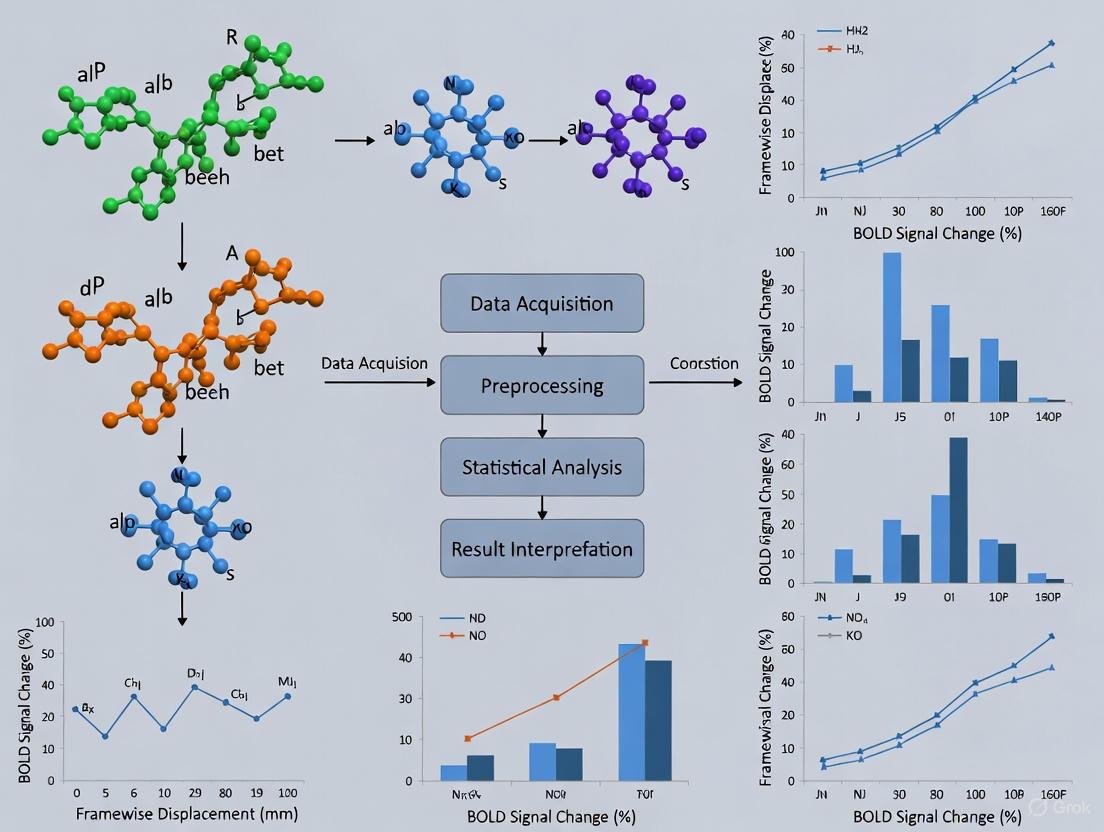
This article provides a comprehensive analysis of the complex relationship between framewise displacement (FD) and the BOLD signal in fMRI studies.
Framewise Displacement and BOLD Signal: A Comprehensive Guide to Artifacts, Impact on Connectivity, and Mitigation Strategies for Researchers
Abstract
This article provides a comprehensive analysis of the complex relationship between framewise displacement (FD) and the BOLD signal in fMRI studies. It explores the foundational mechanisms by which head motion introduces systematic, temporally-lagged artifacts that can persist for over 20 seconds, profoundly affecting functional connectivity metrics. We detail methodological approaches for quantifying these effects, including novel tools for assessing residual lagged structure and trait-specific motion impact scores. The content covers troubleshooting and optimization strategies for mitigating motion-related artifacts across different populations, with particular attention to clinical and developmental cohorts. Finally, we examine validation frameworks and comparative analyses of correction methodologies, addressing implications for drug development and regulatory qualification of fMRI biomarkers. This resource is essential for researchers, scientists, and drug development professionals seeking to improve the validity and reproducibility of their fMRI findings.
Understanding the Core Problem: How Motion Creates Systematic BOLD Signal Artifacts
Framewise displacement (FD) has emerged as a critical quantitative metric in functional magnetic resonance imaging (fMRI) research, serving as both a measure of head motion and a proxy for analyzing associated noise in the blood-oxygen-level-dependent (BOLD) signal. This technical guide examines FD's mathematical formulation, its evolution into a central biomarker for data quality control, and its complex relationship with spurious functional connectivity. Within the broader context of BOLD signal research, we demonstrate how FD quantification enables researchers to distinguish neural correlates from motion-induced artifacts, thereby addressing one of the most pervasive confounds in modern neuroimaging. Through synthesis of current methodologies and empirical findings, this review provides a comprehensive framework for implementing FD metrics in research and clinical applications, with particular relevance for drug development professionals targeting neurological and psychiatric disorders.
Head motion presents a formidable challenge for resting-state functional MRI (rs-fMRI), introducing systematic artifacts that compromise data integrity and interpretation [1]. Even "micro" head movements as small as 0.1mm can introduce systematic artifactual differences in functional connectivity metrics, potentially leading to spurious findings in brain-wide association studies [2] [1]. These motion-induced artifacts are particularly problematic in clinical populations and developmental studies where head movement may covary with variables of interest.
Framewise displacement has evolved from a simple motion summary statistic to a critical noise proxy that captures complex relationships between physical movement and BOLD signal artifacts. The profound impact of motion on fMRI data quality stems from the fundamental physics of MRI acquisition: head movement during scans disrupts the establishment of magnetic gradients and subsequent readout of the BOLD signal, effects that persist despite spatial realignment and regression of motion estimates [3]. This technical foundation establishes FD as an essential tool for any researcher working with fMRI data, particularly in the context of drug development where distinguishing true neurophysiological effects from motion-related confounds is paramount.
Mathematical Definition and Calculation of Framewise Displacement
Core Formula and Parameters
Framewise displacement quantifies the total head movement between consecutive fMRI volumes by combining translational and rotational realignment parameters (RPs) into a single scalar value. The standard FD formula, as defined by Power et al. (2012), is calculated for each timepoint (i) as follows:
Where:
- ( \Delta xi = x{i-1} - x_i ) (and similarly for (y) and (z))
- (x, y, z) represent translational displacements in millimeters
- (\alpha, \beta, \gamma) represent rotational displacements in radians
- The rotational displacements are typically converted to millimeters by measuring displacement on a sphere of radius 50 mm (default) [4] [5]
Implementation Considerations
Practical implementation of FD calculation requires attention to several technical considerations. The rotation units may be specified in degrees or radians, while translational units are typically millimeters. The critical parameter of brain_radius (often set to 50mm) enables the conversion of rotational displacements to spatial measurements on the surface of a sphere representing typical head size [5]. Advanced implementations may include detrending options using discrete cosine transform (DCT) bases to remove slow drifts from realignment parameters before FD computation [4].
Table 1: Parameters for FD Calculation
| Parameter | Description | Default Values | Alternative Options |
|---|---|---|---|
trans_units |
Translational units | "mm" | "cm", "in" |
rot_units |
Rotational units | "deg" | "rad", "mm", "cm", "in" |
brain_radius |
Radius for rotation conversion | 50 mm | User-defined value |
detrend |
Remove slow drifts | FALSE | TRUE (uses 4 DCT bases) |
cutoff |
Outlier flag threshold | 0.3 mm | Study-dependent values |
The following diagram illustrates the computational workflow for deriving FD from realignment parameters:
FD as a Proxy for BOLD Signal Artifacts
Motion-Artifact Relationships in Functional Connectivity
Research has established that FD serves as a powerful proxy measure for understanding motion-induced artifacts in BOLD signals. Power et al. (2012) demonstrated that subject motion produces substantial changes in resting-state functional connectivity MRI timecourses despite spatial registration and motion parameter regression [3]. These changes manifest as systematic correlation structures throughout the brain, with motion decreasing long-distance correlations while increasing short-distance correlations [3].
The relationship between FD and BOLD signal artifacts exhibits temporal persistence that extends far beyond the immediate motion event. Siegel et al. (2017) identified that framewise displacements—both large and very small—were followed by structured, prolonged, and global changes in the BOLD signal that persist for 20-30 seconds following the initial displacement [6] [7]. This lagged BOLD structure varies systematically according to the magnitude of the preceding displacement and independently predicts considerable variance in the global cortical signal (30-40% in some subjects) [7].
Spatial Patterns of Motion Artifacts
The impact of motion on BOLD signals demonstrates regional variation across the brain. Yan et al. (2013) conducted a comprehensive voxel-based examination revealing that positive motion-BOLD relationships were most prominent in primary and supplementary motor areas, particularly in low-motion datasets [1]. Conversely, negative motion-BOLD relationships were most prominent in prefrontal regions and expanded throughout the brain in high-motion datasets [1]. This spatial patterning helps explain why motion artifacts create systematic biases in functional connectivity analyses.
Table 2: Motion-BOLD Signal Relationships Across Brain Regions
| Brain Region | Motion-BOLD Relationship | Conditions of Prominence | Interpretation |
|---|---|---|---|
| Primary/Supplementary Motor Areas | Positive correlation | Low-motion datasets | Potential neural origins |
| Prefrontal Regions | Negative correlation | All datasets, expands in high motion | Likely motion artifact |
| Long-distance Connections | Decreased correlation | All motion levels | Systematic artifact |
| Short-distance Connections | Increased correlation | All motion levels | Systematic artifact |
The conceptual relationship between motion, FD, and BOLD signal artifacts can be visualized as follows:
Experimental Protocols for FD Validation and Application
Assessing Motion Impact with SHAMAN
Recent methodological advances provide sophisticated approaches for quantifying motion's impact on specific trait-FC relationships. The Split Half Analysis of Motion Associated Networks (SHAMAN) framework, introduced in a 2025 Nature Communications paper, assigns a motion impact score to specific trait-FC relationships [2]. This method capitalizes on the relative stability of traits over time by measuring differences in correlation structure between split high- and low-motion halves of each participant's fMRI timeseries.
The SHAMAN protocol operates on the principle that when trait-FC effects are independent of motion, the difference between high- and low-motion halves will be non-significant because traits are stable over time [2]. A significant difference indicates that state-dependent differences in motion impact the trait's connectivity. The direction of the motion impact score relative to the trait-FC effect distinguishes between motion overestimation (aligned direction) and motion underestimation (opposite direction) of trait-FC effects [2].
Lagged Artifact Analysis Protocol
Siegel et al. (2017) developed a method for quantifying temporally extended noise artifact using a peri-event time histogram approach [6] [7]. This protocol involves:
- Identifying displacement events: Categorizing framewise displacements by magnitude ranges
- Epoch extraction: Extracting BOLD signal epochs following all similar displacement magnitudes
- Cross-epoch averaging: Computing average BOLD changes across all epochs with similar preceding FD values
- Variance explanation: Modeling the cumulative effects of this artifact across entire runs
This method revealed that residual lagged structure following displacements explains substantial variance in global cortical signals and affects mean functional connectivity estimates, even after strict censoring [7]. The protocol is particularly valuable for identifying artifacts that persist despite standard preprocessing pipelines.
Quality Control Procedures in Multi-Site Studies
Birn et al. (2023) outlined comprehensive quality control procedures for resting-state fMRI that incorporate FD metrics at multiple processing stages [8]. Their protocol includes:
- Real-time monitoring: Assessing data quality while the subject is still in the scanner
- Multi-stage assessment: Evaluating quality at multiple processing pipeline stages
- Threshold optimization: Testing different motion censoring thresholds (0.2, 0.4, 1.0 mm)
- Comprehensive metrics: Combining qualitative inspection with quantitative FD measures
This approach emphasizes that QC procedures should monitor not only the original and processed data quality but also the accuracy and consistency of acquisition parameters across sites [8], a critical consideration for multi-site clinical trials in drug development.
Table 3: Essential Tools for FD Calculation and Motion Denoising Research
| Tool/Resource | Function/Purpose | Implementation Details |
|---|---|---|
| fMRIscrub (R package) | Calculate FD and other motion metrics | FD(X) function with detrending options and outlier flagging [4] [5] |
| SHAMAN Framework | Assign motion impact scores to trait-FC relationships | Distinguishes overestimation vs. underestimation of effects [2] |
| Peri-Event Histogram Tool | Quantify lagged BOLD structure post-displacement | MATLAB script for visualizing displacement-linked artifacts [6] [7] |
| AFNI Processing Suite | Comprehensive fMRI processing with QC integration | 3dvolreg for motion realignment; afni_proc.py for automated processing [8] |
| ABCD-BIDS Pipeline | Default denoising for large datasets (e.g., ABCD Study) | Includes global signal regression, respiratory filtering, motion regression [2] |
| Framewise Censoring | Remove motion-contaminated volumes | Exclusion of timepoints exceeding FD threshold (e.g., 0.2mm) [1] [8] |
Current Challenges and Methodological Considerations
Limitations of FD Metrics
Despite its widespread adoption, FD has several methodological limitations as a motion quantification tool. The standard FD formula treats translational and rotational parameters equivalently in the summation, though their actual impact on BOLD signals may differ [4]. Additionally, FD summary statistics may not distinguish between qualitatively different types of subject movement—a subject with one large movement versus a subject with frequent small movements may have similar FD values despite different artifact profiles [3].
Another significant challenge is that residual motion artifacts persist even after aggressive denoising procedures. In the ABCD Study, after denoising with ABCD-BIDS (including global signal regression, respiratory filtering, and motion parameter regression), 23% of signal variance was still explained by head motion [2]. Furthermore, the motion-FC effect matrix showed a strong negative correlation (Spearman ρ = -0.58) with the average FC matrix, indicating that connection strength was systematically weaker in participants who moved more [2].
Emerging Solutions and Future Directions
Recent research has focused on developing novel denoising approaches for multiband resting-state functional connectivity fMRI data. Faghiri et al. (2022) proposed new quantitative metrics agnostic to QC-FC correlations for evaluating motion denoising pipelines, addressing limitations of common evaluation assumptions [9]. Their work enables dataset-specific optimization of volume censoring parameters prior to final analysis.
The complex relationship between preprocessing choices and statistical artifacts remains an active research area. A 2025 NeuroImage review highlighted that standard rsfMRI preprocessing—particularly band-pass filters (0.009–0.08 Hz and 0.01–0.10 Hz)—introduce biases that increase correlation estimates between independent time series [10]. These preprocessing-induced distortions can lead to inflated statistical significance and increased false positives, complicating the interpretation of motion-corrected data.
Framewise displacement has evolved from a simple summary statistic to a critical noise proxy that enables researchers to quantify and mitigate one of the most significant confounds in fMRI research. Its mathematical formulation provides a practical tool for data quality assessment, while its relationship with lagged BOLD signal artifacts reveals the complex interplay between head motion and neuroimaging metrics. For researchers and drug development professionals, rigorous implementation of FD metrics—within appropriate methodological frameworks that account for its limitations—remains essential for distinguishing true neurophysiological effects from motion-induced artifacts. As fMRI continues to advance as a tool for understanding brain function and evaluating therapeutic interventions, framewise displacement will maintain its crucial role in ensuring the validity and reproducibility of functional connectivity findings.
Functional magnetic resonance imaging (fMRI) research is fundamentally predicated on the ability to separate neuronal-related blood oxygen level-dependent (BOLD) signals from noise. However, residual noise remains problematic—particularly for functional connectivity analyses where findings can be spuriously influenced by noise sources that covary with individual differences [6] [7]. Among these nuisance factors, head motion represents a particularly formidable challenge, with recent evidence demonstrating that even "micro" head movements as small as 0.1mm can introduce systematic artifactual differences in fMRI metrics [1]. The relationship between framewise displacement (FD)—an index of frame-to-frame head movement derived from image realignment estimates—and the subsequent BOLD response represents a critical area of investigation for improving the validity of fMRI findings.
This technical guide examines the characteristic 20-30 second lagged BOLD responses that follow framewise displacements, a consistent spatiotemporal signature of motion artifacts observed across multiple datasets and studies [6] [7]. Beyond merely documenting this phenomenon, we explore its underlying mechanisms, quantitative properties, and implications for functional connectivity research. Understanding this structured residual noise is essential both for assessing how such noise might influence conclusions and for developing more effective cleanup methods, particularly in studies where motion may covary with variables of interest such as clinical status, age, or other individual differences [6] [1].
Core Phenomenon: The Lagged BOLD Signature
Characteristic Temporal Pattern
Research has consistently revealed that framewise displacements are followed by structured, prolonged changes in the global cortical BOLD signal that persist for extended epochs of 20-30 seconds following the initial displacement [6] [7]. This lagged BOLD structure demonstrates a clear dose-response relationship with the magnitude of the preceding displacement, with larger displacements predicting more pronounced signal changes [7]. The persistence of this response across tens of seconds indicates that motion effects are not transient phenomena but rather represent extended perturbations of the BOLD signal.
Notably, this characteristic pattern remains robust across datasets and is observable within many individuals' data. The consistency of this finding across independent datasets collected with different parameters (e.g., TR = 813 ms vs. TR = 720 ms) suggests this represents a fundamental property of the relationship between motion and the BOLD signal rather than a methodology-specific artifact [6]. This residual lagged structure persists despite the application of numerous common preprocessing methods, including some state-of-the-art practices [7].
Quantitative Impact on BOLD Variance
The practical significance of this motion-related artifact becomes evident when examining its quantitative impact on signal variance:
Table 1: Variance Explained by Lagged BOLD Structure Following Framewise Displacements
| Metric | Impact | Notes |
|---|---|---|
| Global Cortical Signal | 30-40% variance explained in some subjects | Independently predicted considerable variance [6] [7] |
| Functional Connectivity Estimates | Varied as function of preceding displacements | Effects persisted even after strict censoring [6] |
| Spatial Distribution | Widespread cortical effects | Prominent in global cortical (gray matter) signal [6] |
This substantial explanatory power demonstrates that motion-related artifacts are not merely statistical nuisances but rather represent major sources of signal variance that can potentially dominate the BOLD timecourse in certain individuals [6] [7].
Experimental Approaches and Methodologies
Core Assessment Method: Peri-Event Time Histogram Construction
The primary method for identifying lagged BOLD structure involves a construction similar to a peri-event time histogram that assesses whether common structure exists in BOLD epochs immediately following similar instances of nuisance signals [6] [7]. The experimental workflow for this analytical approach can be visualized as follows:
The specific methodological steps include:
Framewise Displacement Calculation: Compute FD from the three translation and three rotation parameters obtained during image realignment [1].
Event Categorization: Identify all instances of framewise displacements within specific magnitude ranges, including both large movements and those falling within typical data inclusion thresholds (e.g., FD < 0.2mm) [6] [7].
Epoch Extraction: Extract the mean cortical BOLD signal for a 20-30 second window following each displacement event [7].
Temporal Alignment and Averaging: Align all epochs by their displacement onset and average across events within the same magnitude range to reveal consistent patterns [6].
This approach effectively extends the logic of standard preprocessing, wherein any systematic relationship between the BOLD signal and nuisance signals of no interest is considered noise that should be removed [6] [7].
Dataset Specifications
Table 2: Representative Dataset Parameters for Lagged Artifact Research
| Parameter | IU Dataset | Human Connectome Project (HCP) |
|---|---|---|
| Sample Size | 51 participants (after quality exclusion) | Publicly available dataset [6] |
| Diagnostic Groups | Autism spectrum disorder (ASD) and neurotypical controls | Not specified in context |
| TR | 813 ms | 720 ms |
| Session Design | Two ~16-minute resting state scans per session | Standard HCP protocol |
| Motion Constraints | No a priori exclusion for most participants | Standard HQC quality control |
The consistency of findings across these independent datasets with slightly different acquisition parameters strengthens the evidence for this being a fundamental property of the BOLD signal rather than a dataset-specific artifact [6].
Respiratory Contributions
Exploratory analyses of physiological traces available for subset of scans suggest the involvement of respiratory processes as one likely mechanism underlying displacement-linked structure [6] [7]. Several lines of evidence support this connection:
- Similar Lagged Patterns: Parallel analyses reveal similar patterns of residual lagged BOLD structure following respiratory fluctuations [7]
- Covariance with Motion: Respiratory and framewise displacement traces themselves are related, suggesting FD may partially index physiological noise [6]
- Physiological Plausibility: Respiration produces structured noise at both short timescales (chest movements modulating magnetic field) and longer lags (vasodilatory effects of arterial CO2 changes) [6]
Respiratory effects can modulate the BOLD signal through multiple pathways, including changes in arterial CO2 concentration that trigger vasodilation and consequent alterations in cerebral blood flow and volume [6] [11]. These CO2-mediated effects operate through well-established physiological pathways that influence neurovascular coupling.
Neurovascular Coupling and BOLD Origins
To understand motion-related artifacts, it is essential to recognize that the BOLD signal is an indirect reflection of neuronal activity, primarily determined by changes in paramagnetic deoxygenated hemoglobin resulting from combinations of changes in oxygen metabolism, cerebral blood flow, and volume [12]. The classical BOLD response to stimulus begins within approximately 500 ms and peaks 3-5 seconds after stimulus onset, with more complex dynamics for prolonged stimuli [11].
The relationship between framewise displacement and the BOLD signal can be conceptualized through the following physiological pathways:
The vascular origin of these artifacts is further supported by evidence that a significant component of the spatiotemporally structured BOLD signal reflects vascular anatomy rather than neuronal activity [13]. This vascular structure accounts for approximately 30% of the signal variance on average, representing a profound impact on fMRI data [13].
Implications for Functional Connectivity
Effects on Connectivity Metrics
The lagged BOLD structure following framewise displacements has demonstrable consequences for functional connectivity estimates:
- Systematic Bias: Mean functional connectivity estimates vary as a function of displacements occurring many seconds in the past, even after strict censoring procedures [6] [7]
- Distance-Dependent Effects: Motion artifacts lead to distance-dependent biases in inferred signal correlations, typically inflating short-range connectivity while weakening long-range connectivity [1] [14]
- Spurious Group Differences: When motion covaries with individual differences of interest (e.g., clinical status, age), residual motion artifacts can produce spurious findings of group differences [6] [1]
These effects pose particular challenges for studies comparing groups with inherently different motion characteristics, such as children vs. adults, clinical populations vs. controls, or studies of developmental and pathological processes [1].
Mitigation Strategies and Efficacy
Table 3: Motion Artifact Mitigation Strategies and Efficacy Against Lagged Structure
| Method | Approach | Effect on Lagged Structure | Limitations |
|---|---|---|---|
| Global Signal Regression | Regression of global BOLD signal | Largely attenuates artifactual structure [6] [7] | Potential removal of neural signal, controversy in field |
| aCompCor | PCA-based noise estimation from WM/CSF | More effective than mean signal regression [14] | Enhanced specificity of functional connectivity |
| Structured Matrix Completion | Low-rank matrix completion to recover censored data | Reduces motion effects in connectivity matrices [15] [16] | Computational complexity, memory demands |
| Censoring ("Scrubbing") | Removal of high-motion volumes | Limited efficacy alone for lagged structure [6] | Data loss, temporal discontinuity |
| Higher-Order Motion Regression | Expanded motion parameter models | Diminishes but does not eliminate artifacts [1] | Residual artifact remains regardless of model order |
Current evidence suggests that combining multiple approaches (e.g., modeling with expanded motion parameters together with censoring) brings about the greatest reduction in motion-induced artifact [1]. However, residual relationships between motion and functional connectivity metrics often remain, underscoring the need to include motion as a covariate in group-level analyses [1].
Research Toolkit: Essential Methodological Solutions
Table 4: Research Reagent Solutions for Lagged Artifact Investigation
| Tool/Resource | Function | Application Context |
|---|---|---|
| Framewise Displacement (FD) | Index of frame-to-frame head movement | Available in all fMRI datasets; serves as primary nuisance signal [6] [7] |
| Peri-Event Histogram Script | MATLAB-based tool for visualizing lagged structure | Quality assessment; generalizable to any nuisance signal [6] [7] |
| Physiological Recordings | Respiratory belt, pulse oximeter measurements | Direct assessment of physiological contributions to artifacts [6] |
| aCompCor | PCA-based noise estimation from white matter and CSF | Enhanced motion artifact reduction compared to mean signal regression [14] |
| Structured Low-Rank Matrix Completion | Advanced matrix completion for censored data | Motion compensation with slice-time correction [15] |
| Global Signal Regression | Removal of global BOLD signal | Effective attenuation of lagged motion-related structure [6] [7] |
This methodological toolkit enables researchers to both identify the characteristic lagged artifacts in their own data and implement strategies to mitigate their impact on functional connectivity findings.
The characteristic 20-30 second lagged BOLD responses following framewise displacements represent a fundamental spatiotemporal signature of motion artifacts in fMRI data. This consistent pattern, observable across diverse datasets and persisting despite common preprocessing approaches, independently explains substantial variance in the global cortical signal and systematically influences functional connectivity estimates. The physiological basis of these artifacts appears to involve both direct physical effects of head movement and more complex physiological processes, particularly respiration and consequent CO2-mediated vascular effects.
For researchers, particularly those investigating individual differences where motion may covary with variables of interest, these findings highlight the critical importance of both assessing data for these characteristic artifacts and implementing appropriate mitigation strategies. The available evidence supports the use of specialized quality assessment tools, combined preprocessing approaches, and appropriate statistical controls at the group level to minimize the potential for spurious conclusions resulting from this structured residual noise. Future methodological developments that more specifically target these lagged relationships may further enhance our ability to separate motion-related artifacts from neural signals of interest in fMRI research.
Analyses of functional connectivity MRI (fcMRI) are predicated on the idea that signals of interest reflecting neural connectivity can be accurately separated from non-neural noise [6]. Subject motion is a well-established source of such noise, fundamentally disrupting the magnetic gradients essential for BOLD signal acquisition [3]. Despite standard countermeasures like spatial realignment and regression of motion parameters, systematic artifacts persist in the data. This paper examines a central and spurious phenomenon: the tendency of subject motion to artificially decrease long-distance correlations while simultaneously increasing short-distance correlations in functional connectivity networks [3]. This effect represents a form of colored noise that can obscure genuine patterns of brain organization and create spurious group differences in individual difference studies [6] [3]. Understanding this artifact is particularly critical when studying populations prone to greater movement, such as pediatric or clinical cohorts, where motion can systematically covary with the variables of interest [3]. Framing this within broader research on framewise displacement and the BOLD signal, we explore the nature of this artifact, its quantitative properties, the methodologies for its identification, and potential mitigation strategies.
Core Artifact: Characterization and Quantitative Data
The motion-induced artifact manifests as a structured change in correlation patterns across the brain. The underlying mechanism involves a complex interplay between physical head displacement and its prolonged, lagged effects on the BOLD signal.
Systematic Alteration of Correlation Patterns
The primary finding is that subject motion introduces a systematic bias in functional connectivity maps. The analysis of multiple cohorts has consistently shown that even after standard preprocessing, including spatial registration and regression of motion estimates, the inclusion of motion-contaminated data leads to two key effects:
- Weakening of long-distance correlations: Connections between widely separated brain regions, particularly those spanning different hemispheres or lobes, show spuriously reduced correlation strength [3].
- Strengthening of short-distance correlations: Connections between geographically proximate brain regions exhibit artificially inflated correlation coefficients [3].
This pattern is not random but is directly linked to the amplitude and timing of head movements.
Quantitative Profile of the Artifact
The table below summarizes key quantitative findings from foundational studies that documented the systematic effects of motion on functional connectivity:
Table 1: Quantitative Findings on Motion-Related Artifacts in fcMRI
| Metric | Description | Value / Magnitude | Citation |
|---|---|---|---|
| FD Threshold for Lagged Structure | Structurally altered BOLD signals were observed following framewise displacements of all magnitudes, including very small movements within typical inclusion standards. | Observable from very small FD (>0.1 mm) | [6] |
| Duration of Lagged BOLD Effect | The prolonged, structured change in global BOLD signal following a framewise displacement. | 20–30 seconds | [6] [7] |
| Variance Explained in Global Signal | The variance in the global cortical BOLD signal independently predicted by the modeled lagged structure following displacements. | 30–40% (in some subjects) | [6] [7] |
| Effect on Correlation Strength | Motion increases short-distance correlations and decreases long-distance correlations, altering the apparent network topology. | Systematic and significant changes | [3] [17] |
| Reduction in RMS Motion from Censoring | Reduction in root mean square (RMS) motion after applying framewise censoring ("scrubbing") to data. | Example: Cohort 1: 0.51 mm to 0.41 mm | [3] |
These quantitative effects demonstrate that the artifact is substantial, prolonged, and not adequately addressed by standard preprocessing pipelines.
Relationship to Framewise Displacement and Broader BOLD Signal Research
Framewise displacement (FD) serves as a practical index for investigating this artifact. FD is derived from image realignment parameters and represents the frame-to-frame head movement [6]. Its utility stems from two factors:
- Universal Availability: Unlike physiological recordings (e.g., respiratory belts), FD can be calculated for any fMRI dataset [6].
- Multifactorial Nature: FD traces likely reflect numerous noise sources beyond pure head motion, including physiological noise like respiration, especially in high-temporal-resolution multiband fMRI data [6] [7].
Research reveals a temporally-lagged relationship between FD and the BOLD signal. Using a peri-event time histogram approach, studies show that a framewise displacement—even a small one—is followed by a structured, global change in the BOLD signal that persists for tens of seconds [6] [7]. This lagged structure independently predicts a significant portion of variance in the global signal and causes mean functional connectivity estimates to vary as a function of displacements occurring many seconds in the past [7]. Furthermore, respiratory fluctuations co-vary with FD and produce similar patterns of lagged BOLD structure, implicating respiration as one likely physiological mechanism underlying this artifact [6] [7].
Experimental Protocols and Methodologies
To systematically study and mitigate this artifact, researchers have developed specific protocols for quantification and quality control.
Protocol 1: Quantifying Lagged BOLD Structure Following Nuisance Signals
This protocol, designed to reveal residual temporally-extended noise, uses an approach analogous to a peri-event time histogram [6] [7].
Workflow Overview:
Detailed Steps:
- Data Input: Begin with preprocessed BOLD data and a concurrent nuisance regressor time series, most commonly the framewise displacement (FD) trace [6] [7].
- Epoch Identification: Identify every time point in the scan where the nuisance signal (FD) occurs. This can include all events or can be restricted to events within specific magnitude ranges [6].
- Epoch Segmentation: For each identified event, extract an epoch of the global mean BOLD signal (or signals from specific regions) spanning a time window from several seconds before to 20-30 seconds after the event [6] [7].
- Epoch Sorting & Binning: Sort all the extracted epochs into bins based on the magnitude of the nuisance signal that initiated them (e.g., small, medium, and large FD ranges) [6].
- Averaging & Analysis: Average the BOLD epochs within each magnitude bin. The resulting average time series reveals any systematic, lagged BOLD structure that follows the nuisance signal. The consistency of this pattern across datasets allows for creating a model of the artifact that can be applied to new data [6] [7].
Protocol 2: Framewise Censoring for Motion Artifact Mitigation
This protocol describes a "scrubbing" method to reduce motion-related effects by removing severely motion-contaminated frames from the analysis [3].
Workflow Overview:
Detailed Steps:
- Parameter Calculation: From the volume realignment parameters, compute two frame-wise indices of data quality:
- Thresholding & Flagging: Flag individual frames as suspect based on these indices. A common approach is to flag any frame where FD exceeds a threshold (e.g., 0.2-0.5 mm) [3]. More nuanced approaches can also flag frames where DVARS exceeds a threshold.
- Temporal Padding: To account for the temporally smeared effect of motion, it is also recommended to flag one or more frames immediately preceding and following the identified bad frame [3].
- Analysis with Censored Data: Perform the functional connectivity analysis (e.g., correlation calculation between regions) using only the frames that were not flagged. This excludes the most severely contaminated data points from the correlation estimates [3].
The Scientist's Toolkit: Research Reagent Solutions
The following table details key materials, tools, and methodological solutions essential for research in this domain.
Table 2: Essential Research Tools for Investigating Motion Artifacts in fcMRI
| Tool / Solution | Function / Description | Relevance to Research |
|---|---|---|
| Framewise Displacement (FD) | A scalar index derived from realignment parameters, quantifying volume-to-volume head movement. | Serves as a primary, universally available nuisance regressor and event trigger for quantifying motion-related artifact [6] [3]. |
| Global Signal Regression (GSR) | A preprocessing step that removes the mean signal across the entire brain from each voxel's time series. | Shown to largely attenuate the observed lagged structure following displacements in both the BOLD signal and functional connectivity, though its use remains debated [6] [7]. |
| Framewise Censoring ("Scrubbing") | The process of removing (censoring) individual time points from analysis based on FD and DVARS thresholds. | A direct method to mitigate the influence of high-motion frames, leading to reduced short-distance and increased long-distance correlations [3]. |
| Physiological Recordings | Concurrent acquisition of respiratory and cardiac cycles during fMRI scans using a belt and pulse oximeter. | Allows for direct modeling of physiological noise (e.g., RETROICOR) and investigation of its relationship with FD and BOLD artifacts [6]. |
| Peri-Event Time Histogram Method | An analysis technique that aligns and averages BOLD signal epochs following instances of a nuisance signal. | A core tool for visualizing and quantifying the magnitude and duration of residual lagged BOLD structure associated with motion or other noise sources [6] [7]. |
| High-Temporal-Resolution fMRI | Acquisition sequences (e.g., multiband) with TRs below 1 second. | Provides better sampling of noise dynamics and can make FD traces more sensitive to physiological fluctuations, aiding in artifact characterization [6]. |
Discussion and Synthesis
The evidence unequivocally demonstrates that subject motion introduces a spurious spatial structure in functional connectivity matrices, characterized by artificially inflated short-distance correlations and diminished long-distance correlations. This artifact is not fully countered by standard volume realignment and motion regression techniques [3]. The artifact's roots extend beyond simple head displacement to include complex, lagged physiological processes, with respiration being a key candidate [6] [7]. The persistence of this structured noise for 20-30 seconds after even minor movements means it can profoundly influence connectivity estimates, especially in studies where groups differ in average motion levels.
Mitigation strategies exist on a spectrum. Framewise censoring directly removes contaminated data, effectively reducing the artifact and "strengthening" long-distance connections that were previously suppressed [3]. Global signal regression also attenuates the artifact but remains controversial due to concerns about introducing other biases [6] [7]. The choice of method depends on the research question and the severity of the motion contamination. Ultimately, these findings highlight the necessity for rigorous motion control and quality assessment in all fcMRI studies and suggest a need to critically revisit previous work where motion may not have been adequately controlled, potentially leading to spurious conclusions [3].
Framewise displacement (FD), an index of frame-to-frame head movement derived from image realignment, is a critical source of artifact in functional magnetic resonance imaging (fMRI) [1]. Even micromovements as small as 0.1mm can introduce systematic, artifactual differences in resting-state fMRI (R-fMRI) metrics between individuals and groups [1]. However, the impact of these movements is not uniform across the brain; it exhibits distinct regional patterns. Understanding this regional vulnerability—whereby the relationship between motion and the Blood Oxygen Level Dependent (BOLD) signal varies significantly across different brain areas—is essential for developing targeted noise correction methods and avoiding spurious findings in functional connectomics [1]. This guide synthesizes current research to detail the topography, mechanisms, and methodological implications of these variable motion-BOLD relationships, framing them within the broader context of fMRI research aimed at disentangling neural signals from motion-induced artifact.
Regional Patterns of Motion-BOLD Relationships
Topography of Positive and Negative Correlations
The relationship between head motion and the BOLD signal is spatially heterogeneous. Research has consistently identified two primary types of motion-BOLD relationships, which are regionally specific and can be differentially affected by the overall degree of head motion in a dataset.
Table 1: Regional Vulnerability to Motion-BOLD Relationships
| Brain Region | Motion-BOLD Relationship | Context/Dataset Characteristics | Proposed Interpretation |
|---|---|---|---|
| Primary & Supplementary Motor Areas | Positive Correlation [1] | Most prominent in low-motion datasets [1] | Potential reflection of neural origins related to movement planning or execution [1] |
| Prefrontal Regions | Negative Correlation [1] | Most prominent in low-motion datasets [1] | Likely artifactual origin [1] |
| Widespread Cortical Areas | Negative Correlation [1] | Expands throughout the brain in high-motion datasets (e.g., children) [1] | Artifactual, potentially linked to motion-induced spin history effects and magnetic field inhomogeneities [1] |
| Default Mode & Frontoparietal Networks | Altered Fractal Dynamics (Lower Hurst exponent during movie-watching) [18] | Naturalistic viewing conditions (movie) vs. rest [18] | Distinct neural processing demands in higher-order associative networks [18] |
| Visual, Somatomotor, Dorsal Attention Networks | Altered Fractal Dynamics (Higher Hurst exponent during movie-watching) [18] | Naturalistic viewing conditions (movie) vs. rest [18] | Stimulus-driven neural processing [18] |
These regional relationships are not merely transient. Framewise displacements can induce structured, global changes in the BOLD signal that persist for tens of seconds (20-30 seconds) after the initial movement [6] [7]. This lagged artifact can explain a substantial portion of variance in the global cortical signal—as much as 30-40% in some subjects—and can systematically influence functional connectivity estimates, even after strict censoring of high-motion volumes [6] [7].
Underlying Mechanisms and Contributing Factors
The observed regional vulnerability arises from a confluence of factors, which can be conceptualized as a network of interacting causes and consequences.
The diagram above illustrates the primary mechanisms. Negative motion-BOLD relationships are largely considered artifactual, stemming from technical factors like spin history effects, partial voluming, and magnetic field inhomogeneities introduced by movement [1]. Furthermore, motion is often correlated with respiration, which itself can produce widespread, lagged changes in the BOLD signal due to CO2-related vasodilation, complicating the disentanglement of motion and physiological noise [6] [7]. In contrast, positive relationships observed in motor areas may, at least partially, reflect genuine neural activity associated with the generation of head motion itself [1].
Methodological Protocols for Investigation and Mitigation
Experimental Approach for Quantifying Lagged Artifacts
A powerful method for identifying residual, motion-related structure in the BOLD signal involves constructing a peri-event histogram around instances of framewise displacement.
Table 2: Key Reagents and Tools for Motion-BOLD Research
| Research Tool / Metric | Function/Description | Relevance to Motion-BOLD Research |
|---|---|---|
| Framewise Displacement (FD) | Summarizes frame-to-frame head movement from volume realignment [1]. | Primary regressor of interest for quantifying subject motion [1] [6]. |
| Peri-Event Time Histogram | Averages BOLD signal epochs following similar-magnitude FD events [6] [7]. | Core tool for visualizing and quantifying temporally-lagged motion artifacts [6] [7]. |
| Global Signal Regression (GSR) | Nuisance regression technique that removes the global mean BOLD signal [1] [6]. | Effectively attenuates lagged motion artifact and related functional connectivity distortions [1] [6] [7]. |
| scrubbing | Removal or regression of motion-contaminated volumes (e.g., FD > 0.2 mm) [1]. | Reduces artifact from high-motion time points; best used in combination with regression [1]. |
| FIX (FMRIB's ICA-based Xnoiseifier) | Classifies and removes noise components from fMRI data via independent component analysis [19]. | Advanced denoising to mitigate motion and other artifacts after standard preprocessing [19]. |
| High-Order Motion Regression (e.g., 24-param) | Models cumulative effects of motion on spin history beyond basic realignment [1]. | Reduces residual motion artifact, though some structure may remain [1]. |
The experimental workflow for this analysis is systematic. First, preprocessing is performed, which may include various levels of motion correction (e.g., volume realignment, tissue-based nuisance regression, ICA-based denoising like FIX). Second, the Framewise Displacement (FD) time series is calculated for the entire scan. Third, BOLD signal epochs are extracted from the preprocessed data. These epochs span a window (e.g., from -5 to +30 seconds) surrounding every time point where the FD falls within a specific, pre-defined range (e.g., 0.1-0.2 mm, 0.2-0.3 mm, etc.). Finally, the residual lagged structure is quantified by averaging all BOLD epochs within each FD range, revealing the systematic, time-locked signal change that follows head movements of a given magnitude [6] [7].
Mitigation Strategies and Efficacy
No single method completely eliminates motion artifacts, necessitating a multi-pronged approach. The following strategies are commonly employed, with varying efficacy:
- Modeling-Based Regression: Regressing out the 6 realignment parameters (and their derivatives) is standard but inadequate for removing micromovement effects. Higher-order models (e.g., 24- or 36-parameter models) that account for the spin excitation history show improved performance, though residual artifact often persists [1].
- scrubbing: Removing volumes with FD exceeding a threshold (e.g., > 0.2 mm), along with adjacent volumes, is effective at reducing artifact, particularly negative motion-BOLD correlations [1]. However, it can lead to significant data loss and complicates frequency-based analyses.
- Global Signal Regression (GSR): GSR is notably effective at attenuating lagged motion artifact and reducing spurious motion-related differences in functional connectivity [1] [6] [7]. Its use, however, remains debated due to potential introduction of other statistical biases.
- Combined Approaches: The most effective strategy is a combination of scrubbing and high-order motion parameter regression within a single integrated model [1]. Furthermore, including a summary measure of individual motion (e.g., mean FD) as a nuisance covariate in group-level analyses is essential to account for residual variance shared by motion and the variables of interest [1].
The relationship between framewise displacement and the BOLD signal is fundamentally non-uniform, exhibiting distinct regional vulnerability. Positive correlations in motor areas and negative correlations in prefrontal and other association regions underscore the complex interplay between neural and artifactual sources of variance. The discovery of prolonged, lagged artifact further highlights that motion's influence extends far beyond the moment of movement itself, posing a significant threat to the validity of functional connectivity and individual differences research. A comprehensive understanding of these regional and temporal patterns, combined with rigorous mitigation protocols that extend beyond standard preprocessing, is paramount for advancing the precision and reliability of fMRI-based biomarkers in basic and clinical neuroscience.
Framewise displacement (FD), a common metric for head motion in fMRI studies, exhibits a complex and temporally extended relationship with the BOLD signal that can confound functional connectivity findings. A growing body of evidence indicates that respiration serves as a primary physiological mechanism underlying this relationship, with respiratory fluctuations contributing to both head motion and BOLD signal changes through multiple pathways. This technical review synthesizes current research on respiration as a key confound, detailing the physiological basis, methodological approaches for quantification, and preprocessing strategies for mitigation. We present quantitative data demonstrating the substantial variance explained by respiration-linked artifacts and provide practical guidance for researchers investigating the relationship between FD and BOLD signal changes.
In functional magnetic resonance imaging (fMRI) research, framewise displacement (FD) has traditionally been treated as an indicator of head motion, with the assumption that its relationship with the blood oxygen level-dependent (BOLD) signal primarily reflects physical movement artifacts. However, emerging evidence challenges this simplistic view, revealing that FD traces capture not only head motion but also physiological noise sources, particularly respiratory fluctuations [6]. This recognition fundamentally shifts our understanding of the relationship between FD and BOLD signal changes.
Respiration influences the BOLD signal through multiple mechanisms operating at different temporal scales. At shorter time scales, chest movements during breathing modulate the magnetic field, while at longer lags, vasodilatory effects of changes in arterial CO2 concentration significantly modulate cerebral blood flow and volume, thereby affecting the BOLD signal [6]. These respiratory effects frequently persist in data despite standard preprocessing, particularly in datasets lacking physiological recordings, and can covary with individual differences of interest, potentially producing spurious findings in group comparisons [6] [20].
The broader thesis framing this review posits that accurate interpretation of the relationship between FD and BOLD signal changes requires recognizing FD as a multifactorial index that reflects both head motion and physiological processes, with respiration serving as a key linking mechanism. This perspective necessitates more nuanced preprocessing approaches and analytical frameworks for distinguishing true neural signals from physiologically-confounded variance in fMRI data.
Physiological Basis of Respiratory Influence on BOLD Signals
Central Respiratory Control and Brainstem Mechanisms
Respiratory control is maintained by a distributed network of neural centers throughout the central nervous system. The fundamental respiratory pattern is generated primarily in the medulla oblongata, which contains the dorsal respiratory group (DRG) and ventral respiratory column (VRC) [21]. These centers integrate afferent signals from peripheral chemoreceptors and modulate respiratory motor neurons. Pontine centers, including the pneumotaxic and apneustic centers within the pontine respiratory group (PRG), provide fine-tuning influences over medullary centers to produce normal smooth inspirations and expirations [21].
Suprapontine structures, including limbic areas, diencephalon, striatum, and cortex, play essential roles in modulating the brainstem's respiratory drive [21]. This hierarchical organization means that respiratory control integrates automatic brainstem mechanisms with voluntary cortical influences, creating multiple pathways through which respiratory fluctuations can correlate with neural activity patterns of interest in fMRI studies.
Chemical Control of Respiration and Vascular Effects
Chemical regulation of respiration represents a primary pathway through which breathing affects the BOLD signal. Central chemoreceptors in the brainstem continuously monitor pH, partial pressure of carbon dioxide (PCO2), and oxygen (pO2) in the blood [21]. When CO2 levels rise (hypercapnia), the resulting decrease in pH stimulates ventilation to remove excess gas. Cerebral blood flow is highly sensitive to arterial CO2 levels, with hypercapnia causing significant vasodilation and increased flow [21] [22].
The relationship between CO2 and cerebral vasculature creates a direct mechanism through which respiratory fluctuations influence the BOLD signal. Natural variations in breathing depth and rate produce oscillations in arterial CO2 that subsequently modulate cerebral blood flow and volume, creating widespread hemodynamic fluctuations across the brain that correlate with respiration but are independent of neural activity [6] [23]. These effects are particularly problematic for fMRI because they occur at similar temporal frequencies to neural activation patterns and can manifest as spurious functional connectivity.
Mechanical and Magnetic Field Effects
Beyond chemical pathways, respiration also influences the BOLD signal through physical mechanisms. Chest movements during breathing cause magnetic field modulations that can be detected in fMRI data, particularly with multiband, high temporal-resolution sequences [6] [24]. Respiratory-induced body movements can also produce small head displacements that are captured in FD metrics, creating a correlation between respiratory traces and FD timecourses [6].
The integration of these multiple pathways—chemical, vascular, and mechanical—establishes respiration as a significant confound in interpreting the relationship between FD and BOLD signal changes. The following diagram illustrates these interconnected pathways:
Methodological Approaches for Quantifying Respiratory Effects
Lagged Covariance Analysis Using Peri-Stimulus Time Histograms
Several innovative methods have been developed to quantify the temporally extended relationship between FD, respiration, and BOLD signals. One powerful approach uses a construction similar to a peri-event time histogram to assess whether common structure exists in BOLD epochs following similar instances of a nuisance signal (e.g., framewise displacements within a specific range) [6].
This method involves several key steps. First, all framewise displacements within a particular magnitude range are identified across the fMRI timecourse. Next, BOLD signal epochs following these displacements are extracted and aligned. Finally, covariance across these aligned epochs is computed to identify systematic patterns of lagged BOLD changes associated with the preceding displacements [6]. This approach can reveal structured, prolonged changes in the BOLD signal that extend for 20-30 seconds following even very small displacements and depend systematically on the magnitude of the preceding displacement [6].
Data-Driven Respiratory Signal Reconstruction
When respiratory recordings are unavailable—a common scenario in existing fMRI datasets—computational techniques can reconstruct respiratory variation signals directly from fMRI data. One such method uses multivariate pattern analysis to estimate continuous low-frequency respiration volume (RV) fluctuations from fMRI data alone [23].
The reconstruction approach typically involves several processing stages. First, the fMRI data undergoes standard preprocessing, including motion correction and spatial normalization. Next, spatial components most strongly associated with respiratory patterns are identified, often through principal component analysis (PCA) or independent component analysis (ICA) of noise regions of interest [23] [20]. These components are then integrated into a continuous respiratory variation signal that can be used for noise modeling in subsequent analyses. Validation studies demonstrate that predicted RV signals can account for similar patterns of temporal variation in resting-state fMRI data compared to measured RV fluctuations [23].
Multi-Echo Acquisition and RETROICOR Methods
For studies collecting dedicated physiological data, the RETROICOR (Retrospective Image Correction) method provides a robust approach for modeling and removing cardiac and respiratory noise from fMRI data [24]. This method uses concurrently recorded cardiac and respiratory signals to create phase-locked noise models that are regressed out of the fMRI time series [24].
In multi-echo fMRI acquisitions, RETROICOR can be implemented in two primary ways: applying corrections to individual echoes (RTCind) before combining them, or applying correction to the composite multi-echo data (RTCcomp) after combination [24]. Studies comparing these approaches found minimal differences between them, with both methods significantly improving data quality metrics such as temporal signal-to-noise ratio (tSNR) and signal fluctuation sensitivity, particularly in moderately accelerated acquisitions [24].
The following table summarizes key methodological approaches for quantifying and addressing respiratory confounds:
Table 1: Methodological Approaches for Respiratory Confound Quantification and Mitigation
| Method | Principle | Data Requirements | Key Advantages | Limitations |
|---|---|---|---|---|
| Lagged Covariance Analysis [6] | Identifies systematic BOLD patterns following FD events | fMRI data with FD traces | Reveals temporal extent of artifacts; Quantifies variance explained | Does not distinguish physiological sources |
| RV Signal Reconstruction [23] | Derives respiratory signals from fMRI data | fMRI data alone | Enriches existing datasets; Works without physiological recordings | Model-dependent accuracy |
| RETROICOR [24] | Models physiological noise using recorded signals | fMRI + cardiac/respiratory recordings | Direct noise modeling; High efficacy with good quality data | Requires physiological recordings |
| Multi-Echo ICA [24] | Separates BOLD and non-BOLD components using T2* decay | Multi-echo fMRI data | Data-driven; Does not require external recordings | Requires specialized sequences |
| aCompCor [20] | Uses noise ROIs (WM/CSF) for noise estimation | fMRI data alone | Anatomically guided; Widely implemented | May remove neural signal in WM |
Quantitative Evidence of Respiratory Artifacts
Magnitude and Temporal Extent of FD-Linked BOLD Changes
Empirical studies using the lagged covariance approach have quantified the substantial impact of respiration-linked FD fluctuations on the BOLD signal. Research demonstrates that framewise displacements—both large and very small—are followed by structured, prolonged changes in the BOLD signal that persist for tens of seconds (20-30 seconds) following the initial displacement [6].
The magnitude of these signal changes varies systematically according to the initial displacement magnitude, with larger displacements predicting larger subsequent BOLD fluctuations [6]. This lagged BOLD structure is remarkably consistent across datasets and independently predicts considerable variance in the global cortical signal—as much as 30-40% in some subjects—highlighting the potentially massive confounding effect of respiration-linked motion on functional connectivity findings [6].
Functional Connectivity Implications
Critically, mean functional connectivity estimates vary systematically as a function of displacements occurring many seconds in the past, even after strict censoring of high-motion volumes [6]. This finding suggests that standard motion censoring approaches may be insufficient for addressing the temporally extended effects of respiration-linked motion on connectivity metrics.
The spatial distribution of respiratory-related artifacts also poses particular challenges. Respiratory effects manifest as widespread hemodynamic fluctuations across the brain, with particular strength in regions near large vessels and cerebrospinal fluid spaces [22] [20]. This global pattern means that respiratory artifacts can inflate apparent connectivity between distant regions, potentially producing spurious network identifications.
Table 2: Quantitative Measures of Respiratory and FD Impact on BOLD Signals
| Metric | Finding | Temporal Characteristics | Implications for fMRI |
|---|---|---|---|
| Variance Explained [6] | FD-linked structure explains 30-40% of global signal variance in some subjects | Prolonged effects (20-30 seconds) | Massive potential for false positives in individual differences research |
| Temporal Lag [6] | Maximum BOLD changes occur several seconds after FD events | Peak effects at 5-15 second lag | Standard censoring insufficient; Need extended nuisance modeling |
| Spatial Distribution [6] [20] | Global cortical signal affected; Widespread patterns | Simultaneous effects across networks | Can inflate long-range connectivity; Produce spurious network identification |
| Respiratory-Cardiac Interaction [22] [25] | Respiratory sinus arrhythmia modulates heart-brain coupling | Cyclic patterns at respiratory frequency | Introduces complex physiological interactions beyond simple respiration |
| Age Effects [26] [20] | Older adults show reduced cardiorespiratory-brain coupling | Persistent throughout lifespan | Age-dependent artifact structure requires tailored denoising |
Mitigation Strategies and Denoising Approaches
Global Signal Regression and Tissue-Based Regression
Multiple preprocessing strategies have been developed to mitigate respiratory artifacts in fMRI data. Global signal regression (GSR) has been shown to largely attenuate artifactual structure associated with framewise displacements, both in the BOLD signal and in functional connectivity metrics [6]. However, GSR remains controversial because it may also remove neurally-relevant global signal fluctuations and can alter the interpretability of connectivity matrices by introducing negative correlations [20].
Alternative approaches include regression of signals from white matter and cerebrospinal fluid (WM-CSF regression), which assumes these regions primarily contain noise rather than neural signals [20]. While this method avoids some limitations of GSR, evidence suggests that white matter also contains information about brain function, and average signals from WM and CSF may not account for regionally-specific temporal variations of physiological effects [20].
Component-Based Methods (CompCor and ICA-AROMA)
Component-based denoising methods provide more sophisticated approaches for respiratory artifact removal. The CompCor family of methods applies principal component analysis (PCA) on signals from "noise" regions of interest, removing components with the highest variance [20]. Anatomical CompCor (aCompCor) defines noise sources anatomically (within WM and CSF masks), while temporal CompCor (tCompCor) defines noise sources temporally (based on high temporal standard deviation) [20].
ICA-AROMA (Automatic Removal of Motion Artifacts) uses independent component analysis to identify noise-related components based on spatial and temporal features, automatically removing those classified as motion or physiological artifacts [20]. Comparative studies have found that ICA-AROMA and GSR remove the most physiological noise but may also remove more low-frequency neural signals, while aCompCor and tCompCor appear better at removing high-frequency physiological signals but preserve more low-frequency power [20].
Multi-Echo Acquisition and Advanced Modeling
Multi-echo fMRI acquisition provides a powerful foundation for sophisticated denoising by acquiring multiple echoes for each image volume with varying T2* weighting [24]. This approach enables data-driven methods like multi-echo ICA (ME-ICA), which differentiates BOLD and non-BOLD signals in fMRI time series based on their distinct T2* decay characteristics [24].
When combined with RETROICOR for physiological noise correction, multi-echo approaches can significantly improve data quality, particularly in moderately accelerated acquisitions (multiband factors 4 and 6) with optimized flip angles [24]. The integration of acquisition parameter optimization with advanced denoising represents the current state-of-the-art in addressing respiratory and motion-related confounds.
The following workflow diagram illustrates an integrated approach for addressing respiratory confounds:
The Scientist's Toolkit: Research Reagent Solutions
Table 3: Essential Materials and Tools for Investigating Respiratory Confounds
| Tool/Resource | Function/Purpose | Example Applications | Implementation Considerations |
|---|---|---|---|
| Physiological Recording Equipment (respiratory belt, pulse oximeter) [24] | Capture cardiac and respiratory signals during fMRI | RETROICOR modeling; Physiological noise correction | Synchronization with fMRI volumes; Signal quality verification |
| High-Temporal Resolution fMRI Sequences [6] [20] | Reduce physiological noise aliasing; Improve sampling of physiological signals | Studying dynamic processes; Spectral analysis of physiological noise | Trade-offs with spatial resolution and coverage |
| Multi-echo fMRI Acquisition [24] | Enable T2*-based BOLD/non-BOLD separation | ME-ICA denoising; Improved physiological artifact removal | Specialized sequences; Longer TR possible |
| Lagged Covariance Scripts [6] | Quantify temporally extended FD-BOLD relationships | Quality assessment; Artifact characterization | Customizable for different nuisance regressors |
| Data-Driven Denoising Tools (ICA-AROMA, CompCor) [20] | Remove physiological noise without recorded signals | Processing existing datasets; When physiological data unavailable | Method-specific biases; Parameter optimization needed |
| Respiratory Signal Reconstruction Algorithms [23] | Estimate respiratory traces from fMRI data alone | Enriching datasets lacking physiological recordings | Validation against measured signals when possible |
Respiration represents a critical physiological confound in understanding the relationship between framewise displacement and BOLD signal changes, operating through multiple interconnected pathways including chemical regulation of cerebral vasculature, mechanical effects on magnetic field homogeneity, and direct contributions to head motion metrics. The substantial variance explained by respiration-linked artifacts—up to 30-40% of global signal in some individuals—highlights the potential for spurious findings in functional connectivity research, particularly in studies investigating individual differences where respiratory patterns may covary with variables of interest.
Moving forward, the field requires increased adoption of integrated acquisition and processing approaches that explicitly account for respiratory confounds, including multi-echo sequences, physiological monitoring, and lagged artifact modeling. Researchers should implement rigorous quality assessment procedures to quantify residual respiratory artifacts after preprocessing and exercise appropriate caution when interpreting relationships between FD and BOLD signal changes, particularly in datasets lacking physiological recordings. Through more nuanced recognition and mitigation of respiratory confounds, we can advance toward more accurate characterization of neural processes in fMRI research.
Framewise displacement (FD) has traditionally served as a standard metric for quantifying head motion in functional magnetic resonance imaging (fMRI). However, emerging research positions FD as a multifactorial index that captures a complex interplay of physiological, technical, and artifact-related influences on Blood Oxygenation Level-Dependent (BOLD) signal quality. This technical review synthesizes current evidence to argue that FD values reflect not merely subject motion but also intrinsic data quality issues that can confound functional connectivity analyses and brain-behavior associations. We present quantitative frameworks and experimental protocols demonstrating that elevated FD correlates with systematic alterations in functional connectivity, necessitating advanced denoising strategies and interpretation cautions. By reconceptualizing FD as a comprehensive data quality index, researchers can better account for multifactorial sources of variance in BOLD signal research and develop more robust analytical pipelines for neuroscientific and clinical applications.
In fMRI research, framewise displacement quantifies the volume-to-volume movement of a subject's head by summarizing the absolute derivatives of the six realignment parameters (three translations and three rotations) [27]. While originally developed as a motion metric, FD increasingly demonstrates sensitivity to multiple data quality factors beyond simple head movement. The profound impact of motion on fMRI data has been well-established, with even sub-millimeter movements systematically altering functional connectivity patterns [2].
Critically, FD values correlate with a distinct spatial signature of connectivity changes characterized by decreased long-distance connectivity and increased short-range connectivity [2]. This systematic bias poses particular challenges for studies of populations with inherently higher movement, such as children, older adults, and individuals with neurological or psychiatric conditions, potentially generating spurious brain-behavior associations [2]. Understanding FD as a multifactorial index rather than a simple motion metric reframes its utility in BOLD signal research and necessitates more sophisticated interpretation frameworks.
Quantitative Evidence: FD Thresholds and Their Impact on Data Quality
FD Thresholds in Experimental Applications
Research utilizing real-time FD monitoring has established specific thresholds for data quality intervention. In motion feedback studies, FD thresholds are strategically set to trigger visual cues to participants, demonstrating how FD values directly inform data acquisition quality control [27].
Table 1: Experimental FD Thresholds in Motion Feedback Protocols
| FD Threshold (mm) | Feedback Signal | Interpretation & Action |
|---|---|---|
| < 0.2 | White cross | Acceptable motion range |
| 0.2 - < 0.3 | Yellow cross | Cautionary range; moderate motion |
| ≥ 0.3 | Red cross | Excessive motion; need for reduction |
Impact of Residual Motion After Denoising
Even after implementing sophisticated denoising procedures, residual motion artifact continues to significantly impact functional connectivity measures. Analyses of the ABCD Study dataset reveal the persistent effects of motion after standard processing [2].
Table 2: Residual Motion Effects After Denoising in the ABCD Study
| Processing Stage | Variance Explained by Motion | Relative Reduction vs. Minimal Processing |
|---|---|---|
| Minimal processing (motion-correction only) | 73% | Baseline |
| ABCD-BIDS denoising (respiratory filtering, motion timeseries regression, despiking) | 23% | 69% reduction |
| Relationship | Effect Size | Statistical Characterization |
| Correlation between motion-FC effect matrix and average FC matrix | Spearman ρ = -0.58 | Strong negative correlation |
| Motion-FC effect after censoring (FD < 0.2 mm) | Spearman ρ = -0.51 | Persistent strong negative correlation |
The data demonstrate that even after comprehensive denoising, motion continues to explain approximately one-quarter of the signal variance, with higher motion associated with systematically weaker connection strength across all functional connections [2].
Methodological Protocols: From Motion Monitoring to Connectivity Analysis
Real-Time FD Monitoring and Feedback Protocol
The FIRMM (FMRIB's Image Registration and Motion Monitoring) software implementation provides a methodology for real-time motion tracking and feedback during scanning sessions [27]. This protocol demonstrates the direct application of FD metrics for data quality improvement.
Experimental Protocol: Real-Time Motion Feedback with FIRMM
Software Setup: Implement FIRMM software for real-time calculation of realignment parameters and FD estimation during scanning sessions.
Participant Instruction: For the feedback group, provide specific instructions: "You will see a white fixation cross on the screen. The cross will change to yellow and then red depending on how much you are moving. It will go back to white if you become still again."
Visual Feedback Implementation: Program visual feedback using the following FD thresholds:
- White cross: FD < 0.2 mm
- Yellow cross: FD 0.2 mm to < 0.3 mm
- Red cross: FD ≥ 0.3 mm
Between-Run Feedback: After each scanning run, display a Head Motion Report showing performance on a gauge of 0-100% and a graph of motion level over time.
Participant Encouragement: Encourage participants to improve their score on subsequent runs.
Control Group Protocol: For the no-feedback group, provide standard instructions: "During this task, it is important that you hold your body and head very still. Please stay relaxed, stay alert, and keep your eyes open and on the fixation cross."
This protocol achieved a statistically significant reduction in average FD from 0.347 mm to 0.282 mm, with effects most apparent in high-motion events [27].
SHAMAN Protocol for Quantifying Motion Impact on Trait-FC Relationships
The Split Half Analysis of Motion Associated Networks (SHAMAN) methodology provides a framework for quantifying trait-specific motion impact on functional connectivity, addressing the multifactorial nature of FD's influence on brain-behavior associations [2].
Experimental Protocol: SHAMAN Motion Impact Assessment
Data Preparation: Process resting-state fMRI data using standard denoising pipelines (e.g., ABCD-BIDS including global signal regression, respiratory filtering, spectral filtering, despiking, and motion parameter timeseries regression).
Framewise Displacement Calculation: Compute FD for each participant across all resting-state scans.
Timeseries Splitting: For each participant, split the fMRI timeseries into high-motion and low-motion halves based on FD values.
Connectivity Calculation: Compute functional connectivity matrices separately for high-motion and low-motion halves.
Trait-FC Effect Estimation: Measure the correlation between trait measures and FC for both halves.
Motion Impact Score Calculation:
- Compute difference in trait-FC effects between high-motion and low-motion halves
- Alignment with trait-FC effect direction indicates motion overestimation
- Opposite direction indicates motion underestimation
Statistical Validation: Use permutation testing and non-parametric combining across pairwise connections to generate significance values for motion impact scores.
Application of this protocol to 45 traits from n=7,270 participants in the ABCD Study revealed that 42% (19/45) of traits had significant motion overestimation scores and 38% (17/45) had significant underestimation scores after standard denoising without motion censoring [2].
Visualizing the Multifactorial Nature of FD and Its Impact
The following diagram illustrates the extended relationship between FD and multiple data quality factors in BOLD signal research.
The conceptual framework illustrates how FD serves as an integrative index capturing multiple sources of variance, with implications for data interpretation and mitigation strategy implementation.
Table 3: Research Reagent Solutions for FD and Data Quality Management
| Tool/Category | Specific Examples | Function & Application |
|---|---|---|
| Real-Time Motion Monitoring | FIRMM (FMRIB's Image Registration and Motion Monitoring) software | Provides real-time calculation of realignment parameters and FD estimates during scanning; enables visual feedback to participants [27] |
| Denoising Pipelines | ABCD-BIDS preprocessing | Integrated denoising approach including global signal regression, respiratory filtering, motion timeseries regression, and despiking [2] |
| Motion Impact Assessment | SHAMAN (Split Half Analysis of Motion Associated Networks) | Quantifies trait-specific motion impact on functional connectivity; distinguishes between overestimation and underestimation effects [2] |
| Advanced Connectivity Modeling | DELMAR (DEep Linear Matrix Approximate Reconstruction) | Deep learning approach for identifying hierarchical brain connectivity networks; incorporates denoising capabilities [28] |
| Data Quality Frameworks | Data Quality Dimensions (Completeness, Accuracy, Consistency, Validity, Uniqueness, Integrity) | Provides comprehensive metrics for assessing overall data quality beyond motion parameters [29] [30] |
Discussion: Implications for BOLD Signal Research and Future Directions
The reconceptualization of FD as a multifactorial data quality index rather than a simple motion metric has profound implications for BOLD signal research. This perspective acknowledges that FD values capture a composite of head movement, physiological noise, scanner artifacts, and other data quality issues that collectively impact functional connectivity measures [2]. The systematic relationship between FD and connectivity patterns—specifically the reduction in long-distance connections and potential enhancement of short-range connections—must be accounted for in analytical models, particularly when studying populations with movement-prone characteristics.
Future methodological developments should focus on several key areas. First, integrating real-time FD monitoring with adaptive scanning protocols could dynamically adjust acquisition parameters based on data quality metrics [27]. Second, developing trait-specific motion impact scores would enable researchers to quantify and correct for motion-related bias in brain-behavior associations [2]. Third, advancing multilayer denoising approaches that simultaneously address multiple data quality dimensions will improve the specificity of functional connectivity measurements [28]. These developments will enhance the validity of BOLD signal research across basic neuroscience and clinical application domains.
Framewise displacement represents a multifactorial index of data quality that extends beyond its traditional role as a head motion metric. The integration of FD within comprehensive data quality frameworks—encompassing completeness, accuracy, consistency, and integrity dimensions—provides researchers with a more nuanced approach to evaluating BOLD signal data quality [29] [30]. By adopting this expanded perspective and implementing the experimental protocols and analytical strategies outlined in this review, researchers can more effectively account for multifactorial sources of variance, enhance the validity of functional connectivity findings, and advance the rigor of BOLD signal research in both basic and clinical neuroscience applications.
Quantifying Motion Effects: Tools and Techniques for Assessing FD-BOLD Relationships
Functional magnetic resonance imaging (fMRI) has revolutionized cognitive neuroscience by enabling non-invasive measurement of brain activity. However, the blood oxygenation level-dependent (BOLD) signal measured by fMRI contains not only neural activity but also various noise sources that can severely compromise data interpretation. Among these, framewise displacement (FD) - an index of head movement - has been identified as a particularly problematic confound that exhibits complex, temporally extended relationships with the BOLD signal [6] [7]. This technical guide explores the application of the peri-event histogram (PETH) approach, a method adapted from neurophysiology, to characterize the lagged structure of BOLD artifacts following displacements, framing this within broader research on the relationship between framewise displacement and BOLD signals.
The fundamental challenge addressed by this approach stems from the recognition that many noise sources, particularly motion and respiration, can have effects on the BOLD signal that persist for tens of seconds after the initial triggering event [6]. Standard preprocessing techniques often fail to completely remove these temporally extended artifacts, leaving residual structured noise that can spuriously influence functional connectivity estimates and other fMRI-derived metrics [7] [31]. This problem is especially critical for individual difference studies, where noise sources may systematically covary with the variables of interest [6].
The peri-event histogram method provides a powerful analytical framework for quantifying these residual lagged relationships, offering researchers a tool to assess data quality and develop more targeted preprocessing approaches [7]. By visualizing the systematic covariance between nuisance signals like framewise displacement and subsequent BOLD activity, this approach reveals artifact structure that might otherwise go undetected yet substantially impact research conclusions.
Theoretical Foundation: From Neuronal Spikes to BOLD Artifacts
Historical Development of Peri-Event Histograms
The peri-event time histogram (PETH) originated in neurophysiology as a technique for visualizing the timing and rate of neuronal spike discharges in relation to external stimuli or events [32]. Traditional PETH construction involves aligning spike sequences from a single neuron with the onset of repeatedly presented stimuli, dividing the observation period into discrete time bins, counting the number of spikes falling within each bin across all trials, and normalizing by the number of trials and bin size to generate a firing rate histogram [32]. This method has been widely used to characterize neuronal response properties, receptive fields, and the timing of neural computations.
In classical neurophysiology applications, PETHs revealed how external stimuli modulate neural firing patterns. As one example, peristimulus time histograms have been used to assess the integrity of the corticomotoneuronal system by measuring changes in motor unit firing probability following transcranial magnetic stimulation [33]. The primary peak observed in these histograms reflects the synchrony of neuronal responses, with abnormalities indicating pathological conditions such as those found in motor neuron disease [33].
Adaptation for fMRI Artifact Characterization
The translation of the PETH approach from neuronal spike analysis to BOLD artifact characterization represents a methodological innovation that leverages the same fundamental principle: aligning data around specific events to reveal systematic temporal patterns. Rather than analyzing spike times, the adapted approach aligns BOLD signal epochs around instances of nuisance signals such as framewise displacements [6] [7].
This adaptation is mathematically analogous to cross-correlation analysis but provides a more intuitive visualization of the temporal relationship between triggering events and subsequent signal changes. The core theoretical insight is that if any systematic covariance exists in BOLD epochs following similar displacement events, this represents residual structured noise that should be removed or accounted for in analysis [7]. This approach extends the logic of standard preprocessing, where relationships between BOLD signals and nuisance regressors are typically considered noise [6].
Diagram 1: Conceptual translation of PETH methodology from neurophysiology to fMRI artifact characterization.
Methodological Framework
Core Algorithm and Implementation
The peri-event histogram approach for identifying lagged BOLD artifacts follows a systematic procedure designed to reveal temporal relationships between nuisance signals and subsequent BOLD activity [6] [7]:
Event Identification: Identify all instances of the nuisance signal (e.g., framewise displacements) that fall within specified magnitude ranges. This includes both large displacements that might be censored in conventional processing and smaller displacements that typically pass quality thresholds.
Epoch Extraction: For each identified event, extract the BOLD signal epoch beginning at the event time and extending for a sufficient duration to capture lagged effects (typically 20-30 seconds based on empirical observations).
Alignment and Averaging: Align all extracted epochs relative to their triggering event and compute the average BOLD signal across epochs at each time point following the event.
Visualization and Analysis: Generate histograms or line plots showing the temporal evolution of the BOLD signal following events, typically stratified by event magnitude to identify dose-response relationships.
The mathematical foundation of this approach rests on detecting systematic covariance in BOLD signal epochs that follow similar nuisance events. If the BOLD signal contained only neural activity and random noise, epochs following similar displacements would show no consistent temporal pattern. The presence of a consistent pattern across epochs indicates residual structured noise [7].
Quantitative Profile of Lagged BOLD Artifacts
Application of the PETH approach has revealed a characteristic profile of lagged BOLD artifacts following framewise displacements [6] [7]:
Table 1: Temporal Characteristics of Lagged BOLD Artifacts Following Framewise Displacements
| Displacement Magnitude | Artifact Duration | Peak Signal Change | Temporal Pattern | Variance Explained in Global Signal |
|---|---|---|---|---|
| Large FD (>0.2mm) | 20-30 seconds | Pronounced decrease followed by rebound | Biphasic or complex multiphasic | Up to 30-40% in individual subjects |
| Small FD (<0.1mm) | 20-30 seconds | Subtle but measurable changes | Similar pattern to large FD but reduced amplitude | Significant despite small magnitude |
| Respiratory fluctuations | 20-30 seconds | Comparable to motion-related effects | Similar to FD-linked patterns | Substantial, covarying with FD |
The quantitative findings demonstrate that even extremely small framewise displacements, including those that fall well within typical standards for data inclusion, are followed by structured, prolonged changes in the BOLD signal [6]. This lagged structure depends systematically on the magnitude of the preceding displacement, with larger displacements generally producing more pronounced signal changes [7]. The persistence of these effects across tens of seconds highlights the limitations of standard preprocessing approaches that typically model only immediate relationships between nuisance signals and BOLD activity.
Integration with Experimental Workflows
The PETH approach for artifact characterization can be integrated at multiple stages of the fMRI analysis pipeline:
Table 2: Integration Points for PETH Artifact Analysis in fMRI Workflows
| Analysis Stage | Application Purpose | Key Outputs | Impact on Downstream Analysis |
|---|---|---|---|
| Data Quality Assessment | Identify residual structured noise following preprocessing | Visualization of lagged artifact patterns | Informs need for additional preprocessing |
| Preprocessing Optimization | Compare efficacy of different denoising strategies | Quantitative measures of residual artifact magnitude | Guides selection of optimal preprocessing pipeline |
| Functional Connectivity Analysis | Assess spurious correlations related to displacement history | Relationship between past displacements and current connectivity estimates | Informs interpretation of connectivity results |
| Group Difference Studies | Evaluate potential confounding by motion-related individual differences | Documentation of systematic group variations in artifact profiles | Supports validity of group comparisons |
Diagram 2: Integration of PETH artifact analysis within fMRI processing workflow.
Signaling Pathways and Physiological Mechanisms
Vascular and Physiological Origins
The lagged BOLD structure identified through the PETH approach likely originates from multiple physiological mechanisms with distinct temporal signatures:
Respiratory Contributions: Respiration affects the BOLD signal through multiple pathways with different temporal dynamics. Chest movements directly modulate the magnetic field, creating immediate signal fluctuations, while changes in arterial CO2 concentration induce vasodilation with delayed effects on cerebral blood flow and volume [6]. Carbon dioxide acts as a potent vasodilator, with changes in arterial CO2 concentration leading to adjustments in cerebral blood flow that manifest in the BOLD signal after a delay [6]. This respiratory-vascular coupling represents a key mechanism underlying the observed lagged relationships.
Cardiovascular Influences: While cardiac pulsatility typically produces more rapid signal fluctuations, cardiovascular regulation in response to motion or other perturbations can generate longer-term BOLD signal drifts. Blood pressure changes and autonomic responses to movement may contribute to the observed lagged patterns.
Cerebrovascular Dynamics: The intrinsic properties of the cerebrovascular system, including vascular compliance, autoregulatory mechanisms, and blood transit times, shape the temporal profile of motion-related BOLD artifacts [34]. The time lag phenomenon in resting-state fMRI appears to reflect local variations in hemodynamic responses rather than neuronal signaling delays [34].
Molecular and Cellular Mechanisms
At the molecular level, several signaling pathways mediate the relationship between physiological perturbations and vascular responses:
Neurovascular Coupling: Motion and respiratory changes may indirectly affect neural activity through arousal or other mechanisms, triggering typical neurovascular coupling. Astrocytes, neurons, and vascular cells interact through glutamate, potassium, and various vasoactive substances to regulate local blood flow.
Vascular Signaling: Direct effects on vasculature include the role of CO2 in modulating smooth muscle tone through pH-sensitive channels and signaling pathways. CO2 leads to formation of carbonic acid, decreasing extracellular pH and activating acid-sensing ion channels on vascular smooth muscle cells, resulting in vasodilation.
Metabolic Factors: Motion and respiratory changes alter cerebral metabolism, generating metabolic byproducts that influence vascular tone. Adenosine, lactate, and other metabolites serve as vasoactive signals that contribute to BOLD signal fluctuations.
Diagram 3: Multiscale physiological mechanisms contributing to lagged BOLD artifacts with different temporal dynamics.
Experimental Evidence and Validation
Empirical Characterization
The PETH approach has been systematically applied to characterize lagged BOLD artifacts across multiple datasets and experimental conditions. Key empirical findings include:
Consistency Across Datasets: Byrge and Kennedy (2018) applied the PETH method to both in-house collected data and the publicly available Human Connectome Project dataset, finding remarkably consistent patterns of lagged BOLD structure despite differences in acquisition parameters and subject populations [6] [7]. This consistency demonstrates the robustness of the artifact phenomenon across imaging environments and protocols.
Dose-Response Relationship: The magnitude and duration of lagged BOLD artifacts show a systematic relationship with the magnitude of the triggering framewise displacement [7]. Even small displacements below typical censoring thresholds produce measurable lagged effects, suggesting that conventional motion censoring approaches may be insufficient to eliminate displacement-related artifacts.
Spatial Distribution: Lagged artifacts following displacements exhibit a global distribution throughout cortical gray matter, though with regional variations in magnitude and temporal profile [6]. This global nature means that artifacts can affect functional connectivity estimates throughout the brain rather than being confined to specific regions.
Methodological Comparisons
Research has compared the efficacy of various preprocessing techniques in mitigating the lagged artifacts revealed by PETH analysis:
Table 3: Efficacy of Preprocessing Methods in Addressing Lagged BOLD Artifacts
| Preprocessing Method | Effect on Lagged Artifacts | Limitations | Recommendations |
|---|---|---|---|
| Standard Regression (Friston-24) | Partial reduction of immediate effects, limited efficacy for lagged structure | Fails to model extended temporal relationships | insufficient as standalone approach |
| Censoring (FD > 0.2mm) | Removes most affected volumes but leaves smaller displacement effects | Aggressive censoring reduces statistical power | Should be combined with other methods |
| Global Signal Regression | Substantial attenuation of lagged artifact structure | Removes neural signal of interest along with artifact | Controversial but effective for artifact removal |
| Physiological Recording-Based Correction | Targeted removal of respiratory and cardiac effects | Requires additional data collection not always available | Gold standard when feasible |
| Bandpass Filtering | Limited efficacy for artifact frequency range | Artifacts overlap with typical resting-state frequencies | Insufficient for addressing structured artifacts |
Global signal regression has been identified as particularly effective at attenuating the lagged structure following displacements, both in the BOLD signal itself and in functional connectivity estimates [6] [7]. However, this approach remains controversial due to concerns about removing neural signal along with noise.
Research Reagents and Tools
Implementation of the PETH approach for artifact characterization requires specific analytical tools and resources:
Table 4: Essential Research Tools for PETH-Based Artifact Analysis
| Tool Category | Specific Examples | Function | Implementation Considerations |
|---|---|---|---|
| Data Acquisition Platforms | Open Ephys [35], BPod Behavior Control System [35] | Synchronized recording of physiological and behavioral data | Ensure precise temporal alignment across data streams |
| Physiological Monitoring | Respiratory belt, Pulse oximeter, Framewise displacement traces | Capture potential nuisance signals | FD available in all fMRI datasets, physiological recordings often unavailable [6] |
| Analysis Environments | MATLAB, Python with NumPy/SciPy, AFNI, FSL | Implement PETH algorithm and statistical analysis | Custom scripts required, example MATLAB implementation available [7] |
| Visualization Tools | Viz Palette [36], Custom plotting scripts | Generate PETH visualizations and quality assessment plots | Ensure color accessibility for interpretation [36] |
| Specialized Software | OPETH (Open Source Peri-Event Time Histogram) [35], ZMQInterface Plugin | Real-time PETH visualization and analysis | Particularly valuable for optogenetic tagging experiments [35] |
The OPETH tool provides an open-source solution for real-time peri-event time histogram implementation, originally developed for electrophysiology but adaptable for fMRI artifact analysis [35]. This tool enables flexible online visualization of signal alignment to external events, which could be extended to framewise displacement events in fMRI contexts.
Implications for fMRI Research and Drug Development
Methodological Implications
The findings derived from PETH analysis of lagged BOLD artifacts have profound implications for fMRI research design and interpretation:
Individual Differences Research: The potential for noise sources to covary with individual differences of interest represents a particularly serious challenge for studies comparing clinical populations, developmental stages, or other group classifications [6] [7]. For example, if clinical populations exhibit higher motion levels, residual motion-related artifacts could be misinterpreted as neural differences.
Functional Connectivity Findings: Lagged artifacts following displacements can spuriously influence functional connectivity estimates, potentially accounting for some inconsistent findings in the literature [6] [31]. The PETH approach reveals that mean functional connectivity estimates vary systematically as a function of displacements occurring many seconds in the past, even after strict censoring of high-motion volumes [7].
Pharmacological fMRI: For drug development applications, undetected artifacts could masquerade as drug effects or obscure true pharmacological responses. Cardiovascular or respiratory effects of compounds could interact with motion-related artifacts in complex ways, potentially leading to misinterpretation of drug mechanisms.
Best Practices and Recommendations
Based on evidence from PETH analyses, researchers should adopt the following practices:
Routine Artifact Assessment: Implement PETH-based quality assessment as a standard component of fMRI preprocessing to evaluate residual structured noise.
Supplementary Cleaning Methods: Consider global signal regression or similar approaches when studying populations with systematic motion differences, despite methodological controversies.
Transparent Reporting: Clearly document motion levels, preprocessing strategies, and results of quality assessment in publications to enable evaluation of potential artifact influences.
Methodological Development: Contribute to ongoing development of more nuanced preprocessing techniques that specifically address lagged artifact structure without removing neural signals of interest.
The PETH approach for visualizing lagged structure following displacements represents a valuable addition to the fMRI methodological toolkit, enabling researchers to identify and address problematic artifacts that might otherwise compromise research conclusions, particularly in clinical and pharmacological applications where accurate signal interpretation is paramount.
In the domain of functional magnetic resonance imaging (fMRI), head motion represents a significant and persistent challenge, systematically biasing measurements of resting-state functional connectivity (FC). This issue is particularly acute in large-scale studies investigating brain-behavior relationships, where spurious correlations can lead to false positive findings. The framewise displacement (FD) metric, which summarizes total movement across six rigid-body realignment parameters, has become a standard for quantifying head motion [27]. However, standard denoising algorithms and motion censoring approaches often fail to completely remove motion-induced bias, especially in studies of populations or traits inherently associated with greater movement. The Split Half Analysis of Motion Associated Networks (SHAMAN) framework was developed to directly address this problem by assigning a quantitative motion impact score to specific trait-FC relationships, thereby allowing researchers to distinguish genuine neurobiological correlations from motion-induced artifacts [37].
As neuroimaging evolves into a "big data" science with initiatives like the Adolescent Brain Cognitive Development (ABCD) Study involving thousands of participants, the problem of motion-related confounds is magnified [38]. SHAMAN provides a critical methodological advancement for ensuring the validity of findings in this large-data context, particularly when analyzing traits known to correlate with motion, such as certain psychiatric disorders or developmental conditions.
The SHAMAN Framework: Core Methodology and Algorithm
Theoretical Foundation and Operational Principle
The SHAMAN methodology operates on the principle that residual motion artifacts after standard denoising can create systematic biases in trait-FC correlations. These biases can manifest as either overestimation (false inflation) or underestimation (false suppression) of true effect sizes. SHAMAN quantifies this bias through a split-half reliability approach that examines how trait-FC relationships differ between high-motion and low-motion data partitions [37].
The algorithm computes a motion impact score that specifically indicates whether motion is causing overestimation or underestimation of trait-FC effects. This directional discrimination is crucial for accurate interpretation, as it helps researchers understand not just whether motion is affecting results, but the specific nature of its distorting influence. The methodology functions by:
- Split-half partitioning: Dividing data based on motion characteristics while preserving trait variability
- Comparative correlation analysis: Assessing trait-FC relationships across motion partitions
- Bias quantification: Calculating the direction and magnitude of motion-induced bias
- Statistical evaluation: Determining significance of motion impact scores
Computational Workflow and Implementation
Figure 1: SHAMAN Motion Impact Scoring Workflow. The algorithm processes preprocessed fMRI data through motion quantification, data partitioning, and comparative correlation analysis to classify motion impact on trait-FC relationships.
Empirical Validation: Large-Scale Application and Quantitative Findings
ABCD Study Application and Motion Impact Prevalence
SHAMAN was rigorously validated using data from the Adolescent Brain Cognitive Development (ABCD) Study, comprising n=7,270 participants—a sample size representative of modern neuroimaging's "big data" scale [37] [38]. Researchers assessed 45 diverse behavioral and cognitive traits, revealing the alarming prevalence of motion-related confounds:
Table 1: Motion Impact on Trait-FC Relationships in ABCD Study (n=7,270)
| Analysis Condition | Traits with Significant Overestimation | Traits with Significant Underestimation | Total Traits Affected |
|---|---|---|---|
| After Standard Denoising (No Censoring) | 42% (19/45 traits) | 38% (17/45 traits) | 80% (36/45 traits) |
| With FD Censoring (<0.2 mm) | 2% (1/45 traits) | 38% (17/45 traits) | 40% (18/45 traits) |
The data reveal that standard denoising alone leaves the vast majority of traits susceptible to motion artifacts. While aggressive motion censoring (FD < 0.2 mm) effectively addresses overestimation bias, it fails to resolve underestimation artifacts, indicating these represent a distinct class of motion-related confounds requiring specialized detection methods like SHAMAN.
Motion Censoring Efficacy and Limitations
The differential impact of motion censoring on overestimation versus underestimation biases provides critical insights for methodological decision-making:
Table 2: Efficacy of Motion Censoring (FD < 0.2 mm) on Motion Impact Types
| Motion Impact Type | Pre-Censoring Prevalence | Post-Censoring Prevalence | Reduction Efficacy |
|---|---|---|---|
| Overestimation Bias | 42% (19/45 traits) | 2% (1/45 traits) | 95% reduction |
| Underestimation Bias | 38% (17/45 traits) | 38% (17/45 traits) | No reduction |
These findings demonstrate that while motion censoring effectively controls for one type of bias (overestimation), it is insufficient for addressing the full spectrum of motion-related artifacts. SHAMAN's ability to detect both types of bias represents a significant advantage over conventional motion correction approaches.
Complementary Motion Mitigation: Real-Time Feedback Protocols
FIRMM-Based Motion Reduction During Acquisition
While SHAMAN addresses motion artifacts analytically post-acquisition, complementary approaches aim to reduce motion at the source during scanning. Real-time feedback protocols using FIRMM (Frame-wise Image Real-time MRI Monitoring) software have demonstrated efficacy in reducing head motion during both resting-state and task-based fMRI [27].
The FIRMM implementation provides participants with visual feedback about their head movement through a color-coded display (white: FD < 0.2 mm, yellow: FD 0.2-0.3 mm, red: FD ≥ 0.3 mm). Between scanning runs, participants receive a Head Motion Report with a percentage score and temporal graph of their motion, encouraging improvement in subsequent runs [27].
Protocol Efficacy and Task-Based Application
In a study of 78 adults performing an auditory word repetition task, real-time motion feedback resulted in a statistically significant reduction in average framewise displacement from 0.347 mm to 0.282 mm, representing a small-to-moderate effect size [27]. Reductions were most apparent in high-motion events, suggesting the intervention effectively curbs the most damaging movements.
This demonstration of efficacy during task-based fMRI is particularly notable, as task paradigms typically induce greater head motion than resting-state scans due to speech, button presses, and cognitive engagement [27]. The success of real-time feedback during a language task indicates participants can productively utilize motion feedback despite concurrent cognitive demands.
The Scientist's Toolkit: Essential Research Reagents and Solutions
Table 3: Essential Research Reagents and Methodological Solutions for Motion Impact Analysis
| Research Tool | Primary Function | Implementation Specifics | Key References |
|---|---|---|---|
| SHAMAN Algorithm | Quantifies motion impact on trait-FC relationships | Split-half analysis assigning motion impact scores to specific trait-FC relationships | Kay et al., Nature Communications [37] |
| FIRMM Software | Real-time motion monitoring and feedback | Provides visual feedback to participants; calculates FD in real-time during scanning | Dosenbach et al., NeuroImage [27] |
| Framewise Displacement (FD) | Summarizes total head movement | Derived from 6 rigid-body realignment parameters; rotations converted to distance | Power et al., NeuroImage [27] |
| ABCD-BIDS Pipeline | Standardized fMRI preprocessing | Incorporates component-based noise correction (CompCor) | Ciric et al., NeuroImage [37] |
| Motion Censoring ("Scrubbing") | Removes high-motion frames | Excludes volumes exceeding FD threshold (typically 0.2-0.3 mm) | Power et al., NeuroImage [37] |
Integrated Experimental Protocol: Implementation Guidelines
Preprocessing and Motion Impact Analysis Pipeline
For comprehensive motion impact assessment, researchers should implement this integrated protocol:
Data Acquisition with Real-Time Monitoring
- Utilize FIRMM or comparable real-time motion tracking during scanning
- Provide visual feedback to participants using standard FD thresholds (white: <0.2 mm, yellow: 0.2-0.3 mm, red: ≥0.3 mm)
- Collect between-run motion reports to encourage participant self-correction
Standardized Preprocessing
- Process data through standardized pipelines (e.g., ABCD-BIDS)
- Implement component-based noise correction (CompCor)
- Calculate framewise displacement for all volumes
SHAMAN Motion Impact Scoring
- Execute split-half analysis based on motion quantiles
- Calculate motion impact scores for all trait-FC relationships
- Determine statistical significance of motion impact (p < 0.05 threshold)
- Classify significant results as overestimation or underestimation bias
Mitigation Strategy Implementation
- Apply motion censoring at FD < 0.2 mm for overestimation control
- Interpret findings with significant underestimation scores cautiously, as they persist post-censoring
- Consider excluding traits with significant motion impact from final analyses
Interpretation Framework for Motion Impact Scores
Researchers should adopt a systematic approach to interpreting SHAMAN results:
- Significant Overestimation Scores: Indicate motion is artificially inflating trait-FC effect sizes; results may represent false positives
- Significant Underestimation Scores: Suggest motion is suppressing true trait-FC relationships; may lead to false negatives or effect size underestimation
- Non-Significant Scores: Provide greater confidence that trait-FC relationships are free of substantial motion bias
The SHAMAN framework represents a critical methodological advancement for ensuring the validity of brain-behavior relationships identified in large-scale fMRI studies. By providing quantitative, directional motion impact scores for specific trait-FC relationships, it enables researchers to distinguish genuine neurobiological correlations from motion-induced artifacts with unprecedented precision.
The empirical demonstration that 80% of traits examined in the ABCD Study showed significant motion impact underscores the pervasive nature of this confounding influence. Furthermore, the differential efficacy of motion censoring on overestimation versus underestimation biases reveals the complex nature of motion artifacts and the need for sophisticated detection methods like SHAMAN.
As neuroimaging continues its evolution as a "big data" science with increasing sample sizes and multimodal data integration [38], rigorous control for motion artifacts becomes increasingly critical. SHAMAN provides an essential tool for this purpose, helping to ensure that the growing body of research on brain-behavior relationships builds upon a foundation of methodologically robust and reproducible findings.
In resting-state functional magnetic resonance imaging (rs-fMRI), functional connectivity (FC) has traditionally been quantified using correlation coefficients, predominantly Pearson's correlation, to measure the statistical dependence between blood oxygenation level-dependent (BOLD) time courses from different brain regions. However, this approach has a demonstrated vulnerability to confounding factors, with head motion being a particularly pervasive source of systematic artifact. Research has firmly established that subject motion induces spurious correlations that exhibit a distance-dependent structure, wherein long-distance correlations are artificially decreased and short-distance correlations are artificially increased [3]. This artifact persists despite standard countermeasures such as spatial registration and regression of motion parameters from the data [3]. This technical whitepaper explores the principles of distance-dependent correlation analysis, its critical importance in mitigating motion-related confounds, and the advancement offered by multivariate distance-based measures for obtaining more accurate and reliable maps of brain network connectivity—a matter of paramount importance for both basic neuroscience and drug development research.
Framed within a broader thesis on the relationship between framewise displacement and the BOLD signal, this guide details how motion artifacts manifest as systematic, distance-dependent biases. The distance-dependent artifact is not merely noise; it represents a structured confound that can mimic or obscure genuine neurobiological findings, potentially leading to invalid conclusions in studies comparing different populations (e.g., pediatric vs. adult, clinical vs. healthy control) [3]. Consequently, understanding and correcting for this artifact is a prerequisite for any rigorous FC analysis. This paper provides an in-depth technical overview of the artifact's genesis, presents quantitative evidence of its effects, and outlines advanced methodological frameworks, including the use of distance correlation, to achieve a more robust and truthful measurement of the brain's functional architecture.
The Motion Artifact: A Distance-Dependent Confound
Genesis and Characteristics of the Artifact
Head motion during fMRI acquisition fundamentally disrupts the spin history assumptions underlying MRI, leading to complex signal distortions. Even after standard data processing steps, a systematic relationship between motion and connectivity patterns remains.
- Spatial Structure: The artifact manifests as a systematic bias where correlations between nearby brain regions are inflated, while correlations between distant regions are suppressed [3]. This pattern arises because motion-induced signal changes are often more similar in spatially proximate voxels.
- Impact on Analysis: This spurious distance-dependent relationship can create the illusion of "local" network organization strengthening and "global" integration weakening, which are key hypotheses in neurodevelopmental and psychiatric disorders. If uncorrected, it can lead to false positives and false negatives in group comparisons [3].
Quantitative Evidence of Motion's Impact
The following table summarizes key quantitative findings from foundational studies that have characterized the motion-based, distance-dependent artifact in FC.
Table 1: Quantitative Evidence of Distance-Dependent Motion Artifacts in Functional Connectivity
| Study Cohort | Key Finding on Motion and Connectivity | Implication |
|---|---|---|
| 3T Children (n=22) [3] | High residual motion after standard processing; frame removal (scrubbing) required to reduce artifacts. | Standard motion correction is insufficient, especially in populations prone to higher motion. |
| 3T Adolescents (n=29) [3] | Motion artifact present, though less severe than in younger children. | Motion remains a significant confound across development. |
| 3T Adults (n=26) [3] | Systematic artifacts persist even in cooperative adult subjects. | No cohort is immune to motion effects; rigorous correction is universally needed. |
| General Finding [3] | Motion causes a systematic decrease in long-distance correlations and a systematic increase in short-distance correlations. | The artifact has a predictable, distance-dependent structure that biases network topology. |
Beyond Pearson Correlation: A Multivariate Solution
The Limitations of Standard Functional Connectivity Measures
The conventional approach to FC uses Pearson correlation on regionally averaged BOLD time series. This method has two primary limitations in the context of motion and biological accuracy:
- Averaging Artifacts: Averaging voxel time courses within a region of interest (ROI) can introduce bias if the ROI is functionally inhomogeneous (e.g., contains sub-regions with distinct connectivity profiles). Motion artifacts can exacerbate this inhomogeneity [39].
- Exclusive Capture of Linear Dependence: Pearson correlation only measures linear relationships, potentially missing important nonlinear aspects of neural interactions [40] [39].
Distance Correlation as an Advanced Metric
Distance correlation (dCor) is a multivariate statistical method that measures both linear and nonlinear dependencies between random vectors of arbitrary dimensions [40] [39]. Its application to FC estimation offers several distinct advantages:
- Multivariate Nature: Instead of averaging, dCor uses the voxel-wise time courses from within each ROI as a multivariate vector. It directly computes dependence by assessing spatial relations among all voxels in one ROI against all voxels in another [40] [39].
- Comprehensive Dependence Measurement: A zero distance correlation implies statistical independence, unlike Pearson correlation where a zero value only indicates no linear relationship [40].
- Enhanced Robustness and Reliability: Studies on real fMRI data have demonstrated that dCor-based FC is more reliable across scanning sessions, more similar across participants, and more robust to different ROI parcellations compared to Pearson correlation [39].
Table 2: Comparative Analysis of Functional Connectivity Metrics
| Feature | Pearson Correlation | Distance Correlation |
|---|---|---|
| Data Input | Univariate (averaged time course per ROI) | Multivariate (all voxel time courses per ROI) |
| Dependence Captured | Linear only | Linear and nonlinear |
| Sensitivity to ROI Inhomogeneity | High (averaging can cause bias) | Low (leverages full spatial pattern) |
| Robustness to Motion Artifacts | Standard mitigation required [41] | Inherently more robust and reliable [39] |
| Computational Complexity | Low | Higher |
Experimental Protocols for Robust Connectivity Analysis
Workflow for Distance-Dependent Artifact Assessment
A critical first step is to empirically verify the presence of distance-dependent motion artifacts in one's own dataset.
- Calculate Framewise Displacement (FD): Compute the FD time series for each subject as a summary measure of head motion between consecutive volumes [3].
- Compute Standard FC Matrices: Generate whole-brain FC matrices using Pearson correlation for all subjects.
- Correlate FD with FC: For each subject, compute the correlation between their mean FD and the strength of each connection in their FC matrix.
- Plot against Distance: For each connection, plot its correlation-with-FD value against the Euclidean distance between the centroids of the two connected regions. A significant negative trend is diagnostic of the distance-dependent artifact [3].
Protocol for Implementing Distance Correlation in FC Analysis
The following workflow outlines the steps for calculating and utilizing distance correlation for robust FC estimation, integrating the assessment of motion effects.
Step-by-Step Protocol:
- Data Preparation and ROI Definition: Begin with preprocessed rs-fMRI data (including motion correction, normalization, and smoothing). Define a set of ROIs based on a standard atlas (e.g., AAL, Harvard-Oxford).
- Voxel-wise Time Course Extraction: For each ROI, instead of averaging, extract the full, multivariate set of voxel-wise BOLD time courses. This preserves the spatial information within the ROI [39].
- Pairwise Distance Correlation Calculation: For each pair of ROIs, compute the distance correlation between their multivariate voxel-wise time courses. This involves: a. Calculating Euclidean distance matrices for the voxels in each ROI across time. b. Double-centering these distance matrices. c. Computing the dCor statistic from the resulting matrices [40] [39].
- FC Matrix Construction: Populate a group-level FC matrix where each element (i, j) represents the dCor value between ROI i and ROI j. This matrix can be used for subsequent network analysis.
- Integrated Motion Assessment: Crucially, integrate motion metrics (like mean FD) into the analysis. Correlate subject-specific motion with overall connectivity patterns and test for the presence of residual distance-dependent effects even after using dCor.
Table 3: Key Research Reagent Solutions for Distance-Dependent FC Analysis
| Item / Resource | Function / Description | Relevance to Field |
|---|---|---|
| Framewise Displacement (FD) | A scalar time series quantifying volume-to-volume head motion. | Primary quantitative metric for correlating motion with BOLD signal changes and connectivity artifacts [3]. |
| Distance Correlation (dCor) Software | Computational libraries (e.g., in R or Python) for calculating distance correlation/covariance. | Enables implementation of multivariate, nonlinear FC estimation, improving accuracy and robustness [40] [39]. |
| High-Quality rs-fMRI Dataset | A dataset with known motion characteristics, ideally with repeated scans. | Essential for validating novel FC metrics and motion correction protocols. The Human Connectome Project is a prime example [41]. |
| Graph Neural Network (GNN) Models | Machine learning models for learning complex spatial dependency structures. | Emerging tool for modeling distance-dependent effects, as seen in geophysics [42]; potential application for modeling fMRI motion artifacts. |
| Robust Independent Component Analysis (RICA) | A robust ICA method based on a modified distance correlation for outlier resistance. | Useful for blind source separation in the presence of motion and other artifacts, improving source signal estimation [43]. |
Distance-dependent correlation analysis is not merely a technical refinement but a fundamental requirement for ensuring the validity of functional connectivity findings. The systematic relationship between framewise displacement and the BOLD signal introduces a profound confound that can drastically alter the interpretation of brain network organization. Moving beyond univariate Pearson correlation to embrace multivariate, distance-based metrics like distance correlation provides a powerful pathway to mitigate these artifacts. The experimental protocols and resources outlined in this whitepaper offer a framework for researchers, particularly in clinical and pharmaceutical settings, to achieve more reliable, accurate, and biologically plausible mappings of brain connectivity, thereby strengthening the foundation for discoveries in brain health and disease.
Residual variance refers to the variance in a model that cannot be explained by the predictor variables included in that model [44]. In the specific context of functional magnetic resonance imaging (fMRI) denoising, this represents the noise components that remain in the blood oxygenation level-dependent (BOLD) signal after standard preprocessing techniques have been applied [6]. This residual noise remains problematic for fMRI analyses—particularly for techniques such as functional connectivity, where findings can be spuriously influenced by noise sources that can covary with individual differences [6]. Many such potential noise sources—for instance, motion and respiration—can have a temporally lagged effect on the BOLD signal, creating structured artifacts that persist despite standard denoising approaches [6].
The assessment of residual variance is particularly crucial for research examining the relationship between framewise displacement (FD) and BOLD signal, as unaccounted residual motion artifacts can produce false positives in individual difference studies. When noise sources covary with the individual differences of interest, they can create spurious findings that threaten the validity of research conclusions [6] [45]. This technical guide provides comprehensive methodologies for quantifying, visualizing, and addressing residual variance in fMRI studies, with particular emphasis on motion-related artifacts in the context of framewise displacement and BOLD signal research.
The Impact of Motion on BOLD Signal
Characterizing Motion-Related Artifacts
Head motion during fMRI acquisition introduces complex artifacts through multiple mechanisms, including alterations in radiofrequency transmitter/receiver sensitivity, disruption of spatial encoding processes, and B0 field modulation [46]. In 2D echo planar imaging (EPI) sequences commonly used for fMRI, motion produces particularly problematic effects such as phase encoding direction image shifts that vary by slice, and altered spin excitation history where protons shift between slices, changing the time between RF excitations [46].
Even after perfect volume-based motion correction, residual motion artifact persists due to the partial volume effect of surrounding voxels during resampling of the target image [46]. This residual variance demonstrates a characteristic pattern of structured, prolonged, and global changes in the BOLD signal that depend on the magnitude of the preceding displacement and extend for tens of seconds [6]. Research has shown that framewise displacements—both large and very small—are followed by changes in the BOLD signal that persist for 20-30 seconds following the initial displacement [6].
Quantitative Relationship Between Framewise Displacement and BOLD Signal
Studies systematically examining the relationship between framewise displacement and subsequent BOLD changes have revealed several consistent patterns:
Table 1: Characteristics of FD-Lagged BOLD Structure
| FD Magnitude | Temporal Duration | Spatial Extent | Variance Explained |
|---|---|---|---|
| Large displacements | 20-30 seconds | Global cortical signal | Considerable variance |
| Very small displacements | 20-30 seconds | Global cortical signal | 30-40% in some subjects |
| All FD ranges | Prolonged epochs | Widespread effects | Consistent across datasets |
This residual lagged BOLD structure independently predicts considerable variance in the global cortical signal—as much as 30-40% in some subjects [6]. Critically, mean functional connectivity estimates vary similarly as a function of displacements occurring many seconds in the past, even after strict censoring of motion-contaminated volumes [6]. These findings underscore the necessity of rigorous residual variance assessment in studies investigating the relationship between framewise displacement and BOLD signal.
Methodologies for Assessing Residual Variance
PETHA: Peri-Event Time Histogram Approach
The Peri-Event Time Histogram Approach (PETHA) provides a novel method for quantifying temporally extended noise artifact associated with nuisance signals such as framewise displacement [6]. This approach examines whether there is common structure in the BOLD epochs immediately following all similar instances of a nuisance signal—specifically, following all framewise displacements within a particular range of values.
The fundamental logic of PETHA extends standard preprocessing approaches: any systematic covariance shared by BOLD epochs that follow similar displacements reflects residual displacement-linked noise that should not be present in perfect data cleanup [6]. This method can be applied at any spatial scale and with any nuisance signal, though it has particular utility for examining framewise displacement traces, which are available in all fMRI datasets and may partially index physiological noise in high-temporal-resolution fMRI data [6].
Diagram 1: PETHA Workflow for Residual Variance Assessment. This diagram illustrates the systematic approach for identifying lagged BOLD structure following framewise displacement events.
Experimental Protocol for PETHA Implementation
To implement PETHA for residual variance assessment, researchers should follow this detailed protocol:
- Data Preparation: Preprocess fMRI data using standard pipelines (realignment, normalization, smoothing) but exclude aggressive denoising steps that might remove the signal of interest.
- Framewise Displacement Calculation: Compute framewise displacement (FD) from realignment parameters using standard formulas [6].
- Event Categorization: Categorize FD events into magnitude bins (e.g., 0-0.1mm, 0.1-0.2mm, 0.2-0.5mm, >0.5mm) to examine dose-dependent effects.
- Epoch Extraction: For each FD event, extract BOLD signal epochs from 5 seconds before to 30 seconds after the displacement event.
- Cross-Epoch Alignment: Align all epochs relative to their triggering FD event and compute average response patterns across all similar events.
- Statistical Analysis: Assess systematic patterns in the average response using appropriate statistical methods (e.g., t-tests against baseline, ANOVA across FD magnitude bins).
- Variance Quantification: Calculate the proportion of variance in the global signal explained by the FD-linked structured noise.
This protocol can be implemented using custom scripts in environments such as MATLAB, Python, or R, with available code resources from published studies [6].
Advanced Motion Correction Frameworks
Recent methodological advances have introduced more sophisticated frameworks for addressing residual variance. The Joint image Denoising and motion Artifact Correction (JDAC) framework employs an iterative learning strategy to handle noisy MRIs with motion artifacts, combining an adaptive denoising model with a motion artifact correction model [47]. This approach uses a novel noise level estimation strategy based on the variance of image gradient maps and incorporates a gradient-based loss function designed to maintain brain anatomical integrity during motion correction [47].
For 2D EPI acquisitions, the slice-oriented motion correction method (SLOMOCO) addresses intravolume motion by measuring in-plane and out-of-plane motion separately in each slice [46]. When enhanced with partial volume regressors (modified SLOMOCO or mSLOMOCO), this approach has demonstrated superior performance in reducing residual motion artifacts compared to traditional volume-based correction methods [46].
Denoising Strategies and Their Efficacy
Comparative Performance of Denoising Pipelines
Different denoising approaches show marked heterogeneity in their ability to mitigate and balance residual motion-related artifacts [45]. The most effective strategies include:
Table 2: Denoising Pipeline Efficacy for Residual Variance Reduction
| Denoising Approach | Key Features | Residual Motion Reduction | Limitations |
|---|---|---|---|
| aCompCor | PCA-based noise component removal | High efficacy in multiple benchmarks | Limited distance-dependent artifact reduction |
| Global Signal Regression | Removal of whole-brain signal average | Effectively attenuates lagged artifact structure | May remove neural signal of interest |
| ICA-AROMA | ICA-based component classification | Moderate efficacy for motion artifact removal | Variable performance across datasets |
| Censoring/Scrubbing | Removal of high-motion volumes | Substantially reduces distance-dependent artifacts | Reduces temporal degrees of freedom, cost-ineffective |
| Traditional Regression | Realignment parameter regression | Limited efficacy for lagged artifacts | Fails to address structured residual variance |
Research evaluating these denoising strategies according to benchmarks designed to assess either residual artifacts or network identifiability has found that no pipeline completely suppresses motion artifacts while simultaneously maximizing network identifiability [45]. However, strategies exploiting an optimized aCompCor (component-based noise correction method) yielded the best overall results [45].
Special Considerations for Task-Based fMRI
In task-based fMRI designs, residual variance assessment requires special consideration because cognitive engagement typically reduces in-scanner movement compared to unconstrained conditions [45]. This creates a systematic confound where motion artifacts are differentially distributed across experimental conditions. Effective denoising must therefore not only reduce residual variance but also balance it between conditions to avoid introducing spurious task-related effects [45].
The Scientist's Toolkit: Essential Research Reagents
Table 3: Key Research Tools for Residual Variance Assessment
| Tool/Resource | Function | Application Context |
|---|---|---|
| Framewise Displacement (FD) | Index of frame-to-frame head movement | Available in all fMRI datasets; serves as primary nuisance signal |
| PETHA Scripts | Custom code for lagged artifact visualization | Quality assessment tool for structured noise |
| SLOMOCO Pipeline | Slice-oriented motion correction | Addresses intravolume motion in 2D EPI data |
| JDAC Framework | Joint denoising and artifact correction | Iterative processing for severely corrupted data |
| aCompCor | PCA-based noise component removal | Optimized denoising with preserved network identifiability |
| SimPACE Sequence | Motion-corrupted data simulation | Gold standard validation using ex vivo phantom |
Visualizing Residual Variance Patterns
Systematic analysis of residual variance reveals characteristic patterns of lagged BOLD structure following motion events:
Diagram 2: Characteristic Patterns of Motion-Related Residual Variance. This diagram illustrates the systematic BOLD changes following framewise displacement events, including the prolonged temporal duration and global spatial distribution of these artifacts.
Interpretation and Reporting Guidelines
Quantitative Benchmarks for Residual Variance
When reporting residual variance assessments, researchers should include specific quantitative measures to allow cross-study comparisons:
- Proportion of variance explained: The percentage of variance in the global cortical signal explained by FD-linked structured noise
- Temporal extent: The duration (in seconds) of significant BOLD deviations following FD events
- Spatial characteristics: The distribution of effects across brain regions (global, regional, or local)
- Dose-response relationship: The correlation between FD magnitude and subsequent BOLD signal changes
- Denoising efficacy: The percentage reduction in residual variance achieved by specific preprocessing strategies
Integration with Broader Framewise Displacement Research
Residual variance assessment must be contextualized within the broader framework of framewise displacement and BOLD signal research. The relationship between motion and BOLD signal is not merely a confound to be eliminated but represents a complex interaction with potential neurobiological significance [6]. Factors such as respiratory fluctuations (which covary with framewise displacements) may represent one mechanism underlying the displacement-linked structure observed in residual variance [6].
Future research directions should focus on developing more nuanced preprocessing techniques that can mitigate artifactual structure in a targeted manner while preserving potentially meaningful individual differences in motion-related signal components [6]. The integration of physiological monitoring, advanced acquisition strategies, and iterative processing frameworks represents the most promising approach to addressing the challenge of residual variance in fMRI research.
Framewise displacement (FD), an index of head movement derived from fMRI realignment parameters, exhibits a temporally extended and spatially systematic relationship with the BOLD signal, introducing substantial artifact into functional connectivity (FC) measures. This technical guide synthesizes current research to detail the mechanisms by which motion influences BOLD signals, identifies brain networks most vulnerable to these artifacts, and provides validated methodologies for quantifying and mitigating motion-BOLD coupling. Evidence confirms that even small displacements (FD < 0.2 mm) produce structured, global changes in BOLD activity that persist for 20-30 seconds, disproportionately affecting long-range connections and default mode network integrity. The precise mapping of these effects is crucial for generating valid inferences in individual differences research, particularly for clinical populations and developmental cohorts who exhibit higher baseline motion.
In-scanner head motion represents the largest source of artifact in functional magnetic resonance imaging (fMRI) data, introducing systematic bias that threatens the validity of functional connectivity findings [2]. The blood oxygenation level-dependent (BOLD) signal, while informative about brain function, is vulnerable to contamination from movement artifacts that occur across multiple temporal scales. While early approaches focused on removing large movements, contemporary research demonstrates that even submillimeter movements—well within typical data inclusion thresholds—produce structured, prolonged changes in the BOLD signal [6]. These motion-related artifacts exhibit spatially specific patterns across the brain, making certain functional networks particularly vulnerable to spurious findings.
The relationship between framewise displacement and BOLD signal represents a fundamental challenge for studies investigating individual differences, as many clinically relevant populations (e.g., those with neurodevelopmental disorders, elderly populations, pediatric cohorts) systematically move more than comparison groups [2]. Without appropriate characterization and correction, motion-BOLD coupling can generate false positive findings that mistakenly attribute motion artifacts to neural phenomena. This technical guide provides a comprehensive framework for identifying, quantifying, and addressing regional vulnerabilities to motion-BOLD coupling within the broader context of framewise displacement research.
Physiological and Technical Mechanisms of Motion-BOLD Coupling
Temporal Dynamics of Motion Artifacts
Framewise displacements trigger a characteristic pattern of structured BOLD artifact that persists far longer than the initial movement. Research using peri-event time histogram analyses reveals that both large and very small displacements are followed by global BOLD signal changes that extend for 20-30 seconds post-movement, with signal fluctuation magnitude directly proportional to the preceding displacement magnitude [6]. This prolonged time course exceeds the temporal scope of many standard preprocessing approaches, leaving residual structured noise that systematically influences functional connectivity estimates.
The relationship between FD and BOLD signal arises from multiple physiological mechanisms:
- Respiratory fluctuations: Chest movements during respiration modulate the magnetic field, while subsequent CO2 concentration changes trigger vasodilatory effects that manifest in the BOLD signal at delayed timepoints [6].
- Cardiovascular pulsatility: Cardiac cycles produce subtle head movements and directly influence cerebral blood flow, creating periodic artifacts in the BOLD signal.
- Neurovascular coupling disruptions: Actual head movement may mechanically disrupt the delicate relationship between neural activity and hemodynamic response, though this mechanism is less well characterized.
Notably, framewise displacement traces may serve as a proxy for physiological noise in datasets lacking respiratory belt or pulse oximeter recordings, particularly for multiband, high-temporal-resolution fMRI sequences [6].
Methodological Artifacts
Additional technical factors exacerbate motion-BOLD coupling:
- Spin history effects: Movement changes the spatial positioning of tissue relative to radiofrequency pulses, creating signal intensity artifacts.
- Magnetic field inhomogeneities: Head motion through a static but imperfect magnetic field creates spatially varying distortions.
- Echo-planar imaging distortions: Susceptibility-induced geometric distortions change as head position varies.
Table 1: Physiological and Technical Sources of Motion-BOLD Coupling
| Source Type | Specific Mechanism | Temporal Characteristic | Primary Brain Regions Affected |
|---|---|---|---|
| Respiratory | Magnetic field modulation | Immediate (seconds) | Global, particularly ventral regions |
| Respiratory | CO2 vasodilation | Lagged (10-20 seconds) | Global cortical |
| Cardiovascular | Pulsatility | Periodic (heart rate) | Areas near large vessels |
| Technical | Spin history effects | Immediate (sub-second) | Tissue boundaries |
| Technical | Magnetic inhomogeneities | Movement-locked | Air-tissue interfaces |
Vulnerable Brain Networks: Regional Susceptibility to Motion Artifacts
Default Mode Network Vulnerability
The default mode network (DMN) demonstrates particular vulnerability to motion artifacts, with motion inducing systematically decreased long-distance connectivity between DMN nodes [2]. This specific vulnerability creates a concerning pattern whereby individuals with higher motion (including clinical populations) appear to have "weaker" DMN connectivity—a potentially spurious finding that reflects motion artifact rather than neural pathology.
Distance-Dependent Effects
Motion artifacts exhibit a robust distance-dependent effect on functional connectivity. Specifically, motion reduces correlations between distant brain regions while increasing short-range correlations [2]. This pattern emerges because motion artifacts tend to be spatially structured and regionally specific, rather than globally uniform. The systematic nature of this effect means that motion can create the appearance of altered network topology that aligns with known hierarchical brain organization.
Signal Variability and Coupling with Functional Integration
Emerging evidence suggests that the relationship between BOLD signal variability and functional integration metrics like degree centrality (DC) may be particularly vulnerable to motion effects. Normally, mean-scaled fractional BOLD signal variability (mfSDBOLD) shows strong coupling with DC both across voxels and subjects, and this coupling strength predicts cognitive performance [48]. However, motion disrupts this typical relationship, with regions showing greater mismatch between mfSDBOLD and long-range DC demonstrating increased vulnerability to brain diseases [48].
Table 2: Characteristic Motion Artifact Patterns in Vulnerable Brain Networks
| Brain Network | Primary Motion Effect | Direction of Effect | Potential Misinterpretation |
|---|---|---|---|
| Default Mode Network | Decreased long-distance connectivity | Weaker correlations | "Network disintegration" in clinical populations |
| Somatomotor Network | Increased local connectivity | Stronger correlations | "Hyperconnectivity" in sensorimotor regions |
| Frontoparietal Control Network | Mixed distance-dependent effects | Variable | Altered "executive function" connectivity |
| Visual Network | Moderate local increases | Stronger correlations | Enhanced "perceptual processing" |
| Limbic Network | Variable effects | Inconsistent | Altered "emotion processing" circuits |
Analytical Frameworks for Detecting Motion-BOLD Coupling
The SHAMAN Framework for Trait-Specific Motion Impact
The Split Half Analysis of Motion Associated Networks (SHAMAN) provides a novel method for computing trait-specific motion impact scores that operates on one or more resting-state fMRI scans per participant [2]. SHAMAN capitalizes on the observation that traits (e.g., cognitive ability) are stable over the timescale of an MRI scan, while motion varies from second to second. The method works by:
- Splitting each participant's timeseries into high-motion and low-motion halves based on framewise displacement values
- Computing correlation structures separately for each half
- Measuring differences in trait-FC relationships between halves
- Generating motion impact scores through permutation testing and non-parametric combining across connections
A motion impact score aligned with the trait-FC effect direction indicates motion overestimation, while an opposite direction indicates motion underestimation [2]. Application to the ABCD Study revealed that after standard denoising, 42% (19/45) of traits had significant motion overestimation scores, reduced to 2% (1/45) after stringent censoring (FD < 0.2 mm) [2].
Peri-Event Time Histogram Analysis
This method quantifies temporally extended noise artifact by examining BOLD epochs following similar instances of nuisance signals (e.g., framewise displacements within specific value ranges) [6]. The approach:
- Identifies systematic covariance in BOLD signals following movements of similar magnitude
- Reveals characteristic waveforms of motion-related artifact across extended timecourses (20-30 seconds)
- Quantifies artifact magnitude relative to displacement size
- Works across spatial scales from global signal to regional analyses
Application of this method has demonstrated that residual lagged BOLD structure following framewise displacements independently explains 30-40% of variance in the global cortical signal in some subjects, even after strict censoring [6].
Structural-Functional Coupling Analyses
Examining the alignment between structural and functional connectivity (SC-FC coupling) provides another framework for understanding motion-related artifacts. Normally, functional interactions unfold on structural brain networks, and individual differences in SC-FC coupling patterns predict cognitive abilities [49]. Motion artifacts disrupt typical SC-FC relationships, potentially explaining why motion reduces the detection of biologically meaningful brain-behavior relationships.
Experimental Protocols for Motion-BOLD Coupling Assessment
Protocol 1: Comprehensive Motion Artifact Quantification
Purpose: To fully characterize motion-BOLD coupling across temporal, spatial, and individual difference dimensions.
Data Requirements:
- Resting-state fMRI with high temporal resolution (TR ≤ 1 second)
- Physiological recordings (respiratory, cardiac) when available
- Structural scans for anatomical registration
- Behavioral/cognitive measures of interest
Processing Pipeline:
- Minimal preprocessing: Frame realignment, distortion correction
- FD calculation: Using Power et al. (2012) formulation
- Physiological noise modeling: RETROICOR or equivalent approaches
- Multi-echo processing: If available, for improved artifact removal
- Quality assessment: Using framewise displacement and DVARS metrics
Analytical Steps:
- Peri-event histogram analysis: Align BOLD signal to movement events
- Network-level correlation: Relate motion to functional connectivity matrices
- Distance-dependent analysis: Examine motion effects as function of inter-regional distance
- Trait-specific motion impact: Apply SHAMAN or similar framework
Interpretation Guidelines:
- Significant motion-FC correlations > |r| = 0.2 suggest substantial contamination
- Spatial patterns aligning with known motion-vulnerable networks indicate systematic artifact
- Trait-motion correlations > |r| = 0.1 warrant specialized correction
Protocol 2: Motion Impact Score Calculation for Specific Traits
Purpose: To determine whether motion artifact significantly impacts specific trait-FC relationships of interest.
Procedure:
- Extract framewise displacement timeseries for all participants
- Compute whole-brain functional connectivity matrices
- For each participant, split data into high-motion and low-motion halves
- Calculate trait-FC effects separately for each half
- Compare effect sizes between halves using permutation testing
- Generate motion overestimation and underestimation scores
Thresholds for Concern:
- Significant motion overestimation scores (p < 0.05) suggest inflated trait-FC effects
- Significant motion underestimation scores (p < 0.05) suggest obscured true relationships
- Motion impact scores > 10% of trait-FC effect size warrant reporting and specialized handling
Mitigation Strategies and Best Practices
Acquisition Parameters for Minimizing Motion-BOLD Coupling
Optimal sequence parameters can reduce motion sensitivity:
- Multi-echo acquisition: Provides improved denoising through TE-dependent information [50]
- Shorter TR sequences: Enable better characterization of motion-related dynamics
- Higher spatial resolution: Reduces voxel-level spin history effects
- Prospective motion correction: Real-time adjustment of imaging planes
Processing Approaches for Motion Artifact Reduction
Effective mitigation requires layered approaches:
- Rigorous censoring: Removal of high-motion frames (FD > 0.2 mm) significantly reduces motion overestimation artifacts [2]
- Physiological noise modeling: Incorporation of respiratory and cardiac recordings when available
- Global signal regression: Reduces motion-related artifact but may introduce additional biases [6]
- ICA-based denoising: Automated classification and removal of motion-related components
- Multi-echo ICA: Particularly effective for distinguishing BOLD from non-BOLD signals
Analytical Considerations for Vulnerable Populations
When studying motion-correlated traits (e.g., neurodevelopmental disorders):
- Implement stringent censoring: FD < 0.2 mm threshold recommended
- Include motion as covariate: In group-level analyses
- Validate findings: With motion-matched subgroups when possible
- Report motion differences: Between groups transparently
- Apply trait-specific motion impact scores: For critical brain-behavior relationships
The Scientist's Toolkit: Essential Research Reagents
Table 3: Essential Tools for Motion-BOLD Coupling Research
| Tool Category | Specific Solution | Primary Function | Implementation Considerations |
|---|---|---|---|
| Motion Quantification | Framewise Displacement (FD) | Quantifies frame-to-frame head movement | Derived from image realignment parameters; available for all fMRI datasets |
| Physiological Monitoring | Respiratory Belt & Pulse Oximeter | Records physiological signals for noise modeling | Frequently unavailable in existing datasets; prone to acquisition artifacts |
| Denoising Algorithms | ABCD-BIDS Pipeline | Integrated denoising (global signal regression, respiratory filtering, motion regression) | Reduces motion-related variance by ~69% compared to minimal processing |
| Artifact Detection | SHAMAN Framework | Quantifies trait-specific motion impact on FC | Requires one or more rs-fMRI scans; distinguishes over/underestimation |
| Temporal Analysis | Peri-Event Time Histogram | Visualizes lagged BOLD structure following movements | Reveals extended (20-30s) artifactual patterns after displacements |
| Censoring Tools | Frame Removal (Censoring) | Post-hoc exclusion of high-motion timepoints | Balance between artifact reduction and data retention; FD < 0.2 mm recommended |
Regional analysis of motion-BOLD coupling reveals systematic patterns of vulnerability across brain networks, with the default mode network showing particular sensitivity to motion artifacts. The spatially structured nature of these effects means that motion can create the appearance of altered network topology that aligns with known hierarchical brain organization. Contemporary methods like SHAMAN provide trait-specific motion impact scores that help researchers distinguish true neural effects from motion-related artifacts.
Future research should prioritize:
- Development of acquisition sequences less sensitive to motion
- Real-time motion correction integrated with online reconstruction
- Dynamic censoring approaches that preserve neural signal while removing artifact
- Improved physiological monitoring integrated with standard imaging protocols
- Open-source tools implementing motion impact scores for diverse study designs
As fMRI studies grow larger and investigate more subtle brain-behavior relationships, comprehensive characterization and mitigation of motion-BOLD coupling becomes increasingly essential for valid scientific inference.
Diagram: Experimental Workflow for Motion-BOLD Coupling Analysis
In blood oxygenation level-dependent (BOLD) functional magnetic resonance imaging (fMRI) research, particularly in studies investigating the relationship between framewise displacement (FD) and the BOLD signal, quality assessment (QA) has evolved from a peripheral check to a fundamental component of robust analysis pipelines. Residual noise in the BOLD signal remains problematic for fMRI—especially for techniques like functional connectivity, where findings can be spuriously influenced by noise sources that covary with individual differences [6]. Motion-related artifacts, indexed by FD, can have temporally lagged effects on the BOLD signal that persist for tens of seconds, structuredly influencing global signal and connectivity estimates even after standard preprocessing [6]. This technical guide provides neuroscience researchers, scientists, and drug development professionals with practical methodologies and tools for implementing rigorous QA protocols specifically within the context of FD-BOLD research, enabling the detection and mitigation of such insidious artifacts.
Understanding the FD-BOLD Relationship: The Foundation for QA
Framewise displacement, an index derived from image realignment parameters, quantifies instantaneous head motion between consecutive volumetric acquisitions (frames). Its relationship with the BOLD signal is complex and multifaceted. Even small displacements, including those within typical data inclusion thresholds, can be followed by prolonged, structured changes in the BOLD signal [6]. Research indicates this lagged BOLD structure can independently predict considerable variance in the global cortical signal (30-40% in some subjects) and similarly affect functional connectivity estimates [6]. Critically, FD traces may partially index physiological noise (e.g., respiration) in addition to head motion, especially in high-temporal-resolution multiband fMRI, making them a potential proxy for assessing multiple noise sources [6].
Table 1: Key Characteristics of FD-Lagged BOLD Artifacts
| Characteristic | Description | QA Implication |
|---|---|---|
| Temporal Duration | Effects extend 20-30 seconds post-displacement | Requires extended epoch analysis beyond immediate frame |
| Magnitude Dependence | Signal change amplitude scales with initial FD magnitude | QA must assess effects across FD value ranges |
| Global Influence | Widespread cortical effects observed | Global signal and network-level QA essential |
| Physiological Link | Covaries with respiratory fluctuations | QA benefits from multi-modal physiological recording |
Essential QA Tools and Scripts for FD-BOLD Pipelines
The Lagged-Structure Assessment Tool
A specialized QA tool for assessing temporally extended noise artifact uses a construction similar to a peri-event time histogram to quantify residual lagged structure in the BOLD signal associated with nuisance signals like FD [6]. This method identifies whether systematic covariance exists in BOLD epochs following similar FD instances, revealing residual noise that persists after standard preprocessing.
Implementation Workflow:
- Categorize FD Events: Classify all framewise displacements within a run into magnitude bins (e.g., 0-0.1 mm, 0.1-0.2 mm, >0.2 mm)
- Extract BOLD Epochs: For each FD event, extract the BOLD signal timecourse from a predefined window (e.g., -5 to +30 seconds) relative to the displacement event across all gray matter voxels or regions of interest
- Average Within Bins: Compute the average BOLD timecourse across all events within each FD magnitude bin
- Assess Significance: Determine whether the averaged post-FD BOLD timecourses show statistically significant structure compared to baseline or null distributions
This script is available for community use as a novel QA tool for visualizing lagged structure associated with any nuisance measure [6].
BOLD-Filter Method for Enhanced Functional Connectivity QA
For task-based fMRI investigating FD-BOLD relationships, the BOLD-filter method serves as a valuable preprocessing step for enhancing functional connectivity analysis. This method extracts reliable BOLD components, substantially improving the isolation of task-evoked BOLD signals [51]. Compared to conventional preprocessing, the BOLD-filter identified over eleven times more activation voxels at high statistical thresholds and more than twice as many at lower thresholds, while FC networks revealed clearer task-related patterns [51]. This enhanced sensitivity makes it a powerful QA tool for identifying true neural effects separate from motion-related artifacts.
Multi-Echo fMRI for Signal Fidelity
Multi-echo fMRI acquisition and processing provides intrinsic QA capabilities by addressing the indeterminacy problem of signal sources [52]. By acquiring multiple echo images per slice and modeling T2* decay at every voxel, multi-echo fMRI distinguishes brain activity from artifactual constituents, offering improved signal fidelity and interpretability compared to single-echo fMRI [52]. This technique is particularly valuable in high-field (7T+) MRI, where motion-related artifacts may be amplified.
Table 2: Research Reagent Solutions for FD-BOLD QA Pipelines
| Tool/Resource | Function in QA Pipeline | Implementation Notes |
|---|---|---|
| Lagged-Structure Assessment Script [6] | Quantifies temporally extended noise following FD events | Customizable FD magnitude bins; outputs temporal response profiles |
| BOLD-Filter [51] | Enhances isolation of task-evoked BOLD signals | Compatible with standard preprocessing pipelines; improves FC sensitivity |
| Multi-Echo fMRI Processing [52] | Discriminates BOLD from non-BOLD signal components | Requires specialized acquisition; integrated processing tools available |
| High-Field (7T) MRI [52] | Increases SNR and spatial resolution for artifact detection | Enables precision neuroimaging; requires specialized hardware |
| Physiological Recording (Respiratory Belt) [6] | Disentangles motion from physiological noise sources | Critical for verifying respiratory contributions to FD traces |
Quantitative Protocols for FD-BOLD QA Assessment
Protocol 1: Lagged Artifact Quantification
Purpose: Quantify the magnitude and duration of structured BOLD changes following framewise displacements.
Methodology:
- Preprocessing: Apply standard preprocessing (realignment, normalization, smoothing) followed by nuisance regression (e.g., Friston-24 motion parameters, WM/CSF signals)
- FD Calculation: Compute framewise displacement from realignment parameters using standard formulas (e.g., Power et al., 2012)
- Event Categorization: Identify all FD events exceeding a minimal threshold (e.g., >0.05 mm) and categorize into magnitude-quartile bins
- Epoch Extraction: For each event, extract global gray matter signal from 5 seconds pre-event to 35 seconds post-event
- Response Modeling: Compute mean and confidence intervals of BOLD signal for each timepoint relative to event onset, within each FD magnitude bin
- Variance Explanation: Calculate the proportion of variance in the global signal explained by a general linear model incorporating the lagged FD response profile
QA Metrics:
- Maximum BOLD signal deviation from baseline (percentage)
- Duration of significant signal deviation (seconds)
- Proportion of global signal variance explained by FD-lagged model (R²)
Protocol 2: Functional Connectivity Susceptibility Assessment
Purpose: Evaluate how functional connectivity estimates vary as a function of preceding framewise displacements.
Methodology:
- Data Preparation: Preprocess resting-state or task-based fMRI data with standard pipelines
- FD Stratification: Segment the fMRI time series into epochs based on time since recent FD events (e.g., 0-10s, 10-20s, 20-30s post-FD)
- FC Calculation: Compute functional connectivity matrices (e.g., correlation matrices between predefined network nodes) separately for each post-FD epoch category
- Comparison: Statistically compare FC matrices across post-FD epoch categories using network-based statistics
- Control Analysis: Repeat analysis using randomly assigned timepoints to establish null distributions
QA Metrics:
- Number of connections significantly differing between immediate (0-10s) and late (20-30s) post-FD periods
- Effect sizes for FD-susceptible connections
- Between-subject consistency in FD-FC relationship patterns
Visualization and Interpretation of QA Results
Workflow for FD-BOLD QA Pipeline
The following diagram illustrates the comprehensive quality assessment pipeline for evaluating framewise displacement effects on BOLD signals:
FD-BOLD QA Pipeline Workflow
Interpreting QA Outcomes and Decision Thresholds
Effective interpretation of QA results requires establishing validated thresholds for data inclusion and preprocessing adequacy. For the lagged artifact analysis, studies indicate that even submillimeter displacements (FD < 0.2 mm) can produce significant structured noise lasting 20+ seconds [6]. QA thresholds should therefore consider:
- Temporal Extent: Data showing significant lagged effects beyond 25-30 seconds may require specialized denoising
- Magnitude Sensitivity: Global signal changes >0.1% following small FD (0.1 mm) suggest high susceptibility
- Connectivity Impact: FD-related changes in >5% of network connections indicate substantial functional connectivity contamination
Advanced Considerations and Future Directions
As fMRI methodologies advance, QA pipelines must evolve correspondingly. Emerging approaches include:
Precision Neuroimaging: Intensive individual sampling across multiple sessions provides sufficient signal for native-space individualized QA, capturing person-specific FD-BOLD relationships [52].
Multimodal Integration: Combining fMRI with quantitative MRI sequences (T1 relaxometry, magnetization transfer) enriches biophysical characterization of artifacts and inter-individual differences [52].
High-Field Advantages: 7T MRI increases signal-to-noise ratio and spatial resolution, enhancing detection of subtle motion-related artifacts [52].
Statistical Refinements: Recent work highlights that standard band-pass filtering (0.009-0.08 Hz) introduces spurious correlations in functional connectivity measures, necessitating adjusted sampling rates and surrogate data methods to control Type I errors in FD-BOLD relationship studies [10].
These advanced approaches enable researchers to move beyond generic QA thresholds toward individualized, biophysically-informed quality assessment in framewise displacement and BOLD signal research.
Mitigation Strategies: Best Practices for Reducing Motion Artifacts in fMRI Data
Resting-state functional magnetic resonance imaging (rs-fMRI) has become a cornerstone of human brain mapping in both basic neuroscience and clinical drug development. The blood-oxygen-level-dependent (BOLD) signal, however, represents an indirect and inherently noisy measure of neuronal activity, contaminated by multiple non-neural sources of variance [11] [12]. Among these, framewise displacement (FD)—an index of subtle head movement—has been established as a particularly pernicious source of artifact that introduces temporally-lagged, structured noise into the BOLD signal, potentially leading to spurious findings in functional connectivity analyses [6] [7] [1]. This technical whitepaper examines the complex relationship between framewise displacement and BOLD signal fluctuations, and provides a systematic evaluation of contemporary denoising algorithms designed to mitigate these artifacts, with particular relevance for researchers and drug development professionals requiring robust, reproducible biomarkers.
The challenge is particularly acute in clinical neuroscience and pharmaceutical development, where individual differences in motion may covary with clinical status or treatment response. Recent investigations have demonstrated that even micromovements (FD < 0.2 mm) can precipitate structured, global changes in the BOLD signal lasting 20-30 seconds, explaining as much as 30-40% of variance in the global cortical signal in some individuals [6] [7]. These motion-related artifacts manifest as systematic changes in functional connectivity measures, potentially confounding identification of valid biomarkers and treatment effects [53] [1]. This paper synthesizes current evidence on denoising efficacy, providing a technical framework for selecting appropriate preprocessing pipelines based on empirical performance metrics.
Framewise Displacement and BOLD Signal Dynamics
Characterizing Motion-Related Artifacts
Framewise displacement quantifies instantaneous head movement by calculating the derivative of the realignment parameters obtained during image registration. While initially conceived as a measure of gross head motion, FD traces have been found to partially index physiological noise, particularly respiration, making them a valuable proxy for multiple artifact sources [6] [7]. The temporal dynamics of FD-related artifacts are characterized by their prolonged duration and systematic patterning, which can be quantified using peri-event time histogram approaches that align BOLD signal epochs to instances of similar displacement magnitudes [7].
Critical findings from lagged artifact analyses reveal:
- Temporal Extent: FD events, including those below common inclusion thresholds (0.2 mm), are followed by structured BOLD changes persisting for 20-30 seconds post-displacement [6] [7]
- Spatial Characteristics: The artifact manifests as widespread, global signal changes affecting primarily gray matter, with negative motion-BOLD relationships most prominent in prefrontal regions [1]
- Magnitude Dependence: The amplitude of signal changes varies systematically with the initial displacement magnitude [7]
- Physiological Correlates: Respiratory fluctuations covary with FD traces and produce similar lagged BOLD structure, implicating respiration as a key mechanism [6] [7]
Impact on Functional Connectivity
The presence of structured, temporally-lagged noise following FD events has profound implications for functional connectivity (fcMRI) estimates. Systematic investigations demonstrate that mean functional connectivity estimates vary significantly as a function of displacements occurring many seconds in the past, even after stringent censoring procedures [6] [7]. This residual structure threatens the validity of individual differences research, particularly in studies comparing populations with differential motion characteristics (e.g., pediatric vs. adult populations, patient groups vs. healthy controls) [53] [1].
Table 1: Motion-Related Artifact Characteristics in BOLD fMRI
| Artifact Characteristic | Spatial Manifestation | Temporal Profile | Impact on Connectivity |
|---|---|---|---|
| Lagged FD Effects | Global cortical signal, particularly prefrontal regions | 20-30 seconds duration | Alters correlation structure between regions |
| Respiratory Artifacts | Widespread cortical effects | Short and long timescales | Introduces spurious correlations |
| Negative Motion-BOLD Relationships | Prefrontal regions expanding with increased motion | Instantaneous and persistent | Reduces apparent connectivity in affected regions |
| Positive Motion-BOLD Relationships | Primary and supplementary motor areas | Instantaneous | Increases apparent connectivity in motor networks |
Denoising Algorithm Performance
Comparative Efficacy of Major Denoising Approaches
Multiple denoising strategies have been developed to mitigate motion-related artifacts in fMRI data, each with distinct theoretical foundations and practical implementations. Recent comparative studies have evaluated these methods using diverse metrics including temporal signal-to-noise ratio (tSNR), spectral characteristics, functional connectivity reliability, and preservation of biological signals.
Table 2: Denoising Algorithm Performance Metrics
| Denoising Method | Physiological Noise Reduction | Low-Frequency Signal Preservation | Impact on Age-Related fcMRI Differences | Motion-Connectivity Uncoupling |
|---|---|---|---|---|
| Global Signal Regression (GSR) | Highest reduction | Removes more low-frequency signals | Substantially lower age-related differences | Effective at reducing motion artifacts |
| ICA-AROMA (aggressive) | High reduction | Removes moderate low-frequency signals | Lower age-related differences | Highly effective, high network reproducibility |
| aCompCor | Effective for high-frequency noise | Better low-frequency preservation | Higher age-related differences | Moderate effectiveness |
| tCompCor | Effective for high-frequency noise | Better low-frequency preservation | Higher age-related differences | Moderate effectiveness |
| WM-CSF Regression | Moderate reduction | Better low-frequency preservation | Moderate age-related differences | Less effective than GSR or ICA-AROMA |
| ME-ICA + aCompCor | Highest overall reduction | Good low-frequency preservation | Data not specified | Potentially preserves more signal-of-interest |
Specialized Denoising Protocols
Multi-Echo ICA (ME-ICA)
For multi-echo fMRI acquisitions, ME-ICA leverages the TE-dependence of BOLD signals to facilitate highly effective denoising. This approach separates BOLD from non-BOLD components based on their linear dependence on echo time, providing a powerful mechanism for isolating neural-related signals. When combined with aCompCor in a two-stage denoising pipeline, ME-ICA achieves superior noise reduction while potentially preserving more neural signal of interest compared to aggressive ICA-AROMA [54].
Experimental Protocol:
- Acquire multi-echo fMRI data with appropriate echo time spacing
- Perform ME-ICA to decompose data into BOLD and non-BOLD components
- Apply aCompCor to remove spatially diffuse noise from BOLD components
- Validate using quantitative quality metrics (tSNR, DVARS, spectral entropy)
Intersubject MVPD (iMVPD) Validation
An innovative approach to denoising validation uses intersubject multivariate pattern dependence (iMVPD) to compare within-subject and between-subject connectivity matrices. Since noise sources are more strongly correlated within subjects than between subjects, effective denoising should minimize the discrepancy between these matrices. Using this methodology, the combination of global signal regression and CompCor has been shown to optimize denoising efficacy [55].
Experimental Protocol:
- Preprocess data using standard pipelines (fMRIPrep)
- Compute within-subject MVPD matrices for ROI pairs
- Compute between-subject iMVPD matrices (training on one subject, testing on another)
- Calculate discrepancy metrics between within-subject and between-subject matrices
- Compare discrepancy across denoising methods
Research Reagent Solutions
Table 3: Essential Research Tools for fMRI Denoising Research
| Tool/Platform | Primary Function | Application Context | Key Features |
|---|---|---|---|
| fMRIPrep | Standardized fMRI preprocessing | General preprocessing for diverse studies | BIDS-compliant, minimizes experimenter degrees of freedom |
| DeepPrep | Accelerated preprocessing pipeline | Large-scale datasets, clinical applications | Deep learning integration, 10x acceleration over fMRIPrep |
| ICA-AROMA | Automatic motion artifact removal | Studies with significant motion concerns | Identifies motion components based on spatial and temporal features |
| CONN Toolbox | Functional connectivity analysis | Network-based neuroscience studies | Implements aCompCor and other denoising methods |
| ME-ICA Pipeline | Multi-echo data denoising | Studies using multi-echo acquisitions | Leverages TE-dependence for component classification |
Advanced Methodological Considerations
Pipeline Configuration and Order Effects
The sequencing of denoising steps within preprocessing pipelines significantly impacts outcomes. Studies systematically varying the order of despiking, motion regression, and group ICA steps have demonstrated that preprocessing sequence alters classification performance in patient/control discrimination tasks [53]. Specifically, regressing motion variance before group ICA produced clearer group differences and stronger correlations with clinical measures (e.g., nicotine dependence) compared to alternative orderings [53].
For optimal pipeline configuration:
- Motion Regression Timing: Apply motion regression (including higher-order models) early in preprocessing
- Censoring Integration: Combine scrubbing (FD > 0.2 mm) with modeling approaches in integrated regression models
- Global Signal Handling: Consider GSR for datasets with substantial global noise, despite controversies about neural signal removal
- Frequency Filtering: Implement careful high-pass filtering, recognizing potential signal loss in frequencies >0.15 Hz
Scalable Processing Solutions
The emergence of large-scale datasets (e.g., UK Biobank with >50,000 scans) has driven development of accelerated processing pipelines. DeepPrep represents one such solution, leveraging deep learning algorithms to achieve tenfold acceleration compared to standard tools like fMRIPrep while maintaining or improving accuracy [56]. This enhanced computational efficiency enables more rapid prototyping of denoising approaches and facilitates application in clinical settings with time-sensitive requirements.
Experimental Workflows
Lagged Artifact Quantification Protocol
Lagged Artifact Analysis
Denoising Method Comparison Framework
Denoising Method Evaluation
The relationship between framewise displacement and BOLD signal represents a critical challenge for fMRI research, particularly in studies investigating individual differences or clinical populations. Contemporary denoising approaches offer varying tradeoffs between artifact removal and neural signal preservation, with optimal selection dependent on study-specific goals and data characteristics. Based on current evidence, aggressive ICA-AROMA and ME-ICA combined with aCompCor demonstrate particularly favorable efficacy for motion-related artifact reduction, while GSR remains effective despite concerns about potential neural signal removal. Future methodological development should focus on more nuanced, targeted approaches that account for the temporally-lagged nature of motion artifacts while preserving individual differences of neuroscientific and clinical relevance. For drug development professionals, selecting and consistently applying appropriate denoising pipelines is essential for establishing robust, reproducible biomarkers from resting-state fMRI data.
In functional magnetic resonance imaging (fMRI), the blood-oxygen-level-dependent (BOLD) signal serves as a fundamental, albeit indirect, measure of neural activity. A significant technical challenge in its interpretation is that head motion introduces systematic biases that can profoundly alter functional connectivity (FC) estimates [2]. During acquisition, patient movement causes artifacts in k-space that manifest as blurring, ringing, or ghosting effects in reconstructed images, with the phase-encode direction being particularly vulnerable because its sampling interval matches the period of most physiological motions [57] [58]. The core problem for research lies in the fact that many subject traits (e.g., psychiatric disorders, age, cognitive status) are themselves associated with greater head motion [2]. Without proper correction, motion can create spurious brain-behavior associations, potentially leading to false positive results in brain-wide association studies (BWAS) [2]. For instance, early studies concluding that autism decreases long-distance FC were likely conflating neural correlates with a higher propensity for head motion in autistic participants [2].
Framewise displacement (FD), a summary metric derived from frame-to-frame head movement, is widely used to quantify motion [59] [60]. However, FD is not a pure measure of head motion; it is also contaminated by respiration-induced magnetic field perturbations, especially in the phase-encode direction [60]. This factitious motion appears as higher-frequency fluctuations (>0.1 Hz) in motion parameters, complicating the relationship between the FD trace and the genuine BOLD signal [60] [6]. The central challenge in "scrubbing"—the process of identifying and removing (censoring) motion-contaminated volumes—is to balance the removal of artifactual variance with the preservation of valuable data and neural signal, a balance critical for both the statistical power and the biological validity of fMRI studies [59] [61] [62].
Quantitative Evidence: The Scale of the Motion Problem and Censoring Efficacy
The confounding effects of motion on functional connectivity are substantial, quantifiable, and persist despite standard denoising procedures. The following tables summarize key quantitative findings from large-scale studies, illustrating the pervasive nature of motion artifacts and the differential effectiveness of censoring approaches.
Table 1: Impact of Residual Head Motion on Trait-FC Associations After Denoising (ABCD Study Data; n=7,270)
| Analysis Metric | Result Before Censoring | Result After Censoring (FD < 0.2 mm) | Key Finding |
|---|---|---|---|
| Motion Overestimation Score | 42% (19/45) of traits significant [2] | 2% (1/45) of traits significant [2] | Stringent censoring drastically reduces false positive overestimation of trait-FC effects. |
| Motion Underestimation Score | 38% (17/45) of traits significant [2] | No decrease in number of significant traits [2] | Censoring is less effective at mitigating motion-induced underestimation of true effects. |
| Correlation: Motion-FC effect vs Avg. FC | Spearman ρ = -0.58 [2] | Spearman ρ = -0.51 [2] | A strong, negative relationship persists, showing participants who move more have systematically weaker long-distance connectivity. |
Table 2: Comparative Performance of Scrubbing Methods (HCP-style Data)
| Scrubbing Method | Volumes/Subjects Flagged | Functional Connectivity Validity & Reliability | Identifiability (Fingerprinting) |
|---|---|---|---|
| Stringent Motion Scrubbing (e.g., FD < 0.2 mm) | High rates of volume and entire subject exclusion [59] [61] | Worsened validity and reliability on average [59] [61] [62] | Small improvements [59] [61] [62] |
| Data-Driven Scrubbing (Projection Scrubbing, DVARS) | "A fraction of the number" compared to motion scrubbing [59] [61] [62] | No general worsening; in some cases, improvements [59] [61] [62] | Greater improvements on average [59] [61] [62] |
The evidence confirms that even after aggressive denoising pipelines like ABCD-BIDS—which includes global signal regression, respiratory filtering, and motion parameter regression—residual motion artifact remains a potent confound [2]. Furthermore, motion's impact is not uniform; it can cause both overestimation and underestimation of true effects, and censoring does not ameliorate both types of bias equally [2]. The choice of scrubbing technique also involves a trade-off: while stringent motion scrubbing can control for some artifacts, it does so at a high cost to data retention and can negatively impact key analysis benchmarks [59] [61].
Experimental Protocols for Assessing Motion Impact
The SHAMAN Framework for Trait-Specific Motion Impact Scores
The Split Half Analysis of Motion Associated Networks (SHAMAN) is a novel method designed to assign a specific motion impact score to individual trait-FC relationships [2]. Its protocol is as follows:
- Rationale: It capitalizes on the fact that traits (e.g., intelligence) are stable states during a scan, whereas motion is a time-varying state. A significant difference in the trait-FC correlation between high- and low-motion halves of a participant's data indicates a motion impact [2].
- Procedure:
- For each participant, split the preprocessed fMRI timeseries into high-motion and low-motion halves.
- Calculate the functional connectivity matrix for each half.
- Compute the difference in trait-FC effects between the two halves.
- A motion impact score aligned with the trait-FC effect's direction indicates overestimation; a score in the opposite direction indicates underestimation [2].
- Significance Testing: Permutation of the timeseries and non-parametric combining across connections yields a p-value for the motion impact score [2].
Protocol for Characterizing Lagged Motion Artifacts
Power et al. (2017) detailed a method to quantify temporally extended noise artifact that persists after head movements [6]:
- Core Method: A peri-event time histogram construction is used to analyze BOLD signal epochs following instances of similar-magnitude framewise displacements.
- Procedure:
- For all framewise displacements within a specific value range, extract the BOLD signal epochs following each displacement event.
- Align and average these epochs to identify any systematic, shared covariance structure in the post-motion BOLD signal.
- This reveals the characteristic shape and duration of the motion-induced artifact, which can extend for 20-30 seconds [6].
- Application: This method can be applied to the global signal, individual regions, or functional connectivity estimates to visualize the prolonged influence of motion that is not fully removed by standard nuisance regression [6].
Protocol for Evaluating Censoring in Fetal fMRI
A 2025 study systematically evaluated motion correction in fetal populations, providing a protocol adaptable to other challenging cohorts [63]:
- Hypotheses:
- Nuisance regression alone leaves residual motion-related noise.
- Volume censoring at an optimal threshold alleviates this effect.
- Censoring improves the signal-to-noise ratio for predicting neurobiological features (e.g., gestational age) [63].
- Experimental Design:
- Processing: Apply nuisance regression with different sets of motion regressors (6, 12, 24, 36 parameters) to fetal rs-fMRI data.
- Censoring: Apply increasing censoring thresholds (e.g., FD from 0.5 mm to 2.0 mm).
- Validation via Prediction: Use machine learning to predict either average FD (to test for residual motion) or neurobiological features (to test for preserved signal) from the processed FC matrices [63].
- Outcome Measure: The censorship threshold that maximizes prediction accuracy for neurobiological features while minimizing prediction of FD is considered optimal [63].
Visualization of Processes and Methodologies
Motion Artifact Mechanisms and Scrubbing Impact
The following diagram illustrates the pathway through which motion contaminates the BOLD signal and how scrubbing intervenes to mitigate its effects.
Decision Workflow for Scrubbing Strategy
This flowchart provides a practical guide for researchers deciding on a scrubbing approach, incorporating recent findings on data-driven methods.
Table 3: Key Research Reagent Solutions for Motion Censoring Experiments
| Tool / Resource | Function in Motion Research | Example Implementation / Note |
|---|---|---|
| Framewise Displacement (FD) | Quantifies frame-to-frame head movement as a scalar summary. Serves as the primary metric for motion scrubbing. | Derived from rigid body realignment parameters. Thresholds commonly range from 0.2-0.5 mm [59] [60]. |
| DVARS | A data-driven scrubbing metric that measures the rate of change of the BOLD signal across the entire brain. | Flags volumes based on observed noise in the processed timeseries, independent of motion parameters [59] [61]. |
| Projection Scrubbing | A novel data-driven method that uses statistical outlier detection on dimension-reduced data (e.g., ICA components) to flag artifacts. | Isolates artifactual variation more precisely than FD, leading to less data loss and improved fingerprinting [59] [61] [62]. |
| SHAMAN (Split-Half Analysis of Motion Associated Networks) | Computes a trait-specific motion impact score to determine if specific brain-behavior associations are confounded by motion. | Distinguishes between motion causing overestimation or underestimation of trait-FC effects [2]. |
| Low-Pass Filtered FD | Removes high-frequency, respiration-related contamination from the FD trace to improve its accuracy as a head motion estimate. | Particularly useful for multiband acquisitions. A cutoff of 0.1 Hz is effective [60]. |
| Global Signal Regression (GSR) | A controversial but effective denoising step that regresses out the global mean BOLD signal. | Can help mitigate motion-related artifacts, including lagged effects, but may introduce anti-correlations [2] [6]. |
| ICA-based Denoising (FIX, AROMA) | Uses Independent Component Analysis to automatically identify and remove noise-related components from the BOLD data. | Effective for removing multiple sources of artifacts without requiring external recordings [59] [64]. |
Motion censoring remains an essential yet nuanced step in the preprocessing of fMRI data. The relationship between framewise displacement and the BOLD signal is complex, involving not just mechanical head movement but also physiological processes like respiration that introduce factitious motion [60] [6]. While stringent motion scrubbing can reduce certain types of bias, it does so at a high cost to data retention and can systematically exclude specific participant populations, potentially introducing selection bias into large-scale studies [59].
The future of motion mitigation lies in the development and adoption of more sophisticated, data-driven methods like projection scrubbing, which flag artifacts based on the observed noise in the data itself rather than on a potentially contaminated external measure [59] [61]. Furthermore, tools like SHAMAN will empower researchers to move beyond one-size-fits-all denoising by quantifying the trait-specific impact of motion on their hypotheses of interest [2]. As the field progresses, the ideal pipeline will strategically combine multiple denoising approaches, including potentially global signal regression and censoring, to balance the imperative of artifact removal with the preservation of statistical power and the integrity of neural signals [2] [6]. This balanced approach is crucial for ensuring that brain-behavior associations derived from fMRI are both robust and biologically meaningful.
Global Signal Regression (GSR) remains one of the most contentious preprocessing steps in resting-state functional magnetic resonance imaging (rs-fMRI). Its use is primarily motivated by the need to mitigate pervasive motion-related and physiological artifacts that systematically corrupt the blood-oxygen-level-dependent (BOLD) signal. The core of this debate centers on a critical trade-off: GSR effectively removes global artifacts but simultaneously alters the fundamental properties of functional connectivity matrices, potentially introducing interpretational confounds. This technical guide examines the role of GSR within the specific context of framewise displacement (FD) and BOLD signal research, providing researchers with a evidence-based framework for its application. FD, a summary measure of volume-to-volume head movement, is intrinsically linked to widespread, structured noise in the BOLD signal that can persist for tens of seconds following even minor displacements [6] [7] [65]. Understanding how GSR interacts with these motion-related artifacts is paramount for drawing valid conclusions in studies of individual differences, development, and clinical disorders.
The Nature of Motion Artifacts and the Global Signal
Characterizing Motion-Related Artifacts in BOLD fMRI
Head motion introduces complex, temporally structured noise into fMRI data. Key characteristics of these artifacts include:
- Spatial Properties: Motion causes a global decrease in signal intensity across the brain parenchyma, with simultaneous signal increases at tissue boundaries due to partial volume effects. The spatial distribution is not uniform; motion is greater in frontal regions and increases with distance from the atlas vertebrae [65].
- Temporal Properties: Motion artifacts are not transient. Framewise displacements trigger structured, prolonged changes in the global cortical BOLD signal that can extend for 20-30 seconds post-movement. The magnitude of these signal changes varies systematically with the initial displacement magnitude [6] [7].
- Impact on Functional Connectivity (FC): Motion artifacts systematically inflate short-range connectivity while attenuating long-range connectivity. This distance-dependent effect poses a severe threat to studies comparing groups with different movement profiles, as it can produce spurious group differences [65] [2].
The Global Signal and Its Relationship to Motion
The global signal represents the average time series across the entire brain or gray matter. It contains contributions from multiple sources:
- Neuronal Contributions: The global signal is coupled with electrophysiological neural activity across multiple frequency bands and fluctuates with vigilance and arousal states [66].
- Non-Neuronal Artifacts: The global signal is strongly associated with head motion, respiration, and cardiac rhythms. Studies have shown that lagged BOLD structure following framewise displacements can explain 30-40% of variance in the global cortical signal in some subjects [6] [7].
Table 1: Components of the Global BOLD Signal
| Signal Component | Origin | Characteristics | Influence of Motion |
|---|---|---|---|
| Neuronal | Synchronous cortical activity | Correlated with vigilance and arousal; contains brain network information | Indirect coupling through arousal changes |
| Respiratory | Changes in arterial CO₂ concentration | Vasodilatory effects on blood flow; temporally lagged | Covaries with framewise displacement |
| Motion Artifact | Head movement; spin history effects | Signal dropouts; global intensity changes; lasts 20-30 seconds | Direct cause; FD is a primary measure |
| Cardiac | Pulsatility; blood flow variations | Higher frequency oscillations | Less directly correlated with FD |
Advantages of Global Signal Regression in Motion Artifact Reduction
Efficacy in Removing Motion-Related Variance
Substantial evidence demonstrates GSR's effectiveness as a denoising tool:
- Reduction of Motion-FC Correlations: GSR significantly reduces the correlation magnitude between quality control metrics (like FD) and functional connectivity measures, thereby mitigating one of the most pernicious sources of bias in individual differences research [66] [65].
- Removal of Lagged Artifact Structure: GSR largely attenuates the characteristic pattern of structured BOLD artifact that follows framewise displacements. This lagged structure, which is resistant to many preprocessing approaches, is markedly reduced when GSR is applied [6] [7].
- Improvement in Behavioral Associations: In young healthy adults, applying GSR strengthened the association between resting-state functional connectivity and behavior. Across two large datasets (Brain Genomics Superstruct Project and Human Connectome Project), GSR increased behavioral variance explained by whole-brain RSFC by an average of 47% and 40%, respectively, across multiple behavioral measures [66].
Comparison with Alternative Denoising Methods
GSR's performance must be contextualized against other common approaches:
- aCompCor: A principal components analysis approach that estimates nuisance signals from white matter and cerebrospinal fluid. Studies found that aCompCor more effectively attenuates motion artifacts than mean signal regression and enhances the specificity of functional connectivity. When using aCompCor, scan scrubbing provided no additional benefit for motion artifact reduction [14].
- ICA-FIX: An independent component analysis-based denoising method used in the Human Connectome Project. GSR provided additional benefit above and beyond ICA-FIX, increasing behavioral prediction accuracy by 12% in the HCP dataset after ICA-FIX denoising [66].
Table 2: Quantitative Comparison of GSR Performance Across Studies
| Study/Dataset | Performance Metric | Without GSR | With GSR | Improvement |
|---|---|---|---|---|
| GSP Dataset [66] | Behavioral variance explained by RSFC | Baseline | +47% average increase | 47% |
| HCP Dataset [66] | Behavioral variance explained by RSFC (post-ICA-FIX) | Baseline | +40% average increase | 40% |
| GSP Dataset [66] | Behavioral prediction accuracy | Baseline | +64% average increase | 64% |
| HCP Dataset [66] | Behavioral prediction accuracy (post-ICA-FIX) | Baseline | +12% average increase | 12% |
| ABCD Study [2] | Signal variance explained by head motion (after ABCD-BIDS) | ~23% of variance | Further reduced (exact % not specified) | Significant |
Limitations and Potential Biases of Global Signal Regression
The most widely recognized limitation of GSR is its mathematical imposition of negative correlations:
- Artificial Anti-Correlations: By centering the correlation distribution around zero, GSR introduces widespread negative correlations whose neural significance remains debated. These negative values may represent mathematical artifacts rather than genuine inhibitory neuronal interactions [66] [67].
- Altered Network Hierarchy: GSR systematically changes the rank ordering of correlation values within connectivity matrices, not merely shifting their mean. This fundamentally alters the relative strength of connections between brain regions [67].
Biases in Group Comparisons
GSR can systematically distort findings in case-control studies:
- Reversal of Group Differences: In studies of Autism Spectrum Disorders (ASD), GSR has been shown to reverse the direction of group differences compared to other preprocessing approaches. While methods without GSR typically show decreased connectivity in ASD, GSR can produce a mixture of increased and decreased correlations, potentially obscuring true neurobiological effects [67].
- Dependence on Global Correlation Levels: When groups differ in their overall strength of functional connectivity (global correlation or GCOR), GSR's centering effect will necessarily introduce artifactual group differences in both directions, potentially creating false positive findings [67].
Removal of Biologically Relevant Signal
Critically, the global signal contains meaningful neural information:
- Neuronal Contributions: The global signal correlates with electrophysiological measures of neural activity (local field potentials) and fluctuates with arousal and vigilance. Removing it potentially discards behaviorally relevant neural information [66].
- Vigilance and Arousal: Global signal fluctuations track changes in vigilance states. For research questions related to arousal or consciousness, removing this signal might eliminate the phenomenon of interest [66].
Experimental Protocols and Methodological Considerations
Protocol: Assessing Lagged Motion Artifacts with Peri-Displacement Histograms
This method quantifies residual temporally-extended noise following motion events [6] [7]:
- FD Trace Calculation: Compute framewise displacement from realignment parameters for each subject.
- Epoch Extraction: Extract BOLD signal epochs following all instances of FD within specified magnitude ranges (e.g., 0-0.1 mm, 0.1-0.2 mm, >0.2 mm).
- Averaging: Average these epochs across all similar displacement events within and across subjects.
- Visualization and Quantification: Plot the average BOLD signal trajectory following displacements. Quantify the magnitude and duration of displacement-locked signal changes.
- Pipeline Comparison: Repeat this process with and without GSR to evaluate its efficacy in removing lagged artifact structure.
Protocol: Evaluating Trait-Specific Motion Impact with SHAMAN
The Split Half Analysis of Motion Associated Networks (SHAMAN) provides a trait-specific motion impact score [2]:
- Data Splitting: Split each participant's fMRI timeseries into high-motion and low-motion halves based on FD.
- Connectivity Calculation: Compute functional connectivity matrices for both halves.
- Trait-FC Effect Estimation: Calculate the correlation between a behavioral trait and FC in both halves.
- Impact Score Calculation: Compare trait-FC effects between high and low-motion halves. A significant difference indicates residual motion impact.
- Direction Interpretation: Motion impact scores aligned with the trait-FC effect direction indicate overestimation; opposite directions indicate underestimation.
Motion Artifacts and GSR Impact Pathway
Protocol: Comparative Denoising Pipeline Assessment
A systematic approach for comparing GSR with alternative denoising strategies:
- Pipeline Implementation: Process the same dataset through multiple parallel pipelines:
- Motion-FC Correlation: Quantify the residual relationship between FD and functional connectivity for each pipeline.
- Benchmarking: Evaluate pipelines against benchmarks of data quality:
- Distance-dependent effects of motion on FC
- Biological plausibility of network structure
- Specificity of connectivity to established networks
- Association with behavioral measures
- Trait-Specific Assessment: For traits of interest, apply SHAMAN to identify residual motion impacts [2].
Table 3: Key Computational Tools and Resources for GSR Research
| Tool/Resource | Type | Function/Purpose | Example Applications |
|---|---|---|---|
| Framewise Displacement (FD) [6] [65] | Motion Metric | Quantifies volume-to-volume head movement from realignment parameters | Primary measure of in-scanner motion; threshold for censoring |
| GSR Implementation [66] | Preprocessing Algorithm | Regresses global mean signal from each voxel's timeseries | Mitigation of global motion and physiological artifacts |
| aCompCor [14] | Denoising Algorithm | Uses principal components of noise ROIs (WM/CSF) to denoise data | Alternative to GSR; may better preserve neural signal |
| ICA-FIX [66] | Denoising Algorithm | Classifies and removes noise components using machine learning | Automated denoising; used in HCP and ABCD studies |
| SHAMAN [2] | Validation Tool | Computes trait-specific motion impact scores | Quantifying residual motion effects after denoising |
| Peri-Displacement Histograms [6] [7] | Diagnostic Tool | Visualizes lagged BOLD structure following motion events | Quality assessment; pipeline validation |
| DELMAR [28] | Deep Learning Tool | Deep linear matrix approximate reconstruction with denoising | Hierarchical connectivity mapping; integrated denoising |
Global Signal Regression presents a complex trade-off in the preprocessing of resting-state fMRI data. For studies where motion artifact removal is paramount—particularly in individual differences research with behavioral measures—GSR can provide substantial benefits by strengthening brain-behavior associations and reducing motion-related bias. However, in group comparison studies where populations may differ in their global correlation characteristics, GSR can introduce systematic biases that alter the direction and spatial distribution of findings. The decision to apply GSR must be guided by the specific research question, participant population, and potential for motion to confound the effects of interest. Emerging methods for quantifying trait-specific motion impacts, such as SHAMAN, offer promising approaches for validating denoising strategies and ensuring that biological conclusions are not driven by residual artifact. As the field moves toward more nuanced denoising approaches and large-scale datasets, understanding the precise mechanisms through which GSR influences functional connectivity metrics remains essential for advancing neurobiological discovery.
Head motion remains one of the most significant challenges in functional magnetic resonance imaging (fMRI), particularly for resting-state functional connectivity analyses. While traditional preprocessing approaches typically employ six rigid-body motion parameters as nuisance regressors, growing evidence indicates that these basic models insufficiently capture motion's complex, temporally extended effects on the BOLD signal. This technical guide examines advanced higher-order regression frameworks that better model the nonlinear, lagged relationship between framewise displacement (FD) and structured noise in fMRI data. We synthesize methodological developments from contemporary research, provide quantitative comparisons of correction efficacy, and detail experimental protocols for implementing these approaches. Within the broader context of framewise displacement and BOLD signal research, we demonstrate how these advanced models reduce spurious findings while preserving neural signals of interest—a critical consideration for both basic neuroscience and drug development applications.
The Nature of Motion Artifacts in BOLD fMRI
Head motion introduces complex artifacts in the blood oxygenation level-dependent (BOLD) signal through multiple mechanisms: changes in tissue composition altering net magnetization, spin history effects from varying excitation timing, and exacerbation of magnetic field inhomogeneities causing distortions and signal dropouts [68]. Critically, even submillimeter movements (FD < 0.2 mm) can produce structured noise that systematically biases functional connectivity estimates [6] [1].
The relationship between framewise displacement and BOLD signal is not instantaneous but temporally prolonged. Research demonstrates that motion produces lagged effects persisting 20-30 seconds post-movement, with characteristic signal changes that vary systematically with displacement magnitude [6] [7]. This structured noise can explain 30-40% of variance in the global cortical signal of some individuals, presenting substantial potential for spurious findings in individual differences research [7].
Limitations of Basic Motion Parameter Regression
Traditional six-parameter motion regression (3 translation + 3 rotation parameters) fails to adequately address motion artifacts because:
- It assumes an immediate, linear relationship between displacement and BOLD signal, ignoring prolonged effects
- It cannot capture spin history effects where current signal depends on both present and past head positions [1]
- It does not account for nonlinear interactions between different motion parameters and their derivatives
- It is ineffective against respiratory-related fluctuations that often co-vary with framewise displacement [6]
These limitations necessitate more sophisticated higher-order regression approaches that better model the complex relationship between motion and BOLD signal contamination.
Higher-Order Regression Frameworks
Expanded Parameter Sets
The most direct extension of basic motion regression involves expanding the nuisance regressor set:
Table 1: Higher-Order Motion Regression Parameters
| Parameter Set | Components | Number of Regressors | Key Rationale |
|---|---|---|---|
| Basic 6-parameter | X, Y, Z translations; pitch, yaw, roll rotations | 6 | Models immediate rigid-body displacement |
| 12-parameter | Basic 6 + their first-order temporal derivatives | 12 | Accounts for rate of motion change |
| 24-parameter (Friston et al. model) | Current and previous time point parameters | 24 | Addresses spin history effects through autoregressive structure |
| 36-parameter | 24-parameter set + squared terms for all parameters | 36 | Captures nonlinear relationships between motion and BOLD signal |
Higher-order models based on Friston's autoregressive framework [1] specifically address spin history effects by modeling how current spin excitation depends on both present and past head positions. The 36-parameter variant further incorporates nonlinear components through squared terms, recognizing that motion-BOLD relationships often deviate from linearity.
Integrated Scrubbing Approaches
Volume censoring ("scrubbing") complements expanded parameter regression by removing severely contaminated time points:
- FD thresholding: Identifying volumes with framewise displacement >0.2 mm [1]
- Spike regression: Creating dummy regressors for contaminated volumes and their neighbors [68]
- Combined efficacy: Regression with scrubbing demonstrates superior motion artifact reduction compared to either approach alone [1]
The combination approach can be implemented in a single integrated regression model that includes both motion parameters and spike regressors for scrubbed time points.
Data-Driven Regression Using Convolutional Neural Networks
Recent advances employ deep learning to derive optimized motion regressors nonparametrically:
- Architecture: Temporal convolutional networks process motion parameters to generate customized regressors [68]
- Training: Models optimize using white matter and cerebrospinal fluid signals where BOLD neural contributions are minimal [68]
- Advantage: Automatically captures prolonged motion effects without requiring explicit mathematical modeling [68]
- Performance: CNN-derived regressors demonstrate superior motion artifact reduction compared to traditional approaches with equivalent regressor numbers [68]
Figure 1: CNN architecture for deriving optimized motion regressors. The network uses temporal convolutional layers to model prolonged motion effects nonparametrically, trained on white matter (WM) and cerebrospinal fluid (CSF) signals where neural BOLD contributions are minimal [68].
Quantitative Comparison of Method Performance
Systematic evaluations reveal differential efficacy across motion correction strategies:
Table 2: Performance Comparison of Motion Correction Methods
| Method | Residual Motion-BOLD Relationship | Impact on Functional Connectivity | Data Loss | Computational Demand |
|---|---|---|---|---|
| Basic 6-parameter regression | Substantial positive and negative correlations remain [1] | High distance-dependent bias persists [1] | None | Low |
| 24-parameter autoregressive model | Moderate reduction in motion correlations [1] | Reduced but non-negligible distance-dependent bias [1] | None | Medium |
| 36-parameter expanded model | Further reduction compared to 24-parameter [1] | Moderate improvement over simpler models [1] | None | Medium |
| FD scrubbing (FD > 0.2 mm) | Effectively removes negative correlations; less effective for positive correlations [1] | Substantial reduction in motion-related bias [6] | Variable (can be substantial in high-motion subjects) [1] | Low |
| Combined regression + scrubbing | Greatest reduction in motion-BOLD relationships [1] | Most effective reduction of motion-related bias [6] [1] | Variable | Medium |
| CNN-derived regressors | Superior reduction compared to traditional regression with same regressor count [68] | Not fully quantified but predicted superior performance [68] | None | High (initial training) |
Key findings from comparative studies:
- Positive vs. negative motion-BOLD correlations: Positive correlations in motor areas may reflect neural origins, while negative correlations in prefrontal regions likely represent artifact [1]
- Global signal regression: Effectively reduces lagged structure following displacements but introduces negative functional connectivity bias [6] [7]
- Residual artifacts: Even advanced methods leave some motion-related structure, necessitating group-level motion covariates [1]
Experimental Protocols and Implementation
Implementing Expanded Parameter Models
For the 36-parameter model based on Friston's approach [1]:
A. Parameter Calculation:
- Extract six rigid-body motion parameters from volume realignment
- Compute first-order temporal derivatives (differences between consecutive volumes)
- Create time-lagged versions by shifting parameters backward by one volume
- Generate squared terms for all original, derivative, and lagged parameters
- Apply the full set in a general linear model framework
B. Implementation Considerations:
- Orthogonalization decisions: Whether to orthogonalize regressors with respect to one another
- Bandpass filtering: Apply after nuisance regression to avoid frequency domain contamination
- Temporal masking: Address missing data from scrubbed volumes in time-lagged parameters
Framewise Displacement Calculation and Scrubbing
Standardized FD quantification enables consistent censoring thresholds:
A. FD Computation:
- Obtain translation (mm) and rotation (radians) parameters from realignment
- Convert rotational displacements from radians to millimeters by assuming a brain radius of 50 mm
- Calculate FD as the sum of absolute values of the six derivatives:
FD = |Δx| + |Δy| + |Δz| + |Δα| + |Δβ| + |Δγ| - Apply threshold (typically 0.2 mm) to identify contaminated volumes
B. Scrubbing Protocol:
- Flag volumes exceeding FD threshold
- Include one preceding and two subsequent volumes in censoring
- Create spike regressors for each flagged volume (binary indicators)
- Incorporate spike regressors in nuisance regression model
Quality Assessment Using Lagged-Structure Analysis
A critical validation step assesses residual motion-BOLD relationships after correction:
A. Peri-Displacement Signal Analysis:
- Identify all framewise displacements within specific magnitude ranges
- Extract BOLD signal epochs following each displacement
- Align and average epochs to reveal systematic patterns
- Quantify amplitude and duration of residual displacement-linked structure [6] [7]
B. Interpretation Guidelines:
- Successful correction should eliminate structured signal changes following displacements
- Prolonged signal deflections (>5 seconds) suggest inadequate motion modeling
- Magnitude-dependent patterns indicate residual displacement-linked artifact
Figure 2: Workflow for assessing residual lagged BOLD structure following framewise displacements. This quality assessment method reveals systematic artifact patterns that persist after motion correction [6] [7].
Table 3: Key Experimental Resources for Higher-Order Motion Regression
| Resource/Category | Specific Examples | Function/Purpose | Implementation Considerations |
|---|---|---|---|
| Software Libraries | SPM, FSL, AFNI, ANTs | Image processing, registration, and statistical modeling | SPM provides flexible nuisance regression implementation; FSL's FIX includes automated artifact classification [6] [68] |
| Motion Estimation | Framewise displacement, DVARS | Quantifying head motion between volumes | FD threshold of 0.2 mm recommended for scrubbing; radius assumption affects rotational contribution [1] |
| Physiological Recording | Respiratory bellows, pulse oximeter | Capturing cardiac and respiratory fluctuations | Critical for modeling respiratory-related BOLD changes that covary with motion; often unavailable in existing datasets [6] |
| Quality Assessment Tools | Lagged-structure analysis scripts [6] | Visualizing residual displacement-linked BOLD structure | MATLAB script provided by [6] enables general quality assessment for any nuisance signal |
| Deep Learning Frameworks | TensorFlow, PyTorch | Implementing CNN-based motion regression | Requires specialized expertise but offers nonparametric modeling advantages [68] |
| Data Resources | Human Connectome Project, ADNI, ABIDE | Benchmarking and method validation | Public datasets enable comparison across methods and laboratories [6] [68] |
Higher-order regression models represent significant advancements over basic motion parameter approaches for mitigating framewise displacement artifacts in BOLD fMRI. By accounting for temporal dynamics, nonlinear relationships, and prolonged effects that traditional methods miss, these approaches reduce spurious findings in functional connectivity research—particularly crucial for studies of individual differences where motion may systematically covary with variables of interest. The optimal motion correction strategy typically combines expanded parameter regression with targeted scrubbing, validated using quality assessment tools that quantify residual lagged structure. As fMRI continues to advance both basic neuroscience and drug development applications, implementing these robust higher-order regression frameworks will strengthen the reliability and interpretability of BOLD signal research.
Resting-state functional magnetic resonance imaging (R-fMRI) has emerged as a mainstream imaging modality with myriad applications in basic, translational, and clinical neuroscience [1]. However, head motion presents a particularly formidable challenge for R-fMRI research. Recent work has demonstrated that "micro" head movements, as small as 0.1mm from one time point to the next, can introduce systematic artifactual inter-individual and group-related differences in R-fMRI metrics [1]. These motion artifacts are now recognized as a major methodological challenge for studies of functional connectivity, especially because in-scanner motion frequently correlates with variables of interest such as age, clinical status, cognitive ability, and symptom severity, creating potential for systematic bias [65].
The relationship between framewise displacement (FD) and BOLD signal is complex and regionally specific. Positive motion-BOLD relationships have been detected in primary and supplementary motor areas, particularly in low motion datasets, and may reflect neural origins of motion. In contrast, negative motion-BOLD relationships are most prominent in prefrontal regions and expand throughout the brain in high motion datasets (e.g., children) [1]. Scrubbing of volumes with FD > 0.2mm effectively removes negative but not positive correlations, supporting the hypothesis that positive relationships may reflect neural origins while negative relationships likely originate from motion artifact [1] [69].
Table 1: Motion-BOLD Relationship Characteristics by Brain Region
| Brain Region | Motion-BOLD Relationship | Likely Origin | Sensitivity to Scrubbing (FD > 0.2mm) |
|---|---|---|---|
| Primary Motor Areas | Positive | Neural | Resistant |
| Supplementary Motor Areas | Positive | Neural | Resistant |
| Prefrontal Regions | Negative | Motion Artifact | Effectively Removed |
| Distributed Cortical Areas | Negative | Motion Artifact | Effectively Removed |
The Nature and Impact of Motion Artifacts
Spatial and Temporal Characteristics of Motion Artifacts
Motion exhibits a distinct spatial distribution throughout the brain. As expected given the biomechanical constraints of the neck, motion is minimal near the atlas vertebrae (where the skull attaches to the neck) and increases with the distance from the atlas [65]. Prefrontal regions show particularly high motion, most likely due to the preponderance of y-axis rotation associated with nodding movements [65]. The impact of motion on the BOLD signal also demonstrates characteristic temporal properties, with motion resulting in a substantial drop in signal immediately following the movement event, which scales with the magnitude of motion [65].
Critically, recent research has revealed that framewise displacements—both large and very small—are followed by structured, prolonged, and global changes in the BOLD signal that depend on the magnitude of the preceding displacement and extend for tens of seconds [6]. This residual lagged BOLD structure is consistent across datasets and can independently predict considerable variance in the global cortical signal (as much as 30-40% in some subjects) [6]. Even after strict censoring, mean functional connectivity estimates vary similarly as a function of displacements occurring many seconds in the past [6].
Measurement of In-Scanner Motion
In-scanner motion is typically estimated from the functional time series itself during preprocessing, where each volume is rigidly realigned to a reference volume, producing a set of 6 realignment parameters (3 translations, 3 rotations) describing how much a given volume must be moved [65]. These parameters are commonly summarized as framewise displacement (FD), which is computed in relative terms versus the prior volume, providing a concise index of volume-to-volume motion [65].
Table 2: Motion Measurement Parameters and Their Characteristics
| Parameter Type | Components | Calculation Method | Limitations |
|---|---|---|---|
| Realignment Parameters (RPs) | 3 translations, 3 rotations | Rigid body realignment to reference volume | Limited temporal resolution; inaccurate in substantially corrupted images |
| Framewise Displacement (FD) | Derived from RPs | Vector sum of translational and rotational displacements | Difficult to compare across studies with different acquisition sequences; doesn't capture within-volume motion |
| Extended Parameter Sets | 24-36 parameters | Includes current and past position parameters plus squares | Computationally intensive; may still leave residual artifact |
Current Motion Correction Methodologies
Preprocessing and Modeling Approaches
Standard post-acquisition motion correction begins with realigning brain images to correct for motion-related changes in position. However, motion-induced artifacts remain due to partial voluming, magnetic inhomogeneity, and spin history effects [1]. For addressing these residual artifacts, two primary approaches are advocated: (1) modeling the impact of motion artifacts on BOLD signal and removing the fitted response, and (2) scrubbing motion-contaminated time points [1].
Modeling approaches typically involve regressing time series data on the three translation and three rotation parameters from motion realignment, sometimes with the addition of temporal derivatives of these six parameters [1]. While widely used, these modeling-based approaches appear inadequate for attenuating the impact of micromovements on BOLD signal synchronies [1]. Higher-order models (up to 36 parameters) based on work by Friston et al. (1996) demonstrate advantages but still leave residual artifact regardless of the model used [1].
Diagram 1: Motion Correction Processing Workflow
Scrubbing Techniques and Limitations
Scrubbing involves removing or regressing out single time points characterized by sudden, sharp movements, or segments of motion-corrupted data [1]. Power et al. proposed rigorous scrubbing of any time frames where micromovements occur, as well as their neighboring time points, using FD > 0.2mm as the threshold for frame removal [1]. Recent work suggests that the combination of scrubbing and modeling-based approaches brings about the greatest reduction in motion-induced artifact [1].
However, scrubbing approaches have significant limitations. They can lead to removal of large (>50%) proportions of time points from a single participant's R-fMRI data, resulting in significant variation in the remaining numbers of time points and degrees of freedom between subjects [1]. This variation can impact findings for inter-individual or group differences in R-fMRI metrics. Additionally, removing non-contiguous time points alters the underlying temporal structure of the data, precluding conventional frequency-based analyses and requiring more complicated discrete Fourier transforms instead [1].
Prospective Motion Correction
Beyond post-processing approaches, prospective motion correction (PMC) aims to offset the impact of movements as they occur [70]. PMC relies on monitoring the position of the volume being measured using tracking methods such as optical markers rigidly attached to a subject's head, and adjusting imaging parameters appropriately if movement occurs [70]. Quantitative evaluations of PMC have shown that motion patterns vary between subjects as well as between repeated scans within a subject, complicating performance assessments [70]. Studies comparing marker fixation methods have found that mouth guard-based systems achieve better PMC performance compared to nose bridge mountings [70].
Trait-Specific Considerations and Correction Approaches
Addressing Motion-Correlated Phenotypes
The challenge of motion artifacts is particularly acute when motion correlates with phenotypic traits of interest. For instance, developmental populations (children), clinical groups (ADHD, autism spectrum disorders), and elderly populations may exhibit systematically different motion characteristics that confound functional connectivity findings [1] [65]. In these cases, standard motion correction approaches may be insufficient to address trait-motion covariance.
Recent research indicates that global signal regression reduces relationships between motion and inter-individual differences in correlation-based R-fMRI metrics [1]. Similarly, Z-standardization (mean-centering and variance normalization) of subject-level maps for R-fMRI metrics prior to group-level analyses demonstrates similar advantages for mitigating motion effects [1]. These approaches appear particularly valuable for addressing trait-motion confounds.
Table 3: Trait-Specific Motion Challenges and Recommended Approaches
| Population/Trait | Motion Characteristics | Recommended Correction Strategies |
|---|---|---|
| Developmental (Children) | High motion; systematic differences from adults | Combined scrubbing & modeling; global signal regression; group-level motion covariates |
| Clinical (ADHD, ASD) | Hyperkinetic movements; trait-motion covariance | Prospective motion correction; rigorous scrubbing; global signal regression |
| Elderly | Different motion patterns; potential vascular confounds | Extended parameter models; physiological monitoring; trait-specific covariance adjustments |
| Psychiatric Populations | Potential medication effects on movement | Comprehensive preprocessing; validation with motion-free metrics (e.g., ALFF) |
Advanced Methodologies for Trait-Specific Correction
For research involving motion-correlated phenotypes, several advanced methodologies show promise:
Lagged-Structure Modeling: The recent discovery that motion produces lagged effects on BOLD signal extending for 20-30 seconds following displacement events suggests the need for more extended temporal modeling of motion effects [6]. Customized regressors that account for this prolonged structure can be generated and incorporated into preprocessing pipelines.
Physiological Integration: Since framewise displacements may partially index physiological noise (particularly respiration), integrating physiological monitoring (respiratory belt, pulse oximeter) when available can improve discrimination between motion and physiological artifacts [6].
Multi-Dimensional Covariate Approaches: In group-level analyses, incorporating multiple dimensions of motion metrics (mean FD, number of censored frames, maximum displacement) as covariates can better account for complex relationships between motion and traits of interest [1].
Diagram 2: Trait-Specific Correction Pipeline
Experimental Protocols and Assessment Methodologies
Quantitative Framework for Motion Correction Evaluation
Establishing a robust framework for evaluating motion correction methods is essential, particularly when addressing trait-specific applications. As noted by PMC research, comparisons between motion correction setups must consider that varying intrinsic motion patterns between acquisitions can induce bias [70]. This can be addressed by replaying recorded motion trajectories from subjects in phantom experiments, using the results as covariates in models comparing motion corrections [70].
For quantitative assessment of motion correction efficacy, several metrics have been developed:
Average Edge Strength (AES): Quantifies image blurring at edges, with decreased values indicating increased blurring from motion [70].
Haralick Texture-Based Indicators: Captures diffuse artifacts not limited to edges, using grey level co-occurrence matrix entropy to characterize image heterogeneity [70].
Test-Retest Reliability: Motion generally compromises test-retest reliability of R-fMRI metrics, with the exception of those based on frequency characteristics—particularly amplitude of low frequency fluctuations (ALFF) [1].
The Scientist's Toolkit: Essential Research Reagents
Table 4: Research Reagent Solutions for Motion Correction Research
| Tool/Reagent | Function/Application | Implementation Considerations |
|---|---|---|
| Framewise Displacement (FD) Calculators | Quantifies volume-to-volume head movement | Multiple calculation methods exist (Power, Jenkinson); impacts threshold values |
| Optical Motion Tracking Systems | Enables prospective motion correction | Marker fixation critical (mouth guard superior to nose bridge) |
| Physiological Monitoring Equipment | Records respiratory and cardiac signals | Helps discriminate motion from physiological artifacts |
| High-Order Nuisance Regressors (36-parameter models) | Models spin history effects | Computationally intensive; reduces but doesn't eliminate artifact |
| Customized Scrubbing Algorithms | Removes motion-contaminated time points | FD > 0.2mm threshold common; consider temporal neighbors |
| Global Signal Regression | Reduces motion-related inter-individual differences | Controversial but effective for motion mitigation |
| Phantom Replay Systems | Enables controlled motion correction evaluation | Allows motion pattern replay for standardized testing |
Addressing motion-correlated phenotypes requires specialized approaches that account for the complex relationship between framewise displacement and BOLD signal. The most effective strategies combine multiple correction modalities: rigorous scrubbing with appropriate thresholds, high-order nuisance regression, global signal regression or Z-standardization, and inclusion of motion covariates at group-level analyses [1]. For traits with known motion correlations, prospective motion correction should be implemented when feasible, and analyses should validate findings with motion-insensitive metrics such as ALFF [1].
Future developments in this field will likely focus on better characterization of the physiological mechanisms underlying motion artifacts, particularly the relationship between head movement and respiratory-induced BOLD fluctuations [6]. Additionally, more sophisticated models of the lagged structure following motion events may enable targeted removal of this persistent artifact without the need for global signal regression [6]. As the field moves toward increasingly precise trait-neurobiology mappings, accounting for motion artifacts in a trait-specific manner will remain essential for valid and reproducible functional connectomics research.
In functional magnetic resonance imaging (fMRI), the Blood Oxygenation Level Dependent (BOLD) signal serves as an indirect, yet fundamental, proxy for neural activity. The integrity of this signal is perpetually challenged by a pervasive confound: in-scanner head motion. Even sub-millimeter head movements introduce systematic artifacts that profoundly alter the BOLD signal, complicating the interpretation of functional connectivity (FC) and potentially leading to spurious brain-behavior associations [2]. Framewise displacement (FD), a scalar quantity that summarizes head movement between consecutive volume acquisitions, has become a standard metric for quantifying this motion. The relationship between FD and the BOLD signal is not merely correlational; motion causes non-linear, spatially systematic effects, including decreased long-distance connectivity and increased short-range connectivity, particularly within networks like the default mode [2].
This technical guide examines preventive and corrective strategies across the experimental pipeline, from initial design to final analysis. We synthesize recent methodological advancements to provide researchers, scientists, and drug development professionals with a robust framework for safeguarding their findings against motion-induced artifacts, thereby enhancing the validity and reproducibility of brain-wide association studies (BWAS).
Quantitative Foundations: Establishing the Motion-Artifact Relationship
The systematic nature of motion artifact is clearly demonstrated in large-scale datasets. Following standard denoising algorithms, a strong, negative correlation (Spearman ρ = -0.58) can persist between the motion-FC effect matrix and the average FC matrix. This signifies that participants who move more consistently show weaker connection strengths across the brain's functional networks [2]. The impact of this artifact is substantial; the effect size of motion on a single connection can be larger than the effect size related to any behavioral trait of interest [2].
Table 1: Motion Artifact Effect Sizes After Standard Denoising
| Analysis Stage | Metric | Effect Size / Value | Interpretation |
|---|---|---|---|
| Signal Variance | Variance explained by FD after minimal processing | 73% | Motion is the largest source of artifact [2] |
| Signal Variance | Variance explained by FD after denoising (ABCD-BIDS) | 23% | Denoising provides a 69% relative reduction [2] |
| Network-Level Impact | Correlation between motion-FC effect and average FC matrix | ρ = -0.58 | Strong, systematic reduction in connectivity with motion [2] |
| Network-Level Impact | Correlation after censoring (FD < 0.2 mm) | ρ = -0.51 | Censoring reduces, but does not eliminate, the effect [2] |
Experimental Protocols and Proactive Mitigation Strategies
Participant Training and Acquisition Protocols
A primary line of defense against motion artifact is proactive mitigation during data acquisition. Effective strategies include:
- MRI Simulator Training: Participants, especially children or clinical populations, should undergo practice sessions in an MRI simulator. This familiarizes them with the scanner environment, including the sounds and the requirement to lie still, thereby reducing anxiety and involuntary movement [71].
- Behavioral Interventions and Real-Time Tracking: The use of behavioral coaching and real-time motion tracking software during the scan session can provide immediate feedback and significantly reduce the amount of in-scanner head motion [2].
- Extended Data Acquisition: Research shows that obtaining more than 20-30 minutes of fMRI data per individual is often necessary to achieve precise individual-level estimates of brain function. Longer acquisitions help average out motion-related noise and improve the reliability of FC measurements [72].
Denoising Pipeline Benchmarking and Selection
Post-processing denoising is a critical step, yet the selection of an optimal pipeline is non-trivial. A recent multi-metric comparison of nine different denoising strategies recommended a specific approach as the best compromise between artifact removal and preservation of biological signal. The favored pipeline included the regression of mean signals from white matter and cerebrospinal fluid areas, plus global signal regression [73]. Standardized software tools like the HALFpipe (Harmonized AnaLysis of Functional MRI pipeline), which is containerized to ensure reproducibility, can be used to implement and compare multiple denoising strategies consistently [73].
Table 2: Key Research Reagents and Computational Tools
| Tool / Reagent Name | Type | Primary Function | Application Context |
|---|---|---|---|
| HALFpipe | Software Pipeline | Standardized workflow for fMRI preprocessing and denoising | Reproducible data processing; integrates fMRIPrep, FSL, ANTs [73] |
| SHAMAN Method | Analytical Algorithm | Quantifies trait-specific motion impact (over-/under-estimation) | Post-hoc quality control for brain-behavior associations [2] |
| ABCD-BIDS | Denoising Algorithm | Comprehensive denoising (global signal regression, respiratory filtering, despiking) | Default processing for large-scale studies like the ABCD Study [2] |
| CPM (Connectome-based Predictive Modeling) | Modeling Framework | Predicts behavior from brain connectivity (functional/structural) | Investigating neural underpinnings of cognitive control [74] |
| MRI Simulator | Hardware/Software | Acclimates participants to scanner environment | Proactive motion reduction in all study populations [71] |
Advanced Analytical Frameworks for Motion Impact Assessment
The SHAMAN Framework for Trait-Specific Motion Diagnosis
The Split Half Analysis of Motion Associated Networks (SHAMAN) is a novel method designed to diagnose the impact of residual motion on specific brain-behavior relationships [2]. It operates on the principle that traits (e.g., cognitive scores) are stable during a scan, while motion is a time-varying state. The method works as follows:
- Data Splitting: For each participant, the resting-state fMRI timeseries is split into high-motion and low-motion halves.
- Trait-FC Effect Calculation: The correlation between the trait and functional connectivity is computed separately within each half.
- Impact Score Generation: A motion impact score is derived from the difference in trait-FC effects between the two halves. Permutation testing and non-parametric combining yield a statistically significant score.
- Directional Interpretation: A motion impact score aligned with the trait-FC effect indicates overestimation (a false positive bias). A score opposite the trait-FC effect indicates underestimation (a false negative bias) [2].
Application of SHAMAN to the ABCD Study revealed that, even after standard denoising, 42% (19/45) of behavioral traits showed significant motion overestimation, while 38% (17/45) showed significant underestimation. This underscores that motion artifact is not a uniform nuisance but a complex, trait-specific confound [2].
Diagram 1: The SHAMAN workflow for assessing motion impact on brain-behavior relationships.
Precision Approaches and Individualized Modeling
Addressing the reliability of both brain and behavioral measures is paramount. Precision approaches, which involve collecting extensive data per participant (e.g., thousands of behavioral trials or long-duration fMRI scans), can dramatically improve the signal-to-noise ratio [72]. For instance, unreliable estimates of a construct like inhibitory control, often derived from brief tasks, can inflate between-subject variability and attenuate brain-behavior correlations [72]. Furthermore, employing individualized modeling approaches, such as individual-specific brain parcellations or hyper-alignment of functional connectivity, can yield more precise neural measures and enhance behavioral prediction by accounting for unique brain organization [72] [74].
Integrated Experimental Workflow: From Acquisition to Inference
Implementing a robust motion mitigation strategy requires an integrated approach that spans the entire research pipeline. The following workflow synthesizes the key steps and decision points.
Diagram 2: An integrated workflow for motion-robust fMRI research.
The relationship between framewise displacement and the BOLD signal represents a fundamental challenge for fMRI research. While motion artifacts can never be fully eliminated, a strategic combination of proactive acquisition protocols, rigorous and benchmarked denoising, and advanced analytical frameworks like SHAMAN provides a powerful multi-layered defense. By systematically implementing these acquisition and design solutions, researchers can significantly reduce spurious findings, strengthen the validity of brain-behavior associations, and ultimately produce more reproducible and translatable neuroscientific knowledge.
Evaluating Solutions: Validation Frameworks and Comparative Analysis of Correction Methods
Functional magnetic resonance imaging (fMRI) has revolutionized neuroscience by enabling non-invasive mapping of human brain function and connectivity. However, the integrity of fMRI data is perpetually challenged by a formidable adversary: head motion. Despite decades of methodological advancement, residual motion artifacts persist even after standard correction procedures, posing a significant threat to the validity of neuroimaging findings, particularly in studies of individual differences [6] [1]. This technical guide frames this problem within the broader thesis that framewise displacement (FD)—a summary metric of head movement—maintains a structured, temporally complex relationship with the BOLD signal that is not fully captured by conventional preprocessing. The persistence of these artifacts can spuriously influence key results, such as functional connectivity estimates, and potentially lead to false conclusions in clinical and drug development research [6] [7] [75]. This document provides an in-depth examination of methods for quantifying these residual motion effects, detailing experimental protocols, presenting key quantitative data, and offering visualization tools to aid researchers in robustly assessing data quality.
Core Principles: The Nature of Residual Motion Artifacts
Residual motion artifact refers to structured noise that remains in the BOLD signal after the application of standard motion correction techniques, such as volume realignment and regression of motion parameters [46] [1]. The challenge is not merely one of gross head movement, but of "micro" head movements, some as small as 0.1 mm, which can introduce systematic artifactual differences between individuals or groups [1].
A critical insight from recent research is that the relationship between motion and the BOLD signal is temporally lagged and extended. Motion events, indexed by framewise displacement, are followed by structured, global changes in the BOLD signal that can persist for 20–30 seconds [6] [7]. This artifact is not random noise but a predictable signal that depends on the magnitude of the preceding displacement. Furthermore, framewise displacement is not a pure measure of head motion alone; it also covaries with physiological noise, particularly respiratory fluctuations, making it a potential surrogate for assessing multiple noise sources in datasets where physiological recordings are unavailable [6] [7].
Table 1: Characteristics of Residual Motion Artifacts After Correction
| Characteristic | Description | Impact on BOLD Signal |
|---|---|---|
| Temporal Profile | Lagged and extended effects following motion events [6] [7] | Signal changes persist for 20-30 seconds post-motion, complicating removal [6] [7]. |
| Spatial Profile | Widespread, global changes [6] [7]; Regional variation in motion-BOLD relationships [1] | Positive correlations in motor areas; Negative correlations in prefrontal regions [1]. |
| Relationship to FD | Predictable signal changes scale with FD magnitude [6] [7] | Even small FD values (<0.2 mm) can produce structured artifact [6] [7]. |
| Physiological Links | FD covaries with respiratory volume [6] [7] | Respiration is a likely mechanism underlying some FD-linked BOLD structure [6] [7]. |
Quantitative Effects of Motion on fMRI Metrics
Residual motion artifact systematically biases a wide array of resting-state fMRI (R-fMRI) metrics. The impact varies across metrics, influencing their reliability and sensitivity to group differences. The following table synthesizes quantitative findings on how motion affects common R-fMRI measures.
Table 2: Impact of Motion on Resting-State fMRI Metrics
| R-fMRI Metric | Effect of Motion | Test-Retest Reliability Under Motion |
|---|---|---|
| Correlation-based FC | Artificially inflates or deflates correlation estimates; Mean FC varies with preceding FD [6] [75] [1] | Generally compromised by motion [1]. |
| Amplitude of Low-Frequency Fluctuations (ALFF) | Increased in motor areas; Decreased in prefrontal and posterior regions [1] | Maintains good reliability despite motion [1]. |
| Fractional ALFF (fALFF) | Affected similarly to ALFF but may be less sensitive to noise [76] | Reliability is compromised by motion [1]. |
| Regional Homogeneity (ReHo) | Alters local synchronization [76] | Reliability is compromised by motion [1]. |
Experimental Protocols for Quantifying Residual Artifact
The Peri-Displacement Histogram Method
This method, introduced by Siegel et al., is designed to reveal temporally extended lagged structure in the BOLD signal associated with a nuisance regressor like framewise displacement (FD) [6] [7].
Workflow Overview:
Detailed Procedure:
- Calculate Framewise Displacement (FD): For every volume in the BOLD time series, compute the FD trace from the six rigid-body realignment parameters (three translations, three rotations) [6] [7] [1].
- Identify Motion Events: Categorize all time points based on their FD value into specific ranges (e.g., 0–0.1 mm, 0.1–0.2 mm, etc.). This includes even small displacements typically considered within acceptable limits [6] [7].
- Extract Post-Motion BOLD Epochs: For every identified motion event, extract the epoch of the global cortical BOLD signal (or signals from specific regions) that follows the event. The epoch should be long enough to capture prolonged effects (e.g., 20–30 seconds post-trigger) [6] [7].
- Align and Average Epochs: Group the extracted BOLD epochs based on the FD range of their triggering motion event. Average the BOLD signals within each FD bin to create a peri-stimulus time histogram (PETH) for each FD range [6] [7].
- Analyze for Systematic Structure: The presence of a consistent, structured pattern in the averaged BOLD epochs across different scans and subjects indicates residual lagged BOLD structure linked to the motion event. The magnitude and duration of this signal should vary systematically with the initial FD [6] [7].
SIMPACE Validation with an Ex Vivo Phantom
The SIMulated Prospective Acquisition CorrEction (SIMPACE) method uses an ex vivo brain phantom to generate motion-corrupted data with known ground truth, allowing for precise validation of motion correction pipelines [46].
Workflow Overview:
Detailed Procedure:
- Phantom Preparation: An ex vivo brain phantom, fixed and soaked in a perfluorocarbon to remove susceptibility artifacts and bubbles, is placed in the scanner coil [46].
- Motion Simulation: The SIMPACE sequence is used to synthetically inject user-defined intervolume (volume-wise) and/or intravolume (slice-wise) motion patterns by altering the imaging plane coordinates before each slice and volume acquisition. This emulates realistic motion corruption without moving the physical phantom [46].
- Data Acquisition: Standard fMRI data (e.g., 2D EPI) is acquired while the SIMPACE sequence injects the motion. The precise motion parameters applied are logged [46].
- Motion Correction: The motion-corrupted data is processed through the motion correction pipeline under evaluation (e.g., volume-based correction, slice-based correction like SLOMOCO, with various nuisance regressors) [46].
- Quantification of Residual Artifact: The corrected data is compared to a ground-truth, motion-free acquisition. The standard deviation (SD) of the residual time-series signals in gray matter is a key metric. A lower SD indicates more effective artifact removal [46].
Group-Level Analysis with Motion as a Covariate
This approach acknowledges that individual-level correction is often imperfect and seeks to statistically control for the remaining effects of motion at the group-level analysis stage [1].
Detailed Procedure:
- Compute Subject-Level Motion Summary: For each subject, calculate a summary measure of in-scanner motion. The mean FD (averaged across the entire time series) is a commonly used and effective metric [1].
- Derive Subject-Level R-fMRI Metrics: For each subject, compute the R-fMRI metrics of interest (e.g., functional connectivity matrices, ALFF maps, ReHo maps) after individual-level preprocessing and motion correction [1].
- Group-Level Regression: In the group-level statistical model (e.g., a regression or ANCOVA testing for group differences or correlations with behavior), include the mean FD as a nuisance covariate. This helps to dissociate variance in the R-fMRI metrics that is attributable to motion from variance related to the variables of genuine interest [1].
Table 3: Key Resources for Residual Motion Artifact Research
| Tool / Resource | Function | Example / Note |
|---|---|---|
| Framewise Displacement (FD) | A scalar summary of volume-to-volume head movement [6] [7] [1] | Derived from 6 rigid-body realignment parameters; available for all fMRI datasets [6] [7]. |
| Ex Vivo Brain Phantom | Provides a motion-free ground truth for validation [46] | Used with SIMPACE to generate motion-corrupted data with known motion parameters [46]. |
| Optical Motion Tracking | Enables prospective motion correction (PMC) [77] | MR-compatible camera tracks head position in real-time; logged data can be used for artifact reproduction [77]. |
| Physiological Recordings | Measures physiological signals linked to motion artifact [6] [7] | Respiratory belt and pulse oximeter; not always available, but FD can act as a proxy [6] [7]. |
| Quality Assessment Scripts | Implements specialized artifact detection methods [6] [7] | e.g., MATLAB script for peri-displacement histogram analysis [6] [7]. |
| Advanced Motion Correction Software | Implements slice-wise or volume-wise correction and denoising [46] | e.g., SLOMOCO pipeline; often available via GitHub [46]. |
Visualization and Analysis Diagrams
Relationship Between Motion, Physiology, and BOLD Signal
The following diagram illustrates the complex, multi-factorial relationship between head motion, physiological processes, and the BOLD signal, which gives rise to residual artifact.
Decision Workflow for Motion Artifact Assessment and Mitigation
This workflow provides a structured approach for researchers to assess and address residual motion artifacts in their datasets.
Quantifying residual motion artifact is not a mere quality control step but a fundamental requirement for ensuring the validity of fMRI findings, especially in studies where motion may covary with clinical status, age, or other individual differences of interest [6] [1]. The methods detailed herein—ranging from the peri-displacement histogram for revealing lagged structure, to the SIMPACE phantom for ground-truth validation, and group-level covariate analysis—provide a multi-pronged toolkit for researchers to rigorously assess and account for these pervasive artifacts. As fMRI continues to play a critical role in basic neuroscience and drug development, a thorough and nuanced understanding of residual motion effects, framed within the complex relationship between framewise displacement and the BOLD signal, is essential for drawing robust and reproducible conclusions about brain function.
Head motion is the largest source of artifact in functional MRI (fMRI) signals, posing a significant threat to the validity of brain-wide association studies (BWAS) that investigate individual differences [2]. This technical guide presents the Split Half Analysis of Motion Associated Networks (SHAMAN), a novel methodological framework designed to quantify and mitigate motion-related false positives in studies relating functional connectivity (FC) to individual traits. SHAMAM capitalizes on the relative stability of traits over time by measuring differences in correlation structure between high- and low-motion halves of each participant's fMRI timeseries, assigning a trait-specific motion impact score that distinguishes between overestimation and underestimation of effects [2]. When applied to 45 traits from n=7,270 participants in the Adolescent Brain Cognitive Development (ABCD) Study, SHAMAN revealed that even after standard denoising, 42% (19/45) of traits exhibited significant motion overestimation, while 38% (17/45) showed significant underestimation [2]. This whitepaper details the experimental protocols, validation data, and implementation guidelines for employing SHAMAN, providing researchers with a robust tool for ensuring the validity of individual difference studies in the context of framewise displacement and BOLD signal research.
The Impact of Framewise Displacement on BOLD Signal
In-scanner head motion introduces systematic bias to resting-state fMRI functional connectivity that is not completely removed by standard denoising algorithms [2]. The relationship between framewise displacement (FD) and the BOLD signal is particularly problematic because motions—both large and very small—can be followed by structured, prolonged, and global changes in the BOLD signal that extend for tens of seconds [6]. This residual lagged BOLD structure independently predicts considerable variance in the global cortical signal (as much as 30-40% in some subjects) and causes mean functional connectivity estimates to vary as a function of displacements occurring many seconds in the past, even after strict censoring [6].
The effect of motion on FC has been shown to be spatially systematic, causing decreased long-distance connectivity and increased short-range connectivity, most notably in the default mode network [2]. This creates a fundamental validity challenge for researchers studying traits associated with motion propensity (e.g., psychiatric disorders, age-related conditions), who need to know if their trait-FC relationships are impacted by residual motion to avoid reporting false positive results [2].
Limitations of Existing Motion Correction Approaches
While numerous approaches exist to mitigate motion artifact—including global signal regression, motion parameter regression, spectral filtering, respiratory filtering, principal component analysis, independent component analysis, and despiking of high-motion frames—their effectiveness remains limited [2]. The complexity of these approaches makes it difficult to be certain that enough motion artifact has been removed to avoid over- or underestimating trait-FC effects [2]. Furthermore, standard approaches for quantifying motion are typically agnostic to the specific hypothesis under study, despite the fact that some traits or participant groups are more strongly correlated with motion than others [2].
The SHAMAN Framework: Core Methodology
Theoretical Foundation and Algorithm
SHAMAN is grounded in the observation that traits (e.g., weight, intelligence) are stable over the timescale of an MRI scan, whereas motion is a state that varies from second to second [2]. The method capitalizes on this relative stability by measuring the difference in correlation structure between split high- and low-motion halves of each participant's fMRI timeseries. When trait-FC effects are independent of motion, the difference between halves will be non-significant because traits are stable over time. A significant difference emerges only when state-dependent differences in motion impact the trait's connectivity.
The directionality of the motion impact score is crucial for interpretation:
- A motion overestimation score occurs when the motion impact direction aligns with the trait-FC effect direction
- A motion underestimation score occurs when the motion impact direction opposes the trait-FC effect direction
Permutation of the timeseries and non-parametric combining across pairwise connections yields a motion impact score with an associated p-value distinguishing significant from non-significant impacts of motion on trait-FC effects [2].
Experimental Protocol and Implementation
Data Requirements and Preprocessing
SHAMAN requires one or more resting-state fMRI scans per participant with the following minimum specifications:
- Minimum data duration: At least 8 minutes of rs-fMRI data per participant
- Motion quantification: Framewise displacement (FD) calculated from realignment parameters
- Preprocessing: Application of standard denoising pipeline (e.g., ABCD-BIDS) including:
- Global signal regression
- Respiratory filtering
- Spectral (low-pass) filtering
- Despiking and interpolation of high-motion frames
- Motion parameter timeseries regression
For the ABCD Study dataset, the preprocessing pipeline achieved a 69% relative reduction in the proportion of signal variance related to motion compared to minimal processing alone (motion-corrected by frame realignment only) [2]. After minimal processing, 73% of signal variance was explained by head motion; after denoising, this was reduced to 23% [2].
SHAMAN Analysis Workflow
- Timeseries Splitting: For each participant, divide the preprocessed fMRI timeseries into high-motion and low-motion halves based on median framewise displacement
- Trait-FC Effect Calculation: Compute correlation structures between the trait of interest and functional connectivity separately for each half
- Difference Score Calculation: Calculate the difference in trait-FC effects between high- and low-motion halves
- Statistical Testing: Perform permutation testing (typically 1,000-10,000 permutations) to establish significance of motion impact
- Directionality Assessment: Classify significant results as motion overestimation or underestimation based on alignment with trait-FC effect direction
- Multiple Comparison Correction: Apply appropriate correction for the number of traits and connections tested
Validation and Quantitative Findings
Motion Impact in the ABCD Study
SHAMAN was validated using data from the Adolescent Brain Cognitive Development (ABCD) Study, which collected up to 20 minutes of rs-fMRI data on 11,874 children ages 9-10 years with extensive demographic, biophysical, and behavioral data [2]. Analysis of 45 traits from n=7,270 participants revealed substantial motion impact even after rigorous denoising.
Table 1: Motion Impact on Traits After Standard Denoising (ABCD Study, n=7,270)
| Analysis Condition | Traits with Significant Motion Overestimation | Traits with Significant Motion Underestimation | Total Traits Analyzed |
|---|---|---|---|
| After standard denoising (ABCD-BIDS) | 42% (19/45) | 38% (17/45) | 45 |
| After censoring (FD < 0.2 mm) | 2% (1/45) | 38% (17/45) | 45 |
The data demonstrates that standard denoising alone is insufficient to eliminate motion-related artifacts, with the majority of traits showing significant motion impact. Censoring at FD < 0.2 mm effectively addressed overestimation but did not reduce underestimation effects [2].
Effect Size Comparisons
The magnitude of motion-FC effects was substantially larger than typical trait-FC effects of interest. The motion-FC effect matrix showed a strong, negative correlation (Spearman ρ = -0.58) with the average FC matrix, indicating that connection strength tended to be systematically weaker in participants who moved more [2]. This strong negative correlation persisted even after motion censoring at FD < 0.2 mm (Spearman ρ = -0.51).
Table 2: Comparative Effect Sizes in fMRI Individual Difference Studies
| Effect Type | Typical Magnitude | Context and Implications |
|---|---|---|
| Motion-FC effects | Large (single connection ΔFC/mm FD up to 0.15) | Exceeds most trait effects; creates systematic bias |
| Typical trait-FC effects | Small to moderate | Often smaller than motion effects; vulnerable to obscurement |
| Maximum conservative effect sizes in large samples | Cohen's d: 0.1-0.3, R²: 0.01-0.08 | Based on BrainEffeX analysis of large datasets [78] |
| Motion overestimation impact | 42% of traits affected | False positive risk for motion-correlated traits |
| Motion underestimation impact | 38% of traits affected | False negative risk; effect masking |
Research Reagent Solutions: Essential Tools for Implementation
Table 3: Essential Research Materials and Computational Tools for SHAMAN Implementation
| Tool Category | Specific Solution | Function in SHAMAN Workflow |
|---|---|---|
| Data Resources | ABCD Study Data | Large-scale validation dataset with rs-fMRI and traits [2] |
| Human Connectome Project Data | Supplementary validation dataset [2] | |
| Preprocessing Tools | ABCD-BIDS Pipeline | Standard denoising (global signal regression, respiratory filtering, motion regression) [2] |
| Framewise Displacement Calculator | Quantifies frame-to-frame head movement [2] [6] | |
| Analysis Frameworks | SHAMAN Algorithm | Core method for computing motion impact scores [2] |
| Permutation Testing Library | Non-parametric statistical testing [2] | |
| Effect Size References | BrainEffeX Web App | Reference for typical fMRI effect sizes [78] |
| Quality Assessment | Lagged Structure Analysis Tool | Identifies residual displacement-linked BOLD structure [6] |
Integration with Broader fMRI Methodology
Relationship to BOLD Signal Physiology
The SHAMAN framework operates within the broader context of BOLD signal physiology, where head motions have been shown to produce effects that persist much longer than addressed by many existing preprocessing practices [6]. Residual lagged BOLD structure following framewise displacements extends for 20-30 seconds, with signal changes varying systematically according to the initial displacement magnitude [6]. Respiratory fluctuations, which covary with framewise displacements, represent one likely mechanism underlying this displacement-linked structure, as changes in arterial CO₂ concentration produce vasodilatory effects that modulate cerebral blood flow and volume [6].
Implications for Brain-Wide Association Studies (BWAS)
Large-scale brain-wide association studies involving thousands of participants (e.g., HCP, ABCD, UK Biobank) often provide data that have already been processed to remove motion, yet researchers still face choices about how much data to retain or censor [2]. SHAMAN addresses the natural tension between the need to remove motion-contaminated volumes to reduce spurious findings and the risk of biasing sample distributions by systematically excluding individuals with high motion who may exhibit important variance in the trait of interest [2].
The framework is particularly valuable for traits known to correlate with motion propensity, such as attention-deficit hyperactivity disorder, autism spectrum conditions, and age-related cognitive decline [2]. In these cases, even when much of the overall signal variance associated with motion has been removed, inferences about motion-correlated traits may still be significantly impacted by residual motion artifact [2].
The SHAMAN framework represents a significant advancement in methodological rigor for individual difference studies in fMRI research. By providing trait-specific motion impact scores that distinguish between overestimation and underestimation biases, SHAMAN addresses a critical vulnerability in brain-behavior association research. The validation findings from the ABCD Study demonstrate that motion-related artifacts persist despite state-of-the-art denoising, affecting a substantial proportion of traits examined.
Future development of SHAMAN includes integration with multivariate methods, expansion to task-based fMRI designs, and adaptation for real-time quality assessment during data acquisition. As fMRI studies continue to grow in scale and complexity, tools like SHAMAN will be essential for ensuring that reported associations reflect genuine neurobiological relationships rather than motion-induced artifacts.
Analyzing the relationship between brain function and behavior is a cornerstone of modern neuroscience, particularly using functional magnetic resonance imaging (fMRI). However, the blood oxygen-level dependent (BOLD) signal is vulnerable to numerous non-neuronal contaminants, with in-scanner head motion representing perhaps the most significant source of spurious brain-behavior associations [2] [3] [79]. Even small, involuntary head movements systematically alter the fMRI signal, creating structured noise that can mimic or obscure genuine neurobehavioral relationships [3] [17]. This technical whitepaper examines the mechanisms through which motion introduces spurious associations, presents quantitative frameworks for detecting these artifacts, and provides methodological guidance for distinguishing genuine brain-behavior relationships from motion-induced false positives, with particular attention to the relationship between framewise displacement (FD) and BOLD signal characteristics.
The challenge is particularly acute when studying populations prone to greater movement (e.g., children, older adults, or individuals with certain neurological or psychiatric conditions), as the trait of interest may be inherently correlated with motion levels [2] [3]. For instance, early studies concluding that autism spectrum disorder decreases long-distance functional connectivity (FC) were likely conflating true neural signatures with systematic motion artifacts, as autistic participants often move more in the scanner [2]. This creates a pressing need for robust methodological approaches that can quantify and correct for motion's confounding effects.
The Impact of Motion on BOLD Signal and Functional Connectivity
Systematic Effects on Correlation Structure
Head motion introduces spurious but systematic correlations in functional connectivity MRI (fcMRI) networks. The artifact manifests not as random noise, but as a predictable pattern: motion typically decreases long-distance correlations between brain regions while simultaneously increasing short-distance correlations [3] [17]. This distance-dependent effect arises because motion disrupts spin history assumptions fundamental to MRI physics, causing signal changes that cannot be fully corrected through spatial realignment alone [3] [79].
The spatial structure of motion artifacts closely mimics established neurobiological patterns. Research has demonstrated that the motion-FC effect matrix shows a strong negative correlation (Spearman ρ = -0.58) with the average FC matrix, meaning connections that are typically strong at rest appear weakened in individuals who move more [2]. This pattern persists even after aggressive denoising and motion censoring, though the effect size is reduced (Spearman ρ = -0.51 after FD < 0.2 mm censoring) [2].
Quantitative Assessment of Motion Effects
Recent large-scale studies have quantified the substantial impact of residual motion even after standard denoising procedures. Analysis of the Adolescent Brain Cognitive Development (ABCD) Study dataset (n = 7,270) revealed that motion effects can be larger than trait-FC effects of interest [2].
Table 1: Prevalence of Motion Impact on Brain-Behavior Associations in ABCD Study (n=7,270)
| Analysis Condition | Traits with Significant Motion Overestimation | Traits with Significant Motion Underestimation |
|---|---|---|
| After standard denoising (no censoring) | 42% (19/45 traits) | 38% (17/45 traits) |
| After censoring (FD < 0.2 mm) | 2% (1/45 traits) | 38% (17/45 traits) |
Source: Adapted from Nature Communications 16, 8614 (2025) [2]
The data reveals two crucial insights: first, motion substantially impacts a large proportion of brain-behavior relationships; second, the effect of motion censoring differs for overestimation versus underestimation artifacts. While aggressive censoring (FD < 0.2 mm) effectively addresses motion-induced overestimation of effects, it does not resolve underestimation artifacts [2]. This highlights the complex nature of motion-related bias and the need for specialized detection methods.
Methodologies for Detecting Spurious Associations
The SHAMAN Framework
The Split Half Analysis of Motion Associated Networks (SHAMAN) framework represents a recent methodological advance for assigning a trait-specific motion impact score [2]. SHAMAN capitalizes on the observation that behavioral traits are stable over the timescale of an MRI scan, while motion is a state that varies second-to-second [2]. The method operates by:
- Splitting each participant's fMRI timeseries into high-motion and low-motion halves based on framewise displacement (FD)
- Measuring differences in correlation structure between these split halves
- Computing a motion impact score by comparing the direction of trait-FC effects with motion-FC effects
- Distinguishing overestimation versus underestimation through permutation testing and non-parametric combining across connections
A motion impact score aligned with the direction of the trait-FC effect indicates motion causing overestimation, while a score in the opposite direction indicates underestimation [2]. This directional specificity provides crucial information for interpreting potentially spurious findings.
Benchmarking Functional Connectivity Methods
The choice of pairwise interaction statistic for estimating functional connectivity significantly influences sensitivity to motion artifacts. A comprehensive benchmarking study evaluated 239 pairwise statistics from 6 families of measures, revealing substantial variation in their properties [80].
Table 2: Properties of Functional Connectivity Method Families Relative to Motion Sensitivity
| FC Method Family | Representative Measures | Distance Dependency | Structure-Function Coupling (R²) | Sensitivity to Motion |
|---|---|---|---|---|
| Covariance | Pearson's Correlation | Moderate inverse relationship | Moderate | High |
| Precision | Partial Correlation | Variable | High (up to 0.25) | Lower |
| Distance | Euclidean Distance | Positive relationship | Low | Moderate |
| Spectral | Coherence, Imaginary Coherence | Mild relationship | Moderate | Variable |
| Information Theoretic | Mutual Information | Moderate inverse relationship | Moderate | High |
| Stochastic Interaction | Variable | High | Lower |
Source: Adapted from Nature Methods 22, 1593–1602 (2025) [80]
Precision-based methods (e.g., partial correlation) generally showed stronger correspondence with structural connectivity and less motion-dependent artifact, likely because they partial out shared influences across multiple brain regions [80]. This suggests that method selection represents an important strategic decision for minimizing spurious motion-related associations in brain-behavior research.
Experimental Protocols for Motion Artifact Detection
Framewise Displacement and Data Quality Indices
The framewise displacement (FD) metric quantifies head movement between consecutive volumes, calculated as the sum of absolute values of translational displacements (x, y, z) and rotational displacements (pitch, yaw, roll), typically using a radius of 50 mm to convert rotational displacements to millimeters [3] [17]. Complementary quality indices include:
- DVARS: The root mean square of voxel-wise differentiated signal intensity changes between volumes
- RMS movement: Root mean square of realignment parameters
These framewise metrics enable motion censoring ("scrubbing") - the removal of motion-contaminated volumes from analysis. Power et al. (2012) proposed thresholds of FD > 0.2 mm or DVARS > 0.5% for flagging problematic volumes [3] [17]. However, censoring creates a natural tension between removing artifact and preserving data, particularly for high-motion populations where excessive censoring may systematically exclude participants with clinical traits of interest [2].
Denoising Pipeline Evaluation
Comprehensive motion artifact mitigation requires multiple processing stages. Evaluation of the ABCD-BIDS denoising pipeline demonstrated that while standard processing substantially reduces motion-related variance, significant artifacts remain [2]:
- Minimal processing (motion correction only): 73% of BOLD signal variance explained by motion
- After ABCD-BIDS denoising (global signal regression, respiratory filtering, motion regression, despiking): 23% of variance explained by motion
- Relative reduction: 69% decrease in motion-related variance
This represents substantial improvement but confirms that standard denoising leaves considerable residual motion artifact that can inflate or deflate brain-behavior correlations [2]. The SHAMAN motion impact score provides a targeted approach for determining which specific trait-FC relationships require additional motion mitigation.
The Scientist's Toolkit: Essential Research Reagents
Table 3: Key Analytical Tools for Detecting Spurious Brain-Behavior Associations
| Tool Category | Specific Tools/Measures | Function/Purpose |
|---|---|---|
| Motion Quantification | Framewise Displacement (FD), DVARS, RMS Movement | Quantify head movement at the volume-to-volume level |
| Denoising Algorithms | ABCD-BIDS, ICA-AROMA, GSR, Motion Parameter Regression | Remove motion-related variance from BOLD signal |
| Functional Connectivity Measures | Pearson's Correlation, Partial Correlation, Distance Correlation, Mutual Information | Estimate statistical dependencies between brain region time series |
| Motion Impact Detection | SHAMAN (Split Half Analysis of Motion Associated Networks) | Compute trait-specific motion impact scores to detect overestimation/underestimation |
| Quality Control Visualization | AFQ-Browser, XTK, BrainBrowser | Interactive visualization of data quality and motion artifacts |
| Statistical Frameworks | Permutation Testing, Non-Parametric Combining | Assess significance of motion impact while controlling for multiple comparisons |
Distinguishing genuine brain-behavior relationships from motion-induced artifacts requires a multifaceted approach that extends beyond standard denoising pipelines. The following strategies emerge as critical for robust inference:
First, trait-specific motion impact assessment using methods like SHAMAN provides crucial information about which findings may be compromised by residual motion [2]. Second, strategic selection of FC methods, with preference for precision-based approaches that show stronger structure-function correspondence and potentially reduced motion sensitivity, can optimize signal-to-noise ratio [80]. Third, transparent reporting of motion mitigation strategies and their limitations enables proper evaluation of result robustness.
The relationship between framewise displacement and BOLD signal represents both a challenge and an opportunity - while motion artifacts can create spurious associations, rigorous methods for their detection and mitigation continue to evolve. By implementing these sophisticated analytical frameworks, researchers can more confidently distinguish genuine neurobehavioral relationships from motion-induced artifacts, advancing more reproducible neuroscience with clearer implications for drug development and clinical translation.
Test-retest reliability is a fundamental prerequisite for the clinical application of functional magnetic resonance imaging (fMRI) in both research and therapeutic contexts. Head motion represents a significant source of artifacts that compromises the reproducibility of blood oxygen-level dependent (BOLD) signal estimates and functional connectivity measures. This technical review synthesizes current evidence on how framewise displacement (FD) impacts BOLD signal stability and evaluates the efficacy of various motion correction strategies. We examine quantitative reliability metrics across multiple studies, provide detailed experimental protocols for assessing motion artifacts, and offer evidence-based recommendations for optimizing preprocessing pipelines. For researchers and drug development professionals, understanding these relationships is crucial for designing robust neuroimaging studies and developing reliable biomarkers for clinical trials.
Head motion during fMRI acquisitions introduces systematic artifacts that profoundly affect the reproducibility of BOLD signal estimates across scanning sessions. Even submillimeter movements can cause spurious signal changes that correlate with task paradigms or mimic authentic functional connectivity patterns [81]. The framewise displacement metric quantifies head motion between consecutive volumes by calculating the root mean square of translational and rotational displacements, providing a standardized measure to identify motion-contaminated volumes [82]. When FD exceeds predetermined thresholds (typically 0.2-0.5 mm), the associated volumes are considered outliers requiring specialized correction approaches.
The relationship between FD and BOLD signal reproducibility is complex and bidirectional. Motion artifacts not only introduce false positives but also reduce sensitivity to detect true neural effects, ultimately compromising the test-retest reliability essential for longitudinal studies and clinical applications [83]. In major depressive disorder research, for instance, poor reliability of fMRI measures has impeded clinical translation despite promising initial findings [83]. Similar challenges affect various clinical populations, including multiple sclerosis patients who may exhibit increased motion due to their condition [81].
Quantitative Impact of Motion on Reliability Metrics
Reliability Standards and Motion Effects
Test-retest reliability in fMRI is commonly assessed using intraclass correlation coefficients (ICC), which quantify the consistency of measurements across sessions. ICC values below 0.4 indicate poor reliability, 0.4-0.59 fair, 0.60-0.74 good, and above 0.75 excellent reliability [83]. The following table summarizes how motion affects various fMRI metrics across multiple studies:
Table 1: Motion Effects on fMRI Reliability Metrics
| fMRI Metric | Impact of Motion | ICC Range with Motion | ICC Range with Correction | References |
|---|---|---|---|---|
| Task fMRI BOLD | Substantial decrease in regional activation consistency | 0.33 - 0.66 (uncorrected) | Improvements vary by correction method | [83] |
| Resting-State FC | Spurious correlations, distance-dependent effects | 0.14 - 0.18 (edge-level) | 0.40 - 0.78 (subject-level) | [84] |
| Default Mode Network | Altered connectivity estimates, especially in medial temporal lobe | Moderate reliability loss | Significantly improved with attenuation correction | [85] |
| Infant fMRI | Site- and scanner-dependent reliability reductions | Variable across sites | Improved with longer run durations | [84] |
| Multiband Acquisition | Potential increase in motion sensitivity | Lower in subcortical regions | MB factor 4 optimal for cortical reliability | [86] |
Pipeline Performance on Motion Correction
Different processing strategies exhibit variable effectiveness for mitigating motion artifacts. Parkes et al. (2018) evaluated 19 denoising pipelines across multiple benchmarks including residual motion-connectivity relationships, distance-dependence effects, and test-retest reliability [82]. The following table summarizes the performance characteristics of major approaches:
Table 2: Motion Correction Pipeline Performance
| Correction Method | Residual Motion Artifacts | Data Loss | Test-Retest Reliability | Clinical Group Sensitivity |
|---|---|---|---|---|
| 6 Motion Parameters | Substantial residual artifacts | None | Low | Highly confounded |
| 24 Motion Parameters | Moderate reduction | None | Low-moderate | Still confounded |
| Volume Censoring | Minimal artifacts | High (up to 50%) | Moderate | Biased with high exclusion |
| ICA-AROMA | Good motion control | Moderate | Moderate-high | Preserved group differences |
| aCompCor | Effective in low-motion data | Low | Moderate | Limited in high-motion |
| Global Signal Regression | Reduced artifacts but increased distance-dependence | None | Improved | Altered group comparisons |
Motion Correction Methodologies: Experimental Protocols
Framewise Displacement and DVARS Calculation
Experimental Protocol: Motion Metric Quantification
FD calculation begins with extracting rigid body head motion parameters from volume realignment. The translational (X, Y, Z) and rotational (pitch, yaw, roll) displacements are computed between consecutive volumes. Rotational displacements are converted to millimeters by calculating the arc length on a sphere of radius 50 mm (approximately the mean distance from the cerebral cortex to the center of the head) [82]. The FD formula is:
FD = Δx + Δy + Δz + Δα + Δβ + Δγ
where Δx, Δy, Δz represent translational changes, and Δα, Δβ, Δγ represent rotational changes converted to millimeters.
Simultaneously, the DVARS metric quantifies the rate of change of BOLD signal across the entire brain at each frame. It is computed as the root mean square of intensity differences between consecutive volumes after spatial normalization [81]. Volumes with FD > 0.2-0.5 mm or DVARS > 0.5% ΔBOLD are typically flagged as motion outliers.
Motion Correction Pipeline Implementation
Experimental Protocol: Comprehensive Motion Correction
The most effective motion correction employs a multi-step approach:
Volume Realignment: All fMRI volumes are aligned to a reference volume (typically the mean or first volume) using rigid body transformation with six degrees of freedom (three translational, three rotational) [81].
Nuisance Regression: Motion parameters are included as regressors in the general linear model. The basic approach uses 6 parameters, while extended approaches include:
- 12 parameters: adding temporal derivatives
- 24 parameters: adding quadratic terms and their derivatives [81]
Motion Outlier Handling: Two primary approaches for addressing motion outliers:
- Scrubbing: Creating additional regressors with value 1 for outlier volumes and 0 elsewhere
- Volume Interpolation: Replacing motion-contaminated volumes with interpolated data from adjacent volumes using algorithms like ArtRepair [81]
Advanced Correction: Supplementary methods include:
- ICA-AROMA: Identifying and removing motion-related components via independent component analysis
- aCompCor: Regressing noise signals from white matter and cerebrospinal fluid regions
- Global signal regression: Removing the global mean signal [82]
Motion Correction Decision Workflow
Table 3: Essential Motion Correction Tools and Resources
| Tool/Resource | Function | Implementation |
|---|---|---|
| Framewise Displacement | Quantifies head motion between volumes | Preprocessing pipeline |
| DVARS | Measures rate of BOLD signal change | Preprocessing pipeline |
| Volume Realignment | Aligns all volumes to reference space | SPM, FSL, AFNI |
| ICA-AROMA | Identifies and removes motion components | Standalone package |
| ArtRepair | Interpolates motion-contaminated volumes | SPM plugin |
| fMRIPrep | Automated preprocessing with integrated motion correction | Python package |
| CONN Toolbox | Functional connectivity analysis with motion correction | MATLAB toolbox |
| Reliability Toolbox | Computes test-retest reliability metrics | SPM extension |
Optimizing Acquisition Protocols for Enhanced Reliability
Multiband Acquisition Parameters
Multiband (MB) sequences significantly influence motion sensitivity and reliability. Cahart et al. (2022) demonstrated that MB factor 4 with and without in-plane acceleration yielded significantly higher test-retest reliability scores for most cortical networks compared to single-band acquisitions and MB factor 6 [86]. However, single-band acquisition remained superior for subcortical regions. These findings highlight the importance of matching acquisition parameters to the neuroanatomical targets of interest.
Scan Duration and Temporal Resolution
Longer scan durations improve reliability estimates, with stability in reliability spatial distribution achieved even at shorter scan lengths (1-30 minutes) [85]. Naturalistic paradigms (e.g., movie viewing) demonstrate approximately 50% higher reliability compared to resting-state conditions, attributed to improved behavioral constraints and reduced unstructured mental activity [87]. The enhanced reliability during natural viewing extends beyond sensory networks to higher-order networks including the default mode and attention networks.
Based on comprehensive evidence across multiple studies, the following recommendations optimize test-retest reliability in fMRI studies:
Implement multi-step motion correction combining volume realignment, nuisance regression with 6 motion parameters, and volume interpolation for motion outliers [81].
Acquire longer scans when possible, as reliability increases with scan duration while maintaining stable spatial distribution of reliability [85].
Consider naturalistic paradigms for functional connectivity studies, which demonstrate substantially higher reliability than resting-state conditions [87].
Match acquisition parameters to brain regions of interest, selecting MB factor 4 for cortical regions and single-band for subcortical foci [86].
Report reliability metrics explicitly, including voxel-wise ICC values within regions of interest, to enhance transparency and reproducibility [83].
Account for clinical characteristics that influence motion patterns and reliability, as optimal correction strategies may vary by population [81].
The relationship between framewise displacement and BOLD signal reliability remains a critical consideration in fMRI research. Through appropriate acquisition protocols, robust motion correction strategies, and comprehensive reporting standards, researchers can significantly enhance the reproducibility of neuroimaging findings, ultimately strengthening their utility in both basic neuroscience and drug development applications.
Functional magnetic resonance imaging (fMRI) denoising is a critical step for ensuring the validity of functional connectivity and other neuroimaging findings. This whitepaper provides a technical comparison of contemporary denoising strategies, including those implemented in the ABCD-BIDS pipeline and FIX cleaning, with a specific focus on their efficacy in addressing the complex relationship between framewise displacement (FD) and the BOLD signal. We synthesize evidence from multiple sources to outline standardized methodologies, quantify performance outcomes, and present a structured framework for evaluating denoising pipelines. The insights are particularly relevant for researchers and drug development professionals utilizing fMRI biomarkers in clinical and translational research contexts.
Residual noise in the blood-oxygen-level-dependent (BOLD) signal remains a significant problem for fMRI, particularly for techniques like functional connectivity where findings can be spuriously influenced by noise sources that covary with individual differences [6] [7]. Many such potential noise sources—including motion and respiration—can have temporally lagged effects on the BOLD signal that persist for tens of seconds beyond the initial triggering event [7]. Understanding and mitigating these artifacts is especially crucial for individual difference studies and clinical trials where noise sources might systematically covary with the variables of interest, potentially leading to spurious conclusions [6].
The preprocessing and post-processing landscape for fMRI has evolved substantially, with pipelines like fMRIPrep, HCP, and ABCD-BIDS producing standardized, minimally pre-processed data [88]. However, post-processing denoising strategies have historically lacked similar standardization, leading to heterogeneous approaches that can impact reproducibility and result interpretation [88]. This technical review examines the comparative performance of denoising approaches from ABCD-BIDS to FIX cleaning, with particular attention to their handling of the complex temporal dynamics between framewise displacement and BOLD signal artifacts.
Framewise Displacement and Lagged BOLD Signal Structure
Characterizing the Artifact
Research has revealed that framewise displacements—both large and very small—are followed by structured, prolonged changes in the global cortical BOLD signal [7]. These changes:
- Persist for extended durations, typically lasting 20-30 seconds following the initial displacement [7]
- Exhibit magnitude dependence, with signal changes varying systematically according to the initial displacement magnitude [7]
- Explain considerable variance in the global cortical signal (as much as 30-40% in some subjects) [7]
- Affect connectivity estimates, with mean functional connectivity estimates varying as a function of displacements occurring many seconds in the past, even after strict censoring [7]
Physiological Mechanisms
The observed lagged BOLD structure following framewise displacements is at least partially linked to respiratory processes [7]. Physiological traces from subset analyses show that:
- Similar patterns of residual lagged BOLD structure appear following respiratory (but not cardiac) fluctuations
- Respiratory and framewise displacement traces are themselves interrelated
- Respiration can produce structured noise at short timescales through chest movements modulating the magnetic field, and at longer lags through vasodilatory effects of changes in arterial CO₂ concentration [7]
Table 1: Characteristics of Lagged BOLD Artifacts Following Framewise Displacement
| Characteristic | Description | Temporal Profile | Primary Mechanism |
|---|---|---|---|
| Initial Signal Change | Immediate BOLD signal deviation following displacement | 0-2 seconds | Mechanical displacement and magnetic field modulation |
| Prolonged Structure | Systematic, extended signal changes | Up to 20-30 seconds | Vasodilatory effects from CO₂ changes and respiratory processes |
| Magnitude Dependence | Artifact amplitude correlates with displacement magnitude | Throughout artifact duration | Larger displacements trigger more pronounced physiological responses |
| Global Signal Impact | Affects widespread cortical signals | Throughout artifact duration | Systemic physiological processes affecting global BOLD |
Denoising Pipeline Architectures and Methodologies
XCP-D: A Unified Post-Processing Framework
XCP-D represents a collaborative effort between PennLINC and DCAN labs to create a robust, scalable post-processing pipeline for fMRI data [88]. Key architectural features include:
- Multi-pipeline compatibility, supporting output from fMRIPrep, HCP, and ABCD-BIDS preprocessing pipelines [88]
- Dual-format support for both NIfTI (volumetric) and CIFTI (surface-based) data formats [88]
- Comprehensive denoising workflow incorporating dummy volume removal, despiking, temporal censoring, regression, interpolation, filtering, and smoothing [88]
- Quality assurance integration with calculation of additional QA measures and generation of interactive visualization reports [88]
- Containerized deployment via Docker or Singularity images, ensuring computational reproducibility [88]
The FIX Cleaning Approach
FIX (FMRIB's ICA-based Xnoiseifier) cleaning employs independent component analysis (ICA) to identify and remove noise components from fMRI data. While not extensively detailed in the provided sources, it is referenced as a preprocessing method that, like other approaches, may leave residual lagged structure in the BOLD signal [7].
Experimental Validation Framework
A critical consideration in evaluating denoising performance is the validation framework itself. Recent approaches emphasize:
- Ground truth testing using synthetic data with known parameters [89]
- Containerized implementation to guarantee computational reproducibility [89]
- Standardized input/output formats following BIDS derivatives conventions [89]
- Multi-algorithm comparison capabilities through standardized output formats [89]
Diagram 1: Comprehensive Denoising Pipeline Architecture showing integration of preprocessing, post-processing, and validation components.
Quantitative Performance Comparison
Performance Metrics and Testing Approaches
Rigorous evaluation of denoising strategies requires multiple validation approaches:
- Confound selection testing confirming loaded confound matrices have appropriate dimensionality [88]
- Censoring verification ensuring identical volume removal from BOLD files and confound files [88]
- Regression efficacy measured by decreased correlation between random voxels and confound timeseries [88]
- Filtering accuracy compared against reference implementations in scientific computing libraries [88]
- Functional connectivity validation confirming parcellated timeseries correlation matches connectivity matrices [88]
Table 2: Denoising Pipeline Performance Across Key Metrics
| Performance Metric | XCP-D Implementation | FIX Cleaning Reference | ABCD-BIDS |
|---|---|---|---|
| Residual Lagged Structure | Implements strategies to address temporally-lagged artifacts [88] | Shows residual lagged structure following displacements [7] | Compatible input format for XCP-D [88] |
| Framewise Displacement Association | Explicitly addresses FD-linked artifacts in denoising strategy [88] | FD-linked artifacts persist after processing [7] | Supported preprocessing pipeline [88] |
| Pipeline Compatibility | Supports multiple preprocessing pipelines (fMRIPrep, HCP, ABCD-BIDS) [88] | Specific compatibility not detailed in sources | Native compatibility with XCP-D post-processing [88] |
| Data Format Support | NIfTI and CIFTI formats for volumetric and surface-based analysis [88] | Information not specified in sources | Information not specified in sources |
| Validation Framework | Continuous integration testing with ~81% code coverage [88] | Validation through lagged structure assessment [7] | Part of standardized pipeline ecosystem [88] |
Impact on Functional Connectivity Metrics
The effectiveness of denoising strategies has direct implications for downstream analytical outcomes:
- Global signal regression largely attenuates artifactual lagged structure following displacements [7]
- Residual structure after incomplete denoising can spuriously influence functional connectivity estimates [7]
- Temporally extended noise can covary with individual differences of interest, potentially leading to false conclusions in clinical and research applications [6]
Experimental Protocols and Methodologies
Protocol for Assessing Lagged BOLD Structure
The provided sources detail a method for quantifying temporally extended noise artifact using a peri-event time histogram approach [7]:
- Identify displacement events: Extract all framewise displacement values from the realignment parameters
- Categorize by magnitude: Bin displacements by magnitude ranges (e.g., 0-0.1mm, 0.1-0.2mm, etc.)
- Extract BOLD epochs: For each displacement instance, extract the BOLD signal epoch following the displacement
- Average within bins: Compute the average BOLD signal across all epochs within each displacement magnitude bin
- Visualize and quantify: Plot the averaged BOLD signals to reveal systematic patterns and quantify variance explained
This approach can be generalized to assess residual structure associated with any nuisance signal, at any spatial scale, providing a flexible quality assessment tool for denoising performance [7].
XCP-D Denoising Protocol
The XCP-D pipeline implements a comprehensive denoising protocol with multiple configurable steps [88]:
- Removal of dummy volumes to eliminate non-steady-state initial scans
- Despiking to remove large spikes in the signal
- Temporal censoring for high-motion outlier removal
- Confound regression using noise models and physiological parameters
- Interpolation across censored segments
- Temporal filtering to isolate frequency bands of interest
- Spatial smoothing to improve signal-to-noise ratio
- Generation of functional derivatives including connectivity matrices and specialized metric maps
Validation Protocol for Denoising Software
A robust validation framework for neuroimaging software should include [89]:
- Synthetic data generation (x-Synthesize) creating test data with known parameters
- Algorithm implementation (x-Analyze) running the software on test data
- Performance reporting (x-Report) comparing outputs with ground truth parameters
- Containerization to ensure computational reproducibility across environments
- BIDS-standard formatting for inputs and outputs to ensure interoperability
The Scientist's Toolkit: Essential Research Reagents
Table 3: Essential Tools and Solutions for fMRI Denoising Research
| Tool/Resource | Function/Purpose | Implementation Details |
|---|---|---|
| XCP-D Pipeline | Post-processing of fMRI data from multiple preprocessing pipelines | Docker/Singularity container; Python/NiPype implementation; supports NIfTI/CIFTI formats [88] |
| BIDS Validator | Verification of dataset compliance with Brain Imaging Data Structure standards | Browser-based and command-line versions; checks file organization and metadata requirements [90] |
| Lagged Artifact Assessment Tool | Quantification of residual temporally-extended BOLD structure following nuisance signals | MATLAB script; peri-event time histogram approach; applicable to any nuisance signal [7] |
| Synthetic Data Generation | Creation of ground truth test data for validation | Forward model of BOLD signal with controllable parameters; compatible with validation framework [89] |
| Containerization Platforms | Computational reproducibility across different computing environments | Docker and Singularity support; encapsulates complete software environment with dependencies [88] [89] |
Diagram 2: Lagged BOLD Artifact Assessment Workflow using peri-event time histogram approach.
Denoising strategies for fMRI data have evolved significantly, with modern pipelines like XCP-D offering standardized, reproducible approaches to address complex artifacts including the temporally-lagged BOLD structure associated with framewise displacement [88]. The persistent finding that residual lagged artifacts follow even small displacements—and can influence functional connectivity estimates—highlights the critical importance of robust denoising for both basic neuroscience and clinical applications [7].
Future developments in this field will likely focus on:
- More nuanced modeling of the physiological mechanisms linking displacement to BOLD signal changes
- Integration of multimodal data including respiratory and cardiac recordings when available
- Advanced validation frameworks employing synthetic data with known ground truth [89]
- Standardized reporting of denoising methodologies and performance metrics across studies
- Containerized implementation to ensure computational reproducibility and facilitate adoption [88]
For researchers and drug development professionals, selecting appropriate denoising strategies requires careful consideration of the specific artifact profiles in their data, the compatibility with their preprocessing pipelines, and the validation evidence supporting each method's efficacy. The continuing development and validation of denoising approaches remains essential for generating reliable, interpretable fMRI biomarkers in both research and clinical contexts.
Functional magnetic resonance imaging (fMRI) has emerged as a powerful tool for developing biomarkers in neurological and psychiatric drug development. These biomarkers, particularly those derived from drug cue reactivity (FDCR) paradigms, can quantify core aspects of addiction neurobiology and other brain disorders by measuring brain activation patterns during exposure to disease-relevant stimuli [91]. The growing interest in fMRI biomarkers reflects an industry shift toward leveraging neurobiological measurements to facilitate development of novel treatment targets and theoretically grounded biomarkers for patient-tailored care [91]. In the third decade of FDCR research, with consistently observed correlations between FDCR and important clinical outcomes, biomarkers derived from these paradigms are increasingly positioned to inform intervention development and clinical care [91].
The validation pathway for fMRI biomarkers requires careful consideration of both technical and regulatory requirements. According to frameworks developed by the FDA and European Medicines Agency, initial steps include specifying precise contexts of use (COU) and conducting rigorous analytical validation [91]. For fMRI biomarkers, this process must account for unique methodological considerations including the impact of head motion on the Blood Oxygen Level Dependent (BOLD) signal - a relationship that forms a critical aspect of biomarker reliability and validity [2]. The growing recognition of motion artifacts in fMRI data has prompted methodological innovations to detect and mitigate spurious brain-behavior associations that could compromise biomarker validity [2].
Regulatory Framework for Biomarker Qualification
Biomarker Roles in Regulatory Decision-Making
The FDA has established comprehensive pathways for biomarker qualification, with biomarkers playing increasingly significant roles in neurological drug development and regulatory evaluation [92]. Between 2008 and 2024, regulatory submissions for neurological diseases have demonstrated a marked increase in biomarker utilization, with 37 out of 67 New Molecular Entity (NME) submissions incorporating biomarker data reviewed by the FDA [92]. Analysis of these submissions reveals three primary roles for biomarkers in regulatory decision-making, as detailed in Table 1.
Table 1: Roles of Biomarkers in Regulatory Decision-Making for Neurological Drugs (2008-2024)
| Role | Definition | Representative Examples | Frequency in Neurological NMEs (2008-2024) |
|---|---|---|---|
| Surrogate Endpoint | Biomarker reasonably likely to predict clinical benefit, used as basis for accelerated approval | Reduction in plasma neurofilament light chain (NfL) for SOD1-ALS; Reduction in brain amyloid beta for Alzheimer's disease | 5 NMEs [92] |
| Confirmatory Evidence | Pharmacodynamic biomarkers providing mechanistic support for effectiveness | Reduction in serum transthyretin (TTR) for polyneuropathy; Functional connectivity changes for psychiatric disorders | 8 NMEs [92] |
| Dose Selection | Biomarkers informing optimal dosing strategies in clinical trials | B-cell counts for multiple sclerosis drugs; FDCR measures for addiction therapies | 24 NMEs [92] |
The regulatory framework for biomarker qualification is continually evolving. The FDA provides guidances and reference materials through its Biomarker Qualification Program, emphasizing the importance of evidentiary standards for surrogate endpoint qualification [93]. Recently, the FDA has also issued draft guidance on the use of artificial intelligence to support regulatory decision-making for drug and biological products, providing a risk-based credibility assessment framework for establishing and evaluating AI models for a particular context of use [94].
Biomarker Context of Use and Qualification Process
Defining the Context of Use (COU) is a fundamental first step in biomarker development [91]. The COU provides a detailed description of how the biomarker will be utilized in drug development and regulatory decision-making, including the specific purpose, population, and interpretation framework. According to FDA frameworks, different methods and validation standards are required depending on whether an fMRI-derived biomarker is developed to classify individuals into subtypes versus predicting responses to a specific intervention [91].
The biomarker qualification process involves staged development from specification through characterization and validation [91]. After defining the COU, developers must establish analytical validation demonstrating appropriate accuracy, repeatability, and reproducibility within the proposed context [91]. Clinical validity requires establishing an etiological link between the biomarker and disease symptoms or treatment outcomes [91]. Finally, practical utility must be demonstrated for use in clinical or drug development contexts, including cost-effectiveness analyses [91].
Technical Validation of fMRI Biomarkers
Impact of Framewise Displacement on BOLD Signal
Framewise displacement (FD) quantifies head motion during fMRI acquisition and represents a critical confound in BOLD signal interpretation. Head motion is the largest source of artifact in fMRI signals, with systematic effects on functional connectivity (FC) measures [2]. Even sub-millimeter head movements systematically alter fMRI data, with non-linear characteristics of MRI physics making complete motion artifact removal during post-processing difficult [2].
Recent research has demonstrated that the effect of motion on FC is spatially systematic, causing decreased long-distance connectivity and increased short-range connectivity, most notably in the default mode network [2]. One study found that after standard denoising algorithms, motion-FC effect matrices maintained strong negative correlations (Spearman ρ = -0.58) with average FC matrices, indicating that connection strength was systematically weaker in participants who moved more [2]. This effect persisted even after motion censoring at FD < 0.2 mm (Spearman ρ = -0.51) [2].
The relationship between FD and trait measurement is particularly important for psychiatric disorders, as many clinical populations exhibit higher in-scanner head motion [2]. For example, participants with attention-deficit hyperactivity disorder or autism typically have higher motion than neurotypical participants, potentially creating spurious associations if not adequately addressed [2]. This challenge has motivated the development of specialized methods for quantifying trait-specific motion artifacts in FC [2].
Methodological Standards for Motion Mitigation
Several methodological approaches have been developed to mitigate motion artifacts in fMRI biomarkers. The ABCD-BIDS pipeline, which includes global signal regression, respiratory filtering, spectral filtering, despiking, and motion parameter regression, achieved a 69% relative reduction in motion-related signal variance compared to minimal processing alone [2]. However, even after this comprehensive denoising, 23% of signal variance remained explainable by head motion [2].
Recent innovations include the Split Half Analysis of Motion Associated Networks (SHAMAN) method, which assigns a motion impact score to specific trait-FC relationships [2]. SHAMAN distinguishes between motion causing overestimation or underestimation of trait-FC effects by measuring differences in correlation structure between split high- and low-motion halves of each participant's fMRI timeseries [2]. Applied to the ABCD study dataset (n=7,270), SHAMAN revealed that 42% (19/45) of traits had significant motion overestimation scores and 38% (17/45) had significant underestimation scores after standard denoising without motion censoring [2].
Table 2: Motion Mitigation Methods and Their Efficacy
| Method | Description | Efficacy | Limitations |
|---|---|---|---|
| ABCD-BIDS Denoising | Combination of global signal regression, respiratory filtering, motion timeseries regression, despiking | 69% relative reduction in motion-related variance compared to minimal processing | 23% of signal variance remains motion-related [2] |
| Motion Censoring (FD < 0.2 mm) | Excluding high-motion fMRI frames from analysis | Reduces significant overestimation from 42% to 2% of traits | Does not decrease underestimation artifacts; may bias sample distribution [2] |
| SHAMAN Analysis | Trait-specific motion impact scoring using split-half analysis | Quantifies direction and significance of motion impact on specific trait-FC relationships | Computational intensive; requires multiple scans per participant for optimal performance [2] |
| FD Filtering | Applying framewise displacement thresholds during participant inclusion | Increased ASD classification accuracy from 91% to 98.2% in ABIDE dataset [95] | May reduce sample size and statistical power |
Methodological Considerations for fMRI Biomarker Development
FDCR Paradigm Design and Implementation
The functional magnetic resonance imaging drug cue reactivity (FDCR) paradigm represents a well-established approach for biomarker development in addiction medicine. A systematic review of 415 FDCR studies published between 1998-2022 revealed substantial methodological heterogeneity that must be addressed in biomarker validation [91]. These studies recruited 19,311 participants, including 13,812 individuals with substance use disorders, demonstrating the extensive evidence base for this approach [91].
Key methodological considerations in FDCR paradigm design include cue selection and task structure. While 85.3% of studies used visual cues, other sensory modalities (auditory, semantic, gustatory, olfactory, or tactile) can elicit different neural activation patterns [91]. Task design also varies significantly, with 61.9% of studies using blocked designs, while event-related designs may better characterize the BOLD response shape to drug cues [91]. Combined paradigms that probe interactions between cue exposure and cognitive processes (used in 12.5% of studies) may increase ecological validity but present standardization challenges [91].
The selection of methodological parameters involves important trade-offs. Simple visual FDCR paradigms are relatively inexpensive and widely used, while complex interactional designs with multisensory stimuli may offer greater ecological validity but present technical challenges and standardization difficulties [91]. Methodological heterogeneity between studies complicates comparison of findings and meta-analyses for biomarker development, highlighting the need for standardized best practices and methodological harmonization [91].
Analytical Validation Standards
Analytical validation of fMRI biomarkers requires demonstration of accuracy, repeatability, and reproducibility within the proposed context of use [91]. For regulatory qualification, developers must establish appropriate reliability measures across several domains:
- Test-retest reliability: Consistency of biomarker measurements across multiple scanning sessions
- Inter-scanner reliability: Consistency across different MRI scanner models and manufacturers
- Inter-site reliability: Consistency across different imaging centers in multi-site trials
- Processing pipeline robustness: Consistency across different analytical approaches and parameter choices
The Enhanced NeuroImaging Genetics through Meta-Analyses (ENIGMA) Addiction Cue-Reactivity Initiative (ACRI) has developed a reporting checklist to promote standardized best practices [91]. Similarly, the COBIDAS guideline provides comprehensive recommendations for reporting fMRI studies [91]. Implementation of these standards is particularly important given the wide variations in reporting quality across FDCR studies [91].
Implementation Framework for Regulatory Submissions
Clinical Trial Imaging Endpoint Standards
The FDA has established comprehensive guidelines for imaging endpoints in clinical trials, emphasizing standardization across four key areas [96]:
Image Acquisition Standards: Implementation of consistent imaging protocols across all trial sites with standardized patient positioning, preparation, and timing of image acquisition relative to device use [96].
Display Standards: Consistent display parameters including brightness, contrast, and resolution settings across all review stations, with calibrated viewing monitors and thorough documentation of display settings [96].
Archiving Standards: Secure storage systems with appropriate backup procedures, complete audit trails, retention of both raw and processed image data, and systems compliant with 21 CFR Part 11 for electronic records [96].
Interpretation Process Standards: Qualified readers with appropriate training, blinded assessment procedures, standardized interpretation criteria, and independent review for certain applications [96].
Manufacturers should develop a comprehensive imaging charter detailing acquisition protocols, equipment specifications, reader qualifications, interpretation criteria, and quality control procedures [96]. This document serves as the foundation for consistent, high-quality imaging throughout the trial and should be reviewed and approved by all stakeholders before trial initiation [96].
Advanced Analytical Approaches
Recent advances in machine learning and artificial intelligence offer new opportunities for fMRI biomarker development but introduce additional validation considerations. Graph neural networks (GNNs) have emerged as a popular tool for modeling fMRI datasets, with many studies reporting significant improvements in disorder classification performance [97]. However, the salient features highlighted as potential biomarkers vary greatly across studies on the same disorder, with reproducibility limited to a small subset at the level of regions [97].
Explainable AI approaches are increasingly important for clinical acceptance of fMRI biomarkers. One study using the ABIDE I dataset (n=884) demonstrated that combining a Stacked Sparse Autoencoder with a softmax classifier achieved 98.2% accuracy in autism spectrum disorder classification when using FD filtering (>0.2 mm) [95]. Systematic benchmarking of interpretability methods identified gradient-based approaches, particularly Integrated Gradients, as most reliable for fMRI interpretation [95]. These methods consistently highlighted visual processing regions as critical for classification, aligning with independent genetic studies and neuroimaging research [95].
The FDA's draft guidance on AI use in regulatory decision-making provides a risk-based credibility assessment framework that may be applied to AI-derived fMRI biomarkers [94]. This framework emphasizes establishing model credibility for a specific context of use, with considerations for data quality, model development, and analytical validation [94].
FDA Biomarker Validation Pathway: This diagram outlines the structured pathway for fMRI biomarker validation, from initial context definition through regulatory qualification and clinical implementation.
Table 3: Research Reagent Solutions for fMRI Biomarker Development
| Resource Category | Specific Tools/Methods | Function | Regulatory Considerations |
|---|---|---|---|
| Motion Mitigation | SHAMAN analysis [2], ABCD-BIDS pipeline [2], Framewise displacement filtering [95] | Quantify and reduce motion artifacts in BOLD signal | Demonstrate efficacy for specific trait-FC relationships; Document impact on effect size estimates |
| Interpretability Frameworks | Integrated Gradients [95], Remove And Retrain (ROAR) [95], Gradient-based methods | Identify salient features driving classification decisions | Systematic benchmarking against multiple methods; Validation against established neuroscientific literature |
| Standardized Reporting | ENIGMA-ACRI checklist [91], COBIDAS guideline [91] | Promote methodological harmonization and reporting completeness | Address heterogeneity in study methodology; Facilitate meta-analyses for biomarker development |
| Data Processing | Graph Neural Networks (GNNs) [97], Stacked Sparse Autoencoders [95], Functional connectivity analysis | Model complex patterns in fMRI data; Extract discriminative features | Address variability in salient features across studies; Establish reproducibility of identified biomarkers |
Motion Impact Assessment Workflow: This diagram illustrates the SHAMAN methodology for quantifying motion's impact on trait-FC relationships, distinguishing between overestimation and underestimation effects.
The validation of fMRI biomarkers for drug development applications requires careful attention to both regulatory frameworks and technical considerations, with particular emphasis on the relationship between framewise displacement and BOLD signal integrity. The growing utilization of biomarkers in neurological drug development underscores their potential value in accelerating innovative treatments and improving diagnostic, prognostic, and predictive clinical judgments [92]. However, effective implementation requires cross-sector collaboration, rigorous analytical validation, and clear demonstration of the linkage between biomarker changes and meaningful clinical benefits [92].
As the field advances, methodological standards for addressing motion artifacts and other confounds will be essential for developing robust fMRI biomarkers. Systematic approaches to interpretability and validation, such as those demonstrated in recent autism spectrum disorder research [95], provide a framework for bridging the gap between computational performance and meaningful clinical insights. By adhering to regulatory guidelines and implementing comprehensive validation strategies, researchers can develop fMRI biomarkers that genuinely advance drug development and patient care.
Conclusion
The relationship between framewise displacement and BOLD signal represents a critical challenge that impacts the validity and interpretation of fMRI findings, particularly in clinical and developmental populations with inherently higher motion. This synthesis reveals that even small, submillimeter movements produce systematic, temporally-extended artifacts that persist despite standard preprocessing, potentially leading to spurious brain-behavior associations. Effective mitigation requires a multi-layered approach combining rigorous preprocessing, trait-specific motion impact assessment, and appropriate censoring strategies. For drug development professionals, these findings underscore the importance of robust motion correction for qualifying fMRI as a reliable biomarker. Future directions should focus on developing more nuanced, targeted cleanup methods, establishing standardized motion reporting practices across studies, and advancing real-time motion correction technologies to preserve data integrity at acquisition. Ultimately, acknowledging and properly addressing FD-BOLD relationships is essential for advancing reproducible fMRI research and translating findings into meaningful clinical applications.
References
- 1. A Comprehensive Assessment of Regional Variation in the ... [https://pmc.ncbi.nlm.nih.gov/articles/PMC3896129/]
- 2. Motion impact score for detecting spurious brain-behavior ... [https://www.nature.com/articles/s41467-025-63661-2]
- 3. Spurious but systematic correlations in functional connectivity ... [https://pmc.ncbi.nlm.nih.gov/articles/PMC3254728/]
- 4. FD • fMRIscrub - Framewise Displacement [https://neuroconductor.org/help/fMRIscrub/reference/FD.html]
- 5. Calculate Framewise Displacement (FD) [https://search.r-project.org/CRAN/refmans/fMRIscrub/html/FD.html]
- 6. Identifying and characterizing systematic temporally- ... [https://pmc.ncbi.nlm.nih.gov/articles/PMC5857478/]
- 7. Identifying and characterizing systematic temporally ... [https://www.sciencedirect.com/science/article/abs/pii/S1053811917311060]
- 8. Quality control procedures and metrics for resting-state ... [https://www.frontiersin.org/journals/neuroimaging/articles/10.3389/fnimg.2023.1072927/full]
- 9. Advancing motion denoising of multiband resting-state ... [https://www.sciencedirect.com/science/article/pii/S1053811922000374]
- 10. The diagnostic potential of resting state functional MRI [https://www.sciencedirect.com/science/article/pii/S1053811925003374]
- 11. Coupling Mechanism and Significance of the BOLD Signal [https://pmc.ncbi.nlm.nih.gov/articles/PMC4147398/]
- 12. Physiological modeling of the BOLD signal and ... [https://www.sciencedirect.com/science/article/pii/S1053811923004007]
- 13. A Resilient, Non-neuronal Source of the Spatiotemporal ... [https://pmc.ncbi.nlm.nih.gov/articles/PMC5425609/]
- 14. Reduction of motion-related artifacts in resting state fMRI ... [https://www.sciencedirect.com/science/article/abs/pii/S105381191400175X]
- 15. Reducing the effects of motion artifacts in fMRI: A structured ... [https://pmc.ncbi.nlm.nih.gov/articles/PMC8934405/]
- 16. Reducing the Effects of Motion Artifacts in fMRI [https://labs.childrenshospital.org/onurafacan/publications/reducing-effects-motion-artifacts-fmri-structured-matrix-completion-approach]
- 17. Spurious but systematic correlations in functional ... [https://www.sciencedirect.com/science/article/abs/pii/S1053811911011815]
- 18. Fractal-Based Analysis of fMRI BOLD Signal During ... [https://pmc.ncbi.nlm.nih.gov/articles/PMC8787275/]
- 19. Moment-to-Moment BOLD Signal Variability Reflects Regional ... [https://pmc.ncbi.nlm.nih.gov/articles/PMC5452342/]
- 20. Comparing data-driven physiological denoising ... [https://www.frontiersin.org/journals/neuroscience/articles/10.3389/fnins.2024.1223230/full]
- 21. fMRI studies evaluating central respiratory control in humans [https://pmc.ncbi.nlm.nih.gov/articles/PMC9537466/]
- 22. Cardiorespiratory dynamics in the brain: Review on ... [https://www.sciencedirect.com/science/article/pii/S105381192400497X]
- 23. Reconstruction of respiratory variation signals from fMRI data [https://www.sciencedirect.com/science/article/pii/S1053811920309447]
- 24. Correction of Physiological Artifacts in Multi‐Echo fMRI Data ... [https://pmc.ncbi.nlm.nih.gov/articles/PMC12183604/]
- 25. Analysis of Respiratory Sinus Arrhythmia and Directed ... [https://www.mdpi.com/2227-9059/11/4/1028/review_report]
- 26. The physiological component of the BOLD signal: Impact ... [https://www.vanderbilt.edu/valiant/2025/08/25/the-physiological-component-of-the-bold-signal-impact-of-age-and-heart-rate-variability-biofeedback-training/]
- 27. Real-time feedback reduces participant motion during task- ... [https://pmc.ncbi.nlm.nih.gov/articles/PMC9882243/]
- 28. Deep linear matrix approximate reconstruction with ... [https://www.frontiersin.org/journals/neuroscience/articles/10.3389/fnins.2025.1577029/full]
- 29. Understanding Data Quality Index (DQI) - NBFC Compliance [https://www.nbfccompliance.com/post/understanding-data-quality-index-dqi]
- 30. The 6 Data Quality Dimensions with Examples [https://www.collibra.com/blog/the-6-dimensions-of-data-quality]
- 31. Identifying and Characterizing Systematic Temporally-Lagged ... [https://pubmed.ncbi.nlm.nih.gov/29288128/]
- 32. Peristimulus time histogram [https://en.wikipedia.org/wiki/Peristimulus_time_histogram]
- 33. Peristimulus Time Histogram - an overview [https://www.sciencedirect.com/topics/neuroscience/peristimulus-time-histogram]
- 34. Origin of the Time Lag Phenomenon and the Global Signal ... [https://www.frontiersin.org/journals/neuroscience/articles/10.3389/fnins.2020.596084/full]
- 35. OPETH: Open Source Solution for Real-Time Peri-Event ... [https://www.frontiersin.org/journals/neuroinformatics/articles/10.3389/fninf.2020.00021/full]
- 36. Color palettes and accessibility features for data visualization [https://medium.com/carbondesign/color-palettes-and-accessibility-features-for-data-visualization-7869f4874fca]
- 37. Motion impact score for detecting spurious brain-behavior ... [https://pubmed.ncbi.nlm.nih.gov/41022827/]
- 38. Human Neuroimaging as a “Big Data” Science - PMC [https://pmc.ncbi.nlm.nih.gov/articles/PMC3983169/]
- 39. Functional connectivity and structural covariance between ... [https://www.sciencedirect.com/science/article/pii/S1053811916300878]
- 40. Distance Correlation-Based Brain Functional Connectivity ... [https://pmc.ncbi.nlm.nih.gov/articles/PMC9594860/]
- 41. Evaluating the sensitivity of functional connectivity ... [https://www.sciencedirect.com/science/article/pii/S1053811921006832]
- 42. Distance-dependent spatial correlation modeling of within- ... [https://central.scec.org/publication/14494]
- 43. Independent Component Analysis by Robust Distance ... [https://arxiv.org/html/2505.09425v1]
- 44. What is Residual Variance? (Definition & Example) [https://www.statology.org/residual-variance/]
- 45. Evaluation of denoising strategies for task‐based ... [https://pmc.ncbi.nlm.nih.gov/articles/PMC7978116/]
- 46. Estimation and Removal of Residual Motion Artifact in ... [https://apertureneuro.org/article/123369-estimation-and-removal-of-residual-motion-artifact-in-retrospectively-motion-corrected-fmri-data-a-comparison-of-intervolume-and-intravolume-motion-u]
- 47. Iterative Learning for Joint Image Denoising and Motion ... [https://www.sciencedirect.com/science/article/pii/S1361841525004189?dgcid=rss_sd_all]
- 48. The coupling of BOLD signal variability and degree ... [https://www.sciencedirect.com/science/article/pii/S105381192100464X]
- 49. Structural-functional brain network coupling during cognitive ... [https://pmc.ncbi.nlm.nih.gov/articles/PMC12137705/]
- 50. The biological role of local and global fMRI BOLD signal ... [https://pmc.ncbi.nlm.nih.gov/articles/PMC10634715/]
- 51. Enhancing Functional Connectivity Analysis in Task-Based ... [https://pubmed.ncbi.nlm.nih.gov/41275945/]
- 52. Multimodal precision MRI of the individual human brain at ... [https://www.nature.com/articles/s41597-025-04863-7]
- 53. The Effect of Preprocessing Pipelines in Subject ... [https://pmc.ncbi.nlm.nih.gov/articles/PMC5035165/]
- 54. Comparing the efficacy of data-driven denoising methods ... [https://pubmed.ncbi.nlm.nih.gov/37669723/]
- 55. Intersubject MVPD: Empirical comparison of fMRI denoising ... [https://journals.plos.org/plosone/article?id=10.1371/journal.pone.0222914]
- 56. DeepPrep: an accelerated, scalable and robust pipeline for ... [https://www.nature.com/articles/s41592-025-02599-1]
- 57. A k-Space Model of Movement Artefacts [https://pmc.ncbi.nlm.nih.gov/articles/PMC7116018/]
- 58. Motion artifact direction [https://mri-q.com/motion-artifact-direction.html]
- 59. Less is more: balancing noise reduction and data retention ... [https://pmc.ncbi.nlm.nih.gov/articles/PMC10773988/]
- 60. Removal of high frequency contamination from motion ... [https://pmc.ncbi.nlm.nih.gov/articles/PMC7308220/]
- 61. Less is more: balancing noise reduction and data retention ... [https://www.sciencedirect.com/science/article/pii/S1053811923001180]
- 62. Less is more: balancing noise reduction and data retention in ... [https://pubmed.ncbi.nlm.nih.gov/36842522/]
- 63. Evaluating the effects of volume censoring on fetal ... [https://www.nature.com/articles/s41598-025-96538-x]
- 64. Effective artifact removal in resting state fMRI data improves ... [https://pmc.ncbi.nlm.nih.gov/articles/PMC4531245/]
- 65. Motion artifact in studies of functional connectivity [https://pmc.ncbi.nlm.nih.gov/articles/PMC5930165/]
- 66. Global Signal Regression Strengthens Association ... [https://pmc.ncbi.nlm.nih.gov/articles/PMC6585462/]
- 67. The perils of global signal regression for group comparisons [https://www.frontiersin.org/journals/human-neuroscience/articles/10.3389/fnhum.2013.00356/full]
- 68. Robust Motion Regression of Resting-State Data Using a ... [https://pmc.ncbi.nlm.nih.gov/articles/PMC6482337/]
- 69. A comprehensive assessment of regional variation in the ... [https://www.sciencedirect.com/science/article/abs/pii/S1053811913002127]
- 70. Quantitative framework for prospective motion correction ... [https://pmc.ncbi.nlm.nih.gov/articles/PMC4567538/]
- 71. Examining Relationships between Functional and ... [https://www.eneuro.org/content/12/7/ENEURO.0430-24.2025]
- 72. Using Precision Approaches to Improve Brain-Behavior ... [https://pmc.ncbi.nlm.nih.gov/articles/PMC12483401/]
- 73. Multi‐Metric Approach for the Comparison of Denoising ... [https://pmc.ncbi.nlm.nih.gov/articles/PMC12044599/]
- 74. Connectome-based prediction modeling of cognitive ... [https://www.sciencedirect.com/science/article/abs/pii/S0278262624000988]
- 75. Rethinking Measures of Functional Connectivity via ... [https://www.nature.com/articles/s41598-020-57915-w]
- 76. Current Methods and New Directions in Resting State fMRI [https://pmc.ncbi.nlm.nih.gov/articles/PMC7365764/]
- 77. Reproduction of Motion Artifacts for Performance Analysis ... [https://pmc.ncbi.nlm.nih.gov/articles/PMC3674114/]
- 78. BrainEffeX: A web app for exploring fMRI effect sizes [https://apertureneuro.org/article/146251]
- 79. Methods for cleaning the BOLD fMRI signal [https://www.sciencedirect.com/science/article/pii/S1053811916307418]
- 80. Benchmarking methods for mapping functional connectivity ... [https://www.nature.com/articles/s41592-025-02704-4]
- 81. Task-based functional MRI challenges in clinical ... [https://www.frontiersin.org/journals/neuroscience/articles/10.3389/fnins.2022.1017211/full]
- 82. An evaluation of the efficacy, reliability, and sensitivity ... [https://www.sciencedirect.com/science/article/pii/S1053811917310972]
- 83. Importance of test–retest reliability for promoting fMRI ... [https://www.nature.com/articles/s41398-021-01507-3]
- 84. Intra-session test-retest reliability of functional connectivity ... [https://www.sciencedirect.com/science/article/pii/S1053811921005607]
- 85. Reliability correction for functional connectivity - PMC - NIH [https://pmc.ncbi.nlm.nih.gov/articles/PMC4803495/]
- 86. Test-retest reliability of time-varying patterns of brain ... [https://www.frontiersin.org/journals/human-neuroscience/articles/10.3389/fnhum.2022.980280/full]
- 87. Test–retest reliability of functional connectivity networks during ... [https://pmc.ncbi.nlm.nih.gov/articles/PMC6867176/]
- 88. XCP-D: A Robust Pipeline for the post-processing of fMRI ... [https://pmc.ncbi.nlm.nih.gov/articles/PMC10690221/]
- 89. A validation framework for neuroimaging software: The case of ... [https://pmc.ncbi.nlm.nih.gov/articles/PMC7343185/]
- 90. BIDS validation - The Brain Imaging Data Structure [https://bids.neuroimaging.io/tools/validator.html]
- 91. Parameter Space and Potential for Biomarker Development in ... [https://pmc.ncbi.nlm.nih.gov/articles/PMC11304510/]
- 92. Biomarker Utilization for Regulatory Decision Making [https://pmc.ncbi.nlm.nih.gov/articles/PMC12619682/]
- 93. Biomarker Guidances and Reference Materials [https://www.fda.gov/drugs/biomarker-qualification-program/biomarker-guidances-and-reference-materials]
- 94. Considerations for the Use of Artificial Intelligence [https://www.fda.gov/regulatory-information/search-fda-guidance-documents/considerations-use-artificial-intelligence-support-regulatory-decision-making-drug-and-biological]
- 95. Identification of critical brain regions for autism diagnosis from ... [https://pmc.ncbi.nlm.nih.gov/articles/PMC12573454/]
- 96. Imaging Endpoints for Medical Device Approvals: FDA ... [https://collectiveminds.health/articles/imaging-endpoints-for-medical-device-approvals-fda-guidelines-best-practices]
- 97. Discovering robust biomarkers of psychiatric disorders from ... [https://www.sciencedirect.com/science/article/pii/S1053811925004252]