Environmental Enrichment: Mechanisms and Therapeutic Potential in Dendritic Remodeling and Adult Neurogenesis
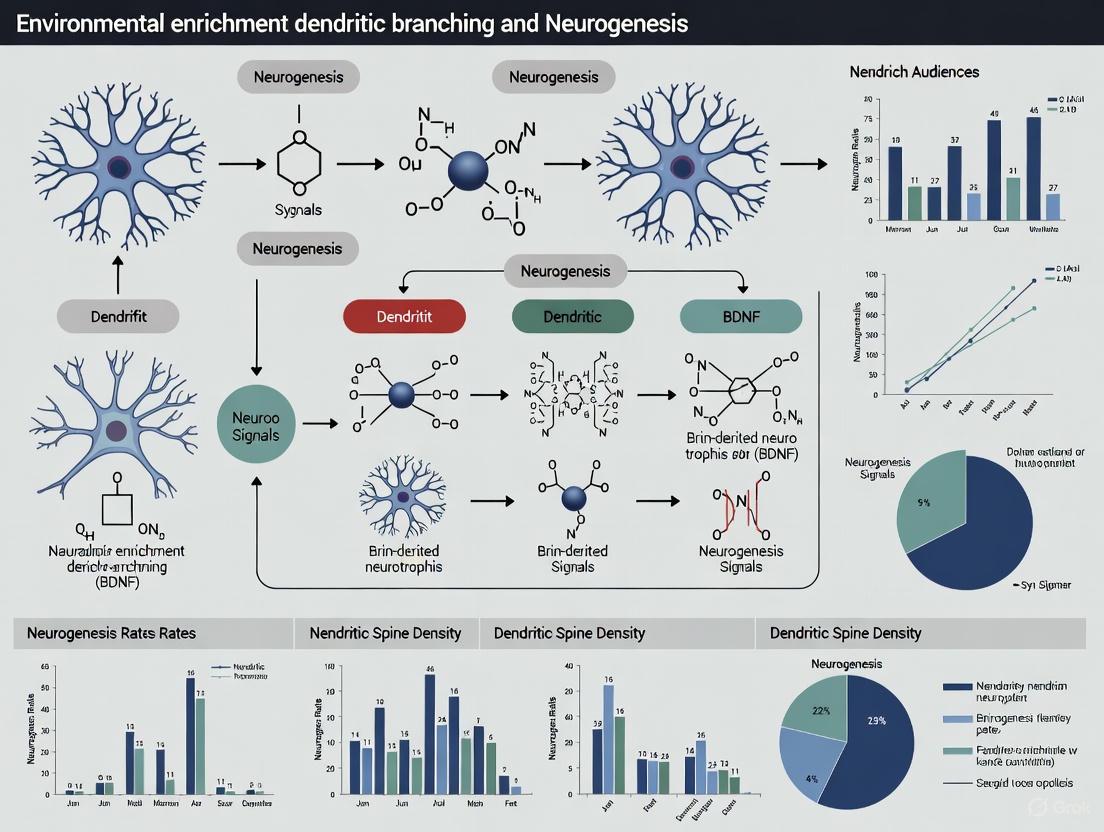
This article synthesizes current research on the profound impacts of environmental enrichment (EE) on brain plasticity, specifically focusing on dendritic branching and neurogenesis.
Environmental Enrichment: Mechanisms and Therapeutic Potential in Dendritic Remodeling and Adult Neurogenesis
Abstract
This article synthesizes current research on the profound impacts of environmental enrichment (EE) on brain plasticity, specifically focusing on dendritic branching and neurogenesis. Aimed at researchers and drug development professionals, it explores the foundational neurobiological mechanisms, methodological approaches for studying EE, strategies for optimizing its effects across different disease models, and a comparative analysis of its therapeutic potential against other interventions. The review highlights EE's role in enhancing synaptic density, dendritic complexity, and hippocampal neurogenesis, and discusses its implications for developing non-invasive therapeutic strategies for neurological and psychiatric disorders, from ischemic stroke and Alzheimer's disease to diabetes-related cognitive decline.
The Neuroplastic Blueprint: How Environmental Enrichment Reshapes Neural Architecture
Environmental enrichment (EE) represents a fundamental experimental paradigm for investigating experience-dependent neuroplasticity. Defined as housing conditions that provide enhanced sensory, cognitive, motor, and social stimulation compared to standard laboratory facilities, EE induces significant structural and functional changes in the brain. This technical guide synthesizes current evidence on EE protocols, their quantitative effects on neurobiological outcomes—specifically dendritic branching and neurogenesis—and the underlying molecular mechanisms. We provide detailed methodologies for implementing EE in preclinical research and analyze its implications for drug development and neurological disease modeling, establishing a critical foundation for standardized application in neuroscience research.
Operational Definition and Core Components
Environmental enrichment is an experimental housing condition characterized by increased complexity that promotes species-typical behaviors through enhanced sensory, cognitive, motor, and social stimulation [1] [2]. It is explicitly defined in relation to standard housing, which typically provides only basic necessities (absorbent bedding, ad libitum food and water) in relatively small, static cages with minimal stimulation [2]. EE transforms this impoverished environment into a complex habitat that encourages natural behaviors and provides cognitive challenges.
The core components of EE can be systematically categorized as follows [2]:
- Physical Enrichment: Larger cages with increased floor space, multiple levels, tunnels, shelters, nesting materials, and manipulable objects that encourage exploration, hiding, and physical activity.
- Sensory Enrichment: Introduction of varied visual, tactile, and occasionally auditory stimuli that provide novel sensory experiences.
- Motor Enrichment: Running wheels, ladders, ropes, and platforms that promote voluntary physical exercise and motor skill acquisition.
- Cognitive Enrichment: Changing configurations of objects, maze-like structures, and novel items that encourage problem-solving and learning.
- Social Enrichment: Housing social species like rodents in stable groups, allowing for complex conspecific interactions.
Table 1: Quantitative Comparison of Standard versus Enriched Housing Conditions
| Feature | Standard Housing | Enriched Environment |
|---|---|---|
| Space | Minimal cage size requirements | 100-300% increased floor space + vertical complexity |
| Social Structure | Often single-housed or minimal groups | Group housing (3+ individuals for rodents) |
| Physical Complexity | Absorbent bedding only | Shelters, tunnels, nesting material, multiple levels |
| Novelty Introduction | Infrequent or no changes | Regular rotation of objects (weekly or bi-weekly) |
| Exercise Opportunities | None | Running wheels, ladders, climbing structures |
| Cognitive Stimulation | Minimal | Complex layouts, novel object exploration |
Neurobiological Effects: Quantitative Analysis
Environmental enrichment induces measurable changes in brain structure and function across multiple levels of organization. The most robust findings demonstrate significant effects on dendritic complexity, synaptogenesis, and adult neurogenesis, particularly in hippocampal and cortical regions [3] [1].
Effects on Dendritic Complexity and Synaptogenesis
Enhanced sensory-motor stimulation promotes substantial restructuring of neuronal arbors. Quantitative morphological analyses reveal that enriched environments increase cortical thickness by 3.3-7%, with up to 25% more synapses in the cerebral cortex of enriched animals compared to standard-housed controls [1]. These structural changes represent fundamental mechanisms of neural plasticity that enhance computational capacity and information processing.
Table 2: Quantitative Effects of Environmental Enrichment on Neural Structures
| Parameter | Change | Brain Region | Significance |
|---|---|---|---|
| Cortical Thickness | ↑ 3.3-7% | Cerebral Cortex | Increased neuropil volume [1] |
| Synapse Number | ↑ 25% | Cerebral Cortex | Enhanced connectivity [1] |
| Dendritic Branching | ↑ Higher-order complexity | Cortex, Hippocampus | Expanded receptive surface [3] |
| Glial Cell Numbers | ↑ 12-14% | Cerebral Cortex | Enhanced metabolic support [1] |
| Capillary Density | ↑ Significant | Cortex, Hippocampus | Improved energy delivery [1] |
| Neurogenesis | ↑ 57% cell survival | Dentate Gyrus | Enhanced plasticity [3] |
Research utilizing automated quantification tools like SOA.2.0 (Segmentation and Orientation Analysis) demonstrates that EE promotes non-random patterning of dendritic branches, including increased parallel growth among both sister and non-sister branches [4] [5]. This organized growth pattern significantly exceeds what would be expected by random chance, suggesting that EE actively shapes the architectural principles of neuronal network formation.
Effects on Adult Hippocampal Neurogenesis
The subgranular zone of the hippocampal dentate gyrus represents one of the few canonical neurogenic niches in the adult mammalian brain. EE robustly enhances the survival of newborn neurons in this region, with studies demonstrating up to 57% more BrdU-positive cells per dentate gyrus in enriched mice compared to standard-housed controls [3]. The process of adult hippocampal neurogenesis follows a well-defined sequence:
- Activation of relatively quiescent radial glia-like neural stem cells in the subgranular zone
- Proliferation of intermediate progenitor cells (type 2 cells) and neuroblasts (type 3 cells)
- Migration of newborn cells into the granule cell layer
- Differentiation into mature dentate granule cells
- Functional integration into existing hippocampal circuits [6]
This enhanced neurogenesis contributes to what researchers term cognitive reserve—the brain's resilience to pathological damage and age-related decline [1]. The functional integration of adult-born neurons follows a specific temporal sequence, beginning with GABAergic inputs at approximately 10 days, followed by cholinergic inputs from septal nuclei around 2 weeks, and finally incorporation into classic hippocampal trisynaptic circuits by 3 weeks [6].
Molecular Mechanisms and Signaling Pathways
The structural changes induced by environmental enrichment are mediated by complex molecular signaling cascades that translate experience into persistent neural changes. Key pathways include neurotrophin signaling, neurotransmitter systems, and growth factor cascades.
Molecular Pathways of Environmental Enrichment
Key molecular mediators include:
- Neurotrophin Upregulation: EE increases concentrations of brain-derived neurotrophic factor (BDNF), nerve growth factor (NGF), and neurotrophin-3 (NT-3), which promote neuronal survival, differentiation, and synaptic plasticity [1].
- Wnt Signaling Activation: Mimics the effects of EE on hippocampal synapses, regulating synaptogenesis and dendritic complexity [1].
- Vascular Endothelial Growth Factor (VEGF): Mediates EE-induced neurogenesis through enhanced angiogenesis and direct effects on neural precursor cells [1].
- Neurotransmitter Systems: EE modulates cholinergic, serotonergic, and beta-adrenergic systems, contributing to enhanced cognitive function and emotional regulation [1].
These molecular changes ultimately drive the structural plasticity observed at the cellular level, including increased expression of synaptic proteins such as synaptophysin and PSD-95 [1].
Experimental Protocols and Methodologies
Standardized Enrichment Protocol for Rodents
Objective: To implement a controlled environmental enrichment paradigm that enhances sensory, cognitive, motor, and social stimulation for laboratory rodents.
Materials:
- Large cages (minimum 48cm × 78cm × 70cm for rats) with multiple levels
- Group housing (3-4 individuals for social species)
- Various shelters (Sputnik houses, plastic tunnels, wooden structures)
- Nesting material (shredded cardboard, paper strips)
- Manipulable objects (wooden balls, blocks for gnawing)
- Exercise equipment (running wheels, ladders, ropes, swings)
- Novelty items (regularly rotated objects of different shapes, colors, textures)
Procedure:
- Habituation Phase (1 week): House animals in enriched conditions with standard configuration.
- Enrichment Rotation Phase (4-8 weeks): Implement one of two protocols:
- Consistent Enrichment: Maintain stable configuration of items throughout study period.
- Enrichment Change: Systematically rotate items twice weekly (e.g., hanging/gnawing items on Mondays, shelter/tunnel items on Thursdays) [7].
- Environmental Complexity: Ensure simultaneous presentation of items from multiple categories (shelters, tunnels, manipulable objects, exercise equipment).
- Spatial Organization: Arrange items to create complex pathways and exploration opportunities.
- Documentation: Maintain detailed records of enrichment schedules and configurations.
Duration Considerations: Most protocols run for 4-6 weeks (31.43% of studies) or 1-3 weeks (23.39% of studies), with animals typically starting during adolescence (41-90 postnatal days) [2].
Dendritic Morphology Quantification Using SOA.2.0
Objective: To quantitatively analyze dendritic branching patterns and parallel growth in neuronal cultures or tissue sections.
Materials:
- Fluorescently labeled neuronal preparations (2D cultures or tissue sections)
- High-resolution fluorescence microscope
- SOA.2.0 software platform (publicly available on GitHub)
- Computer with Python libraries (OpenCV, NumPy, Matplotlib, scikit-image, PIL, Pandas, Tkinter)
Procedure:
- Image Acquisition: Capture high-quality 2D fluorescence images of dendritic networks.
- Image Preprocessing:
- Convert images to grayscale
- Apply Frangi filter with sigma values (0.25 to 3.5, incremented by 0.25) to enhance ridge-like structures of dendritic branches
- Segmentation:
- Use dynamic thresholding with real-time adjustment via SOA.2.0 GUI
- Remove small, irrelevant objects to retain significant dendritic branches
- Generate skeletonized images for morphological analysis
- Feature Extraction:
- Detect contours representing dendritic branch boundaries
- Identify branch points through pixel connectivity analysis
- Exclude branches shorter than user-defined threshold (adjustable via GUI)
- Collect data on branch location, angle, length, and connectivity
- Parallel Growth Analysis:
Validation: Compare empirical data against simulated random branch distributions with identical complexity to confirm non-random patterning [5].
The Researcher's Toolkit: Essential Reagents and Materials
Table 3: Essential Research Reagents and Materials for Environmental Enrichment Studies
| Item | Function/Application | Specific Examples |
|---|---|---|
| Running Wheels | Voluntary exercise component | Standard rodent running wheels |
| Nesting Materials | Promotes natural nesting behavior | Shredded cardboard, paper strips, Sizzle nest |
| Shelters/Hideouts | Provides security and complexity | Sputnik houses, plastic tunnels, wooden structures |
| Manipulable Objects | Encourages exploration and play | Wooden balls, blocks, bones/chews |
| Climbing Structures | Enhances motor stimulation | Ropes, ladders, platforms, swings |
| Novelty Items | Cognitive stimulation through change | Various regularly rotated objects |
| BrdU/Bromodeoxyuridine | Labels dividing cells for neurogenesis studies | Intraperitoneal injection, 50-100mg/kg |
| DCX Antibodies | Marks immature neurons | Immunohistochemistry for doublecortin |
| SOA.2.0 Software | Quantifies dendritic branching patterns | Automated segmentation and orientation analysis |
Implications for Drug Development and Disease Modeling
Environmental enrichment has demonstrated significant potential in modulating disease progression across various neurological disorders, with particular relevance for drug development:
Alzheimer's Disease: EE enhances visual and learning memory in mouse models, with early-life enrichment showing preventive, long-lasting effects on amyloid pathology and spatial memory deficits [1]. EE represents a potential non-pharmacological intervention that could complement drug therapies.
Stroke Recovery: Animals recovering in enriched environments post-stroke show significantly improved neurobehavioral function, enhanced learning capability, and larger infarct reduction compared to standard-housed controls [1] [8]. EE also improves social engagement in stroke recovery models [1].
Huntington's Disease: EE relieves motor and psychiatric deficits, restores lost protein levels, and prevents striatal and hippocampal deficits in BDNF, suggesting potential therapeutic applications [1].
Parkinson's Disease: EE ameliorates neuronal death in adult mouse models, particularly affecting the nigrostriatal pathway important for managing dopamine and acetylcholine levels critical for motor function [1].
These disease-modifying effects highlight the importance of considering housing conditions in preclinical drug testing, as standard laboratory housing may fail to capture the full therapeutic potential of candidate compounds and potentially confound translational outcomes.
Environmental enrichment represents a standardized, robust experimental paradigm that transcends simple improvement of animal welfare to become an essential tool in neuroscience research. The systematic implementation of EE protocols produces quantifiable changes in dendritic architecture and neurogenic capacity that illuminate fundamental mechanisms of neural plasticity. As research continues to elucidate the molecular pathways mediating these effects and their applications in disease models, environmental enrichment stands as a critical methodology for advancing our understanding of experience-dependent plasticity and developing novel therapeutic strategies for neurological disorders. The standardization of enrichment protocols across research facilities will enhance reproducibility and translational potential in preclinical neuroscience and drug development.
The foundational concept that experience can sculpt brain structure and function finds its roots in the seminal work of Donald O. Hebb. His 1949 book, The Organization of Behavior, introduced a revolutionary principle that continues to guide neuroscience: "When an axon of cell A is near enough to excite cell B and repeatedly or persistently takes part in firing it, some growth process or metabolic change takes place in one or both cells such that A's efficiency, as one of the cells firing B, is increased" [9] [10]. This principle, often summarized as "neurons that fire together, wire together," proposed that synaptic connections are not static but can be remodeled by experience, providing a fundamental mechanism for learning and memory [10] [11]. Hebb's theory introduced the concepts of the "Hebb synapse," the "cell assembly," and the "phase sequence," laying the conceptual groundwork for all subsequent research into how experience, including environmental enrichment, alters the brain's physical architecture [9].
From Theory to Structure: Linking Experience to Dendritic Branching
The Discovery of Experiential Structural Plasticity
While Hebb provided the theoretical framework, it was the pioneering work of researchers like Mark Rosenzweig that first provided concrete anatomical evidence. Beginning in the 1960s, studies systematically comparing rats housed in enriched environments (EE)—featuring complex stimuli, social interaction, and motor challenges—to those in standard or impoverished cages revealed that EE led to measurable physical changes in the brain [12] [1]. These changes included increased cortical volume and weight. Subsequent research determined that this increased volume was due to a thicker cerebral cortex, containing a greater number of synapses and more complex glial and capillary support systems [1].
Quantitative Structural Changes Induced by Enrichment
Modern neuroscience has precisely quantified the profound impact of environmental enrichment on neuronal structure. The following table summarizes key morphological changes observed in the brains of animals exposed to EE.
Table 1: Quantitative Neuroanatomical Changes from Environmental Enrichment
| Neuroanatomical Feature | Observed Change | Brain Region | Functional Implication |
|---|---|---|---|
| Cortical Thickness | Increase of 3.3–7% [1] | Cerebral Cortex | Underpins increased brain volume and cognitive capacity. |
| Synapse Number | Increase of ~25% [1] | Cerebral Cortex | Provides structural basis for enhanced neural communication and circuit complexity. |
| Dendritic Complexity | Increased dendritic arborization, higher-order branching, and longer distal branches [12] [1] | Cortex, Hippocampus | Expands the neuron's capacity to receive and integrate synaptic inputs. |
| Dendritic Spine Density | Increased spine density and enlarged spine size [12] [13] | Cortex, Hippocampus | Correlates with strengthened synapses and enhanced synaptic plasticity (LTP). |
| Glial Cell Number | Increase of 12–14% per neuron [1] | Cerebral Cortex | Provides increased metabolic and trophic support for heightened synaptic activity. |
| Capillary Density | Increased density and width [1] | Cerebral Cortex | Supplies greater energy (oxygen, glucose) to support increased neural activity. |
These structural modifications are not merely anatomical curiosities; they represent the physical substrate for improved cognitive function. Enhanced dendritic arborization directly increases the surface area available for synaptic contacts, while the formation of synaptic clusters within dendrites is theorized to act as a fundamental unit for storing related memories [13]. This demonstrates a direct link from Hebb's conceptual "growth process" to observable, quantifiable changes in neuronal morphology that underpin learning and behavioral adaptation.
Modern Experimental Paradigms: Probing Neurogenesis and Dendritic Complexity
Standardized Protocols for Environmental Enrichment
To ensure reproducibility in studying environmental enrichment, researchers utilize standardized housing conditions. The enriched environment is typically defined in contrast to standard laboratory housing [12].
- Enriched Environment (EE): Larger cages housing groups of animals, equipped with a variety of tunnels, nesting materials, running wheels, and toys that are rearranged or replaced regularly to maintain novelty and complexity.
- Standard Environment: Smaller cages, often with limited social contact and no complex stimuli or motor challenges.
- Impoverished Environment: Isolated housing in bare cages with minimal sensory input.
Exposure to EE can occur at different developmental stages—perinatal, post-weaning, or lifelong—with varying behavioral and neurological outcomes [14].
Methodologies for Quantifying Dendritic Architecture and Neurogenesis
Advanced digital reconstruction and labeling techniques allow for precise quantification of the structural changes induced by EE.
Table 2: Core Methodologies for Assessing Neural Plasticity
| Method | Function | Key Reagents & Tools |
|---|---|---|
| Digital Morphological Reconstruction | Creates 3D digital tracings of axonal and dendritic arbors from microscopy images for complex quantitative analysis (e.g., Sholl analysis) [15]. | NeuroMorpho.Org repository, Neurolucida software, Deep-learning algorithms [15] [16]. |
| Thymidine Analog Labeling (BrdU, EdU) | Labels dividing cells through incorporation into DNA during cell division, allowing for birth-dating and tracking of new neuron survival [12] [17]. | Bromodeoxyuridine (BrdU), Ethynyldeoxyuridine (EdU), Anti-BrdU antibodies, Click-chemistry kits for EdU. |
| Immunohistochemistry (IHC) | Visualizes specific cell types, immature neurons, and synaptic proteins using antibodies [17]. | Antibodies against DCX, NeuN, Ki-67, PSA-NCAM, Synaptophysin, PSD-95. |
| Retroviral Vector Labeling | Genetically labels dividing neural progenitor cells and their progeny for detailed morphological and functional analysis [17]. | GFP/RFP-expressing retroviruses, Confocal microscopy. |
| Stereology | A gold-standard, unbiased method for cell counting that provides accurate and reproducible estimates of total cell numbers in a defined brain region [17]. | Stereo Investigator software, Optical fractionator probe. |
Adhering to rigorous protocols like stereology is critical for reliable quantification, especially in contentious areas like adult human neurogenesis [17]. The workflow typically involves: 1) Perfusing animals and post-fixing brains in 4% paraformaldehyde (PFA); 2) Sectioning brain tissue (e.g., 40 μm thick sections); 3) Immunostaining for relevant markers (e.g., DCX for immature neurons, BrdU for divided cells); 4) Using stereological principles to systematically sample and count cells throughout the entire structure of interest (e.g., the dentate gyrus); and 5) Reconstructing and analyzing labeled neurons using digital tracing software [17].
Molecular Mechanisms: Signaling Pathways from Surface to Synapse
Environmental enrichment triggers a cascade of molecular events that ultimately lead to the observed increases in dendritic branching and neurogenesis. The following diagram illustrates the key signaling pathways involved.
Molecular Pathways of Environmental Enrichment
The diagram shows how complex stimulation leads to increased activity in key neurotransmitters like glutamate. This activates receptors such as the NMDA receptor, a molecular coincidence detector, allowing calcium influx that triggers downstream signaling via CaMKII and other kinases [10]. These signals converge on transcription factors like CREB, driving the expression of genes that support synaptic strengthening, dendritic growth, and cell survival [10] [13]. A critical component of this process is the elevated production of Brain-Derived Neurotrophic Factor (BDNF), which supports dendritic arborization, synaptogenesis, and the survival of newborn neurons in the hippocampus [12] [1]. The resulting structural changes, including the formation of synaptic clusters on dendritic branches, are thought to be a primary mechanism for memory storage, effectively bridging Hebb's theoretical cell assemblies with modern dendritic physiology [13].
The Scientist's Toolkit: Essential Reagents for Plasticity Research
Table 3: Research Reagent Solutions for Neural Plasticity Studies
| Reagent / Resource | Function in Research | Application Example |
|---|---|---|
| BrdU (Bromodeoxyuridine) | A thymidine analog that incorporates into DNA during the S-phase of cell division, serving as a birth-date marker for new cells. | Quantifying cell proliferation and long-term survival of adult-born neurons in the hippocampus [12] [17]. |
| Anti-DCX Antibody | Immunohistochemical marker for doublecortin, a protein expressed in immature neuronal precursors and neuroblasts. | Identifying and quantifying the population of newborn, migrating neurons in the dentate gyrus [17]. |
| Anti-NeuN Antibody | Immunohistochemical marker for Neuronal Nuclei, a protein found in most mature post-mitotic neurons. | Confirming neuronal phenotype and assessing neuronal maturation and integration [17]. |
| rAAV-(hSyn-GFP) | Recombinant Adeno-Associated Virus with a human synapsin promoter driving GFP expression; a tool for selective neuronal labeling. | Tracing neuronal morphology, visualizing dendritic spines, and mapping neural circuits with high resolution [15]. |
| NeuroMorpho.Org | A centrally curated online repository for digital neuronal reconstructions and associated metadata. | Sharing, accessing, and re-using digitized neuronal morphologies for quantitative analysis and computational modeling [15]. |
| Kainic Acid | An agonist for the AMPA/kainate subtype of glutamate receptors, used to excite neurons and induce controlled excitotoxicity. | Modeling temporal lobe epilepsy and studying seizure-induced changes in dendritic structure and neurogenesis [15]. |
The journey from Hebb's foundational postulate to modern neuroscience reveals a clear and compelling narrative: experience, encapsulated by the paradigm of environmental enrichment, directly and profoundly shapes the brain's physical structure. The theories of "cell assemblies" and "phase sequences" have found their biological correlates in dendritic branching, synaptic clustering, and experience-dependent neurogenesis. For researchers and drug development professionals, this path offers promising therapeutic avenues. Hebbian plasticity is now implicated in stroke recovery, where surviving circuits are strengthened via LTP, and in mitigating pathologies like Alzheimer's and Huntington's disease [10] [1]. The future of this field lies in further elucidating the precise molecular pathways, refining non-invasive methods to measure neurogenesis in humans, and developing targeted interventions—pharmacological, environmental, or combinatorial—that can harness this innate plasticity to foster cognitive resilience and treat neurological and psychiatric disorders.
Environmental enrichment (EE), a paradigm incorporating complex sensory, motor, cognitive, and social stimulation, induces profound plasticity in the mammalian brain. This whitepaper details the core structural hallmarks of this plasticity: significant increases in cortical thickness and synapse number. Framed within a broader thesis on EE's effects on dendritic branching and neurogenesis, we synthesize evidence from molecular, cellular, and systems-level analyses. The data underscore EE's capacity to enhance brain reserve and cognitive reserve, making it a critical non-pharmacological intervention of interest for researchers and drug development professionals aiming to harness endogenous plasticity mechanisms for therapeutic purposes.
Environmental enrichment refers to a housing condition for laboratory animals that vastly exceeds standard care by providing enhanced opportunities for sensory stimulation, physical activity, cognitive engagement, and social interaction [18]. Initially observed by Donald Hebb, this paradigm has consistently been shown to promote functional and structural changes in the brain, a phenomenon known as neuroplasticity [19]. The "brain reserve" (BR) concept posits that the protective potential of anatomical features like cortical thickness, neuronal density, and synaptic connectivity can provide a buffer against neurological damage [19]. Concurrently, the "cognitive reserve" (CR) concept describes the brain's active ability to cope with damage through efficient neural processing and compensatory mechanisms [19]. EE directly contributes to both reserves, with increases in cortical thickness and synapse numbers representing fundamental structural hallmarks of this enhanced capacity. These macroscopic and microscopic changes are supported by underlying processes of dendritic branching, spinogenesis, and the remodeling of synaptic nanoarchitecture, which will be explored in this technical guide.
Quantitative Data Synthesis: Structural Changes Induced by EE
The following tables synthesize key quantitative findings from EE research, providing a clear overview of the structural changes observed across different brain regions and experimental models.
Table 1: EE-Induced Changes in Cortical Morphology and Synaptic Density
| Brain Region | Measured Parameter | Effect of EE | Experimental Model | Citation |
|---|---|---|---|---|
| Parietal Cortex | Dendritic spine density | ↑ Increase | Wistar rats | [20] |
| Frontal Cortex | Dendritic spine density | ↑ Increase | Wistar rats | [19] |
| Sensorimotor Cortex | Dendritic arborization | ↑ Increased length & branching | Wistar rats | [19] |
| Visual Cortex | Spine head size | ↑ Increase | Mouse (STED nanoscopy) | [21] |
| Cortex (General) | Cortical thickness | ↑ Increase | Multiple rodent studies | [18] |
| Hippocampus | Synaptophysin levels | ↑ Increase | Multiple rodent studies | [20] |
| Striatum | Dendritic spine density (Medium Spiny Neurons) | ↑ Increase | Deer mouse | [22] |
Table 2: EE-Induced Molecular Changes and Functional Outcomes
| Parameter | Effect of EE | Experimental Model | Functional/Behavioral Correlation | Citation |
|---|---|---|---|---|
| PSD95 Nanoorganization | ↑ Enhanced dynamics & patterning | Mouse visual cortex | Associated with enhanced learning | [21] |
| BDNF Levels | ↑ Increase | Rodent hippocampus & cerebellum | Improved spatial memory & cognitive flexibility | [19] |
| Indirect Basal Ganglia Pathway Activity | ↑ Increased neuronal activation (STN, GP) | Deer mouse | ↓ Attenuation of repetitive motor behaviors | [22] |
| Spatial Memory Performance | ↑ Improved acquisition & recall | Wistar rats (Radial Arm Maze) | Correlated with enhanced dendritic growth | [20] |
Experimental Protocols: Methodologies for Key Findings
Protocol: Golgi-Cox Staining for Dendritic Spine Density and Morphology
Application: Used to quantify EE-induced changes in dendritic branching and spine density in cortical and subcortical regions [22] [20].
- Perfusion and Tissue Preparation: Following the experimental period (e.g., 2-3 months of EE), deeply anesthetize subjects and transcardially perfuse with saline followed by a suitable fixative. Extract brains and post-fix for 24-48 hours before embedding in low-melting-point agarose or vibratome sectioning.
- Golgi-Cox Impregnation: Immerse brain tissue blocks in a Golgi-Cox solution (potassium dichromate, mercuric chloride, and potassium chromate) for an extended period, typically 2-4 weeks in darkness.
- Sectioning and Development: Section the impregnated tissue at 100-200 µm thickness using a vibratome. Develop the sections in ammonium hydroxide, followed by stabilization in Kodak Film Fixer or a similar thiosulfate solution.
- Imaging and Analysis: Under a light microscope, identify and image suitable neurons from target regions (e.g., parietal cortex pyramidal neurons). Use specialized software (e.g., Neurolucida, ImageJ) for 3D reconstruction of dendritic arbors and manual or semi-automated counting of dendritic spines. Data are expressed as spine density (spines per µm).
Protocol: STED Nanoscopy of Synaptic Nanoarchitecture
Application: Used to superresolve the dynamics of endogenous PSD95 and spine geometry in vivo in the mouse cortex under EE conditions [21].
- Viral Vector and Labeling: Generate recombinant adeno-associated viral (AAV) particles encoding a transcriptionally regulated intrabody (e.g., αGFP-PSD95 nanobody fused to Citrine) to label endogenous PSD95 without overexpression artifacts. Co-transfect with a membrane label (e.g., EGFP) to visualize spine morphology.
- Surgical Procedure: Craniotomy performed over the target region (e.g., visual cortex) and a cranial glass window implanted to allow for repeated in vivo imaging.
- In Vivo Two-Color STED Imaging: Use a custom-built STED microscope with alternating 483 nm and 520 nm excitation lasers to temporally separate the signals from EGFP (spine morphology) and Citrine (PSD95). Deplete both fluorophores with a single 595 nm STED laser beam.
- Image Analysis and Quantification: Analyze acquired superresolution images for:
- Spine Head Volume: Calculated from the EGFP channel.
- PSD95 Cluster Size and Nanoorganization: Quantified from the Citrine channel.
- Temporal Dynamics: Track changes in the above parameters over time (minutes to hours) to assess plasticity and correlate changes between spine structure and PSD95 organization.
Protocol: Radial Arm Maze for Spatial Working Memory
Application: To assess the functional cognitive benefits of EE, specifically spatial working memory, which is linked to cortical and hippocampal plasticity [20].
- Apparatus: An elevated maze with eight (or twelve) radially extending arms, each baited with a food reward.
- Habituation: Animals are familiarized with the maze and the food reward.
- Testing: In a "win-shift" paradigm, the animal is placed in the center and allowed to freely choose arms until all rewards are collected. An entry into an already-visited arm is counted as a working memory error.
- Data Collection: Key parameters include:
- Total Errors: Number of re-entries into arms.
- Time to Completion: Total time to retrieve all rewards.
- Correct Visits in First Chosen Arms: Reflects the efficiency of spatial strategy.
Visualization of EE Signaling and Structural Pathways
The following diagram synthesizes the core mechanisms by which EE induces structural plasticity, integrating sensory-motor-cognitive stimuli with molecular, cellular, and systems-level outcomes.
The Scientist's Toolkit: Essential Research Reagents and Materials
This table details key reagents, tools, and materials essential for investigating EE-induced structural plasticity, as featured in the cited research.
Table 3: Research Reagent Solutions for EE Structural Plasticity Research
| Item | Function/Application | Specific Example from Research |
|---|---|---|
| Golgi-Cox Staining Kit | Impregnates a random subset of neurons in their entirety, allowing visualization of dendritic arbors and spines under light microscopy. | Used to quantify increased spine density in parietal cortex pyramidal neurons of EC rats [20]. |
| AAV Vectors for Endogenous Protein Tagging | Enables labeling of endogenous proteins (e.g., PSD95) without the confounds of overexpression, crucial for super-resolution studies of synaptic nanostructure. | AAV encoding αGFP-PSD95 nanobody fused to Citrine for in vivo STED imaging of endogenous PSD95 dynamics [21]. |
| Anti-BDNF Antibodies | Detect and quantify changes in Brain-Derived Neurotrophic Factor (BDNF) levels, a key molecular mediator of EE-induced plasticity, via ELISA or immunohistochemistry. | EE is associated with increased BDNF levels in the hippocampus and cerebellum [19]. |
| Cytochrome Oxidase (CO) Histochemistry | Index of long-term neuronal metabolic activity. Measures functional activation of specific neural pathways in response to EE. | Used to show increased neuronal activation in the subthalamic nucleus and globus pallidus of EE deer mice [22]. |
| STED-Compatible Fluorophores (e.g., EGFP, Citrine) | Fluorescent proteins with emission properties suitable for depletion by STED lasers, allowing for live, superresolution imaging of synaptic components. | Enabled virtually crosstalk-free, two-color in vivo STED microscopy of spine geometry and PSD95 [21]. |
| Radial Arm Maze | Standardized behavioral apparatus to assess spatial working memory, a key functional outcome correlated with EE-induced structural enhancements. | Used to demonstrate superior spatial working memory in EC-reared rats compared to SC controls [20]. |
The structural hallmarks of EE—increased cortical thickness and synapse numbers—are robust, measurable indicators of experience-dependent plasticity. These changes are supported by a cascade of events from molecular upregulation (e.g., BDNF) to cellular remodeling (dendritic branching, spinogenesis) and nanostructural reorganization of the synapse. The provided quantitative data, detailed protocols, and mechanistic overview offer researchers and drug developers a solid foundation for exploring EE as a potent, multi-faceted intervention. Future research should focus on standardizing EE paradigms for specific neurological conditions and identifying critical time windows for intervention to maximize the translational potential of harnessing the brain's innate plastic capacity.
Dendritic complexity, characterized by the extent of arborization and density of spines, is a fundamental determinant of neuronal connectivity and cognitive function. This whitepaper synthesizes current research demonstrating that environmental enrichment (EE) and specific molecular pathways can significantly enhance dendritic morphology in hippocampal and cortical neurons. We present quantitative evidence from rodent models showing EE-induced increases in dendritic spine density and alterations in synaptic connectivity, particularly within the hippocampal dentate gyrus (DG)-CA3 circuit. Furthermore, we detail the critical roles of neurogenesis and key signaling pathways—including Wnt, BDNF, and Notch—in mediating these structural changes. The findings underscore the potential of targeting dendritic complexity for therapeutic interventions in cognitive disorders.
The brain's remarkable ability to adapt its structure and function in response to experience, a phenomenon known as neuroplasticity, is exemplified by changes in dendritic architecture. Dendrites, the tree-like projections of neurons, receive synaptic inputs from other cells. Their complexity—defined by the branching pattern (arborization) and the density of small protrusions called spines—directly influences neural computation and cognitive processes such as learning and memory [23]. Deficits in dendritic morphology are associated with a range of neurodevelopmental and neurodegenerative disorders. This review frames the discussion of enhanced arborization and spine density within the broader thesis that environmental enrichment (EE) serves as a powerful, non-invasive modulator of brain plasticity, with effects encompassing both dendritic remodeling and adult hippocampal neurogenesis [24] [25]. We will explore the quantitative morphological changes, the underlying molecular mechanisms, and the functional consequences of enhanced dendritic complexity.
Quantitative Data on Dendritic and Synaptic Changes
Environmental enrichment and other interventions induce measurable changes in dendritic morphology and synaptic density. The following tables summarize key quantitative findings from recent studies.
Table 1: Effects of Environmental Enrichment on Spine Density and Behavior in Rodent Models
| Brain Region | Experimental Group | Spine Density Change | Behavioral/Cognitive Outcome | Citation |
|---|---|---|---|---|
| Hippocampus CA1 | Hypoxic-Ischemic (HI) Rats in Standard Env. | Decreased | Object recognition memory impairment [26] | |
| Hippocampus CA1 | Hypoxic-Ischemic (HI) Rats in Enriched Env. | Recovered to control levels | Recovery of object recognition memory [26] | |
| Globus Pallidus (GP) | Enriched Deer Mice (Low Repetitive Behavior) | Increased | Attenuation of repetitive motor behaviors [22] | |
| Subthalamic Nucleus (STN) | Enriched Deer Mice (Low Repetitive Behavior) | Increased | Attenuation of repetitive motor behaviors [22] |
Table 2: Synaptic and Structural Changes Induced by Electroconvulsive Stimulation (ECS) in Mice
| Parameter | Experimental Group | Change vs. Sham | Key Finding | Citation |
|---|---|---|---|---|
| Hippocampal Volume (MRI) | 9x ECS | Increased | Dose-dependent increase in ventral hippocampus (CA1, DG) [27] | |
| Excitatory Synaptic Density (vGluT1/PSD95) | 9x ECS | Increased | Primary correlate of hippocampal volume increase [27] | |
| Neurogenesis (DCX+ cells) | 9x ECS | Increased | Not required for MRI-detectable volume increase [27] | |
| Hippocampal Volume (MRI) | 9x ECS (X-ray irradiated) | Increased (same as non-irradiated) | Volume increase is neurogenesis-independent [27] |
Table 3: Key Molecular Regulators of Adult Hippocampal Neurogenesis and Dendritic Development
| Molecular Mechanism / Factor | Role in Neurogenesis / Dendritic Development | Effect of Manipulation | Citation |
|---|---|---|---|
| Wnt Signaling | Promotes neuronal differentiation via NeuroD1 activation. | Relief of Sox2 repression by Wnt is necessary for neurogenesis. [24] | |
| BDNF (Brain-Derived Neurotrophic Factor) | Regulates neuronal maturation, survival, and synaptic plasticity. | A key regulatory factor in the neurogenic niche. [24] | |
| Notch Signaling | Maintains neural stem cell (NSC) quiescence and promotes Sox2 expression. | Canonical Notch→RBPJκ→Hes5/Sox2 pathway is crucial for NSC maintenance. [24] | |
| Sox2 | Transcription factor pivotal for NSC self-renewal. | Conditional deletion depletes NSCs and decreases granule neurons. [24] | |
| NeuroD1 | Basic transcription factor for survival and maturation of new neurons. | Expression is repressed by Sox2; relief by Wnt signaling enables neurogenesis. [24] | |
| GIT1 | GTPase regulator of dendritic morphogenesis and spine formation. | Mutation leads to reduced dendritic spine density and altered morphology. [23] |
Detailed Experimental Protocols
To ensure reproducibility, this section outlines key methodologies from cited studies.
- Animals: Adult deer mice (Peromyscus maniculatus).
- Housing Conditions:
- Standard Housing (SH): Mice housed in conventional laboratory cages.
- Enriched Environment (EE): Mice housed in larger cages equipped with running wheels, tunnels, nesting materials, and assorted toys. Social density is also increased.
- Duration: Rearing in respective environments from weaning into adulthood.
- Outcome Measures:
- Behavior: Quantification of repetitive motor behaviors (e.g., hindlimb jumping, backward somersaulting).
- Histology: Brain extraction and processing for:
- Cytochrome Oxidase (CO) Histochemistry: To assess long-term neuronal metabolic activity in basal ganglia nuclei (DLS, GP, STN).
- Golgi-Cox Staining: To impregnate neurons for analysis of dendritic spine density and morphology in the GP and STN.
- Animals: Early-life stress (ELS) model mice (e.g., using limited bedding and nesting method).
- Intervention:
- Enrichment Track (ET): A complex obstacle course designed for cognitive stimulation. Mice are trained to navigate the track.
- Control Track (CT): A simple ramp without cognitive challenges, controlling for physical exercise.
- Training Regimen: Three 30-minute sessions per week for a period of three months.
- Longitudinal Testing: Spatial memory (e.g., Object Location Memory, Morris Water Maze) is assessed at multiple time points (e.g., 6, 13, and 20 months).
- Terminal Histological Analysis:
- Synaptic Quantification: Using endogenous fluorescence (GCaMP6f) in DG and immunofluorescence with excitatory synaptic markers (e.g., PSD-95) in CA3 to visualize and quantify mossy fiber synapses.
- Model System: PVD neuron in C. elegans (late L4 larval stage or young adult).
- Imaging: Fluorescence microscopy of the PVD neuron.
- Computational Analysis (Tracing and Feature Extraction):
- Image Filtering: A Convolutional Neural Network (CNN) is applied to classify and extract the neuronal signal from raw microscopy images.
- Neuron Tracing: A region-based active contour model fits a series of discrete rectangular elements to the tubular dendrites, optimizing for fit score and orientation.
- Morphological Quantification: The algorithm automatically classifies dendritic structures into fundamental shapes (junctions, linear elements) for quantitative analysis of parameters like junction distribution and symmetry.
- Application: The method can quantify subtle morphological defects, for example, in
git-1mutants.
Molecular Mechanisms and Signaling Pathways
The enhancement of dendritic complexity is governed by a network of evolutionarily conserved signaling pathways.
Core Signaling Pathways in Neurogenesis and Dendritic Patterning
Diagram 1: Key molecular pathways regulating neurogenesis and spine formation. Pathways like Notch maintain stem cell pools, while Wnt and BDNF promote neuronal differentiation and plasticity. GIT1 mutation is linked to spine deficits [24] [23].
Experimental Workflow for Morphological Analysis
Diagram 2: Generalized workflow for dendritic morphology studies, from animal models and interventions to tissue processing, imaging, and quantitative analysis [26] [23] [27].
The Scientist's Toolkit: Research Reagent Solutions
Table 4: Essential Reagents and Tools for Dendritic Morphology Research
| Reagent / Tool | Function / Target | Application in Research | Citation |
|---|---|---|---|
| Anti-DCX (Doublecortin) | Antibody against a marker of newborn neurons. | Labeling and quantifying adult hippocampal neurogenesis. [27] | |
| Anti-PSD95 | Antibody against a scaffold protein in excitatory postsynaptic densities. | Labeling and quantifying excitatory synapses. [27] | |
| Anti-VGluT1 | Antibody against a vesicular glutamate transporter in excitatory presynaptic terminals. | Labeling and quantifying excitatory presynaptic terminals. [27] | |
| Golgi-Cox Staining | Historical impregnation technique that randomly stains a small subset of neurons in their entirety. | Visualizing and analyzing complete dendritic arborization and spine density. [22] | |
| GCaMP6f/s | Genetically encoded calcium indicator. | Visualizing neuronal activity and specific neuronal projections (e.g., mossy fibers). [25] | |
| Automated Neuron Tracing Algorithms | Computational tools for extracting neuronal morphology from microscopy images. | High-throughput, objective quantification of dendritic length, branching, and topology. [23] | |
| Sholl Analysis | A method involving drawing concentric circles centered on the cell soma and counting dendritic intersections. | Quantifying the extent and complexity of dendritic arborization. [28] |
Environmental enrichment (EE), an experimental paradigm involving complex sensorimotor and social stimulation, has emerged as a potent non-invasive strategy for enhancing adult hippocampal neurogenesis (AHN). The hippocampus remains one of the most robust neurogenic niches in the adult mammalian brain, a site where neural stem cells (NSCs) continuously give rise to new neurons throughout life [6]. This process of AHN is a crucial component of hippocampal plasticity, contributing significantly to cognitive functions such as learning, memory, and pattern separation [29] [30]. Within the context of a broader thesis on how environmental factors shape brain circuitry, this review examines the compelling evidence that EE serves as a powerful stimulus for both the proliferation of neural progenitors and the survival of newborn neurons in the dentate gyrus. Furthermore, we explore how EE-induced neurogenesis interacts with and potentially stimulates dendritic arborization, creating integrated circuits that enhance hippocampal function. The therapeutic potential of EE is particularly relevant for mitigating deficits associated with various neurological and psychiatric conditions, including those induced by pharmacological insults, aging, and neurodegenerative diseases [31] [29].
The Process and Significance of Adult Hippocampal Neurogenesis
Developmental Stages of Adult-Born Neurons
Adult hippocampal neurogenesis is a multi-stage process occurring in the subgranular zone (SGZ) of the dentate gyrus. It begins with relatively quiescent radial glia-like cells (RGLs), classified as Type 1 cells, which express markers such as GFAP, nestin, and Sox2 [6] [30]. Upon activation, these Type 1 stem cells give rise to proliferating intermediate progenitor cells (Type 2 cells), which further differentiate into neuroblasts (Type 3 cells) characterized by the expression of doublecortin (DCX). These neuroblasts exit the cell cycle and mature into functionally integrated dentate granule cells (DGCs) [6]. The entire process from proliferation to maturity takes approximately 2-4 weeks in rodents, but is notably longer in primates and humans [6] [30]. During a unique critical period of about 4-6 weeks, these adult-born neurons exhibit heightened excitability and synaptic plasticity, including a lower threshold for long-term potentiation (LTP), which is crucial for their functional integration into existing hippocampal networks [6].
Functional Integration into Hippocampal Circuits
The integration of new neurons follows a precise timeline and is vital for their function. Initial GABAergic inputs arrive first from local interneurons, followed by modulatory cholinergic inputs and finally glutamatergic synapses integrating them into the classic hippocampal tri-synaptic circuit [6]. A key functional outcome of this integration is pattern separation—the ability to distinguish between highly similar experiences or environments—which is a primary function of the dentate gyrus circuitry enhanced by the continuous addition of new, highly plastic neurons [30]. This makes AHN a fundamental process for adaptive learning and memory.
Table: Timeline of Functional Integration for Adult-Born Hippocampal Neurons in Rodents
| Time Post-Mitosis | Electrophysiological Properties | Synaptic Inputs Received | Key Markers & Morphology |
|---|---|---|---|
| ~7-10 days | High input resistance; depolarizing GABA response | GABAergic (from local interneurons) | DCX+; axon extends into hilus |
| ~2 weeks | NMDA receptors with NR2B subunit; enhanced LTP | Cholinergic (from septal nuclei); initial glutamatergic | DCX+; large dendritic arbor formation |
| ~3 weeks | Ability to generate action potentials | Integrated into hippocampal tri-synaptic circuits | DCX+; NeuN begins expression |
| ~4-6 weeks | Distinctly more excitable than mature DGCs; prone to LTP/LTD | Full afferent/efferent integration | Calbindin+; NeuN+; morphological maturation complete |
Quantitative Evidence: EE's Impact on Neurogenesis and Dendritic Complexity
Reversing Drug-Induced Deficits
A 2025 study provides compelling quantitative evidence for EE's restorative power. Prenatal exposure to the antipsychotic aripiprazole (3.0 mg/kg) in mice led to significant impairments in hippocampal plasticity in adult male offspring, including reduced adult neurogenesis, dendrite retraction, and spine loss of granule cells in the dentate gyrus, alongside recognition memory deficits [31]. Proteomic and neurochemical analyses revealed that these structural and functional deficits were associated with decreased hippocampal levels of DARPP-32, a key regulator of dopamine signaling, as well as disturbances in dopamine and serotonin neurotransmitter systems [31]. Notably, intervention with EE, initiated at weaning, successfully reversed the disruption of spatial memory function and partially restored impaired hippocampal neuronal plasticity [31]. This demonstrates EE's capacity to counteract neurodevelopmental insults by modulating specific molecular pathways.
Broader Impacts on Cognitive Health
The benefits of EE extend beyond reversing pharmacological deficits. EE is recognized as an effective physical therapy strategy to enhance AHN and combat cognitive impairment associated with various conditions, including cerebrovascular diseases, Alzheimer's disease, and natural aging [29]. The mechanisms are believed to involve the alleviation of neuroinflammation and the enhancement of synaptic plasticity. Furthermore, the complex sensorimotor stimulation provided by EE directly promotes the formation of complex dendritic arbors. While dendritic growth is a stochastic process involving random branching, elongation, and retraction [32], environmental cues can modulate this process to generate highly branched, space-filling morphologies that are optimal for receiving synaptic inputs. EE provides the necessary activity to guide this stochastic growth, resulting in denser, more complex dendritic networks that underpin improved cognitive function.
Table: Quantitative Effects of Environmental Enrichment on Neurogenic and Structural Outcomes
| Experimental Context / Condition | Key Quantitative Findings | Functional & Behavioral Outcomes |
|---|---|---|
| Prenatal Aripiprazole Exposure (Mouse) [31] | EE reversed deficits in neurogenesis, dendrite retraction, and spine loss. Partially restored dopamine/serotonin levels and DARPP-32. | Reversal of impaired spatial and recognition memory. |
| Aging & Neurodegenerative Conditions [29] | EE enhances AHN, alleviates neuroinflammation, and improves synaptic plasticity. | Improvement in cognitive deficits related to aging, Alzheimer's disease, and cerebrovascular disease. |
| Dendritic Arbor Development [32] | Stochastic growth under EE conditions builds dense, economical, and rapid space-filling dendritic arbors. | Enhanced connectivity and integration into circuits, supporting superior information processing. |
Molecular Mechanisms and Signaling Pathways
The efficacy of EE is mediated through its influence on multiple molecular signaling pathways that converge on the neurogenic niche. As illustrated in the signaling pathway diagram below, EE-induced sensorimotor stimulation triggers a cascade of events. A key mechanism identified in the reversal of aripiprazole-induced deficits involves the dopamine and serotonin systems. EE was shown to normalize drug-induced imbalances in these neurotransmitters and upregulate DARPP-32, a critical integrator of dopamine signaling that promotes neuronal survival and differentiation [31]. Furthermore, EE is known to elevate levels of neurotrophic factors like Brain-Derived Neurotrophic Factor (BDNF), which supports the survival of newborn neurons. The diagram also incorporates the established timeline of synaptic integration, showing how newborn neurons progress from receiving initial GABAergic input to full integration into hippocampal circuits, a process that is accelerated and strengthened under enriched conditions [6].
Experimental Protocols for Key Methodologies
Standard Environmental Enrichment Protocol
A typical EE protocol for mice, as used in recent studies [31], involves housing animals in large, multi-level cages (e.g., 36 × 25 × 60 cm) equipped with running wheels, tunnels, shelters, swings, and a variety of objects of different shapes and textures. To maintain novelty—a critical component—the type, number, and spatial arrangement of these toys are changed on a weekly basis. This paradigm also increases social interaction by housing 5-6 mice together, compared to the 3-4 in standard housing. This protocol is typically initiated at weaning (postnatal day 28) and continued for several weeks or months throughout the behavioral testing period to assess long-term effects on neurogenesis and cognition [31].
Assessing Neurogenesis: Golgi-Cox Staining and Analysis
To visualize and quantify the impact of EE on dendritic complexity and spine density, Golgi-Cox staining is a widely used technique [31]. The protocol involves:
- Impregnation: Fresh or lightly fixed brain tissue is immersed in a Golgi-Cox solution (a mixture of potassium dichromate, mercuric chloride, and potassium chromate) for an extended period, typically 1-2 weeks in the dark.
- Sectioning: The brain is then transferred to a sucrose solution for 2-3 days before being sectioned (e.g., at 100-200 μm thickness) using a vibratome or slicer.
- Development and Staining: The sections are developed in ammonium hydroxide, dehydrated in a graded ethanol series, cleared in xylene, and coverslipped with a mounting medium.
- Analysis: Well-impregnated, isolated dentate gyrus granule neurons are selected for analysis. Using specialized microscopy and software (e.g., Neurolucida), researchers can trace dendrites to quantify total dendritic length, branching complexity (via Sholl analysis), and spine density along dendritic segments.
Tracking Cell Proliferation and Survival
To specifically label and track newborn cells, the thymidine analog BrdU (Bromodeoxyuridine) is administered intraperitoneally. To assess cell proliferation, animals are injected with BrdU and sacrificed shortly after (e.g., 2 hours or 24 hours). To assess cell survival and differentiation, animals are injected and then sacrificed several weeks later. Brain sections are then immunostained with antibodies against BrdU and combined with antibodies for neuronal markers like DCX (for immature neurons) or NeuN (for mature neurons). This allows for the quantification of BrdU+ cells (all new cells), BrdU+/DCX+ cells (new immature neurons), and BrdU+/NeuN+ cells (new mature neurons) in the dentate gyrus subgranular zone and granule cell layer [6].
The Scientist's Toolkit: Essential Research Reagents
Table: Key Reagents for Investigating Adult Hippocampal Neurogenesis
| Reagent / Material | Function in Experimental Context |
|---|---|
| BrdU (Bromodeoxyuridine) | A thymidine analog that incorporates into DNA during the S-phase of the cell cycle; used for birth-dating and tracking proliferating cells and their long-term survival [6]. |
| Anti-DCX (Doublecortin) Antibody | Immunohistochemical marker for identifying and quantifying immature neurons (neuroblasts and young post-mitotic neurons) [6] [30]. |
| Anti-NeuN Antibody | Immunohistochemical marker for mature neuronal nuclei; used in conjunction with BrdU to confirm neuronal phenotype of newborn surviving cells [30]. |
| Anti-GFAP & Anti-Sox2 Antibodies | Immunohistochemical markers for identifying radial glia-like neural stem cells (Type 1) and early progenitors in the subgranular zone [6] [30]. |
| Golgi-Cox Staining Kit | A histological stain that randomly impregnates a small percentage of neurons in their entirety, allowing for detailed visualization and analysis of dendritic arborization and spine density [31]. |
| Stereotaxic Injector & Retrovirus | Enables targeted delivery of genetic constructs (e.g., GFP-expressing retrovirus) specifically into the dividing cells of the dentate gyrus for high-resolution lineage tracing and morphological analysis of newborn neurons [6]. |
| Aripiprazole | A second-generation antipsychotic drug used in experimental models to induce deficits in neurogenesis and dendritic morphology, allowing for testing of rescue interventions like EE [31]. |
The pursuit of understanding environmental enrichment's effects on dendritic branching and neurogenesis inevitably converges on the study of key molecular mediators that orchestrate these structural changes. Among these, Brain-Derived Neurotrophic Factor (BDNF) emerges as a principal regulator, functioning as a critical biological translator that converts environmental stimuli into enduring neural changes. This whitepaper provides a technical overview of BDNF's central role, alongside other essential neurotrophic factors and molecular players, in mediating the plasticity-enhancing effects of environmental enrichment. For researchers and drug development professionals, understanding this intricate signaling landscape is paramount for developing novel therapeutic interventions for neurodegenerative and psychiatric disorders. The evidence is clear that BDNF sits at the nexus of environmental input and neuroplastic output, making it a high-value target for therapeutic innovation [33].
Molecular Biology of BDNF: From Gene to Functionally Diverse Isoforms
Genomic Architecture and Precision Expression
The BDNF gene, located on chromosome 11p14.1, exhibits complex regulatory architecture that enables precise, context-dependent expression critical for neural plasticity [33]. Its multi-promoter structure drives tissue-specific expression, with activity-dependent transcription being particularly relevant for environmental enrichment effects. Neuronal excitation triggers calcium influx through NMDA receptors and voltage-gated channels, activating intracellular cascades (CaMK and MAPK/ERK) that phosphorylate the transcription factor CREB (cAMP response element-binding protein). Phosphorylated CREB binds to promoter IV, initiating BDNF transcription and creating a direct molecular pathway from environmental stimulation to gene expression [33]. This process is further refined by epigenetic mechanisms including DNA methylation and histone modification, which dynamically gate access to BDNF gene regions in response to experiences such as exercise [33].
Protein Isoforms and Functional Dichotomy
BDNF is initially translated as a pre-proBDNF precursor that undergoes proteolytic cleavage to generate two functionally distinct isoforms with opposing biological actions [33]. The immature precursor, proBDNF, binds to the p75 neurotrophin receptor (p75^NTR) in complex with sortilin, promoting apoptosis and synaptic pruning—essential processes for developmental refinement and circuit optimization [33]. In contrast, the mature form, mBDNF, preferentially binds to the tropomyosin receptor kinase B (TrkB), activating signaling cascades that support neuronal survival, synaptic strengthening, and the adaptive plasticity underlying learning and memory [33]. Recent research has elucidated that the extracellular protease matrix metalloproteinase-9 (MMP-9) is critically required for the proteolytic conversion of proBDNF to mBDNF during structural synaptic plasticity, revealing a key regulatory point in BDNF functional maturation [34].
Table 1: BDNF Isoforms and Their Functional Characteristics
| Isoform | Receptor Binding | Primary Functions | Cellular Consequences |
|---|---|---|---|
| proBDNF | p75^NTR + sortilin | Synaptic pruning, apoptosis | Structural refinement, competition elimination |
| mBDNF | TrkB | Synaptic strengthening, neuronal survival | LTP, circuit reinforcement, neuroprotection |
BDNF in Adult Hippocampal Neurogenesis
The Neurogenic Process and BDNF Dependency
Adult hippocampal neurogenesis (AHN) represents one of the most robust forms of brain plasticity, comprising a multi-stage process from neural stem cell activation to functional integration of new neurons [6]. This process occurs primarily in the subgranular zone (SGZ) of the dentate gyrus, where radial glia-like neural stem cells (Type 1 cells) give rise to transiently amplifying intermediate progenitors (Type 2 cells), which subsequently generate neuroblasts (Type 3 cells) that exit the cell cycle and mature into dentate granule cells [24] [6]. Throughout this developmental continuum, BDNF serves as a critical regulator, particularly during the differentiation and maturation stages where it promotes dendritic arborization, spine formation, and synaptic integration [35] [33].
The integration of newborn neurons follows a defined temporal sequence, beginning with GABAergic inputs from local interneurons (approximately 10 days post-mitosis), followed by modulatory cholinergic inputs from septal nuclei and glutamatergic synaptic inputs (around 2 weeks), culminating in incorporation into classic hippocampal trisynaptic circuits (approximately 3 weeks) [6]. Throughout this process, BDNF-TrkB signaling enhances the structural and functional maturation of newborn neurons, with immature neurons exhibiting distinct electrophysiological properties including higher input resistance, lower threshold for action potential generation, and enhanced susceptibility to long-term potentiation (LTP) [24] [6].
Experimental Evidence: BDNF and Environmental Enrichment
The pivotal relationship between environmental enrichment, BDNF, and adult neurogenesis has been demonstrated through carefully controlled experimental paradigms. Research examining the effects of environmental enrichment—typically consisting of running wheels, novel objects, and social interaction—has revealed that this multi-factorial stimulation significantly increases doublecortin (DCX) immunoreactivity, a marker of immature neurons, in the dorsal dentate gyrus [35]. This neurogenic response exhibits striking dorso-ventral specialization, with environmental enrichment preferentially increasing DCX in the cognitively-oriented dorsal dentate gyrus while having less effect or even opposite effects in the mood-regulating ventral dentate gyrus [35].
Unexpectedly, these neurogenic changes can occur independently of significant BDNF level alterations, suggesting that environmental enrichment may engage multiple complementary signaling pathways beyond BDNF [35]. However, the essential role of BDNF becomes apparent in therapeutic contexts, where combined approaches that simultaneously increase both neurogenesis and BDNF levels produce superior cognitive outcomes. In Alzheimer's disease models, exercise-induced cognitive benefits require the co-occurrence of enhanced neurogenesis and elevated BDNF levels, as neither increased neurogenesis alone nor exercise without neurogenesis elevation ameliorates cognition [36]. This synergistic effect was successfully mimicked by genetically and pharmacologically inducing adult hippocampal neurogenesis while concurrently elevating BDNF levels, establishing this combination as a potent therapeutic strategy [36].
Signaling Pathways Regulating Neurogenesis
Core Neurogenic Signaling Cascades
Beyond BDNF, multiple evolutionarily conserved signaling pathways form an intricate regulatory network that controls the proliferation, differentiation, and maturation of neural stem cells in the adult hippocampus. The Wnt/β-catenin pathway plays a particularly crucial role in maintaining neural stem cell pools and promoting neuronal fate determination. Wnt activation relieves Sox2-dependent repression of Neurogenic Differentiation 1 (NeuroD1), a basic helix-loop-helix transcription factor essential for neuronal maturation [24]. In aged brains, reduced expression of wild-type p53-induced protein 1 (WIP1) leads to increased inhibition of Wnt signaling via Dickkopf 3 (DKK3), contributing to age-related neurogenesis decline and positioning DKK3 as a potential therapeutic target [24].
The Notch signaling pathway, mediated through RBPJκ, maintains neural stem cell quiescence and promotes Sox2 expression, thereby preserving the stem cell reservoir [24]. Similarly, sonic hedgehog (Shh) signaling through the transcription factor Gli1 regulates neural stem cell self-renewal and proliferation in the adult dentate gyrus [24]. Bone morphogenetic proteins (BMPs) promote glial differentiation over neuronal fate, creating a balanced signaling environment where the relative activities of these pathways determine neurogenic output.
Transcription Factor Networks
A hierarchical cascade of transcription factors executes the neurogenic program downstream of extracellular signaling. Sox2 maintains neural stem cell self-renewal and pluripotency, with its conditional deletion resulting in depletion of the neural stem cell pool [24]. The orphan nuclear receptor TLX promotes self-renewal by recruiting histone deacetylases to repress cell cycle inhibitors and tumor suppressors, while simultaneously activating Wnt signaling [24]. As neural stem cells commit to the neuronal lineage, AscL1 drives neuronal fate specification, and Tbr2 facilitates neuronal lineage progression in intermediate progenitors [24]. Finally, NeuroD1 and CREB coordinate the maturation and functional integration of newborn neurons into existing hippocampal circuitry [24].
Table 2: Key Transcription Factors in Adult Hippocampal Neurogenesis
| Transcription Factor | Expression Stage | Primary Function | Experimental Manipulation Outcome |
|---|---|---|---|
| Sox2 | Neural Stem Cells | Maintains self-renewal and pluripotency | Conditional deletion depletes NSC pool [24] |
| TLX | Neural Stem Cells | Promotes proliferation via cell cycle regulation | Required for NSC self-renewal in SGZ [24] |
| AscL1 | Early Progenitors | Neuronal fate specification | Ectopic expression alters progenitor fate [24] |
| NeuroD1 | Late Progenitors/Neuroblasts | Neuronal differentiation and maturation | Necessary for survival and maturation of new neurons [24] |
| CREB | Immature Neurons | Neuronal maturation and synaptic plasticity | Implicated in structural and functional integration [24] |
Experimental Methodologies and Research Tools
Standardized Neurogenesis Assessment Protocols
Rigorous assessment of neurogenesis and its molecular mediators requires standardized methodologies and specialized research tools. The quantification of adult hippocampal neurogenesis typically employs a combination of stage-specific molecular markers assessed through immunohistochemistry, RNA analysis, and protein quantification. For proliferating neural progenitor cells and neuroblasts, doublecortin (DCX) immunohistochemistry serves as the gold standard, providing sensitive detection of immature neurons [35] [37]. This can be complemented with BrdU (bromodeoxyuridine) or other thymidine analogs that incorporate into dividing cells during S-phase, allowing birth-dating and lineage tracing [6].
Advanced techniques include rabies-virus-based monosynaptic retrograde tracing to map functional connectivity of newborn neurons, and two-photon microscopy combined with glutamate uncaging to visualize structural plasticity at individual dendritic spines [6] [34]. For BDNF signaling assessment, researchers employ TrkB phosphorylation assays, single-spine stimulation paradigms, and proteolytic activity sensors to detect MMP-9 activation during structural plasticity [34]. The recent implementation of single-cell RNA sequencing has revolutionized the molecular characterization of neurogenic lineages, revealing complex gene expression dynamics during neuronal differentiation in both physiological and pathological conditions [37].
The Scientist's Toolkit: Essential Research Reagents
Table 3: Essential Research Reagents for Neurogenesis and BDNF Studies
| Research Tool | Application | Experimental Function | Example Use |
|---|---|---|---|
| DCX Antibodies [35] | Immunohistochemistry, Western Blot | Marker for immature neurons | Quantifying neurogenic response to enrichment [35] |
| BrdU/EdU [6] | Cell proliferation assay | Thymidine analogs for birth-dating | Lineage tracing and survival analysis of newborn cells [6] |
| LV-Wnt3 [36] | Genetic manipulation | Activates Wnt signaling to enhance NPC proliferation | Stimulating neurogenesis in AD models [36] |
| P7C3 [36] | Pharmacological intervention | Neuroprotective compound enhancing NPC survival | Improving newborn neuron survival in therapeutic paradigms [36] |
| AAV-BDNF [38] | Gene delivery | Enables targeted BDNF overexpression | Hippocampus-targeted BDNF therapy in AD models [38] |
| TrkB Agonists [33] | Pharmacological signaling | Activates BDNF receptor pathway | Mimicking BDNF signaling in therapeutic contexts [33] |
Therapeutic Applications and Future Directions
BDNF-Targeted Interventions for Neurological Disorders
The robust association between reduced BDNF signaling, impaired neurogenesis, and neurological dysfunction has positioned BDNF enhancement as a promising therapeutic strategy for diverse brain disorders. In Alzheimer's disease, where hippocampal neurogenesis is impaired early in the disease process, approaches that combine neurogenesis stimulation with BDNF elevation have demonstrated particular efficacy [36] [37]. Hippocampus-targeted BDNF gene delivery using advanced adeno-associated virus (AAV) vectors has shown promise in mitigating neuronal degeneration and cognitive impairment across multiple AD mouse models without directly affecting amyloid-β or tau pathology [38]. Transcriptomic analyses reveal that such BDNF interventions orchestrate upregulation of genes associated with neuronal structural organization and synaptic transmission while downregulating inhibitory factors like bone morphogenetic proteins [38].
For major depressive disorder, the neurotrophin hypothesis posits that decreased BDNF contributes to pathophysiology, while successful antidepressant treatments restore BDNF levels and promote neurogenesis, particularly in the ventral dentate gyrus which regulates mood and stress responses [37] [33]. Similar approaches are being explored for Parkinson's disease, Huntington's disease, and amyotrophic lateral sclerosis, where diminished BDNF signaling accelerates disease progression [37] [33]. The emerging understanding that BDNF's effects extend beyond traditional neurodegenerative models to include ischemic injury and gut-brain axis communication further expands its potential therapeutic relevance [33].
Innovative Delivery Platforms and Technical Challenges
Despite BDNF's compelling therapeutic potential, clinical translation has faced significant challenges related to delivery, stability, and targeted action. Innovative solutions now under development include lipid nanoparticle-based mRNA therapies that enable transient, regulated BDNF expression; CRISPR-dCas9 epigenetic editing to selectively enhance endogenous BDNF transcription; and engineered AAV serotypes with improved CNS tropism for region-specific gene delivery [38] [33]. The development of small molecule TrkB agonists that bypass the need for BDNF delivery altogether represents another promising approach [33].
For drug development professionals, critical considerations include the pleiotropic nature of BDNF signaling, which can produce diverse effects in different cellular contexts; the balance between proBDNF and mBDNF signaling, which may require precise regulation to achieve desired outcomes; and patient-specific factors such as the common Val66Met polymorphism that affects BDNF trafficking and function [39] [33]. Future therapeutic strategies will likely involve multiplex biomarker panels that combine BDNF dynamics with complementary indicators of pathological processes, enabling personalized treatment approaches and sophisticated therapeutic monitoring [33]. As these technologies mature, BDNF-centered therapies hold transformative potential for revolutionizing brain disorder treatment and advancing precision medicine in neurology and psychiatry.
The brain's remarkable capacity for experience-dependent change is powerfully modulated by environmental enrichment (EE), a paradigm that enhances sensory, cognitive, motor, and social stimulation. While the resultant improvements in learning, memory, and neural repair are well-documented, the pivotal supportive roles of the vascular and glial systems in facilitating these adaptations are increasingly recognized. This whitepaper synthesizes current research to detail the specific vascular and glial adaptations that underpin the enhanced neural networks observed in enriched environments. We examine the mechanisms of enhanced vascularization, oligodendrocyte-mediated myelination, and astrocytic support, framing these findings within the broader context of EE-induced dendritic branching and neurogenesis. The document provides a structured analysis of quantitative data, detailed experimental methodologies, and key research tools, offering a technical resource for researchers and drug development professionals aiming to harness these adaptive mechanisms for therapeutic intervention.
Environmental enrichment (EE), characterized by housing conditions that provide complex combinations of sensory, motor, cognitive, and social stimuli, is a powerful experimental manipulation that promotes structural and functional plasticity in the brain [40] [41]. The beneficial effects of EE on neurogenesis and dendritic complexity are established pillars of neuroscience research [20] [42]. However, these neuronal changes are not autonomous; they are critically supported by dynamic adaptations in the brain's non-neuronal components.
The neurovascular unit, a functional construct comprising neurons, blood vessels, and glial cells (astrocytes, microglia, and oligodendrocytes), works in concert to maintain the health and functionality of the central nervous system (CNS). This review focuses on the often-overlooked yet essential adaptations within this unit: the vascular changes that meet the heightened metabolic demands of an active brain, and the glial responses that provide structural support, regulate the extracellular environment, and facilitate rapid signal transmission. Understanding these vascular and glial adaptations is crucial for developing a complete mechanistic picture of how EE enhances neural network function and promotes brain resilience, thereby informing novel therapeutic strategies for neurodegenerative and neurodevelopmental disorders [43] [41].
Vascular Adaptations to Environmental Enrichment
The brain's intense energy requirements necessitate a close coupling between neural activity and cerebral blood flow. Environmental enrichment induces significant changes in the vascular system to support the enhanced neural network.
Mechanisms of Enhanced Vascularization
EE promotes angiogenesis, the formation of new blood vessels from pre-existing ones. This process is largely driven by increased neuronal activity and the subsequent release of growth factors. A key mechanism involves the activity-dependent expression of Vascular Endothelial Growth Factor (VEGF). While our search results do not provide specific molecular details for EE, the principle is well-established: heightened synaptic and neural activity triggers VEGF signaling, which stimulates endothelial cell proliferation and the formation of new capillaries [44]. This expanded vascular network serves to deliver essential oxygen and nutrients more efficiently to active brain regions.
Furthermore, endothelial cells, which line the blood vessels, do more than just form conduits for blood. Recent evidence highlights their active role in guiding brain development and function by providing molecular cues and structural support for migrating neurons and developing neural circuits [45]. This suggests that EE-induced vascular changes may also create a more favorable microenvironment for ongoing neurogenesis and neuronal integration.
Functional and Structural Outcomes
The functional outcome of these vascular adaptations is a denser and more robust capillary network. Research in diabetic mice has quantitatively demonstrated that short-term EE leads to a significant enhancement of the vascular network area within the hippocampal dentate gyrus [44]. This increased vascular density is not an isolated phenomenon; it is closely associated with the neurogenic niche, where neural progenitor cells reside and new neurons are generated. An improved vascular supply in this region likely supports the heightened metabolic demands of adult neurogenesis, which is also boosted by EE [44].
Table 1: Quantitative Data on Vascular and Glial Adaptations to Environmental Enrichment
| Adaptation Type | Parameter Measured | Experimental Model | Key Finding | Citation |
|---|---|---|---|---|
| Vascular | Vascular Network Area | STZ-induced Diabetic Mice | Significant increase in the vascular network area of the dentate gyrus after 10-day EE. | [44] |
| Oligodendrocyte | Oligodendrocyte Progenitor Cells (OPCs) | Perinatal Hypoxia Injury Model (P30) | HX-EE: 9284 ± 393 cells/mm³ vs. HX: 6080 ± 167 cells/mm³. | [43] |
| Oligodendrocyte | Differentiated OLs (EGFP+CC1+) | Perinatal Hypoxia Injury Model (P45) | HX-EE: 30,115 ± 1011 cells/mm³ vs. HX: 24,302 ± 411 cells/mm³. | [43] |
| Oligodendrocyte | Myelinated Axons (EM) | Perinatal Hypoxia Injury Model (P45) | HX-EE: 22 ± 2.7 axons/field vs. HX: 8.7 ± 3.0 axons/field. | [43] |
| Astrocyte | Glutamate Transporter (GLT-1) | Substance Use Disorder Models | EE helps restore glutamate homeostasis, partly through astrocytic GLT-1. | [46] |
Glial Adaptations to Environmental Enrichment
Glial cells, including oligodendrocytes, astrocytes, and microglia, undergo profound, experience-dependent changes that are essential for the support and optimization of neural circuits in an enriched environment.
Oligodendrocytes and Myelination
Oligodendrocytes are the myelin-forming cells of the CNS, and their function is critical for the rapid saltatory conduction of action potentials. EE has been shown to potently influence the entire oligodendrocyte lineage. In a model of perinatal brain injury, EE was found to promote oligodendroglial maturation and myelination [43]. This process begins with a significant increase in the proliferation of oligodendrocyte progenitor cells (OPCs), which subsequently differentiate into mature, myelinating oligodendrocytes.
The ultimate result of this enhanced oligodendrogenesis is a substantial increase in myelinated axons and thicker myelin sheaths, as confirmed by electron microscopy and measurements of myelin proteins such as MBP and MAG [43]. This enhancement of myelination is a key form of white matter plasticity that facilitates more efficient communication between distant brain regions, thereby supporting the complex behaviors and cognitive functions improved by EE.
Astrocytes and Microglia
Astrocytes, the most abundant glial cell type, form an integral part of the tripartite synapse and are crucial for maintaining synaptic health and function. They play a key role in clearing neurotransmitters like glutamate from the synaptic cleft via the high-affinity transporter GLT-1, which is exclusively expressed on astrocytes [46]. By preventing glutamate excitotoxicity and regulating synaptic transmission, astrocytes help maintain the delicate balance required for optimal neural network function. EE has been implicated in supporting this glutamate homeostasis, which is often disrupted in various neurological disorders [46].
Microglia, the resident immune cells of the CNS, are also modulated by EE. While the specific pro- or anti-inflammatory effects are context-dependent, EE generally promotes a state that helps mitigate chronic inflammatory responses in the brain [41]. This reduction in neuroinflammation creates a more permissive environment for neuroplasticity, including dendritic branching and synaptogenesis.
Diagram 1: Signaling Pathways in Vascular and Glial Adaptation. This diagram illustrates the primary mechanisms through which Environmental Enrichment triggers coordinated vascular and glial adaptations, culminating in enhanced neural network function.
Experimental Protocols for Key Findings
To facilitate replication and further investigation, this section outlines the detailed methodologies from pivotal studies on vascular and glial adaptations.
Protocol: Investigating EE-Induced White Matter Recovery
This protocol is based on the work presented in [43], which demonstrated that EE promotes oligodendrocyte maturation and functional myelination recovery after perinatal brain injury.
- Animal Model: CNP-EGFP transgenic mice (for visualization of oligodendrocyte lineage) were used. The experimental groups were:
- Normoxic Standard (NX)
- Normoxic Enriched (NX-EE)
- Hypoxic Standard (HX) - exposed to chronic hypoxia (10.5% O₂) from postnatal day (P)3 to P11 to model perinatal white matter injury.
- Hypoxic Enriched (HX-EE)
- Environmental Enrichment Paradigm: EE intervention began at P15 and continued until the endpoint. The enriched cages were larger and contained a variety of objects such as toys, tunnels, nesting material, and running wheels. The objects were rearranged, and novelty was introduced periodically to maintain stimulation.
- Key Analyses and Timepoints:
- Cell Counts (P30, P45): Immunohistochemistry was performed on brain sections. OPCs were labeled with antibodies against NG2. Proliferating cells were labeled with Ki67. Mature oligodendrocytes were labeled with CC1. Cell densities (cells/mm³) were quantified in the subcortical white matter using stereological methods.
- Myelin Protein Analysis (P45): Western blotting was used to quantify the expression levels of myelin-associated proteins, specifically Myelin Associated Glycoprotein (MAG) and Myelin Basic Protein (MBP).
- Electron Microscopy (P45): The corpus callosum was analyzed using transmission electron microscopy to count the number of myelinated axons per field of view and to measure g-ratios (the ratio of the inner axonal diameter to the total outer diameter) as an indicator of myelin thickness.
Protocol: Assessing Vascular and Neurogenic Changes
This protocol is derived from [44], which showed that short-term EE enhances adult neurogenesis and the vascular network in the hippocampus, even in a diabetic model.
- Animal Model and Induction of Diabetes: Adult (16-week-old) male C57BL/6 mice were injected with streptozotocin (STZ, 195 mg/kg, i.p.) to induce type 1 diabetes. Control mice received vehicle.
- Environmental Enrichment Paradigm: Ten days post-STZ injection, mice were assigned to Standard (SC) or Enriched (EE) conditions for 10 days. The EE consisted of larger cages housing 5 mice, equipped with toys, tunnels, plastic houses, and nesting material. Objects were rearranged every 2 days. Running wheels were explicitly excluded to isolate the effects of enrichment from voluntary exercise.
- BrdU Injection Paradigm: To label newborn cells, Bromodeoxyuridine (BrdU, 250 mg/kg) was administered intraperitoneally 24 hours before the start of the differential housing.
- Key Analyses:
- Vascular Network Assessment: Immunohistochemistry for laminin (a basement membrane protein) was used to outline blood vessels. The vascular area was quantified in the dentate gyrus.
- Adult Neurogenesis Analysis: BrdU immunohistochemistry and immunofluorescence were used to assess cell proliferation, survival, and neuronal differentiation (co-labeling with neuronal markers like β-III-Tubulin).
- Dendritic Complexity: The left brain hemispheres were processed using a modified Golgi silver impregnation technique. Dendritic arborization and spine density of CA1 pyramidal neurons were analyzed using Sholl analysis.
Diagram 2: Experimental Workflow for EE Studies. A generalized timeline integrating key procedures from cited protocols for investigating neural, glial, and vascular adaptations.
The Scientist's Toolkit: Research Reagent Solutions
Table 2: Essential Research Reagents for Studying EE-Induced Adaptations
| Reagent / Material | Primary Function / Target | Experimental Application | Key Findings Enabled |
|---|---|---|---|
| CNP-EGFP Transgenic Mice | Labels oligodendrocyte lineage cells. | Visualizing and quantifying OPCs and mature oligodendrocytes via fluorescence. | EE promotes OPC proliferation and oligodendrocyte maturation after injury [43]. |
| BrdU (Bromodeoxyuridine) | Synthetic thymidine analog incorporated into DNA during S-phase. | Labeling and tracking proliferating cells and their long-term survival/differentiation. | Short-term EE enhances survival of newborn neurons in the hippocampus [44]. |
| Antibodies: NG2, Ki67, CC1 | Cell type-specific markers (OPCs, proliferation, mature OLs). | Immunohistochemistry/IHC for cell identification and density quantification. | Quantification of EE-induced changes in oligodendroglial populations [43]. |
| Antibodies: Laminin | Basement membrane protein of blood vessels. | IHC to visualize and quantify the vascular network architecture. | EE enhances vascular network area in the dentate gyrus [44]. |
| Antibodies: β-III-Tubulin (TuJ1) | Neuronal-specific cytoskeletal protein. | IHC/IF to identify newly generated and mature neurons. | Confirmation of neuronal differentiation of BrdU+ newborn cells [44]. |
| Golgi-Cox Stain Kit | Impregnates a small, random subset of neurons in their entirety. | Detailed morphological analysis of dendritic arborization and spine density. | EE increases dendritic complexity and spine density in hippocampal neurons [20] [44]. |
The compelling evidence summarized in this whitepaper firmly establishes that the benefits of environmental enrichment on the brain are not solely a neuron-centric phenomenon. The enhanced neural network, characterized by refined dendritic branching and robust neurogenesis, is fundamentally supported by a cascade of intricate vascular and glial adaptations. The expansion of the vascular bed ensures the metabolic foundation for plasticity, while the activation of oligodendrocytes and astrocytes enhances structural integrity and synaptic efficiency. A comprehensive understanding of this collaborative interplay within the neurovascular unit is paramount. Future research should focus on precisely delineating the molecular signals that orchestrate these changes. This knowledge will be invaluable for drug development professionals aiming to design targeted therapies that mimic or enhance these supportive adaptations, offering hope for treating a wide spectrum of neurological disorders where neuroplasticity and brain resilience are compromised.
From Cage to Clinic: Standardizing EE Protocols and Translating Stimulation into Therapy
Environmental Enrichment (EE) is an experimental paradigm in which the living conditions of laboratory animals are modified to enhance sensory, cognitive, motor, and social stimulation [47] [48]. A large body of preclinical evidence demonstrates that EE facilitates functional recovery after neurological injury and promotes neural plasticity, including enhanced neurogenesis, increased dendritic branching, and synaptogenesis [48] [49]. This in-depth technical guide delineates the core components of EE paradigms, frames them within the context of neural plasticity research, and provides detailed methodologies to support standardization and replication in preclinical research for drug development.
Core Components and Key Principles of EE
The efficacy of EE hinges on the synergistic integration of multiple, dynamic components that engage specific brain functions rather than merely adding objects to a cage [47]. A scoping review of preclinical post-stroke EE protocols identified six fundamental principles underpinning successful EE interventions: complexity (spatial and social), variety, novelty, targeting needs, scaffolding, and integration of rehabilitation tasks [47].
Table 1: Core Components of an Environmental Enrichment Paradigm
| Component | Description | Key Elements | Primary Neural Targets |
|---|---|---|---|
| Sensory Stimulation | Provision of varied, novel, and complex stimuli to multiple senses [47] [48]. | Novel objects of different textures, shapes, and colors; changing layouts; auditory stimuli; olfactory stimuli (e.g., sawdust, essential oils) [47]. | Sensory cortices, dendritic spine density, neurotrophic factors (e.g., BDNF) [48] [49]. |
| Cognitive Stimulation | Challenges that promote problem-solving, learning, and memory [47]. | Mazes, puzzles, hidden food rewards; tasks requiring spatial navigation and memory [47] [50]. | Hippocampus, prefrontal cortex, synaptic plasticity, neurogenesis [48] [49]. |
| Motor Stimulation | Opportunities for voluntary and sustained physical activity [47] [48]. | Running wheels, ladders, ropes, tunnels, varied vertical and horizontal spaces to promote climbing and exploration [47] [49]. | Motor cortex, cerebellum, angiogenesis, neurogenesis [48]. |
| Social Stimulation | Housing that facilitates conspecific interaction in a complex group [47] [51]. | Group housing (typically larger than standard, e.g., 12 mice/cage) to enable diverse social behaviors and hierarchies [47] [49]. | Limbic system, social brain networks, oxytocin systems, reduction of stress [48]. |
Table 2: Key Design Principles for EE Protocols [47]
| Principle | Application in Preclinical EE | Rationale |
|---|---|---|
| Complexity | Spatial: Multi-level cages with tunnels, shelters. Social: Group housing [47] [51]. | Creates a rich, engaging environment that encourages natural behaviors and neural engagement. |
| Novelty & Variety | Regular introduction of new objects and rearrangement of the spatial configuration (e.g., 2-3 times per week) [47]. | Prevents habituation, encourages continuous exploration, and stimulates neural plasticity. |
| Targeting Needs | Placing food or water in locations that require physical effort or problem-solving to access [47]. | Motivates engagement with the environment to satisfy basic drives, promoting activity in relevant neural circuits. |
| Scaffolding | Gradual increase in the complexity of motor or cognitive challenges (e.g., more complex mazes over time) [47]. | Allows animals to build skills progressively, optimizing the induction of plasticity without causing frustration. |
EE, Dendritic Branching, and Neurogenesis: Mechanisms and Evidence
The structured stimulation provided by EE induces profound and measurable changes in brain neurobiology. The following diagram illustrates the conceptual pathway from EE exposure to functional recovery, which is mediated by these key neural plasticity mechanisms.
Impact on Dendritic Architecture and Synaptic Efficacy
EE has been demonstrated to directly reverse injury- or genetic deficit-induced impairments in dendritic structure. A key study on mice with genetically impaired interleukin-1 signaling (IL-1rKO)—which display reduced dendritic spine size and impaired memory—found that EE completely restored spine size and concomitant memory functioning [49]. This structural correction was coupled with the restoration of long-term potentiation (LTP), a cellular correlate of learning and memory [49]. Furthermore, EE generally promotes dendritic arborization and increased synaptic density across various brain regions, which underpins enhanced cognitive function [48].
Stimulation of Neurogenesis
EE is a potent stimulator of adult neurogenesis, particularly in the dentate gyrus of the hippocampus. This effect is mediated by increased levels of Brain-Derived Neurotrophic Factor (BDNF), a protein crucial for neuron growth, maturation, and survival [48] [49]. In IL-1rKO mice, EE was found to promote neurogenesis to a similar degree as in wild-type controls, suggesting its effects can operate through multiple, parallel biological pathways [49]. The combination of motor activity (e.g., voluntary running wheel exercise) within an EE appears to be particularly effective in driving these neurogenic changes [48].
Detailed Experimental Protocols
The translation of EE's benefits to reliable preclinical models requires meticulous protocol design. The following section details specific methodologies from key studies.
Standard Post-Injury EE Protocol in Rodents
This protocol is adapted from a scoping review of post-stroke EE [47] and a study on traumatic brain injury (TBI) [51], representing a widely used and validated approach.
- Animals: Adult rodents (rats or mice). Group housing is critical.
- EE Cage Specifications: Large, transparent cages (e.g., 60 × 60 × 40 cm) are used to house groups of 10-12 animals [47] [49].
- Enrichment Items:
- Structural/Spatial: Plastic tunnels, ladders, multiple levels, platforms, nesting materials [47] [49].
- Motor: Running wheels [49].
- Cognitive/Sensory: A set of novel objects made of various materials (plastic, wood, metal) in different shapes and colors. These objects are changed and rearranged according to a set schedule (e.g., 2-3 times per week) to maintain novelty and complexity [47].
- Intervention Timeline: The EE intervention typically begins shortly after injury (e.g., 24-72 hours post-stroke or TBI) and continues for several weeks (e.g., 5-6 weeks) [47] [51].
- Control Condition (Standard Housing): Animals are housed in triads or pairs in standard small cages (e.g., 25 × 20 × 15 cm) with only bedding, food, and water, devoid of any additional stimulating objects [49] [51].
Protocol: Dissecting Essential EE Components
A critical study empirically compared typical EE with "atypical" EE to determine the necessity of each component post-TBI [51]. The experimental workflow below outlines this comparative design.
- Key Findings: The study demonstrated that while individual components offered slight benefits, only the combination of social, sensory, and motor stimulation in the "Typical EE" group yielded optimal and significant improvements in cognitive performance and histological protection after TBI [51]. This underscores that the core components act synergistically.
Protocol: EE in Neurodevelopmental Disorders
EE principles have shown promise in models of neurodevelopmental disorders like Autism Spectrum Disorder (ASD) and Rett syndrome.
- Animal Models: BTBR T+ Itpr3tf/J (BTBR) mice (an idiopathic ASD model) or valproic acid-exposed rats [48].
- Enrichment Strategy: Enriched housing conditions that provide increased opportunities for sensory integration, social interaction, and physical activity [48].
- Outcomes: Documented improvements include reduced repetitive behaviors, improved social affiliation, ameliorated cognitive deficits, and associated neurobiological changes such as increased neurogenesis and elevated BDNF levels [48].
The Scientist's Toolkit: Essential Research Reagents and Materials
Table 3: Essential Materials for Implementing a Rodent EE Paradigm
| Item Category | Specific Examples | Function in EE Paradigm | Research Context / Note |
|---|---|---|---|
| Housing Equipment | Large cages (e.g., 60x60x40 cm), Infrared video camera systems. | Provides the complex spatial environment; enables continuous behavioral monitoring and scoring without human interference. | Critical for group housing and ensuring animal welfare. |
| Motor Enrichment | Running wheels, wooden or plastic ladders, ropes, tunnels, bridges. | Encourages voluntary physical activity, improves motor skills, and drives angiogenesis and neurogenesis. | Running wheels are a potent standalone stimulator of hippocampal neurogenesis [48]. |
| Cognitive & Sensory Enrichment | Assorted novel objects (Lego, plastic toys, PVC pipes), nesting material, varied substrates (e.g., sawdust, shredded paper). | Provides novelty and complexity; encourages exploration, problem-solving, and natural foraging/nesting behaviors. | Objects must be changed and rearranged regularly (e.g., 2-3x/week) to maintain efficacy [47]. |
| Social Enrichment | N/A (Group Housing). | Facilitates natural social interactions, which is a core component for optimal functional recovery [51]. | The "social" component is a key variable that cannot be replaced by inanimate objects [51]. |
| Analysis Reagents | Antibodies (e.g., anti-BDNF, anti-DCX), dyes for histological staining (e.g., Cresyl Violet). | Used for post-mortem quantification of neuroplasticity markers (BDNF) and newborn neurons (Doublecortin, DCX). | Essential for correlating behavioral improvements with underlying neural changes. |
A robust Environmental Enrichment paradigm is not merely an "improved" cage but a systematically designed multi-modal intervention. Its power to drive meaningful functional recovery in animal models of neurological injury and disease is inextricably linked to its synergistic engagement of sensory, cognitive, motor, and social systems. The resultant plasticity—evidenced by increased dendritic spine density, potentiated LTP, and enhanced neurogenesis—provides a strong biological rationale for its use in preclinical drug development. By adhering to the detailed principles and protocols outlined in this guide, researchers can standardize EE interventions, thereby enhancing the translational validity of their findings and strengthening the discovery of novel therapeutic agents that target the brain's innate capacity for plasticity.
The investigation of Environmental Enrichment (EE) as a modulator of brain plasticity sits at a critical methodological crossroads, characterized by the tension between standardized protocols necessary for experimental reproducibility and relative approaches that account for biological variability. EE is broadly defined as a housing condition that enhances sensory, cognitive, motor, and social stimulation compared to standard laboratory conditions [18]. Within the context of neural plasticity research, EE has demonstrated profound effects, including the promotion of dendritic branching, increased synaptic density, and the stimulation of adult hippocampal neurogenesis [22] [6] [18]. These structural changes are not merely morphological curiosities; they are linked to functional outcomes such as enhanced learning and memory and the attenuation of repetitive, stereotyped behaviors [22] [18].
However, the very nature of enrichment—its complexity and multifactorial design—poses a significant challenge to the field. The absence of a universal standard for what constitutes an "enriched environment" leads to substantial variability across studies, complicating the interpretation and replication of findings. This whitepaper examines the core challenges in EE protocol design, focusing on their impact on research concerning dendritic arborization and neurogenesis, and proposes frameworks to enhance methodological rigor and translational relevance for researchers and drug development professionals.
Neurobiological Mechanisms: Linking Enrichment to Plasticity
The positive effects of EE on brain function are underpinned by measurable structural and cellular changes. A key mechanism involves the basal ganglia circuitry, particularly the balance between its direct and indirect pathways. Research in deer mouse models has shown that EE-induced attenuation of repetitive motor behaviors is associated with increased neuronal activation and dendritic spine density specifically within the indirect pathway structures, namely the subthalamic nucleus (STN) and globus pallidus (GP) [22]. This suggests that EE does not induce global, nonspecific changes but rather promotes targeted circuit refinement.
Concurrently, EE exerts significant effects in the hippocampus, one of the primary neurogenic niches in the adult brain. Adult hippocampal neurogenesis (AHN) is a multi-stage process involving the proliferation of neural stem cells, their differentiation into neurons, and the subsequent maturation, migration, and functional integration of these adult-born neurons (ABNs) into existing hippocampal circuits [6]. Enriched environments provide stimuli that enhance this process. The resulting ABNs exhibit a period of heightened plasticity, characterized by unique electrophysiological properties such as higher input resistance and a greater susceptibility to long-term potentiation (LTP), making them crucial for pattern separation and certain forms of learning [6]. Furthermore, dendritic growth itself is a highly dynamic and stochastic process. In vivo imaging reveals that dendrites grow through continuous cycles of branch elongation, retraction, and lateral branching [32]. EE is thought to modulate these microscopic stochastic events, guiding the emergence of complex, space-filling dendritic arbors that are optimal for synaptic integration and information processing [32].
The following diagram illustrates the key neural plasticity pathways modulated by environmental enrichment:
Core Challenges in Enrichment Protocol Design
The Standardization Dilemma
A primary obstacle in EE research is the profound lack of protocol standardization, which directly impacts the reliability of findings related to neural plasticity.
- Variable Components: EE protocols are composed of various elements, including running wheels, tunnels, shelters, novel objects, and social housing. The type, number, and complexity of these items vary widely between laboratories [18] [2]. For instance, a survey of enrichment practices found that 97.6% of laboratories use environmental enrichment, but the specific implementations are highly diverse [52].
- Temporal and Age Factors: The duration of EE exposure and the developmental age at which it is initiated are critical factors with no established consensus. Protocols range from 1-3 weeks to 4-6 weeks, with most interventions beginning immediately after weaning or in young adulthood (41-90 postnatal days) [2]. This is particularly relevant for neurogenesis research, as the brain's responsiveness to enrichment is age-dependent. For example, clinical studies in infants with cerebral palsy indicate that the optimal age window for EE to improve motor and cognitive outcomes is between 6-18 months [53].
- The Problem of "Pseudo-Enrichment": Some efforts are classified as "pseudo-enrichment," providing objects that fail to deliver meaningful biological benefits or engage the animal in natural, species-typical behaviors. True EE must motivate exploration, interaction, and problem-solving [2].
The Relativity of Enrichment
The "richness" of an environment is not an absolute metric but is relative to an animal's intrinsic characteristics and its baseline conditions.
- Strain and Sex Dependencies: The effects of EE are not uniform across all laboratory animals. Certain strains, such as Balb/C mice, are known to be more stress-sensitive and may exhibit paradoxical responses to EE, including increased anxiety- and depressive-like behaviors, especially with continuous, rather than intermittent, exposure [54]. Furthermore, sex-specific effects of EE on emotionality and neuroplasticity have been reported, underscoring the need to consider biological variables in protocol design [54].
- Species-Typical Behaviors: Effective EE must cater to the ethological needs of the species. For rats and mice, this includes providing opportunities for burrowing, nest building, hiding, gnawing, and foraging [2]. Enrichment that fails to facilitate these innate behaviors may not constitute meaningful enrichment and can lead to persistent negative welfare states like boredom and distress [2].
- The Novelty-Habituation Balance: Animals habituate to static environments. Therefore, the rotation and introduction of novel stimuli are often recommended to maintain the efficacy of EE. However, the optimal schedule for refreshing enrichment items to balance novelty against the stress of constant change is not well-defined [2].
The table below summarizes key animal-related factors that cause the effects of EE to be relative and variable.
Table 1: Animal-Related Factors Contributing to the Relativity of Enrichment Effects
| Factor | Impact on EE Response | Research Evidence |
|---|---|---|
| Genetic Strain | Strain-specific anxiety levels can lead to increased stress in some mice (e.g., Balb/C) with continuous EE. | Balb/C mice showed increased anxiety- and depressive-like behaviors after 44 days of continuous EE [54]. |
| Sex | Neuroplasticity and behavioral outcomes can differ significantly between males and females. | Studies report sex-specific effects of EE on emotional behaviors and related neurobiological correlates [54]. |
| Developmental Age | Critical windows exist where the brain is most responsive to enrichment. | The most effective EE for motor development in infants with CP is delivered between 6-18 months of age [53]. |
| Baseline Housing | The effect size of EE is dependent on the impoverishment of the standard housing control. | Effects are most pronounced when comparing EE to barren standard cages, which themselves induce abnormal behaviors [22] [2]. |
Implementation Barriers in Real-World Settings
The challenges of EE extend beyond the laboratory design phase into practical application. A qualitative study of zookeepers working with big cats identified several implementation impediments relevant to research settings [55].
- Conflicting Priorities and Resources: Keepers reported that routine tasks and immediate concerns (e.g., sick animals) often took precedence over enrichment programs. In laboratories, similar conflicts can arise between enrichment protocols and the demands of specific research schedules, staffing, and budget constraints [55].
- Uncertainty and Lack of Clear Goals: Uncertainty about which enrichment practices are truly effective and a "struggle to understand the goal" can hinder implementation. This highlights the need for clearer, evidence-based guidelines on EE efficacy [55].
- Concerns over Standardization and Research Interference: A significant barrier in research is the concern that introducing complex, variable environments will increase data variability and interfere with standardized research protocols. This fear can lead to the provision of minimal, non-functional enrichment [55] [52].
Experimental Protocols and Methodologies
To illustrate the concrete application of EE in neuroscience research, this section details a foundational protocol from the search results and presents a toolkit of common reagents.
Detailed Methodology: EE-Induced Change in Repetitive Behavior
A seminal series of experiments in deer mice (Peromyscus maniculatus) demonstrates how EE attenuates the development of repetitive motor behaviors and links this to changes in basal ganglia circuitry and dendritic morphology [22].
- Animal Model: Deer mice, which naturally develop high levels of repetitive hindlimb jumping and backward somersaulting when reared in standard laboratory cages.
- Enrichment Protocol:
- EE Group: Housed in large enclosures containing running wheels, multiple levels of platforms, tunnels, nesting materials, and novel objects that are rearranged and replaced regularly to maintain novelty. Increased social density is also a component.
- Control Group: Housed in standard laboratory cages with only bedding, food, and water.
- Duration: Mice are reared in these conditions from weaning into adulthood.
- Behavioral Assessment:
- Repetitive behavior is quantified through standardized observational scoring systems. The reduction in repetitive motor acts is the primary behavioral outcome.
- Neural Correlate Analysis:
- Neuronal Activation: Measured using Cytochrome Oxidase (CO) histochemistry, a marker of long-term metabolic activity. This revealed significant increases in CO activity in the Subthalamic Nucleus (STN) and Globus Pallidus (GP) of EE mice that showed behavioral improvement.
- Dendritic Spine Density: Analyzed using Golgi-Cox histochemistry to impregnate neurons. Subsequent analysis demonstrated increased dendritic spine densities specifically in the STN and GP, correlating with behavioral attenuation.
This workflow, linking a specific EE paradigm to a behavioral phenotype and underlying neural substrates, provides a robust template for studying EE-mediated plasticity.
The Scientist's Toolkit: Research Reagent Solutions
The following table catalogues essential materials and their functions as derived from the experimental protocols within the provided literature.
Table 2: Key Research Reagents and Materials for EE and Neural Plasticity Studies
| Reagent/Material | Function/Application | Experimental Context |
|---|---|---|
| Running Wheels | Provides voluntary physical exercise; a core component of motor stimulation. | Standard in most EE paradigms to promote activity and neurogenesis [22] [18]. |
| Nesting Material & Shelters | Allows for species-typical nest building and provides hiding places, reducing stress. | Considered a primary enrichment for meeting behavioral needs of rodents [2]. |
| Novel Objects (wooden blocks, tunnels, balls) | Provides cognitive and sensory stimulation through exploration and habituation. | Objects are rotated regularly to maintain novelty and complexity [22] [18]. |
| DietGel / HydroGel / LabGel Forage | Nutritional enrichment; encourages natural foraging behavior and provides hydration. | Used in laboratories as palatable, engaging dietary supplements that prolong activity [52]. |
| Cytochrome Oxidase (CO) | Histochemical marker for quantifying long-term neuronal metabolic activity. | Used to identify brain regions with altered neural activity due to EE (e.g., in STN and GP) [22]. |
| Golgi-Cox Stain | Histochemical technique that randomly impregnates a small percentage of neurons in their entirety. | Allows for detailed analysis of dendritic arborization and spine density [22]. |
| Anti-DCX Antibody | Immunohistochemical marker for newborn neurons (neuroblasts and immature neurons). | Used to label and quantify the levels of adult neurogenesis in the dentate gyrus [6]. |
| Bromodeoxyuridine (BrdU) | Synthetic nucleoside that incorporates into DNA during the S-phase, labeling dividing cells. | Injected to birth-date new cells and track the proliferation and survival of neural progenitors [6]. |
Strategic Framework for Protocol Design
Navigating the challenges of EE protocol design requires a strategic framework that balances scientific rigor with biological relevance. The following diagram outlines a decision workflow for developing a robust EE study.
To enhance the translational value of EE research, the field must move towards a more nuanced and transparent approach.
- Adopt a "Standardized Reporting" Model: Instead of striving for a one-size-fits-all protocol, the focus should shift to standardized, meticulous reporting of all EE parameters. This includes the exact nature, number, and rotation schedule of enrichment items, cage dimensions, social group composition, and any other relevant environmental variables. This transparency will allow for meaningful meta-analyses and better replication.
- Incorporate Dose-Response and Critical Period Analyses: Studies should systematically vary the duration and intensity of EE (e.g., intermittent vs. continuous) to establish dose-response relationships for specific outcomes [54]. Furthermore, interventions should be designed to identify critical or sensitive periods for EE-induced plasticity, as seen in clinical studies [53].
- Integrate Multi-Level Outcome Measures: A single study should, where feasible, combine behavioral analysis with structural (e.g., spine density, neurogenesis) and molecular (e.g., gene expression, protein levels) readouts. This integrated approach strengthens the causal link between the enrichment experience, neural changes, and functional benefits.
- Validate with Positive and Negative Controls: Including a positive control (e.g., a known cognitive enhancer or anti-depressant in behavioral tests) and demonstrating that EE does not affect all behaviors or neural structures indiscriminately (a form of negative control) can bolster the validity and specificity of the findings.
The dichotomy between standardized and relative enrichment is a fundamental, inherent feature of environmental enrichment research, not a problem to be completely solved. For researchers investigating dendritic branching and neurogenesis, the path forward lies not in imposing a rigid, universal protocol, but in embracing this complexity through rigorous experimental design and comprehensive reporting. By systematically accounting for the factors that make enrichment relative—such as species, strain, sex, and age—and by transparently documenting all aspects of the protocol, scientists can transform EE from a confounding variable into a powerful, reproducible tool. This refined approach will deepen our understanding of experience-dependent plasticity and accelerate the development of non-pharmacological therapeutic strategies that harness the brain's innate capacity for change.
Environmental Enrichment (EE) cages are specialized housing systems designed to provide enhanced sensory, motor, and cognitive stimulation to laboratory animals, surpassing the conditions of standard housing [56]. Within the context of neuroscience research, EE cages serve as a fundamental tool for investigating experience-dependent neural plasticity. The paradigm is framed within a broader thesis that environmental stimulation directly influences dendritic branching, synaptogenesis, and neurogenesis—key mechanisms underlying brain plasticity and cognitive function [22] [26]. By mimicking a more complex and engaging environment, researchers utilize EE to explore how specific environmental manipulations can induce structural and functional changes in the brain, thereby offering insights into potential therapeutic interventions for neurological and neurodevelopmental disorders [22].
The following sections provide a comprehensive technical guide to the physical specifications of EE cages, the critical protocol of stimulus rotation, and the methodological application of these paradigms in experiments designed to elucidate the effects of environmental enrichment on neural circuitry.
EE Cage Specifications and Standardization
EE cages are characterized by their multi-level structure and inclusion of various objects that encourage natural behaviors such as exploring, climbing, foraging, and exercising.
Commercial and Customizable EE Cage Designs
| Specification | Mouse EE Cage | Rat EE Cage | Notes |
|---|---|---|---|
| Overall Dimensions | 52 cm (L) × 34.3 cm (W) × 92.4 cm (H) [56] | 79 cm (L) × 52 cm (W) × 140 cm (H) [56] | Larger volume compared to standard cages. |
| Social Housing Density | 8-10 subjects [56] | 8-10 subjects [56] | Promotes social stimulation. |
| Key Structural Components | Three floors, two balconies, four flights [56] | Three floors, two balconies, four flights [56] | Encourages climbing and exploration. |
| Common Enrichment Objects | Plastic tunnels, wooden sticks, toys, balls, paper nesting material, running wheel, multiple feeding boxes/water bottles [56] | Plastic tunnels, wooden sticks, toys, balls, paper nesting material, running wheel, multiple feeding boxes/water bottles [56] | Objects should be non-toxic and safe. |
| Cost (Commercial) | $1,990 [56] | $2,190 [56] | |
| Cost-Effective Alternative | Downloadable, DIY cage designs; requires 3D printing/laser cutting; build time <8 hours [57] | Aims to improve standardization and accessibility [57]. |
The Scientist's Toolkit: Essential Reagents and Materials
The following table details key materials required for implementing an EE paradigm and their primary functions in research.
| Item Name | Function in Research |
|---|---|
| Running Wheel | Provides voluntary physical exercise, which is a key component for inducing neurogenesis and synaptic plasticity [56] [58]. |
| Various Manipulable Objects (toys, tunnels, balls) | Encourages object exploration, novelty-seeking, and cognitive stimulation, contributing to enhanced dendritic branching [56] [22]. |
| Nesting Material | Allows for natural nesting behavior, reducing stress and providing a complex sensory environment [56]. |
| Multiple Feeding/Watering Stations | Encourages foraging behavior, especially when combined with a stimulus rotation protocol [56]. |
| Beam Break Activity Monitor (e.g., BXYZ Monitor) | Precisely quantifies general locomotor activity, distance traveled, and speed in the home cage environment [58]. |
| High-Resolution Load Cells (e.g., MM2 Load Cell) | Enables real-time, precise measurement of food and water intake, as well as voluntary body mass, with minimal disturbance to the animal [58]. |
| Access Control Door (e.g., AC2 Module) | Allows for programmed control of access to food or water, enabling sophisticated experimental designs like paired or yoked feeding studies [58]. |
Stimulus Rotation Paradigm
Stimulus rotation is a critical procedural component in EE studies, essential for maintaining the novelty and cognitive challenge of the environment.
Protocol and Rationale
The core protocol involves changing, replacing, or moving the enrichment objects within the EE cage twice per week [56]. This schedule prevents habituation and encourages ongoing exploration and foraging behavior. The rationale is to provide continuous cognitive stimulation, which is necessary for inducing and sustaining the neural plasticity effects that are the focus of the research, such as the growth of new dendritic spines and the strengthening of neural circuits [56] [22]. The diagram below illustrates the workflow and neural impact of this paradigm.
Experimental Protocols and Data Analysis
Integrating EE cages into robust experimental designs is crucial for investigating neurostructural changes.
Sample Experimental Workflow
A detailed protocol for assessing cognitive and neural changes in aging rodents involves several key phases [56]:
- Habituation and Pre-training: Animals are allowed to habituate to the test room for 5 minutes daily for five consecutive days.
- Baseline Behavioral Screening:
- Open Field Test: The subject is released into an arena and allowed to explore for 10 minutes to assess locomotor activity and anxiety-like behavior.
- Step-through Passive Avoidance Test: Over several days, this test evaluates aversive memory by assessing the animal's ability to remember a compartment where it previously received a mild foot shock.
- Group Allocation and Housing Intervention: Following screening, subjects are divided into two groups:
- EE Group: Housed in the EE cage with 8-10 cage mates for a defined period (e.g., 12 weeks).
- Standard Housing (SH) Group: Housed in pairs with minimal enrichment.
- Post-Intervention Testing: After the housing period (e.g., 12 weeks), all subjects are retested on the behavioral tasks (Open Field and Passive Avoidance) to observe differences from baseline.
- Ex Vivo Analysis: Following behavioral tests, brain tissue is collected for histological analysis. A key metric is the quantification of dendritic spine density in regions of interest like the hippocampus CA1 subfield or basal ganglia, which provides a direct measure of structural neuroplasticity [26].
Key Parameters for Data Analysis
The following parameters should be analyzed to correlate environmental intervention with behavioral and structural outcomes:
Behavioral Parameters:
- Exploratory Behavior: Change in total distance moved and rearing frequency in the Open Field test post-EE [56].
- Memory Retention: Latency to enter the dark compartment in the Passive Avoidance test, indicating aversive memory strength [56].
- Repetitive Behaviors: Quantification of stereotypic motor movements (e.g., hindlimb jumping), which EE has been shown to reduce [22].
Neurostructural Parameters:
- Dendritic Spine Density: Count of spines per unit length on dendrites in regions such as the hippocampus and basal ganglia, often increased by EE [22] [26].
- Neuronal Metabolic Activation: Measured via Cytochrome Oxidase (CO) histochemistry, indicating long-term functional changes in brain regions like the subthalamic nucleus (STN) and globus pallidus (GP) [22].
Neural Mechanisms of EE-Induced Plasticity
The behavioral and cognitive improvements driven by EE are supported by specific changes in neural circuitry and synaptic structure. Research indicates that the attenuation of repetitive behaviors by EE is linked to a selective increase in neuronal activation and dendritic spine density within the indirect pathway of the basal ganglia, specifically in the subthalamic nucleus (STN) and globus pallidus (GP) [22]. This pathway is crucial for suppressing competing motor programs, and its enhancement through EE helps restore balance to cortico-striato-thalamo-cortical circuits [22]. Furthermore, EE has been demonstrated to increase dendritic spine density in the hippocampus, a region vital for learning and memory, which correlates with the recovery of memory deficits in animal models of brain injury [26]. The diagram below summarizes this pathway and the site of EE's action.
The use of standardized EE cages, coupled with a rigorous stimulus rotation protocol, provides a powerful and reliable paradigm for investigating experience-dependent neuroplasticity. The detailed specifications and methodologies outlined in this guide offer a framework for researchers to implement this tool effectively. The resulting experimental data, encompassing both behavioral and sophisticated histological analyses, robustly supports the thesis that complex environments drive specific structural changes in the brain, such as increased dendritic branching and spine density. These changes underlie the documented enhancements in cognitive function and reductions in aberrant behaviors, positioning EE as a potent non-pharmacological intervention in preclinical research with strong translational potential.
In the field of neuroplasticity research, quantifying structural and cellular changes is paramount for understanding the effects of environmental interventions such as environmental enrichment (EE). EE, characterized by increased sensory, motor, and social stimulation, has been demonstrated to induce beneficial neural changes, including enhanced dendritic branching and increased neurogenesis. This whitepaper provides an in-depth technical guide to three cornerstone methodologies for quantifying these outcomes: Golgi-Cox staining for visualizing neuronal morphology, Sholl analysis for quantifying dendritic arborization, and BrdU labeling for detecting newly generated cells. We present current, optimized protocols, data analysis techniques, and how these tools can be integrated to provide a comprehensive picture of neuroplastic changes, offering researchers and drug development professionals a robust framework for their investigative work.
The brain's capacity to reorganize itself in response to experience—a property known as neuroplasticity—is a fundamental mechanism underpinning learning, memory, and recovery from injury. Environmental enrichment (EE), an experimental paradigm that enhances sensory, cognitive, and motor stimulation, is a powerful driver of neuroplasticity [59]. Research consistently shows that EE leads to significant structural changes in the brain, including increased dendritic complexity, higher spine density, and the generation of new neurons (adult neurogenesis) [6] [59]. For instance, volumetric MRI studies reveal that EE can induce hippocampal growth in adult mice, a region critical for memory and learning [59].
To move from observing these broad effects to understanding their specific cellular underpinnings, researchers rely on a suite of quantitative anatomical techniques. This guide details three essential methods:
- Golgi-Cox Staining: A classical histochemical technique that randomly and completely labels a small subset of neurons, allowing for clear visualization of their entire dendritic and spine morphology.
- Sholl Analysis: A quantitative method used to analyze the geometry and complexity of dendritic arborizations by counting intersections of dendrites with concentric circles centered on the soma.
- BrdU Labeling: An immunohistochemical technique that leverages the thymidine analog Bromodeoxyuridine (BrdU) to label and quantify DNA synthesis, thereby identifying proliferating cells and their downstream fate.
Integrating these methods provides a multi-faceted assessment of neuroplasticity, from the structural remodeling of existing circuits to the birth and integration of new neurons.
Golgi-Cox Staining: Visualizing Neuronal Morphology
Principles and Applications
The Golgi-Cox method is a mercury-based impregnation technique that labels a random, sparse population of neurons in their entirety, revealing fine morphological details such as dendritic branches and spines without the need for specific neuronal markers [60]. This makes it indispensable for studying experience-dependent changes in neuronal structure. Its application is particularly relevant in EE studies, where it can be used to quantify increases in dendritic branching in regions like the hippocampus and striatum.
Optimized Protocol for Fragile Tissue
While many protocols exist for adult brain tissue, studying early postnatal development—a critical period for EE interventions—requires specific adaptations due to the tissue's high water content and fragility [60]. The following optimized protocol is designed for consistency across developmental time points, including neonatal (e.g., Postnatal Day 1, PND1) and early postnatal (PND30) mouse brains [60].
Workflow: Golgi-Cox Staining for Neonatal and Adult Tissue
Tissue Preparation and Impregnation: Deeply anesthetize the animal and perform intracardiac perfusion with phosphate-buffered saline (PBS) followed by 4% paraformaldehyde (PFA) [61]. For very early postnatal pups (PND1-PND3), immersion of the whole head in Golgi-Cox solution can be as effective as using a dissected brain, simplifying the process without compromising quality [60]. Immerse the brain or whole head in a 1:1 mixture of Golgi-Cox Solutions A&B for 24 hours, then replace with fresh solution and impregnate for a total of 14 days in the dark at room temperature [60] [61]. This 14-day duration is critical for consistent results in both neonatal and adult tissue.
Sectioning and Development: After impregnation, transfer tissue to Solution C for 3 days (replacing it after the first 24 hours) [61]. For cryoprotection, a solution of 25% sucrose and 15% glycerol in PBS has been shown to be optimal for preserving the integrity of fragile, impregnated tissue during sectioning [60]. Snap-freeze the brain and cut 100 μm thick coronal sections using a cryostat. Mount sections on slides and develop by submerging in a mixture of Solutions D&E according to kit instructions, followed by rinsing in distilled water [61].
Enhancing Anatomical Demarcation: In neonatal brains, where anatomical boundaries are underdeveloped, combining Golgi-Cox with a Nissl stain (e.g., Cresyl Violet) on the same section can greatly improve the demarcation of regions like the striatum, facilitating accurate neuronal analysis [60].
Research Reagent Solutions
| Reagent / Kit | Function / Description | Example & Notes |
|---|---|---|
| FD Rapid GolgiStain Kit (FD NeuroTechnologies) | Commercial kit containing optimized Solutions A-E for reliable Golgi-Cox impregnation and development. | A widely used, standardized solution [61]. The protocol can also be established affordably in-house [60]. |
| Paraformaldehyde (PFA) | Fixative for tissue preservation. Cross-links proteins to maintain cellular structure. | Typically used at 4% in PBS for perfusion [61]. |
| Sucrose & Glycerol | Cryoprotectant. Reduces ice crystal formation during freezing, preserving tissue and ultrastructure. | A 25% sucrose + 15% glycerol in PBS solution is optimal for Golgi-impregnated tissue [60]. |
| Cresyl Violet | Nissl stain. Stains RNA in rough endoplasmic reticulum, highlighting neuronal somata and cytoarchitecture. | Used post-Golgi development to delineate anatomical boundaries in immature brain sections [60]. |
Sholl Analysis: Quantifying Dendritic Complexity
Principles of the Method
Sholl analysis, first described in 1953, is a quantitative method for characterizing the geometry of a neuron's dendritic tree [62] [63]. The core principle involves superimposing a series of concentric circles (or spheres in 3D) centered on the neuron's soma and counting the number of dendritic intersections with each circle. The resulting data provides a profile of how dendritic material is distributed as a function of distance from the soma, yielding metrics that describe the neuron's branching pattern and complexity [62].
Methodology and Advanced Descriptors
Workflow: From Neuron Image to Sholl Metrics
Standard Analysis Workflow:
- Image and Reconstruct: Obtain a high-quality image of a completely filled Golgi-stained neuron (e.g., a hippocampal pyramidal neuron or striatal medium spiny neuron). The neuron is then traced, either manually or using specialized software, to create a digital reconstruction.
- Apply Concentric Circles: A system of concentric circles, spaced at a fixed interval (e.g., 10 or 20 μm), is centered on the neuron's soma.
- Count Intersections: The number of dendrites crossing each circle is counted, generating a raw data set of intersection numbers (N) at different radii (r).
- Data Presentation and Metrics: The data can be presented as a plot of N vs. r (linear Sholl), log N vs. r (semi-log), or log N vs. log r (log-log). The choice depends on the neuron type, as different plots linearize the data for different branching patterns [62]. Key metrics derived include:
- Sholl Regression Coefficient (k): The slope of the regression line in semi-log or log-log plots, indicating the rate of decay in branching with distance.
- Critical Radius (Rc): The radial distance from the soma at which the maximum number of intersections occurs.
- Maximum Intersections (Nmax): The highest number of intersections counted at any circle.
Advanced Topological Descriptors: Recent advancements have expanded the Sholl concept beyond simple intersection counts. It is now possible to compute "Sholl descriptors" for various morphological features, each as a function of distance from the soma [63]. These descriptors, which can be combined and analyzed with machine learning algorithms, provide a more powerful and objective classification of neuronal types. They include:
- Tortuosity: Measures the sinuosity of dendrites.
- Branching Pattern: Characterizes the local branching geometry.
- Wiring: Tracks the total dendritic length within each shell.
- Leaf Index: Quantifies the distribution of terminal tips.
These advanced descriptors have been shown to outperform conventional morphometric analyses in classifying diverse neuronal cell types [63].
Quantitative Data in Enrichment Studies
Table 1: Exemplary Sholl Analysis Data from Environmental Enrichment Studies
| Brain Region / Cell Type | Experimental Group | Key Sholl Metric | Observed Change with EE | Functional Implication |
|---|---|---|---|---|
| Prefrontal Cortex Pyramidal Neurons | Adult Rats | Total Dendritic Length, Branching Complexity | ↑ | Enhanced cognitive flexibility and working memory. |
| Hippocampal Dentate Granule Cells | Adult Mice | Number of Primary Dendrites, Critical Radius (Rc) | ↑ | Improved spatial learning and memory capacity. |
| Striatal Medium Spiny Neurons | Neonatal Mice (PND1-PND30) [60] | Dendritic Arborization | ↑ (vs. standard housing) | Linked to improved motor learning and coordination. |
| Sensory Cortex Pyramidal Neurons | Sensory-Deprived Mice | Sholl Regression Coefficient (k) | ↑ steeper decay (impaired) | EE can reverse this effect, restoring complexity. |
BrdU Labeling: Detecting Cell Proliferation
Principles and Background
BrdU (5-bromo-2'-deoxyuridine) is a synthetic nucleoside that is incorporated into newly synthesized DNA during the S-phase of the cell cycle, serving as a thymidine analog [64]. The detection of BrdU-labeled cells via specific antibodies allows researchers to identify and quantify cell proliferation in vivo and in vitro. This method is a cornerstone for studying adult neurogenesis, the process by which new neurons are generated in the adult brain, primarily in the subventricular zone (SVZ) and the hippocampal subgranular zone (SGZ) [6]. EE is a potent positive regulator of adult hippocampal neurogenesis, making BrdU labeling a critical tool for assessing the proliferative effects of enrichment.
Detailed Staining Protocol
Workflow: BrdU Labeling and Immunodetection
BrdU Administration:
- In Vivo (Intraperitoneal Injection): Prepare a sterile BrdU solution (e.g., 10 mg/mL in PBS). Inject mice at a typical dose of 50-100 mg per kg of body weight [64]. The survival time after injection depends on the experimental question: a short survival (e.g., 2 hours) identifies proliferating cells, while longer survivals (weeks) allow for tracking cell fate and maturation.
- In Vivo (Oral Administration): A non-invasive method suitable for chronic labeling. Dissolve BrdU in drinking water (e.g., 0.8 mg/mL). Prepare fresh daily [64].
- In Vitro: Prepare a 10 µM BrdU labeling solution in culture medium. Replace the existing medium and incubate for 1-24 hours, depending on cell proliferation rates [64].
Tissue Processing and Staining:
- Fixation and Sectioning: After the desired survival period, perfuse the animal and post-fix the brain in 4% PFA. Process and section the tissue using standard histological methods for immunohistochemistry (IHC) or immunocytochemistry (ICC) [64].
- DNA Denaturation (Critical Step): The DNA must be denatured to make the BrdU epitope accessible to the antibody. Incubate sections in 1-2.5 M HCl for 30 minutes to 1 hour at room temperature or 37°C. Alternatively, heat-induced epitope retrieval can be used. Optionally, neutralize with a 0.1 M sodium borate buffer (pH 8.5) [64].
- Immunodetection: Proceed with standard IHC/ICC protocols. Incubate with an anti-BrdU primary antibody, followed by an appropriate secondary antibody conjugated to a fluorophore or enzyme for detection [64].
Fate Analysis and Quantitative Methods
To determine the fate of BrdU-labeled cells, co-staining with cell-type-specific markers is essential [64] [6].
- Proliferation: Ki67 (a protein present in all active phases of the cell cycle but absent in resting cells).
- Immature Neurons: Doublecortin (DCX, a microtubule-associated protein expressed by migrating and differentiating neurons).
- Mature Neurons: NeuN (a neuronal nuclear protein).
- Astrocytes: GFAP (glial fibrillary acidic protein).
- Oligodendrocytes: Olig2.
For advanced, genome-wide quantification of DNA replication dynamics, particularly in non-mammalian systems, quantitative BrdU immunoprecipitation sequencing (qBrdU-seq) has been developed. This method involves pooling barcoded samples before immunoprecipitation, allowing for highly accurate, normalized comparisons of replication timing and origin firing across the genome [65].
Research Reagent Solutions
| Reagent / Kit | Function / Description | Example & Notes |
|---|---|---|
| BrdU (5-bromo-2'-deoxyuridine) | Thymidine analog incorporated into DNA during synthesis. The core labeling agent. | Available from multiple suppliers (e.g., ab142567 from Abcam). Prepare stock solutions in sterile water or PBS [64]. |
| Anti-BrdU Antibody | Primary antibody for detecting incorporated BrdU in fixed tissue. | Clone B44 (e.g., ab6326 from Abcam) is a well-cited, validated option. Conjugates available [64]. |
| BrdU Staining Kit | Complete kit containing buffers, antibodies, and controls for simplified workflow. | IHC kits (e.g., ab125306 from Abcam) provide ready-to-use reagents for rapid results [64]. |
| HCl / Sodium Borate Buffer | DNA denaturation and neutralization solutions. Critical for epitope exposure. | 1-2.5 M HCl for denaturation; 0.1 M Sodium Borate pH 8.5 for neutralization [64]. |
| Cell Fate Markers | Antibodies for cell phenotype identification via co-staining. | Ki67 (proliferation), Doublecortin (DCX, immature neurons), NeuN (mature neurons) [64]. |
Integrated Application in Environmental Enrichment Research
The true power of these techniques is realized when they are integrated into a coherent research strategy to dissect the effects of environmental enrichment.
Study Design Example: A researcher can house experimental mice in either an Enriched Environment (EE) - with running wheels, tunnels, and social interaction - or a Standard Environment (SE) from weaning into adulthood.
- Proliferation Phase: Administer BrdU to label a cohort of newborn cells.
- Tissue Collection: After a survival period (e.g., 4 weeks), collect brain tissue.
- Integrated Analysis:
- Use BrdU/NeuN co-staining in the dentate gyrus to quantify the number of BrdU-positive cells that have matured into neurons. EE cohorts typically show a significant increase in this number, indicating enhanced survival and neuronal differentiation.
- Perform Golgi-Cox staining on hippocampal and cortical tissue.
- Conduct Sholl analysis on reconstructed pyramidal neurons from these regions. This would reliably reveal an increase in dendritic branching complexity and spine density in EE animals compared to SE controls.
This multi-modal approach demonstrates that EE not only increases the production of new neurons (BrdU) but also enhances the structural complexity of existing circuits (Golgi-Cox/Sholl), providing a comprehensive picture of experience-dependent plasticity. Meta-analyses confirm that EE interventions significantly improve motor development, gross motor function, and cognitive development, with the most effective age window for intervention often falling within early infancy (6-18 months in humans) [53]. Furthermore, these effects can begin perinatally, where EE-induced changes in maternal care mediate early structural brain changes in neonates, even before they actively explore their environment [59].
Golgi-Cox staining, Sholl analysis, and BrdU labeling form an indispensable toolkit for quantitatively assessing the impact of environmental enrichment and other interventions on brain structure and cellular dynamics. The continuous refinement of these protocols—such as adaptations for neonatal tissue [60], the development of topological Sholl descriptors for superior classification [63], and quantitative methods like qBrdU-seq [65]—ensures that researchers and drug developers have access to increasingly precise and informative metrics. By applying these techniques in an integrated manner, scientists can move beyond correlation to establish causative links between environmental stimuli, structural neuroplasticity, and functional behavioral outcomes, ultimately accelerating the development of novel therapeutic strategies for neurological and neurodevelopmental disorders.
The translation of Environmental Enrichment (EE) from preclinical research to clinical practice represents a paradigm shift in neurorehabilitation. Defined as a modification of living conditions to increase sensory, cognitive, and social stimulation, EE has demonstrated profound effects on neuroplasticity, dendritic branching, and hippocampal neurogenesis in animal models [47] [66]. For stroke and neurodegenerative disease patients, specialized ward designs that incorporate EE principles can significantly enhance functional recovery by targeting the underlying molecular and cellular processes of brain repair [8] [67]. This technical guide synthesizes current evidence and preclinical data to provide a framework for designing clinical enriched environments that actively promote neural recovery through mechanisms including enhanced synaptic plasticity, reduced inflammation, and increased neurotrophic factor expression [68] [66].
The fundamental premise rests upon decades of preclinical research demonstrating that enriched environments consistently induce structural and functional changes in the brain, including increased cortical thickness, synaptic density, and dendritic complexity, particularly in the hippocampus and cortex [8] [48]. More recently, clinical studies have begun translating these findings into therapeutic environments. Research from The University of Western Australia indicates that innovative ward designs provide not only improved patient outcomes but significant economic benefits, including reduced hospital costs and substantial savings to disability support systems [67]. This guide aims to bridge the gap between fundamental neuroscience and clinical application by providing evidence-based specifications for creating enriched treatment environments that optimize the molecular and cellular conditions for neural recovery.
Molecular Mechanisms Linking Environment to Neural Recovery
Key Signaling Pathways Activated by Environmental Enrichment
Environmental enrichment influences brain function through multiple molecular pathways that converge on enhanced synaptic plasticity and cell survival. The following diagram illustrates the primary signaling cascades activated by EE stimulation:
The molecular mechanisms through which EE mediates its effects involve complex interactions between multiple signaling pathways. Brain-Derived Neurotrophic Factor (BDNF) serves as a central mediator, with EE significantly upregulating BDNF expression, which in turn activates downstream pathways including ERK1/2 and CREB phosphorylation [68] [66]. These pathways collectively enhance synaptic plasticity and promote the transcription of genes essential for neuronal survival and differentiation. Concurrently, EE modulates Wnt/β-catenin and Notch signaling, which are crucial for maintaining neural stem cell populations and directing neurogenesis in the hippocampal subgranular zone [24]. Additional beneficial effects include reduction of pro-inflammatory cytokines and microglial activation, creating a less hostile environment for neural repair, as well as epigenetic modifications that potentially reverse age- and disease-related DNA methylation patterns [8] [66].
Environmental Enrichment Effects on Dendritic Branching & Neurogenesis
Table 1: Quantitative Effects of Environmental Enrichment on Neural Plasticity Measures in Preclinical Models
| Neural Parameter | Experimental Model | Effect Size | Molecular Mediators | Functional Outcome |
|---|---|---|---|---|
| Dendritic Complexity | Rodent stroke models | ↑ 25-40% dendritic branching [8] | BDNF, SYN, PSD-95 [68] | Enhanced motor learning & spatial memory |
| Synaptic Density | Alzheimer's mouse models | ↑ 30% synaptophysin & PSD-95 [68] | BDNF, GAP-43, SYN [68] | Improved cognitive performance |
| Hippocampal Neurogenesis | Aged rodents | ↑ 50-60% new neuron survival [24] | Wnt, NeuroD1, Sox2 [24] | Enhanced pattern separation & memory |
| Cortical Thickness | Rodent stroke recovery | ↑ 10-15% cortical thickness [8] | BDNF, VEGF, SYP [8] | Improved sensorimotor function |
| White Matter Integrity | Post-stroke rodents | ↑ 20% myelination [8] | BDNF, IGF-1 [8] | Enhanced coordinated movement |
The structural improvements documented in Table 1 underlie the functional recovery observed in enriched environments. Enhanced dendritic branching directly increases the receptive surface area of neurons, facilitating greater synaptic integration and neural computation [8]. Similarly, increased synaptic density, particularly of proteins such as synaptophysin and PSD-95, strengthens neuronal communication and supports the formation of neural networks that subserve recovered functions [68]. The stimulation of hippocampal neurogenesis through EE is especially relevant for neurodegenerative conditions like Alzheimer's disease, where new neurons contribute to network plasticity and cognitive reserve [24] [68]. These structural changes are not isolated but work in concert to create neural circuits that are more resilient to pathology and more adaptable in the face of functional demands.
Principles for Translating Preclinical EE to Clinical Ward Design
Core Design Principles from Preclinical Research
The translation of EE from animal models to human clinical settings requires careful consideration of the fundamental principles that underlie its efficacy. A comprehensive scoping review of preclinical EE protocols identified six key design principles that can inform the development of enriched wards for human patients [47]:
Complexity: Incorporating both spatial and social complexity through varied layouts, multiple levels, and opportunities for supervised social interactions that encourage navigation and problem-solving.
Variety: Providing diverse sensory experiences (visual, auditory, tactile), therapeutic activities, and equipment that can be rotated to maintain engagement and stimulate different neural systems.
Novelty: Introducing new elements and rearranging existing ones on a structured schedule to promote exploratory behavior and cognitive engagement, typically with changes implemented 2-3 times per week based on preclinical protocols.
Targeting Needs: Designing environments that specifically address the sensorimotor and cognitive deficits of the patient population while allowing for personal choice and autonomy in therapeutic activities.
Scaffolding: Implementing graduated challenges that match and slightly exceed current patient abilities, providing appropriate support to ensure success while progressively increasing difficulty as recovery advances.
Integration of Rehabilitation Tasks: Embedding therapeutic exercises into meaningful, goal-directed activities that resemble real-world tasks rather than decontextualized repetitions [47].
These principles work synergistically to create environments that continuously challenge the nervous system, promoting activity-dependent plasticity that is essential for both functional recovery and structural neural changes [47] [69].
Applied Ward Design Specifications
Table 2: Clinical Ward Design Elements Derived from Preclinical EE Principles
| EE Principle | Preclinical Implementation | Clinical Ward Translation | Targeted Neural Mechanism |
|---|---|---|---|
| Complexity | Multi-level cages with tunnels, platforms, varied surfaces [47] | Zoned areas with varied elevations, textured pathways, interactive walls | Dendritic branching, spatial mapping |
| Variety | Rotation of 5-10 different objects with varied textures, sizes [47] | Modular furniture, interchangeable art, multi-sensory stimulation equipment | Sensory integration, cortical reorganization |
| Novelty | Object replacement 2-3 times weekly [47] | Scheduled reconfiguration of therapeutic areas, rotating activity stations | Hippocampal neurogenesis, learning circuits |
| Targeting Needs | Food/water positioned to encourage foraging & movement [47] | Personal goal-oriented stations, accessible ADL practice areas, adjustable challenges | Task-specific neuroplasticity, circuit formation |
| Social Integration | Group housing (8-12 animals/cage) [47] | Communal dining, group therapy spaces, family involvement areas | Oxytocin pathways, social brain networks |
| Physical Activity | Running wheels, ladders, climbing structures [47] | Safe walking circuits, balance challenges, supervised exercise stations | BDNF expression, angiogenesis |
The implementation of these design elements must be tailored to the specific patient population and their unique neurological challenges. For stroke patients, designs that promote constrained-induced movement of affected limbs during natural ward activities are particularly effective [67]. For neurodegenerative patients such as those with Alzheimer's disease, wayfinding cues, memory supports, and environments that reduce agitation while encouraging appropriate levels of stimulation are essential [68]. The overarching goal is to create what researchers have termed "activated therapeutic environments" where patients do not need to wait passively for therapy but can engage in self-directed rehabilitation activities throughout their day [67]. This approach maximizes the duration and intensity of therapeutic engagement, a critical factor in driving neuroplastic changes.
Experimental Protocols for Validating Enriched Environments
Preclinical EE Protocol Methodology
The foundation for clinical translation rests upon robust preclinical experimental protocols. A standardized methodology for implementing EE in post-stroke animal models involves the following procedures:
Subjects & Housing: Adult rodents (typically rats or mice) are housed in enriched conditions post-stroke induction (e.g., MCAO model). Enriched groups contain 8-12 animals to facilitate social interaction, compared to 4-5 in standard housing [47].
Environmental Specifications: Enriched cages are significantly larger (approximately 4-5× standard cages) and contain multiple levels, running wheels, tunnels, nesting materials, and a variety of manipulable objects made of different materials (wood, plastic, metal) with varied shapes and textures [47].
Stimulus Rotation Protocol: Objects are partially replaced and rearranged on a fixed schedule, typically 2-3 times per week, to maintain novelty and encourage continued exploration. Food and water are sometimes positioned to encourage foraging behavior and physical movement [47].
Intervention Duration: The EE intervention typically begins 24 hours to several days post-stroke and continues for 2-8 weeks depending on the study objectives, with longer durations generally associated with more robust effects on both behavioral and molecular outcomes [47].
Outcome Measures: Animals are assessed using motor function tests (e.g., beam walking, adhesive removal), cognitive tests (e.g., Morris water maze, novel object recognition), and post-mortem molecular analyses (e.g., immunohistochemistry for BrdU+ cells, dendritic spine analysis, synaptic protein quantification) [47] [68].
This methodology has consistently demonstrated enhanced recovery in animal models, providing the empirical basis for clinical translation. The following diagram illustrates a translational research workflow that bridges preclinical findings with clinical implementation:
Clinical Validation Framework
Validating the efficacy of enriched ward designs requires a multidimensional assessment approach that captures molecular, functional, and systems-level outcomes:
Molecular Biomarkers: Regular assessment of blood-based biomarkers including BDNF, inflammatory markers (e.g., IL-6, TNF-α), and emerging neurodegeneration markers where appropriate. Recent advances in proteomic platforms (e.g., SOMAmer technology) enable large-scale biomarker discovery that can track neuroplastic changes [70].
Neuroimaging Measures: Structural and functional MRI to quantify changes in cortical thickness, hippocampal volume, white matter integrity, and resting-state functional connectivity following exposure to enriched environments.
Functional Outcomes: Standardized measures of motor function (e.g., Fugl-Meyer Assessment), cognitive status (e.g., MoCA), and independence in activities of daily living (e.g., FIM instrument) administered at baseline and regular intervals.
Economic Metrics: Tracking of healthcare utilization, length of stay, discharge dispositions, and analysis of return-on-investment from enriched ward designs, which have demonstrated significant economic benefits in recent studies [67].
This comprehensive validation framework ensures that enriched environments are evaluated not only for their clinical efficacy but also for their impact on the underlying neurobiological processes that support recovery.
The Scientist's Toolkit: Research Reagent Solutions
Table 3: Essential Research Reagents for Investigating Environmental Enrichment Mechanisms
| Reagent/Category | Specific Examples | Research Application | Molecular Targets |
|---|---|---|---|
| Neurogenesis Markers | BrdU, EdU, Ki67, DCX, NeuN | Labeling & quantifying newborn neurons | Cell proliferation, neuronal differentiation |
| Synaptic Plasticity Assays | Antibodies against PSD-95, Synaptophysin, GAP-43 | Quantifying synaptic density & plasticity | Synaptic structure, presynaptic vesicles |
| Neurotrophic Factor ELISA | BDNF, NGF, GDNF, VEGF ELISA kits | Measuring neurotrophic factor expression | Trophic support, neuronal survival |
| Pathway Inhibitors/Activators | TrkB inhibitors, ERK pathway modulators, Wnt agonists | Mechanistic studies of signaling pathways | Specific pathway manipulation |
| Proteomic Platforms | SOMAmer, Olink, Mass Spectrometry | High-throughput protein biomarker discovery | Global proteome changes [70] |
| Epigenetic Tools | DNA methylation arrays, HDAC inhibitors, TET protein assays | Evaluating epigenetic modifications | Gene expression regulation [66] |
This toolkit enables researchers to comprehensively investigate the molecular mechanisms underlying environmental enrichment effects. The reagents listed in Table 3 facilitate quantification of key neuroplastic processes including cell proliferation (via BrdU/Ki67), neuronal differentiation (via DCX/NeuN), and synaptic remodeling (via PSD-95/synaptophysin) [24] [68]. Additionally, the inclusion of high-throughput proteomic platforms reflects the growing importance of unbiased discovery approaches in identifying novel biomarkers of enrichment effects, as demonstrated by large-scale consortia like the Global Neurodegeneration Proteomics Consortium [70]. These tools collectively enable researchers to move beyond behavioral observations to mechanistic understanding, facilitating the rational design of more effective enriched environments.
The translation of environmental enrichment from preclinical research to clinical ward design represents a promising frontier in neurorehabilitation. By creating therapeutic environments that actively promote neuroplasticity through targeted sensory, motor, cognitive, and social stimulation, we can significantly enhance recovery outcomes for stroke and neurodegenerative disease patients. The principles outlined in this guide—complexity, variety, novelty, targeted challenge, and integration of rehabilitation—provide an evidence-based framework for designing spaces that do more than simply house patients; they actively participate in the therapeutic process.
Future directions in this field include the development of personalized enrichment protocols tailored to individual patient profiles, genetic factors, and specific neurological deficits. Additionally, the integration of digital enrichment technologies with physical environments presents exciting opportunities to create adaptive, responsive environments that continuously optimize therapeutic challenge. As research continues to elucidate the complex molecular mechanisms underlying environmental enrichment effects, particularly in the realms of epigenetics and proteomics, we can expect increasingly sophisticated and effective enriched ward designs that harness the brain's inherent capacity for repair and reorganization throughout the recovery process.
Environmental enrichment (EE) represents a robust experimental framework that explores the intricate interplay between genes and the environment in shaping brain development and function. Defined as a combination of complex inanimate and social stimulation, EE is recognized as a non-invasive intervention that is readily translatable to human populations [8]. This comprehensive review examines the therapeutic potential of EE across four major neurological disorders, framing the discussion within the broader context of its effects on dendritic branching, neurogenesis, and neural plasticity. For researchers and drug development professionals, understanding EE's mechanisms provides valuable insights for developing novel therapeutic strategies that harness the brain's inherent plasticity mechanisms.
The core mechanisms through EE mediates its beneficial effects include enhanced dendritic complexity, increased synaptic density, promotion of neurogenesis, and regulation of excitation-inhibition balance within neuronal networks [8] [71]. These structural and functional changes are facilitated by EE's ability to stimulate multiple sensory modalities simultaneously, encourage physical activity, and promote social interaction, thereby creating a synergistic effect on brain plasticity.
Neurobiological Mechanisms of Environmental Enrichment
Effects on Dendritic Branching and Synaptic Plasticity
Environmental enrichment induces significant structural changes in the brain, particularly enhancing dendritic complexity and synaptic density. Research consistently demonstrates that EE leads to structural changes in the brain, such as enhanced dendritic complexity and synaptic density, particularly in the hippocampus and cortex [8]. These changes represent the neuroanatomical foundation for improved cognitive function and behavioral recovery across disease models.
The mechanisms underlying these structural adaptations involve multiple molecular pathways. EE promotes the expression of neurotrophic factors, including brain-derived neurotrophic factor (BDNF), which supports neuronal survival, dendritic arborization, and synaptogenesis. Additionally, EE modulates various signaling cascades that ultimately converge to promote structural plasticity through cytoskeletal reorganization and enhanced synaptic protein synthesis.
Effects on Neurogenesis and Neural Circuit Integration
A unique feature of the hippocampus is the continuous formation of new neurons throughout life that incorporate into the dentate gyrus [72]. These immature neurons are characterized by high levels of plasticity and play important roles in learning and memory processes. Hippocampal neurogenesis is impaired early in multiple neurological disorders, including Alzheimer's disease mouse models and human patients, with evidence suggesting it is compromised in mild cognitive impairment (MCI) [72].
Environmental enrichment has been demonstrated to rescue these deficits in neurogenesis. Studies show that EE amplifies neurogenesis through increased neural progenitor cell (NPC) populations [8]. The newly generated neurons under EE conditions exhibit enhanced synaptic integration into existing circuits, particularly in the dentate gyrus, where they contribute to pattern separation and cognitive flexibility. This enhanced neurogenesis represents a crucial mechanism by which EE improves hippocampal-dependent memory functions across neurological disease models.
Mounting evidence demonstrates that neurological disorders, including Alzheimer's disease, exhibit an imbalance between excitation and inhibition (E/I), leading to altered brain oscillations and cognitive deficits [71]. Parvalbumin-expressing (PV+) GABAergic neurons play a crucial role in maintaining this E/I balance, and their impaired function has been causally linked to abnormal brain network activity and cognitive impairments in AD mouse models and patients [71].
Environmental enrichment directly modulates this E/I balance through its effects on PV+ interneurons and their associated perineuronal nets (PNN). PNNs are dense extracellular matrix structures organized around PV+ cells that stabilize excitatory inputs onto these inhibitory neurons [71]. Studies demonstrate that EE induces remodeling of PV+ interneurons and their PNNs, which is essential for the cognitive benefits observed in enriched animals [71]. Specifically, preventing PV/PNN remodeling during EE abolishes spatial memory improvements, whereas enhancing this remodeling restores memory performance [71].
Environmental Enrichment in Specific Disease Models
Ischemic Stroke
Age represents the most important risk factor for ischemic stroke, and EE has shown particular promise as a rehabilitative approach for age-related stroke recovery [8]. EE is characterized by increased sensory, cognitive, and social stimulation, which collectively promote neural repair processes. In preclinical stroke models, EE enhances cognitive function and supports recovery by promoting multiple nested mechanisms, including neurogenesis, increased cortical thickness, and reduction of white matter damage [73].
A recent scoping review of 116 preclinical studies identified key principles underpinning effective EE protocols for post-stroke recovery [73] [47]. These protocols frequently modify the animals' daily environment to create richness of spatial, structural, and/or social opportunities to engage in various daily life-related motor, cognitive, and social exploratory activities. The review identified six fundamental principles guiding effective EE interventions: complexity (spatial and social), variety, novelty, targeting needs, scaffolding, and integration of rehabilitation tasks [73].
Table 1: Key Principles of Environmental Enrichment in Preclinical Stroke Models
| Principle | Description | Implementation Examples |
|---|---|---|
| Complexity | Spatial and social layout richness | Multi-level cages, tunnels, multiple animals housed together |
| Variety | Diversity of stimuli and experiences | Different types of objects, textures, and manipulanda |
| Novelty | Introduction of new elements | Regular rotation of objects, introduction of new items |
| Targeting Needs | Addressing species-specific behaviors | Feeding, nesting, sheltering, exploring activities |
| Scaffolding | Progressive increase of challenges | Gradual increase in motor or cognitive demands |
| Task Integration | Incorporation of rehabilitation tasks | Specific motor or cognitive training exercises |
Tailored EE interventions for elderly human stroke survivors include cognitively stimulating activities and participation in social groups, which have been shown to enhance cognitive function and support recovery [8]. The translation of EE principles to clinical settings focuses on creating rehabilitation environments that incorporate the key elements identified in preclinical research while adapting them to human needs and capabilities.
Alzheimer's Disease
Alzheimer's disease is currently the most prevalent neurodegenerative disease among the aging population worldwide, characterized by progressive impairment of cognitive functions, including memory [71]. Research demonstrates that EE produces significant benefits in AD models through multiple complementary mechanisms, with particular emphasis on the remodeling of parvalbumin-expressing inhibitory neurons and their perineuronal nets.
In the Tg2576 mouse model of AD, just 10 days of environmental enrichment significantly restores both spatial and social memory, accompanied by a remarkable increase in PV+ and PV+/PNN+ cells in the hippocampus [71]. The critical importance of this PV/PNN remodeling was demonstrated through intervention studies: preventing PV/PNN remodeling in the CA1 hippocampal region during EE using Chondroitinase-ABC (ChABC) abolished the spatial memory improvements, whereas localized neuregulin-1 (NRG1) injections to induce PV/PNN remodeling restored memory performance [71]. These findings indicate that hippocampal PV/PNN remodeling is a key contributor to the cognitive benefits of EE in AD, highlighting this neuronal population as a substrate for cognitive reserve.
Table 2: Key Experimental Findings of EE in Alzheimer's Disease Models
| Parameter | Effect of EE | Experimental Model | Significance |
|---|---|---|---|
| Spatial Memory | Significant restoration | Tg2576 mice | Improved performance in water maze tasks |
| Social Memory | Significant restoration | Tg2576 mice | Enhanced social recognition memory |
| PV+ Cells | 227.8% increase in CA1 | Tg2576 mice | Restoration of inhibitory interneuron populations |
| PV+/PNN+ Cells | 227.8% increase in CA1 | Tg2576 mice | Enhanced perineuronal net formation around PV+ cells |
| Memory Mechanism | Dependent on PV/PNN remodeling | ChABC inhibition studies | Identified crucial pathway for EE benefits |
Beyond its effects on inhibitory circuits, EE also addresses the impaired neurogenesis observed in Alzheimer's disease. Research indicates that neurogenesis is compromised in mild cognitive impairment, suggesting that rescuing neurogenesis may restore hippocampal plasticity and attenuate neuronal vulnerability and memory loss [72]. The immature, new neurons generated through neurogenesis are characterized by high levels of plasticity and form synapses with neurons in layer II of the entorhinal cortex and with the CA3 region, circuits that are particularly vulnerable in Alzheimer's disease [72].
Parkinson's Disease
Environmental enrichment demonstrates significant benefits in Parkinson's disease models, extending beyond neuroprotection to include improved reproductive parameters in genetic models of the condition. Research using B6.Cg-Tg(THY1-SNCA*A53T)M53Sud mice, a model of Parkinson's disease, found that enhanced enrichment combined with enhanced nutrition increased dam weight and decreased interlitter intervals [74]. Furthermore, enhanced enrichment increased the production index, number of pups born, pups weaned, and the percent survival of pups [74].
These findings underscore the importance of incorporating enrichment to enhance reproductive parameters in mice that are models of Parkinson disease, addressing concerns about research efficiency while simultaneously improving animal welfare [74]. The mechanisms through which EE produces benefits in Parkinson's models likely involve similar pathways to those observed in other neurological disorders, including enhanced neuroplasticity, increased neurotrophic factor expression, and reduced inflammation, though the specific effects on dopaminergic systems represent an important area for further investigation.
It is worth noting that some earlier research in this area has faced challenges, as evidenced by a retraction notice for a study on "Enriched environment promotes similar neuronal and behavioral recovery in a young and aged mouse model of Parkinson's disease" [75]. This highlights the importance of rigorous methodological standards in EE research.
Diabetic Neuropathy
Diabetic neuropathy (DN) affects approximately 50% of patients with diabetes and is predominantly characterized by distal symmetric polyneuropathy, leading to sensory loss, pain, and motor dysfunction [76]. While direct studies of EE in diabetic neuropathy models are limited in the available literature, research on related neuropathic pain conditions provides insights into potential mechanisms.
The NeuPSIG 2025 conference highlighted important developments in neuropathic pain research, including new treatment guidelines that incorporate non-pharmacological approaches [77]. Furthermore, research on VER-01, a cannabinoid-based therapeutic containing THC, cannabigerol, and cannabidiol, demonstrated efficacy in chronic pain conditions with neuropathic features [77]. This suggests that multimodal approaches targeting multiple mechanisms may be particularly effective for neuropathic pain conditions, including diabetic neuropathy.
The pathogenesis of DN involves multiple factors, including hyperglycemia, dyslipidemia, oxidative stress, mitochondrial dysfunction, and inflammation, which collectively damage peripheral nerves [76]. While EE research has primarily focused on central nervous system effects, its potential impact on peripheral nerves through reduction of systemic inflammation and oxidative stress represents a promising area for future investigation.
Experimental Protocols and Methodologies
Standardized Environmental Enrichment Protocols
The translation of EE from preclinical models to clinical applications requires careful consideration of protocol design and implementation. Based on the analysis of 116 preclinical studies in stroke models, effective EE protocols share common characteristics [73] [47]. These protocols typically modify the animals' daily environment to create richness of spatial, structural, and/or social opportunities to engage in various daily life-related motor, cognitive, and social exploratory activities that are relevant to the inhabiting individual and involve activation of the body functions affected by the neurological condition.
A typical EE protocol for rodents involves housing animals in large cages (e.g., 60 × 60 × 40 cm) in groups of 10-12 animals, with access to running wheels, plastic-tube mazes, ladders, and various manipulable objects that are changed regularly to maintain novelty [49]. The duration of EE exposure varies across studies, with interventions ranging from as short as 10 days to several months, depending on the research question and disease model.
Targeting Specific Neural Mechanisms
For researchers interested in investigating specific mechanisms of EE, several targeted approaches have been developed:
- PV/PNN Remodeling Studies: To investigate the role of perineuronal nets in EE-mediated benefits, researchers can utilize Chondroitinase-ABC (ChABC) injections to prevent PNN remodeling or neuregulin-1 (NRG1) injections to enhance it [71].
- Neurogenesis Tracking: Bromodeoxyuridine (BrdU) labeling or genetic fate mapping can be used to track the birth, survival, and integration of new neurons in response to EE.
- Dendritic Morphology Analysis: Golgi-Cox staining or viral vector-based labeling followed by confocal microscopy and reconstruction allows for quantitative analysis of dendritic branching and spine density.
Research Reagent Solutions Toolkit
Table 3: Essential Research Reagents for Environmental Enrichment Studies
| Reagent/Tool | Application | Function in EE Research |
|---|---|---|
| Chondroitinase-ABC (ChABC) | Mechanism investigation | Digests perineuronal nets to prevent PV/PNN remodeling |
| Neuregulin-1 (NRG1) | Mechanism investigation | Enhances PV/PNN remodeling to restore E/I balance |
| Bromodeoxyuridine (BrdU) | Neurogenesis tracking | Labels newly born cells for birth dating and survival analysis |
| Parvalbumin Antibodies | Immunohistochemistry | Identifies PV+ interneurons for quantification and analysis |
| Wisteria Floribunda Lectin | Histochemistry | Labels perineuronal nets for visualization and quantification |
| Golgi-Cox Stain | Neuroanatomy | Reveals complete dendritic arborization for morphological analysis |
| AAV-Cre Vectors | Genetic manipulation | Enables cell-type specific manipulation in transgenic models |
Signaling Pathways and Experimental Workflows
The following diagrams visualize key signaling pathways and experimental workflows discussed in this review, created using Graphviz DOT language with adherence to the specified color and formatting guidelines.
EE-Mediated PV/PNN Remodeling Pathway in Alzheimer's Models
Experimental Workflow for EE Mechanism Investigation
Environmental enrichment represents a powerful, non-invasive intervention with demonstrated efficacy across multiple neurological disease models. The convergence of findings from studies on stroke, Alzheimer's disease, Parkinson's disease, and related neuropathic conditions highlights the universal nature of EE's benefits while revealing disorder-specific mechanisms of action. For researchers and drug development professionals, these insights provide a foundation for developing targeted therapies that harness the brain's inherent plasticity mechanisms.
The translation of EE principles to clinical settings represents both a challenge and opportunity. The identification of specific design principles—complexity, variety, novelty, targeting needs, scaffolding, and task integration—provides a framework for developing effective human rehabilitation protocols [73]. Furthermore, the elucidation of specific molecular mechanisms, particularly the crucial role of PV/PNN remodeling in Alzheimer's models, offers promising targets for pharmacological interventions that might mimic or enhance the benefits of EE [71].
Future research should focus on refining our understanding of the temporal dynamics of EE benefits, identifying critical periods for intervention, and developing strategies to maximize therapeutic outcomes through combined approaches that leverage both environmental and pharmacological strategies. As our understanding of EE's mechanisms continues to grow, so too does its potential to contribute to effective interventions for some of the most challenging neurological disorders.
Within the broader study of environmental enrichment (EE) and its profound impact on brain plasticity, the specific contribution of its social component has historically been overlooked. EE is a potent positive regulator of adult hippocampal neurogenesis (AHN), a process encompassing the birth and integration of new neurons in the dentate gyrus throughout life [78] [6]. Traditionally, EE is considered a combination of three stimulatory components: increased physical activity, constant cognitive stimulation, and enhanced social interaction [78] [79]. While the pro-neurogenic effects of physical activity and cognitive stimulation have been extensively characterized in adult rodents, the specific, isolated contribution of the social dimension has remained less explored [78] [80]. This whitepaper synthesizes recent research that successfully dissects the pro-neurogenic effects of social enrichment (SE) from the other components of EE. We provide a detailed analysis of the experimental protocols, quantitative data, and underlying mechanisms, offering researchers and drug development professionals a technical guide to this critical area of neuroscience.
Experimental Paradigms: Isolating Social Enrichment
A pivotal study designed to isolate the social component of EE implemented three distinct housing conditions for adult female C57BL6/J mice, providing a clear model for investigating specific pro-neurogenic stimuli [78] [79].
Housing Conditions and Experimental Workflow
The following table summarizes the key differences between the experimental groups:
Table: Differential Housing Conditions for Isolating Social Enrichment
| Experimental Group | Group Size | Physical Activity Component | Cognitive Stimulation Component | Social Interaction Component |
|---|---|---|---|---|
| Control Housing (CH) | 2-3 mice per cage | Standard (no running wheel) | Standard (no novel objects) | Standard (low social density) |
| Social Enrichment (SE) | 12 mice per cage | Standard (no running wheel) | Standard (no novel objects) | Enhanced (high social density) |
| Environmental Enrichment (EE) | 12 mice per cage | Enhanced (running wheels provided) | Enhanced (toys changed regularly) | Enhanced (high social density) |
The experimental workflow for this paradigm was as follows [78] [79]:
This design allowed for a direct comparison between EE and SE, revealing the specific effects attributable to social interaction alone. The use of RGB retroviruses enabled the simultaneous tracking of newborn dentate granule cells (DGCs) of different ages within the same animal, providing a powerful tool for morphological analysis [78].
Quantitative Impacts on Neurogenesis and Cell Maturation
The effects of these housing conditions were quantified through immunohistochemical and morphological analyses, with key metrics presented in the table below.
Key Quantitative Findings from Social Enrichment Studies
Table: Effects of Social and Environmental Enrichment on Neurogenesis and Maturation
| Measured Parameter | Control Housing (CH) | Social Enrichment (SE) | Environmental Enrichment (EE) | Significance |
|---|---|---|---|---|
| Number of DCX+ cells | Baseline | Increased | Increased | SE & EE > CH [78] [79] |
| Dendritic Maturation | Baseline | Increased (in specific DGC populations) | Increased (in specific DGC populations) | SE & EE > CH [78] |
| Exploratory Behavior | Baseline | Increased | Increased | SE & EE > CH [78] [79] |
| Morphology: "Vertical type" DCX+ cells | Lower percentage | Higher percentage | Higher percentage | Associated with advanced maturation [79] |
DCX (Doublecortin) is a widely used marker for immature neurons, and an increase in DCX+ cell numbers is a standard indicator of enhanced neurogenesis [78] [6]. The morphological shift towards "vertical type" DCX+ cells signifies a more advanced state of dendritic maturation [79]. Furthermore, the increased dendritic complexity and total dendritic length observed in SE conditions indicate that social interaction alone is sufficient to drive significant structural plasticity in newborn neurons, facilitating their integration into existing hippocampal circuits [78].
The Scientist's Toolkit: Essential Research Reagents
The following table details key reagents and materials used in the featured experiments, providing a resource for replicating and extending this research.
Table: Essential Research Reagents for Social Enrichment and Neurogenesis Studies
| Reagent / Material | Function / Application | Specific Example / Note |
|---|---|---|
| RGB Retroviruses | Labels dividing neural progenitors and newborn DGCs for morphological tracking. | RSF91 backbone encoding mCherry (R), Venus (G), Cerulean (B) [78] [79]. |
| Anti-Doublecortin (DCX) Antibody | Immunohistochemical marker for identifying and quantifying immature neurons. | Critical for assessing the number and morphological stages of newborn cells [78] [79]. |
| C57BL6/J Mouse Line | A standard inbred strain for neurogenesis and behavioral research. | Female mice were used to avoid dominance-related negative impacts on AHN [78] [79]. |
| Social Interaction Test | Behavioral assay to quantify social and exploratory behavior. | Used to validate the behavioral effects of SE and EE manipulations [78]. |
| Large Polycarbonate Cages | Housing infrastructure for enriched environment protocols. | Dimensions: 55 cm × 33 cm × 20 cm (Plexx Ref. 13005) [78] [79]. |
Mechanisms and Functional Implications
The pro-neurogenic effects of social enrichment are part of a broader biological response to a stimulating environment. The following diagram integrates the key mechanisms and functional outcomes discussed across the research.
As illustrated, social enrichment acts as a multisensory stimulus that enhances brain-wide functionality. Neuroimaging studies show that an enriched environment maintains network segregation in the brain, notably in olfactory and visual networks, while social isolation reduces it [81]. This proper functional organization is crucial for adaptive behavior. These changes are supported by cellular events, including the upregulation of plasticity-related factors like BDNF [82]. The culmination of these effects is a behavioral phenotype characterized by increased exploratory activity and potential resilience to mood disorders, positing AHN as a key cellular process that integrates environmental signals to adjust brain function [83].
The evidence clearly demonstrates that social enrichment is a potent pro-neurogenic stimulus independent of physical activity and cognitive stimulation. Isolating this social dimension is not merely an academic exercise; it has profound translational implications. For instance, in clinical populations or elderly individuals where increased physical activity is not feasible, targeted social interventions could be designed to harness these physical activity-independent mechanisms to promote brain health and cognitive function [78] [79]. Future research should focus on elucidating the precise neurochemical and molecular pathways (e.g., oxytocin, BDNF) that mediate the effects of social interaction on neurogenesis. Furthermore, translating these findings into the development of "enviromimetics"—pharmacological agents that mimic the beneficial effects of a positive environment—represents a promising avenue for drug development in neurology and psychiatry [84] [85] [82]. As we continue to unravel the complexities of how social experiences shape our brains, the strategic application of this knowledge promises novel interventions for a range of neurological and psychiatric disorders.
Maximizing Plasticity: Critical Periods, Component Isolation, and Overcoming Limitations
The Time Window Hypothesis posits that the therapeutic and developmental benefits of Environmental Enrichment (EE) are not uniform across the lifespan but are instead constrained by critical or sensitive periods of heightened neuroplasticity. EE, defined as a housing condition that enhances sensory, cognitive, motor, and social stimulation, has been demonstrated to powerfully influence brain structure and function [40] [86]. While EE can induce positive neuroplastic changes in the adult and injured brain, a growing body of evidence suggests that the magnitude and nature of these effects are profoundly influenced by the developmental stage at which the enrichment is provided [40] [87]. This in-depth technical guide synthesizes current research on EE's time-dependent efficacy, framing it within the broader context of dendritic branching and neurogenesis research. The objective is to provide researchers and drug development professionals with a consolidated resource on the experimental evidence, mechanistic underpinnings, and methodological protocols that define this critical area of neuroscience.
Critical Periods in Neurodevelopment and EE Response
The brain's development follows a non-linear trajectory characterized by periods of exuberant synaptogenesis followed by activity-dependent pruning and refinement [87]. These phases of heightened plasticity represent windows during which environmental inputs, including EE, can exert their most potent and enduring effects.
The Developmental Pace Hypothesis and Socioeconomic Correlates
Recent perspectives in human neurodevelopment suggest that childhood socioeconomic status (SES) influences not only the outcome but also the pace of brain development [87]. Higher childhood SES, which often affords greater access to enriching resources, is associated with a more protracted trajectory of brain development. This includes delayed cortical thinning in prefrontal and temporal regions and a slower trajectory of functional network segregation, ultimately leading to more efficient cortical networks in adulthood [87]. Conversely, exposure to chronic adversity and stress, more common in low-SES environments, is hypothesized to accelerate brain maturation, potentially shortening the window of maximum plasticity as an adaptive mechanism [87]. This framework provides a compelling model for understanding how EE, by providing novel positive experiences and reducing stress, might decelerate developmental processes to allow for more refined circuit optimization, a hypothesis with direct implications for designing EE-based interventions.
Empirical Evidence for Time-Windows in Animal Models
Animal studies allow for precise control over the timing and nature of EE exposure, providing causal evidence for time-window effects. The efficacy of EE varies significantly across pre-weaning, adolescent, and adult stages [40].
- Pre-weaning and Adolescence: Early-life EE promotes normal neural development by enhancing neuroplasticity. During these periods, the brain is exceptionally responsive to environmental stimuli, which can shape the fundamental architecture of neural circuits [40]. However, it is crucial to note that not all sub-components of EE are effective uniformly across development; for instance, juvenile animals may not respond to physical exercise alone before weaning, indicating a temporal hierarchy in the effectiveness of different enrichment modalities [40].
- Aging and Neurodegeneration: In aging models, EE has been shown to improve cognitive function and mitigate neuropathology. For example, in aged rats, EE can recover memory deficits and promote synaptic plasticity, though these effects are often less robust than those observed following early-life enrichment [40]. This underscores the concept of a declining but still present plasticity window in later life.
Table 1: Summary of EE Effects Across Developmental Stages
| Developmental Stage | Key Neural Impacts of EE | Behavioral Outcomes | Time Window Sensitivity |
|---|---|---|---|
| Pre-weaning / Juvenile | Enhanced synaptic density, dendritic branching, cortical thickness, robust neurogenesis [40] | Improved spatial learning, memory capacity, decreased anxiety-like behavior [40] [86] | Very High - foundational circuit formation |
| Adolescence | Refinement of neural circuits, continued synaptic plasticity, functional network segregation [87] | Enhanced learning speed, improved sensory discrimination, complex problem-solving [86] | High - period of refinement and optimization |
| Adulthood | Moderate neurogenesis, synaptic plasticity, increased dendritic spine density, enhanced gliogenesis [40] [26] | Recovery of learning and memory after injury, improved cognitive flexibility [40] [26] | Moderate - plasticity persists but is more constrained |
| Aging | Attenuated decline in neurogenesis, protection against synaptic loss, modulation of neuroinflammation [40] | Mitigation of age-related cognitive decline, preserved memory function [40] | Lower - primarily protective and compensatory |
EE in Neural Repair: The Timing of Intervention
The time window for EE efficacy is a critical variable in models of neurological injury and disease. Post-injury enrichment can drive experience-dependent plasticity to support functional recovery, but the optimal timing for such intervention is disease- and context-specific.
Cerebral Ischemia
In models of cerebral ischemia, EE serves as a potent non-pharmacological strategy to promote repair. The post-stroke brain re-enters a state of heightened plasticity, creating a secondary critical period during which EE can guide adaptive rewiring [40]. EE after cerebral ischemia leads to molecular and cellular adaptations, including increased expression of neurotrophic factors, enhanced synaptic plasticity, and reduced inflammation, which contribute to the restoration of functional activities [40]. However, the success of EE is highly dependent on the timing of initiation, with most studies showing that early intervention yields superior recovery, though the exact optimal window post-stroke remains an active area of investigation.
Traumatic Brain Injury (TBI) and Hypoxic-Ischemic Injury
Research indicates that EE exposure following experimental TBI confers significant sensorimotor and cognitive benefits [86]. The mechanisms are thought to involve EE-induced changes in neuronal excitability and connectivity within sensory cortices, which are often disrupted by TBI [86]. A specific study on neonatal hypoxic-ischemic (HI) injury in rats provides a clear example of time-dependent efficacy. When seven-day-old rat pups subjected to HI were exposed to EE, the intervention was effective in recovering declarative memory impairments in an object recognition task and in preserving hippocampal dendritic spine density loss [26]. This demonstrates that even after an early-life insult, a subsequent window of opportunity exists for EE to rescue specific functional and morphological deficits.
Table 2: Efficacy of EE in Selected CNS Disorder Models
| Disorder Model | Key Benefits of EE | Underlying Neural Mechanisms | Time Window Considerations |
|---|---|---|---|
| Cerebral Ischemia [40] | Functional recovery, enhanced learning and memory | Neurotrophic factor upregulation, enhanced synaptic plasticity, reduced inflammation, morphological adaptations | A critical post-stroke window exists; early intervention is generally more effective. |
| Traumatic Brain Injury [86] | Improved sensorimotor function, enhanced cognition | Altered neuronal function and connectivity in sensory cortices, molecular and morphological changes | Applied in adult models, demonstrating efficacy outside of developmental periods. |
| Hypoxic-Ischemic Injury [26] | Recovery of object recognition memory, preservation of dendritic spine density | Increased dendritic spine density in hippocampal CA1 subfield | Effective when applied after the initial neonatal insult. |
| Alzheimer's Disease Models [40] | Improved cognitive status, reduced neuropsychiatric symptoms | Improved vascular function, mobilization of progenitor cells, enhanced synaptic density | Benefits observed in aged models, suggesting a window for decelerating decline. |
Experimental Protocols and Methodologies
To ensure reproducibility and rigorous testing of the Time Window Hypothesis, standardized yet flexible experimental protocols are essential.
Generic vs. Specific EE Paradigms
EE paradigms are generally categorized as either "generic" or "specific" [86].
- Generic EE involves a complex combination of inanimate and social stimuli to provide enhanced sensory, cognitive, motor, and social stimulation. A typical setup includes a larger-than-standard cage containing multiple novel objects of varying shapes, sizes, textures, and colors (e.g., tunnels, running wheels, blocks), which are rearranged and replaced regularly to maintain novelty. The cage also houses a larger number of animals to encourage complex social interactions [40] [86].
- Specific EE tailors the enrichment to target a particular sensory system, such as auditory-specific enrichment (exposure to a variety of salient sounds) or tactile-specific enrichment (objects with varied textures) [86]. The choice between generic and specific paradigms depends on the research question.
Detailed Protocol: Assessing EE Efficacy After Neonatal HI Injury
The following protocol, adapted from a key study [26], provides a template for evaluating time-window effects in a recovery model.
- Subject and Group Allocation: Use seven-day-old male rat pups. Randomly assign them to four experimental groups:
- CTSE: Control maintained in a Standard Environment.
- CTEE: Control submitted to EE.
- HISE: Subjects undergoing HI procedure, maintained in a Standard Environment.
- HIEE: Subjects undergoing HI procedure, submitted to EE.
- HI Procedure: Perform the hypoxic-ischemic surgery on the designated groups, typically involving the permanent occlusion of one common carotid artery followed by exposure to a hypoxic atmosphere for a predetermined duration.
- Environmental Manipulation: House standard environment groups in conventional laboratory cages with adequate food and water but no additional enrichment. House EE groups in large, multi-level enclosures containing a variety of novel objects, running wheels, and nesting materials, with objects being changed and rearranged 2-3 times per week. The EE intervention should begin after the HI procedure and continue for the duration of the study (e.g., 9 weeks) [26].
- Behavioral Testing: Conduct a battery of tests at the end of the environmental stimulation period:
- Object Recognition Task: Assesses declarative memory. Animals are exposed to two identical objects, and after a delay, one is replaced with a novel object. More time spent exploring the novel object indicates intact memory.
- Inhibitory Avoidance Task: Measures aversive memory. The animal learns to avoid a chamber where it previously received a mild footshock.
- Open Field Test: Evaluates locomotor activity and anxiety-like behavior.
- Rota-rod Test: Assesses motor coordination and balance.
- Tissue Collection and Morphological Analysis: Perfuse animals transcardially. Extract brains and process hippocampal tissue for Golgi-Cox impregnation or similar staining. Using microscopy, quantify dendritic spine density on pyramidal neurons in the CA1 subfield of the hippocampus, ipsilateral to the occlusion. Compare spine density across all four experimental groups.
Signaling Pathways and Logical Workflows
The following diagrams, defined using the DOT language and adhering to the specified color palette and contrast rules, illustrate key concepts and experimental workflows.
Logical Workflow of the Time Window Hypothesis
Diagram 1: Hypothesis logic flow. This diagram illustrates the core logic of the Time Window Hypothesis, where environmental stimuli must interact with a specific brain state of high plasticity to induce significant neuroplastic changes and positive outcomes.
Key Signaling Pathways Activated by EE
Diagram 2: Key EE signaling pathways. This diagram outlines two major signaling pathways (BDNF/TrkB and enhanced neurotransmission) through which EE induces molecular and cellular changes, culminating in improved cognitive function.
The Scientist's Toolkit: Essential Research Reagents and Materials
The following table details key reagents, tools, and materials essential for conducting rigorous research into EE and its time-dependent effects on neural plasticity.
Table 3: Research Reagent Solutions for EE and Neuroplasticity Studies
| Item Name | Function/Application | Technical Specification & Rationale |
|---|---|---|
| Custom EE Cages | Provides the physical platform for enrichment. | Larger, multi-level enclosures (e.g., 60 x 60 x 60 cm) made of Plexiglas or similar, allowing for complex arrangement of objects and social housing [40] [86]. |
| Novel Object Assortment | Provides cognitive and sensory stimulation. | A rotating collection of objects made from diverse materials (plastic, wood, metal) with varied shapes, sizes, and textures (tunnels, balls, blocks). Novelty is maintained by changing objects 2-3 times per week [40] [86]. |
| Running Wheel | Enables voluntary physical exercise, a key EE component. | Allows for quantification of physical activity, which independently enhances neurogenesis and levels of neurotrophic factors [86]. |
| Golgi-Cox Staining Kit | Histological method for visualizing neuronal dendrites and spines. | Essential for quantifying dendritic branching and spine density in regions like the hippocampus and cortex, providing a direct measure of structural plasticity [26]. |
| Antibodies for Neurogenesis | Immunohistochemical labeling of newborn neurons. | Antibodies against markers like Doublecortin (DCX) for immature neurons and Bromodeoxyuridine (BrdU) for cell proliferation are used to quantify adult neurogenesis in the dentate gyrus. |
| ELISA Kits (BDNF, NGF) | Quantifies neurotrophic factor expression levels. | Allows for precise measurement of Brain-Derived Neurotrophic Factor (BDNF) and Nerve Growth Factor (NGF) in brain tissue homogenates, linking EE exposure to molecular changes [40]. |
| Behavioral Testing Software | Automated analysis of animal behavior. | Software such as EthoVision XT tracks and analyzes movement, exploration, and other parameters in tasks like the open field, object recognition, and Morris water maze, ensuring objectivity and high-throughput data collection. |
The Time Window Hypothesis provides a crucial framework for understanding the efficacy of Environmental Enrichment. The evidence is clear that the developmental or pathological state of the brain defines critical periods during which EE can most powerfully influence neural circuitry through mechanisms such as modulating the pace of brain development, enhancing dendritic branching, and promoting neurogenesis. For researchers and drug developers, this underscores the importance of timing in designing non-pharmacological interventions. Future work must focus on precisely delineating these windows across different neurological systems and disorders, and on translating these findings into targeted, time-sensitive enrichment strategies to maximize therapeutic potential across the human lifespan.
Environmental enrichment (EE) represents a multi-factorial paradigm widely utilized in neuroscience to investigate experience-dependent neuroplasticity. Defined as a housing condition that enhances sensory, cognitive, motor, and social stimulation beyond standard laboratory conditions, EE induces robust structural and functional changes in the brain. Within the context of a broader thesis on dendritic branching and neurogenesis, dissecting the independent and synergistic contributions of EE's core components—exercise, learning, and social interaction—is crucial for understanding the specific mechanisms driving brain plasticity. This dissection enables researchers and drug development professionals to design targeted interventions that maximize beneficial outcomes for cognitive enhancement and counteracting neurobiological deficits.
The hippocampal formation, particularly the dentate gyrus where adult hippocampal neurogenesis occurs, serves as a primary model for studying EE-induced plasticity. The process of adult hippocampal neurogenesis encompasses sequential, tightly regulated stages from cell proliferation to functional integration into existing circuits, with both intrinsic and extrinsic factors regulating this integration [78]. EE is one of the most potent positive regulators of this process, though until recently, the individual contributions of its components remained largely unexplored. This technical guide synthesizes current evidence to provide a detailed framework for understanding how specific enrichment components independently and interactively shape brain plasticity, with particular emphasis on dendritic arborization and neurogenesis metrics relevant to therapeutic development.
Neurobiological Foundations of Environmental Enrichment
Key Plasticity Processes Targeted by EE
Environmental enrichment influences multiple neuroplasticity processes that converge to enhance brain function and resilience. The most studied processes include:
Adult Hippocampal Neurogenesis: The process by which new neurons are generated from neural stem cells in the adult hippocampal dentate gyrus, culminating in their functional integration into the hippocampal circuit [78]. This process is believed to participate in hippocampal-dependent learning and mood regulation.
Dendritic Structural Plasticity: Refers to experience-dependent changes in dendritic architecture, including increased dendritic complexity, branching, and spine density. These structural changes expand the neuron's capacity to form and maintain synaptic connections, directly enhancing neural circuit functionality.
Synaptic Remodeling: The process by which synapses are strengthened, weakened, formed, or eliminated in response to activity, experience, or environmental changes, enabling the brain to adapt, learn, and maintain functional neural circuits [88].
The interplay between these processes creates a foundation for the cognitive and behavioral improvements observed following EE interventions. Neurotrophic factors, particularly brain-derived neurotrophic factor, play a crucial role in mediating these plasticity processes by supporting neuronal growth, survival, and synaptic plasticity [88].
Experimental Models and Methodological Considerations
Rodent models, particularly rats and mice, serve as the primary experimental system for EE research. Standard protocols involve comparing animals housed in enriched conditions against those in standard housing or isolated conditions. The enriched condition typically consists of larger cages containing various objects designed to enhance sensory, cognitive, and motor stimulation, often with increased social interaction opportunities [89] [78].
Critical methodological considerations include:
Onset Age and Duration: The age at which EE initiation occurs and the duration of exposure significantly impact outcomes. Enrichment spanning weeks at a younger age often produces more substantial neuroplastic changes [90].
Strain and Sex Differences: Genetic background influences neuroplasticity responses. Female C57BL/6 mice are frequently used in social enrichment studies to avoid aggression-related confounds common in males [78].
Component Isolation: Sophisticated experimental designs now enable researchers to isolate specific EE components to determine their independent contributions.
Dissecting the Core Components of Environmental Enrichment
The Exercise Component: Voluntary Physical Activity
Experimental Protocols for Isolating Exercise Effects
The exercise component is typically isolated using voluntary running wheels placed in individual or group housing cages. Animals have free access to these wheels, allowing researchers to monitor running distance, duration, and speed. Control groups are housed in otherwise identical conditions without running wheels to control for other environmental variables [78] [91]. Typical protocols involve:
- Duration: 2-8 weeks of continuous access
- Monitoring: Automated revolution counting systems
- Control Conditions: Sedentary housing in standard cages
Neurobiological Effects and Quantitative Outcomes
Exercise induces robust changes in hippocampal structure and function, with measurable effects on cellular and dendritic complexity:
Table 1: Quantitative Effects of Exercise on Neuroplasticity Parameters
| Parameter Measured | Change Direction | Magnitude of Effect | Significance | Experimental Model |
|---|---|---|---|---|
| Cell proliferation in DG | Increase | F(1,8)=8.26, P<0.002 [91] | Highly significant | Rat (Sprague-Dawley) |
| Dendritic length | Increase | ~20-30% increase [91] | Significant | Rat (Sprague-Dawley) |
| Dendritic branching | Increase | ~15-25% increase [91] | Significant | Rat (Sprague-Dawley) |
| Dendritic complexity | Increase | Varies by zone in DG [91] | Highly significant | Rat (Sprague-Dawley) |
The dendritic effects demonstrate regional specialization within the dentate gyrus. In control animals, granule cells originating in the subgranular zone typically possess only one primary dendrite with minimal branching, while exercise significantly increases the number of primary dendrites, degree of dendritic arborization, number of dendritic branches, and total dendritic length [91]. This exercise-induced structural complexity enhances the computational capacity of dentate gyrus neurons and facilitates network integration.
Molecular Mechanisms
The neuroplastic effects of exercise are mediated through several molecular pathways:
- BDNF Upregulation: Exercise increases expression of brain-derived neurotrophic factor, which activates TrkB receptor signaling to promote neuronal survival, dendritic growth, and synaptogenesis [88].
- VEGF Induction: Vascular endothelial growth factor supports both angiogenesis and neurogenesis, creating a vascular niche conducive to new neuron development [91].
- IGF-1 Signaling: Insulin-like growth factor 1 works synergistically with BDNF to support neuronal maturation and circuit integration [88].
The Cognitive Component: Learning and Sensory Stimulation
Experimental Protocols for Cognitive Enrichment
Cognitive enrichment involves providing environments that promote active information processing, problem-solving, and sensory stimulation. Standard protocols include:
- Novel Object Rotation: Introducing new objects of different shapes, sizes, and textures into the home cage, typically changed every 2-3 days to prevent habituation [89] [78]
- Complex Environments: Multi-level cages with tunnels, bridges, and hiding places that encourage spatial learning and exploration
- Cognitive Challenges: Mazes, puzzle feeders, or other task-oriented devices that require learning and memory engagement
The cognitive component specifically targets enhanced neural processing through novel experiences without confounds from increased physical activity or social interaction.
Neurobiological Effects and Mechanisms
Cognitive stimulation primarily enhances synaptic plasticity and dendritic complexity through experience-dependent mechanisms. Unlike exercise, which robustly stimulates cell proliferation, cognitive enrichment particularly supports the functional integration and maturation of newborn neurons. The mechanisms include:
- Long-term potentiation enhancement through modified PKA-dependent signaling
- Schema formation - creating mental structures of concepts and their relationships that facilitate future learning [90]
- Complementary learning systems engagement involving rapid encoding in the hippocampus and gradual knowledge formation in the neocortex [90]
Cognitive enrichment demonstrates the principle that neural circuits are refined through active information processing, not merely increased activity. This has important implications for designing interventions that specifically target cognitive enhancement rather than general activation.
The Social Component: Social Interaction and Enrichment
Experimental Protocols for Social Enrichment
Social enrichment investigates the effects of increased conspecific interaction independent of other enrichment factors. The standard protocol involves:
- Group Housing: Housing mice in large groups (typically 12 animals per cage) compared to standard housing (2-3 animals per cage) [78]
- Social Interaction Testing: Behavioral assessments where experimental animals interact with unfamiliar conspecifics in a novel environment, with behaviors scored as social (anogenital investigation, following) versus non-social (exploration, self-grooming) [89] [78]
- Social Enrichment Control: Groups housed similarly to full EE conditions but without running wheels or frequently changed objects [78]
This design specifically isolates the social component from cognitive stimulation and physical exercise, allowing researchers to quantify its unique contributions.
Neurobiological Effects and Quantitative Outcomes
Social enrichment produces significant, measurable effects on neuroplasticity indices:
Table 2: Effects of Social Enrichment on Neuroplasticity Parameters
| Parameter Measured | Change Direction | Magnitude/Details | Significance | Experimental Model |
|---|---|---|---|---|
| Number of DCX+ cells | Increase | Comparable to full EE effect [78] | Highly significant | Mouse (C57BL/6 female) |
| Dendritic maturation | Increase | Specific to certain DGC populations [78] | Significant | Mouse (C57BL/6 female) |
| Exploratory behavior | Increase | Social Interaction test [78] | Significant | Mouse (C57BL/6 female) |
| Social interaction | Mitigation | Reversed MPH-induced inhibition [89] | H[3]=16.755, p<0.001 | Rat (Wistar) |
These findings demonstrate that social enrichment alone, without additional cognitive stimulation or increased physical activity, possesses potent neurogenesis-stimulating potential [78]. This is particularly relevant for clinical applications where increased physical activity may be contraindicated or impractical.
Synergistic Interactions Between EE Components
Experimental Evidence for Synergistic Effects
While each EE component produces independent effects, their combination generates synergistic outcomes that exceed the sum of individual contributions. Key findings demonstrating synergy include:
Full EE versus Isolated Components: Animals exposed to full EE (combining social, cognitive, and physical components) show greater improvements in learning rate, memory retention, and problem-solving compared to any single component alone [90] [78]
Accelerated Functional Integration: The combination of exercise-induced new neurons with cognitive challenge-driven synaptic plasticity creates optimal conditions for rapid circuit integration
Neurochemical Interactions: Exercise-induced increases in BDNF expression interact with socially and cognitively stimulated neurotransmitter systems (dopamine, serotonin) to enhance synaptic plasticity beyond what any single system achieves independently
Molecular Basis of Synergistic Interactions
The synergistic effects emerge from complementary molecular pathways that converge on shared plasticity mechanisms:
BDNF Cross-Activation: Multiple enrichment components independently increase BDNF expression through different signaling pathways, creating supra-additive effects on neuronal growth and survival
Temporal Sequencing Effects: Exercise preferentially increases cell proliferation, while cognitive and social components support the survival and integration of newborn neurons, creating an optimal sequence for neurogenesis
Network-Level Integration: Different components stimulate distinct but interconnected brain networks (motor systems, social cognition networks, memory systems), with cross-network activation strengthening global connectivity
The Scientist's Toolkit: Research Reagent Solutions
Table 3: Essential Research Reagents and Tools for EE Component Research
| Reagent/Tool | Function/Application | Example Use in EE Research |
|---|---|---|
| RGB Retroviruses [78] | Labeling newborn DGCs of different ages | Simultaneously tracking multiple cohorts of newborn neurons in the same subject |
| BrdU / Other nucleotide analogs | Identifying proliferating cells and birth-dating new neurons | Quantifying cell proliferation and survival rates in response to EE components |
| DCX antibodies [78] | Immunohistochemical detection of immature neurons | Assessing neuronal differentiation and maturation stages |
| Golgi staining methods [91] | Visualizing complete dendritic arborization | Quantifying dendritic complexity, branching, and spine density |
| Behavioral apparatus (Open Field, Social Interaction test) [89] [78] | Standardized behavioral assessment | Measuring anxiety-like behavior, exploration, and social interaction |
| Voluntary running wheels [78] [91] | Isolating exercise component of EE | Quantifying voluntary physical activity and its specific effects |
| RGB retrovirus system (mCherry, Venus, Cerulean) [78] | Multiplexed cell labeling in same animal | Tracing morphological development of newborn neurons over time |
Experimental Design and Protocol Implementation
Standardized Protocols for Component Isolation
To effectively dissect EE components, researchers should implement controlled housing conditions:
Full EE Protocol: Large cages housing 12 mice with running wheels, various toys changed regularly (every 2-3 days) to prevent habituation, and complex environments [78]
Social Enrichment Only: Identical group housing (12 mice) but without running wheels or frequently changed objects [78]
Exercise Only: Individual housing with running wheels but without additional cognitive stimulation or social enrichment
Cognitive Enrichment Only: Standard housing with regularly introduced novel objects but without increased social interaction or running wheels
Control Housing: Standard laboratory housing (2-3 animals per cage) without additional enrichment [78]
Quantitative Analysis Methods
Standardized quantification approaches ensure reproducible measurement of neuroplasticity parameters:
Dendritic Complexity Analysis: Golgi staining followed by Sholl analysis to quantify branching patterns and dendritic length [91]
Cell Quantification Methods: Stereological counting methods (e.g., optical fractionator) for unbiased quantification of BrdU+, DCX+, or NeuN+ cells [78] [91]
Morphometric Analysis: Digital reconstruction of retrovirally-labeled neurons for detailed morphometric analysis of dendritic maturation [78]
Dissecting the independent and synergistic effects of exercise, learning, and social interaction within environmental enrichment paradigms has revealed sophisticated neurobiological principles. Each component contributes unique effects—exercise primarily drives cell proliferation, cognitive stimulation enhances synaptic plasticity and integration, and social enrichment supports neuronal maturation—while their combination creates synergistic outcomes that maximize neuroplastic potential.
These findings have significant implications for designing targeted interventions in both preclinical and clinical contexts. Understanding component-specific effects enables researchers and drug development professionals to create optimized enrichment protocols that target specific plasticity mechanisms, potentially leading to more effective therapeutic approaches for neurodegenerative conditions, neurodevelopmental disorders, and cognitive enhancement strategies. Future research should focus on further elucidating the molecular cross-talk between EE components and translating these findings into clinically applicable protocols that harness the full potential of experience-dependent neuroplasticity.
Brain-Derived Neurotrophic Factor (BDNF) is a member of the neurotrophin family of growth factors and serves as a critical signaling molecule in the nervous system. It plays a fundamental role in neuronal survival, differentiation, and synaptic plasticity [92]. The functional profile of BDNF reveals a spectrum of dependencies: its functions are absolutely essential for processes like cell survival and dendritic development, whereas its role in cellular proliferation appears more modulatory and partially redundant with other factors [93] [94]. This whitepaper delineates the specific dependencies of these core processes on BDNF signaling, providing a mechanistic and methodological resource for researchers and drug development professionals. The findings are further contextualized within the framework of environmental enrichment, an intervention known to potently enhance endogenous BDNF expression and thereby promote dendritic branching and neurogenesis [22] [20] [95].
Molecular Mechanisms of BDNF Signaling
BDNF elicits its biological effects primarily by binding to its high-affinity receptor, Tropomyosin receptor kinase B (TrkB). This interaction triggers a cascade of intracellular signaling pathways that mediate its diverse functions [92].
Receptor Activation and Downstream Cascades
Upon BDNF binding, TrkB receptors dimerize and auto-phosphorylate, creating docking sites for adaptor proteins. This activation initiates three principal signaling pathways [92]:
- The Ras/MAPK/ERK pathway: Crucial for neuronal differentiation and survival.
- The PI3K/Akt pathway: Primarily associated with promoting cell survival and inhibiting apoptosis.
- The PLCγ/DAG/IP3 pathway: Involved in modulating synaptic plasticity and intracellular calcium dynamics.
The following diagram illustrates the core BDNF signaling pathway and its key functional outcomes:
Transcriptional Regulation and Dendritic Growth
The activation of these pathways converges on key transcription factors, most notably the cAMP response element-binding protein (CREB). The MAPK/ERK pathway leads to CREB phosphorylation, which then must interact functionally with its coactivator, CREB-regulated transcription coactivator 1 (CRTC1), to initiate gene expression programs essential for dendritic growth [94]. This CREB/CRTC1 interaction is a critical node for BDNF-dependent dendritic development. Furthermore, the nuclear translocation of CRTC1 is dependent on N-methyl-D-aspartate (NMDA) receptor activation, highlighting an intricate interplay between BDNF signaling and glutamatergic neurotransmission in shaping dendritic architecture [94].
Essential Dependencies on BDNF
Cell Survival
BDNF is a potent pro-survival factor for various neuronal populations, including cortical and hippocampal neurons. This effect is primarily mediated through the PI3K/Akt signaling pathway. Akt activation phosphorylates and inhibits pro-apoptotic proteins like BAD, thereby sequestering them in the cytoplasm and preventing cell death [92]. Inhibition of any component of the PI3K-Akt pathway significantly reduces neuronal survival, even in the presence of other survival factors, underscoring the non-redundant, essential nature of this BDNF signaling axis [92].
Table 1: Key Evidence for BDNF's Essential Role in Cell Survival
| Experimental Model | Key Findings | Mechanistic Insight |
|---|---|---|
| Sympathetic Neuron Cultures [92] | Inhibition of the PI3K-Akt pathway significantly reduces survival. | BDNF-TrkB signaling via PI3K/Akt is a primary, non-redundant survival signal. |
| In vivo ICH Model [96] | BDNF administration reduced apoptosis in the perihematomal area. | Exogenous BDNF enhances the endogenous survival response to brain injury. |
| Signaling Studies [92] | Akt activation sequesters pro-apoptotic BAD protein. | The pathway directly inhibits the core apoptotic machinery. |
Dendritic Development
BDNF is a principal regulator of dendritic length, complexity, and arborization. The mechanism involves the MAPK/ERK pathway leading to the activation of the CREB/CRTC1 transcriptional complex [94]. Notably, neither CREB phosphorylation alone nor CRTC1 activation alone is sufficient to stimulate dendritic growth; a functional interaction between both is required. Knockdown of CRTC1 completely abolishes BDNF-induced dendritic growth, demonstrating an absolute dependence on this pathway [94].
Table 2: Key Evidence for BDNF's Essential Role in Dendritic Development
| Experimental Model | Key Findings | Mechanistic Insight |
|---|---|---|
| Cortical Neuron Cultures [94] | BDNF treatment increases dendritic length/complexity; CRTC1 knockdown blocks this effect. | Dendritic growth depends on the CREB/CRTC1 transcriptional complex. |
| CRTC1 Mutant Studies [94] | A CREB mutant unable to bind CRTC1 fails to support BDNF-induced dendritic growth. | The physical interaction between CREB and CRTC1 is essential. |
| NMDA Receptor Blockade [94] | Antagonizing NMDA receptors inhibits CRTC1 nuclear translocation and dendritic growth. | BDNF's effect requires coincident glutamatergic input for CRTC1 activation. |
Partial Redundancy in Proliferation
In contrast to its essential roles in survival and dendritic development, BDNF's influence on neuronal proliferation is more nuanced and context-dependent. While BDNF can enhance proliferation, this effect is often modulated by other factors and shows redundancy with other signaling systems.
Evidence indicates that the proliferation of neural stem/progenitor cells (NSCs) can be stimulated by BDNF, but this is not exclusively dependent on it. For instance, in a rodent model of intracerebral hemorrhage, BDNF treatment significantly increased the proliferation of nestin-positive neural stem cells in the subventricular zone and perihematomal region [96]. However, other neurotrophins and growth factors (e.g., IGF-1, FGF-2) also exhibit potent proliferative effects on NSCs, suggesting overlapping functions and a degree of redundancy within this cellular process [92] [93]. The mature domain of BDNF, which is responsible for its trophic actions, is under strict purifying selection across millions of years of mammalian evolution, indicating that its core survival and plasticity functions are critically constrained [93]. Conversely, the prodomain region, which is linked to regulation, exhibits more pervasive and diversifying selection, potentially allowing for more flexible modulation of functions like proliferation [93].
The Environmental Enrichment Connection
Environmental enrichment (EE)—a paradigm involving enhanced social, sensory, and motor stimulation—serves as a powerful natural inducer of BDNF expression and provides a compelling functional context for its described dependencies [20] [95].
- BDNF Mediates EE-Induced Plasticity: EE leads to increased levels of BDNF in the hippocampus and cortex [97] [20]. This upregulation is associated with and necessary for the observed enhancements in synaptogenesis, dendritic spine density, and neurogenesis [98] [20]. The beneficial effects of EE on extinguishing stress-induced depressive behaviors are critically dependent on intact adult neurogenesis, a process potently modulated by BDNF [98].
- Mechanistic Link to Dendritic Development: The enriched environment provides complex spatial and cognitive stimuli that drive neuronal activity. This activity, in turn, increases the expression and activity-dependent release of BDNF, which then engages the essential MAPK/CREB/CRTC1 pathway to drive the dendritic growth and complexity observed in EE-reared animals [20] [94].
- Restoration of Circuit Function: In a deer mouse model of repetitive behavior, EE attenuated aberrant behaviors by increasing neuronal activation and spine density in specific nodes of the basal ganglia indirect pathway (e.g., globus pallidus, subthalamic nucleus) [22]. This demonstrates how experience-driven BDNF signaling can reshape neural circuits to promote adaptive function, linking dendritic development directly to behavioral improvement.
The following experimental workflow is commonly used to investigate these relationships:
The Scientist's Toolkit: Key Research Reagents
Table 3: Essential Reagents for BDNF and Neuroplasticity Research
| Reagent / Tool | Function & Application | Example Use Case |
|---|---|---|
| Human Recombinant BDNF [96] | Activates TrkB receptor; used for exogenous BDNF application. | Rescuing dendritic growth deficits in neuronal cultures [94]. |
| BDNF-Neutralizing Antibody [96] | Binds and neutralizes endogenous BDNF; used for functional blockade. | Determining the specific contribution of endogenous BDNF to a process [96]. |
| TrkB Receptor Inhibitors (e.g., ANA-12) | Selectively blocks TrkB kinase activity; inhibits BDNF signaling. | Probing the dependency of an observed effect on TrkB receptor activation. |
| MAPK/ERK Pathway Inhibitor (e.g., U0126) [94] | Inhibits MEK1/2, preventing ERK phosphorylation. | Testing the necessity of the MAPK pathway in BDNF-mediated survival/dendritogenesis [94]. |
| PI3K Pathway Inhibitor (e.g., LY294002) [94] | Inhibits PI3K, preventing Akt activation. | Assessing the role of the PI3K/Akt pathway in BDNF-dependent cell survival [94]. |
| NMDA Receptor Antagonist (e.g., MK-801) [94] | Blocks NMDA receptor channel. | Investigating the interplay between glutamate and BDNF in CRTC1 activation [94]. |
| Anti-Ki67 & Anti-Nestin Antibodies [96] | Immunohistochemical markers for cell proliferation and neural stem cells. | Quantifying neurogenesis and progenitor cell proliferation in vivo [96]. |
| Anti-DCX Antibody [96] | Immunohistochemical marker for newborn neurons. | Assessing neuronal differentiation and migration in neurogenesis studies [96]. |
| Golgi-Cox Stain [22] [20] | Histological method that fully impregnates a small subset of neurons. | Visualizing and analyzing complete dendritic arborization and spine density [20]. |
The dependence of core neurodevelopmental processes on BDNF is hierarchical and context-specific. BDNF signaling is absolutely essential for cell survival, primarily through the PI3K/Akt pathway, and for dendritic development, via the MAPK/CREB/CRTC1 axis. In contrast, its role in cellular proliferation is partial and redundant with other growth factors. The framework of environmental enrichment powerfully encapsulates this biology, demonstrating how experience-driven BDNF release orchestrates essential plastic changes—including enhanced dendritic branching and neurogenesis—that underlie improved cognitive and behavioral outcomes. A deep understanding of these specific dependencies provides a solid foundation for targeted therapeutic strategies in neurodegenerative and neuropsychiatric disorders.
Environmental enrichment (EE) is an experimental paradigm that exposes laboratory animals to complex housing conditions featuring enhanced social interaction, physical activity, and sensory stimulation. Decades of research have demonstrated that EE induces significant brain plasticity across multiple domains, including enhanced neurogenesis, dendritic branching, and synaptic plasticity. This in-depth technical guide examines the mechanistic basis by which EE counteracts deficits induced by neurological stress, aging, and metabolic impairments, providing researchers and drug development professionals with a comprehensive resource on EE's therapeutic potential.
The multimodal nature of EE engages numerous physiological systems simultaneously, making it a powerful non-pharmacological intervention for restoring neural and cellular function. This review synthesizes current findings on EE-induced plasticity within the context of dendritic branching and neurogenesis research, with particular emphasis on quantitative outcomes, experimental protocols, and molecular mechanisms relevant to therapeutic development.
Molecular Mechanisms of Environmental Enrichment
Key Signaling Pathways in EE-Mediated Plasticity
Environmental enrichment activates multiple interconnected signaling cascades that promote neuronal survival, plasticity, and cellular homeostasis. The table below summarizes the principal pathways implicated in EE-mediated rescue effects.
Table 1: Key Signaling Pathways in EE-Mediated Plasticity
| Pathway | Key Components | Biological Outcome | Experimental Evidence |
|---|---|---|---|
| Neurotrophic Signaling | BDNF, NGF, FGF-2 | Enhanced neuronal survival, dendritic growth, synaptic plasticity | Increased cortical and hippocampal BDNF expression [20] [18] |
| Unfolded Protein Response (UPR) | PERK-eIF2α, IRE1-XBP1, ATF6 | Restoration of proteostasis, reduced ER stress | Downregulation of hyperphosphorylated tau, oligomeric Aβ [99] [100] |
| Axonal Transport | Kinesin-1, Dynein | Improved intracellular trafficking | Enhanced kinesin-1 expression in hippocampal neurons [99] |
| Oxidative Stress Response | SOD, Catalase, GADD34 | Reduced reactive oxygen species, decreased oxidative damage | Lowered lipid peroxidation (4-HNE) in aged hearts [101] |
| Epigenetic Regulation | Setd8, histone modifications | Modulation of gene expression networks | Setd8-dependent regulation of neural stem cell aging [102] |
Endoplasmic Reticulum Stress and Proteostasis
ER stress represents a critical node in cellular pathology across multiple impairment models. EE demonstrates a remarkable ability to modulate the unfolded protein response (UPR) and restore proteostasis. In transgenic Alzheimer's models, EE significantly reduced levels of hyperphosphorylated tau and oligomeric Aβ, key precursors to AD hallmarks [99]. These effects were accompanied by enhanced expression of kinesin-1, suggesting improved axonal transport mechanisms.
The molecular relationship between EE, UPR activation, and cellular outcomes can be visualized through the following signaling pathway:
Diagram 1: ER stress signaling pathway
In aging models, EE counters age-related mitochondrial and ER stress responses. Cardiac aging studies reveal that 25-month-old mice exhibit significant induction of mitochondrial stress response proteases (Lonp1, Yme1l1, Afg3l2, Spg7) and ER stress transcription factors (Xbp1, Atf6), which EE can potentially mitigate by reducing oxidative damage as evidenced by lowered lipid peroxidation (4-HNE) levels [101].
Quantitative Analysis of EE Effects on Neural Structure and Function
Dendritic Morphology and Synaptic Plasticity
Environmental enrichment produces quantifiable changes in neuronal structure that correlate with enhanced cognitive function. Quantitative analyses of dendritic branching reveal significant experience-dependent modifications:
Table 2: Quantitative Effects of EE on Neural Structure and Function
| Parameter | Experimental Model | Change with EE | Functional Correlation |
|---|---|---|---|
| Dendritic Branching | Rat parietal cortex | 20-30% increase | Enhanced spatial learning [20] |
| Spine Density | Rat striatum | 30% increase multiple-head spines | Improved motor learning [20] |
| Hippocampal Neurogenesis | APPswe/PS1ΔE9 mice | Rescue of impaired proliferation | Improved memory, reduced Aβ [99] |
| Long-Term Potentiation | APPswe/PS1ΔE9 mice | Significant enhancement | Improved synaptic plasticity [99] |
| Cocaine Seeking | Rat abstinence model | 50-70% reduction | Attenuated relapse behavior [103] |
Research utilizing quantitative dendritic branching analysis demonstrates that EE significantly increases the complexity of dendritic arbors in cortical regions. These morphological changes provide the structural basis for EE-induced cognitive enhancements, particularly in spatial learning and memory [20]. The application of graph theory to dendritic analysis has been instrumental in quantifying these structural changes, treating dendritic ramifications as "forests" of planted, stemmed, binary "trees" with defined mathematical properties [104].
Neurogenesis Across the Lifespan
Hippocampal neurogenesis represents a crucial plasticity mechanism that is particularly sensitive to EE. Research demonstrates that EE robustly enhances neural progenitor cell proliferation, differentiation, and maturation in the hippocampus [99]. This effect is maintained even in pathological models, with EE rescuing significant impairments of hippocampal neurogenesis in transgenic Alzheimer's mice.
The aging process naturally leads to a decline in neurogenesis, with recent research indicating this decline begins surprisingly early in adulthood. Epigenetic regulation through factors like Setd8 plays a crucial role in this process, with decreased Setd8 expression directly linked to impaired neural stem cell activity and memory problems [102]. EE appears to counteract these age-related declines through multiple mechanisms, including enhanced serotonergic signaling and increased brain-derived neurotrophic factor (BDNF) expression [105].
Experimental Protocols for EE Research
Standardized EE Paradigms
For reproducible EE research, consistent experimental protocols are essential. The following methodologies represent established approaches across different research contexts:
Table 3: Standard Environmental Enrichment Protocols
| Application | Duration | Key Components | Control Conditions |
|---|---|---|---|
| Alzheimer's Model (APPswe/PS1ΔE9 mice) | 1-2 months post-weaning | Running wheels, colored tunnels, novel toys repositioned daily | Singly housed in standard housing [99] |
| Cocaine Abstinence Model | 21 days forced abstinence | Social companions, novel objects, physical activity options | Isolation housing or standard group housing [103] |
| Aging Studies | 3-12 months variable | Complex housing with tunnels, nesting material, running wheels | Standard laboratory cages [105] |
| Spatial Learning Assessment | 4-8 weeks during development | Large cages with multiple toys changed regularly | Standard housing without toys [20] |
Protocol for Assessing EE Effects in Neurodegenerative Models
The following detailed protocol has been successfully employed to evaluate EE effects in Alzheimer's transgenic models:
Animals: Male FAD-linked APPswe/PS1ΔE9 transgenic mice and non-transgenic littermates.
EE Setup: Enlarged cages (∼24×17×11 inches) containing running wheels, colored tunnels, and visually stimulating toys with free access to food and water. Objects are repositioned daily to maintain novelty.
Exposure Protocol: Mice are exposed to EE for 3 hours daily from post-natal day 21 for 1-2 months, then returned to standard housing.
Assessment Methods:
- Neurogenesis: Bromodeoxyuridine (BrdU) administration (100 mg/kg every 12 hours for 3 consecutive days) to label proliferating cells.
- Biochemical Analysis: Western blot and immunohistochemistry for hyperphosphorylated tau, oligomeric Aβ, and kinesin-1.
- Synaptic Physiology: Hippocampal slice preparations for long-term potentiation measurements.
- Behavior: Spatial learning and memory tests (Morris water maze, radial arm maze) [99].
The Scientist's Toolkit: Research Reagent Solutions
Table 4: Essential Research Reagents for EE Studies
| Reagent/Resource | Application | Function | Example Usage |
|---|---|---|---|
| Bromodeoxyuridine (BrdU) | Neurogenesis tracking | Thymidine analog incorporating into DNA during cell division | Label newborn neurons in hippocampal dentate gyrus [99] [105] |
| Primary Antibodies (Anti-BDNF, Anti-DCX) | Protein expression analysis | Marker detection for plasticity and neurogenesis | Quantify BDNF increases in hippocampus after EE [18] |
| RNA-sequencing kits | Transcriptome analysis | Genome-wide expression profiling | Identify EE-induced gene network changes in NAc shell [103] |
| Setd8 modulators | Epigenetic mechanisms | Regulate H4K20 methylation in neural stem cells | Probe early aging mechanisms in neurogenesis [102] |
| Western Blot reagents (Anti-4-HNE) | Oxidative stress measurement | Detect lipid peroxidation products | Assess oxidative damage reduction in aged tissue [101] |
Discussion and Research Implications
The accumulated evidence demonstrates that EE activates a multi-system response capable of counteracting deficits across diverse pathological conditions. The therapeutic potential of EE stems from its ability to simultaneously engage multiple protective mechanisms, including enhanced neurogenesis, dendritic branching, synaptic plasticity, and cellular stress response pathways.
For drug development professionals, EE mechanisms provide valuable insights for designing multi-target therapeutic strategies. The EE paradigm suggests that effective interventions for complex neurological disorders may require simultaneous modulation of multiple pathways rather than single-target approaches. The documented effects of EE on ER stress pathways, mitochondrial function, and epigenetic regulation offer specific molecular targets for pharmacological development.
Future research should focus on elucidating the precise temporal dynamics of EE-induced plasticity and identifying critical windows for intervention across the lifespan. Additionally, translating EE principles into clinically feasible interventions represents an important challenge. As research continues to unravel the molecular basis of EE effects, the potential for developing targeted therapies that mimic the benefits of environmental enrichment continues to grow.
The consistent demonstration that EE rescues impairments across models of neurodegeneration, aging, and addiction underscores the remarkable plasticity of the nervous system and provides optimism for developing effective interventions for these challenging conditions.
Environmental enrichment (EE), characterized by enhanced sensory, cognitive, and motor stimulation, is widely recognized for promoting neuroplasticity, including dendritic branching and adult hippocampal neurogenesis (AHN) [6] [18]. In laboratory settings, EE typically involves housing animals in larger cages containing various objects like running wheels, tunnels, and toys that encourage exploration and physical activity, alongside increased social interaction [18] [81]. The positive neurological outcomes associated with EE—such as increased synaptic density, cortical thickness, and enhanced learning and memory—have been extensively documented in animal models [18]. However, the scientific literature reveals significant limitations and inconsistencies in EE effects, with a growing body of evidence indicating that EE does not uniformly produce beneficial outcomes. The efficacy of EE interventions is moderated by multiple factors, including methodological variability, critical period timing, biological constraints, and individual differences [53] [29] [81]. This review systematically examines when and why EE fails to produce positive effects, providing researchers with a critical framework for evaluating EE applications in neural development and repair research.
Methodological Variability: The Problem of Standardization
Inconsistent EE Protocols and Definitions
A fundamental challenge in EE research lies in the lack of standardization across experimental protocols, leading to contradictory findings. The relativity of environmental richness and the diversity of component combinations make it difficult to establish specific, reproducible EE formulations [18]. What constitutes "enrichment" varies significantly across studies, differing in the type, complexity, and duration of stimuli presented.
- Component Variability: EE paradigms inconsistently incorporate physical exercise, sensory stimulation, cognitive challenges, and social interaction [18]. The specific combination and quality of these elements directly impact neurological outcomes. For instance, enrichment providing voluntary physical activity via running wheels may yield different effects on neurogenesis compared to enrichment focused primarily on cognitive stimuli.
- Temporal Factors: The duration of EE exposure and the timing of assessment introduce additional variability. Short-term EE may not allow for full neural integration, while prolonged exposure could lead to habituation and diminished effects [6].
- Control Condition Challenges: Defining an appropriate control condition is complex. Standard laboratory housing represents an impoverished environment, making it difficult to ascertain whether EE benefits arise from enrichment or control conditions from deprivation [81].
Quantifying Enrichment: The Dosage Problem
Unlike pharmacological interventions with precise dosage metrics, EE lacks standardized "dosing" parameters. This complicates correlation between the intensity of enrichment and the magnitude of neurological effects. The novelty and complexity of EE elements are known factors influencing plasticity, but these qualities resist objective quantification [18]. Furthermore, animal interactions with enrichment are self-directed, leading to individual variation in actual stimulation received, even within the same housing condition.
Critical Periods and Age-Related Limitations
Temporal Constraints on EE Efficacy
The success of EE interventions is highly dependent on developmental timing, with specific critical periods exhibiting heightened sensitivity to environmental stimuli. Research indicates that the age at intervention is a decisive factor for EE outcomes. A meta-analysis on infants with or at high risk of cerebral palsy demonstrated that the optimal age window for EE is 6-18 months for motor development and a more narrow window of 6-12 months for cognitive development [53] [106]. Interventions outside these periods show diminished or non-significant effects.
Table 1: Age-Dependent Effects of Environmental Enrichment
| Developmental Period | Observed EE Effects | Key Limitations |
|---|---|---|
| Early Postnatal (0-6 months) | Mixed effectiveness; foundational circuits forming | May miss critical period peaks for specific functions [53] |
| Infancy (6-18 months) | Significant improvements in motor development | Precise timing critical; cognitive benefits narrow to 6-12 months [53] [106] |
| Adolescence | Potent effects on sensory and prefrontal circuits | Social components may outweigh physical enrichment [81] |
| Adulthood | Promotes AHN and cognitive function | Lower magnitude of effects compared to early life [6] [29] |
| Aged | Can mitigate age-related decline | Underlying neurogenic and metabolic constraints limit efficacy [29] |
Biological Constraints in Aging and Disease
In aged organisms, EE often fails to produce robust positive effects due to biological constraints that limit neural plasticity. Aging is associated with a pronounced decline in AHN, linked to both the reduced proliferation of neural stem cells and the increasingly hostile inflammatory environment of the neurogenic niche [29]. The inflammatory state in the aged brain, characterized by microglial activation and increased pro-inflammatory cytokines, creates a microenvironment resistant to the pro-neurogenic signals typically induced by EE [29]. Furthermore, age-related declines in growth factor expression (e.g., BDNF) and metabolic dysfunction further constrain the brain's responsiveness to environmental stimuli. In models of neurodegenerative diseases such as Alzheimer's disease, the profound loss of neural circuitry and the accumulation of pathological proteins like amyloid-β and tau create a substrate that may be less amenable to EE-induced repair [29]. These findings highlight that EE cannot override all underlying pathological processes, especially in advanced disease states or late-life interventions.
Biological Mechanisms Underlying Variable EE Responses
Neuroimmune and Metabolic Pathways
The variable efficacy of EE is rooted in its complex interaction with neuroimmune and metabolic systems. While EE generally reduces chronic neuroinflammation—a known inhibitor of neurogenesis—the pre-existing immune status can determine the outcome. In aged or diseased brains with established microglial activation, EE may be insufficient to counteract the potent anti-neurogenic effects of pro-inflammatory cytokines [29]. Metabolic pathways are equally critical; EE improves energy metabolism and mitochondrial function, which supports the energetically demanding process of neurogenesis [107]. However, in models of metabolic syndrome or diabetes, profound peripheral and central metabolic dysregulation can blunt these beneficial effects of EE [107]. This suggests that the baseline metabolic state modulates the brain's capacity to respond to enrichment.
Signaling Pathways Modulating EE Efficacy
The pro-plasticity effects of EE are mediated by key molecular pathways, including BDNF, Wnt/β-catenin, and Notch signaling, which promote neuronal survival, differentiation, and integration. The BDNF signaling pathway is arguably the most consistently implicated mediator of EE benefits, supporting synaptic plasticity and neuronal survival [18]. Genetic polymorphisms affecting BDNF expression or function can therefore lead to inconsistent EE responses across individuals. Similarly, the Wnt/β-catenin pathway is crucial for the proliferative phase of AHN, and its dysregulation with aging or pathology may explain failures of EE to stimulate neurogenesis [6]. These molecular insights explain why EE does not produce uniform effects across different genetic backgrounds or pathological conditions.
Negative and Inconsistent Outcomes in Experimental Models
Paradigm-Dependent Effects on Behavior and Neural Circuits
Under specific conditions, EE can produce neutral or even detrimental outcomes. Studies comparing EE with social isolation (SI) have revealed that social interaction is a critical component. In some cases, the positive effects of a physically enriched environment are negated or reversed when social interaction is limited, suggesting that social components may be more potent than physical enrichment alone for certain neural circuits [81]. Furthermore, in disease models, EE can sometimes lead to maladaptive plasticity. For instance, in experimental stroke, while EE promotes neurogenesis, it can also result in the formation of aberrant neuronal connections and impaired memory, demonstrating that newly generated neurons do not always integrate correctly into existing circuits, particularly in a pathological environment [29].
Domain-Specific Failures
Meta-analyses of clinical EE interventions reveal that benefits are not uniform across all functional domains. In infants with cerebral palsy, EE significantly improved motor development and cognitive function but showed no significant effect on fine motor function [53] [106]. This domain-specificity indicates that EE's mechanisms of action may target gross motor and cognitive systems more effectively than the neural circuits underlying fine motor control. Such findings argue against a global, generalized effect of EE and instead suggest circuit-specific actions.
Table 2: Documented Failures and Null Effects of Environmental Enrichment
| Experimental Context | Documented Outcome | Proposed Explanation |
|---|---|---|
| Cerebral Palsy (Infants) | No significant effect on fine motor function | Domain-specific action of EE; different neural circuits for fine motor may be less responsive [53] |
| Post-Stroke Models | Aberrant neurogenesis; impaired memory | Maladaptive circuit integration of new neurons in damaged brain [29] |
| Social Isolation vs. EE | Reduced brain network segregation; increased weight gain | Social deprivation may counteract physical enrichment benefits [81] [107] |
| Aged Animals | Blunted neurogenic response | Hostile neurogenic niche with chronic inflammation [29] |
| Genetic Mouse Models | Variable efficacy based on genotype | Genetic background influences plasticity pathways (e.g., BDNF, COMT) [108] |
Challenges in Clinical Translation and Research Applications
The Translational Gap
A significant limitation of EE research is the difficulty in translating controlled animal studies into effective human interventions. The clinical application of EE faces hurdles related to standardization, patient adherence, and equitable access [108] [18]. In humans, "enrichment" is relative and highly dependent on individual socioeconomic and cultural contexts, making it difficult to define a universal protocol. Furthermore, while animal studies allow for tight control over genetic and environmental variables, human populations exhibit vast heterogeneity, which contributes to inconsistent outcomes in clinical trials. For example, genetic variations in factors like BDNF can significantly modulate an individual's response to enrichment, a variable difficult to control for in human studies [108].
Methodological Recommendations for Robust EE Research
To enhance the reliability and interpretability of EE studies, researchers should adopt more rigorous methodological practices. The following experimental workflow provides a framework for designing EE studies that can better account for sources of inconsistency:
The Scientist's Toolkit: Key Research Reagent Solutions
Table 3: Essential Reagents and Tools for Investigating EE Mechanisms
| Reagent/Tool | Primary Function in EE Research | Example Application |
|---|---|---|
| Bromodeoxyuridine (BrdU) | S-phase cell cycle marker for birth-dating new cells | Quantifying adult hippocampal neurogenesis in response to EE [6] |
| Doublecortin (DCX) Antibodies | Immunohistochemical marker of immature neurons | Assessing neuronal differentiation and maturation stages [6] |
| Retroviral Vectors (e.g., GFP-labeling) | Lineage tracing and morphological analysis of newborn neurons | Visualizing dendritic branching and axonal projection of adult-born neurons [6] |
| Rabies Virus-based Tracers | Monosynaptic retrograde tracing of neural circuitry | Mapping functional integration of new neurons into existing hippocampal networks [6] |
| fMRI/BOLD Imaging | Measuring brain-wide functional activity and connectivity | Assessing changes in network segregation and sensory processing in response to EE vs. isolation [81] |
| ELISA Kits (BDNF, Cytokines) | Quantifying protein levels of growth factors and inflammatory markers | Correlating molecular changes with structural and behavioral outcomes of EE [107] |
The limitations and inconsistencies of EE underscore that it is not a universal neural enhancer. Its efficacy is profoundly influenced by methodological rigor, developmental timing, biological context, and individual differences. Failures to replicate positive effects often stem from an oversimplified view of EE as a monolithic intervention rather than a complex, multi-factorial manipulation. Future research must move beyond simply demonstrating EE's benefits and focus on delineating the precise conditions under which it succeeds or fails. This requires carefully controlled studies that deconstruct EE into its active components, identify critical periods for specific outcomes, and account for genetic and biological variables that modulate plasticity. Embracing this more nuanced, mechanistic approach will allow researchers to harness the true potential of EE for promoting dendritic branching, neurogenesis, and functional recovery, while developing more reliable and effective translational applications for neurological and psychiatric disorders.
Environmental enrichment (EE) represents a robust, non-pharmacological intervention with demonstrated efficacy in modulating brain structure and function. Defined as a housing condition that enhances sensory, cognitive, motor, and social stimulation, EE has been shown to promote dendritic branching, synaptogenesis, and adult hippocampal neurogenesis—key forms of neural plasticity that are frequently impaired in neurological and psychiatric disorders [109] [110]. The therapeutic potential of EE lies in its ability to engage experience-dependent plasticity mechanisms, potentially countering disease-specific neuropathology. This whitepaper synthesizes current preclinical evidence to provide a technical guide for researchers aiming to design optimized, disorder-specific EE protocols. The core premise is that the optimal parameters of EE—including its duration, composition, and timing—must be strategically aligned with the underlying pathophysiology of the target condition to maximize therapeutic outcomes. By integrating fundamental principles of neural development with emerging molecular data, we outline a framework for tailoring EE to address the unique challenges presented by conditions such as depression, schizophrenia, and neurodegenerative disorders.
The conceptual foundation for EE's action is rooted in the synaptotropic hypothesis, which posits that neural circuit development is guided by synapse formation and stabilization [111]. Computational models suggest that branching axons and dendrites implement sophisticated strategies to find appropriate synaptic targets in a frugal manner, with branch survival being heavily dependent on the presence and strength of associated synapses [111]. EE effectively amplifies this process by providing structured stimuli that promote the formation and stabilization of functional connections. Furthermore, in the adult brain, EE enhances the integration of newborn neurons into hippocampal circuits, a process critical for pattern separation and emotional regulation [112] [113]. The following sections detail how these universal plasticity mechanisms can be harnessed and refined for specific neurological conditions.
Neurobiological Foundations of EE: Mechanisms of Action
Key Plasticity Mechanisms Activated by EE
Table 1: Core Neuroplasticity Mechanisms Modulated by Environmental Enrichment
| Mechanism | Observed Changes with EE | Functional Consequences |
|---|---|---|
| Dendritic Arborization | Increased size and complexity of dendritic branches; rapid actin polymerization driven by proteins like Spire and Rab11 [109] [114]. | Enhanced neuronal connectivity and integration of information [114]. |
| Adult Hippocampal Neurogenesis | Increased cell proliferation in the dentate gyrus; enhanced maturation and functional integration of newborn neurons [112] [113]. | Improved learning, memory, and pattern separation [115]. |
| Synaptic Plasticity | Restoration and upregulation of synaptic plasticity markers; increased expression of neurotrophic factors (BDNF) [109]. | Strengthened synaptic transmission and learning capacity. |
| Autophagy | Context-dependent upregulation of autophagic markers (e.g., Beclin-1, LC3-II/LC3-I ratio) [110]. | Enhanced cellular homeostasis and clearance of pathogenic proteins. |
Molecular Signaling Pathways
EE induces complex molecular changes. A key pathway involves the upregulation of brain-derived neurotrophic factor (BDNF) and its receptor, tropomyosin receptor kinase B (TrkB), which promotes neuronal survival, differentiation, and synaptogenesis [110]. Furthermore, EE modulates autophagic flux, a crucial process for neuronal health, through markers like Beclin-1 and the LC3-I/LC3-II ratio [110]. Recent research has also identified specific proteins, such as Spire and Rab11, which work in concert to initiate the growth of new dendritic branches by triggering a localized burst of actin filament assembly [114]. The following diagram illustrates the integrated signaling pathways activated by EE.
Disorder-Specific EE Protocol Optimization
Major Depressive Disorder
Pathological Background: Major depression is associated with reduced hippocampal volume, decreased neurogenesis, and impaired dendritic complexity, often exacerbated by chronic stress [112] [113]. The neurogenesis hypothesis of depression posits that a stress-induced reduction in new neurons contributes to the etiology, and that restoring neurogenesis is key to antidepressant efficacy [113].
Evidence for EE: EE paradigms have been shown to counteract these deficits. Chronic antidepressant treatment and EE both stimulate the production of new neurons and promote dendritic remodeling, effects associated with improved mood-related behaviors in animal models [112] [113]. Meta-analyses of MRI studies confirm that hippocampal volume reduction is a feature of depression, and EE strategies aim to reverse this structural deficit [112].
Optimized EE Protocol Parameters:
- Duration: Long-term enrichment (6-8 weeks) is typically required to observe significant changes in neurogenesis and volumetric improvements, mirroring the delayed onset of action of conventional antidepressants [113].
- Key Components: Protocols should combine voluntary physical exercise (e.g., running wheels) with novel object exploration to simultaneously stimulate neurogenesis and promote synaptic integration. Social housing is critical to mitigate stress.
- Molecular Targets: The protocol should be validated by its ability to increase BDNF levels and cell proliferation markers (e.g., Ki-67) in the dentate gyrus.
Schizophrenia
Pathological Background: Schizophrenia involves hippocampal dysfunction, reduced gray matter, and deficits in cognitive functions such as context discrimination and working memory [112] [113]. Postmortem studies and volumetric MRI indicate a smaller hippocampus in patients [112].
Evidence for EE: EE improves outcomes in neurodevelopmental models of schizophrenia. It enhances cognitive function and pattern separation—a process reliant on the dentate gyrus that is often impaired in schizophrenia [113] [115]. EE's ability to promote the integration of new neurons into functional networks is believed to support the improvement of these hippocampal-dependent functions.
Optimized EE Protocol Parameters:
- Timing: Early intervention is likely critical. Enrichment should be initiated during adolescence or early adulthood in relevant animal models to counter developmental trajectory deviations.
- Key Components: Emphasis should be placed on cognitive challenges and learning tasks that engage the hippocampus, such as complex mazes or tasks requiring context discrimination. Social enrichment is a non-negotiable component.
- Outcome Measures: Primary efficacy readouts should include behavioral tests for pattern separation (e.g., fear discrimination tasks) and immunohistochemical analysis of newborn neuron integration [115].
Neurodegenerative Conditions & Stroke
Pathological Background: Conditions like stroke and neurodegeneration involve neuronal death, oxidative stress, neuroinflammation, and a failure of cellular clearance mechanisms like autophagy [110].
Evidence for EE: EE confers neuroprotection in rodent models of cerebral ischemia. It is associated with the upregulation of key autophagic markers (Beclin-1, LC3-II/LC3-I ratio, p62) in brain regions like the cortex and hippocampus, suggesting enhanced clearance of damaged cellular components [110]. EE also reduces neuronal apoptosis and promotes astrocyte proliferation, aiding in tissue repair [110].
Optimized EE Protocol Parameters:
- Duration and Onset: Post-injury enrichment can be effective, but the timing and duration must be optimized. Shorter, intensive enrichment may be beneficial in acute phases, while chronic enrichment may support long-term recovery.
- Key Components: Motor and sensory stimulation are paramount. Protocols should include varied walking surfaces, ladder rungs, and tactile stimuli to promote motor recovery and cortical remapping.
- Molecular Targets: Efficacy should be gauged by measuring autophagic flux markers and the expression of neurotrophic factors in the penumbral area (stroke) or affected brain regions.
Table 2: Tailored EE Protocol Parameters for Distinct Neurological Disorders
| Disorder | Core Pathology | Recommended EE Duration | Critical EE Components | Key Molecular/ Cellular Outcomes |
|---|---|---|---|---|
| Major Depressive Disorder | Reduced hippocampal volume; impaired neurogenesis [112]. | Long-term (6-8 weeks) [113]. | Voluntary exercise, novel objects, social housing. | Increased hippocampal neurogenesis; elevated BDNF [113]. |
| Schizophrenia | Hippocampal dysfunction; poor pattern separation [113]. | Early-onset, chronic application. | Cognitive challenges (mazes), social enrichment. | Improved pattern separation; enhanced neuronal integration [115]. |
| Stroke/ Neurodegeneration | Neuronal death; impaired autophagy [110]. | Varies (acute to chronic). | Motor stimulation, varied sensory stimuli. | Upregulation of autophagic markers (Beclin-1, LC3-II) [110]. |
Experimental Design and Methodological Guidelines
Standardized EE Protocol Workflow
Designing a reproducible EE experiment requires careful planning and a structured workflow to ensure reliable and interpretable results. The following diagram outlines a standard experimental workflow, from subject allocation to outcome assessment.
The Scientist's Toolkit: Essential Research Reagents and Materials
Table 3: Key Reagents and Materials for EE Research
| Item | Function/Application | Technical Notes |
|---|---|---|
| Confocal Microscopy | High-resolution live imaging of dendritic dynamics and protein localization (e.g., Spire, Rab11) [114]. | Essential for capturing rapid structural changes; requires fluorescently tagged proteins. |
| BrdU (Bromodeoxyuridine) / Other proliferation markers (Ki-67, MCM2) | Label dividing cells to quantify adult neurogenesis [112]. | Administered intraperitoneally; requires careful timing relative to EE phase. |
| Antibodies for Autophagy Markers (e.g., Anti-Beclin-1, Anti-LC3) | Detect and quantify autophagic activity via Western Blot or IHC [110]. | The LC3-II/LC3-I ratio is a key metric for autophagosome formation. |
| Antibodies for Neuroplasticity (e.g., Anti-BDNF, Anti-synapsin) | Assess synaptic plasticity and neurotrophic factor expression. | Can be paired with ELISA or PCR for validation. |
| Behavioral Assays (e.g., Fear Discrimination, Open Field, Water Maze) | Assess functional outcomes like pattern separation, anxiety, and learning [115]. | Choose tests validated for the specific disorder model being studied. |
The strategic tailoring of environmental enrichment protocols to align with the specific pathophysiology of neurological disorders represents a promising frontier in non-pharmacological therapeutic development. As outlined in this whitepaper, depression, schizophrenia, and neurodegenerative conditions each present unique pathological profiles that demand distinct EE strategies—varying in their duration, core components, and key molecular targets. The consistent finding that EE promotes dendritic branching and adult neurogenesis across models provides a unifying mechanistic framework, while context-dependent outcomes, such as the modulation of autophagy, highlight the need for precise customization.
Future research must address critical unanswered questions. There is a need for more sex-specific studies to determine if optimal EE parameters differ between males and females [110]. Furthermore, the molecular mechanisms linking complex environmental stimuli to intracellular pathways like autophagy require deeper mechanistic elucidation [110]. Finally, translating the precise parameters of rodent EE into effective human interventions remains a significant challenge. By adopting the structured, evidence-based approach detailed in this guide, researchers can systematically advance the field, moving beyond generic enrichment towards truly optimized, disorder-specific protocols that harness the brain's innate capacity for plasticity to combat neurological and psychiatric disease.
Environmental enrichment (EE) is an experimental paradigm that leverages increased environmental complexity and novelty to study its effects on neural structure and function. In laboratory settings, EE typically provides animals with enhanced opportunities for motor activity, sensory stimulation, cognitive challenge, and social interaction compared to standard housing conditions [18]. This multi-modal intervention has demonstrated profound effects on the nervous system, including enhanced neuroplasticity, dendritic branching, synaptic density, and neurogenesis, particularly in hippocampal regions [49] [18]. The paradigm was first conceptualized by Donald Hebb, who observed that rats allowed to roam freely in homes displayed superior learning and memory capabilities compared to their laboratory-reared counterparts [18].
The translation of EE from controlled animal models to clinical settings presents a fundamental challenge: the relativity of enrichment. What constitutes an "enriched" environment is inherently context-dependent, varying significantly across species, individuals, and cultural backgrounds [18]. This relativity creates substantial standardization problems when designing clinical EE interventions. The very factors that make EE powerful—its multi-modal, complex, and often individualized nature—also make it resistant to the standardized protocols required for rigorous clinical trial design and therapeutic implementation [116] [117]. Within the context of neurogenesis and dendritic branching research, this standardization challenge becomes particularly acute, as the mechanisms linking specific environmental components to precise neural outcomes must be clearly delineated to establish causal relationships and optimize interventions.
Neurobiological Mechanisms: Linking Enrichment to Neural Plasticity
Key Structural and Functional Adaptations
Environmental enrichment induces a cascade of neurobiological changes that manifest at molecular, cellular, and systems levels. These adaptations collectively contribute to enhanced cognitive function, particularly in learning and memory domains. The table below summarizes the key neural changes associated with EE exposure.
Table 1: Neural Adaptations to Environmental Enrichment
| Level of Analysis | Specific Adaptation | Functional Consequence |
|---|---|---|
| Cellular | Increased dendritic branching and spine density [18] | Enhanced synaptic connectivity and neural communication |
| Cellular | Promotion of hippocampal neurogenesis [49] [72] | Improved pattern separation and memory formation |
| Molecular | Increased expression of neurotrophic factors (BDNF, VEGF) [49] | Support for neuronal survival, differentiation, and plasticity |
| Systems | Volume increases in hippocampus and lateral septum [59] | Enhanced spatial and contextual memory performance |
| Systems | Structural changes in sensory cortices [59] | Sharpened perceptual processing |
Signaling Pathways in Enrichment-Induced Plasticity
The neurobiological effects of environmental enrichment are mediated through complex signaling pathways that connect experiential components to structural and functional neural outcomes. The following diagram illustrates the primary pathway through which EE influences dendritic branching and neurogenesis:
Diagram 1: EE-Induced Neural Plasticity Pathway
This pathway demonstrates how multi-modal stimulation triggers molecular cascades, primarily through increased brain-derived neurotrophic factor (BDNF) expression, ultimately leading to structural changes including enhanced dendritic branching and neurogenesis, with functional improvements in synaptic plasticity and memory [49] [18]. The interleukin-1 (IL-1) signaling pathway has also been identified as crucial, with mice lacking functional IL-1 signaling showing impaired long-term potentiation (LTP) and reduced dendritic spine size—deficits that are rescued by environmental enrichment [49].
Experimental Models: Methodologies and Protocols
Standardized Laboratory Paradigms
In animal research, environmental enrichment protocols are carefully designed to augment standard housing conditions along multiple dimensions. Typical EE setups include:
- Social Components: Housing animals in larger groups (e.g., 12 mice per cage instead of 3-4) to facilitate complex social interactions [49] [59].
- Physical Components: Providing large cages (e.g., 60 × 60 × 40 cm) with running wheels, plastic-tube mazes, ladders, and varied toys that are regularly changed to maintain novelty [49] [18].
- Sensory Components: Incorporating objects of different colors, textures, and sometimes auditory stimuli to provide multi-sensory stimulation [18].
- Temporal Parameters: Standard exposure periods typically range from 6 weeks for adult interventions to perinatal exposure beginning during gestation (E13-E17) and continuing through development [49] [59].
The timing of enrichment introduction produces markedly different neural outcomes. Animals exposed to EE during adulthood show strong hippocampal volume increases, while perinatal enrichment produces more pronounced changes in hindbrain, dorsal striatum, and medial habenula [59]. This temporal sensitivity has profound implications for clinical translation, suggesting that optimal intervention timing must be determined for specific therapeutic goals.
Quantitative Assessment of Structural Changes
Researchers employ multiple methodologies to quantify EE-induced neural changes. The table below summarizes key assessment approaches and their representative findings from recent studies:
Table 2: Methodologies for Assessing Enrichment-Induced Neural Changes
| Methodology | Specific Measures | Key Findings |
|---|---|---|
| High-resolution MRI | Voxel-based morphometry, regional volume analysis | Hippocampal volume increase (Cohen's d=1.48-1.51); lateral septum complex increase (Cohen's d=0.63-1.28) [59] |
| Electrophysiology | Long-term potentiation (LTP) in dentate gyrus | Impaired LTP in IL-1rKO mice corrected by EE exposure [49] |
| Histological Analysis | Dendritic spine size and density | Reduced spine size in IL-1rKO mice rescued by EE [49] |
| Immunohistochemistry | Cell proliferation markers, neurogenesis assays | Increased neurogenesis in dentate gyrus; no baseline deficiency in IL-1rKO mice [49] |
| Behavioral Testing | Water maze, fear conditioning | EE rescued impaired spatial and contextual memory in transgenic mice [49] |
Essential Research Reagents and Materials
The following table catalogues essential research reagents and materials used in EE research, particularly relevant for studying neurogenesis and dendritic branching:
Table 3: Key Research Reagents for Environmental Enrichment Studies
| Reagent/Material | Function/Application | Example Use |
|---|---|---|
| Primary Antibodies (Anti-BDNF, Anti-DCX) | Label newborn neurons and neurotrophic factors | Identify newly generated neurons in dentate gyrus [49] [72] |
| BrdU/EdU | Label dividing cells for neurogenesis tracking | Quantify cell proliferation and survival rates [72] |
| IL-1rKO and IL-1raTG Mice | Genetically modified models with impaired IL-1 signaling | Study molecular mechanisms of EE-induced plasticity [49] |
| High-Field MRI Scanner | Ex vivo brain imaging for volumetric analysis | Detect subtle regional volume changes [59] |
| Fear Conditioning Apparatus | Assess hippocampal-dependent memory | Test contextual fear memory [49] |
| Morris Water Maze | Evaluate spatial learning and memory | Measure spatial memory performance [49] |
Clinical Translation: Standardization Challenges and Solutions
The Relativity Problem in Clinical Settings
The translation of environmental enrichment from laboratory models to clinical practice faces substantial hurdles rooted in the fundamental relativity of enrichment. Unlike drug administration with precise dosages, EE constitutes a multi-dimensional intervention whose effectiveness depends on individual patient factors, including pre-existing cognitive abilities, personal interests, cultural background, and specific neurological deficits [18]. This relativity manifests in several clinical challenges:
- Individual Variability: Activities that effectively stimulate one patient may be overly simple or frustratingly complex for another, creating difficulties in standardizing EE protocols across heterogeneous patient populations [18].
- Environmental Diversity: Clinical settings range from rehabilitation hospitals with dedicated therapy spaces to limited home environments, creating inconsistency in EE implementation [18].
- Measurement Complexity: While animal studies can directly measure neurobiological outcomes, clinical trials often rely on behavioral or functional assessments that may not directly correlate with neural changes [116] [117].
These challenges are particularly evident in neurological disorders such as stroke, where researchers have attempted to create enriched clinical environments by dividing patient areas into public and individual spaces equipped with internet computers, reading materials, games, puzzles, and social dining areas [18]. However, the voluntary nature of engagement and personalization of activities introduces significant variability in the "dose" of enrichment received.
Strategic Frameworks for Standardization
Despite these challenges, several strategic approaches can enhance standardization while respecting necessary individualization:
- Component-Based Frameworks: Rather than standardizing specific activities, protocols can define categories of stimulation (motor, sensory, cognitive, social) with options within each category tailored to individual capabilities and interests [18].
- Dosing Parameters: Developing metrics for "enrichment dosage" based on duration, intensity, and frequency of engagement rather than specific activities alone [117].
- Technology Integration: Using digital health technologies, wearable sensors, and AI-driven analytics to objectively monitor participation and response, creating more standardized assessment protocols [117] [118].
The following diagram illustrates a potential workflow for standardizing EE in clinical trials while accommodating necessary individualization:
Diagram 2: Clinical EE Standardization Workflow
Emerging Approaches and Recommendations
As clinical trials face increasing complexity in 2025—with challenges including reduced investment, stricter global regulations, and demands for more diverse participant populations—the need for standardized yet flexible EE protocols becomes increasingly urgent [116] [118]. Several promising approaches may address current standardization challenges:
- Adaptive Trial Designs: Implementing umbrella, platform, and adaptive trial designs that allow for protocol modifications based on interim results while maintaining methodological rigor [116].
- Digital Biomarkers: Leveraging wearable devices and digital biomarkers to obtain objective, continuous measures of both enrichment engagement and neurological response [117] [118].
- Risk-Based Quality Management: Adopting ICH E6(R3) guidelines emphasizing proportionate, risk-based quality management that can accommodate some variability while maintaining core standardized elements [118].
- Structured Data Protocols: Utilizing ICH M11 machine-readable protocols and CDISC standards to ensure consistent data collection across variable EE implementations [118].
For researchers and drug development professionals, the following strategic actions are recommended:
- Define Core Components: Identify the active ingredients of EE for specific neurological conditions rather than attempting to standardize all aspects of the intervention.
- Establish Dosing Metrics: Develop quantifiable metrics for enrichment exposure that account for duration, intensity, and complexity.
- Incorporate Biomarkers: Include neuroimaging and molecular biomarkers alongside functional measures to more directly assess neurobiological effects.
- Implement Tiered Standardization: Create protocols with standardized core elements complemented by adaptable peripheral components.
The relativity of environmental enrichment represents both a challenge and an opportunity for clinical neuroscience and therapeutic development. While standardization difficulties are substantial, they reflect the genuinely personalized nature of effective neurological rehabilitation. By developing sophisticated frameworks that balance protocol standardization with necessary individualization, researchers can harness the powerful neuroplastic effects of enrichment—including enhanced dendritic branching and neurogenesis—while generating robust, reproducible clinical evidence. The future of environmental enrichment in clinical settings lies not in eliminating its inherent relativity, but in developing methodological approaches that accommodate this variability while maintaining scientific rigor, ultimately leading to more effective, personalized neurorehabilitation strategies.
Benchmarks and Efficacy: Validating EE Against Pharmacological and Other Interventions
Environmental enrichment (EE) induces significant plasticity in the central nervous system, promoting structural changes such as enhanced dendritic growth, spinogenesis, and adult neurogenesis. These alterations are correlated with robust improvements in cognitive functions, including spatial learning and memory. This whitepaper synthesizes current research to delineate the mechanistic pathways through which EE mediates these effects, providing a technical guide for researchers and drug development professionals. The content is framed within the broader thesis that experiential demand can harness inherent brain plasticity to rescue cognitive deficits and enhance memory functioning.
The brain's capacity to adapt its structure and function in response to experience is fundamental to learning and memory. Environmental enrichment, a paradigm involving enhanced social, physical, and cognitive stimulation, serves as a powerful non-invasive tool to probe this plasticity. A cornerstone of EE's effect is its ability to drive morphological changes in neurons, including the growth and complexity of dendritic arbors, and to modulate the birth and integration of new neurons in the hippocampus. This review details the quantitative behavioral correlates of these structural changes and outlines the experimental methodologies used to establish these links, providing a scaffold for the development of therapeutic interventions targeting cognitive disorders.
Quantitative Data on EE-Induced Structural and Behavioral Changes
The following tables consolidate key quantitative findings from studies investigating the effects of environmental enrichment.
Table 1: Impact of Environmental Enrichment on Dendritic Morphology and Synaptic Connectivity
| Parameter Measured | Experimental Group | Key Findings | Citation |
|---|---|---|---|
| Dendritic Spine Size | IL-1rKO Mice (Regular Env.) | Reduced spine size | [49] |
| IL-1rKO Mice (Enriched Env.) | Correction of spine size deficit | [49] | |
| Parietal Cortex Dendrites | Rats (Enriched Env.) | Enhanced dendritic arborization and spine density | [20] |
| Dendritic Complexity | ELS Mice (Enriched Env.) | Increased complexity (implied by synaptic changes) | [119] |
| Synaptic Density / Number | ELS Mice (Control Track) | Higher number of DG-CA3 synapses in stratum pyramidale | [119] |
| ELS Mice (Enrichment Track) | Reduced number of atypical DG-CA3 synapses | [119] |
Table 2: Impact of Environmental Enrichment on Neurogenesis, LTP, and Memory Performance
| Parameter Measured | Experimental Group | Key Findings | Citation |
|---|---|---|---|
| Spatial Memory (Water Maze) | IL-1rKO Mice (Regular Env.) | Impaired performance | [49] |
| IL-1rKO Mice (Enriched Env.) | Rescued memory performance | [49] | |
| Spatial Memory (Object Location) | ELS Mice (Control) | Deficits at 6, 13, and 20 months | [119] |
| ELS Mice (Cognitive Enrichment) | Rescued deficits at all time points | [119] | |
| Long-Term Potentiation (LTP) | IL-1rKO Mice (Regular Env.) | Impaired LTP in the Dentate Gyrus | [49] |
| IL-1rKO Mice (Enriched Env.) | Corrected LTP impairment | [49] | |
| Adult Hippocampal Neurogenesis | Mice/Rats (Enriched Env.) | Promoted synaptogenesis and adult neurogenesis | [119] |
Detailed Experimental Protocols
To ensure reproducibility and provide a clear technical roadmap, this section outlines key methodologies from cited works.
Environmental Enrichment Protocol
- Animal Housing: Mice or rats are housed in large groups (e.g., 12 mice in a 60 × 60 × 40 cm cage) to enhance social interaction [49] [119].
- Enrichment Components: Cages are equipped with a variety of objects such as running wheels, plastic-tube mazes, ladders, and nesting materials. These objects are regularly rearranged or replaced to maintain novelty and cognitive demand.
- Protocol Duration: The enrichment period is typically extended, often lasting 6 weeks or longer, to induce stable plastic changes [49]. In longitudinal studies, protocols can extend for several months with training sessions occurring multiple times per week [119].
- Control Conditions: Control animals are housed in standard cages in smaller groups (e.g., triads) with only food, water, and bedding, lacking the additional physical and social stimuli [49].
Dendritic Morphology Analysis
- Tracing and Quantification: Neuronal morphology can be analyzed using modern computational tools. The process involves:
- Image Segmentation: Fluorescent microscopy images of neurons (e.g., from Golgi-Cox staining or genetically labeled neurons) are processed. Deep-learning convolutional neural networks (CNNs) can be employed to classify and extract the neuronal signal from background noise [23].
- Skeletonization: The CNN output is converted into a pixel-wide, thin representation of the dendritic tree [23].
- Feature Extraction: An active contour model fits discrete rectangular elements along the dendritic processes to accurately capture morphology. Algorithms then quantify features like total dendritic length, branch points, and Sholl analysis [23].
- Spine Analysis: Dendritic spines are quantified from high-magnification images. Metrics include spine density (number of spines per micrometer of dendrite) and spine head size, often categorized (e.g., mushroom, thin, stubby) [49].
Spatial Memory Assessment
- Morris Water Maze (MWM): This is a standard test for hippocampal-dependent spatial learning and memory [49] [20].
- Apparatus: A large circular pool filled with opaque water and a hidden, submerged platform.
- Training: Animals are trained over several days to find the platform using distal spatial cues. Performance is tracked via video, measuring latency, path length, and swimming speed.
- Probe Trial: The platform is removed, and the animal's search strategy and time spent in the target quadrant are measured, assessing spatial memory retention.
- Object Location Memory (OLM): A test for hippocampal-dependent spatial memory.
- Habituation & Training: Animals are exposed to an arena with two identical objects.
- Testing: One object is moved to a novel location. The animal's innate preference for exploring the moved object is measured. A significantly higher exploration time for the displaced object indicates successful spatial memory [119].
Synaptic Connectivity Analysis
- Tissue Preparation: Brain sections, typically from the hippocampus, are obtained.
- Immunohistochemistry: Sections are labeled with antibodies against pre- and post-synaptic markers. For example, endogenous fluorescent signals in specific neuron types (e.g., DG granule cells) can be combined with antibodies against proteins like PSD-95 to visualize excitatory synapses [119].
- Confocal Microscopy and Quantification: High-resolution z-stack images are acquired. Synaptic puncta are identified and quantified based on intensity, size, and co-localization of pre- and post-synaptic markers. Density and size distribution of synapses in specific layers (e.g., stratum pyramidale of CA3) are analyzed [119].
Signaling Pathways and Mechanistic Workflows
Diagram 1: Mechanism of EE-Induced Neural Plasticity. This diagram illustrates the interaction between activity-independent molecular signaling (e.g., BDNF/proBDNF) and activity-dependent plasticity (e.g., LTP) in mediating the effects of environmental enrichment on dendritic growth and synaptic organization, leading to improved cognitive function.
Diagram 2: Experimental Workflow for EE Studies. This workflow outlines the key phases of a comprehensive study investigating the effects of environmental enrichment, from animal preparation and intervention to multi-modal analysis and final correlation.
The Scientist's Toolkit: Research Reagent Solutions
Table 3: Essential Research Reagents and Models for Dendritic and Neurogenesis Studies
| Item / Reagent | Function / Application | Example Use Case |
|---|---|---|
| C57BL/6 x 129/Sv Mice | Wild-type control strain for genetic studies | Used as controls for IL-1rKO mice in EE studies [49]. |
| IL-1 Receptor KO Mice | Model of impaired IL-1 signaling and innate plasticity deficits | Studying EE's corrective effects on spine size, LTP, and memory [49]. |
| Early-Life Stress (ELS) Model | Model for induced cognitive deficits (e.g., via limited bedding/nesting) | Testing EE's ability to rescue spatial memory deficits across the lifespan [119]. |
| GCaMP6f/s Transgenic Mice | Genetically encoded calcium indicator for in vivo imaging or structural labeling | Visualizing mossy fiber projections and synapses from DG to CA3 [119]. |
| Anti-PSD-95 Antibody | Marker for post-synaptic densities of excitatory synapses | Labeling and quantifying excitatory synapses in IHC/IF experiments [119]. |
| Convolutional Neural Network (CNN) | Deep-learning algorithm for automated neuron tracing from microscopy images | Objective and high-precision extraction of PVD neuron morphology in C. elegans [23]. |
| Active Contour Model | Algorithm for precise morphological feature extraction post-segmentation | Fitting dendritic processes with rectangular elements to accurately represent neuronal architecture [23]. |
The exploration of non-pharmacological interventions for mood disorders has positioned Environmental Enrichment (EE) and Physical Exercise as robust, plasticity-inducing strategies. This whitepaper frames their efficacy, and that of antidepressant treatments, within the context of their impact on dendritic branching and adult hippocampal neurogenesis (AHN). AHN, the process of generating new neurons in the adult brain, is a cornerstone of neural plasticity, influenced by local environmental cues, molecular signaling pathways, and neural network activities [6]. We provide a comparative analysis of these interventions for researchers and drug development professionals, summarizing quantitative data, detailing experimental protocols, and visualizing core signaling pathways.
Therapeutic Efficacy: Quantitative Comparisons
Comparative Alleviation of Depressive Symptoms
A network meta-analysis of 21 randomized controlled trials (n=2551) provides high-quality evidence comparing exercise, antidepressants, and their combination in adults with non-severe depression. The findings reveal no statistically significant differences in reducing depressive symptom severity among the interventions [120].
Table 1: Comparative Effectiveness on Depressive Symptoms (Post-Intervention)
| Comparison | Standardized Mean Difference (SMD) | 95% Confidence Interval |
|---|---|---|
| Exercise vs. Antidepressants | -0.12 | -0.33 to 0.10 |
| Combination vs. Exercise | 0.00 | -0.33 to 0.33 |
| Combination vs. Antidepressants | -0.12 | -0.40 to 0.16 |
Despite the lack of superior efficacy, all active interventions were more beneficial than control conditions. Furthermore, exercise interventions were associated with significantly higher participant drop-out rates than antidepressant interventions (Risk Ratio 1.31; 95% CI 1.09 to 1.57), indicating potential challenges with adherence [120].
Impact on Neural Structure and Plasticity
Interventions differentially impact structural plasticity, a key mechanism underlying their therapeutic effects.
Table 2: Comparative Effects on Brain Structure and Plasticity
| Intervention | Key Measured Outcomes | Notes / Mechanisms |
|---|---|---|
| Environmental Enrichment (EE) | ↑ Hippocampal volume (strong in adults) [59]↑ Volume in lateral septum, dorsal-rostral caudoputamen [59]Affects hindbrain, dorsal striatum, medial habenula in neonates [59] | Effects mediated in neonates via maternal care. Involves increased complexity, social interaction, and cognitive stimulation. |
| Physical Exercise | ↑ Adult Hippocampal Neurogenesis (AHN) [6]↑ Dopamine transmission [121]↓ Systemic inflammation [121] | Often a core component of EE. Boosts dopamine, reduces inflammation, and enhances motivation. |
| Antidepressants | ↑ Neurogenesis (SSRIs, etc.) [6] | Effects are controversial in non-severe depression; short-term benefits may be small [120]. |
Experimental Protocols and Methodologies
Environmental Enrichment (EE) Protocol
- Objective: To investigate the effect of increased environmental complexity on brain structure in developing and adult mice.
- Subjects: CD1 mice across three experimental datasets: Adult (A), Perinatal (P), and Neonatal (N) [59].
- Housing Conditions:
- Enriched Environment (EE): Larger cages containing various objects for sensory and motor stimulation (e.g., running wheels, tunnels, nesting materials, toys). Social contact is provided by housing multiple animals together. Objects are regularly rearranged or replaced to introduce novelty [59].
- Standard Environment (Control): Standard laboratory cages with basic bedding and food/water, typically with less social contact and no additional stimulating objects [59].
- Experimental Timeline:
- Dataset A (Adult Enrichment): Mice housed in EE from postnatal day 53 (P53) to P96 [59].
- Dataset P (Perinatal Enrichment): Dams and offspring housed in EE from late gestation (embryonic day 17, E17) until P43 [59].
- Dataset N (Neonatal Enrichment): Dams housed in EE from E13; neonatal offspring brains analyzed at P7 [59].
- Outcome Measures:
Physical Exercise & Antidepressant Trial Protocol
- Objective: To assess the comparative effectiveness of exercise, antidepressants, and their combination on depressive symptoms.
- Study Design: Systematic review and network meta-analysis of randomized controlled trials (RCTs) from 1990-2022 [120].
- Participants: Adults (≥18 years) with non-severe major depressive disorder (mild-to-moderate symptoms) [120].
- Interventions:
- Exercise: Planned, structured, and repetitive bodily movement aimed at improving physical fitness. Excluded mind-body practices like yoga. Sessions typically lasted ≥4 weeks [120].
- Antidepressants: Second-generation antidepressants (e.g., SSRIs, SNRIs) approved by the FDA, administered within the standard therapeutic dose range [120].
- Combination: Concurrent administration of exercise and antidepressant interventions.
- Control: Placebo or no-treatment conditions.
- Outcome Measures:
Molecular and Systems-Level Mechanisms
The antidepressant effects of these interventions are mediated through shared and distinct biological pathways, culminating in enhanced neural plasticity.
Diagram 1: Mechanistic pathways from intervention to symptom relief.
The Motivation-Based Framework for Exercise
A novel hypothesis posits that the antidepressant effect of exercise is centrally mediated by motivation [121]. This framework operates across levels:
- Biological: Aerobic exercise reduces systemic inflammation, which is known to dampen dopamine transmission [121].
- Neurochemical: The reduction in inflammation boosts dopamine function in the mesolimbic pathway [121].
- Computational/Circuit: Increased dopamine enhances activity and connectivity in fronto-striatal circuits (e.g., ventral striatum, anterior cingulate cortex), which improves reward processing and effort-based decision-making [121].
- Behavioral/Symptom: By increasing the propensity to exert both physical and cognitive effort for reward, exercise directly targets the "interest-activity" symptom cluster of depression: anhedonia, fatigue, and subjective cognitive impairment [121].
Adult Hippocampal Neurogenesis (AHN) as a Convergent Pathway
AHN is a multi-stage process highly susceptible to environmental and pharmacological manipulation [6]. It begins with the activation of quiescent neural stem cells (NSCs) in the subgranular zone, which proliferate and differentiate into neuroblasts. These new cells migrate, extend axons and dendrites, and integrate into existing hippocampal circuitry, a process taking several weeks [6]. The enhanced excitability and plasticity of these adult-born neurons during a critical period of maturation are thought to contribute to improved learning and memory and mood regulation [6]. Both EE and physical exercise are potent stimulators of AHN, while many antidepressants also promote this process.
The Scientist's Toolkit: Essential Research Reagents
Table 3: Key Reagent Solutions for Neurogenesis and Plasticity Research
| Research Reagent | Primary Function in Experimental Context |
|---|---|
| Bromodeoxyuridine (BrdU) | A thymidine analog that incorporates into the DNA of dividing cells during the S-phase. It is a cornerstone histochemical marker for labeling and quantifying newly generated cells in vivo [6]. |
| Retroviral Vectors | Used for lineage tracing and genetic labeling of newborn neurons. Unlike BrdU, retroviruses only infect dividing cells, allowing for specific, long-term tracking of the development, maturation, and synaptic integration of adult-born neurons [6]. |
| Anti-Doublecortin (DCX) Antibodies | Immunohistochemical markers for identifying and visualizing neuroblasts and immature neurons. DCX expression is transient, providing a snapshot of ongoing neuronal differentiation [6]. |
| Anti-GFAP & Anti-Sox2 Antibodies | Antibodies used to identify and study radial glia-like neural stem cells (NSCs) in their quiescent or activated state within the neurogenic niche [6]. |
| High-Resolution MRI | A non-invasive imaging modality used for ex vivo and in vivo volumetric analysis of brain structures. It is critical for measuring intervention-induced changes in volume of regions like the hippocampus and lateral septum [59]. |
Diagram 2: Cellular stages of adult hippocampal neurogenesis.
The therapeutic potential of environmental enrichment (EE)—a paradigm of enhanced sensory, cognitive, and motor stimulation—extends beyond general wellness to induce measurable, positive plasticity in the nervous and immune systems. EE's ability to promote dendritic branching, synaptogenesis, and neurogenesis is well-established in healthy and neurologically injured brains [49] [59]. This in-depth guide explores how disease-specific computational and biological models are translating these mechanistic insights into targeted therapeutic strategies for three distinct conditions: stroke, Huntington's disease (HD), and Type 1 Diabetes (T1D). The common thesis is that understanding disease-specific disruption of neural and cellular circuits allows for the development of targeted interventions that harness or mimic the rehabilitative and regenerative power of enrichment-like mechanisms, moving beyond symptomatic relief to modify core disease processes.
Stroke: Modeling Network Imbalance to Guide Personalised Rehabilitation
Stroke recovery is a dynamic process characterized by complex transitions between functional states. Modern research leverages quantitative models to predict these trajectories and inform interventions aimed at restoring network-level balance.
Quantifying Functional Recovery with Multi-State Markov Models
A 2025 study of 1000 stroke patients utilized a continuous-time, multi-state Markov model to quantify the probabilities of transitioning between different functional states, classified by modified Rankin Scale (mRS) scores [122]. The model provides critical quantitative insights into recovery dynamics, revealing, for instance, that the monthly transition intensity from severe to moderate disability is the highest (3.13%), indicating a rapid initial improvement phase for severely affected patients [122]. The table below summarizes key cumulative recovery probabilities at the 12-month follow-up.
Table 1: Cumulative Functional State Transition Probabilities at 12 Months Post-Stroke [122]
| Initial Functional State | Probability of Remaining in Original State | Probability of Full Recovery (mRS 0) | Probability of Death (mRS 6) |
|---|---|---|---|
| Mild Disability (mRS 1-2) | 65.4% | 14.3% | Data Not Specified |
| Moderate Disability (mRS 3) | 59.6% | 16.0% | Data Not Specified |
| Severe Disability (mRS 4-5) | 49.0% | 14.5% | Data Not Specified |
Personalised Whole-Brain Models and Therapeutic Targets
Beyond statistical modeling, patient-specific in silico whole-brain models are being developed to simulate the underlying pathophysiology. These models are constrained by an individual's structural connectome (derived from MRI) and lesion location, often identified using automated AI-based segmentation tools like 3D U-Net applied to multi-modal MRI [123]. A key insight from these models is that stroke lesions cause a large-scale disruption of neural dynamics, partly through a dysregulation of the mesoscale excitatory-inhibitory (E-I) balance [123]. This imbalance, in turn, disrupts macroscale network properties essential for proper function. Consequently, these models can be used to simulate the effects of neuromodulation techniques like Transcranial Ultrasound Stimulation (TUS). The goal is to identify optimal cortical targets for stimulation to restore the E-I balance, thereby potentiating cortical reorganization and functional recovery [123].
Huntington's Disease: Targeting Pathogenic Proteins and Promoting Cellular Regeneration
HD research exemplifies a dual-pronged approach: suppressing the production of the toxic mutant protein and replacing lost neurons through regenerative techniques.
Huntingtin-Lowering Therapies and Challenges
The pathogenesis of HD is driven by a toxic gain-of-function of mutant Huntingtin (mHTT) protein. A major therapeutic strategy is therefore to lower mHTT levels using nucleic acid-based therapies [124]. Antisense oligonucleotides (ASOs), such as tominersen, are designed to bind HTT mRNA and trigger its degradation by RNase H. A significant challenge is the presence of a highly toxic exon 1 HTT fragment, which may not be effectively targeted by therapies designed to bind downstream sequences [124]. Therapies are also classified by their selectivity:
- Non-allele selective: Lowers both wild-type and mHTT (e.g., Tominersen).
- Allele-selective: Targets only mHTT, potentially avoiding side effects from depleting the essential wild-type protein [124].
Another critical challenge is delivery. Intrathecal delivery of ASOs provides widespread but uneven distribution, while intraparenchymal convection-enhanced delivery offers more targeted striatal delivery, albeit with higher invasiveness and surgical risks [124].
Cell Replacement and Reprogramming Strategies
Regenerative approaches aim to replace lost striatal medium spiny neurons (MSNs). Protocols have been established to differentiate human embryonic stem cells (hESCs) and induced pluripotent stem cells (iPSCs) into striatal progenitors [125]. Transplantation of these cells into HD rodent models has shown promise, with grafts integrating into the host striatum, extending projections, and ameliorating motor deficits [125]. Innovative research is also exploring in situ reprogramming of resident glial cells into functional neurons, offering a potential future strategy for generating new, healthy neurons directly within the diseased brain environment [125].
Type 1 Diabetes: Immunomodulation and Beta-Cell Preservation
T1D is an autoimmune disorder characterized by the destruction of insulin-producing pancreatic β-cells. Disease-modifying strategies focus on intercepting the autoimmune process and preserving or replacing β-cell mass.
Staging and Quantitative Disease Progression Modeling
A modern staging classification for T1D has been developed to enable early intervention:
- Stage 1: Presence of ≥2 autoantibodies with normoglycemia.
- Stage 2: ≥2 autoantibodies with dysglycemia.
- Stage 3: Clinical diagnosis of diabetes [126] [127].
Quantitative disease progression models, built using data from natural history studies like TrialNet and TEDDY, can predict the time to T1D diagnosis. These joint models use longitudinal biomarkers (e.g., 2-hour oral glucose tolerance test values, HbA1c) and baseline covariates (e.g., number and type of autoantibodies, age) to simulate disease trajectories and optimize prevention trial designs [127].
Immunotherapeutic and Regenerative Protocols
The goal of disease-modifying therapy in T1D is to preserve remaining β-cell function. Several immunotherapies have been investigated:
- Teplizumab: An anti-CD3 monoclonal antibody that has shown efficacy in delaying the onset of Stage 3 T1D in at-risk individuals [126].
- Rituximab: An anti-CD20 monoclonal antibody that depletes B lymphocytes. In clinical trials, it slowed the decline of β-cell function in recent-onset T1D, though the effect was not sustained long-term without continued treatment [126]. While not strictly "environmental enrichment," research into regenerative therapies, including stem cell-derived β-cells and mesenchymal stem cell (MSC) infusions, aims to restore the lost cellular population, aligning with the broader theme of restoring system integrity [126].
The Scientist's Toolkit: Essential Reagents and Models
Table 2: Key Research Reagent Solutions for Investigating Functional Recovery
| Research Reagent / Model | Primary Function in Research | Specific Application Example |
|---|---|---|
| U-Net Convolutional Neural Network | Automated segmentation of lesions from medical images. | Precisely identifying stroke lesion location and volume from multi-modal MRI for patient-specific modeling [123]. |
| IL-1 Signaling Knockout Mice (e.g., IL-1rKO) | Modeling genetically based deficits in memory and plasticity. | Studying the fundamental link between immune signaling (IL-1), synaptic plasticity, and the response to environmental enrichment [49]. |
| Induced Pluripotent Stem Cells (iPSCs) | Generating patient-specific disease-relevant cell types. | Creating HD-in-a-dish models (e.g., cortical organoids, striatal MSNs) for pathogenesis studies and drug screening [125]. |
| Multi-State Markov Model | Quantifying transition probabilities between discrete disease states. | Predicting the likelihood of stroke patients moving between functional disability states over time to inform prognosis [122]. |
| Anti-CD3/ Anti-CD20 mAbs | Selective immunosuppression via T-cell or B-cell depletion. | Testing immunomodulation as a disease-modifying therapy in T1D (e.g., Teplizumab, Rituximab) [126]. |
Visualizing Core Workflows and Pathways
The following diagrams illustrate the core therapeutic framework and a key disease progression model discussed in this guide.
Therapeutic Development Framework
Multistate Model of Stroke Recovery
The evidence from disease-specific models across stroke, Huntington's disease, and Type 1 diabetes reveals a convergent therapeutic principle: effective, disease-modifying interventions require a deep, model-informed understanding of the specific pathogenic disruptions, whether in neural circuits, cellular populations, or immune tolerance. The framework of environmental enrichment provides a powerful unifying thesis, demonstrating that targeted interventions—be they neuromodulation to restore E-I balance, cell replacement to replenish lost neurons, or immunotherapy to halt autoimmune destruction—all aim to guide the affected system toward a state of restored network integrity and homeostasis. Future progress hinges on the continued refinement of these predictive models and the translation of their insights into highly personalized therapeutic protocols that harness the brain's and body's inherent capacity for repair.
Environmental enrichment (EE), characterized by enhanced sensorimotor, cognitive, and social stimulation, induces significant plasticity in the mammalian brain. This review synthesizes evidence demonstrating that EE fosters the development of cognitive and brain reserves, structural and functional enhancements that confer resilience against subsequent neuropathology. We detail the core mechanisms underpinning this phenomenon, focusing on dendritic arborization and adult hippocampal neurogenesis (AHN), and present quantitative data on their modulation by enriched environments. The implications for therapeutic discovery, including the utilization of biomarkers in clinical trials for neurodegenerative disorders, are also explored. This whitepaper serves as a technical guide for researchers and drug development professionals, providing structured data, experimental protocols, and key molecular tools advancing this critical field.
The concept of brain and cognitive reserves posits that life experiences build neuroplasticity, allowing for the maintenance of normal cognitive function even in the face of significant brain pathology [128]. This reserve is not a passive attribute but an active process involving the efficient utilization of pre-existing neuronal networks and the recruitment of alternative circuits to cope with damage [128]. The experimental paradigm of environmental enrichment (EE) provides a powerful model to investigate the biological foundations of this reserve. EE, typically involving housing animals in complex environments with various objects, social companions, and opportunities for physical activity, induces measurable structural and functional changes in the brain. These changes provide the groundwork for improved behavioral performance and the preservation of function following neural insult, forming the fundamental assumption of the reserve hypothesis [128] [129].
Core Mechanisms of Neuroplasticity Induced by Enrichment
Dendritic Arborization and Synaptic Complexity
Dendritic morphogenesis is a fundamental process for establishing neural connectivity. The size, shape, and branching complexity of dendritic arbors are defining characteristics of neuronal types and are critical for determining what signals a neuron receives and how these signals are integrated [130] [131].
Table 1: Key Molecular Regulators of Dendritic Morphogenesis
| Molecule/Pathway | Function in Dendritic Development | Experimental Evidence |
|---|---|---|
| Transcription Factor Cut | Regulates dendrite branching complexity in a dose-dependent manner; different expression levels correlate with distinct branching patterns [130]. | In Drosophila, class I neurons (no Cut) show dramatic increased growth with Cut overexpression; Class IV (high Cut) show shortened branches [130]. |
| Transcription Factor Spineless (Ss) | A bHLH-PAS factor required for proper dendritic branching; exerts cell-type-specific effects, increasing branching in simple neurons and decreasing it in complex ones [130]. | Loss of Ss function leads to decreased branching in complex neurons but increases it in simple ones, while maintaining overall neuronal identity [130]. |
| Abrupt (BTB/POZ protein) | Suppresses dendritic growth and branching in a neuronal type-specific and dose-dependent manner [130]. | Expressed in class I DA neurons; fulfills a function independent of the Cut pathway [130]. |
| Down’s Syndrome Cell Adhesion Molecule (Dscam) | Mediates self-avoidance, ensuring dendrites from the same neuron do not cross over each other, promoting proper field coverage [130]. | Genetic studies in Drosophila show that Dscam is critical for this self/non-self recognition process [130] [131]. |
| Tricornered/Furry Signaling | Mediates tiling, the non-redundant coverage of a receptive field by dendrites of same-type neurons [130]. | This pathway ensures complete but non-overlapping coverage of the body wall by sensory neurons in Drosophila [130]. |
| Golgi Outposts & Secretory Pathway | Polarized secretory trafficking supports the extensive surface area of dendrites; Golgi outposts at branch points are thought to facilitate local membrane and protein addition [130]. | Mutations in secretory pathway proteins reduce dendritic trees without affecting axonal growth, highlighting a dendrite-specific role [130]. |
Environmental enrichment has been shown to promote synaptogenesis and enhance dendritic complexity in higher mammals, including humans. These experience-dependent changes strengthen synaptic connectivity, providing a physical substrate for the cognitive reserve [129].
Adult Hippocampal Neurogenesis (AHN)
AHN is the process of generating new neurons in the dentate gyrus of the adult hippocampus, which persists into the tenth decade of human life [132] [83]. This process is highly sensitive to environmental influences.
Table 2: Effects of Environmental Enrichment on Adult Hippocampal Neurogenesis
| Aspect of Neurogenesis | Impact of Environmental Enrichment | Key Quantitative Findings |
|---|---|---|
| Cell Proliferation | Increases the production of new neuronal progenitor cells [132] [42]. | EE protocols, even without running wheels, can significantly increase cell proliferation markers (e.g., BrdU+ cells) [42]. |
| Neuronal Differentiation & Survival | Enhances the survival and successful integration of new neurons into existing hippocampal circuits [132] [83]. | A regression equation synthesizing rodent studies identifies duration, frequency of change, and diversity of complexity as key factors influencing neurogenesis [132]. |
| Functional Integration | New neurons under EE exhibit enhanced synaptic plasticity and are critical for pattern separation [132]. | AHN is posited to promote flexible integration of novel information into familiar contexts and improve episodic memory [132]. |
| Molecular Mediators | Upregulates expression of neurotrophic factors, notably Brain-Derived Neurotrophic Factor (BDNF) [132] [42]. | EE-induced increases in BDNF levels are correlated with improved learning and memory outcomes in rodents and are also observed in humans following complex activities like gardening [132]. |
EE, through spatial complexity and novelty, is a robust stimulus for AHN. This is evidenced by studies on London taxi drivers, who exhibit structural changes in their hippocampi from extensive navigation, underscoring the translatability of these findings to humans [132]. The resulting new neurons contribute to cognitive functions such as learning, memory, and mood regulation, and their impairment is associated with mood disorders and dementia [132] [83].
Experimental Protocols for Key Investigations
Standard Rodent Environmental Enrichment Protocol
Objective: To investigate the effects of enhanced sensorimotor, cognitive, and social stimulation on neuroplasticity and behavior. Materials: Large cages (e.g., 60 x 50 x 40 cm), groups of 10-12 rodents (social factor), assorted non-toxic objects (e.g., plastic toys, tunnels, nesting materials), running wheels (physical factor), ad libitum food and water. Procedure:
- Housing: House subjects in EE cages for a predetermined period (typically 2-12 weeks). Control groups are housed in standard cages (2-4 animals, minimal bedding).
- Stimulus Rotation: To maintain novelty, rearrange the spatial configuration of objects and replace a subset with new objects 2-3 times per week.
- Cognitive Testing: Following the enrichment period, subject animals to behavioral assays such as the Morris water maze (spatial memory), reversal learning, or attentional set-shifting tests (cognitive flexibility) [129].
- Tissue Collection & Analysis: Perfuse animals and process brain tissue for histological analysis.
- Dendritic Morphology: Use Golgi-Cox staining or transgenic fluorescent markers to visualize neurons. Quantify total dendritic length, branch points, and spine density.
- Neurogenesis: Immunohistochemistry for markers like BrdU (cell birth), Ki67 (proliferation), Doublecortin (DCX; immature neurons), and NeuN (mature neurons) to track stages of AHN [132] [83].
Assessing Cognitive Flexibility via Attentional Set-Shifting
Objective: To specifically evaluate the enhancement of cognitive flexibility (CF)—the ability to adapt behavior to changing rules—following EE [129]. Materials: Operant chamber or open-field arena, reward stimuli (e.g., food pellets). Procedure:
- Habituation: Train animals to dig in bowls for rewards.
- Simple Discrimination: Present two bowls that differ along one perceptual dimension (e.g., odor: A vs B). Reward is always associated with one value (e.g., A).
- Compound Discrimination: Introduce a second, irrelevant dimension (e.g., texture: 1 vs 2). The original reward contingency holds (A+, B-).
- Intra-Dimensional Shift: Change all exemplars within both dimensions (e.g., new odors C and D, new textures 3 and 4). The relevant dimension (odor) remains the same, and the reward rule applies to the new exemplars (C+, D-).
- Extra-Dimensional Shift (EDS): This is the critical test for CF. Change the relevant dimension (e.g., from odor to texture). The reward is now associated with a value in the new dimension (e.g., 3+, 4-). Outcome Measure: The number of trials to reach a learning criterion on the EDS stage. Enriched animals typically achieve criterion significantly faster than standard-housed controls, demonstrating enhanced CF [129].
Signaling Pathways and Molecular Logic
The following diagrams illustrate key signaling pathways and regulatory networks governing dendritic morphogenesis and neurogenesis, as identified in the research.
Diagram 1: EE-induced dendritic complexity. Environmental enrichment activates molecular programs that specify and enhance dendritic arborization. Key mediators include the upregulation of neurotrophic factors like BDNF and the activation of complex transcriptional networks involving factors such as Cut, Spineless, and Abrupt, which collectively determine neuron-type-specific dendritic branching patterns and field coverage [130] [131] [129].
Diagram 2: EE promotes adult hippocampal neurogenesis. Complex environments stimulate the multi-stage process of adult hippocampal neurogenesis, from the proliferation of progenitor cells to the functional integration of new neurons. This process is potently modulated by activity-dependent factors like BDNF, which is upregulated by EE. The successful integration of new neurons contributes to key hippocampal functions [132] [42] [83].
The Scientist's Toolkit: Key Research Reagent Solutions
Table 3: Essential Reagents and Tools for Investigating EE-Induced Plasticity
| Research Tool | Primary Function | Application Example |
|---|---|---|
| Bromodeoxyuridine (BrdU) | Thymidine analogue that incorporates into DNA during synthesis; labels dividing cells. | Pulse-chase experiments to track the birth, survival, and fate of new cells born during or after EE exposure [132] [83]. |
| Antibodies: DCX, PSA-NCAM | Immunohistochemical markers of immature, migrating neurons. | Quantifying the number and morphology of newborn neurons in the dentate gyrus following EE [132] [83]. |
| Antibodies: NeuN, MAP2 | Markers of mature neurons (NeuN) and dendrites (MAP2). | Assessing neuronal survival and analyzing dendritic complexity and arborization via Sholl analysis [130] [129]. |
| Golgi-Cox Staining | Histological technique that randomly stains a small subset of neurons in their entirety. | Visualizing and quantifying the complete dendritic structure of neurons without the need for genetic labeling [129]. |
| Lentiviral/AAV Vectors | Gene delivery tools for overexpression or knockdown of specific genes in vivo. | Testing causal roles of genes (e.g., BDNF, Cut) in EE-induced plasticity by manipulating their expression in specific brain regions or cell types [130] [131]. |
| Mosaic Analysis with a Repressible Cell Marker (MARCM) | Genetic technique in Drosophila to generate and visualize homozygous mutant cells in an otherwise heterozygous animal. | Studying the cell-autonomous function of genes in dendritic morphogenesis of identifiable neurons [130]. |
Implications for Drug Discovery and Development
The understanding that environmental enrichment builds reserve has profound implications for CNS drug development. A major challenge in the field is attrition, with CNS toxicity accounting for nearly one-quarter of failures in development pipelines [133]. The reserve concept suggests that therapeutic strategies should aim not only at directly targeting pathology but also at boosting the brain's inherent resilience mechanisms.
Biomarkers are critical tools for this new approach. In clinical trials for neurodegenerative disorders like Alzheimer's and Parkinson's disease, biomarkers are used for:
- Target Engagement: Confirming that a drug reaches its intended site of action in the CNS [134] [135].
- Patient Stratification: Enriching trial populations with individuals at a specific disease stage or with a particular biomarker profile [134].
- Pharmacodynamics: Measuring biological responses to a therapeutic, such as reductions in amyloid-beta or tau in Alzheimer's disease [134] [135].
- Predicting and Monitoring Efficacy: Using surrogate endpoints (e.g., neuroimaging, blood-based biomarkers) to predict clinical benefit, potentially accelerating drug approval [134].
The measurable structural and molecular changes induced by EE—such as increased BDNF levels, neurogenesis, and dendritic complexity—provide a blueprint for identifying and validating such biomarkers to assess pro-resilience therapies in humans [132] [134] [135].
Compelling evidence from animal models and translational human studies confirms that environments enriched with complex, novel, and socially interactive stimuli are superior to impoverished conditions in building cognitive and brain reserves. The mechanisms hinge on experience-dependent neuroplasticity, primarily through the enhancement of dendritic arborization and the stimulation of adult hippocampal neurogenesis. These changes are orchestrated by conserved molecular programs and result in a brain that is more resilient to age-related decline and pathological insults. For the drug development community, this knowledge opens avenues for novel therapeutic strategies focused on enhancing resilience and validates the critical role of biomarkers in guiding clinical trials. Future research must continue to elucidate the detailed molecular pathways and optimize their translation into human interventions.
Long-term potentiation (LTP) represents a fundamental electrophysiological mechanism underlying synaptic plasticity and information storage in neural networks. This technical guide examines LTP within the broader context of environmental enrichment effects on dendritic branching and neurogenesis, synthesizing current research on electrophysiological validation methodologies. We detail how LTP induction produces measurable enhancements in functional connectivity across distributed networks, with particular emphasis on experimental protocols for quantifying these relationships. The whitepaper further explores how environmental enrichment paradigms promote neural plasticity through mechanisms converging on LTP-like processes, providing researchers with comprehensive methodologies for investigating these phenomena in preclinical models. Advanced techniques combining electrophysiology with functional magnetic resonance imaging (fMRI) and proteomic analyses are presented as innovative approaches for validating system-wide network modifications induced by synaptic potentiation.
Long-term potentiation (LTP) constitutes a persistent, activity-dependent enhancement of synaptic efficacy first documented by Bliss and Lømo in 1973 [136]. As the predominant experimental model for investigating synaptic plasticity mechanisms underlying learning and memory, LTP manifests as increased electrophysiological responses following specific patterns of stimulation. This phenomenon operates as a crucial mechanism through which environmental experiences become biologically embedded within neural circuitry via structural and functional modifications.
Functional connectivity refers to the temporal correlation between spatially separated neurophysiological events, providing a quantitative framework for analyzing information processing across distributed brain networks. Research demonstrates that LTP induction triggers reorganization of functional connectivity patterns beyond locally potentiated synapses, reflecting system-level network adaptations [136]. These distributed effects highlight LTP's role as a catalyst for broad network remodeling rather than merely a local synaptic phenomenon.
Environmental enrichment research provides critical context for understanding how experiential factors modulate neural plasticity mechanisms. Enriched environments—characterized by complex sensorimotor stimulation, social interaction, and physical activity—promote dendritic branching, synaptogenesis, and neurogenesis through mechanisms that converge with LTP pathways [22] [20]. This whitpaper examines the electrophysiological validation of LTP-induced functional connectivity changes within this broader conceptual framework of experience-dependent plasticity.
Experimental Protocols for LTP and Functional Connectivity Assessment
Electrophysiological LTP Induction and Recording
In Vivo Electrophysiology Protocol:
- Animal Preparation: Anesthetize rodents (urethane, 1.5-2.0 g/kg i.p.) and position in stereotaxic apparatus. Maintain body temperature at 37°C using heating pad.
- Electrode Implantation: Implant bipolar stimulating electrodes in perforant path (coordinates: 7.0 mm posterior to bregma, 4.1 mm lateral). Position recording electrode in ipsilateral dentate gyrus granule cell layer (3.8 mm posterior to bregma, 2.5 mm lateral).
- Baseline Recording: Deliver test pulses (0.1 ms duration) at low frequency (0.033 Hz) to establish baseline field excitatory postsynaptic potential (fEPSP) slope and population spike amplitude.
- LTP Induction: Apply high-frequency stimulation (HFS) protocols: either theta-burst stimulation (10 bursts of 4 pulses at 100 Hz, interburst interval 200 ms) or tetanic stimulation (100 Hz for 1s). Monitor responses for epileptiform activity.
- Post-Tetanic Recording: Continue low-frequency test pulses for minimum 60 minutes post-HFS. Calculate LTP magnitude as percentage increase in fEPSP slope relative to baseline.
- Data Analysis: Quantify paired-pulse facilitation ratios, input-output relationships, and synaptic potency using specialized software (e.g., LabView, Neuroplex) [136].
Chemical LTP (cLTP) Induction Protocol:
- Preparation: Cultured neurons or acute brain slices maintained in artificial cerebrospinal fluid (aCSF).
- Induction: Apply tetraethylammonium (TEA, 25 mM) for 10-15 minutes to block potassium channels and enhance neuronal excitability.
- Validation: Measure increased AMPA receptor trafficking and dendritic spine stabilization via live imaging.
- Application: Particularly valuable for human-derived neuron cultures, as demonstrated in amyotrophic lateral sclerosis motor neuron studies [137].
Combined fMRI-Electrophysiology Methodology
Simultaneous BOLD and Electrophysiological Recording:
- Animal Preparation: Anesthetized rats (urethane) or awake behaving animals with acclimatization.
- Apparatus: MRI-compatible electrodes (platinum-iridium) connected to specialized amplification systems.
- fMRI Parameters: BOLD imaging at high field (7T or higher), TR/TE = 1000/20 ms, resolution 0.3×0.3×1.0 mm.
- Stimulation Paradigm: Electrical stimulation of perforant pathway (0.1 ms pulses, 10-20 Hz) during fMRI acquisition.
- Data Correlation: Simultaneous recording of local field potentials (LFP) and BOLD signals to establish neurovascular coupling.
- Network Analysis: Calculate functional connectivity matrices from BOLD time series correlations across regions [136].
This integrated approach enables researchers to correlate microscale synaptic changes with macroscale network reorganization, providing comprehensive assessment of LTP-induced functional connectivity modifications.
Quantitative Data Synthesis
Table 1: Electrophysiological and Functional Connectivity Parameters Following LTP Induction
| Parameter | Baseline Values | Post-LTP Values | Measurement Technique | Biological Significance |
|---|---|---|---|---|
| fEPSP Slope | 100% (reference) | 150-250% | In vivo electrophysiology | Synaptic efficacy enhancement |
| Population Spike Amplitude | 100% (reference) | 180-300% | In vivo electrophysiology | Neuronal output gain |
| BOLD Signal Amplitude (DG) | 0.5-1.0% change | 1.5-3.0% change | fMRI | Local hemodynamic response |
| Functional Connectivity (Hippocampus-PFC) | r = 0.3-0.5 | r = 0.6-0.8 | fMRI correlation analysis | Network integration strength |
| Dendritic Spine Density | ~1.0 spines/μm | 1.3-1.8 spines/μm | Golgi-Cox staining | Structural plasticity basis |
| Synaptic Vesicle Protein Expression | Reference levels | 120-180% increase | Proteomics, Western blot | Presynaptic remodeling |
Table 2: Environmental Enrichment Effects on Neural Plasticity Indicators
| Parameter | Standard Housing | Enriched Environment | Measurement Technique | Functional Consequences |
|---|---|---|---|---|
| Repetitive Motor Behaviors | 40-60 episodes/hour | 10-20 episodes/hour | Behavioral scoring | Reduced stereotypy [22] |
| Basal Ganglia Spine Density | Reference levels | 115-130% increase | Golgi-Cox histochemistry | Enhanced circuit connectivity [22] |
| Spatial Memory Errors | 65-80% correct | 80-95% correct | Radial arm maze | Improved cognitive function [20] |
| Adult Neurogenesis Rate | Reference levels | 150-200% increase | BrdU/NeuN staining | Enhanced plasticity reserve [138] |
| BDNF Expression | Reference levels | 120-180% increase | ELISA, PCR | Trophic support upregulation [139] |
| LTP Magnitude | 130-160% of baseline | 160-220% of baseline | In vivo electrophysiology | Enhanced synaptic plasticity [20] |
Signaling Pathways and Experimental Workflows
Diagram 1: Signaling Pathways Linking Environmental Enrichment to LTP and Network Function. Environmental enrichment enhances neuronal activity, increasing BDNF release and TrkB receptor activation. This promotes dendritic spine morphogenesis while facilitating LTP induction through NMDA receptor activation, calcium influx, CamKII signaling, and AMPA receptor trafficking, ultimately enhancing functional network connectivity.
Diagram 2: Experimental Workflow for LTP and Functional Connectivity Validation. Comprehensive methodology integrating subject preparation, baseline assessment, intervention application, multimodal recording across electrophysiological, functional, structural, and molecular domains, culminating in convergent data analysis for experimental validation.
The Scientist's Toolkit: Research Reagent Solutions
Table 3: Essential Research Reagents for LTP and Plasticity Studies
| Reagent/Category | Specific Examples | Research Application | Key Functions |
|---|---|---|---|
| LTP Induction Agents | Tetraethylammonium (TEA), Glycine, Forskolin | Chemical LTP induction | Potassium channel blockade, NMDA receptor potentiation, adenylate cyclase activation [137] |
| Neural Activity Markers | Cytochrome oxidase, c-Fos, Arc | Metabolic mapping | Histochemical indicators of long-term neuronal activation [22] |
| Structural Plasticity Assays | Golgi-Cox staining, DiOlistics, GFP transfection | Dendritic morphology analysis | Visualization and quantification of dendritic branching and spine density [22] [20] |
| Neurotrophic Factor Reagents | Recombinant BDNF, TrkB agonists/antagonists, BDNF ELISA kits | Trophic signaling investigation | Modulation and measurement of BDNF-TrkB pathway activity [139] |
| Electrophysiology Tools | MRI-compatible electrodes, multi-electrode arrays, patch-clamp systems | Functional recording | Extracellular and intracellular potential measurement during plasticity [136] [137] |
| Genetic Manipulation Tools | HSV-tk/valganciclovir system, Cre-lox technology, RNA interference | Targeted circuit manipulation | Conditional suppression of neurogenesis or specific pathway inhibition [138] |
Integration with Environmental Enrichment and Neurogenesis Research
Environmental enrichment paradigms demonstrate striking convergence with LTP mechanisms at multiple biological levels. Research utilizing deer mouse models reveals that enriched environments significantly attenuate repetitive motor behaviors while increasing neuronal activation and dendritic spine densities specifically within the indirect basal ganglia pathway, including the subthalamic nucleus and globus pallidus [22]. These structural modifications parallel LTP-induced synaptic strengthening and reflect experience-dependent circuit optimization.
The critical relationship between environmental enrichment and adult neurogenesis emerges from studies showing that enrichment-induced recovery from psychosocial stress is abolished when neurogenesis is genetically suppressed [138]. This demonstrates a necessary role for newborn neurons in mediating the beneficial effects of enriched environments, potentially through enhanced synaptic plasticity and LTP capabilities in hippocampal circuits.
Molecular analyses reveal that BDNF signaling serves as a key mediator connecting environmental enrichment with LTP mechanisms. Environmental complexity increases BDNF expression, which in turn promotes dendritic spine formation through Rac1 activation and enhances LTP through TrkB receptor signaling [139]. This molecular pathway provides a mechanistic bridge between experiential input and synaptic-level plasticity modifications.
Advanced experimental approaches combining fMRI with electrophysiology have elucidated how LTP induction reorganizes functional connectivity across distributed networks. Following perforant pathway LTP induction, increased bilateral hippocampal coupling emerges alongside potentiation of commissural pathways, demonstrating that localized synaptic strengthening produces system-wide network consequences [136]. These findings establish LTP as a mechanism for coordinating functional connectivity across brain regions, potentially explaining how environmental enrichment produces broad cognitive benefits.
Electrophysiological validation of LTP and functional connectivity provides crucial insights into neural plasticity mechanisms that are enhanced by environmental enrichment. The integrated methodologies detailed in this whitepaper—combining electrophysiology, fMRI, structural analysis, and molecular approaches—enable comprehensive investigation of how synaptic-level potentiation translates to network-level functional reorganization.
Future research directions should prioritize further elucidation of temporal dynamics linking LTP induction with subsequent structural modifications, particularly during critical periods of heightened plasticity. Additionally, investigation of individual differences in enrichment-induced plasticity may reveal susceptibility factors underlying neurological and psychiatric disorders. The development of more precise optogenetic and chemogenetic tools will enable targeted manipulation of specific plasticity pathways, potentially leading to novel therapeutic strategies for conditions characterized by synaptic dysfunction.
The convergence of environmental enrichment research with LTP mechanisms underscores the profound capacity of experiential factors to shape neural circuitry through fundamental plasticity processes. This integrative framework provides a comprehensive foundation for advancing our understanding of how life experiences become biologically embedded within brain networks.
The development of new therapeutics faces a critical bottleneck in the transition from preclinical animal studies to human clinical trials. Current drug development processes require over 15 years and $2 billion on average to traverse from discovery to full approval, with notoriously high failure rates in human trials [140]. A significant contributing factor to these failures is the translational disparity between animal models and human physiology. Approximately 90% of drugs fail in clinical development due to either loss of efficacy or emergence of unforeseen side effects when administered to humans [141]. This challenge is particularly acute in neurological research and drug development, where species-specific differences in brain architecture, neural circuitry, and neuroimmune signaling can profoundly impact how interventions tested in animal models translate to human patients.
The limitations of traditional animal models are becoming increasingly apparent. While rodents have been the mainstay of preclinical research due to their short reproductive cycles and economic feasibility, they exhibit significant physiological differences from humans [141]. Non-human primates demonstrate closer phylogenetic similarity to humans and can develop neuropathological conditions more analogous to human diseases, but their use is constrained by high maintenance costs, extended growth cycles, and ethical considerations [141]. These challenges are particularly relevant for research on environmental enrichment effects on dendritic branching and neurogenesis, where subtle species-specific differences in neural plasticity mechanisms can significantly impact how findings from rodent studies translate to human applications.
This whitepaper examines the scientific foundations of cross-species validation, with particular emphasis on research investigating environmental enrichment effects on neural plasticity. We provide a comprehensive technical guide to methodologies that enhance translational predictability, experimental protocols for cross-species research, and emerging approaches that may revolutionize how we bridge the gap between rodent models and human clinical trials.
Current Landscape of Animal Models in Neuroscience Research
Comparative Analysis of Model Organisms
Animal models play a crucial role in testing the safety and efficacy of drugs before advancing to human clinical trials [141]. The selection of appropriate model organisms requires careful consideration of their relative advantages and limitations for specific research questions.
Table 1: Comparative Analysis of Model Organisms in Neuroscience Research
| Model Type | Phylogenetic Similarity to Humans | Key Advantages | Major Limitations |
|---|---|---|---|
| Rodents (Rats/Mice) | Moderate | Short reproductive cycle, economical, well-established genetic tools, extensive historical data | Significant physiological differences, lower LDL/VLDL levels, different plaque formation patterns in atherosclerosis studies [141] |
| Non-Human Primates | High | Develop neuropathological conditions similar to humans, complex neural circuitry comparable to humans | High maintenance costs, extended growth cycles, ethical concerns, limited availability [141] |
| 3D In Vitro Models | Variable (human cells) | Reproducibility, high-throughput capability, controllability, human-relevant cellular mechanisms | Inadequate mechanical properties, challenges mimicking disease progression, limited complexity [141] |
Analysis of phylogenetic relationships indicates greater similarity between monkeys and humans compared with rodents, highlighting the importance of evolutionary proximity in model selection [141]. However, rodents remain the most widely used animal models for vascular and neurological diseases due to their practicality and the extensive research infrastructure supporting their use.
Limitations in Predictive Value
The predictive validity of animal models varies substantially across different physiological systems and disease states. For some adverse events, such as cardiac effects, animal models demonstrate general predictivity of human safety. However, the absence of toxicity in animals has very low predictivity for lack of adverse events in humans for some organs and animal species [140]. This translational gap contributes significantly to the high failure rates observed in Phase I and II clinical trials, where approximately 60% of trials fail due to lack of efficacy and 30% fail due to toxicity concerns [140].
Key distinctions between humans and animals that contribute to these limitations include:
- Metabolic differences: Variations in how drugs are broken down and cleared from the body
- Pathophysiological disparities: Difficulties in replicating relevant disease mechanisms across species
- Genetic diversity: Lack of human-representative genetic variation in inbred rodent strains
- Neural circuitry differences: Species-specific organization of brain networks and connectivity patterns
These limitations are particularly relevant for studies investigating environmental enrichment effects on dendritic branching and neurogenesis, where subtle differences in neural plasticity mechanisms between species can significantly impact translational outcomes.
Cross-Species Signaling Pathways Analysis: A Bioinformatics Approach
Methodological Framework
The "Cross-species signaling pathways analysis" approach has been developed to address translational challenges by systematically identifying genes and pathways with consistent or differential expression patterns across multiple species [141]. This methodology integrates multiple datasets from single-cell and bulk-seq RNA-sequencing data from rats, monkeys, and humans to enhance the selection of appropriate animal models for drug screening.
The fundamental premise of this approach is that drugs targeting pathways showing consistent expression trends across species demonstrate better translational outcomes, while drugs targeting pathways with opposite trends between models and humans often exhibit adverse effects or lack of efficacy [141]. The effectiveness of this method has been validated through analysis of pharmacological predictions of known anti-vascular aging drugs used in animal and clinical experiments.
Technical Implementation
The implementation of cross-species signaling pathways analysis involves several critical steps:
Data Collection and Integration: Collection of transcriptome data from GEO database (Gene Expression Omnibus), which offers valuable sources for mining data for drug study and disease modeling [141]. Downstream analysis of scRNA-seq datasets is performed using the "Seurat V4" R package.
Gene Set Enrichment and Protein-Protein Interaction Analysis: Gene set enrichment analysis (GSEA) is performed using the Broad Institute algorithm GSEA 4.3.2 on a pre-ranked list of genes defined from differential expression analysis results [141]. The Normalized Enrichment Score (NES), with positive (+) and negative (-) values, is used to estimate the activation or inhibition status of pathways.
Protein-Protein Interaction Network Construction: Differentially expressed genes are uploaded to the STRING database to construct PPI networks, with Cytoscape software (version 3.8.0) used to visualize interaction networks. Betweenness centrality algorithms in the Cytoscape plug-in cyto-NCA identify key genes.
Single-Cell RNA-seq Data Normalization: Single-cell RNA-seq data undergo dimensionality reduction through selection of highly variable genes as feature selection, followed by further dimension reduction through principal component analysis (PCA) [141].
Diagram 1: Cross-Species Signaling Pathway Analysis Workflow
Environmental Enrichment: From Rodent Models to Human Relevance
Neurobiological Effects of Environmental Enrichment
Environmental enrichment (EE) comprises a variety of social and physical stimuli that have been shown to enhance hippocampal-dependent memory and plasticity in normal mice [49]. EE has demonstrated robust effects on neural structure and function across multiple species and developmental stages:
- Adult rodents exposed to novel, enriched environments show rapid structural brain changes detectable via MRI, with the hippocampus being particularly sensitive to EE [59]
- Perinatal exposure to EE affects brain development during critical developmental windows, with studies showing brain structure differences in mouse neonates as early as postnatal day 7 (P7) [59]
- Genetic models of impaired memory functioning, such as mice with deletion of the receptor for interleukin-1 (IL-1rKO), show corrective effects of EE on spatial and contextual memory [49]
The timing of enrichment exposure produces distinct neuroanatomical signatures. While most structural effects of enrichment are similar when animals are exposed perinatally or during adulthood, specific brain regions respond differentially based on developmental timing [59]. Adult animals exposed to EE show strong hippocampal volume increases, whereas perinatal enrichment produces more pronounced changes in hindbrain, dorsal striatum, and medial habenula [59].
Mechanisms of Environmental Enrichment Effects
Research on environmental enrichment has identified multiple mechanisms through which EE mediates its effects on neural structure and function:
- Dendritic spine plasticity: IL-1rKO mice raised in regular environments show reduced dendritic spine size, which is corrected by environmental enrichment [49]
- Long-term potentiation: Impaired LTP in IL-1rKO mice is rescued by EE exposure [49]
- Neurogenesis: EE promotes neurogenesis in the dentate gyrus, though IL-1rKO mice raised in regular environments show no deficiencies in baseline neurogenesis [49]
- Growth factor secretion: BDNF and vascular endothelial growth factor secretion are increased by EE in both IL-1rKO and wild-type mice [49]
Diagram 2: Environmental Enrichment Signaling Pathways
Maternal Mediation of Early Enrichment Effects
During the perinatal period, when neonates have limited direct interaction with their environment, maternal care serves as a potential mediator of EE effects. Research demonstrates that:
- Maternal behavior differs between enriched and standard environments [59]
- Maternal care patterns correlate with brain structure changes in neonates [59]
- Early changes in brain structure due to environmental enrichment are at least partly mediated by maternal care [59]
Pioneering studies show that maternal behavior affects the neonates' glucocorticoid system and drives epigenetic changes in brain regions, including the hippocampus [59]. This mechanism represents a potentially crucial pathway for how early environmental exposures can produce lasting effects on neural structure and function.
Quantitative Data Synthesis: Cross-Species Comparison
Volumetric Changes in Response to Environmental Enrichment
High-resolution MRI studies have quantified the effects of environmental enrichment on brain structure across different developmental periods. The following table summarizes key volumetric changes observed in response to EE:
Table 2: Quantitative Effects of Environmental Enrichment on Brain Structure
| Brain Region | Perinatal Enrichment Effect Size (Cohen's d) | Adult Enrichment Effect Size (Cohen's d) | Species/Strain | Measurement Method |
|---|---|---|---|---|
| Hippocampus | 1.48 | 1.51 | CD1 mice | Ex vivo MRI volumetric analysis [59] |
| Lateral Septum Complex | 1.28 | 0.63 | CD1 mice | Ex vivo MRI volumetric analysis [59] |
| Piriform Area | -1.26 | 0.70 | CD1 mice | Ex vivo MRI volumetric analysis [59] |
| Auditory Areas | -0.95 | 0.57 | CD1 mice | Ex vivo MRI volumetric analysis [59] |
| Somatomotor Areas | -0.75 | 0.21 | CD1 mice | Ex vivo MRI volumetric analysis [59] |
| Orbital Area | -0.81 | 0.59 | CD1 mice | Ex vivo MRI volumetric analysis [59] |
The differential effect sizes based on developmental timing of EE exposure highlight the critical period effects in experience-dependent neural plasticity. While hippocampal responsiveness to EE remains strong across development, other regions show markedly different responses based on whether enrichment was present during perinatal development or introduced in adulthood.
Behavioral and Physiological Outcomes
Environmental enrichment produces measurable improvements in cognitive and physiological outcomes across multiple animal models:
- Spatial memory: EE rescues impaired spatial memory in the water maze in IL-1 signaling deficient mice [49]
- Contextual fear conditioning: EE improves hippocampal-dependent contextual fear conditioning in IL-1rKO and IL-1raTG mice [49]
- Dendritic spine size: Reduced spine size in IL-1rKO mice is corrected by EE [49]
- Long-term potentiation: Impaired LTP in IL-1rKO mice is rescued by EE exposure [49]
Experimental Protocols for Cross-Species Validation
Standardized Environmental Enrichment Protocol
For studies investigating environmental enrichment effects, consistent implementation of EE conditions is essential for cross-study comparisons and replication:
Enrichment Conditions:
- Housing in large transparent cages (60 × 60 × 40 cm) in groups of 12 animals [49]
- Provision of running wheels, plastic-tube mazes, and ladders [49]
- Duration of exposure: 6 weeks before evaluation of effects on memory and plasticity [49]
Control Conditions:
- Housing in standard small cages (25 × 20 × 15 cm) in triads [49]
- Regular food pellets and water ad libitum with no additional stimuli [49]
Timing Considerations:
- Perinatal enrichment: Exposure from late gestation (E17) until postnatal day 43 [59]
- Adult enrichment: Exposure from postnatal day 53 to 96 [59]
- Neonatal assessment: Evaluation at postnatal day 7 (P7) with dams housed in enriched conditions from embryonic day 13 (E13) [59]
Memory Assessment Paradigms
Standardized behavioral testing is essential for cross-species comparisons of cognitive function:
Fear Conditioning:
- Apparatus: Transparent square conditioning cage (25 × 21 × 18 cm) with grid floor wired to shock generator and scrambler [49]
- Protocol: 120 sec habituation, followed by pure tone (2.9 kHz) for 20 sec, then 2 sec, 0.5 mA foot-shock, repeated once [49]
- Testing: Contextual fear conditioning measured 48 hr later by continuous measurement of freezing for 5 min in original conditioning cage [49]
- Auditory-cued fear conditioning tested 2 hr later in different context with tone presentation [49]
Water Maze:
- Apparatus: Round tank, 1.6 m in diameter, filled with opaque water [49]
- Training: Three trials per day with 1 hr break between trials for 3 days using random protocol [49]
- Measurement: Computerized tracking of latency to reach platform, path length, and swimming speed [49]
Neural Plasticity Assessment
In Vivo Electrophysiology:
- Anesthesia: Urethane (21% solution: 1.2 g/kg, i.p.) [49]
- Electrode placement: Bipolar 125 μm concentric stimulating electrode in perforant path [49]
- Recording: Glass pipette in DG of dorsal hippocampus using hydraulic microdrive [49]
Structural MRI Analysis:
- Method: Ex vivo high-resolution magnetic resonance imaging [59]
- Analysis: Coregistration of brain samples generating deformation maps for high-sensitivity structural comparison [59]
Emerging Human-Relevant Models and Approaches
Advanced In Vitro Systems
Biomedical research is undergoing a paradigm shift towards approaches centred on human disease models owing to the notoriously high failure rates of the current drug development process [142]. Major drivers for this transition are the limitations of animal models, which, despite remaining the gold standard in basic and preclinical research, suffer from interspecies differences and poor prediction of human physiological and pathological conditions [142].
Organ-on-a-Chip Technology:
- Design: Microfluidic devices lined with living human cells about the size of a USB memory stick containing hollow microfluidic channels [140]
- Applications: Drug development, disease modeling, and personalized medicine [140]
- Examples: Brain, colon, duodenum, kidney, liver, and lung systems [140]
- Validation: Liver Chip models found to outperform conventional models in predicting drug-induced liver injury [140]
Organoid Systems:
- Capabilities: Long-term expanding human airway organoids for disease modeling [142]
- Applications: Modeling human development and disease in pluripotent stem-cell-derived gastric organoids [142]
- Translation: Vascularized and functional human liver from iPSC-derived organ bud transplants [142]
Computational and In Silico Approaches
New methods for preclinical testing are not limited to human-relevant in vitro systems but also include quantitative computational/in silico models to predict drug metabolism, toxicities, and off-target effects [140]. These approaches include:
- Quantitative systems modeling and AI-based tools [140]
- Clinical trial simulation tools that generate virtual populations [140]
- Digital twin technologies that create virtual representations of individual patients [140]
The FDA has acknowledged the growing importance of these approaches, noting a substantial uptick in AI-driven applications in 2024 and releasing guidance entitled "Considerations for the Use of Artificial Intelligence to Support Regulatory Decision Making for Drug and Biological Products" in January 2025 [140].
Regulatory Evolution
Significant regulatory changes are supporting the transition to human-relevant models:
- FDA Modernization Act 2.0 (December 2022): Specifically states intent to utilize alternatives to animal testing for Investigational New Drug applications [140]
- FDA's Center for Drug Evaluation and Research (CDER): Accepted its first letter of intent for an organ-on-a-chip technology as a drug development tool in September 2024 [140]
- Fit-for-Purpose Initiative: For regulatory acceptance of computational/in-silico drug development tools [140]
The Scientist's Toolkit: Essential Research Reagents and Materials
Table 3: Essential Research Reagents and Materials for Cross-Species Environmental Enrichment Research
| Reagent/Material | Function/Application | Specifications/Considerations |
|---|---|---|
| Seurat V4 R Package | Single-cell RNA-seq data analysis | Enables downstream analysis of scRNA-seq datasets [141] |
| STRING Database | Protein-protein interaction network analysis | Online resource for constructing PPI networks and functional enrichment analysis [141] |
| Cytoscape Software (v3.8.0) | Network visualization and analysis | With cyto-NCA plug-in for betweenness centrality analysis to identify key genes [141] |
| GSEA 4.3.2 | Gene set enrichment analysis | Broad Institute algorithm for analysis on pre-ranked list of genes from differential expression [141] |
| OrthoVenn3 | Phylogenetic relationship analysis | Web-based tool for efficient inference of phylogenetic relationships across species [141] |
| High-Resolution MRI | Structural brain analysis | Ex vivo imaging for volumetric analysis and deformation mapping [59] |
| Organ Chip Devices | Human-relevant in vitro modeling | Microfluidic devices with living human cells for drug development and disease modeling [140] |
| IL-1rKO Mice | Genetic model of impaired memory | Mice with deletion of IL-1 receptor type I showing impaired hippocampal memory and LTP [49] |
| IL-1raTG Mice | Genetic model of impaired IL-1 signaling | CNS-specific transgenic overexpression of IL-1 receptor antagonist [49] |
Cross-species validation represents a critical challenge in translational neuroscience, particularly in research investigating environmental enrichment effects on dendritic branching and neurogenesis. The integration of bioinformatics approaches like cross-species signaling pathways analysis with advanced human-relevant models offers promising avenues for enhancing translational predictability.
Future directions in this field include:
- Refined computational models that better capture species-specific differences in neural plasticity mechanisms
- Integrated approaches combining animal studies with human-relevant in vitro systems
- Advanced imaging methodologies that enable direct comparison of neural structure across species
- Standardized reporting of environmental conditions in animal research to enhance reproducibility
- Expanded use of human-derived stem cell models that capture genetic diversity in human populations
As the field continues to evolve, the systematic application of cross-species validation approaches will be essential for bridging the gap between rodent models and human clinical trials, ultimately accelerating the development of effective interventions for neurological and psychiatric disorders.
Environmental enrichment (EE), defined as a housing condition that provides complex sensory, motor, cognitive, and social stimulation, represents a highly cost-effective, non-invasive adjunctive therapy with significant potential to improve neurological and psychiatric health outcomes [66]. While the direct medical costs of EE are minimal, its benefits are profound, impacting the core pathological processes of numerous brain disorders. This whitepaper synthesizes current evidence demonstrating that EE induces structural and functional plasticity—including enhanced dendritic branching, adult hippocampal neurogenesis (AHN), and synaptic strengthening—which translates to measurable cognitive and functional recovery in disease models [95] [143]. By leveraging non-pharmacological interventions that patients can implement in their own living environments, EE offers a scalable and economically sustainable strategy to augment standard treatments, potentially reducing the long-term economic burden of neurodegenerative and neuropsychiatric diseases.
The therapeutic potential of Environmental Enrichment is grounded in its robust effects on neuroplasticity. A growing body of evidence positions EE not merely as a general wellness intervention but as a powerful modulator of the brain's inherent capacity to change its structure and function in response to experience.
- Impact on Adult Hippocampal Neurogenesis (AHN): AHN is the process of generating new neurons in the adult brain's dentate gyrus, a form of plasticity critical for learning, memory, and mood regulation [6]. EE has been consistently shown to stimulate AHN, increasing the proliferation, survival, and functional integration of adult-born neurons (ABNs) [95]. These new neurons display enhanced plasticity and excitability, contributing to cognitive flexibility and pattern separation [6] [144].
- Impact on Dendritic Structure and Synaptic Efficacy: Beyond neurogenesis, EE promotes dendritic branching, spine density, and synaptogenesis. These structural changes are coupled with functional enhancements, such as the strengthening of synaptic connections through mechanisms like Long-Term Potentiation (LTP), a cellular correlate of learning and memory [143]. EE has been demonstrated to reverse deficits in hippocampal LTP, directly linking environmental intervention to the restoration of cellular function [143].
The following visual conceptualizes how EE acts as an adjunctive therapy by targeting multiple, synergistic plasticity pathways to improve clinical outcomes.
Quantitative Evidence: Efficacy Data Supporting Economic Value
The economic argument for EE is predicated on its demonstrated efficacy. The tables below summarize key quantitative findings from preclinical and clinical studies, highlighting the significant improvements in neurological and cognitive outcomes that underpin its cost-effectiveness.
Table 1: Efficacy of EE in Reversing Noise-Induced Hippocampal Impairments (Preclinical Model) [143]
| Outcome Measure | Naïve Control Group | Noise-Exposed (NE) Group | NE + EE Group | Key Finding |
|---|---|---|---|---|
| Morris Water Maze (Escape Latency) | Rapid decrease | Significantly slower | Matched naïve performance | EE restored learning speed |
| Novel Object Recognition (Preference Index) | Strong novel preference | No significant preference | Strong novel preference | EE restored recognition memory |
| Y-Maze (Time in Novel Arm) | Baseline exploration | Significantly less time | Matched naïve performance | EE restored spatial memory |
| PV+ Interneuron Density (CA1) | Baseline level | ~30% reduction | Restored to near-baseline | EE reversed cellular pathology |
| Hippocampal LTP | Robust LTP | Significantly reduced | Restored to robust levels | EE reversed synaptic dysfunction |
Table 2: Comparative Efficacy of an Adjunctive Pharmacological Therapy (Cerebrolysin) in Acute Ischemic Stroke [145] This table provides a benchmark for the scale of improvement achievable with an adjunctive therapy in a clinical population.
| Outcome Measure | Standard Therapy Group (n=70) | Adjuvant Therapy Group (n=73) | Key Finding |
|---|---|---|---|
| NIHSS Score Reduction (Day 14) | 10.1 to 4.8 (Δ 5.3) | 9.9 to 3.4 (Δ 6.5) | Greater neurological recovery with adjuvant therapy (p<0.001) |
| Patients Shifting to Minor Stroke Severity | 25.71% | 43.84% | Adjuvant therapy doubled the rate of major improvement |
| Barthel Index (Achieving Full Independence) | 5.71% | 16.44% | Adjuvant therapy tripled the rate of functional independence |
Experimental Protocols: Methodological Foundations of EE Research
The robust data supporting EE's benefits are generated through standardized, though varied, experimental protocols. Detailed below are common methodologies used to investigate EE's effects on neuroplasticity.
Standard Environmental Enrichment Protocol
- Housing Conditions: Rodents are typically group-housed (e.g., 8-12 per cage) in large, multi-level cages (e.g., 80cm x 60cm x 100cm) significantly larger than standard laboratory cages.
- Enrichment Components: The environment is enriched with a variety of items that are changed and rearranged 2-3 times per week to maintain novelty and complexity. Components include:
- Physical/Sensory: Running wheels, tunnels, ladders, platforms, nesting materials, and objects of varying textures and colors.
- Cognitive: Complex mazes (e.g., Hamlet maze, Marlau cage) that require spatial problem-solving to access food and water.
- Social: The group-housing itself provides continuous social interaction, a critical component [143].
- Duration: Protocols vary from several weeks to months, with longer durations often showing more pronounced effects [95].
Key Outcome Measurement Techniques
- Assessing Neurogenesis:
- Bromodeoxyuridine (BrdU) Labeling: Animals are injected with BrdU, a thymidine analog that incorporates into the DNA of dividing cells. Subsequent immunohistochemical analysis allows for quantification of newborn cell proliferation and survival [146].
- Doublecortin (DCX) Immunohistochemistry: DCX is a microtubule-associated protein expressed in immature neurons. Staining for DCX allows for the identification and quantification of newborn neurons approximately 1-3 weeks of age [6] [146].
- Assessing Synaptic Plasticity:
- Long-Term Potentiation (LTP) Electrophysiology: Hippocampal brain slices are prepared, and a baseline synaptic response is recorded from the Schaffer collateral-CA1 pathway. A high-frequency stimulation protocol is then applied. A sustained increase in the strength of the synaptic response post-tetanus is recorded as LTP, a direct measure of synaptic plasticity [143].
- Assessing Learning and Memory:
- Morris Water Maze: A gold-standard test for hippocampus-dependent spatial learning and memory. Animals learn to find a submerged platform in a pool of opaque water using spatial cues. Performance is measured by escape latency and time spent in the target quadrant [143].
- Novel Object Recognition: Tests episodic-like memory. Animals are exposed to two identical objects, and after a delay, one object is replaced with a novel one. A preference for exploring the novel object indicates successful memory retention [143].
The Scientist's Toolkit: Essential Reagents and Materials
Table 3: Key Research Reagent Solutions for EE and Neurogenesis Studies
| Reagent / Material | Function in Research | Application Example |
|---|---|---|
| Bromodeoxyuridine (BrdU) | S-phase cell cycle marker; labels proliferating cells and their progeny. | Quantifying the number of new cells born in the dentate gyrus during or after an EE intervention [146]. |
| Anti-Doublecortin (DCX) Antibody | Immunohistochemical marker for immature, migrating neurons. | Identifying and quantifying the population of newborn neurons (approx. 1-3 weeks old) to assess neurogenic success [146]. |
| Anti-Parvalbumin (PV) Antibody | Immunohistochemical marker for PV+ inhibitory interneurons. | Evaluating the integrity and density of a key class of GABAergic interneurons crucial for network oscillations and cognitive function [143]. |
| Kainic Acid (KA) | Agonist for kainate receptors; induces neuronal excitation and seizures. | Used as a controlled stimulus to probe the capacity for upregulated neurogenesis and plasticity in disease models (e.g., R6/2 HD mice) [146]. |
| Cerebrolysin | Neuropeptide preparation with neurotrophic and neuroprotective properties. | Used as a comparative adjunctive therapy in clinical studies (e.g., stroke) to benchmark the potential efficacy of add-on treatments [145]. |
| Complex Housing Cages (Marlau, Hamlet) | Specialized rodent caging with integrated mazes and problem-solving tasks. | Providing a highly controlled and cognitively challenging form of EE to isolate the effects of spatial learning and intermittent complexity on neurogenesis [95]. |
Economic Analysis: The Cost-Benefit Profile of EE
The economic case for EE as an adjunctive therapy is compelling when its near-zero direct costs are contrasted with its multi-faceted benefits and the high costs of standard and adjuvant pharmacological treatments.
Direct Cost Comparison:
- EE: The "intervention" consists of structural modifications to living environments and curated activities. While research setups have costs, the translational equivalent involves minimal recurring expenses after initial setup, primarily driven by personnel for facilitation.
- Pharmacological Adjuncts: Drugs like Cerebrolysin add significant direct costs for acquisition and administration (e.g., IV infusion in a clinical setting) [145]. Another example, the breast cancer drug Neratinib, was associated with an incremental cost of over $56,000 per patient in an adjuvant setting [147]. EE presents orders of magnitude lower direct cost.
Mechanisms of Cost-Savings:
- Reduced Care Dependency: By improving functional independence (e.g., as measured by the Barthel Index), EE can directly reduce the need for long-term assisted living and nursing care, which constitute the largest portion of costs for chronic neurological conditions [145].
- Augmented Efficacy of Standard Care: As demonstrated by Cerebrolysin in stroke, effective adjunctive therapy can accelerate recovery, shorten hospital stays, and improve the quality of life, all of which reduce the overall economic burden of the disease [145].
- Preventative and Prolonged Effects: EE-induced enhancements in cognitive reserve through mechanisms like increased neurogenesis and synaptic strength may delay the onset or slow the progression of neurodegenerative diseases, postponing the most expensive phases of care [95] [66].
Environmental Enrichment presents a powerful, cost-effective, and biologically grounded strategy as a non-invasive adjunctive therapy. The evidence is clear: EE directly targets and enhances fundamental mechanisms of brain plasticity, including adult neurogenesis, dendritic complexity, and synaptic efficacy, leading to significant functional improvements in preclinical models of brain disorders.
Future research must focus on optimizing EE protocols for human application, determining critical parameters such as the optimal "dosing" of complexity, duration, and key components (e.g., the essential role of social interaction) [143]. Furthermore, translational work is needed to develop biomarkers (e.g., BDNF levels, functional MRI correlates of neurogenesis) to objectively measure EE's effects in humans [95]. Finally, cost-effectiveness analyses based on real-world implementation data will be crucial to convincingly argue for the inclusion of EE-inspired interventions in public health guidelines and insurance reimbursement models. For researchers, clinicians, and drug developers, investing in the understanding and application of EE is not just a scientific pursuit but an economic imperative with the potential to deliver sustainable, high-value care in neurology and psychiatry.
Conclusion
Environmental enrichment stands as one of the most robust non-pharmacological interventions for enhancing brain plasticity, consistently demonstrating its capacity to drive dendritic branching, synaptogenesis, and adult neurogenesis. The synthesis of evidence confirms that EE's benefits are mediated through multifaceted mechanisms, with BDNF playing a central role, and are applicable across a spectrum of neurological conditions, from age-related cognitive decline to ischemic stroke and diabetic neuropathy. Future research must prioritize the standardization of EE protocols for clinical application, the precise identification of critical intervention windows, and the development of 'enviro-mimetics'—pharmacological agents that can mimic the beneficial effects of enrichment. For drug development, understanding these mechanisms provides novel targets for therapeutic intervention, positioning EE not just as a rehabilitation tool but as a foundational concept for promoting cognitive health and resilience throughout the lifespan.
References
- 1. - Wikipedia Environmental enrichment [https://en.wikipedia.org/wiki/Environmental_enrichment]
- 2. Environmental enrichment for laboratory rats and mice [https://www.frontiersin.org/journals/veterinary-science/articles/10.3389/fvets.2025.1622417/full]
- 3. Neural consequences of enviromental enrichment [https://www.nature.com/articles/35044558?error=cookies_not_supported&code=e9ba18d5-4cc0-481c-b646-c8790ecd3388]
- 4. A method for quantifying parallel growth between neuronal ... [https://journals.plos.org/plosone/article?id=10.1371/journal.pone.0335919]
- 5. A method for quantifying parallel growth between neuronal ... [https://pmc.ncbi.nlm.nih.gov/articles/PMC12578326/]
- 6. Adult hippocampal neurogenesis: New avenues for treatment ... [https://pmc.ncbi.nlm.nih.gov/articles/PMC12447344/]
- 7. The influence of regularly changing enrichment on ... [https://www.nature.com/articles/s41598-025-22088-x]
- 8. : a neurostimulatory approach to aging and... Environmental enrichment [https://pubmed.ncbi.nlm.nih.gov/40237879/]
- 9. Donald O. Hebb and the Organization of Behavior: 17 years in ... [https://pmc.ncbi.nlm.nih.gov/articles/PMC7137474/]
- 10. Hebbian Theory - an overview | ScienceDirect Topics [https://www.sciencedirect.com/topics/neuroscience/hebbian-theory]
- 11. Hebbian theory [https://en.wikipedia.org/wiki/Hebbian_theory]
- 12. Neural consequences of enviromental enrichment [https://www.nature.com/articles/35044558?error=cookies_not_supported&code=a5548cda-6d20-4364-9c08-23988fced177]
- 13. Synaptic clustering within dendrites: an emerging theory of ... [https://pmc.ncbi.nlm.nih.gov/articles/PMC4361279/]
- 14. behavioral and pharmacological... Environmental enrichment affects [https://pubmed.ncbi.nlm.nih.gov/37549865/]
- 15. Quantitative investigations of axonal and dendritic arbors [https://pmc.ncbi.nlm.nih.gov/articles/PMC4723268/]
- 16. Neuron tracing and quantitative analyses of dendritic ... [https://journals.plos.org/ploscompbiol/article?id=10.1371/journal.pcbi.1009185]
- 17. Steps towards standardized quantification of adult ... [https://www.nature.com/articles/s41467-020-18046-y]
- 18. The role of enriched environment in neural development ... [https://www.frontiersin.org/journals/cellular-neuroscience/articles/10.3389/fncel.2022.890666/full]
- 19. Environmental Factors Promoting Neural Plasticity [https://pmc.ncbi.nlm.nih.gov/articles/PMC5504954/]
- 20. Environmental enrichment promotes improved spatial ... [https://www.sciencedirect.com/science/article/abs/pii/S0166432805001555]
- 21. Environmental enrichment enhances patterning and ... [https://elifesciences.org/articles/73603]
- 22. How does environmental enrichment reduce repetitive motor ... [https://pmc.ncbi.nlm.nih.gov/articles/PMC4696878/]
- 23. Neuron tracing and quantitative analyses of dendritic ... [https://pmc.ncbi.nlm.nih.gov/articles/PMC8321406/]
- 24. Therapeutic modulation of neurogenesis to improve ... [https://pmc.ncbi.nlm.nih.gov/articles/PMC12047516/]
- 25. Cognitive enrichment improves spatial memory and alters ... [https://pmc.ncbi.nlm.nih.gov/articles/PMC12575294/]
- 26. Effects of daily environmental enrichment on behavior and ... [https://www.sciencedirect.com/science/article/pii/S0014488612004438]
- 27. Neurogenesis-independent mechanisms of MRI-detectable ... [https://www.nature.com/articles/s41386-023-01791-1]
- 28. Dissecting Sholl Analysis into Its Functional Components [https://www.sciencedirect.com/science/article/pii/S2211124719305777]
- 29. Current understanding and prospects for targeting ... [https://pmc.ncbi.nlm.nih.gov/articles/PMC12094536/]
- 30. Survey of transcriptome analyses of hippocampal ... [https://www.frontiersin.org/journals/cell-and-developmental-biology/articles/10.3389/fcell.2025.1605116/full]
- 31. Environmental enrichment improves deficits in ... [https://www.nature.com/articles/s41398-025-03335-1]
- 32. Neurons exploit stochastic growth to rapidly and ... [https://www.nature.com/articles/s41467-025-60800-7]
- 33. From Synaptic Plasticity to Neurodegeneration: BDNF as a ... [https://www.mdpi.com/1422-0067/26/9/4271]
- 34. BDNF-driven synaptic plasticity requires autocrine matrix ... [https://pubmed.ncbi.nlm.nih.gov/40991708/]
- 35. Effects of Environmental Enrichment on Doublecortin and ... [https://www.frontiersin.org/journals/neuroscience/articles/10.3389/fnins.2017.00488/full]
- 36. Induced Adult Neurogenesis plus BDNF Mimicks the Effects of ... [https://pmc.ncbi.nlm.nih.gov/articles/PMC6149542/]
- 37. Human adult hippocampal neurogenesis in health and disease [https://pmc.ncbi.nlm.nih.gov/articles/PMC12304703/]
- 38. Hippocampus-targeted BDNF gene therapy to rescue ... [https://www.sciencedirect.com/science/article/pii/S2352304225001382]
- 39. Unraveling the brain expression of bdnf in a mouse model ... [https://www.nature.com/articles/s41398-025-03618-7]
- 40. The role of enriched environment in neural development and ... [https://pmc.ncbi.nlm.nih.gov/articles/PMC9350910/]
- 41. Relationship between enriched environment and ... [https://clinicalepigeneticsjournal.biomedcentral.com/articles/10.1186/s13148-025-01820-4]
- 42. Environmental enrichment and neurogenesis: from mice to ... [https://www.sciencedirect.com/science/article/abs/pii/S235215461500039X]
- 43. Environmental enrichment ameliorates perinatal brain ... [https://www.nature.com/articles/s41467-020-14762-7]
- 44. Short-Term Environmental Enrichment Enhances Adult ... [https://journals.plos.org/plosone/article?id=10.1371/journal.pone.0013993]
- 45. Reviewing vascular influences on neuronal migration ... [https://www.nature.com/articles/s41380-025-03200-z]
- 46. Glial and neuroinflammatory targets for treating substance use ... [https://pmc.ncbi.nlm.nih.gov/articles/PMC5790191/]
- 47. A Scoping Review of Preclinical Environmental Enrichment ... [https://link.springer.com/article/10.1007/s12975-025-01335-3]
- 48. Environmental Enrichment - an overview [https://www.sciencedirect.com/topics/psychology/environmental-enrichment]
- 49. Environmental Enrichment Restores Memory Functioning in ... [https://pmc.ncbi.nlm.nih.gov/articles/PMC6665266/]
- 50. Beneficial effects of multisensory and cognitive stimulation ... [https://pmc.ncbi.nlm.nih.gov/articles/PMC3933247/]
- 51. Empirical Comparison of Typical and Atypical ... [https://pmc.ncbi.nlm.nih.gov/articles/PMC2943502/]
- 52. Enhancing Laboratory Animal Welfare: Key Takeaways ... [https://clearh2o.com/blogs/animal-research/enhancing-laboratory-animal-welfare-key-takeaways-from-the-2024-enrichment-survey?srsltid=AfmBOoqhtQEbrEYy6MjAR1KiHO2p3003fDEaxISUWaJJLIK1ieG_B6bc]
- 53. The effects of environmental enrichment in infants with or at ... [https://pmc.ncbi.nlm.nih.gov/articles/PMC12374424/]
- 54. and anxiety-like behaviors in male Balb/C mice [https://www.sciencedirect.com/science/article/abs/pii/S0166432825000488]
- 55. Why Are Enrichment Practices in Zoos Difficult to Implement ... [https://pmc.ncbi.nlm.nih.gov/articles/PMC8908830/]
- 56. Environmental Enrichment (EE) Cage - Maze Engineers [https://maze.conductscience.com/portfolio/environmental-enrichment-ee-cage/]
- 57. Environmental Enrichment Cage for Laboratory Mice [https://pubmed.ncbi.nlm.nih.gov/38230543]
- 58. Rodent Metabolic and Behavioral Cages [https://www.sablesys.com/products/promethion-core-line/rodent-metabolic-and-behavioral-cages/]
- 59. Perinatal environmental enrichment affects murine ... [https://elifesciences.org/reviewed-preprints/106709]
- 60. Golgi-Cox Staining Protocol for Medium Spiny Neurons in ... [https://pmc.ncbi.nlm.nih.gov/articles/PMC12387020/]
- 61. Golgi-Cox staining protocol [https://bio-protocol.org/exchange/minidetail?id=7688822&type=30]
- 62. Application of modified Sholl analysis to neuronal dendritic ... [https://www.sciencedirect.com/science/article/abs/pii/S0165027006002871]
- 63. Topological Sholl descriptors for neuronal clustering and ... [https://pmc.ncbi.nlm.nih.gov/articles/PMC9255741/]
- 64. BrdU staining and BrdU assay protocol [https://www.abcam.com/en-us/technical-resources/protocols/brdu-staining]
- 65. Quantitative BrdU immunoprecipitation method ... [https://pmc.ncbi.nlm.nih.gov/articles/PMC4772018/]
- 66. Relationship between enriched environment and ... [https://pmc.ncbi.nlm.nih.gov/articles/PMC11761206/]
- 67. Innovative ward designs improve outcomes for stroke ... [https://www.uwa.edu.au/news/article/2025/may/innovative-ward-designs-improve-outcomes-for-stroke-patients-and-clinicians]
- 68. The Molecular Effects of Environmental Enrichment on ... [https://link.springer.com/article/10.1007/s12035-022-03016-w]
- 69. Exercise and Environmental Enrichment as Enablers of ... [https://www.sciencedirect.com/science/article/pii/S1878747923015945]
- 70. The Global Neurodegeneration Proteomics Consortium [https://www.nature.com/articles/s41591-025-03834-0]
- 71. Enriched environment requires the remodeling of ... [https://pmc.ncbi.nlm.nih.gov/articles/PMC12410357/]
- 72. Therapeutic modulation of neurogenesis to improve ... [https://www.sciencedirect.com/science/article/pii/S1878747925000583]
- 73. A Scoping Review of Preclinical Environmental Enrichment ... [https://pubmed.ncbi.nlm.nih.gov/39913056/]
- 74. Environmental Enrichment Attenuates Reproductive ... [https://pubmed.ncbi.nlm.nih.gov/40035270/]
- 75. Retraction notice to “Enriched environment promotes ... [https://www.sciencedirect.com/science/article/pii/S0306452225002246]
- 76. Diabetic neuropathy: cutting-edge research and future directions [https://pmc.ncbi.nlm.nih.gov/articles/PMC12022100/]
- 77. Three key insights from NeuPSIG 2025 that are reshaping ... [https://www.fortrea.com/insights/three-key-insights-neupsig-2025-are-reshaping-chronic-pain-research]
- 78. The Social Component of Environmental Enrichment Is a Pro ... [https://pmc.ncbi.nlm.nih.gov/articles/PMC6497743/]
- 79. The Social Component of Environmental Enrichment Is a ... [https://www.frontiersin.org/journals/cell-and-developmental-biology/articles/10.3389/fcell.2019.00062/full]
- 80. The Social Component of Environmental Enrichment Is a ... [https://pubmed.ncbi.nlm.nih.gov/31080799/]
- 81. Differential impacts of social isolation and enriched ... [https://www.nature.com/articles/s41467-025-62253-4]
- 82. Environmental Enrichment as a Treatment? Epigenetic ... [https://www.frontiersin.org/journals/pharmacology/articles/10.3389/fphar.2021.658970/full]
- 83. The impact of adult neurogenesis on affective functions [https://www.nature.com/articles/s41380-024-02504-w]
- 84. Environmental enrichment-inspired pharmacological tools ... [https://pubmed.ncbi.nlm.nih.gov/32966941/]
- 85. Environmental enrichment-inspired pharmacological tools ... [https://www.sciencedirect.com/science/article/abs/pii/S1471489220300801]
- 86. Environmental enrichment and the sensory brain: the role ... [https://pmc.ncbi.nlm.nih.gov/articles/PMC4151031/]
- 87. Environmental influences on the pace of brain development [https://www.nature.com/articles/s41583-021-00457-5]
- 88. Neuro-Nutrition and Exercise Synergy: Exploring the ... [https://www.mdpi.com/2306-5354/12/2/208]
- 89. Role of environmental enrichment on social interaction ... [https://pmc.ncbi.nlm.nih.gov/articles/PMC10682710/]
- 90. Bridging Neuroscience and AI: Environmental Enrichment ... [https://pmc.ncbi.nlm.nih.gov/articles/PMC11213130/]
- 91. Exercise-induced changes in dendritic structure and ... [https://www.sciencedirect.com/science/article/abs/pii/S030645220501167X]
- 92. Brain-derived neurotrophic factor and its clinical implications [https://pmc.ncbi.nlm.nih.gov/articles/PMC4697050/]
- 93. The evolution of BDNF is defined by strict purifying selection ... [https://pmc.ncbi.nlm.nih.gov/articles/PMC9217794/]
- 94. Regulation of Dendritic Development by BDNF Requires ... [https://pmc.ncbi.nlm.nih.gov/articles/PMC2937884/]
- 95. Environmental enrichment: a systematic review on the ... [https://www.frontiersin.org/journals/neuroscience/articles/10.3389/fnins.2024.1368411/full]
- 96. Intraventricular continuous BDNF administration ... [https://www.frontiersin.org/journals/neurology/articles/10.3389/fneur.2025.1606606/full]
- 97. Brain-Derived Neurotrophic Factor: A Key Molecule for ... [https://www.frontiersin.org/journals/cellular-neuroscience/articles/10.3389/fncel.2019.00363/full]
- 98. Environmental enrichment requires adult neurogenesis to ... [https://pmc.ncbi.nlm.nih.gov/articles/PMC2990187/]
- 99. Complex environment experience rescues impaired ... [https://pmc.ncbi.nlm.nih.gov/articles/PMC4050966/]
- 100. Endoplasmic reticulum stress: molecular mechanism and ... [https://www.nature.com/articles/s41392-023-01570-w]
- 101. Aging triggers mitochondrial, endoplasmic reticulum, and ... [https://pmc.ncbi.nlm.nih.gov/articles/PMC11928159/]
- 102. New research shows neurogenesis slows in early ... [https://www.news-medical.net/news/20250725/New-research-shows-neurogenesis-slows-in-early-adulthood-impacting-memory.aspx]
- 103. Environmental enrichment during forced abstinence from ... [https://www.nature.com/articles/s41598-020-67966-8]
- 104. Quantitative analysis of dendritic branching. I. Simple ... [https://pubmed.ncbi.nlm.nih.gov/394030/]
- 105. Neurogenesis markers in brain aging and their ... [https://www.sciencedirect.com/science/article/pii/S2950588725000758]
- 106. The effects of environmental enrichment in infants with or at ... [https://bmcpediatr.biomedcentral.com/articles/10.1186/s12887-025-05954-5]
- 107. The impact of environmental enrichment on energy ... [https://journals.plos.org/plosone/article?id=10.1371/journal.pone.0320180]
- 108. Reviewing 2025's Most Promising Cognitive Enhancement ... [https://ericker.com/blog/cognitive-enhancement-research.html]
- 109. A bibliometric analysis of studies on environmental ... [https://pmc.ncbi.nlm.nih.gov/articles/PMC11652173/]
- 110. Is environmental enrichment effective in modulating ... [https://www.frontiersin.org/journals/cellular-neuroscience/articles/10.3389/fncel.2025.1624500/full]
- 111. Optimal Axonal and Dendritic Branching Strategies During the ... [https://pmc.ncbi.nlm.nih.gov/articles/PMC2776482/]
- 112. Adult Neurogenesis and Psychiatric Disorders - PMC [https://pmc.ncbi.nlm.nih.gov/articles/PMC5008067/]
- 113. Adult Neurogenesis and Mental Illness [https://www.nature.com/articles/npp2014230]
- 114. How neurons grow: teamwork behind new dendritic branches [https://rimuhc.ca/-/how-neurons-grow-teamwork-behind-new-dendritic-branches]
- 115. Pharmacological Enhancement of Adult Hippocampal ... [https://www.sciencedirect.com/science/article/pii/S2667174324001320]
- 116. The biggest challenges clinical trials will face in 2025 [https://www.clinicaltrialsarena.com/features/clinical-trials-challenges-expect-2025/]
- 117. Top 10 Challenges and Solutions for Decentralized ... [https://globalforum.diaglobal.org/issue/march-2025/top-10-challenges-and-solutions-for-decentralized-clinical-trials-technology-diversity-and-regulations-in-2025-and-beyond/]
- 118. Clinical Research in 2025: Key Shifts, Challenges, and ... [https://blog.cloudbyz.com/resources/clinical-research-in-2025-key-shifts-challenges-and-whats-next]
- 119. Cognitive enrichment improves spatial memory and alters ... [https://www.frontiersin.org/journals/cellular-neuroscience/articles/10.3389/fncel.2025.1646883/full]
- 120. Comparative effectiveness of exercise, antidepressants ... [https://pmc.ncbi.nlm.nih.gov/articles/PMC9685718/]
- 121. From movement to motivation: a proposed framework ... [https://www.nature.com/articles/s41398-024-02922-y]
- 122. Multistate Markov model for functional recovery in stroke [https://www.nature.com/articles/s41598-025-18297-z]
- 123. Patient-specific modeling for guided rehabilitation of stroke ... [https://pmc.ncbi.nlm.nih.gov/articles/PMC10719856/]
- 124. Potential disease modifying therapies for Huntington's disease ... [https://pmc.ncbi.nlm.nih.gov/articles/PMC7613206/]
- 125. Regenerative Approaches in Huntington's Disease [https://www.frontiersin.org/journals/neuroscience/articles/10.3389/fnins.2018.00800/full]
- 126. New therapeutic approaches for type 1 diabetes: Disease ... [https://pmc.ncbi.nlm.nih.gov/articles/PMC9606789/]
- 127. Optimizing future type 1 diabetes prevention studies - PMC [https://pmc.ncbi.nlm.nih.gov/articles/PMC10349195/]
- 128. On whether the environmental enrichment may provide ... [https://pubmed.ncbi.nlm.nih.gov/19631687/]
- 129. Does Experience Enhance Cognitive Flexibility? An ... [https://www.frontiersin.org/journals/behavioral-neuroscience/articles/10.3389/fnbeh.2019.00150/full]
- 130. Molecular and cellular mechanisms of dendritic morphogenesis [https://pmc.ncbi.nlm.nih.gov/articles/PMC2237896/]
- 131. Branching out: mechanisms of dendritic arborization [https://www.nature.com/articles/nrn2836]
- 132. Environmental enrichment: a systematic review on the effect of ... [https://pmc.ncbi.nlm.nih.gov/articles/PMC11196820/]
- 133. Drug discovery and development: Biomarkers of neurotoxicity ... [https://pmc.ncbi.nlm.nih.gov/articles/PMC6434454/]
- 134. Biomarker-guided decision making in clinical drug ... [https://www.nature.com/articles/s41573-025-01165-w]
- 135. Advancing Use of Biomarkers in CNS Drug Discovery and ... [https://www.precisionformedicine.com/blog/advancing-the-use-of-biomarkers-in-cns-drug-discovery-and-development/]
- 136. Functional MRI of long-term potentiation: imaging network ... [https://pmc.ncbi.nlm.nih.gov/articles/PMC3843884/]
- 137. Induced long-term potentiation improves synaptic stability ... [https://pubmed.ncbi.nlm.nih.gov/40945542/]
- 138. Environmental enrichment requires adult neurogenesis to ... [https://www.nature.com/articles/mp201034]
- 139. Neuronal plasticity and neurotrophic factors in drug ... [https://www.nature.com/articles/mp201761]
- 140. Beyond Animals: Revolutionizing Drug Discovery with Human ... [https://wyss.harvard.edu/news/beyond-animals-revolutionizing-drug-discovery-with-human-relevant-models/]
- 141. Cross‐species signaling pathways analysis inspire animal ... [https://pmc.ncbi.nlm.nih.gov/articles/PMC11164676/]
- 142. Human disease models in drug development [https://www.nature.com/articles/s44222-023-00063-3]
- 143. Environmental enrichment reverses noise induced ... [https://www.nature.com/articles/s41598-025-96119-y]
- 144. Adult neurogenesis reconciles flexibility and stability of ... [https://elifesciences.org/articles/104443]
- 145. Evaluating the Effect of Cerebrolysin as an Adjuvant ... [https://pmc.ncbi.nlm.nih.gov/articles/PMC12472081/]
- 146. Abnormalities of Neurogenesis in the R6/2 Mouse Model ... [https://pmc.ncbi.nlm.nih.gov/articles/PMC6726042/]
- 147. Cost Analysis of Neratinib in an Extended Adjuvant ... [https://www.jons-online.com/breast-cancer-bulletin/cost-analysis-of-neratinib-in-an-extended-adjuvant-treatment-setting-for-patients-with-early-stage-hr-positive-her2-positive-breast-cancer]