fMRI vs. EEG vs. fNIRS: A Neuroscientist's Guide to Choosing the Right Brain Imaging Tool
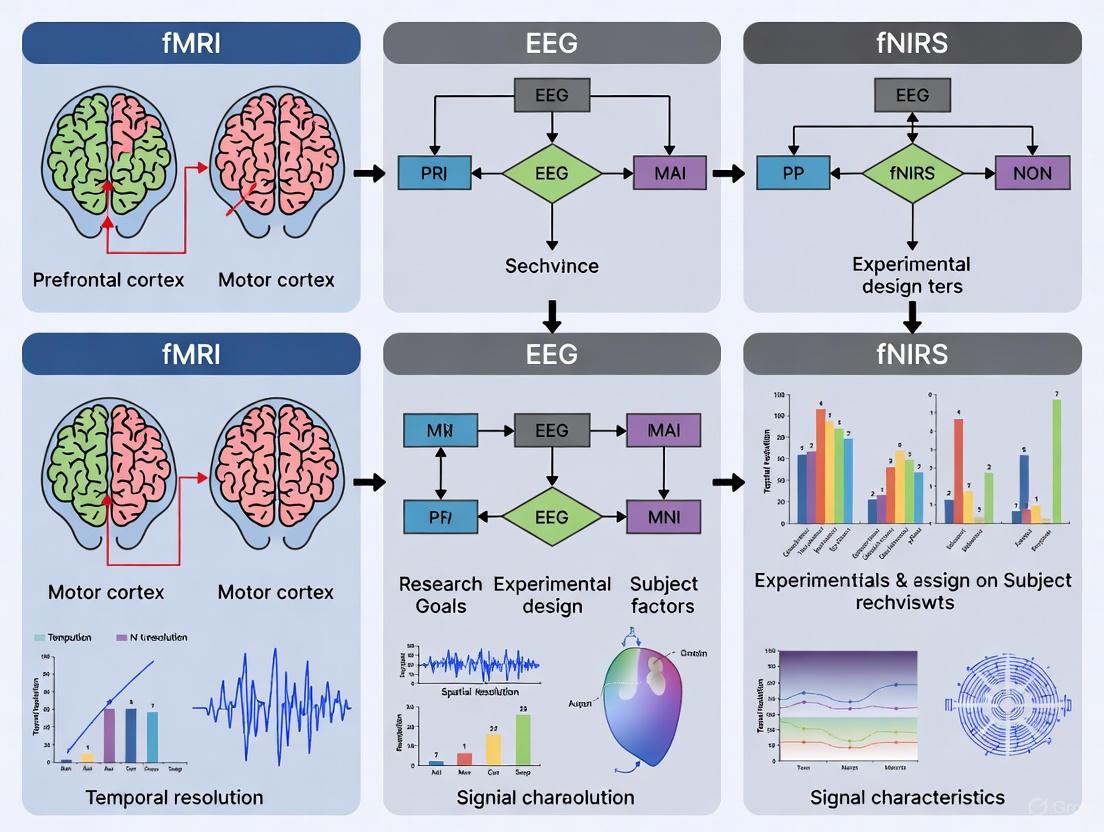
Selecting the optimal neuroimaging modality is a critical decision that directly impacts the success and validity of neuroscience and clinical research.
fMRI vs. EEG vs. fNIRS: A Neuroscientist's Guide to Choosing the Right Brain Imaging Tool
Abstract
Selecting the optimal neuroimaging modality is a critical decision that directly impacts the success and validity of neuroscience and clinical research. This guide provides a comprehensive framework for researchers and drug development professionals to navigate the choice between functional Magnetic Resonance Imaging (fMRI), Electroencephalography (EEG), and functional Near-Infrared Spectroscopy (fNIRS). We break down the core principles, spatial and temporal resolution, cost, and practical applications of each technique. The article further explores advanced methodological integrations, such as multimodal setups (e.g., EEG-fNIRS, fMRI-fNIRS), to overcome the limitations of single-modality approaches. Finally, we address common troubleshooting challenges, validation strategies, and future-looking perspectives to empower informed, hypothesis-driven experimental design.
Understanding the Neuroimaging Trinity: Core Principles of fMRI, EEG, and fNIRS
What Are You Actually Measuring? Electrical Activity (EEG) vs. Hemodynamics (fMRI/fNIRS)
Understanding the brain requires tools that can capture its dynamic activity, which manifests through two primary, interconnected physiological processes: electrical and hemodynamic. Electroencephalography (EEG) measures the brain's immediate electrical activity, providing a direct window into neural communication with millisecond precision. In contrast, functional Magnetic Resonance Imaging (fMRI) and functional Near-Infrared Spectroscopy (fNIRS) measure the slower hemodynamic response—the changes in blood flow and oxygenation that support neural activity. This fundamental difference in what is being measured dictates the applications, strengths, and limitations of each technology. Choosing the right tool is not merely a technical decision but a conceptual one that shapes the research questions we can ask and the answers we can find. This guide provides a detailed comparison of these core neuroimaging modalities, equipping researchers and drug development professionals with the knowledge to select the optimal method for their specific study.
Fundamental Measurement Principles
EEG: Capturing Electrical Potentials
EEG records the brain's electrical activity directly from the scalp. The signals originate primarily from the summed postsynaptic potentials of large, synchronously firing groups of cortical pyramidal neurons. When these neurons are activated, ionic currents flow during synaptic excitation or inhibition. Because pyramidal cells are oriented perpendicularly to the cortical surface, their coordinated postsynaptic potentials generate electrical dipoles that are strong enough to be detected at the scalp [1]. The key principle is differential amplification, where the voltage difference between an active electrode and a reference electrode is recorded. When the active electrode is more negative than the reference, the resulting waveform deflects upward, forming the characteristic "brain waves" of an EEG recording. It is crucial to note that the electrical signals must pass through several biological layers—including the cerebrospinal fluid, meninges, and skull—which act as resistors and spatial filters, attenuating the signal and spreading it out [1]. This fundamental physical process is why EEG offers exquisite temporal but limited spatial resolution.
fMRI: Mapping Blood Oxygenation
fMRI does not measure neural activity directly but rather infers it through the Blood-Oxygen-Level-Dependent (BOLD) signal, an indirect metabolic correlate. The physical principle is based on nuclear magnetic resonance, where hydrogen protons in a strong magnetic field align and precess. When exposed to radiofrequency pulses, these protons are displaced, and as they return to equilibrium, they emit a detectable electromagnetic signal [2]. The BOLD contrast arises from the different magnetic properties of oxygenated hemoglobin (HbO) and deoxygenated hemoglobin (HbR). HbO is diamagnetic and has little interaction with the magnetic field, whereas HbR is paramagnetic and distorts the local magnetic field, leading to a reduction in the MR signal [3] [2]. During neural activation, a localized increase in cerebral blood flow delivers an oversupply of oxygenated blood. This leads to a decrease in the concentration of paramagnetic HbR, which in turn increases the MR signal in that area. Thus, the BOLD signal is a complex proxy reflecting changes in blood flow, blood volume, and oxygen metabolism [2].
fNIRS: Tracking Hemoglobin with Light
Like fMRI, fNIRS is an indirect hemodynamic measure. It utilizes the differential light absorption properties of biological tissues in the near-infrared spectrum (650-950 nm). Within this "optical window," light can penetrate biological tissues relatively well, and the primary chromophores (light-absorbing molecules) are oxygenated and deoxygenated hemoglobin [4] [3]. fNIRS systems project near-infrared light of specific wavelengths through the scalp and skull into the brain cortex. The amount of light that is diffusely refracted back to the surface is detected. During brain activation, neurovascular coupling triggers a localized increase in blood flow, altering the concentrations of HbO and HbR. These changes modify the tissue's light absorption characteristics. By measuring the intensity of attenuated light reaching the detectors at multiple wavelengths, fNIRS can calculate relative concentration changes in HbO and HbR, providing a hemodynamic correlate of neural activity [4]. Typically, activation is associated with an increase in HbO and a decrease in HbR [4].
Figure 1: Core Signaling Pathways of EEG, fMRI, and fNIRS. EEG provides a direct electrical measurement, while fMRI and fNIRS measure the slower, indirect hemodynamic response via different physical principles.
Technical Specifications & Quantitative Comparison
The fundamental differences in what each technique measures lead to distinct technical performance profiles. The table below provides a quantitative comparison of the core specifications for EEG, fMRI, and fNIRS.
Table 1: Technical Specification Comparison of EEG, fMRI, and fNIRS
| Feature | EEG | fMRI | fNIRS |
|---|---|---|---|
| What It Measures | Electrical potentials from postsynaptic neurons [5] [1] | Blood-Oxygen-Level-Dependent (BOLD) signal [3] [2] | Concentration changes in HbO and HbR [4] [5] |
| Temporal Resolution | High (milliseconds) [5] | Low (seconds) [6] [7] | Moderate (seconds) [5] |
| Spatial Resolution | Low (centimeter-level) [5] | High (millimeter-level) [6] [7] | Moderate (1-3 cm) [6] [7] |
| Depth Penetration | Cortical surface [5] | Whole brain (cortical & subcortical) [6] [7] | Superficial cortex (1-2.5 cm) [5] [3] |
| Portability | High (wearable systems available) [5] | None (fixed scanner) [3] | High (portable/wearable) [6] [3] |
| Tolerance to Motion | Low (highly susceptible to artifacts) [5] | Very Low (requires complete stillness) [3] | Moderate to High [5] [3] |
| Best Use Cases | Seizure detection, ERP studies, sleep research, rapid cognitive processes [8] [5] [1] | Precise spatial localization, deep brain structures, network connectivity [6] [7] | Naturalistic settings, child development, rehabilitation, bedside monitoring [4] [6] [3] |
Experimental Protocols & Methodologies
A Representative EEG Experiment: Event-Related Potentials (ERPs)
Objective: To investigate the neural correlates of a specific cognitive event (e.g., visual recognition) with high temporal precision.
The Scientist's Toolkit: Key Research Reagents & Materials
- EEG System: Includes an amplifier and a cap with electrodes (e.g., Ag/AgCl). It measures microvolt-level voltage fluctuations [8] [1].
- Electrode Gel: A conductive gel or paste is used to reduce impedance between the scalp and electrodes, ensuring a high-quality signal [8] [5].
- Visual Stimulus Presentation Software: Software (e.g., E-Prime, PsychoPy) to present visual stimuli with precise timing, crucial for aligning brain data to the event [1].
- Data Processing Software: Specialized software (e.g., EEGLAB, BrainVision Analyzer) for filtering, segmenting, and averaging the EEG signal to extract ERPs [1].
Protocol Overview:
- Preparation: The participant's scalp is cleaned, and an electrode cap is positioned according to the international 10-20 system. Electrode gel is applied to achieve impedance typically below 5 kΩ [8].
- Task: Participants perform a computerized task where they view a series of images or symbols. They are instructed to press a button upon seeing a specific "target" stimulus randomly interspersed with "non-target" stimuli. Each stimulus presentation is a "trial."
- Data Acquisition: Continuous EEG is recorded throughout the task. The exact onset time of each stimulus is marked in the EEG data stream via a trigger signal from the stimulus computer.
- Data Processing:
- Filtering: Raw data is band-pass filtered (e.g., 0.1-30 Hz) to remove slow drifts and high-frequency noise.
- Segmentation: The continuous data is segmented into epochs (e.g., -200 ms to +800 ms) time-locked to each stimulus onset.
- Artifact Rejection: Epochs contaminated by large eye blinks or muscle movements are manually or automatically removed.
- Averaging: All epochs for each condition (e.g., target vs. non-target) are averaged together. This averaging process cancels out random background brain activity and amplifies the consistent voltage response to the stimulus, revealing the ERP components (e.g., P300, a positive deflection around 300 ms post-target) [1].
A Representative fMRI/fNIRS Experiment: Block Design Motor Task
Objective: To localize brain activation in the motor cortex during a hand movement task. The following protocol is adapted from a multimodal study that compared fNIRS and fMRI [9].
The Scientist's Toolkit: Key Research Reagents & Materials
- fMRI Scanner: A high-field (e.g., 3 Tesla) scanner with a head coil to generate BOLD contrast images [9] [2].
- fNIRS System: A continuous-wave system with light sources (e.g., LEDs at 760 nm and 850 nm) and detectors placed over the motor cortex [9].
- Response Equipment: An fMRI-compatible button box or fNIRS-compatible finger-tapping sensor to record task performance [9].
- Data Analysis Suite: Software for processing hemodynamic data (e.g., SPM, FSL for fMRI; Homer3, NIRS-SPM for fNIRS) [9].
Protocol Overview:
- Setup:
- fMRI: The participant is positioned in the MRI scanner. Head motion is minimized using foam padding.
- fNIRS: A cap or headband holding fNIRS optodes is positioned over the primary motor cortex, based on the 10-20 system (e.g., C3/C4 locations). The source-detector distance is typically set to 3 cm to ensure cortical sensitivity [9].
- Task: A block design paradigm is used, consisting of alternating periods:
- Active Block (30 sec): The participant performs a bilateral finger-tapping sequence at a specified frequency [9].
- Baseline/Rest Block (30 sec): The participant remains still and does not perform the movement.
- This cycle is repeated multiple times (e.g., 4-5 active blocks).
- Data Acquisition:
- Data Processing:
- fMRI Preprocessing: Includes slice-timing correction, motion realignment, spatial normalization to a standard brain, and spatial smoothing [9].
- fNIRS Preprocessing: Involves converting raw light intensity to optical density, then to concentration changes of HbO and HbR using the modified Beer-Lambert law. Motion artifact correction is often applied [9].
- Statistical Analysis: A General Linear Model (GLM) is used for both modalities. The model includes a predictor convolved with a hemodynamic response function that represents the timing of the active blocks. The GLM identifies voxels (fMRI) or channels (fNIRS) where the signal is significantly correlated with the task paradigm [9].
Figure 2: fMRI/fNIRS Experimental Workflow. The protocol involves a block design to evoke a robust hemodynamic response, followed by standardized processing and statistical analysis.
The Strategic Choice: Selecting the Right Tool for Your Research
The decision to use EEG, fMRI, or fNIRS should be driven by the specific aims of the study, prioritizing the physiological process of interest and the required resolution.
Table 2: Decision Framework for Selecting a Neuroimaging Modality
| Research Consideration | Recommended Modality | Rationale |
|---|---|---|
| Requires millisecond timing (e.g., sensory processing, seizure dynamics, ERP components) | EEG [5] | EEG's unparalleled temporal resolution is essential for tracking the rapid sequence of neural events. |
| Requires precise spatial localization (e.g., mapping functional areas, studying subcortical structures) | fMRI [6] [7] | fMRI provides whole-brain coverage with millimeter-level spatial resolution, unmatched by EEG or fNIRS. |
| Studying naturalistic behaviors or mobile subjects (e.g., walking, rehabilitation, classroom learning) | fNIRS [4] [3] | fNIRS is portable and more robust to movement artifacts, enabling brain imaging outside the lab. |
| Working with sensitive populations (e.g., infants, children, clinical patients) | fNIRS or EEG [4] [3] | Both are quieter, less restrictive, and better tolerated than the loud, confined fMRI scanner environment. |
| Budget-constrained or high-volume testing | EEG or fNIRS [3] | These systems have a lower upfront cost and no per-scan fees, unlike the expensive and resource-intensive fMRI. |
| Seeking a comprehensive view of brain dynamics | Multimodal Integration (EEG+fMRI or EEG+fNIRS) [10] [6] | Combining modalities (e.g., EEG with fNIRS) provides simultaneous high temporal and spatial resolution, offering a more complete picture of brain function. |
EEG, fMRI, and fNIRS are powerful tools that measure fundamentally different aspects of brain activity. EEG provides a direct, high-temporal-resolution measure of the brain's electrical symphony, making it ideal for studying dynamics and networks. fMRI offers an indirect but high-spatial-resolution map of the hemodynamic consequences of neural activity, providing unparalleled anatomical localization. fNIRS strikes a balance with its portability and tolerance for movement, enabling hemodynamic monitoring in real-world contexts. There is no single "best" technology; rather, the optimal choice is dictated by the specific research question, participant population, and experimental environment. By understanding what each technique actually measures, researchers and drug developers can make an informed strategic decision, ensuring their chosen method aligns with their scientific goals and ultimately advances our understanding of the human brain.
Spatial resolution is a fundamental metric in brain imaging, defining the smallest discernible detail within a measured neural activity map. For researchers and drug development professionals, the choice between functional Magnetic Resonance Imaging (fMRI), Electroencephalography (EEG), and functional Near-Infrared Spectroscopy (fNIRS) hinges on understanding the inherent trade-offs between spatial resolution, temporal resolution, cost, and portability. Each modality captures distinct physiological phenomena—hemodynamic, metabolic, and electrical—at vastly different spatial scales, from the sub-millimeter precision of ultra-high-field fMRI to the centimeter-scale estimations of EEG. This technical guide provides a quantitative deep dive into the spatial resolution characteristics of these predominant neuroimaging technologies, equipping scientists with the evidence needed to align methodological selection with specific research objectives, whether for mapping precise neural circuits in drug efficacy studies or monitoring broader brain states in clinical trials.
Table 1: Fundamental Characteristics of Major Neuroimaging Modalities
| Modality | Primary Signal Source | Typical Spatial Resolution | Temporal Resolution | Key Strength | Key Limitation |
|---|---|---|---|---|---|
| fMRI | Hemodynamic (BOLD response) | Sub-millimeter to 3 mm [11] [12] | ~1-3 seconds [13] | High spatial specificity & whole-brain coverage [12] | Low temporal resolution; expensive; non-portable |
| EEG | Neuronal electrical potentials | ~1-2 centimeters (7 mm mean error shown) [14] | Milliseconds (<1 ms) [15] [16] | Direct neural electrical measurement; excellent temporal resolution [16] | Skull acts as a spatial low-pass filter; poor spatial localization [15] |
| fNIRS | Hemodynamic (HbO/HbR changes) | Millimeter-scale (superficial cortex) [15] [13] | ~1-10 seconds [13] [16] | Good surface resolution; portable; motion-tolerant [13] [16] | Limited to cortical surface; depth sensitivity ~1-2.5 cm [16] |
Quantitative Spatial Resolution Breakdown
fMRI: The Sub-Millimeter Benchmark
Functional MRI achieves its high spatial resolution through magnetic field strength and sophisticated encoding gradients. At standard 3T field strength, "high resolution" is defined as 1-2 mm isotropic voxels (1-8 mm³ volume), while "ultra-high resolution" at 7T and above can reach sub-millimeter levels, enabling laminar and columnar studies [11]. This resolution allows fMRI to detail processing in small subcortical auditory regions and has the potential to localize the primary auditory cortex in individual hemispheres [12]. The spatial specificity is tightly linked to the blood-oxygen-level-dependent (BOLD) signal, which originates from the venous vasculature. Advancements in ultra-high-field (UHF) fMRI, particularly at 7T, provide gains in signal-to-noise ratio (SNR) and contrast-to-noise ratio (CNR) that are directly leveraged for higher spatial resolution imaging [11]. Head gradient inserts can further reduce readout times, minimizing image distortion and signal drop-out, which are particularly beneficial at high fields [11].
EEG: Overcoming the Blurring Skull
EEG measures electrical potentials generated by synchronized neuronal activity, primarily from pyramidal cells in the cerebral cortex. Its spatial resolution is fundamentally limited not by the electrode density alone, but by the skull and scalp, which act as a spatial low-pass filter, smearing and attenuating the electrical signals originating from the brain [15] [16]. This results in a spatial resolution on the order of centimeters, with a typical point spread of several centimeters, making it difficult to distinguish spatially close neuronal sources [15]. However, through high-density electrode arrays (128-channel or more) and advanced source imaging algorithms that solve the EEG inverse problem, the spatial resolution can be substantially improved. One study that localized retinotopic organization in the primary visual cortex (V1) found a mean location error of 7 mm between EEG source imaging and fMRI, demonstrating that EEG can discriminate cortical activation changes corresponding to less than 3° of visual field change [14].
fNIRS: The Millimeter-Scale Surface Probe
fNIRS measures hemodynamic responses similar to fMRI but uses near-infrared light, confining its measurements to the brain's superficial cortex. When used for source reconstruction in Diffuse Optical Tomography (DOT) mode, fNIRS can achieve millimeter-scale spatial resolution [15]. A 2024 study directly comparing whole-head fNIRS with fMRI during motor and visual tasks found a promising spatial correspondence, with fNIRS overlapping up to 68% of the fMRI activation at the group level and 47.25% within individual subjects [17]. The resolution is constrained by optode density and source-detector separation; high-density setups with overlapping measurement volumes can achieve higher resolution than regular-density systems (typical source-detector distance of ~3 cm) [15]. The spatial precision is sufficient to target specific regions of interest in the outer cortex but is depth-limited to about 1-2.5 cm, making it insensitive to subcortical or deep cortical structures [16].
Figure 1: The fundamental trade-off between spatial and temporal resolution in non-invasive neuroimaging modalities. EEG leads in temporal resolution but lags in spatial precision, while the inverse is true for fMRI.
Experimental Protocols for Validating Spatial Resolution
Protocol 1: EEG-fMRI Retinotopic Mapping for Spatial Validation
This protocol validates EEG spatial resolution against the gold-standard retinotopic maps from fMRI [14].
- Objective: To quantify the spatial resolution and localization accuracy of EEG cortical source imaging by tracking moving visual stimuli along the horizontal meridian.
- Stimuli: Circular black-white checkerboards (4.8° diameter) presented at 3°, 6°, and 9° visual angles along the horizontal meridian. A central red cross ensures fixation.
- fMRI Acquisition: Conducted in a 3T or higher scanner. High-resolution T1-weighted anatomical images are acquired first. For fMRI, a block design is used with 20-30 second blocks of stimulus presentation alternating with rest. The resolution is typically 2-3 mm isotropic.
- EEG Acquisition: 128-channel dense array EEG system. Data is sampled at 1000 Hz or higher with appropriate online filtering. Impedances are kept below 10 kΩ.
- Data Analysis:
- fMRI Processing: Standard preprocessing (motion correction, spatial smoothing). General Linear Model (GLM) analysis identifies significant activation foci in V1 for each stimulus position.
- EEG Source Imaging: Preprocessing to remove artifacts. A forward model is constructed using the subject's MRI. The inverse problem is solved (e.g., using L2-minimum norm estimation) at the peak latency of the C1 component (~70-80 ms).
- Outcome Measure: The Euclidean distance between the center of mass of the fMRI activation in V1 and the peak of the EEG source estimate for each stimulus location. A study using this protocol reported a mean location error of 7 mm for EEG [14].
This protocol demonstrates enhanced resolution by combining EEG and fNIRS/DOT [15].
- Objective: To reconstruct the activity of two neuronal sources that are both spatially and temporally close, a scenario where single-modal methods fail.
- Setup:
- EEG: 32- or 64-channel system based on the 10-20 placement system.
- DOT: A regular-density optode grid with a source-detector distance of ~3 cm.
- Co-registration: Precise co-registration of EEG electrode and DOT optode locations to the subject's head or a standard atlas (e.g., ICBM152) using digitization.
- Forward Modeling: A tetrahedral head model (e.g., from the ICBM152 atlas) is created with four tissue types (scalp, skull, CSF, brain). The leadfield matrix for EEG and the sensitivity matrix for DOT are computed.
- Experimental Paradigm: Simulated or task-based sequential activation of two cortical patches (e.g., representing different fingers in the somatosensory cortex). The patches are separated by 2.3-3.3 cm and activated with a temporal separation of 50 ms.
- Inverse Problem & Joint Reconstruction:
- DOT Reconstruction: The hemodynamic inverse problem is solved first to localize active regions.
- EEG Reconstruction with DOT Prior: The high-temporal-resolution EEG inverse problem is solved, but is spatially constrained using the DOT reconstruction as a prior. This can be implemented using a Restricted Maximum Likelihood (ReML) framework [15].
- Outcome Measure: Successful separation and accurate reconstruction of the magnitude and timing of the two sources, which is not achievable using either EEG or DOT alone [15].
Figure 2: Workflow for joint EEG-fNIRS (DOT) reconstruction. This multimodal approach leverages the spatial prior from DOT to significantly improve the spatial accuracy of the high-temporal-resolution EEG signal [15].
The Scientist's Toolkit: Essential Research Reagents & Materials
Table 2: Essential Materials and Analytical Tools for High-Resolution Neuroimaging
| Category | Item | Specific Function & Importance |
|---|---|---|
| Hardware & Acquisition | High-Density EEG System (128+ channels) | Increases spatial sampling density, which is crucial for improving the accuracy of source localization algorithms [14]. |
| High-Density fNIRS/DOT System | Optode arrangements with overlapping source-detector pairs (high-density) enable millimeter-scale spatial resolution, moving beyond simple functional monitoring [15]. | |
| Ultra-High-Field MRI Scanner (7T+) | Provides the high signal-to-noise ratio (SNR) and contrast-to-noise ratio (CNR) required for sub-millimeter and laminar fMRI [11] [12]. | |
| Integrated EEG-fNIRS Caps/Helmets | Allows for simultaneous, co-registered data acquisition. Custom 3D-printed or thermoplastic helmets ensure consistent and stable probe placement across sessions [10]. | |
| Software & Analysis | Anatomical Registration & Segmentation Tools (e.g., FSL, FreeSurfer) | Coregisters functional data with anatomical scans, enabling accurate construction of individual head models for source analysis and activation mapping. |
| Forward Modeling Software (e.g., Fieldtrip with SimBio, NIRS toolboxes) | Calculates the leadfield (EEG) and sensitivity (fNIRS) matrices, which define how sources in the brain manifest as signals at the sensors [15]. | |
| Inverse Problem Solvers | Algorithms (e.g., L2-minimum norm, Bayesian frameworks, ReML) that estimate the underlying brain activity from the measured sensor data [15] [14]. | |
| Multimodal Data Fusion Algorithms (e.g., ssmCCA, jICA) | Statistically fuse EEG and fNIRS data to identify brain regions consistently active in both electrical and hemodynamic domains, validating findings [18]. |
The choice of neuroimaging modality is a strategic decision dictated by the spatial resolution requirements of the research question. For drug development professionals, this choice has direct implications on trial design, outcome measurement, and data interpretation. fMRI is the undisputed choice when the objective is to map drug effects on precise, localized brain circuits with high spatial specificity, particularly for subcortical targets. EEG is optimal for assessing the rapid temporal dynamics of neural effects, such as changes in seizure activity or event-related potentials, where millisecond timing is more critical than exact localization. fNIRS presents a powerful alternative for longitudinal or ecologically valid studies where portability and tolerance to movement are paramount, and the target is superficial cortical regions like the prefrontal cortex.
The emerging paradigm of multimodal integration, such as joint EEG-fNIRS, effectively breaks the inherent trade-offs of single-modal approaches. By leveraging the spatial prior of fNIRS to constrain the temporal resolution of EEG, researchers can achieve spatiotemporal resolution that is impossible with either modality alone [15]. This synergistic approach is particularly promising for clinical applications and therapeutic monitoring, offering a more complete picture of brain function for researchers and drug developers aiming to bridge the gap between neural mechanisms and therapeutic outcomes.
Temporal resolution refers to the precision with which a neuroimaging technique can measure the timing of neural events. It determines how accurately researchers can track the rapidly changing patterns of brain activity that underlie perception, cognition, and behavior. In the human brain, neural communication occurs at the millisecond timescale, creating a significant challenge for imaging technologies that attempt to capture these fleeting events. Understanding temporal resolution is crucial for selecting the appropriate tool for specific research questions, particularly when studying dynamic processes such as language, decision-making, or epileptic activity.
The various neuroimaging modalities available to researchers occupy different positions on the temporal resolution spectrum. Electroencephalography (EEG) directly measures the electrical activity of neurons with millisecond precision, making it ideal for tracking the rapid sequence of brain events [19] [20]. In contrast, functional magnetic resonance imaging (fMRI) and functional near-infrared spectroscopy (fNIRS) measure the slower hemodynamic response—changes in blood flow and oxygenation that follow neural activity—which unfolds over seconds [21] [6]. This fundamental difference in what each technique measures creates a trade-off between temporal and spatial resolution that researchers must navigate when designing studies.
This guide provides an in-depth examination of temporal resolution across three primary neuroimaging modalities: EEG, fMRI, and fNIRS. By understanding the technical basis, capabilities, and limitations of each technique, researchers can make informed decisions about the most appropriate methodology for their specific research needs in cognitive neuroscience and drug development.
Quantitative Comparison of Neuroimaging Techniques
Table 1: Technical Specifications of Major Neuroimaging Modalities
| Technique | Temporal Resolution | Spatial Resolution | Depth Penetration | Primary Signal Source | Key Temporal Limitations |
|---|---|---|---|---|---|
| EEG | <1 millisecond [22] | 10 mm [22] | Cortical surface, limited to superficial layers [20] | Post-synaptic potentials of pyramidal neurons [20] | Limited to cortical sources; poor spatial localization |
| fNIRS | ~100 milliseconds [23] | 1-3 cm [21] [6] | 2-3 cm (cortical surface only) [21] [24] | Hemodynamic response (HbO/HbR concentration changes) [21] | Hemodynamic lag (4-6 seconds); limited to cortical regions |
| fMRI | 1-4 seconds (standard); <1 second (advanced sequences) [6] [25] | 1-3 mm [22] | Whole brain (cortical and subcortical) [6] | Hemodynamic response (BOLD signal) [21] [6] | Hemodynamic lag (4-6 seconds); sensitive to motion; scanner environment |
Table 2: Practical Considerations for Technique Selection
| Factor | EEG | fNIRS | fMRI |
|---|---|---|---|
| Equipment Cost | ~$100,000 [22] | Relatively affordable [3] | ~$2,000,000+ [22] |
| Operating Cost | ~$150 [22] | Low ongoing costs [3] | ~$800 [22] |
| Tolerance to Motion | Moderate (sensitive to muscle artifacts) | High [23] [24] | Low (requires complete stillness) [6] |
| Subject Population | All ages and populations [20] | Ideal for infants, children, patients [23] [3] | Limited for claustrophobic, pediatric, implanted devices [21] |
| Naturalistic Settings | Good (portable systems available) | Excellent (wearable, wireless) [23] | Poor (confined scanner environment) [23] |
Fundamental Principles and Physiological Basis
Neurovascular Coupling and the Hemodynamic Response
The temporal limitations of fMRI and fNIRS originate in the physiological process of neurovascular coupling—the relationship between neural activity and subsequent changes in cerebral blood flow. When neurons become active, they trigger a complex cascade of metabolic and vascular events. This begins with increased oxygen extraction from local capillaries, which initially increases deoxyhemoglobin concentration (the "initial dip") [21]. Within 1-2 seconds, the brain responds by increasing cerebral blood flow to the active region, delivering oxygenated blood that typically overshoots metabolic demands [21].
This entire hemodynamic response unfolds over 4-6 seconds, peaking after neural activity has already subsided [6] [25]. This fundamental physiological lag creates an inherent temporal limitation for any technique measuring blood flow changes rather than direct neural activity. The hemodynamic response function (HRF) effectively acts as a low-pass filter on neural events, smoothing out rapid neural dynamics that occur within hundreds of milliseconds [21].
Direct Neural Recording Principles
EEG operates on fundamentally different principles than hemodynamic-based methods. It directly measures the postsynaptic potentials of synchronized pyramidal neurons in the cerebral cortex [20]. When large populations of similarly oriented neurons fire simultaneously, they generate electrical fields strong enough to be detected through the skull and scalp. These electrical potentials occur virtually instantaneously with neural activity, allowing EEG to capture neural events with millisecond precision [19] [20].
However, this exceptional temporal resolution comes at the cost of spatial precision. The electrical signals are distorted by intermediary tissues (scalp, skull, meninges) which act as resistors and capacitors, blurring the spatial origin of signals [20]. Furthermore, EEG is predominantly sensitive to superficial cortical sources with specific geometrical orientation, and cannot detect activity from deep brain structures such as the hippocampus or thalamus [20].
Figure 1: Temporal Sequence of Neural and Hemodynamic Events. This diagram illustrates the cascade from initial neural firing to the measurable hemodynamic response, showing which techniques capture each stage. EEG detects the initial neural activity, while fMRI and fNIRS measure the slower hemodynamic response that follows after several seconds.
Technical Deep Dive: Methodologies and Experimental Protocols
Electroencephalography (EEG) Methodologies
Experimental Protocol for Evoked Response Studies:
- Electrode Placement: Apply 64-256 electrodes according to the International 10-20 system or high-density variants [19]. Use conductive gel to ensure impedance below 5 kΩ for optimal signal quality.
- Reference Scheme: Select appropriate reference (linked mastoids, average reference, or reference-free transformation) based on research question.
- Task Design: Implement event-related paradigms with precise stimulus timing. Randomize trial types and include adequate inter-trial intervals (1-3 seconds) to avoid overlapping responses.
- Data Acquisition: Sample at 500-1000 Hz or higher to capture high-frequency components. Apply online filters (typically 0.1-100 Hz bandpass) to remove drift and line noise.
- Artifact Handling: Monitor for eye blinks, muscle activity, and electrode artifacts. Implement rejection protocols or correction algorithms like independent components analysis.
EEG's millisecond temporal resolution enables the study of event-related potentials (ERPs)—stereotyped neural responses time-locked to specific sensory, cognitive, or motor events [20]. By averaging multiple trials, researchers can extract these small signals from background brain activity. Components such as the P300 (occurring ~300 ms after a salient stimulus) provide windows into cognitive processes like attention and decision-making [20].
Functional MRI (fMRI) Methodologies
Experimental Protocol for BOLD Imaging:
- Sequence Selection: Employ echo-planar imaging (EPI) for rapid whole-brain acquisition. Standard TR (repetition time): 2-3 seconds; advanced sequences: TR <1 second [25].
- Head Stabilization: Use padding and bite bars to minimize head movement, which causes significant artifacts in fMRI data.
- Task Design: Implement block designs (alternating between task and rest conditions) for robust signal detection, or event-related designs for analyzing individual trial responses.
- Physiological Monitoring: Record cardiac and respiratory cycles for noise correction in post-processing.
- Data Acquisition: Acquire whole-brain volumes every 1-2 seconds (conventional) or 300-800 ms (fast fMRI) [25].
Recent advances in fast fMRI sequences have pushed temporal resolution below 1 second, enabling the detection of previously unobserved neuro-temporal dynamics [25]. These rapid sampling rates (TR <1 s) can capture finer temporal features of the hemodynamic response and improve statistical power through increased degrees of freedom. However, these gains come with trade-offs in spatial coverage or signal-to-noise ratio, requiring careful experimental consideration [25].
Functional NIRS (fNIRS) Methodologies
Experimental Protocol for Cortical Activation Studies:
- Optode Placement: Position sources and detectors 2.5-3.5 cm apart for adults (1.5-3 cm for children) to achieve optimal cortical penetration [21]. Use digitization methods to co-register with individual anatomy.
- Wavelength Selection: Employ multiple wavelengths (typically 690-830 nm range) to distinguish oxyhemoglobin (HbO) and deoxyhemoglobin (HbR) absorption profiles [21].
- Task Design: Utilize block designs (30-second epochs) or event-related designs similar to fMRI paradigms.
- Data Acquisition: Sample at 10-100 Hz to oversample the hemodynamic response, then filter and down-sample during processing.
- Signal Processing: Apply short-distance channels (<1 cm separation) to estimate and remove superficial scalp hemodynamics [21].
fNIRS occupies a unique middle ground with better temporal resolution than fMRI (approximately 100 ms) and better spatial resolution than EEG [23]. Its relative tolerance to motion artifacts makes it particularly suitable for studying naturalistic behaviors and special populations including infants, children, and patients with movement disorders [23] [3]. The technology's portability enables studies of social interaction through hyperscanning—simultaneously recording brain activity from multiple individuals during real-time interaction [23].
The Scientist's Toolkit: Essential Research Reagents and Materials
Table 3: Key Research Reagents and Materials for Neuroimaging Studies
| Item | Function/Purpose | Application Notes |
|---|---|---|
| EEG Electrode Caps | Standardized electrode placement according to 10-20 system | Available in various sizes; material (fabric, neoprene) affects comfort and durability |
| Conductive Electrode Gel | Reduces impedance between scalp and electrodes | High-chloride formulations prevent electrode polarization; viscosity affects application ease |
| fNIRS Optodes | Light sources and detectors for transmitting/detecting NIR light through tissue | LED vs. laser sources offer different power/coherence trade-offs; detector sensitivity critical for depth penetration |
| MRI-Compatible Stimulus Presentation System | Presents visual/auditory stimuli in scanner environment | Must be non-magnetic; includes projectors, screens, response devices; fiber optic data transmission preferred |
| Electrodermal Activity (EDA) Sensors | Measures sympathetic arousal through skin conductance | Often combined with fNIRS/EEG for multimodal assessment of cognitive state |
| 3D Digitization Systems | Records precise optode/electrode locations relative to head landmarks | Enables co-registration with anatomical MRI; improves spatial accuracy for source localization |
| Short-Distance Separator Channels | Estimates and removes superficial scalp hemodynamics | Critical for fNIRS signal quality; typically <1 cm source-detector separation [21] |
Selection Framework: Choosing the Right Technique
Figure 2: Technique Selection Workflow. This decision tree guides researchers in selecting the most appropriate neuroimaging modality based on their specific research requirements, considering temporal needs, experimental setting, and biological targets.
Application-Specific Recommendations
For studies requiring millisecond timing:
- Epilepsy monitoring and seizure localization: EEG remains the gold standard for detecting interictal epileptiform discharges and capturing seizure dynamics [20]. Its millisecond resolution is essential for identifying pathological spike-and-wave complexes and localizing epileptic foci.
- Cognitive component isolation: EEG is ideal for disentangling rapid successive stages of information processing using ERP components such as N170 (face processing), N400 (semantic violation), and P300 (attention/context updating) [20].
- Brain-computer interfaces: EEG's real-time capabilities enable direct neural control of external devices, with temporal precision critical for decoding intended actions.
For naturalistic and clinical applications:
- Infant and child development studies: fNIRS is particularly valuable for studying language acquisition and cognitive development in pediatric populations [23]. Its tolerance to movement and non-invasive nature make it suitable for testing awake, behaving infants.
- Rehabilitation monitoring: fNIRS enables brain activity assessment during physical therapy and motor retraining in stroke patients, where movement is essential but fMRI would be impossible [23] [6].
- Social interaction research: fNIRS hyperscanning during real-time social exchanges can reveal neural synchrony between interacting individuals [23].
For precise spatial localization:
- Deep brain structures investigation: fMRI remains unmatched for studying subcortical regions (hippocampus, amygdala, thalamus) in learning, memory, and emotion [6].
- Clinical preoperative mapping: fMRI provides detailed localization of eloquent cortex (motor, language) prior to neurosurgical procedures.
- Network connectivity analysis: fMRI's whole-brain coverage enables comprehensive mapping of distributed functional networks.
Multimodal Integration Strategies
Increasingly, researchers are combining multiple neuroimaging techniques to leverage their complementary strengths:
EEG-fMRI simultaneous recording: This approach combines EEG's millisecond temporal resolution with fMRI's millimeter spatial precision [6]. Technical challenges include removing MRI gradient artifacts from EEG data and dealing with limited EEG channel counts in the scanner environment.
fNIRS-EEG co-registration: This portable combination allows for studying brain dynamics in naturalistic settings while capturing both electrophysiological and hemodynamic aspects of neural activity [23]. The techniques have minimal interference, making integration relatively straightforward.
fMRI-fNIRS validation studies: fNIRS signals are often validated against the fMRI BOLD response, as both measure hemodynamic activity [6] [3]. Simultaneous recording allows researchers to capitalize on fMRI's spatial precision while benefiting from fNIRS's practical advantages for longitudinal or ecological monitoring.
Temporal resolution represents a fundamental consideration in neuroimaging technique selection, with direct implications for research questions ranging from basic cognitive processes to clinical applications. EEG remains unparalleled for capturing neural dynamics at their natural millisecond timescale, while fMRI and fNIRS provide complementary information about the hemodynamic consequences of neural activity with better spatial precision. The emerging trend toward multimodal integration and technological advances in rapid sampling continues to push the boundaries of what we can observe in the working human brain. By carefully matching technique capabilities to research objectives, scientists can optimize their experimental approaches to unravel the complex temporal dynamics of human brain function.
For researchers and drug development professionals, selecting an appropriate neuroimaging modality is a critical decision that directly impacts study design, operational costs, and ecological validity. Functional magnetic resonance imaging (fMRI), electroencephalography (EEG), and functional near-infrared spectroscopy (fNIRS) each present distinct practical profiles across the key dimensions of cost, portability, and ease of use. While fMRI remains the gold standard for spatial resolution and whole-brain coverage, its high cost and immobility contrast sharply with the growing accessibility of portable EEG and fNIRS systems. This technical guide provides a detailed comparison of these modalities, empowering scientists to make evidence-based selections aligned with their research objectives, participant populations, and operational constraints.
Quantitative Comparison of Modality Specifications
The choice between neuroimaging technologies requires balancing their inherent technical capabilities against practical implementation constraints. The table below summarizes the core characteristics of fMRI, EEG, and fNIRS across these dimensions.
Table 1: Technical and Practical Specifications Comparison of fMRI, EEG, and fNIRS
| Specification | fMRI | EEG | fNIRS |
|---|---|---|---|
| Spatial Resolution | High (millimeter-level) [7] | Low (~2 cm) [26] | Medium (1-3 cm) [7] |
| Temporal Resolution | Low (0.33-2 Hz, hemodynamic lag) [7] | Very High (millisecond-level) [26] | Medium-High (up to millisecond-level) [7] |
| Tissue Penetration | Full brain (cortical & subcortical) [7] | Cortical surface [26] | Superficial cortical (up to ~2 cm depth) [7] [26] |
| Portability | Non-portable (fixed installation) [7] [27] | Highly portable (wireless systems available) [28] [29] | Highly portable (wearable, wireless systems) [30] [3] |
| Approximate System Cost | Very High ($1M+) [3] | Low ($ thousands - tens of thousands) [31] | Medium ($ tens of thousands) [32] [3] |
| Operational Environment | Controlled laboratory, shielded room [7] | Laboratory, clinic, naturalistic settings [28] [26] | Laboratory, clinic, home, naturalistic settings [30] [3] |
| Participant Motion Tolerance | Very Low (requires complete stillness) [7] | Medium (tolerates some movement) [30] | High (tolerates movement, suitable for naturalistic behaviors) [7] [30] |
| Metallic Implant Compatibility | Low (safety concerns, artifacts) [3] [33] | High (no known restrictions) [3] | High (no known restrictions) [3] |
| Primary Measured Signal | Blood Oxygen Level Dependent (BOLD) [7] [3] | Electrical potentials at scalp surface [26] | Hemodynamic response (HbO, HbR concentration changes) [7] [3] |
Detailed Cost Analysis and Market Context
Beyond initial acquisition costs, researchers must consider the total cost of ownership and operational expenditures associated with each modality.
fMRI represents the most significant financial investment, with high-field systems costing millions of dollars to purchase and install, requiring specialized infrastructure and ongoing maintenance [27] [3]. These systems necessitate dedicated space, magnetic shielding, and cryogenic cooling, contributing to substantial operational overhead. While fMRI provides unparalleled spatial mapping, its cost structure limits accessibility and constrains sample sizes in research studies.
fNIRS occupies a middle ground in the cost spectrum, with market projections estimating the global fNIRS market at $350 million in 2024 and growing to $800 million by 2030 [32]. Portable fNIRS systems offer a compelling value proposition, providing hemodynamic monitoring comparable to fMRI at a fraction of the cost. The development of low-cost, do-it-yourself fNIRS systems has further improved accessibility, opening opportunities for larger sample sizes and longitudinal study designs [31].
EEG systems represent the most accessible option, with portable commercial systems available for thousands of dollars and open-source solutions further reducing barriers to entry [28] [29]. Recent advances have demonstrated that low-cost portable EEG devices can achieve clinical-grade data quality when used with proper protocols, making large-scale studies in diverse populations financially feasible [29].
Portability and Environmental Considerations
The portability and operational flexibility of neuroimaging technologies directly impact their applicability across research contexts.
fMRI is fundamentally non-portable, requiring participants to travel to specialized imaging facilities and remain motionless within the confined scanner environment [7] [27]. This constraint introduces selection biases, limits naturalistic paradigm designs, and excludes populations with mobility issues or difficulty tolerating confined spaces. Recent developments in low-field portable MRI show promise for extremity imaging in non-traditional settings [33], but whole-brain functional imaging remains confined to fixed installations.
fNIRS offers superior portability, with wearable systems enabling brain monitoring in naturalistic environments including homes, schools, and clinical settings [30] [3]. This mobility facilitates studies of brain function during active behaviors, social interactions, and rehabilitation exercises. Modern fNIRS platforms incorporate wireless technology, augmented reality guidance for sensor placement, and cloud-based data management, supporting unsupervised data collection in ecologically valid contexts [30].
EEG systems have achieved remarkable portability, with wireless headsets enabling large-scale data collection in rural and resource-limited settings [28]. Studies have successfully deployed EEG technology through non-specialist field personnel in community settings, demonstrating acceptability and feasibility across diverse populations [28]. This portability supports research in naturalistic contexts while maintaining high temporal resolution for capturing neural dynamics.
Experimental Protocol Implementation
Protocol for Combined fMRI-fNIRS Validation Studies
Multimodal integration approaches leverage the complementary strengths of different neuroimaging modalities.
Table 2: Key Reagents and Equipment for Multimodal Neuroimaging
| Item Name | Function/Application | Specification Notes |
|---|---|---|
| MRI-Compatible fNIRS Probe | Measures hemodynamic response during simultaneous fMRI acquisition | Must use non-magnetic materials (fiber optics, non-ferromagnetic components) to ensure MR compatibility and safety [7] |
| EMI Shielding Materials | Reduces electromagnetic interference in acquired signals | Copper shielding, conductive cloth for wrapping subjects; critical for signal quality in combined setups [7] [33] |
| Synchronization Trigger Box | Temporally aligns data acquisition across different systems | Sends precise timing pulses to synchronize fNIRS and fMRI data streams; essential for correlating signals [7] |
| Anatomical Landmark Digitizer | Coregisters fNIRS sensor positions with anatomical brain images | 3D digitizing pen to record sensor positions relative to cranial landmarks; enables precise mapping to brain anatomy [3] |
| Task Paradigm Presentation System | Prescribes standardized cognitive tasks during imaging | Visual and auditory stimulation software with precise timing; ensures consistent experimental conditions [7] [26] |
Procedure:
- Participant Screening: Exclude individuals with standard MRI contraindications (metallic implants, claustrophobia) [3].
- fNIRS Probe Placement: Position MRI-compatible fNIRS optodes according to the international 10-20 system, targeting cortical regions of interest.
- EMI Shielding Implementation: Apply conductive shielding materials to minimize electromagnetic interference within the MRI environment [33].
- System Synchronization: Connect and test synchronization triggers between fMRI and fNIRS systems.
- Anatomical Co-registration: Record precise fNIRS optode positions using a 3D digitizer for subsequent anatomical mapping.
- Simultaneous Data Acquisition: Conduct prescribed cognitive tasks (motor imagery, working memory tasks) while collecting synchronized fMRI and fNIRS data.
- Data Quality Assessment: Verify signal quality in both modalities before subject discharge.
Protocol for Portable fNIRS in Naturalistic Settings
Advanced fNIRS protocols enable high-quality data collection in real-world environments, supporting precision mental health applications [30].
Procedure:
- Device Preparation: Configure wireless, multichannel fNIRS headband systems and validate battery operation.
- Augmented Reality Guidance: Use tablet-based AR applications to guide participants through proper, reproducible device placement [30].
- Cognitive Task Administration: Implement standardized cognitive assessments (N-back, Flanker, Go/No-go tasks) through tablet interfaces synchronized with fNIRS recording.
- Remote Monitoring: Utilize cloud-based platforms for real-time data quality monitoring and secure data transfer.
- Dense-Sampling Protocol: Conduct repeated measurement sessions (e.g., 10 sessions over 3 weeks) to establish individual-level reliability.
- Signal Processing: Apply motion artifact correction algorithms and hemodynamic response modeling to extract activation patterns.
Neuroimaging Modality Selection Decision Workflow
Selection Framework for Research Applications
Choosing the optimal neuroimaging technology requires systematic consideration of research objectives, participant characteristics, and operational constraints.
Recommended Applications by Modality
fMRI Applications: Ideal for studies requiring precise spatial localization of neural activity, investigation of deep brain structures, and clinical diagnostics where cost and portability are secondary concerns [7] [3]. Recommended for: drug efficacy studies targeting specific brain regions, fundamental neuroscience investigating network connectivity, and preoperative mapping.
fNIRS Applications: Optimal for longitudinal studies, pediatric populations, psychiatric patients, and investigations requiring ecological validity [30] [3]. Recommended for: rehabilitation monitoring, social interaction studies, cognitive assessment in natural environments, and large-scale population studies where fMRI costs are prohibitive.
EEG Applications: Essential for capturing neural dynamics with millisecond precision, monitoring brain states in real-time, and clinical neurophysiology applications [26] [29]. Recommended for: seizure detection, sleep studies, brain-computer interfaces, and attention monitoring in educational or occupational settings.
Emerging Trends and Multimodal Approaches
The convergence of neuroimaging technologies represents a promising frontier for comprehensive brain mapping. Combined fMRI-fNIRS approaches leverage fMRI's spatial precision with fNIRS's temporal resolution and portability [7]. Similarly, simultaneous EEG-fNIRS recordings capture complementary electrical and hemodynamic information, particularly valuable for brain-computer interface development [26]. These multimodal strategies enable cross-validation of findings and more comprehensive characterization of neural processes across spatiotemporal scales.
The practical considerations of cost, portability, and ease of use reveal a nuanced landscape for neuroimaging modality selection. fMRI maintains superiority in spatial resolution and whole-brain coverage but at the expense of accessibility and operational flexibility. fNIRS occupies a strategic middle ground, balancing respectable spatial resolution with significantly improved portability and cost-efficiency. EEG excels in temporal resolution and affordability while supporting increasingly mobile applications. Researchers must align their modality selection with specific study requirements, recognizing that multimodal approaches often provide the most comprehensive solution for complex research questions in neuroscience and drug development.
Selecting the optimal neuroimaging technique is a critical decision that directly impacts the validity, scope, and ecological relevance of neuroscience research. Functional Magnetic Resonance Imaging (fMRI), Electroencephalography (EEG), and functional Near-Infrared Spectroscopy (fNIRS) each provide a unique window into brain function. This guide provides a detailed technical comparison and outlines experimental protocols to inform researchers' selection for both fundamental and clinical studies.
Neuroimaging Modalities at a Glance
The following table summarizes the core technical specifications and methodological considerations for fMRI, EEG, and fNIRS.
| Feature | fMRI | EEG | fNIRS |
|---|---|---|---|
| What It Measures | Blood Oxygen Level Dependent (BOLD) signal [7] [3] | Electrical potentials from synchronized neuronal firing [34] | Concentration changes in oxygenated (HbO) & deoxygenated hemoglobin (HbR) [7] [34] |
| Physiological Basis | Neurovascular coupling (hemodynamic response) [35] [3] | Post-synaptic potentials of cortical neurons (direct neural activity) [34] | Neurovascular coupling (hemodynamic response) [35] [3] |
| Spatial Resolution | High (millimeter-level) [7] | Low (centimeter-level) [34] | Moderate (for cortical areas) [7] [34] |
| Temporal Resolution | Low (seconds) ~0.33-2 Hz [7] | Very High (milliseconds) [34] | Low (seconds) [7] [34] |
| Depth Penetration | Whole brain (cortical & subcortical) [7] | Cortical surface [34] | Superficial cortex (1-2.5 cm) [7] [34] |
| Portability & Environment | Not portable; requires MRI scanner [7] | Highly portable; lab and real-world settings [34] | Portable; suitable for real-world and bedside settings [7] [35] |
| Tolerance to Movement | Low; highly sensitive to motion [7] | Moderate to Low; susceptible to movement artifacts [34] | High; relatively robust to motion [34] |
| Cost | Very High (system and operational costs) [3] | Low to Moderate [34] | Moderate (generally higher than EEG) [34] |
| Best Use Cases | Precise spatial localization of brain activity; deep brain structures [7] | Studying rapid neural dynamics (e.g., ERPs); sleep studies [34] | Naturalistic studies; clinical populations; children; sustained cognitive states [34] [3] |
Experimental Protocols for Multimodal Integration
No single modality can fully capture the brain's complexity. Multimodal integration leverages the strengths of complementary techniques. The following protocols are foundational to contemporary brain research.
Protocol 1: Combined EEG-fNIRS for Motor Imagery and Neurofeedback
This protocol is highly relevant for Brain-Computer Interface (BCI) development and motor rehabilitation, particularly post-stroke [36] [37].
- Objective: To decode motor intention or to enable self-regulation of sensorimotor cortex activity through neurofeedback.
- Experimental Setup:
- Participants: Patients or healthy volunteers perform kinesthetic motor imagery (e.g., imagining hand grasping) without moving.
- Equipment: An integrated cap holding both EEG electrodes and fNIRS optodes. EEG is positioned over sensorimotor cortices (e.g., locations C3, Cz, C4 according to the 10-10 system). fNIRS channels cover the same areas, with sources and detectors placed 2.5-3 cm apart [37].
- Synchronization: A shared trigger signal from the stimulus presentation computer synchronizes the onset of the task with both EEG and fNIRS recordings.
- Procedure:
- Calibration (5-10 min): Participants perform multiple trials of the motor imagery task. Data is used to calibrate participant-specific classification or neurofeedback parameters.
- Task Execution (Blocked or Event-Related): Each trial consists of a rest period (baseline), followed by a cue to perform the motor imagery task.
- Real-Time Feedback: In neurofeedback paradigms, a visual gauge (e.g., a moving ball) provides real-time feedback based on a computed score from EEG (e.g., a decrease in mu-rhythm power, known as Event-Related Desynchronization (ERD)) and/or fNIRS (an increase in HbO in the contralateral motor cortex) [37].
- Data Fusion & Analysis:
- EEG: Time-frequency analysis to extract ERD in the mu (8-12 Hz) and beta (13-30 Hz) bands.
- fNIRS: General Linear Model (GLM) analysis to detect significant HbO increases during task blocks versus rest.
- Multimodal Fusion: Deep learning models can spatiotemporally fuse features, or decision-level fusion (e.g., Dempster-Shafer theory) can combine classification results from each modality to improve overall accuracy of intent decoding [36].
Protocol 2: Combined fMRI-fNIRS for Hemodynamic Response Validation
This protocol is used to validate fNIRS findings against the gold-standard spatial resolution of fMRI and to study the hemodynamic response in detail [7] [38].
- Objective: To spatially correlate fNIRS signals with the fMRI BOLD response and investigate temporal characteristics of neurovascular coupling.
- Experimental Setup:
- Participants: Perform a simple task (e.g., finger tapping, visual stimulation) inside the MRI scanner.
- Equipment: An MRI-compatible fNIRS system with long optical fibers and non-metallic optodes is used to avoid interference with the magnetic field. The fNIRS probe is placed on the scalp over the brain region of interest (e.g., primary motor cortex for finger tapping) [38].
- Synchronization: The fMRI scanner's trigger pulse (TTL) is sent to the fNIRS system to mark the start of each volume acquisition, ensuring precise temporal alignment.
- Procedure:
- Task Design: A block-design paradigm is typically used (e.g., 30s rest, 30s task, repeated).
- Simultaneous Acquisition: Both fMRI and fNIRS data are collected concurrently while the participant performs the task in the scanner.
- Data Fusion & Analysis:
- fMRI Analysis: Standard preprocessing and GLM analysis are performed to generate a statistical activation map (e.g., using SPM or FSL).
- fNIRS Analysis: Data is converted to HbO/HbR concentration changes and analyzed with a GLM using a canonical hemodynamic response function.
- Correlation: The fNIRS channels are co-registered to the participant's anatomical MRI or a standard brain atlas. The time-course of the fNIRS HbO signal from a specific channel is then directly correlated with the BOLD time-course from the underlying voxels. The HbR signal from fNIRS is expected to show a strong negative correlation with the BOLD signal [7] [38].
Signaling Pathways and Experimental Workflows
The following diagram illustrates the core physiological principle shared by fMRI and fNIRS, and the subsequent experimental workflow for a multimodal study.
From Neural Activity to Hemodynamic Response
Multimodal EEG-fNIRS Experimental Workflow
The Scientist's Toolkit: Essential Research Reagents & Materials
Successful execution of neuroimaging experiments, especially multimodal ones, relies on specific hardware, software, and methodological components.
| Item / Solution | Function & Purpose |
|---|---|
| Integrated EEG-fNIRS Cap | A custom cap with pre-defined holders that integrates EEG electrodes and fNIRS optodes, ensuring consistent and compatible placement over brain regions of interest (e.g., sensorimotor cortex) according to the 10-10 system [37]. |
| MRI-Compatible fNIRS System | A specialized fNIRS system with non-magnetic components and long, flexible optical fibers, allowing for safe and concurrent data acquisition inside the MRI scanner bore without signal interference [38]. |
| Synchronization Trigger Box | A hardware device that generates a Transistor-Transistor Logic (TTL) pulse to mark the start of an experimental trial or stimulus. This is sent to all recording devices (EEG, fNIRS, fMRI) to ensure perfect temporal alignment of data streams during offline analysis [34]. |
| General Linear Model (GLM) | A standard statistical software approach (e.g., in SPM, NIRS-KIT) used to model brain activity in fMRI and fNIRS data. It identifies voxels or channels where the signal time-course significantly correlates with the task paradigm, convolved with a canonical hemodynamic response function [39]. |
| Canonical Hemodynamic Response Function (HRF) | A mathematical model that represents the typical delay and shape of the blood flow response (peaking at 4-6 seconds) following a brief neural event. It is used in the GLM to detect task-related activations in fMRI and fNIRS data [7]. |
The choice between fMRI, EEG, and fNIRS is not a matter of which is universally "best," but which is most appropriate for the specific research question, population, and experimental context.
- Choose fMRI when your primary goal is the precise spatial localization of brain activity across the entire brain, including deep structures, and when the experimental constraints (e.g., immobile participants, controlled lab setting) can be met [7] [3].
- Choose EEG when your research hinges on capturing the rapid dynamics of brain activity with millisecond precision, such as studying event-related potentials or the oscillatory nature of brain networks, and when cost and portability are key factors [35] [34].
- Choose fNIRS when you need a balance between spatial resolution and ecological validity, especially for studies involving naturalistic settings, movement, or vulnerable populations (infants, patients) where fMRI is impractical and EEG's spatial limitations are prohibitive [7] [34] [3].
For a comprehensive understanding of complex brain states, a multimodal approach that combines the high temporal resolution of EEG with the superior spatial resolution of fNIRS (or fMRI) is increasingly becoming the gold standard, providing a more holistic view of brain function by capturing both its electrical and vascular facets [7] [36] [37].
Selecting the optimal neuroimaging modality is a critical step in designing effective neuroscience or clinical studies. Functional Magnetic Resonance Imaging (fMRI), Electroencephalography (EEG), and functional Near-Infrared Spectroscopy (fNIRS) each offer a unique window into brain function, with distinct strengths and limitations. This guide provides a detailed comparison of these core techniques, grounded in current research, to help you align your methodological choice with your primary research objectives.
Technical Foundations and Key Differentiators
Each modality captures brain activity through a different physiological principle, which directly dictates its applications.
fMRI measures the Blood-Oxygen-Level-Dependent (BOLD) signal, which relies on the different magnetic properties of oxygenated and deoxygenated hemoglobin. It provides high-resolution spatial maps of brain activity, encompassing both cortical and deep subcortical structures like the hippocampus and amygdala [3] [7].
fNIRS also relies on neurovascular coupling, using near-infrared light to measure changes in oxygenated (HbO) and deoxygenated hemoglobin (HbR) concentrations in the superficial cortex. Its signal is comparable to the fMRI BOLD response but is acquired with more portable and motion-tolerant equipment [3] [4].
EEG takes a direct approach by measuring the brain's electrical activity via electrodes on the scalp. It captures postsynaptic potentials from populations of cortical neurons, providing a direct view of neural dynamics with millisecond precision [40] [10].
The table below provides a quantitative comparison of the three modalities.
| Feature | fMRI | fNIRS | EEG |
|---|---|---|---|
| What It Measures | BOLD signal (hemodynamic response) | HbO & HbR concentration changes (hemodynamic response) | Electrical potentials from neuronal firing |
| Spatial Resolution | High (millimeter-level) [7] | Moderate (1-3 cm), cortical surface only [4] [7] | Low (centimeter-level) [40] [10] |
| Temporal Resolution | Low (0.33-2 Hz, limited by hemodynamics) [7] | Moderate (up to 10 Hz, limited by hemodynamics) [41] | Very High (milliseconds) [40] [10] |
| Portability | No (requires fixed scanner) [3] | Yes (fully portable/wearable systems) [3] [7] | Yes (portable/wireless systems available) [40] |
| Tolerance to Motion | Low (highly sensitive to artifacts) [3] | High (relatively robust to movement) [3] [40] | Moderate (susceptible to motion artifacts) [40] |
| Penetration Depth | Whole brain (cortical & subcortical) [7] | Superficial cortex (1-2.5 cm) [3] [40] | Cortical surface [40] |
| Subject Population | Limited (claustrophobia, metal implants) [3] | Broad (infants, children, patients, implants OK) [3] [4] | Broad (all ages, no metal restrictions) |
| Approximate Cost | Very High [3] | Moderate [3] [4] | Low to Moderate [40] |
Experimental Protocols and Methodologies
Well-designed experimental protocols are fundamental for collecting high-quality, interpretable data. The following examples illustrate methodologies for studying motor and cognitive functions across the three modalities.
Protocol 1: Motor Execution, Observation, and Imagery
This protocol is designed to investigate the Action Observation Network (AON) and is well-suited for multimodal fNIRS-EEG setups due to its tolerance of movement [18].
- Task Design: Participants perform three conditions in a blocked design: Motor Execution (ME), where they physically grasp and move an object; Motor Observation (MO), where they watch an experimenter perform the action; and Motor Imagery (MI), where they mentally rehearse the action without movement.
- Stimuli & Presentation: A live, face-to-face paradigm is used for ecological validity. Auditory cues ("your turn," "my turn," "imagine") signal the condition. Each trial lasts 10 seconds, with inter-trial intervals of 10-15 seconds to allow the hemodynamic response to return to baseline.
- Data Acquisition: A 24-channel fNIRS system measures HbO and HbR over sensorimotor and parietal cortices. A high-density (128-electrode) EEG system records electrical activity simultaneously. Optodes and electrodes are embedded in the same cap, and their positions are digitized for precise co-registration.
- Analysis: Unimodal analyses (GLM for fNIRS, time-frequency analysis for EEG) are conducted. For data fusion, Structured Sparse Multiset Canonical Correlation Analysis (ssmCCA) is applied to identify brain regions where both hemodynamic and electrical activities are consistently detected, pinpointing core nodes of the AON such as the left inferior parietal lobe [18].
Protocol 2: Resting-State and Task-Based Functional Connectivity
This protocol examines the brain's network organization and is frequently used in fMRI and fNIRS research [41].
- Task Design: The experiment includes a 5-minute Resting-State period where participants fixate on a cross, followed by a blocked Motor Imagery Task (e.g., 30 trials of 10-second left/right-hand imagery).
- Stimuli & Presentation: For the task phase, visual or auditory cues instruct participants which hand to imagine moving.
- Data Acquisition: fMRI provides whole-brain coverage for connectivity analysis. fNIRS (e.g., 36 channels over motor areas) and EEG (30 electrodes) can be recorded simultaneously. For structural connectivity, a group-consensus diffusion MRI-derived connectome is often used.
- Analysis: Preprocessing of fNIRS/EEG data includes filtering and artifact removal (e.g., using Principal Component Analysis for fNIRS). Functional connectivity networks are constructed. The Structural-Decoupling Index (SDI) within a Graph Signal Processing framework is then calculated to quantify the alignment between functional networks and the underlying structural connectome, revealing regional variations in structure-function coupling [41].
The Scientist's Toolkit: Essential Research Reagents and Materials
Successful neuroimaging experiments rely on a suite of specialized hardware and software tools.
| Item | Function & Application |
|---|---|
| MRI-Compatible fNIRS Module | Enables simultaneous fMRI-fNIRS acquisition. Includes long optical fibers and non-magnetic optodes to safely operate inside the MRI bore without signal interference [38]. |
| Integrated fNIRS-EEG Cap | A helmet or cap with pre-defined fixtures that allow co-registration of fNIRS optodes and EEG electrodes based on the international 10-20/10-5 system, ensuring precise spatial alignment [10] [18]. |
| 3D Magnetic Space Digitizer | Precisely records the 3D locations of fNIRS optodes and EEG electrodes on a participant's head relative to anatomical landmarks (nasion, inion). Crucial for accurate source reconstruction and co-registration with anatomical scans [18]. |
| Structured Sparse Multiset CCA (ssmCCA) | A data fusion algorithm used to identify multivariate associations between fNIRS and EEG datasets. It finds a common representation of brain activity, highlighting regions consistently active across both modalities [18]. |
| Graph Signal Processing (GSP) Toolbox | A mathematical framework for analyzing data on graphs. Used to compute the Structural-Decoupling Index (SDI) and relate functional connectivity patterns (from EEG/fNIRS) to the structural connectome (from dMRI) [41]. |
| Short-Separation Detectors | fNIRS detectors placed very close (~8 mm) to a source. They predominantly capture systemic physiological noise from the scalp. This signal is used to regress out confounding artifacts from the standard "long-separation" channels that measure brain activity [42]. |
The Power of Multimodal Integration
No single modality provides a complete picture of brain function. Consequently, integrating multiple techniques has become a powerful strategy to overcome individual limitations.
fNIRS-EEG Integration: This is a highly synergistic combination. EEG contributes its millisecond temporal resolution to track rapid neural dynamics, while fNIRS provides better spatial localization of the ensuing hemodynamic response [10] [42]. This bimodal system is ideal for studying brain networks, neurovascular coupling, and for applications in brain-computer interfaces and clinical monitoring, especially in naturalistic environments [10] [41] [18].
fMRI-fNIRS Integration: This pairing leverages fMRI's high-resolution whole-brain mapping to validate and inform fNIRS findings [7]. Simultaneous acquisition allows researchers to use the fMRI BOLD signal as a spatial anchor to infer the origins of the fNIRS signal and to study hemodynamic responses in deeper brain structures that fNIRS cannot access directly [3] [7] [38].
Choosing between fMRI, EEG, and fNIRS is not about finding the "best" tool in absolute terms, but about identifying the right tool for your specific scientific question. By carefully considering the trade-offs between spatial and temporal resolution, the experimental environment, participant demographics, and budget, researchers can effectively leverage these powerful technologies to advance our understanding of the human brain. Furthermore, a multimodal approach often provides the most comprehensive insights, bridging the gaps inherent in any single methodology.
Matching Tool to Task: Methodological Selection for Clinical and Research Applications
Functional Magnetic Resonance Imaging (fMRI) represents the gold standard in non-invasive neuroimaging for deep brain structures and high-definition spatial mapping. Since its inception in the early 1990s, fMRI has become a cornerstone technique in cognitive neuroscience, clinical psychiatry, and presurgical planning due to its unparalleled ability to visualize brain metabolism across both cortical and subcortical structures with millimeter-level precision [7] [43]. The technique's exceptional spatial resolution, combined with its comprehensive whole-brain coverage, enables researchers and clinicians to localize neural activity in regions inaccessible to other non-invasive methods, including the hippocampus, amygdala, and thalamus [7]. This capability positions fMRI uniquely in the neuroimaging landscape, bridging a critical gap between high temporal resolution electrophysiological techniques like EEG and the metabolic imaging provided by other hemodynamic-based methods.
The fundamental basis of fMRI lies in its sensitivity to the Blood Oxygen Level Dependent (BOLD) contrast, which reflects changes in deoxyhemoglobin concentration consequent to task-induced or spontaneous modulation of neural metabolism [43]. This hemodynamic response, while slower than direct neural activity measurements, provides an indirect window into brain function that has proven exceptionally valuable for mapping neural networks, identifying functional substrates preserved during neurosurgical interventions, and investigating the neurobiological mechanisms underlying psychiatric and neurological disorders [7] [43]. As neuroimaging continues to evolve, fMRI maintains its status as the reference modality for spatial localization, against which emerging techniques like functional near-infrared spectroscopy (fNIRS) are often validated [7].
Technical Foundations of fMRI
The BOLD Contrast Mechanism
The physiological foundation of fMRI rests on the well-established relationship between neural activity, energy metabolism, and cerebral blood flow. When a brain region becomes activated, the associated neural signaling processes—including action potential propagation, neurotransmitter release, and postsynaptic activity—require substantial energy in the form of adenosine triphosphate (ATP) [43]. This energy demand triggers a complex cascade of metabolic and vascular events:
- Initial Oxygen Extraction: Increased neural activity leads to a transient rise in the cerebral metabolic rate of oxygen (CMRO₂), causing a brief increase in deoxygenated hemoglobin [Hb] within the local capillary beds [43].
- Hemodynamic Response: Within 1-2 seconds, vasoactive chemical signals (CO₂, NO, H⁺) trigger vasodilation in upstream arterioles, resulting in a substantial increase in cerebral blood flow (CBF) that overcompensates for the initial oxygen extraction [43].
- BOLD Signal Generation: The subsequent increase in oxygenated hemoglobin [HbO₂] and decrease in [Hb] creates the BOLD contrast. Deoxygenated hemoglobin is paramagnetic and creates local magnetic field gradients, while oxygenated hemoglobin is diamagnetic [43]. The fMRI signal is therefore sensitive to the balance between these two states.
The resulting hemodynamic response function typically peaks 4-6 seconds after neural activity, constraining fMRI's temporal resolution but enabling exquisite spatial precision [7]. At standard field strengths (1.5T-3T), gradient-echo (GRE) sequences are most sensitive to T2* weighting, which captures this BOLD effect most prominently in venules and small veins [43].
Pulse Sequences and Spatial Encoding
fMRI utilizes specialized MRI pulse sequences to capture the subtle BOLD contrast changes with both spatial and temporal fidelity. Echo Planar Imaging (EPI) has emerged as the dominant acquisition method for fMRI studies due to its ability to rapidly capture entire brain volumes [43]. A typical whole-brain EPI protocol acquires approximately 32 slices with a voxel size of 3.4 × 3.4 × 4 mm³ every 2 seconds (TR=2s) [43]. This snapshot approach minimizes contamination from head motion and physiological noise while providing sufficient temporal sampling to detect task-related hemodynamic changes.
The spatial localization capabilities of fMRI derive from the fundamental principles of magnetic resonance imaging. By applying magnetic field gradients in three dimensions, the MRI scanner can encode spatial information into the frequency and phase of the signal, allowing reconstruction of detailed anatomical maps [43]. The integration of BOLD contrast with this spatial encoding capability enables the creation of high-resolution functional maps co-registered with structural anatomy.
Quantitative Comparison of Neuroimaging Modalities
Spatial and Temporal Resolution Characteristics
The selection of an appropriate neuroimaging modality requires careful consideration of spatial and temporal resolution requirements relative to the research question. fMRI occupies a unique position in this landscape, offering the best combination of spatial resolution and depth penetration among non-invasive techniques.
Table 1: Comparative Spatial and Temporal Resolution of Neuroimaging Techniques
| Modality | Spatial Resolution | Temporal Resolution | Depth Penetration | Primary Signal Source |
|---|---|---|---|---|
| fMRI | High (mm to sub-mm) [43] | Moderate (seconds) [7] [44] | Whole-brain (cortical and subcortical) [7] | Hemodynamic (BOLD) [43] |
| fNIRS | Moderate (1-3 cm) [7] [44] | High (0.1-10 Hz) [44] | Superficial cortex (1-2 cm) [7] [45] | Hemodynamic (HbO/HbR) [7] [44] |
| EEG | Low (cm-level, ~5-9 cm blurring) [46] [47] [44] | Very High (milliseconds) [47] [44] | Cortical surface (sensitive to superficial sources) [46] [47] | Electrical (postsynaptic potentials) [47] |
| TMS-EEG | Moderate (~10 mm) [48] | Very High (milliseconds) [48] | Cortical and superficial subcortical [48] | Evoked electrical potentials [48] |
Practical Implementation Considerations
Beyond resolution characteristics, practical considerations significantly influence modality selection for specific research contexts or clinical applications.
Table 2: Practical Implementation Characteristics for Neuroimaging Modalities
| Parameter | fMRI | fNIRS | EEG |
|---|---|---|---|
| Portability | Low (fixed installation) [7] [44] | High (wearable systems) [47] [49] [44] | High (lightweight, wireless systems) [47] |
| Motion Tolerance | Low (sensitive to motion artifacts) [7] [45] | High (tolerant to subject movement) [47] [44] | Moderate (susceptible to movement artifacts) [47] [44] |
| Cost | High (system and maintenance) [7] [44] | Low to Moderate [47] [44] | Generally Lower [47] |
| Operational Environment | Controlled lab setting [7] [45] | Naturalistic, real-world settings [7] [49] | Controlled lab to semi-naturalistic [47] |
| Patient Population Compatibility | Limited for claustrophobic, pediatric, or movement-disordered populations [45] | High (suitable for children, clinical populations) [45] [49] [44] | Moderate (can be challenging for movement disorders) [44] |
Experimental Design and Methodological Protocols
Standard fMRI Experimental Paradigms
fMRI experiments employ carefully controlled paradigms designed to isolate specific cognitive processes while accounting for the hemodynamic response's temporal characteristics. The two primary design approaches are:
Block Designs: In this classical approach, experimental and control conditions are presented in alternating blocks typically lasting 20-40 seconds each [43]. This design maximizes detection power for sustained neural activity differences between conditions by allowing the hemodynamic response to reach a steady state. Block designs are optimal for initial localization of functional regions and clinical applications like presurgical mapping [43].
Event-Related Designs: These designs present discrete trials of experimental and control conditions with variable inter-trial intervals [43]. The jittered timing allows the hemodynamic response to return to baseline between trials and enables more precise characterization of the response shape and amplitude. Event-related designs are superior for studying transient cognitive processes and estimating the timing of neural events [43].
Data Acquisition and Analysis Pipeline
The transformation of raw MRI signals into interpretable activation maps requires a sophisticated processing pipeline:
Preprocessing Steps:
- Time-slice correction: Eliminates differences in acquisition time between slices within a volume [43].
- Motion correction: Affine registration of each volume to a reference frame to compensate for head motion [43].
- Physiological noise correction: Removal of cardiac and respiratory fluctuations using external monitoring or data-driven approaches [43].
- Spatial smoothing: Application of Gaussian filters to improve signal-to-noise ratio and meet statistical assumptions [43].
- Spatial normalization: Transformation of individual brains into standard stereotaxic space for group-level analysis [43].
Statistical Analysis:
- General Linear Model (GLM): The most common approach that tests hypotheses about condition-related signal changes while incorporating nuisance regressors (motion parameters, global signal) [43].
- Independent Components Analysis (ICA): A data-driven method that identifies spatially independent patterns of coherent activity without requiring a predefined model [43].
- Multiple comparison correction: Application of statistical corrections (FWE, FDR) to account for the massive multiple testing problem inherent in voxel-wise analyses [43].
Research Reagent Solutions for fMRI Studies
Table 3: Essential Materials and Resources for fMRI Research
| Resource Category | Specific Examples | Function and Application |
|---|---|---|
| Pulse Sequences | Echo Planar Imaging (EPI) [43], Multi-band EPI | Rapid volumetric acquisition for BOLD fMRI; accelerated acquisitions for improved temporal resolution |
| Analysis Software | SPM, FSL, AFNI, CONN, FreeSurfer | Data preprocessing, statistical analysis, visualization, and connectivity modeling |
| Experimental Control | Presentation, E-Prime, PsychToolbox | Precise stimulus delivery and timing synchronization with scanner pulses |
| Head Motion Stabilization | Foam padding, bite bars, custom molds | Minimization of motion artifacts during acquisition |
| Response Collection | MRI-compatible button boxes, eye-tracking systems | Accurate recording of behavioral responses and eye movements during scanning |
| Physiological Monitoring | Pulse oximeters, respiratory belts, ECG | Monitoring of cardiac and respiratory cycles for noise correction |
Integrated Decision Framework: Choosing Your Neuroimaging Tool
The selection of an appropriate neuroimaging modality should be guided by a systematic evaluation of the research question's specific requirements across several dimensions:
Spatial Localization Needs: For studies requiring precise localization of deep brain structures or millimeter-level spatial precision, fMRI remains the unequivocal choice [7] [43]. The modality's comprehensive whole-brain coverage enables investigation of network-level interactions across cortical and subcortical regions [7].
Temporal Dynamics Requirements: When research questions involve millisecond-scale timing of neural events or oscillatory dynamics, EEG provides superior temporal resolution [47] [44]. However, the spatial blurring inherent in EEG signals (approximately 5-9 cm due to volume conduction) significantly limits localization accuracy [46].
Ecological Validity and Population Considerations: For studies requiring naturalistic environments, ambulatory participants, or involving populations challenged by the MRI environment (children, claustrophobic individuals, movement disorders), fNIRS offers an advantageous balance of portability and reasonable spatial resolution for cortical mapping [7] [45] [49].
Multimodal Integration Strategies: Increasingly, researchers employ convergent approaches that leverage the complementary strengths of multiple modalities. Combined fMRI-EEG studies provide simultaneous high spatial and temporal resolution [47], while integrated fMRI-fNIRS approaches enable the correlation of deep brain activity with cortical hemodynamics [7]. These multimodal designs represent the future of comprehensive neuroimaging but require careful consideration of technical integration challenges and analytical complexities.
fMRI maintains its position as the gold standard for non-invasive deep brain imaging and high-definition spatial mapping, offering unparalleled access to both cortical and subcortical structures with millimeter-level precision. While emerging techniques like fNIRS provide valuable alternatives for specific applications—particularly those requiring portability, ecological validity, or compatibility with challenging populations—they cannot replicate fMRI's comprehensive whole-brain coverage and spatial resolution. The continued evolution of fMRI methodology, including advances in high-field scanning, multivariate pattern analysis, and real-time processing, ensures its ongoing relevance in both basic neuroscience and clinical applications. Researchers and clinicians must therefore carefully weigh spatial resolution requirements against temporal dynamics, practical constraints, and population characteristics when selecting the optimal neuroimaging tool for their specific needs.
Electroencephalography (EEG) stands as the preeminent neuroimaging technique for studying the brain's rapid, transient electrical activity. This whitepaper details the technical foundations of EEG for capturing neural oscillations and event-related potentials (ERPs), which provide millisecond-scale temporal resolution essential for understanding sensory processing, cognitive functions, and their impairments. Framed within the critical context of neuroimaging modality selection, we compare EEG's capabilities with functional magnetic resonance imaging (fMRI) and functional near-infrared spectroscopy (fNIRS). We equip researchers and drug development professionals with structured quantitative data, detailed experimental protocols, and clear guidelines to determine when EEG is the optimal tool for their specific study objectives, balancing spatial and temporal resolution requirements within practical constraints.
Selecting the appropriate neuroimaging modality is a critical first step in designing robust neuroscience and drug development research. The three primary non-invasive techniques—EEG, fMRI, and fNIRS—each capture distinct physiological correlates of brain activity with complementary strengths and limitations. Functional Magnetic Resonance Imaging (fMRI) measures blood-oxygen-level-dependent (BOLD) signals, providing high spatial resolution (millimeter-level) for whole-brain coverage, including subcortical structures. However, its temporal resolution is limited by the slow hemodynamic response (seconds), it requires expensive, immobile equipment, and is highly sensitive to motion artifacts [7]. Functional Near-Infrared Spectroscopy (fNIRS) also measures hemodynamic responses (changes in oxygenated and deoxygenated hemoglobin) using near-infrared light. It offers a middle ground with better portability and motion tolerance than fMRI, but is generally confined to monitoring superficial cortical regions [7] [50].
In contrast, Electroencephalography (EEG) directly measures the brain's electrical activity via electrodes on the scalp. It captures postsynaptic potentials from synchronized ensembles of cortical pyramidal neurons, providing an unparalleled temporal resolution on the millisecond scale [51] [50]. This makes it uniquely suited for capturing the rapid dynamics of neural oscillations and event-related potentials (ERPs), which are transient voltage fluctuations in response to specific sensory, motor, or cognitive events. This whitepaper focuses on these core strengths of EEG, providing a technical guide for its application in modern neuroscience research.
Fundamentals of EEG: Oscillations and ERPs
EEG signals can be analyzed as either continuous rhythmic activity or time-locked responses to stimuli.
Neural Oscillations
The continuous EEG reflects the summed activity of thousands of neurons with similar spatial orientation. This activity fluctuates in wave-like patterns, categorized by frequency bands which are linked to different psychological states and cognitive processes [51]:
- Delta (δ): 1-3 Hz, associated with deep sleep.
- Theta (θ): 4-7 Hz, linked to memory and emotional processing.
- Alpha (α): 8-12 Hz, the dominant rhythm during relaxed wakefulness.
- Beta (β): 13-30 Hz, related to active concentration and alertness.
- Gamma (γ): 28+ Hz, involved in demanding cognitive and motor activities [35].
Event-related oscillations (EROs) are changes in these ongoing rhythms induced by a task or stimulus, reflecting the organization and coupling of neural networks during mental activity [51].
Event-Related Potentials (ERPs)
ERPs are averaged EEG responses time-locked to sensory or cognitive events. Key components include:
- P300/P3: A positive deflection occurring around 300 ms after a rare, task-relevant stimulus. It is a hallmark of attention and context updating. Reduced P3 amplitude is a known endophenotype for conditions like alcoholism [51].
- N400: A negative peak around 400 ms post-stimulus, strongly associated with semantic processing and the integration of meaning [52].
- FN400 & LPC: The Frontal N400 (FN400) is linked to familiarity-based recognition, while the Late Positive Component (LPC) is associated with recollection [52].
Table 1: Key EEG-Derived Metrics and Their Clinical Research Applications
| Metric | Description | Typical Research Application | Example Clinical Correlation |
|---|---|---|---|
| P3 Amplitude | Magnitude of the P300 ERP component | Indexing attention, cognitive engagement, and working memory | Reduced in alcoholism, ADHD, and schizophrenia [51] |
| N400 Amplitude | Magnitude of the N400 ERP component | Probing semantic memory and language processing | Altered in aphasia and neurodegenerative diseases [52] |
| Frontal Theta ERO Power | Energy in theta band oscillations over frontal areas | Assessing cognitive control and working memory load | Genetically linked to cholinergic receptor gene CHRM2; reduced in at-risk populations [51] |
| Alpha Power | Amplitude of occipital alpha rhythms | Measuring cortical idling or inhibition | Correlates with level of consciousness and cognitive prognosis post-stroke [35] |
| Brain Symmetry Index (BSI) | Quantifies inter-hemispheric power asymmetry | Monitoring unilateral brain dysfunction | Increased BSI predicts poorer motor recovery after stroke [35] |
Comparative Analysis: EEG, fNIRS, and fMRI
Understanding the trade-offs between these modalities is essential for making an informed choice. The table below provides a direct, quantitative comparison.
Table 2: Technical and Practical Comparison of EEG, fNIRS, and fMRI
| Feature | EEG | fNIRS | fMRI |
|---|---|---|---|
| What It Measures | Electrical activity (postsynaptic potentials) | Hemodynamics (HbO, HbR) | Hemodynamics (BOLD signal) |
| Temporal Resolution | High (Milliseconds) [50] | Low (Seconds) [50] | Low (Seconds) [7] |
| Spatial Resolution | Low (Centimeter-level) [50] | Moderate (Better than EEG) [50] | High (Millimeter-level) [7] |
| Depth Penetration | Cortical surface | Superficial cortex (1-2.5 cm) [50] | Whole brain (cortical & subcortical) [7] |
| Portability | High (wearable systems available) [50] | High [50] | Low (immobile system) |
| Motion Tolerance | Low (susceptible to artifacts) [50] | Moderate/High (more robust) [50] | Low (requires complete stillness) [7] |
| Best For | Rapid cognition, ERPs, sleep, real-time BCI [50] | Naturalistic studies, child development, longitudinal bedside monitoring [50] [39] | Precise spatial localization, deep brain structures, network connectivity [7] |
| Approximate Cost | Low to Moderate | Moderate to High | Very High |
Interpretation Guide
- Choose EEG when your research question hinges on timing. This includes studying the sequence of cognitive processes, capturing pre-conscious sensory responses, or designing brain-computer interfaces that rely on real-time signal processing [50].
- Choose fMRI when you require precise anatomical localization of activity, need to investigate subcortical structures (e.g., hippocampus, amygdala), or are mapping complex whole-brain networks [7].
- Choose fNIRS as a compromise in scenarios where fMRI is impractical—such as with infants, patients with metal implants, or studies requiring more natural movement and portability—but where greater spatial specificity than EEG is desired for cortical regions [10] [39].
Experimental Protocols for Key EEG Applications
Protocol: Eliciting and Analyzing the P300 and Underlying Oscillations
This protocol is foundational for studying attention and cognitive control in psychiatric disorders and drug development.
1. Stimulus Paradigm (Visual Oddball):
- Participants are shown a series of frequent "standard" stimuli (e.g., a letter 'X') and infrequent "target" stimuli (e.g., a letter 'O') in a random sequence.
- The subject is instructed to press a button only upon seeing the target stimulus.
- The low probability of the target elicits a robust P300 component.
2. Data Acquisition:
- Equipment: High-density EEG system (e.g., 32-128 channels).
- Electrode Placement: International 10-20 system. Focus on central (Cz, Pz) and parietal sites where P3 is maximal.
- Settings: Sampling rate ≥ 500 Hz, appropriate band-pass filtering (e.g., 0.1-100 Hz) during recording.
3. Data Preprocessing:
- Filtering: Apply a 0.1-30 Hz band-pass filter to remove high-frequency noise and slow drifts.
- Epoching: Segment the continuous data into epochs from -200 ms pre-stimulus to 800 ms post-stimulus.
- Artifact Removal: Reject epochs containing blinks, eye movements, or muscle artifacts using automated algorithms (e.g., ICA) and manual inspection.
- Baseline Correction: Adjust each epoch relative to the pre-stimulus period.
- Averaging: Average all epochs containing target stimuli to create the ERP waveform. The P3 is identified as the largest positive peak between 250-500 ms.
4. Time-Frequency Analysis (for EROs):
- Apply a time-frequency transformation (e.g., wavelet transform) to the single-trial target stimulus epochs.
- Calculate the power (energy) in the delta (1-3 Hz) and theta (4-7 Hz) frequency bands. The P3 wave largely consists of energy from these oscillations, with delta being more posterior and theta more frontal [51].
- Compare the ERO power between conditions (e.g., target vs. standard) or groups (e.g., patient vs. control).
Protocol: Investigating Semantic Congruence with N400
This protocol is used to study semantic memory and language integration, relevant for neurodegenerative diseases and neuropsychopharmacology.
1. Stimulus Paradigm (Word-Pair):
- Each trial presents a semantic category (e.g., "furniture") for 1500 ms, followed by a delay and then a target word.
- The target word is either Congruent (e.g., "chair") or Incongruent (e.g., "apple") with the category.
- Participants perform a congruence judgment task [52].
2. Data Acquisition & Analysis:
- Follows similar acquisition and preprocessing steps as the P300 protocol.
- The ERP is calculated separately for congruent and incongruent trials.
- The N400 component is identified as a negative deflection peaking around 400 ms post-target word onset, typically larger (more negative) for incongruent words.
- Analysis can be extended to later components like the LPC (400-800 ms) to probe recollection.
The Scientist's Toolkit: Essential Materials & Reagents
Table 3: Key Research Reagent Solutions for EEG Research
| Item | Function/Application | Technical Notes |
|---|---|---|
| High-Density EEG System (e.g., 64-128 channels) | Recording brain electrical activity. | Higher channel counts improve spatial resolution for source localization. |
| Electrode Cap | Holds electrodes in standardized positions (10-20 system). | Available in various sizes; materials include fabric and elastomeric. |
| Electrolyte Gel | Ensures stable, low-impedance electrical connection between scalp and electrode. | Critical for data quality; chloride-based gels are standard. |
| ERP Stimulus Presentation Software (e.g., E-Prime, Presentation) | Precisely control and time the delivery of experimental stimuli. | Must be capable of sending synchronization triggers to the EEG amplifier. |
| Data Analysis Suite (e.g., EEGLAB, BrainVision Analyzer) | Preprocessing, artifact removal, ERP, and time-frequency analysis. | Open-source and commercial options available; choice depends on analysis needs. |
| Electromyography (EMG) System | Monitor muscle activity to control for movement artifacts, especially in motor imagery tasks. | Surface electrodes placed on relevant limbs [53]. |
Integrated Multimodal Approaches
While EEG excels in temporal resolution, its spatial limitations can be addressed by combining it with other modalities. The integration of fNIRS-EEG is a particularly powerful and growing approach [10] [35].
- Rationale: This bimodal system provides simultaneous information on cortical electrical activity (EEG) and the accompanying hemodynamic response (fNIRS) without electromagnetic interference. This allows for the investigation of neurovascular coupling—the fundamental link between neural firing and blood flow changes [35].
- Applications: This combination has been successfully used in clinical domains such as assessing post-stroke motor recovery, monitoring depth of anesthesia, and studying epilepsy [10] [35]. For example, in stroke, EEG can track the restoration of electrical symmetry (via BSI), while fNIRS can map the re-establishment of functional connectivity in motor networks [35].
- Technical Implementation: Integration requires careful co-registration of EEG electrodes and fNIRS optodes on the same helmet, often using customized caps or 3D-printed mounts. Synchronization is achieved either via a unified processor or through external hardware triggers [10].
EEG's supremacy in capturing the millisecond-scale dynamics of neural oscillations and ERPs makes it an indispensable tool for decoding the brain's temporal architecture. Its direct measurement of electrical activity provides unparalleled insight into the rapid sequences of cognitive processing, from early sensory perception to higher-order decision-making.
When designing a study, let the following questions guide your choice:
- Is timing the essence? If your research question revolves around when a cognitive process occurs, the sequence of activation, or real-time brain-computer interfacing, EEG is the unequivocal choice.
- Is precise anatomical localization the primary goal? If you need to pinpoint activity to a specific deep brain structure or a small cortical region, fMRI is the most appropriate tool.
- Do you need a balance of portability and cortical mapping? For studies in naturalistic environments, with mobile participants, or for long-term bedside monitoring where fMRI is impossible, fNIRS presents a compelling solution.
Ultimately, the convergence of multimodal imaging, particularly EEG-fNIRS, represents the future of neuroimaging, offering a more holistic view of brain function by bridging the gap between its electrical and hemodynamic domains. For researchers in drug development, this integrated approach can provide richer biomarkers for assessing target engagement and treatment efficacy, linking rapid neurophysiological changes with underlying metabolic responses.
Functional Near-Infrared Spectroscopy (fNIRS) is establishing itself as a critical neuroimaging technology for studies requiring ecological validity, patient mobility, and tolerance to movement artifacts. Unlike traditional neuroimaging modalities like fMRI and EEG, fNIRS operates at the unique intersection of portability, moderate spatial resolution, and robust performance in real-world environments. This technical guide details the operational principles, experimental protocols, and practical implementation of fNIRS, providing a framework for researchers and drug development professionals to select the optimal neuroimaging tool for their specific study constraints and objectives. The core thesis is that fNIRS is not a replacement for fMRI or EEG, but a complementary technology that unlocks new possibilities for brain monitoring in naturalistic contexts, from clinical bedside to interactive social settings.
The pursuit of understanding human brain function relies on a suite of neuroimaging technologies, each with distinct strengths and limitations. Functional Magnetic Resonance Imaging (fMRI) provides high spatial resolution for deep brain structures but is constrained by immobility, high cost, and sensitivity to motion [7] [6]. Electroencephalography (EEG) captures neural dynamics at millisecond temporal resolution but suffers from limited spatial accuracy and vulnerability to motion artifacts [54] [55]. fNIRS carves its niche by balancing these attributes; it is a non-invasive optical technique that measures cortical hemodynamic responses with a portability that enables studies in naturalistic settings, a tolerance to movement ideal for clinical populations and children, and a cost-effectiveness that facilitates larger cohort studies and longitudinal monitoring [56] [57] [44]. Its application is transformative for fields like precision mental health, where dense sampling of brain activity in real-world environments is crucial for developing individualized diagnostic and therapeutic strategies [57].
Technical Foundations and Comparative Analysis
The Biophysical Basis of fNIRS
fNIRS leverages the relative transparency of biological tissues to near-infrared light (650-950 nm) and the differential absorption properties of oxygenated hemoglobin (HbO) and deoxygenated hemoglobin (HbR) [54] [58]. The technique involves emitting low-power near-infrared light into the scalp via source optodes and detecting the light that diffusely reflects back to the surface after passing through cortical tissue at detector optodes placed 2-4 cm away [58] [44]. The attenuation of light at multiple wavelengths is then analyzed using the modified Beer-Lambert law to compute concentration changes in HbO and HbR, which serve as indirect proxies for neural activity via neurovascular coupling [54] [56]. When a brain region becomes active, the local hemodynamic response typically leads to an increase in cerebral blood flow that surpasses oxygen consumption, resulting in a rise in HbO and a decrease in HbR [58].
Quantitative Comparison of Neuroimaging Modalities
The following table summarizes the core technical specifications of fNIRS against fMRI and EEG, highlighting its strategic position in the neuroimaging toolkit.
Table 1: Technical Comparison of fMRI, fNIRS, and EEG
| Parameter | fMRI | fNIRS | EEG |
|---|---|---|---|
| Spatial Resolution | High (mm-level) [7] | Moderate (1-3 cm) [7] [44] | Low (cm-level, diffuse) [55] |
| Temporal Resolution | Low (seconds, limited by hemodynamic response) [7] | Moderate (0.1-10 Hz) [44] | Very High (milliseconds) [54] [55] |
| Portability | Low (immobile scanner) [7] | High (wearable systems available) [57] [44] | High (wearable systems available) [55] |
| Tolerance to Motion | Low (highly sensitive) [7] | High (robust to artifacts) [59] [44] | Moderate (highly sensitive) [54] [55] |
| Depth Penetration | Whole brain (cortical & subcortical) [7] | Superficial cortex (1-2.5 cm) [7] [55] | Cortical surface [55] |
| Primary Signal | Hemodynamic (BOLD) [7] | Hemodynamic (HbO/HbR) [54] | Electrophysiological (neuronal firing) [54] [55] |
| Best Use Cases | Precise spatial localization of deep brain activity [7] | Naturalistic studies, bedside monitoring, rehabilitation [7] [57] | Capturing rapid neural oscillations, event-related potentials [55] |
Signaling Pathway: From Neural Activity to fNIRS Measurement
The fNIRS signal is a product of a cascade of physiological events, beginning with neural activation and culminating in a measurable optical signal. The diagram below illustrates this neurovascular coupling pathway and the corresponding fNIRS measurement principle.
Diagram 1: The fNIRS signaling pathway from neural activity to data output.
Experimental Protocols and Methodologies
Core Experimental Paradigms
fNIRS experiments typically employ block designs or event-related designs to elicit measurable hemodynamic responses. The following workflows detail the implementation of a common cognitive task and a resting-state protocol.
Table 2: Key fNIRS Experimental Paradigms and Protocols
| Paradigm | Protocol Description | Typical Duration | Measured Cognitive Domain |
|---|---|---|---|
| N-Back Task [57] | Block design alternating between baseline (e.g., 0-back) and target (e.g., 2-back) conditions. Participants indicate when the current stimulus matches the one from 'n' steps back. | ~7 minutes per run [57] | Working Memory, Executive Function |
| Verbal Fluency Task (VFT) [44] | Participants generate words belonging to a semantic (e.g., "animals") or phonetic (e.g., words starting with "F") category during task blocks, interspersed with rest. | Task blocks: 20-30 s; Rest blocks: 30 s [44] | Executive Function, Language Production |
| Resting-State [57] | Participants are instructed to relax with eyes open or closed, fixating on a cross, without engaging in any structured task. | 5-10 minutes [57] | Intrinsic Functional Connectivity |
| Flanker/Go-No-Go Task [57] | Participants respond to target stimuli while inhibiting responses to non-targets or resolving conflicting information. | ~7 minutes per run [57] | Inhibitory Control, Response Inhibition |
Diagram 2: Workflow for a standard block-designed fNIRS experiment.
The Scientist's Toolkit: Essential Research Reagents and Materials
Successful fNIRS experimentation relies on a suite of hardware, software, and methodological components. The following table details these essential elements.
Table 3: Essential fNIRS Research Toolkit
| Item | Function & Description | Example/Specifications |
|---|---|---|
| fNIRS Instrument | Core hardware for signal generation and acquisition. Can be Continuous Wave (CW), Frequency Domain (FD), or Time Domain (TD). CW is most common due to cost and simplicity [54]. | ETG-4000 systems; portable, wireless multichannel systems [59] [57]. |
| Source & Detector Optodes | Physical components placed on the scalp. Sources emit NIR light; detectors capture reflected light. The configuration determines channel count and spatial coverage. | Typically 8-32 pairs per assembly; 3 cm source-detector separation for adult cortical sensing [59]. |
| Probe Caps/Holders | Ensures stable, reproducible optode placement according to the international 10-20 system or its derivatives. Critical for data quality and between-session consistency. | Elastic caps with pre-defined holders; augmented reality-guided placement systems for self-administration [57]. |
| Data Format Standard (SNIRF/BIDS) | Standardized file formats for storing fNIRS data. Ensures interoperability, facilitates data sharing, and enhances reproducibility [60]. | SNIRF file format; BIDS (Brain Imaging Data Structure) extension for fNIRS [60]. |
| Signal Processing Pipeline | Software suite for converting raw light intensity into meaningful HbO/HbR data. Includes steps for motion correction, filtering, and GLM analysis. | Homer2, Homer3, NIRS-KIT; processing steps: motion artifact correction, bandpass filtering, conversion to optical density [59]. |
| Cognitive Task Software | Presents stimuli and records behavioral responses (e.g., accuracy, reaction time) synchronized with fNIRS data acquisition. | MATLAB with Psychtoolbox, PsychoPy, Presentation; integrated tablet applications [57]. |
Implementation and Best Practices
Data Processing Workflow
Raw fNIRS data requires a sequence of processing steps to remove noise and extract the hemodynamic response of interest. The standard pipeline is outlined below.
Diagram 3: Standard fNIRS data processing workflow.
Application in Multimodal Studies
fNIRS is frequently combined with other modalities to create a more comprehensive picture of brain function. Its integration with EEG is particularly powerful, as it compensates for EEG's spatial limitations while EEG supplements fNIRS' temporal resolution [54] [55]. Concurrent fNIRS-EEG studies employ analysis methods such as EEG-informed fNIRS analysis, where EEG features (e.g., event-related potentials) are used as regressors in the fNIRS General Linear Model (GLM), and parallel imaging, where distinct features from each modality are combined for a joint analysis, such as in brain-computer interfaces [54]. Furthermore, fNIRS is often validated against fMRI in synchronous or asynchronous studies, confirming that its hemodynamic signals strongly correlate with the fMRI BOLD response, thus reinforcing its reliability [7] [6] [57].
fNIRS has matured into a robust and indispensable neuroimaging technology that effectively bridges the gap between the high spatial resolution of fMRI and the high temporal resolution of EEG. Its defining characteristics—portability, tolerance to movement, and suitability for long-term monitoring—make it ideally suited for studying brain function in naturalistic settings, at the bedside, and with populations that cannot be easily studied with traditional scanners. The ongoing development of wearable, high-density systems, combined with standardized data formats and analysis pipelines, is poised to further solidify its role in neuroscience research and clinical translation [60] [57]. For researchers and drug development professionals, the choice to use fNIRS is justified when the research question demands ecological validity, patient-centric monitoring, or the study of brain dynamics during active, real-world behaviors, thereby providing a unique window into the functioning brain outside the confines of the laboratory.
This technical guide provides a comparative analysis of functional Magnetic Resonance Imaging (fMRI), Electroencephalography (EEG), and functional Near-Infrared Spectroscopy (fNIRS) to inform modality selection for neuroscience research. Focusing on motor imagery, cognitive tasks, and clinical populations, it outlines the distinct advantages and constraints of each tool to guide experimental design.
The choice between fMRI, EEG, and fNIRS is not a matter of identifying a superior technology, but of selecting the optimal tool for a specific research question, considering the target brain signals, experimental environment, and participant population. The following table summarizes the core characteristics of each modality:
| Feature | fMRI | EEG | fNIRS |
|---|---|---|---|
| Primary Signal | Blood-Oxygen-Level-Dependent (BOLD) response [2] | Electrical potentials from cortical neurons [61] | Hemodynamic response (HbO/HbR concentration changes) [7] [3] |
| Spatial Resolution | High (millimeter-level) [7] | Low (centimeter-level) [61] | Moderate (cortical surface, 1-3 cm) [7] [3] |
| Temporal Resolution | Low (seconds) [7] | High (milliseconds) [61] | Moderate (seconds) [61] |
| Portability | No (fixed scanner) | High (wearable systems) [61] | High (wearable, bedside) [7] [62] |
| Tolerance to Motion | Low [7] | Moderate to Low [61] | High [3] |
| Key Strength | Localizing deep brain activity with high precision | Capturing rapid neural dynamics | Monitoring cortical activity in naturalistic settings |
Technical Comparison and Selection Framework
Core Technical Specifications
A detailed breakdown of the technical performance metrics crucial for experimental planning is provided below.
Table 2.1: Detailed Technical Specifications
| Specification | fMRI | EEG | fNIRS |
|---|---|---|---|
| Spatial Resolution | ~1-3 mm [7] | ~1-10 cm [61] | ~1-3 cm [7] |
| Temporal Resolution | 0.3 - 2 Hz (limited by hemodynamics) [7] | >1000 Hz (millisecond scale) [61] | Up to 100+ Hz (practical resolution limited by hemodynamics) [3] |
| Depth Penetration | Whole brain (cortical & subcortical) [7] | Primarily cortical surface [61] | Superficial cortex (1-2.5 cm) [61] [3] |
| Primary Measured Signal | BOLD signal (deoxyhemoglobin) [2] | Electrical potentials (postsynaptic) [61] | Concentration changes of oxyhemoglobin (HbO) and deoxyhemoglobin (HbR) [7] |
| Key Advantage | Unmatched spatial resolution and whole-brain coverage | Direct measurement of neural electrical activity with unmatched speed | Excellent motion tolerance and ecological validity for cortical studies |
Selection Framework for Key Research Areas
The following diagram illustrates the decision-making process for selecting a neuroimaging modality based on primary research constraints.
Application Spotlights & Experimental Protocols
Motor Imagery (MI) Tasks
Motor imagery involves the mental rehearsal of a movement without physical execution. It is a critical paradigm in rehabilitation and brain-computer interfaces.
Key Findings:
- fNIRS: Effectively detects hemodynamic activity in the sensorimotor cortex and supplementary motor area (SMA) during MI. Studies have validated fNIRS against fMRI for MI tasks, showing strong correlation in activated regions [3].
- EEG: Captures event-related desynchronization (ERD) in the mu (8-13 Hz) and beta (13-30 Hz) rhythms over central electrode sites during MI, a direct signature of motor planning [61].
- Multimodal Approach: Simultaneous fNIRS-EEG recordings during motor execution, observation, and imagery have identified consistent activation in the left inferior parietal lobe and post-central gyrus, providing a more robust signature of the Action Observation Network (AON) than either modality alone [18].
Detailed fNIRS-EEG Protocol for Motor Imagery:
- Participant Preparation: Fit participant with a simultaneous recording cap (e.g., fNIRS optodes embedded in a 128-electrode EEG cap). Use a 3D digitizer to record optode and electrode positions relative to anatomical landmarks (nasion, inion) [18].
- Paradigm Design: Use a block design. Each block consists of a 20-second "Rest" period followed by a 20-second "Imagery" period, repeated 5 times. Auditory cues ("Imagery", "Rest") are recommended [62].
- Task Instruction: During "Imagery" blocks, participants are instructed to mentally imagine repeatedly opening and closing both hands without executing the movement [62].
- Data Acquisition: Record fNIRS signals (e.g., HbO/HbR at 695/830 nm, 10 Hz) and EEG data concurrently.
- Data Fusion Analysis: Apply methods like structured sparse multiset Canonical Correlation Analysis (ssmCCA) to fuse fNIRS and EEG data and identify brain regions consistently active across both modalities [18].
Cognitive Tasks (e.g., Executive Function)
Cognitive tasks often involve processes like attention, working memory, and problem-solving, which are sustained over several seconds to minutes.
Key Findings:
- fNIRS: Ideal for measuring sustained prefrontal cortex (PFC) activation during tasks like the n-back test or Stroop task. Its tolerance for movement makes it suitable for cognitive testing in naturalistic environments like classrooms or simulators [61].
- fMRI: Provides a whole-brain map of networks involved in complex cognition, such as the frontoparietal and default mode networks, with high spatial precision [7].
- EEG: Excellent for decomposing the rapid stages of cognitive processing (e.g., P300 component for context updating, error-related negativity for performance monitoring) [61].
Clinical Populations
Disorders of Consciousness (DoC)
Accurate diagnosis in patients with DoC is challenging as they may possess covert consciousness but be unable to produce motor responses, a condition termed Cognitive Motor Dissociation (CMD).
Key Findings:
- fNIRS Protocol for CMD Detection: A 2025 study successfully identified 7 CMD patients from 70 prolonged DoC patients using fNIRS. Patients performed a command-driven hand-open-close motor imagery task. A support vector machine (SVM) classifier analyzed seven features of the hemodynamic response to distinguish command-followers. Identified CMD patients were more likely to have favorable outcomes 6 months post-assessment [62].
- Advantages of fNIRS: Its portability allows for bedside assessment, it is robust to motion artifacts from involuntary movements, and it poses no metal restrictions, making it safe for patients with implants [62] [3].
Stroke and Schizophrenia
- Stroke: fNIRS is widely used to monitor cortical reorganization and therapy-induced recovery in motor and cognitive functions post-stroke. Its ability to track hemodynamic changes during physical therapy and rehabilitation exercises is a key advantage [7].
- Schizophrenia and Psychiatric Disorders: fMRI remains the gold standard for investigating deep brain structures and network connectivity abnormalities. However, fNIRS is emerging as a practical tool for prefrontal cortex functional monitoring in clinical settings and for studying social cognition paradigms in more interactive, naturalistic contexts [7].
The Scientist's Toolkit: Research Reagent Solutions
This section details essential hardware, software, and analysis tools for conducting neuroimaging studies.
Table 4.1: Essential Research Materials and Tools
| Item | Function & Application | Examples / Notes |
|---|---|---|
| Simultaneous fNIRS-EEG Cap | Enables multimodal data acquisition from the same scalp location, ensuring spatial correspondence between hemodynamic and electrical signals. | Elastic EEG cap with pre-defined openings and holders for fNIRS optodes [18]. |
| 3D Magnetic Digitizer | Records the precise 3D locations of fNIRS optodes and EEG electrodes on the participant's head. Critical for accurate co-registration with anatomical brain maps. | Patriot (Polhemus) digitizer [62]. |
| Structured Sparse Multiset CCA (ssmCCA) | A advanced data fusion algorithm to identify correlated components across simultaneously recorded fNIRS and EEG datasets, highlighting consistent neural sources. | Used to fuse fNIRS-EEG data and pinpoint AON regions [18]. |
| Support Vector Machine (SVM) with Genetic Algorithm | A machine learning classifier used to automatically detect brain activation patterns (e.g., command-following) from fNIRS data in clinical populations. | Successfully identified CMD patients from fNIRS features [62]. |
| Atlas Viewer / Spatial Registration Software | Software tools that map fNIRS measurement channels onto standard brain templates (e.g., MNI space) to infer the underlying Brodmann areas, overcoming fNIRS's lack of inherent anatomical information. | NirSpace software; AtlasViewer [62] [3]. |
Integrated Decision Framework
The following workflow synthesizes the technical and practical considerations for modality selection, including hybrid approaches.
Framework Guidance:
- fMRI is the definitive choice for studies requiring precise localization of activity in subcortical or deep brain structures (e.g., hippocampus, amygdala) [7].
- EEG is unparalleled for investigating the rapid temporal dynamics of brain function, such as sensory processing or the sequential stages of cognitive tasks [61].
- fNIRS is optimal for studying cortical functions in settings where fMRI is impractical, including studies involving movement, naturalistic environments, infants, or bedside clinical monitoring [7] [62] [3].
- Multimodal fNIRS-EEG offers the most comprehensive approach for investigating cortical processes, combining excellent temporal resolution with improved spatial localization, and is highly suited for ecologically valid paradigms [18].
The human brain is a complex system where cognitive, emotional, and motor processes emerge from dynamic interactions across multiple spatial and temporal scales. No single neuroimaging modality can fully capture this complexity, as each technique offers unique insights while possessing inherent limitations. Functional magnetic resonance imaging (fMRI), electroencephalography (EEG), and functional near-infrared spectroscopy (fNIRS) have become cornerstone technologies in neuroscience and clinical research. Framed within the broader context of choosing between these modalities for research, this guide explores how combining them—specifically through EEG-fNIRS and fMRI-fNIRS setups—creates a synergistic effect that overcomes the limitations of individual techniques.
The fundamental motivation for multimodal integration lies in the complementary nature of the signals these tools capture. fMRI provides high-resolution spatial mapping of deep and superficial brain structures but is constrained by poor temporal resolution and immobility. EEG captures neural electrical activity with millisecond temporal precision but suffers from limited spatial resolution and sensitivity to motion artifacts. fNIRS occupies a middle ground, measuring hemodynamic responses with better spatial resolution than EEG and greater tolerance for movement than fMRI, but it cannot image subcortical structures. By integrating these modalities, researchers can achieve a more comprehensive and nuanced understanding of brain function, leveraging the strengths of each to compensate for the weaknesses of the others [7] [63] [64].
This whitepaper provides an in-depth technical examination of combined EEG-fNIRS and fMRI-fNIRS setups. It details the physiological basis of each modality, presents experimental protocols, outlines data fusion methodologies, and offers a practical toolkit for researchers in neuroscience and drug development seeking to implement these powerful multimodal approaches.
Core Neuroimaging Modalities: A Technical Primer
Fundamental Principles and Comparative Analysis
Each primary neuroimaging modality measures a distinct physiological correlate of neural activity, defining its specific applications and limitations.
Functional Magnetic Resonance Imaging (fMRI): fMRI measures brain activity indirectly through the Blood-Oxygen-Level-Dependent (BOLD) signal. This signal relies on the different magnetic properties of oxygenated and deoxygenated hemoglobin. When a brain region is active, the local increase in blood flow typically outweighs oxygen consumption, leading to a decrease in deoxygenated hemoglobin. As deoxygenated hemoglobin is paramagnetic (distorting the magnetic field), its reduction leads to a stronger BOLD signal. fMRI provides high spatial resolution (millimeter-level), enabling visualization of both cortical and subcortical structures. However, its temporal resolution is limited by the slow hemodynamic response (typically 4-6 seconds), and it requires expensive, immobile equipment that is highly sensitive to motion artifacts [3] [7].
Electroencephalography (EEG): EEG measures the electrical potentials generated by the synchronized firing of populations of cortical neurons, primarily pyramidal cells. Electrodes placed on the scalp detect voltage fluctuations resulting from post-synaptic potentials. The key strength of EEG is its exceptional temporal resolution, capable of capturing neural dynamics on a millisecond scale, making it ideal for studying rapid cognitive processes and event-related potentials (ERPs). Its main weakness is poor spatial resolution, as electrical signals are blurred and attenuated as they pass through the skull and scalp [63] [64].
Functional Near-Infrared Spectroscopy (fNIRS): fNIRS utilizes near-infrared light (650-1000 nm) to measure changes in the concentration of oxygenated hemoglobin (HbO) and deoxygenated hemoglobin (HbR) in cortical blood vessels. Light at specific wavelengths is emitted into the scalp, and detectors measure the amount of light that is scattered back after passing through brain tissue. Since HbO and HbR have distinct absorption spectra, their relative concentrations can be calculated, providing an indirect measure of neural activity via neurovascular coupling. fNIRS offers a favorable balance of portability, moderate spatial resolution, and robustness to movement, but is limited to measuring the brain's outer cortex [3] [7] [63].
Table 1: Technical Specification Comparison of Core Neuroimaging Modalities
| Feature | fMRI | EEG | fNIRS |
|---|---|---|---|
| What It Measures | BOLD signal (deoxygenated hemoglobin) | Electrical potentials from neurons | Concentration changes in HbO and HbR |
| Spatial Resolution | High (1-3 mm) | Low (Centimeter-level) | Moderate (1-3 cm) |
| Temporal Resolution | Low (Seconds) | Very High (Milliseconds) | Moderate (Seconds) |
| Depth Penetration | Whole brain | Cortical surface | Outer cortex (1-2.5 cm) |
| Portability | None (Stationary) | High | High |
| Tolerance to Motion | Low | Moderate (susceptible to artifacts) | High (robust to artifacts) |
| Key Strengths | Gold standard for spatial localization; deep brain access | Unmatched temporal resolution; low cost | Ideal for naturalistic settings; good subject tolerance |
| Key Limitations | Cost, immobility, noise, sensitivity to metal | Poor spatial resolution, sensitivity to motion | Cannot probe subcortical regions |
The Hemodynamic Bridge: fNIRS and fMRI
Both fNIRS and fMRI are based on the hemodynamic response to neural activity, a process known as neurovascular coupling. When neurons become active, they trigger a localized increase in cerebral blood flow to deliver oxygen and nutrients. The fMRI BOLD signal is predominantly sensitive to changes in deoxygenated hemoglobin [3]. In contrast, fNIRS independently quantifies changes in both oxygenated and deoxygenated hemoglobin [3] [38]. This shared physiological basis makes the two signals inherently linked and provides a foundation for their combined use, whether for validating fNIRS against the "gold standard" fMRI or for gaining a more nuanced view of the underlying vascular physiology [7] [38].
The Electrophysiological-Hemodynamic Link: EEG and fNIRS
EEG and fNIRS capture fundamentally different yet complementary signals: the former measures direct neuronal electrical activity, while the latter measures the indirect hemodynamic consequences of that activity. The relationship between these signals is governed by neurovascular coupling. By recording them simultaneously, researchers can investigate the coupling between electrophysiological and hemodynamic phenomena, providing a more complete picture of brain function that encompasses both rapid neural firing and the slower metabolic support system [18] [65].
The EEG-fNIRS Multimodal Setup
Synergistic Advantages and Applications
The integration of EEG and fNIRS is particularly powerful because it merges high temporal resolution with improved spatial localization for cortical activity. This combination is highly portable and relatively robust to motion, making it ideally suited for studying brain function in naturalistic environments and across diverse populations, including infants, children, and clinical patients [10] [63] [18].
Key application areas include:
- Motor Execution, Observation, and Imagery: Studying the Action Observation Network (AON) for rehabilitation and motor learning [18].
- Brain-Computer Interfaces (BCIs): Improving classification accuracy for motor imagery tasks by providing complementary feature sets [36] [66].
- Cognitive and Affective Neuroscience: Investigating sustained cognitive states, mental workload, and emotional processing with combined electrical and hemodynamic correlates [63] [65].
- Clinical Diagnostics: Enhancing classification performance for pathological conditions like Amyotrophic Lateral Sclerosis (ALS) and Parkinson's disease [10] [66].
Experimental Protocol: Motor Execution, Observation, and Imagery
A representative experimental protocol for a simultaneous EEG-fNIRS study on the AON is detailed below, based on a published study [18].
- Objective: To elucidate the differences in neural activity during Motor Execution (ME), Motor Observation (MO), and Motor Imagery (MI) using a simultaneous multimodal approach.
- Participants: Healthy adults. Exclusion criteria may include a history of recent concussion or neurological disorders.
- Equipment and Setup:
- fNIRS System: A continuous-wave system (e.g., Hitachi ETG-4100) with wavelengths of 695 nm and 830 nm, sampling at 10 Hz. A bilateral probe set with multiple sources and detectors is used to create ~24 measurement channels covering sensorimotor and parietal cortices.
- EEG System: A high-density system (e.g., 128-electrode cap from Electrical Geodesics, Inc.).
- Integration: The fNIRS probes are embedded within the elastic EEG cap. After fitting the cap, the 3D locations of fNIRS optodes and EEG electrodes are digitized relative to anatomical landmarks (nasion, inion, preauricular points) using a magnetic digitizer (e.g., Polhemus Fastrak) for precise co-registration.
- Paradigm:
- Participants sit face-to-face with an experimenter.
- ME Condition: An audio cue ("Your turn") prompts the participant to grasp, lift, and move a cup using their right hand.
- MO Condition: An audio cue ("My turn") prompts the participant to watch the experimenter perform the same cup-moving action.
- MI Condition: An audio cue prompts the participant to mentally imagine themselves performing the cup-moving action without any physical movement.
- Conditions are typically presented in a randomized or block-design order, with adequate rest periods between trials.
- Data Analysis:
- Unimodal Preprocessing: EEG and fNIRS data are preprocessed through separate, standard pipelines. EEG processing may include filtering, artifact removal (e.g., ocular, muscular), and re-referencing. fNIRS processing involves converting raw light intensity to optical density, then to HbO and HbR concentrations using the modified Beer-Lambert law, followed by filtering to remove physiological noise.
- Multimodal Fusion: A method like structured sparse multiset Canonical Correlation Analysis (ssmCCA) can be employed. This technique fuses the electrical (EEG) and hemodynamic (fNIRS) responses to identify brain regions where activity is consistently detected by both modalities, thereby increasing confidence in the results [18].
Diagram 1: EEG-fNIRS Experimental Workflow
Data Fusion and Analysis Techniques
Fusing EEG and fNIRS data presents a significant computational challenge due to the heterogeneous nature of the signals. The main fusion approaches are:
- Feature-Level Fusion: Features are extracted from each modality (e.g., band power from EEG, HbO/HbR slopes from fNIRS) and then combined into a single feature vector before being fed into a classifier. Simple concatenation can be used, but more sophisticated methods like Mutual Information-based feature selection are employed to optimize complementarity and minimize redundancy, leading to improved classification performance in applications like BCI [66].
- Decision-Level Fusion: Each modality is processed and classified independently. The final decision (e.g., classification of a mental state) is then made by combining the outputs of the individual classifiers, for instance, using a meta-classifier or a weighted voting scheme [66].
- Model-Based Fusion: Advanced analytical frameworks, such as Canonical Correlation Analysis (CCA) or multilayer network models, are used to identify latent relationships between the two datasets and create a unified model of brain activity or connectivity [18] [65].
The fMRI-fNIRS Multimodal Setup
Synergistic Advantages and Applications
Combining fMRI and fNIRS capitalizes on fMRI's high spatial resolution and whole-brain coverage and fNIRS's superior temporal resolution and direct measurement of hemoglobin species. This integration is primarily used for two purposes: validating fNIRS findings against the established gold standard of fMRI, and gaining new insights into neurovascular coupling and brain physiology by combining complementary information from the two hemodynamic signals [3] [7] [38].
Key application areas include:
- Validation of fNIRS: Using fMRI to confirm the spatial specificity of fNIRS-measured activation in regions like the supplementary motor area during motor tasks [3] [7].
- Studying Neurovascular Coupling: Simultaneous measurement allows researchers to correlate the fMRI BOLD signal (sensitive to deoxyhemoglobin) with the fNIRS signals (both oxy- and deoxyhemoglobin), providing a more detailed view of the hemodynamic response [7] [38].
- Clinical Populations: fNIRS can be used as an alternative in patients who cannot undergo fMRI (e.g., those with implants, claustrophobia, or an inability to remain still), with prior validation against fMRI ensuring reliability [3].
Experimental Protocol: Concurrent fMRI-fNIRS Recording
Simultaneous acquisition requires specialized, MRI-compatible equipment to ensure safety and data quality.
- Objective: To validate fNIRS signals and/or study the spatiotemporal characteristics of the hemodynamic response during a motor task.
- Participants: Healthy adults screened for MRI contraindications (e.g., metallic implants, pacemakers).
- Equipment and Setup:
- fMRI System: A standard 3T or 7T MRI scanner.
- fNIRS System: Must be equipped with MRI-compatible modules. This includes long, non-metallic optical fibers and non-magnetic optodes made of plastic or other safe materials. The system must be able to synchronize with the fMRI acquisition clock to avoid interference and align data temporally. Devices like the NIRx NIRSport or NIRScout can be adapted for this purpose [38].
- Paradigm:
- A block-design or event-related motor task is commonly used, such as finger-tapping.
- Participants in the scanner are cued to tap their fingers against their thumb in a specific sequence.
- The task is interleaved with rest periods.
- Data Analysis:
- fMRI Processing: Standard preprocessing pipelines including motion correction, slice-timing correction, normalization to a standard brain space (e.g., MNI), and statistical analysis (e.g., using SPM) to generate activation maps.
- fNIRS Processing: Similar to the EEG-fNIRS protocol, but must also include correction for the specific artifacts found in the MRI environment, such as the ballistocardiogram artifact caused by the pulsatile motion of blood in the magnetic field.
- Correlation and Comparison: The spatial activation patterns from fMRI are directly compared with the fNIRS activation maps (e.g., HbO changes) co-registered to the same brain space. Temporal correlations between the fMRI BOLD signal and the fNIRS HbO/HbR signals are also analyzed [7] [38].
Diagram 2: fMRI-fNIRS Experimental Workflow
The Scientist's Toolkit: Essential Research Reagents and Materials
Successful implementation of multimodal neuroimaging requires careful selection of specialized hardware, software, and analytical tools.
Table 2: Essential Materials for Multimodal Neuroimaging Research
| Item Category | Specific Examples & Functions | Key Considerations |
|---|---|---|
| Integrated Helmets/Caps | Custom 3D-printed helmets; Cryogenic thermoplastic sheets; Modified elastic EEG caps with fNIRS openings. | Ensures stable, co-registered sensor placement. Must balance comfort with minimal movement. Customization improves data quality but increases cost [10]. |
| MRI-Compatible fNIRS | NIRx NIRSport/NIRScout with MRI modules; Non-magnetic optodes; Long optical fibers. | Critical for safety and data quality in simultaneous fMRI-fNIRS. Prevents interference with the magnetic field and ensures participant safety [38]. |
| Synchronization Hardware | TTL pulse generators; Parallel port triggers; Shared clock systems. | Precisely aligns data acquisition from different systems in time, which is crucial for meaningful multimodal analysis [63]. |
| 3D Digitization Systems | Polhemus Fastrak; Other magnetic space digitizers. | Records the precise 3D locations of fNIRS optodes and EEG electrodes relative to head landmarks, enabling accurate co-registration with anatomical scans [18]. |
| Data Fusion Software & Algorithms | Structured Sparse Multiset CCA (ssmCCA); Mutual Information-based feature selection; Joint ICA; Machine Learning classifiers (SVM, CNN). | The core of multimodal analysis. These tools integrate heterogeneous data to extract synergistic information that is not accessible through unimodal analysis [18] [36] [66]. |
| Motion Correction Tools | Algorithmic correction (e.g., PCA, wavelet-based); Tight but comfortable cap fittings. | Minimizes the impact of movement artifacts, which is especially important for EEG and in studies with children or clinical populations [63]. |
The integration of EEG-fNIRS and fMRI-fNIRS represents a paradigm shift in neuroimaging, moving beyond the constraints of single-modality studies. The synergistic power of these combinations is clear: EEG-fNIRS provides a portable solution for capturing both the electrical and hemodynamic facets of cortical activity with high temporal and adequate spatial resolution, while fMRI-fNIRS offers an unparalleled detailed view of the hemodynamic response across the entire brain.
For researchers and drug development professionals choosing between fMRI, EEG, and fNIRS, the decision need not be exclusive. The choice should be guided by the specific research question. If the goal is to localize deep brain activity with high spatial fidelity, fMRI remains paramount. If capturing millisecond-scale neural dynamics is critical, EEG is the best tool. For studying cortical function in naturalistic settings or with challenging populations, fNIRS offers unique advantages. However, when the objective is a comprehensive understanding of complex brain dynamics, a multimodal approach that strategically combines these techniques is the most powerful path forward. By leveraging their complementary strengths, researchers can bridge spatial and temporal gaps, validate findings across modalities, and unlock new insights into the functioning of the human brain in health and disease.
This case study provides a framework for selecting and implementing neuroimaging modalities in motor neurorehabilitation. Functional Near-Infrared Spectroscopy (fNIRS) offers an optimal balance of portability, motion tolerance, and cortical specificity for therapeutic applications, enabling training in ecologically valid contexts. While electroencephalography (EEG) provides superior temporal resolution and functional Magnetic Resonance Imaging (fMRI) delivers unparalleled spatial precision, their practical limitations in clinical environments make fNIRS particularly suitable for rehabilitation protocols. This guide details a standardized fNIRS-based neurofeedback protocol for upper limb motor recovery, incorporating quantitative comparisons, experimental methodologies, and technical implementation requirements to facilitate clinical translation.
Comparative Analysis of Neuroimaging Modalities
Selecting an appropriate neuroimaging modality requires careful consideration of technical specifications, practical constraints, and therapeutic goals. The table below summarizes key characteristics of fMRI, EEG, and fNIRS for neurofeedback applications.
Table 1: Quantitative Comparison of Neuroimaging Modalities for Neurofeedback
| Feature | fMRI | EEG | fNIRS |
|---|---|---|---|
| Spatial Resolution | High (millimeter-level) [7] [6] | Low (centimeter-level) [67] | Moderate (1-3 cm) [7] [68] |
| Temporal Resolution | Low (0.33-2 Hz) [7] [6] | High (milliseconds) [67] | Moderate (seconds) [68] [67] |
| Depth of Measurement | Whole brain (cortical & subcortical) [7] [6] | Cortical surface [67] | Superficial cortex (1-2.5 cm) [7] [67] |
| Portability | Low (immobile system) [7] | High (wearable systems available) [67] | High (portable/wearable formats) [68] [67] |
| Motion Tolerance | Low (requires immobility) [7] | Low (susceptible to artifacts) [67] | High (tolerant to movement) [68] [67] |
| Setup Complexity | High (dedicated facility) [7] | Moderate (electrode gel/prep) [67] | Moderate (optode placement) [67] |
| Approximate Cost | Very High | Low to Moderate | Moderate to High [67] |
| Best Use Cases | Deep brain structures, precise localization [7] | Fast cognitive tasks, ERPs, sleep [67] | Naturalistic studies, rehabilitation, child development [67] [69] |
Clinical Context and Rationale for fNIRS
Motor impairment, particularly following neurological events like stroke, represents a significant rehabilitation challenge. Neurofeedback operates on the principle of operant conditioning, where patients learn to self-regulate brain activity through real-time feedback, potentially driving neuroplastic changes [69]. Successful motor recovery depends on engaging specific neural pathways, making the choice of imaging modality critical.
fNIRS measures hemodynamic responses (changes in oxygenated and deoxygenated hemoglobin) in cortical regions, providing an indirect measure of neural activity that parallels the fMRI blood oxygen level-dependent (BOLD) signal but with greater practicality for clinical settings [7] [68]. For upper limb motor rehabilitation, the primary target is the sensorimotor cortex, which is accessible to fNIRS monitoring [70].
Evidence supports that neurofeedback protocols using motor attempt (MA) rather than motor imagery (MI) alone produce superior functional outcomes, as MA more effectively engages the sensorimotor loop [69]. This protocol therefore emphasizes MA, where patients attempt physical movements while receiving neural feedback.
Protocol Design: fNIRS Neurofeedback for Upper Limb Rehabilitation
The following diagram illustrates the complete experimental workflow from patient screening through outcome assessment.
Workflow for fNIRS Neurofeedback Protocol
fNIRS Signal Processing Pathway
The transformation of raw fNIRS signals into neurofeedback involves multiple processing stages, as shown below.
fNIRS Signal Processing Pathway
Key Design Considerations
Modality Selection: fNIRS is preferred over fMRI due to superior portability and tolerance to movement, and over EEG for its better spatial localization of sensorimotor cortex activity [68] [67]. For complex cases requiring subcortical assessment, combined fMRI-fNIRS approaches may be considered [7] [6].
Feedback Design: Visual feedback typically involves a simple, intuitive representation such as a moving bar or animated object that responds in real-time to changes in hemodynamic activity [70]. The feedback should represent activity from the targeted sensorimotor region.
Task Selection: Motor attempt should be prioritized over motor imagery when possible, as it more effectively engages the sensorimotor loop and produces better functional outcomes [69].
Detailed Experimental Methodology
Participant Screening and Baseline Assessment
Inclusion Criteria:
- Diagnosed with ischemic stroke resulting in upper limb motor impairment
- Minimum 18 years of age
- Ability to provide informed consent
- Some residual motor function (Fugl-Meyer Assessment Upper Extremity score >10)
Exclusion Criteria:
- Severe aphasia or cognitive impairment limiting task comprehension
- Contraindications for fNIRS (e.g., scalp lesions)
- Comorbid neurological conditions
Baseline Measures:
- Fugl-Meyer Assessment Upper Extremity (FMA-UE): Primary motor function outcome
- Action Research Arm Test (ARAT): Functional limb use
- Resting-state fNIRS: Functional connectivity between motor regions [71] [72]
- Modified Barthel Index: Activities of daily living
fNIRS Configuration and Setup
Table 2: fNIRS System Configuration Specifications
| Parameter | Specification | Rationale |
|---|---|---|
| Device Type | Continuous-wave fNIRS | Standard for clinical applications |
| Optode Placement | International 10-20 system (C3, C4, Cz) | Targets sensorimotor cortex [70] |
| Regions of Interest | Bilateral primary sensorimotor, premotor, prefrontal cortices | Captures comprehensive motor network [71] |
| Wavelengths | 650-950 nm | Distinguishes HbO and HbR [68] |
| Sampling Rate | ≥10 Hz | Adequate for hemodynamic response capture |
| Data Processing | HOMER2 toolbox (MATLAB) | Standardized processing pipeline [71] |
Setup Procedure:
- Position optodes over sensorimotor cortex using 10-20 system reference points
- Ensure adequate scalp contact with minimal hair obstruction
- Verify signal quality from all channels before session initiation
- Set baseline hemodynamic levels during 5-minute resting state recording
Neurofeedback Training Protocol
Session Structure:
- Frequency: 3-5 sessions per week for 4-8 weeks
- Duration: 45-60 minutes per session
- Trial Structure: 30-40 trials per session with inter-trial rest periods
Training Paradigm:
- Cue Phase (5s): Visual or auditory cue prompts motor task
- Preparation Phase (3s): Patient prepares for movement
- Motor Attempt Phase (10s): Patient attempts target movement while receiving real-time fNIRS feedback
- Rest Phase (15-20s): Patient relaxes, baseline recording
Feedback Algorithm: The neurofeedback signal is computed from the oxyhemoglobin (HbO) concentration in the contralateral sensorimotor cortex during movement attempts. The feedback value is calculated as:
NF_score = (HbO_contralateral - HbO_baseline) / HbO_baseline
This normalized value drives the visual feedback interface, typically represented as a moving object or progress bar.
Data Processing Pipeline
- Motion Artifact Correction: Apply spline interpolation or wavelet-based methods using HOMER2 toolbox [71]
- Bandpass Filtering: 0.01-0.1 Hz to remove cardiac and respiratory oscillations
- Optical Density Conversion: Raw intensity to optical density
- Hemoglobin Concentration Calculation: Modified Beer-Lambert law to convert to HbO and HbR values
- Feature Extraction: Block averages of HbO during motor attempts vs. baseline
Outcome Measures and Progress Monitoring
Primary Outcome:
- Fugl-Meyer Assessment Upper Extremity (FMA-UE): Administered at baseline, mid-protocol (4 weeks), and post-protocol (8 weeks)
Secondary Outcomes:
- fNIRS-based functional connectivity: Between motor regions during rest [71] [72]
- Action Research Arm Test (ARAT)
- Patient-reported outcomes: Motor activity logs, satisfaction surveys
Progress Decision Rules:
- Continue protocol: <9-point improvement on FMA-UE
- Modify protocol: Plateau for 3 consecutive sessions
- Discharge: ≥9-point improvement on FMA-UE or achievement of patient goals [71]
The Scientist's Toolkit: Essential Research Reagents
Table 3: Essential Materials and Equipment for fNIRS Neurofeedback
| Item | Specification | Function | Example Products |
|---|---|---|---|
| fNIRS System | 106-lead continuous wave | Measures hemodynamic responses | Wuhan Yiruid BS-20000s [71] |
| Data Acquisition Software | Custom or commercial package | Records and processes fNIRS signals | HOMER2, NIRStar, BRAPH |
| Neurofeedback Interface | Custom software development | Presents visual feedback to patient | Python/PsychoPy, MATLAB |
| EEG Cap Integration | fNIRS-compatible EEG cap | Enables multimodal recording | EasyCap with fNIRS mounts |
| Signal Processing Toolbox | HOMER2 (MATLAB) | Motion correction, filtering, analysis | HOMER2 [71] |
| Clinical Assessment Kits | Standardized assessment tools | Quantifies motor function | FMA-UE, ARAT kits |
| Synchronization Hardware | TTL pulse generator | Synchronizes fNIRS with other systems | LabJack, National Instruments |
This protocol outlines a standardized approach for implementing fNIRS-based neurofeedback in motor rehabilitation contexts. The selection of fNIRS over other modalities represents an optimal balance of spatial resolution, practicality, and cost-effectiveness for clinical deployment.
Future developments should explore multimodal integration of fNIRS with EEG to combine superior spatial localization of hemodynamic responses with millisecond temporal resolution of electrical activity [70] [26]. Additionally, machine learning approaches for adaptive feedback and portable systems for home-based training represent promising directions to enhance accessibility and efficacy.
The field would benefit from larger randomized controlled trials to establish optimal training doses and better understand the neural mechanisms underlying recovery. Standardization of protocols across institutions will facilitate meta-analyses and accelerate clinical adoption.
Beyond the Basics: Troubleshooting Common Pitfalls and Optimizing Signal Quality
Functional Near-Infrared Spectroscopy (fNIRS) has emerged as a powerful neuroimaging technology that strikes a balance between spatial specificity, portability, and cost-effectiveness. Its ability to measure cortical brain activity through hemodynamic changes makes it particularly valuable for studying brain function in naturalistic settings and across diverse populations. However, like all neuroimaging modalities, fNIRS presents unique methodological challenges that researchers must address to ensure data reliability and validity.
This technical guide examines two critical challenges in fNIRS research: achieving consistent spatial specificity and effectively managing motion artifacts. Within the broader context of neuroimaging modality selection, understanding these challenges—and their potential solutions—enables researchers to make informed decisions about when fNIRS is the most appropriate tool for their specific research questions, particularly when studying dynamic cognitive processes or working with populations that cannot tolerate more constrained imaging environments.
Understanding the fNIRS Modality in Comparative Context
Before addressing specific methodological challenges, it is essential to position fNIRS within the landscape of available neuroimaging technologies. Each modality offers distinct advantages and limitations based on their underlying physiological principles and technical implementations.
fNIRS measures hemodynamic activity by detecting changes in oxygenated (Δ[HbO]) and deoxygenated (Δ[HbR]) hemoglobin concentrations as near-infrared light passes through cortical tissues [73] [74]. This optical brain imaging method provides a balance between spatial and temporal resolution, offering measurements of both hemodynamic parameters with a typical temporal resolution of approximately 10 Hz, superior to fMRI but inferior to electrophysiological methods like EEG [73].
Table 1: Comparative Analysis of Neuroimaging Modalities
| Modality | Spatial Resolution | Temporal Resolution | Primary Signal | Key Advantages | Key Limitations |
|---|---|---|---|---|---|
| fNIRS | ~1-3 cm | ~0.1-1 second | Hemodynamic (HbO, HbR) | Portable, cost-effective, measures both HbO and HbR, suitable for natural environments | Superficial cortical coverage only, sensitive to motion artifacts |
| fMRI | ~1-5 mm | ~1-2 seconds | Hemodynamic (BOLD - HbR only) | Whole-brain coverage, high spatial resolution | Expensive, immobile, sensitive to motion, loud scanning environment |
| EEG | ~1-10 cm | ~1-5 milliseconds | Electrical activity | Excellent temporal resolution, portable systems available | Poor spatial resolution, sensitive to electrical interference |
| MEG | ~2-5 mm | ~1-5 milliseconds | Magnetic activity | Excellent temporal and good spatial resolution | Extremely expensive, requires magnetic shielding, immobile |
| PET | ~4-6 mm | ~seconds-minutes | Metabolic (radioactive tracers) | Measures metabolism, receptor binding | Poor temporal resolution, radioactive exposure, expensive |
This comparative analysis reveals that fNIRS occupies a unique niche with its combination of reasonable spatial specificity, mobility, and cost-effectiveness [73]. Unlike fMRI, which is considered the gold standard for hemodynamic imaging but requires immobility in a scanner, fNIRS enables measurements in real-world environments, from bedside applications to naturalistic settings [73]. Furthermore, while EEG provides superior temporal resolution, fNIRS offers better spatial localization of cortical activity [10]. These characteristics make fNIRS particularly valuable for studying developmental populations, clinical patients, and any research questions requiring more naturalistic environments than traditional laboratory settings.
Challenge 1: Improving Spatial Specificity
The Spatial Localization Problem in fNIRS
Spatial specificity refers to the ability to accurately localize neural activity to specific cortical regions. In fNIRS, this capability is challenged by several factors: limited anatomical information due to superficial sampling, typically low head coverage, and inconsistencies in probe placement across sessions [73]. These challenges become particularly critical in longitudinal studies or interventions such as neurofeedback, where reliably targeting the same region of interest (ROI) across multiple sessions is essential for valid results [73] [75].
The fundamental physics of fNIRS creates an inherent limitation in spatial resolution. The technique detects hemodynamic changes only in superficial cortical regions [73], with sensitivity decreasing exponentially as depth increases. This contrasts with fMRI, which provides whole-brain coverage, albeit with different practical constraints.
Solutions for Enhanced Spatial Specificity
Anatomical Coregistration and Individualized Mapping
Advanced coregistration techniques significantly improve spatial accuracy by mapping fNIRS optodes to individual anatomical data. This process involves:
- Digitized Optode Positioning: Using digitizers to record precise 3D coordinates of optodes relative to cranial landmarks (nasion, inion, preauricular points) [75].
- MRI Co-registration: Mapping these positions to individual or template structural MRI scans to accurately localize measurement channels to specific cortical regions [41].
- Atlas-Based Alignment: Projecting fNIRS data onto standard brain atlases (e.g., Desikan-Killiany atlas) for group-level analyses and comparisons [41].
Research demonstrates that utilizing digitized optode positions with anatomy-specific source localization significantly improves the reliability of capturing brain activity [75]. One study found that increased shifts in optode placement between sessions correlated with reduced spatial overlap in measured activation patterns, highlighting the importance of consistent positioning [75].
Source Localization and Advanced Reconstruction
Implementing source reconstruction algorithms, similar to those used in EEG and MEG, can enhance spatial resolution. These techniques:
- Model light propagation through head tissues using methods like finite element modeling
- Incorporate anatomical constraints from MRI to improve localization accuracy
- Can distinguish between superficial (scalp) and deep (cortical) hemodynamic changes
Studies show that source localization improves the reliability of fNIRS for capturing brain activity compared to traditional channel-based analyses [75]. This approach moves fNIRS from simply measuring a general region to specifically localizing neural activity within that region.
Standardized Optode Placement Systems
Developing and using standardized helmet systems improves consistency across sessions and subjects. Recent advances include:
- 3D-Printed Custom Helmets: Providing individualized fit and consistent optode placement [10]
- Thermoplastic Customizable Helmets: Materials that can be softened and molded to individual head shapes [10]
- Integrated EEG-fNIRS Systems: Combining both modalities in a unified helmet design for complementary data collection [10]
These systems address the challenge of variable head shapes and sizes, reducing inconsistencies in probe placement that can compromise spatial accuracy and reproducibility.
Diagram Title: Workflow for Improving fNIRS Spatial Specificity
Quantitative Assessment of Spatial Specificity Improvements
Table 2: Impact of Spatial Specificity Enhancement Methods
| Method | Key Metric | Performance Improvement | Experimental Evidence |
|---|---|---|---|
| Anatomical Coregistration | Spatial accuracy of ROI targeting | Significantly improved localization vs. standard cap placement | Digitized positions with anatomical MRI registration [75] |
| Source Reconstruction | Reproducibility across sessions | Higher consistency in activation patterns | Source-level analysis showed improved reproducibility vs. channel-level [75] |
| Standardized Helmets | Inter-session spatial overlap | Reduced variance in optode placement | 3D-printed helmets showed more consistent positioning vs. elastic caps [10] |
| Oxyhemoglobin Focus | Signal reproducibility | HbO more reproducible than HbR across sessions | F(1, 66) = 5.03, p < 0.05 [75] |
Challenge 2: Managing Motion Artifacts
Understanding Motion Artifacts in fNIRS
Motion artifacts represent one of the most significant challenges in fNIRS data acquisition, particularly in real-world applications and with populations that have difficulty remaining still. These artifacts arise from imperfect contact between optodes and the scalp during movement, including displacement, non-orthogonal contact, and oscillation of the optodes [76].
Motion artifacts manifest in fNIRS signals as high-frequency spikes, slow drifts, and baseline intensity shifts [77] that can severely compromise data quality and interpretation. Sources include:
- Head movements: Nodding, shaking, or tilting the head [76]
- Facial muscle movements: Brow furrowing, jaw movements during talking or eating [76]
- Whole-body movements: Walking, transitioning between positions [76]
- Cable movements: Swinging or tugging of measurement cables [78]
The impact of these artifacts can be substantial, reducing the signal-to-noise ratio and potentially leading to erroneous conclusions about brain activity if not properly addressed.
Motion Artifact Correction Techniques
Hardware-Based Solutions
Hardware approaches focus on preventing motion artifacts at the source:
- Accelerometer-Based Detection: Using inertial measurement units (IMUs) to directly measure motion and identify artifact periods [76]
- Improved Probe Attachment: Collodion-fixed prism-based optical fibers provide more stable scalp coupling [76]
- Specialized Optical Designs: Linearly polarized light sources with orthogonally polarized analyzers to reduce motion-related signal contamination [76]
- Mechanical Stabilization: Customized helmets that maintain consistent pressure and optode-scalp contact [10]
These hardware solutions provide the foundation for clean data acquisition but often need to be supplemented with algorithmic approaches for comprehensive artifact management.
Traditional Signal Processing Approaches
Conventional motion artifact correction methods include:
Wavelet-Based Methods: Wavelet Packet Decomposition (WPD) and related techniques identify and remove artifact components in transformed signal space [79]. Studies show WPD combined with Canonical Correlation Analysis (WPD-CCA) achieves ΔSNR improvements of 30.76 dB for EEG and 16.55 dB for fNIRS signals [79].
Moving Standard Deviation & Spline Interpolation: Identifies artifact periods based on signal variability and interpolates using clean data segments [76].
Principal Component Analysis (PCA): Removes components with spatial uniformity indicative of superficial artifacts [41].
Kalman Filtering: Adaptive filtering that models both the hemodynamic response and artifact components [76].
Machine Learning and Deep Learning Approaches
Recent advances in computational methods have introduced sophisticated learning-based approaches:
- Artificial Neural Networks (ANN): Wavelet regression ANNs and back-propagation neural networks reconstruct clean signals from contaminated data [77].
- Convolutional Neural Networks (CNN): U-net architectures trained to reconstruct hemodynamic responses while suppressing motion artifacts [77].
- Denoising Auto-Encoders (DAE): Models trained on synthetic fNIRS data to remove artifacts while preserving neural signals [77].
- Traditional Classifiers: Linear Discriminant Analysis, Support Vector Machines, and other classifiers to identify and remove contaminated segments [77].
These data-driven approaches show promise for automated, effective artifact removal, particularly as larger fNIRS datasets become available for training.
Diagram Title: fNIRS Motion Artifact Correction Approaches
Quantitative Performance of Motion Artifact Correction Methods
Table 3: Performance Comparison of Motion Artifact Correction Techniques
| Method | ΔSNR Improvement | Artifact Reduction (η) | Computational Load | Suitable for Real-Time |
|---|---|---|---|---|
| WPD | 16.11 dB (fNIRS) 29.44 dB (EEG) | 26.40% (fNIRS) 53.48% (EEG) | Moderate | Yes [79] |
| WPD-CCA | 16.55 dB (fNIRS) 30.76 dB (EEG) | 41.40% (fNIRS) 59.51% (EEG) | Moderate-High | Limited [79] |
| Accelerometer-Based | Varies with implementation | Varies with implementation | Low | Yes [76] |
| CNN/U-net | Superior to wavelet and AR models | Lowest MSE in HRF estimation | High | Potentially with optimization [77] |
| Denoising Autoencoder | Competitive with conventional methods | Effective for various artifact types | High (training) / Moderate (application) | Yes [77] |
Experimental Protocols and Methodological Guidelines
Protocol for Assessing Spatial Specificity
To evaluate and ensure spatial specificity in fNIRS experiments:
Pre-Acquisition Setup
- Use digitized optode placement with reference to nasion, inion, and preauricular points
- For multi-session studies, employ customized helmets for consistent placement
- Collect structural MRI if possible for individual coregistration
Functional Localizer Tasks
- Implement robust functional localizers (e.g., finger-tapping for motor cortex, visual stimuli for occipital cortex)
- Use block designs with sufficient repetitions for reliable activation mapping
- Validate ROI activation with known neuroanatomical expectations
Data Analysis Pipeline
- Convert raw intensities to optical densities then to hemoglobin concentrations
- Apply anatomical constraints to channel locations
- For source reconstruction, implement light modeling with appropriate head tissue optical properties
- Conduct statistical analysis at both channel and source levels
Research indicates that oxyhemoglobin (HbO) signals demonstrate significantly better reproducibility across sessions compared to deoxyhemoglobin (HbR) [75], suggesting that focusing on HbO may improve reliability in studies requiring repeated measurements.
Protocol for Motion Artifact Management
A comprehensive approach to motion artifacts includes:
Preventive Measures During Acquisition
- Use secure headgear with consistent optode-scalp contact pressure
- Implement behavioral training to minimize head movement
- For movement-heavy paradigms, incorporate accelerometers for direct motion tracking
Systematic Processing Pipeline
- Identify motion artifacts using moving standard deviation or amplitude thresholds
- Apply appropriate correction method based on artifact characteristics and research goals
- Validate that correction preserves physiological signals of interest
Quality Assessment Metrics
- Calculate signal-to-noise ratio improvements (ΔSNR)
- Assess percentage reduction in motion artifacts (η)
- Evaluate hemodynamic response function reconstruction accuracy
Studies recommend that the combination of multiple approaches often yields better results than relying on a single method [76] [77]. For example, using hardware stabilization alongside algorithmic correction provides defense at multiple stages of the artifact contamination process.
Table 4: Essential Tools for fNIRS Spatial Specificity and Motion Artifact Management
| Tool Category | Specific Tools/Techniques | Function | Key Considerations |
|---|---|---|---|
| Coregistration & Localization | 3D Digitizers, MRI templates, Atlas maps (e.g., Desikan-Killiany) | Accurate anatomical mapping of fNIRS channels | Individual MRI preferred; template-based approaches sufficient for group studies |
| Headgear & Stabilization | 3D-printed custom helmets, Thermoplastic materials, Collodion-fixed optodes | Consistent optode placement and scalp coupling | Balance between stability and participant comfort; custom helmets improve reproducibility |
| Motion Tracking | Inertial Measurement Units (IMU), Accelerometers, 3D motion capture systems | Direct measurement of head movement | Synchronization with fNIRS data critical for effective artifact correction |
| Signal Processing Software | Homer2, NIRS-KIT, MNE, Brainstorm | Implementation of artifact correction algorithms | Consider compatibility with real-time processing for neurofeedback and BCI |
| Algorithmic Tools | Wavelet Packet Decomposition, PCA/ICA, Spline interpolation, Machine learning classifiers | Mathematical removal of motion artifacts | Match algorithm complexity to artifact characteristics and data quality |
| Validation Metrics | ΔSNR, η (artifact reduction), Contrast-to-Noise Ratio (CNR), Reproducibility measures | Quantifying method effectiveness | Use multiple complementary metrics for comprehensive assessment |
Addressing the dual challenges of spatial specificity and motion artifacts is essential for advancing fNIRS research and applications. The methods outlined in this technical guide provide a roadmap for improving data quality and reliability, enabling researchers to leverage the unique advantages of fNIRS while mitigating its limitations.
Within the broader context of neuroimaging modality selection, these methodological refinements strengthen the position of fNIRS as a valuable tool for studying brain function in naturalistic environments, across diverse populations, and in clinical settings where other neuroimaging technologies may be impractical. The continued development of standardized protocols, improved hardware designs, and advanced processing algorithms will further enhance the utility of fNIRS in neuroscience research and clinical applications.
As the field progresses, establishing community-wide standards for spatial coregistration, motion artifact correction, and analytical transparency will be crucial for improving reproducibility and comparability across studies. By systematically implementing these best practices, researchers can maximize the potential of fNIRS to uncover new insights into brain function in increasingly ecologically valid contexts.
Functional Magnetic Resonance Imaging (fMRI) is a cornerstone of non-invasive human brain mapping, providing unparalleled spatial resolution for localizing brain activity. However, its widespread application in neuroscience and clinical research is often challenged by three significant practical constraints: intense acoustic noise, participant claustrophobia, and strict metal contraindications. These factors can compromise data quality, limit participant eligibility, and increase scan failure rates. This guide provides a detailed technical overview of these challenges, offering evidence-based mitigation protocols and data-driven comparisons with alternative modalities like electroencephalography (EEG) and functional near-infrared spectroscopy (fNIRS). By framing these operational hurdles within the broader context of neuroimaging modality selection, this paper equips researchers and drug development professionals with the knowledge to optimize experimental design and participant management for robust brain research.
Acoustic Noise in the fMRI Environment
Impact on Neural Activity and Data Quality
The acoustic noise generated by gradient coils during echo-planar imaging (EPI) sequences is not merely a nuisance; it directly influences brain function and the fidelity of acquired data. This noise can exceed 110 dB SPL, a level comparable to a rock concert or chainsaw [80]. Recent studies using functional ultrasound (fUS) in an fMRI-like environment have quantitatively demonstrated that this noise elicits strong positive responses in the auditory cortex (e.g., a 16.5% ± 2.9% rCBV change at 110 dB) and concurrent negative responses in the motor cortex (-6.7% ± 0.8% rCBV change at 110 dB) [80]. Furthermore, resting-state functional connectivity (FC) is significantly altered, with studies showing a pronounced reduction in FC between the retrosplenial dysgranular and auditory cortices (0.56 ± 0.07 at silence vs. 0.05 ± 0.05 at 110 dB) and an increase in anti-correlation between the infralimbic and motor cortices as noise levels escalate [80]. These findings indicate that acoustic noise can confound the interpretation of task-based and resting-state fMRI studies, particularly those investigating auditory processing, motor function, or default mode network dynamics.
Technical and Methodological Mitigations
Addressing acoustic noise requires a multi-faceted approach combining hardware innovation, sequence design, and participant preparation.
Advanced Pulse Sequences: Novel acquisition techniques like Steady-state On-the-Ramp Detection of INduction-decay with Oversampling (SORDINO) offer a transformative solution. SORDINO maintains a constant total gradient amplitude while continuously changing gradient direction, resulting in an ultra-low slew rate (0.21 T/m/s). This is four orders of magnitude lower than conventional EPI (1263.62 T/m/s), making the sequence virtually silent and eliminating a major source of electromagnetic interference [81].
Established Best Practices:
- Hearing Protection: Mandatory use of earplugs and headphones providing at least 30 dB of attenuation.
- Acoustic Dampening: Installation of noise-absorbing materials within the scanner bore.
- Participant Habituation: Pre-scan training sessions using a mock scanner that replicates the acoustic environment are crucial. This allows participants to adapt to the noise and reduces startle responses.
- Sequence Parameter Optimization: Where possible, use sequences with reduced gradient slew rates and lower sound pressure levels, even if this entails a minor trade-off in acquisition speed.
The following diagram illustrates the effects of and primary solutions for acoustic noise.
Participant Claustrophobia
Prevalence and Impact on Research
Claustrophobia, the fear of enclosed spaces, is a leading cause of aborting or declining participation in fMRI studies, directly impacting data collection and contributing to selection bias. A 2025 feasibility study analyzing cancer research participants found that when an MRI scan was optional, claustrophobia was the single most common reason for refusal, accounting for 28% of declined scans [82]. Even when scans were mandatory, the completion rate was only 76%, suggesting claustrophobia and other factors still lead to significant attrition [82]. This not only hampers recruitment but can also skew study populations if individuals with anxiety disorders are systematically excluded.
Detection and Mitigation Protocols
Proactive management of claustrophobia is essential for successful fMRI research.
Objective Detection: Machine learning applied to EEG signals offers a potential tool for objective claustrophobia detection. Studies have shown that deep learning models like Multi-Layer Perceptron (MLP) and CNN-Bidirectional LSTM can differentiate claustrophobic from healthy controls with accuracies up to 95.15% based on EEG power spectral density features [83]. Frontal and temporal brain regions, and beta and theta frequency bands, are particularly discriminative [83].
Comprehensive Mitigation Strategies:
- Screening and Communication: Implement rigorous pre-screening during participant recruitment. Provide detailed, realistic information about the scanning process, including pictures and videos of the scanner environment.
- Mock Scanner Training: Extensive habituation in a simulated scanner environment is one of the most effective interventions. This allows participants to experience the confinement and sounds in a controlled, low-stakes setting.
- In-Scanner Interventions: Utilize prism glasses that allow a view outside the bore, mirror systems for forward vision, consistent verbal communication from the operator, and a patient-controlled panic button to instill a sense of control. Maintaining physical contact, such as holding a participant's ankle, can also be reassuring.
- Cognitive and Pharmacological Aid: For some individuals, behavioral techniques like mindfulness or relaxation exercises can be beneficial. In severe cases, a mild anxiolytic may be considered, though this may confound certain neuroimaging studies.
The workflow below outlines a protocol for managing claustrophobia.
Metal Contraindications and Safety
The Spectrum of Metal-Related Risks
The powerful static magnetic field of an MRI scanner, along with its time-varying gradient and radiofrequency fields, imposes absolute and relative contraindications for participants with metallic implants or foreign bodies. The primary risks are projectile injury (for ferromagnetic objects), heating of conductive materials leading to burns, induction of electrical currents, and device malfunction (e.g., pacemakers, neurostimulators). Even metals not considered ferromagnetic can cause significant image artifacts, degrading data quality. A recent review highlighted that safety contraindications accounted for 15% of the reasons for not completing optional research MRI scans [82], underscoring its role as a major recruitment barrier.
Standardized Screening and Management Protocol
A rigorous, multi-layered screening process is non-negotiable for participant safety.
- Written Questionnaire: Administer a comprehensive metal safety form to all participants prior to scheduling.
- Verbal Interview: A trained staff member should conduct a structured verbal interview to clarify and expand on written responses.
- Physical Screening: Use a ferromagnetic wand scanner at the facility entrance and have participants change into MRI-safe gowns to eliminate personal items.
- Clearance for Ambiguous Cases: Establish a protocol for consulting with the MR Medical Director or the device manufacturer (e.g., using references like www.MRIsafety.com) to determine the safety status of specific implants.
Quantitative Comparison of Neuroimaging Modalities
The challenges inherent to fMRI make alternative neuroimaging modalities attractive for specific research questions. The table below provides a quantitative comparison of fMRI, fNIRS, and EEG, focusing on key parameters relevant to the discussed constraints.
Table 1: Technical and Operational Comparison of fMRI, fNIRS, and EEG
| Feature | fMRI | fNIRS | EEG |
|---|---|---|---|
| Spatial Resolution | High (millimeter-level) [7] | Moderate (1-3 cm), superior to EEG [7] [84] | Low (centimeter-level) [84] |
| Temporal Resolution | Low (seconds), constrained by hemodynamic response [7] | Low (seconds) [84] | High (milliseconds) [84] |
| Acoustic Noise | Very High (≥110 dB) [80] | Silent | Silent |
| Tolerance to Motion | Low - highly sensitive to motion artifacts [7] | Moderate - more robust to movement [84] | Low - susceptible to movement artifacts [84] |
| Spatial Constraint | High (confined, supine in bore) | Low - highly portable, wearable [7] [84] | Moderate - portable systems available [84] |
| Claustrophobia Risk | High (28% refusal reason) [82] | Very Low | Very Low |
| Metal Contraindications | High (15% refusal reason) [82] | Very Low (non-magnetic) | Low (metallic electrodes are safe) |
| Portability & Cost | Low portability, high cost [7] | High portability, lower cost [7] [84] | High portability, lowest cost [84] |
The Scientist's Toolkit: Research Reagent Solutions
Selecting the appropriate tools and methodologies is critical for designing robust neuroimaging studies. The following table details key solutions for addressing the core challenges discussed in this guide.
Table 2: Essential Research Toolkit for fMRI Challenge Mitigation
| Tool/Solution | Function | Application Context |
|---|---|---|
| SORDINO fMRI Sequence | A silent fMRI acquisition technique that eliminates gradient coil acoustic noise by maintaining constant gradient amplitude [81]. | Functional studies in auditory cortex, resting-state connectivity, and studies with noise-sensitive populations (e.g., children). |
| Mock Scanner Environment | A simulated MRI scanner replica used to habituate participants to the sights, sounds, and confinement of a real scan. | Reducing anticipatory anxiety and claustrophobia-induced scan attrition; essential for pediatric and anxiety-disorder populations. |
| High-Density (HD) fNIRS | An fNIRS probe layout with overlapping, multi-distance channels that improves spatial resolution, sensitivity, and localization of brain activity [85]. | Studies requiring better spatial localization than EEG and more ecological validity than fMRI; ideal for naturalistic or mobile settings. |
| Integrated EEG-fNIRS Systems | Co-registered hardware that simultaneously captures electrical (EEG) and hemodynamic (fNIRS) brain activity [84] [41]. | Investigating neurovascular coupling; gaining a comprehensive view of brain activity with high temporal (EEG) and good spatial (fNIRS) resolution. |
| Machine Learning Claustrophobia Detector | An EEG-based algorithm using deep learning (e.g., CNN-BiLSTM) to objectively identify claustrophobia with high accuracy [83]. | Pre-screening participants for fMRI studies; objective assessment of anxiety states in neuroimaging research. |
The powerful capabilities of fMRI come with significant operational challenges related to acoustic noise, claustrophobia, and metal safety. Effectively navigating this environment requires a proactive, methodological approach that includes technical solutions like silent sequences, comprehensive participant screening and habituation, and rigorous safety protocols. Critically, the choice of neuroimaging modality should be driven by the specific research question. When high spatial resolution is paramount and participants can tolerate the environment, fMRI remains the gold standard. However, for studies requiring naturalistic settings, involving vulnerable populations, or focusing on rapid neural dynamics, EEG and fNIRS present powerful and often preferable alternatives. By understanding these constraints and the growing capabilities of complementary modalities, researchers can design more robust, inclusive, and scientifically valid brain imaging studies.
Electroencephalography (EEG) has long been a cornerstone of non-invasive neuroimaging, providing unparalleled insights into the brain's electrical activity with millisecond temporal resolution. However, its utility in cognitive neuroscience and clinical research has been persistently hampered by two fundamental limitations: low spatial resolution and significant signal distortion caused by the skull and scalp. This technical guide delves into the core of these challenges, exploring advanced methodological and computational solutions that are reshaping EEG's potential. Furthermore, this analysis is framed within the critical, initial step for any modern neuroscientist: making an informed choice between the complementary tools of EEG, functional magnetic resonance imaging (fMRI), and functional near-infrared spectroscopy (fNIRS).
The Fundamental Challenge of EEG: Where and What?
The principal strength of EEG—its direct measurement of neuronal electrical potentials—is also the source of its greatest weakness in spatial localization.
The Source of Spatial模糊
EEG measures the summed postsynaptic potentials of pyramidal cells in the cerebral cortex [86]. When these neurons fire synchronously, they generate electrical fields that propagate through several layers of tissue—including the cerebrospinal fluid, skull, and scalp—before being recorded by electrodes on the surface. Each of these tissues has different electrical conductivity properties, with the skull acting as a particularly strong low-pass filter. This phenomenon, known as volume conduction, causes the electrical signals to blur and spread, making it difficult to pinpoint their precise origin within the brain [87]. The result is a spatial resolution that is typically on the centimeter level, which is insufficient for distinguishing activity from adjacent gyri or deep brain structures.
The Problem of Artifacts
Compounding the spatial blurring issue is EEG's high susceptibility to both physiological and non-physiological artifacts. Physiological artifacts include electrical signals from eye movements (electrooculogram, EOG), muscle activity (electromyogram, EMG), and cardiac rhythms (electrocardiogram, ECG) [88]. These signals are often orders of magnitude stronger than the cortical potentials of interest and can easily obscure neural data. Non-physiological artifacts, such as line noise from electrical equipment and impedance fluctuations due to electrode movement, present additional hurdles for clean data acquisition, particularly in real-world or clinical settings [88].
Table 1: Common EEG Artifacts and Their Sources
| Artifact Category | Specific Types | Primary Sources |
|---|---|---|
| Physiological | Ocular Artifacts | Eye blinks, saccades |
| Muscle Artifacts (EMG) | Jaw clenching, head movement, talking | |
| Cardiac Artifacts | Heartbeat (ECG) | |
| Non-Physiological | Powerline Noise | Electrical grid interference (50/60 Hz) |
| Electrode Popping | Unstable electrode-skin contact | |
| Motion Artifacts | Cable movement, subject movement |
The following diagram illustrates the core problem of source localization and the impact of volume conduction.
Advanced Solutions for Enhanced Spatial Resolution
Overcoming EEG's spatial limitations requires a multi-pronged approach involving high-density setups, sophisticated source modeling, and novel computational techniques.
High-Density Electrode Arrays and Source Imaging
The traditional use of 64 or 128 electrodes is increasingly giving way to high-density arrays comprising 256 or more electrodes. A greater number of sampling points provides a richer dataset for algorithms to model and inversely calculate the location of the underlying neural sources. This technique, known as EEG Source Imaging (ESI) or source localization, combines the high-density EEG data with structural information from an individual's MRI scan. By constructing a detailed head model that accounts for the different conductivities of the brain, skull, and scalp, ESI can project the blurred scalp signals back into the brain to estimate their origins with dramatically improved spatial precision, potentially reaching the centimeter or sub-centimeter range.
Spatial Super-Resolution with Deep Learning
A cutting-edge frontier in solving the EEG puzzle involves using artificial intelligence to computationally enhance spatial resolution. Recent research has demonstrated the power of diffusion models for this task. For instance, the Step-Aware Residual-Guided Diffusion (SRGDiff) model formulates the problem as a dynamic conditional generation task [89]. The key innovation is learning a "dynamic residual condition" from the low-density EEG input, which predicts the step-wise temporal and spatial details to add during the denoising process. This iterative procedure dynamically extracts topographic cues to steer the recovery of high-density signals from sparse measurements, achieving consistency gains of up to 40% over conventional methods and significantly mitigating the spatial-spectral shift between low- and high-density recordings [89].
The workflow below outlines the process of enhancing EEG data from acquisition to high-resolution output.
Methodologies for Robust Artifact Removal
Ensuring that the analyzed signal reflects genuine brain activity is paramount. The choice of artifact removal strategy is highly dependent on the specific research or clinical application.
A variety of algorithms have been developed to identify and remove artifacts while preserving neural signals.
Table 2: EEG Artifact Removal Method Comparison
| Method | Core Principle | Advantages | Limitations |
|---|---|---|---|
| Independent Component Analysis (ICA) | Separates mixed signals into statistically independent components. | Effective for isolating blinks, eye movements, and muscle noise; widely used. | Requires manual component inspection; performance can vary with data quality. |
| Regression-Based Methods | Uses reference channels (EOG/ECG) to estimate and subtract artifact contribution. | Intuitive; provides a direct estimate of artifact morphology. | Requires additional reference channels; can remove correlated neural signals. |
| Adaptive Filtering | Employs a reference signal to model and subtract the artifact dynamically. | Effective for periodic artifacts like ECG. | Requires a clean reference signal, which is not always available. |
| Wavelet Transform | Uses multi-resolution analysis to identify and remove artifacts in specific time-frequency components. | Good for handling non-stationary, transient artifacts. | Threshold selection is critical and can be complex. |
| Deep Learning | Trains neural networks to learn the mapping from artifact-corrupted to clean EEG. | High performance; potential for automatic, real-time application. | Requires large, labeled datasets for training; "black box" nature. |
Application-Driven Protocol Selection
The selection of an optimal artifact removal protocol is not one-size-fits-all; it must be guided by the application's requirements for accuracy, speed, and ease of use [88].
- For Clinical Diagnostics (e.g., Epilepsy, Alzheimer's): Accuracy and reliability are paramount. Hybrid methods that combine the strengths of multiple approaches (e.g., ICA with wavelet transforms) are often suitable, even if they are computationally intensive and require some expert supervision [88].
- For Real-Time BCI and Neurofeedback: Speed is as critical as accuracy. Algorithms must operate with low latency, favoring methods like adaptive filtering or optimized deep learning models that can run in real-time. The trade-off between processing speed and denoising efficacy must be carefully balanced [88].
- For Neuromarketing or Long-Term Studies: User comfort and minimal setup time are priorities. This favors methods that work with a minimal number of channels and require little to no calibration, even if this entails a slight compromise in artifact removal perfection [88].
The Scientist's Toolkit: A Multimodal Perspective
No single neuroimaging modality provides a perfect window into brain function. The informed researcher must therefore understand the complementary strengths of EEG, fMRI, and fNIRS.
Technical Comparison of Primary Modalities
The choice between EEG, fMRI, and fNIRS hinges on the specific neural processes of interest and the constraints of the experimental environment.
Table 3: Neuroimaging Modality Comparison: EEG vs. fMRI vs. fNIRS
| Feature | EEG | fMRI | fNIRS |
|---|---|---|---|
| What It Measures | Electrical potentials from pyramidal cells [87] | Blood oxygenation level dependent (BOLD) signal [7] | Concentration changes in oxygenated/deoxygenated hemoglobin [7] |
| Temporal Resolution | Excellent (Milliseconds) [87] | Poor (Seconds) [7] | Moderate (Seconds) [73] |
| Spatial Resolution | Poor (Centimeters) [87] | Excellent (Millimeters) [7] [90] | Moderate (Superficial cortex, 1-3 cm) [7] [85] |
| Depth Penetration | Cortical surface | Whole brain (cortical & subcortical) | Superficial cortex only [7] |
| Portability / Tolerance to Motion | High (with wireless systems) | Very Low (requires strict immobilization) | High (wearable systems available) [73] |
| Best Use Cases | Event-related potentials, rapid neural dynamics, sleep studies, seizure detection | Precise spatial localization, deep brain structures, network connectivity | Naturalistic settings, clinical bedside monitoring, studies with children [73] [87] |
Research Reagent Solutions: Essential Materials
Successful execution of advanced EEG experiments relies on a suite of specialized tools and software.
Table 4: Essential Reagents and Tools for Advanced EEG Research
| Item Category | Specific Examples | Function & Importance |
|---|---|---|
| High-Density EEG Systems | 256-channel Geodesic Sensor Nets, 128+ channel active electrode systems | Provides the foundational hardware for improved spatial sampling and source localization. |
| Structural Imaging | T1-weighted MRI scans (for individual head models) | Crucial for building accurate head models for EEG source imaging, transforming signals from scalp to brain space. |
| Software for Source Imaging | Brainstorm, FieldTrip, SPM, MNE-Python | Open-source toolboxes that implement algorithms for forward and inverse modeling to solve the source localization problem. |
| Artifact Removal Toolboxes | EEGLAB (ICA), FASTER, ARTE, PREP | Provide standardized, often automated or semi-automated pipelines for identifying and removing various types of artifacts. |
| Computational Resources | High-performance computing (HPC) clusters, GPUs | Necessary for running computationally intensive tasks like deep learning-based super-resolution and large-scale source imaging. |
Integrated Experimental Protocols and Future Directions
A Sample Protocol for High-Resolution ERP Study
- Participant Preparation: Fit a high-density EEG cap (e.g., 128 channels). Acquire a individual T1-weighted structural MRI.
- Data Acquisition: Co-register the 3D positions of EEG electrodes with the participant's head. Record EEG during a task designed to elicit event-related potentials (ERPs), such as an auditory oddball paradigm.
- Core Preprocessing: Apply band-pass filtering (e.g., 0.1-40 Hz). Use an automated pipeline like PREP to remove line noise and bad channels. Run ICA and manually remove components corresponding to blinks and muscle activity.
- Advanced Spatial Enhancement: Construct a realistic head model (e.g., using OpenMEEG) from the individual's MRI. Perform source localization (e.g., with sLORETA or dSPM) on the cleaned ERP data to generate 3D cortical maps of brain activity.
- Validation (Optional): For a subset of participants, concurrently acquire fNIRS data over the region of interest (e.g., prefrontal cortex) to validate the hemodynamic correlate of the electrically localized activity [7].
The Path Forward: Multimodal Integration
The future of solving the EEG puzzle lies not in using EEG in isolation, but in its strategic integration with other modalities. The combination of EEG and fNIRS is particularly powerful, as it provides a direct link between electrical neuronal activity and the subsequent hemodynamic response, all within a portable framework suitable for naturalistic experiments [7] [87]. Furthermore, the use of EEG with fMRI allows for the unparalleled spatial localization of fMRI to constrain and validate EEG source models [7]. As machine learning techniques continue to evolve, they will further enable the fusion of these multimodal data streams, offering a more holistic and precise view of brain function than any single technology could provide alone. The path forward is not to choose one modality, but to intelligently combine them based on the specific research question at hand.
Functional near-infrared spectroscopy (fNIRS) has emerged as a powerful, non-invasive neuroimaging tool that offers an exceptional balance of portability, cost-effectiveness, and tolerance to motion artifacts. However, its growing adoption in basic neuroscience and drug development research has revealed a significant reproducibility crisis, largely driven by variability in analysis pipeline choices. This technical guide examines how analytical decisions—from preprocessing to feature extraction—fundamentally alter fNIRS findings and interpretations. Framed within the broader context of selecting appropriate neuroimaging modalities for research studies, we provide a systematic framework for fNIRS methodology that enhances reproducibility while acknowledging the technique's inherent limitations relative to fMRI and EEG. By establishing clear guidelines for analytical transparency and protocol standardization, we aim to empower researchers to produce more reliable, interpretable, and clinically translatable fNIRS findings.
Understanding the complex functions of the human brain requires multimodal approaches that integrate complementary neuroimaging techniques [7]. The selection of an appropriate neuroimaging modality represents a critical initial decision in study design, with each major technique offering distinct advantages and limitations in spatial resolution, temporal resolution, portability, and cost.
Table 1: Comparative Analysis of Primary Non-Invasive Neuroimaging Modalities
| Modality | Spatial Resolution | Temporal Resolution | Portability | Primary Signal | Key Advantages | Key Limitations |
|---|---|---|---|---|---|---|
| fNIRS | 1-3 cm [7] | ~0.1-1 Hz (hemodynamic) [7] | High [54] | Hemodynamic (HbO, HbR) | Tolerates movement, natural environments, low cost [91] | Superficial penetration (~2 cm), limited spatial resolution [7] |
| fMRI | 1-3 mm [7] | 0.3-2 Hz (BOLD) [7] | None | Hemodynamic (BOLD) | Whole-brain coverage, deep structures [7] | Expensive, immobile, sensitive to motion [7] |
| EEG | ~2 cm [26] | Millisecond [54] | High [54] | Electrical potentials | Excellent temporal resolution, direct neural activity [92] | Poor spatial resolution, sensitive to artifacts [54] |
Electroencephalography (EEG) and functional near-infrared spectroscopy (fNIRS) stand as state-of-the-art techniques for non-invasive functional neuroimaging, with complementary strengths and weaknesses [54]. On a unimodal basis, EEG has poor spatial resolution while presenting high temporal resolution, whereas fNIRS offers better spatial resolution but is constrained by its poor temporal resolution [54]. The integration of EEG and fNIRS signals is supported by the physiological phenomenon of neurovascular coupling within the brain, where neural activity is accompanied by fluctuations in cerebral blood flow that carry oxygen and nutrients to activated neurons [54].
The fNIRS Reproducibility Challenge
The reproducibility crisis in fNIRS research stems from multiple sources of methodological variability that collectively introduce substantial inconsistencies across studies investigating similar research questions.
Fundamental fNIRS Principles and Signal Origins
fNIRS is an optical imaging technique that utilizes near-infrared light (650-950 nm) to measure changes in oxygenated hemoglobin (HbO) and deoxygenated hemoglobin (HbR) concentrations on the cortical surface [7]. The technique is based on the physical principle that chromophores inside the brain, especially HbO and HbR, have specific and sensitive absorption characteristics in the near-infrared range [54]. Lights at different wavelengths are injected into the brain via sources placed on the scalp, and the attenuated lights are detected by optical detectors placed near the illuminators, from which concentration changes of HbO and HbR can be computed based on the Modified Beer-Lambert Law [54].
fNIRS signals are inherently susceptible to multiple contamination sources:
- Superficial artifacts: Scalp blood flow can confound fNIRS measurements [7]
- Motion artifacts: Despite relative tolerance to movement, significant motion introduces signal distortions
- Physiological noise: Cardiac, respiratory, and blood pressure oscillations create confounding signals
Analysis Pipeline Variability
Table 2: Critical Decision Points in fNIRS Analysis Pipelines
| Processing Stage | Methodological Options | Impact on Results |
|---|---|---|
| Preprocessing | Band-pass filtering, ICA, wavelet, CCA [92] | Alters signal-to-noise ratio, may remove neural vs. non-neural signals differently |
| Artifact Removal | Manual rejection, algorithmic correction, SSDs [93] | Introduces selection bias, varying signal integrity |
| Hemodynamic Modeling | mBLL pathlength estimation, different algorithms [93] | Affects absolute hemoglobin concentration values |
| Feature Extraction | HbO vs. HbR focus, block averages, ERAs, connectivity | Changes interpretation of neural activation patterns |
| Statistical Analysis | GLM approaches, multiple comparison corrections | Impacts false positive/negative rates and significance |
The diversity of available analysis methods creates substantial challenges for reproducibility. For example, artifact removal can be approached through multiple mathematical paradigms: Independent Component Analysis (ICA) assumes signals are independent and aims to extract signals of interest by decomposing mixed signals into independent components [92]; Wavelet Transform (WT) simultaneously analyzes local characteristics of signals in both time and frequency domains [92]; while Canonical Correlation Analysis (CCA) employs statistical approaches to maximize correlation between multivariate signal sets for artifact mitigation [92]. Each method operates on different theoretical assumptions and will preserve or eliminate different signal components.
Experimental Protocols and Methodological Standards
Simultaneous fNIRS-EEG Recording Protocol
A growing body of research employs simultaneous fNIRS-EEG recordings to capitalize on their complementary strengths [54]. The following protocol from a study on motor execution, observation, and imagery illustrates a rigorous approach:
Participant Preparation and Equipment Setup
- A 24-channel continuous-wave fNIRS system (e.g., Hitachi ETG-4100) measures changes in oxygenated hemoglobin (HbO) and deoxyhemoglobin (HbR) concentration at two wavelengths (695 nm and 830 nm) with a sampling rate of 10 Hz [18].
- The bilateral fNIRS probe contains 8 sources and 10 detectors to form 24 channels, placed over sensorimotor and parietal cortices to index Action Observation Network hemodynamic activity [18].
- The fNIRS probe is embedded within an elastic, 128-electrode EEG cap, with careful attention to inter-optode spacing (typically 2.88 ± 0.13 cm) [18].
- Upon experiment completion, each participant's fNIRS optodes are digitized in reference to the nasion, inion, and preauricular landmarks using a 3D-magnetic space digitizer to account for variance in cap positioning or inter-subject sizing differences [18].
Experimental Paradigm
- Participants sit face-to-face with an experimenter across a table with a standardized object (e.g., a cup) [18].
- Three conditions are administered in counterbalanced order:
- Each trial is separated by adequate rest periods to allow hemodynamic responses to return to baseline [18].
Data Fusion and Multimodal Analysis
Multimodal fNIRS-EEG approaches require specialized fusion techniques to integrate the distinct neural signals. Structured sparse multiset Canonical Correlation Analysis (ssmCCA) represents one advanced method that investigates multivariate associations between two types of high-dimensional data using canonical vectors or matrices [18]. This approach fuses neural electrical and hemodynamic responses to pinpoint brain regions consistently detected by both fNIRS and EEG, validating findings across complementary modalities [18].
Figure 1: Parallel fNIRS-EEG analysis pipeline with multimodal fusion. This workflow demonstrates the simultaneous processing of hemodynamic and electrical signals that converge through advanced fusion techniques like ssmCCA [18].
The Scientist's Toolkit: Essential Research Reagents and Materials
Table 3: Essential fNIRS Research Equipment and Software
| Category | Item | Function/Purpose | Examples/Notes |
|---|---|---|---|
| Hardware | fNIRS System | Measures cortical hemodynamic activity | NIRSport2 [94], Hitachi ETG-4100 [18] |
| Hardware | EEG System | Measures electrical neural activity | 128-electrode EEG cap [18] |
| Software | Analysis Toolboxes | Processes fNIRS data | HOMER3 [93], NIRS toolbox [93] |
| Software | Probe Design | Optimizes optode placement | fOLD (Optode Location Decider) [94] |
| Software | Montage Creation | Configures cap layout | NIRSite Montage Software [94] |
| Software | Visualization | Displays data on brain models | AtlasViewer [93] |
| Accessories | Digitization System | Records 3D optode positions | Fastrak (Polhemus) [18] |
| Accessories | Short-Separation Detectors | Measures superficial signals | Placed 8mm from source [93] |
Modality Selection Framework
Choosing between fMRI, fNIRS, and EEG requires careful consideration of research goals, experimental constraints, and analytical capabilities.
Figure 2: Neuroimaging modality selection decision tree. This framework guides researchers toward appropriate technique selection based on study requirements and constraints [54] [7].
The reproducibility crisis in fNIRS research presents significant challenges but also opportunities for methodological refinement. Through standardized analysis pipelines, transparent reporting, and appropriate modality selection, researchers can enhance the reliability and interpretability of fNIRS findings. The integration of fNIRS with complementary techniques like EEG provides a promising path forward, enabling cross-validation of results through multimodal convergence. As fNIRS continues to evolve as a vital tool in neuroscience and drug development, adherence to rigorous methodological standards will be paramount for translating research findings into meaningful clinical and scientific advances.
For researchers embarking on fNIRS studies, we recommend:
- Preregistration of analysis plans before data collection
- Comprehensive reporting of all preprocessing and analysis parameters
- Utilization of standardized software (HOMER3, NIRS toolbox)
- Implementation of short-separation detectors to account for superficial artifacts
- Multimodal validation where possible through simultaneous EEG recordings
- Data sharing to enable reanalysis and methodological comparisons
By adopting these practices, the research community can address the current reproducibility challenges while leveraging the unique advantages of fNIRS for studying brain function in naturalistic settings and diverse populations.
The quest to comprehensively understand brain function increasingly relies on multimodal neuroimaging, which integrates complementary technologies to overcome the limitations of any single method. Functional near-infrared spectroscopy (fNIRS) and electroencephalography (EEG) represent a particularly powerful combination, as together they capture both hemodynamic responses and electrophysiological neural activity [10]. This dual-modality approach provides a more complete picture of brain function by combining fNIRS's respectable spatial resolution with EEG's excellent temporal resolution, all within systems that are portable, relatively low-cost, and suitable for naturalistic environments [10] [95]. However, the mechanical, electrical, and experimental integration of these technologies presents significant engineering challenges that researchers must overcome to ensure data quality and system practicality. This whitepaper examines the key hardware integration hurdles in developing effective EEG-fNIRS helmets and compatible equipment, providing a technical guide framed within the broader context of selecting appropriate neuroimaging modalities for research and clinical applications. Understanding these challenges is essential for making informed decisions about neuroimaging approaches and for advancing the development of robust, integrated systems capable of unlocking new discoveries in neuroscience.
Neuroimaging Modality Comparison
Selecting the appropriate neuroimaging technology requires careful consideration of spatial and temporal resolution, invasiveness, cost, portability, and specific application requirements. The following table provides a comparative analysis of major functional neuroimaging modalities to inform research design decisions.
Table 1: Comparative Analysis of Functional Neuroimaging Modalities
| Modality | Spatial Resolution | Temporal Resolution | Invasiveness | Portability | Primary Measured Signal | Key Limitations |
|---|---|---|---|---|---|---|
| fNIRS | 1-3 cm [7] | ~0.1-1 s [7] | Non-invasive | High [10] | Hemodynamic (HbO/HbR) [10] | Superficial penetration only (~1-3 cm) [7] |
| EEG | ~1-10 cm [10] | Millisecond-level [10] | Non-invasive | High [95] | Electrical potentials | Low spatial resolution [10] |
| fMRI | Millimeter-level [7] | 1-5 s [7] | Non-invasive | None | Hemodynamic (BOLD) [7] | Expensive, immobile equipment [10] [7] |
| MEG | ~5 mm - 2 cm [10] | Millisecond-level [10] | Non-invasive | Limited | Magnetic fields | Extremely expensive, magnetically shielded room required |
| PET | 4-5 mm [10] | Minutes [10] | Injective (radioactive tracers) | Limited | Metabolic activity | Radiation exposure, poor temporal resolution [10] |
| ECoG | Millimeter-level [10] | Millisecond-level [10] | Invasive (requires craniotomy) | Limited | Electrical potentials | Highly invasive, clinical populations only [10] |
Technical Hurdles in EEG-fNIRS Integration
Mechanical Integration Challenges
The physical combination of EEG electrodes and fNIRS optodes on the scalp presents fundamental design challenges that directly impact data quality. Current approaches typically integrate both sensing components into a single acquisition helmet, but this integration must address several critical issues [10].
A primary mechanical challenge involves scalp coupling and placement consistency. Traditional elastic EEG caps often yield unsatisfactory results when adapted for fNIRS, as the fabric's stretchability can lead to uncontrolled variations in the distance between fNIRS sources and detectors when worn by different subjects [10]. This inconsistency affects optical pathlength and contact pressure, potentially compromising signal quality, especially during movement or long-duration experiments [10].
The competition for scalp real estate represents another significant hurdle, particularly for populations with smaller head sizes (e.g., infants and children) [95]. Both EEG electrodes and fNIRS optodes require specific placement over target brain regions, and the physical bulk of both components can create spatial conflicts that limit channel density or coverage area [95].
Researchers have explored several innovative solutions to these mechanical challenges. Customized helmet designs using 3D printing technology allow for flexible positioning of both EEG electrodes and NIR probes, accommodating head-size variations among subjects [10]. While promising, this approach currently involves relatively high production costs [10]. Alternative approaches using cryogenic thermoplastic sheets offer a cost-effective, customizable solution—these materials soften at approximately 60°C and can be molded to individual head shapes, retaining stability upon cooling [10]. However, potential issues with rigidity and uncomfortable pressure points remain concerns [10].
Electrical Integration and Signal Quality Issues
Beyond mechanical considerations, the electrical integration of fNIRS and EEG systems introduces complex interference challenges that must be addressed to preserve signal integrity.
Electrical crosstalk represents a critical concern when combining these modalities. fNIRS systems typically employ modulated laser diode (LD) or light-emitting diode (LED) sources, with driving currents that are pulsed, sine-wave modulated, or square-wave modulated to enable sensitive signal detection [95]. These rapidly switching currents can create electromagnetic interference that affects the sensitive electrical potential measurements made by EEG electrodes [95]. The risk of crosstalk depends on the multiplexing approach: frequency-multiplexed fNIRS systems typically generate interference outside the EEG spectrum of interest (0.1–40 Hz), which can be suppressed with appropriate low-pass filters. In contrast, time-multiplexed fNIRS systems may switch sources within the EEG frequency band of interest, posing greater integration challenges [95].
Synchronization precision between acquired signals presents another technical hurdle. Non-integrated EEG-fNIRS systems require external mechanisms to time-lock signals, typically using marker signals or flags to align data during post-processing [95]. However, inherent timing uncertainties persist because each instrument independently digitizes analogue signals using different sample rates and independent clock sources with individual jitter characteristics [95]. Fully integrated systems with unified processor architecture can achieve precise synchronization by simultaneously processing and acquiring both signal types, though this requires more complex system design [10] [95].
Table 2: EEG Electrode Technologies for Integrated Systems
| Electrode Type | Impedance Characteristics | Motion Artifact Sensitivity | Long-term Monitoring Suitability | Integration Considerations |
|---|---|---|---|---|
| Wet Electrodes (Ag/AgCl) | Low (with gel) [95] | Less sensitive [95] | Limited (gel dries over time) [95] | Requires conductive gel application |
| Dry Electrodes | Higher [95] | More sensitive [95] | Good (no gel required) [95] | Simpler integration, higher impedance |
| Active Electrodes | Low (preamplification) [95] | Reduced noise [95] | Varies with specific design | Larger size, requires more space [95] |
System Architecture and Experimental Considerations
The architecture of integrated EEG-fNIRS systems significantly impacts their performance and practicality. Researchers generally employ two primary integration approaches with different trade-offs:
The discrete system integration approach combines separate, commercial EEG and fNIRS systems that are synchronized for acquisition and analysis via a host computer [10] [95]. This method offers implementation simplicity and flexibility in component selection but may sacrifice synchronization precision, which is particularly critical for EEG data with microsecond time resolution [10].
In contrast, unified processor architecture utilizes a single processor to simultaneously process and acquire both EEG signals and fNIRS input/output [10]. This approach achieves precise synchronization and streamlines analytical processes but requires more complex and intricate system design [10]. This method represents the most widely used approach for concurrent fNIRS and EEG detection in research settings [10].
System Architecture Comparison: Discrete vs. Unified Integration Approaches
Advanced Integration: MR-Compatible fNIRS Equipment
Integrating fNIRS with functional magnetic resonance imaging (fMRI) presents unique challenges beyond those encountered in EEG-fNIRS integration. This combination aims to leverage fMRI's high spatial resolution and whole-brain coverage with fNIRS's superior temporal resolution and portability [7]. However, the MRI environment imposes severe constraints on any additional equipment.
The primary challenge in MR-compatible fNIRS equipment design involves addressing electromagnetic interference in both directions. fNIRS components must not contain ferromagnetic materials that could become dangerous projectiles or distort the homogeneous magnetic field essential for MRI [7]. Simultaneously, fNIRS electronics must not generate electromagnetic emissions that could interfere with sensitive MRI signal detection, and must themselves withstand powerful time-varying magnetic fields during scanning [7].
Current research focuses on developing specialized fNIRS probes compatible with MRI environments, utilizing non-magnetic materials and optimized designs that minimize interference while maintaining optical performance [7]. Additional challenges include experimental limitations such as restricted participant motion and the confined space within the MRI bore, which complicate optode placement and subject comfort [7]. Furthermore, data fusion complexities arise from the fundamentally different signal characteristics and physiological origins of fMRI (BOLD signal) and fNIRS (hemoglobin concentration changes) measurements, requiring sophisticated analytical approaches for meaningful integration [7].
Experimental Protocols and Methodologies
Protocol Design for Dual-Modality Studies
Well-designed experimental protocols are essential for obtaining high-quality, interpretable data from integrated EEG-fNIRS systems. The following methodologies represent established approaches in the field:
Resting-state functional connectivity protocols typically involve 1-minute sessions where subjects remain awake but perform no specific task, allowing researchers to investigate intrinsic brain network organization [41]. For simultaneous EEG-fNIRS recordings, EEG data is typically acquired at 1000 Hz (often down-sampled to 200 Hz for analysis) while fNIRS data is collected at 12.5 Hz (commonly down-sampled to 10 Hz) using wavelengths of 760 nm and 850 nm to measure changes in oxygenation levels [41].
Task-based paradigms, such as motor imagery tasks, employ 30 trials of 10-second left and right-hand motor imagination periods following visual or auditory cues [41]. These protocols enable investigation of event-related neural responses captured by both electrical (EEG) and hemodynamic (fNIRS) modalities, providing complementary insights into brain dynamics across different temporal scales [41].
Data Processing Workflows
Integrated EEG-fNIRS data requires specialized processing pipelines to address the unique characteristics of each modality while enabling meaningful cross-modal correlation and analysis.
EEG-fNIRS Data Processing Workflow: Parallel Processing Pipelines
For fNIRS data processing, standard methodologies begin with optical density transformation and quality assessment using metrics like the scalp-coupling index (SCI), with channels typically excluded if SCI < 0.7 [41]. Signals are then bandpass filtered with cutoff frequencies appropriate for hemodynamic responses (e.g., 0.02-0.08 Hz for resting-state studies) using finite impulse response (FIR) filters [41]. Time segments with excessive head movements are identified through metrics like global variance in temporal derivative (GVTD) and rejected [41]. Finally, principal component analysis (PCA) is applied to address systemic physiological effects, removing components with high spatial uniformity values indicative of superficial skin responses [41].
For EEG data processing, standard approaches include bandpass filtering (e.g., 0.5-40 Hz), artifact removal using independent component analysis (ICA) or PCA, and source reconstruction to localize neural generators [41]. The subsequent multimodal fusion enables investigation of neurovascular coupling and complementary aspects of brain function by leveraging the high temporal resolution of EEG and the superior spatial resolution of fNIRS [10] [41].
The Scientist's Toolkit: Research Reagent Solutions
Table 3: Essential Materials and Technologies for EEG-fNIRS Research
| Component | Function/Purpose | Technical Specifications | Integration Considerations |
|---|---|---|---|
| fNIRS Sources | Generate near-infrared light | Laser diodes or LEDs at 760 nm & 850 nm [41] | Modulation frequency must avoid EEG band [95] |
| EEG Electrodes | Detect electrical potentials | Ag/AgCl for wet electrodes; active/passive options [95] | Electrode type affects impedance & motion sensitivity [95] |
| 3D-Printed Helmets | Customized probe placement | Patient-specific geometry [10] | Improved contact pressure control but higher cost [10] |
| Thermoplastic Sheets | Customized headgear | Moldable at ~60°C [10] | Cost-effective but potential rigidity issues [10] |
| Unified Processors | Synchronized data acquisition | Shared ADC architecture [95] | Eliminates synchronization jitter between modalities [10] [95] |
| Synchronization Interfaces | Temporal alignment of signals | Marker-based synchronization [95] | Required for discrete systems; potential microsecond jitter [10] |
The integration of EEG and fNIRS technologies presents substantial but addressable hardware challenges that span mechanical, electrical, and experimental domains. Successful integration requires careful attention to helmet design, interference minimization, synchronization precision, and appropriate data processing methodologies. As these technologies continue to evolve, future directions include improved hardware miniaturization, enhanced system performance, cost reduction, real-time monitoring capabilities, and broader clinical applications [10]. The development of standardized integration protocols and analytical frameworks will further enhance the reliability and accessibility of these multimodal approaches. By understanding and addressing these integration hurdles, researchers can leverage the complementary strengths of EEG and fNIRS to advance both fundamental neuroscience and clinical applications, ultimately providing deeper insights into brain function across diverse populations and settings.
Neurofeedback (NF) enables individuals to self-regulate their brain activity through real-time feedback, a process grounded in operant conditioning that can lead to measurable neuroplasticity and behavioral changes [96]. Its application spans clinical rehabilitation, psychiatric disorders, and performance enhancement in healthy individuals [96] [37]. However, the efficacy of NF is often contested due to poor study design, a lack of standardized guidelines, and a limited understanding of its underlying mechanisms [37]. A central issue undermining reproducibility and effect size is data quality throughout the NF pipeline. The choice of neuroimaging modality—functional Magnetic Resonance Imaging (fMRI), electroencephalography (EEG), or functional Near-Infrared Spectroscopy (fNIRS)—profoundly impacts the data quality landscape, presenting a series of trade-offs between spatial resolution, temporal resolution, portability, and ecological validity [7] [10]. This guide synthesizes best practices for ensuring data quality from preprocessing to real-time analysis, framed within the critical decision of selecting an appropriate modality for a research study. Ensuring high data quality is paramount for isolating true neural signals from artifacts and for providing meaningful, effective feedback to participants.
Core Modalities: Choosing fMRI, EEG, or fNIRS for Your Study
The foundational step in designing a high-quality neurofeedback study is selecting the most suitable modality or modality combination. Each technique captures different facets of brain activity with distinct strengths and limitations, as summarized in the table below.
Table 1: Comparison of Key Neuroimaging Modalities for Neurofeedback Research
| Feature | fMRI | EEG | fNIRS |
|---|---|---|---|
| Spatial Resolution | High (millimeter-level) [7] | Low (centimeter-level) [10] | Moderate (1-3 cm) [7] |
| Temporal Resolution | Low (0.33-2 Hz, hemodynamic lag) [7] | High (millisecond-level) [10] | Moderate (~0.1-10 Hz) [7] |
| Depth Sensitivity | Whole-brain (cortical & subcortical) [7] | Superficial (cortical) | Superficial (cortical, 1-2 cm depth) [7] |
| Portability / Ecological Validity | Low (immobile, restrictive) [7] | High [37] | High [7] [37] |
| Key Artifact Sources | Motion, cardiac, respiratory [96] | Muscle, eye, line noise, motion [10] | Scalp blood flow, motion, hair [7] [85] |
| Cost & Accessibility | Very High [10] | Low [10] | Moderate [10] |
The decision-making process for modality selection can be visualized as a workflow that prioritizes the core requirements of the research question.
Beyond unimodal approaches, multimodal integration leverages the complementary strengths of different techniques to overcome their individual limitations and provide a richer characterization of brain activity [7] [37]. For instance, simultaneous EEG-fNIRS recording is a powerful combination for studying the Action Observation Network during motor execution, observation, and imagery, as it captures both rapid electrical responses and localized hemodynamic changes [18]. This fusion can enhance NF performance by providing more specific, task-related feedback [37].
Foundational Preprocessing for High-Quality Data
Robust preprocessing is non-negotiable for data quality. It removes physiological, motion, and environmental artifacts to isolate the neural signal of interest. The specific steps vary by modality.
Preprocessing for fNIRS Data
fNIRS preprocessing aims to separate cortical hemodynamic changes from confounding signals in the scalp. A standard pipeline, often implemented using the Homer2 toolbox in MATLAB, includes the following key stages established in recent literature [39]:
- Conversion to Optical Density: Raw light intensity signals are converted to optical density, which is more robust to instrumentation noise.
- Signal Quality and CV Check: Channels with a Coefficient of Variation (CV) > 20% are typically identified as "bad channels" due to poor signal-to-noise ratio, often caused by motion artifacts or inadequate scalp coupling [39].
- Band-Pass Filtering: A zero-phase band-pass filter (e.g., 0.01 - 0.2 Hz) is applied to remove slow drifts and high-frequency cardiac noise.
- Superficial Signal Regression: Short-separation channels (e.g., 8 mm) are used to measure and regress out the hemodynamic component originating from the scalp, significantly improving the sensitivity to cerebral activity [85].
- Conversion to Hemoglobin: The processed optical density data is converted into concentration changes of oxygenated (HbO) and deoxygenated hemoglobin (HbR) using the Modified Beer-Lambert Law.
Table 2: Essential fNIRS Preprocessing Steps and Parameters
| Processing Step | Function | Typical Parameters | Tools |
|---|---|---|---|
| CV Calculation | Identifies bad channels | CV Threshold: 20% [39] | Homer2, NIRS-KIT |
| Band-Pass Filtering | Removes drift & heart noise | High-pass: 0.01 Hz, Low-pass: 0.1-0.2 Hz | Homer2 |
| Superficial Regression | Removes scalp hemodynamics | Short-separation: ~8 mm [85] | Homer2 |
| Motion Artifact Correction | Corrects for spike-like motion | PCA, wavelet, or spline interpolation | Homer2 |
Preprocessing for EEG Data
EEG preprocessing focuses on isolating brain-generated electrical potentials from non-neural sources. A standard pipeline includes:
- Filtering: A band-pass filter (e.g., 1-40 Hz) removes low-frequency drift and high-frequency muscle noise.
- Bad Channel Removal: Channels with excessive noise are identified and removed.
- Line Noise Removal: Algorithms like Notch filtering (e.g., 50/60 Hz) remove electrical line noise.
- Artifact Removal: Ocular (eye blinks) and muscle artifacts are identified and removed using techniques like Independent Component Analysis (ICA).
Preprocessing for Real-Time fMRI
Real-time fMRI (rt-fMRI) neurofeedback involves preprocessing steps similar to offline fMRI but with stringent time constraints. Frameworks like Neu3CA-RT perform real-time preprocessing, which can include slice-time correction, motion correction, and spatial smoothing [97]. Denoising algorithms are critical for removing confounding effects like cardiac and respiratory cycles to enhance the Blood Oxygenation Level-Dependent (BOLD) signal for feedback [97].
Real-Time Analysis and Neurofeedback Feature Extraction
Once the data is preprocessed, features must be extracted in real-time to generate the feedback signal. The choice of feature is modality-specific and should be aligned with the NF training goal.
- fMRI-based NF: The most common approach is to provide feedback on the BOLD signal from a specific Region of Interest (ROI). More advanced methods use whole-brain functional networks or multivariate patterns (e.g., Support Vector Machines) to provide a more comprehensive brain state classification [96].
- EEG-based NF: Features are typically derived from oscillatory power in specific frequency bands. For example, downregulating parietal alpha power (8-12 Hz) has been explored to modulate the sense of presence in virtual reality [98]. Slow Cortical Potential (SCP) training is another common approach used to regulate cortical excitability and inhibition [99].
- fNIRS-based NF: The feedback signal is most commonly based on oxygenated hemoglobin (HbO) concentration changes due to its higher signal-to-noise ratio compared to HbR [37]. The signal is often averaged over a block of time (e.g., 5-10 seconds) to account for the slow hemodynamic response.
- Multimodal NF: In EEG-fNIRS NF, a combined score can be calculated from both modalities. For instance, EEG-derived event-related desynchronization (ERD) in the sensorimotor rhythm can be fused with fNIRS-based HbO from the motor cortex to provide a more robust feedback signal during motor imagery tasks [37].
The following diagram illustrates the integrated workflow from data acquisition to feedback presentation.
The Scientist's Toolkit: Essential Research Reagents & Materials
Successful neurofeedback experimentation relies on a suite of hardware and software tools. The following table details key components referenced in contemporary studies.
Table 3: Essential Tools and Materials for Neurofeedback Research
| Item Name / Category | Function / Description | Example Use Case / Citation |
|---|---|---|
| EEG-fNIRS Integrated Cap | A helmet or cap that co-locates EEG electrodes and fNIRS optodes for simultaneous multimodal recording. | Custom designs using 3D printing or cryogenic thermoplastic sheets improve fit and reduce motion artifacts [10] [37]. |
| Short-Separation Channels | fNIRS source-detector pairs with a short distance (~8 mm) to measure and regress out superficial scalp hemodynamics. | Critical for improving data quality by isolating cerebral signals [85]. |
| High-Density (HD) fNIRS Arrays | Dense, overlapping multidistance channel layouts that improve spatial resolution and localization accuracy. | HD-DOT arrays outperform traditional sparse arrays in localizing brain activity, especially in low cognitive load tasks [85]. |
| Portable EEG Amplifier | A lightweight, mobile amplifier that facilitates EEG recording in ecological settings. | Used in VR neurofeedback studies with sponge-based electrodes for practical clinical or at-home setups [98]. |
| Homer2 Toolbox | A MATLAB-based software package for fNIRS data preprocessing and analysis. | Used for standard preprocessing pipelines, including filtering, motion correction, and hemoglobin calculation [39]. |
| Real-time fMRI Framework (e.g., Neu3CA-RT) | Software for real-time fMRI image transfer, preprocessing, and analysis. | Allows for mapping fMRI data to spatial brain networks for neurofeedback [97]. |
| Structured Sparse Multiset CCA (ssmCCA) | A data fusion algorithm to integrate simultaneously recorded fNIRS and EEG data. | Used to identify brain regions consistently activated across both modalities during motor tasks [18]. |
Detailed Experimental Protocols from Cited Research
To translate theory into practice, here are detailed methodologies from key studies that exemplify high-quality neurofeedback design.
Protocol: Multimodal EEG-fNIRS Neurofeedback for Motor Imagery
This protocol, designed to assess the benefits of combined EEG-fNIRS NF, highlights the integration of two complementary modalities [37].
- Objective: To evaluate if a combined EEG-fNIRS NF score results in higher sensorimotor brain activity during motor imagery compared to unimodal NF.
- Participants: Thirty right-handed healthy adults.
- Equipment: A custom cap integrating a 32-channel active EEG system (ActiCHamp) and a continuous-wave fNIRS system (NIRScout XP) with 16 detectors and 16 sources. Sensors are positioned over the sensorimotor cortices.
- Task: Left-hand motor imagery.
- NF Conditions: Randomized EEG-only, fNIRS-only, and EEG-fNIRS NF blocks.
- Feedback: A visual representation of a ball moving upwards on a gauge, controlled by the NF score.
- NF Score Calculation:
- EEG Feature: Event-Related Desynchronization (ERD) in the mu/beta rhythms over the right primary motor cortex.
- fNIRS Feature: Oxygenated hemoglobin (HbO) concentration changes in the right primary motor cortex.
- Combined Score: In the EEG-fNIRS condition, a single score is computed from a linear combination of the standardized EEG and fNIRS features.
- Data Analysis: Compare the NF score, task-related brain activity, and participants' feeling of control across the three conditions.
Protocol: Real-Time fMRI Neurofeedback for Emotion Regulation
This protocol is based on a systematic review of rt-fMRI-NF methodologies and represents a common application in the field [96].
- Objective: To train participants to volitionally upregulate or downregulate the activity of a target brain region (e.g., amygdala) involved in emotion processing.
- Participants: Typically patient populations (e.g., major depressive disorder, PTSD) or healthy controls.
- Equipment: MRI scanner with real-time data processing capability (e.g., using a framework like Neu3CA-RT).
- Task: Participants are presented with emotional stimuli (e.g., pictures, music) and asked to regulate their emotional response using cognitive strategies while viewing their brain activity.
- ROI Definition: The target region (e.g., amygdala) is defined a priori for each participant.
- Feedback Calculation: The BOLD signal from the ROI is extracted in real-time, processed to remove noise, and averaged over a short time window.
- Feedback Presentation: The feedback is typically presented as a continuously updating thermometer or bar display [96].
- Control Group: Best practice includes a sham feedback control group, where participants receive feedback from a different brain region not involved in the task.
- Outcomes: Primary outcomes include the ability to regulate the target brain region and associated changes in clinical or behavioral measures (e.g., symptom reduction, improved emotion regulation).
Achieving high data quality in neurofeedback is a multifaceted challenge that requires meticulous attention from experimental design through to real-time processing. The choice between fMRI, EEG, and fNIRS is not a matter of identifying a "best" technology, but rather the "most appropriate" one for a specific research question, considering the inescapable trade-offs between resolution, portability, and cost. Adhering to standardized preprocessing pipelines, leveraging advancements like high-density fNIRS arrays and short-separation regression, and thoughtfully designing the feedback loop are all critical. Furthermore, multimodal approaches like combined EEG-fNIRS offer a promising path to more robust and informative neurofeedback by compensating for the weaknesses of individual modalities. By adopting these best practices, researchers can enhance the reliability, efficacy, and translational potential of neurofeedback interventions across clinical and non-clinical domains.
Ensuring Rigor: Cross-Validation Strategies and Evidence-Based Comparisons
The choice of an appropriate neuroimaging technique is a critical first step in designing neuroscience studies, each offering a unique balance of spatial resolution, temporal resolution, and practical constraints. Functional magnetic resonance imaging (fMRI) has long been considered the gold standard for localizing brain activity with high spatial resolution, but its high cost, immobility, and sensitivity to motion artifacts limit its applicability in naturalistic settings and certain patient populations [6]. In contrast, functional near-infrared spectroscopy (fNIRS) provides a more flexible alternative with superior temporal resolution, portability, and higher tolerance for movement, making it suitable for real-world environments and rehabilitation settings [100] [6].
This technical guide focuses on the validation of fNIRS measurements against fMRI benchmarks, specifically in the supplementary motor area (SMA) and motor cortex. Such validation is essential for establishing fNIRS as a reliable tool for both basic neuroscience research and clinical applications, particularly in motor rehabilitation and drug development where portable monitoring is advantageous [100] [6]. We present case studies, experimental protocols, and quantitative comparisons to provide researchers with a comprehensive resource for implementing and validating fNIRS in motor system investigations.
Fundamental Principles of fNIRS and fMRI
Comparative Technique Specifications
fMRI and fNIRS are both hemodynamic-based imaging techniques that measure changes in blood oxygenation correlated with neural activity, yet they differ fundamentally in their physical principles and operational characteristics [6]. fMRI detects brain activity indirectly through the blood-oxygen-level-dependent (BOLD) signal, which reflects changes in blood oxygenation, flow, and volume. It provides high spatial resolution (millimeter-level) and whole-brain coverage, including subcortical structures, but has limited temporal resolution (0.33-2 Hz) due to the slow hemodynamic response [6].
fNIRS utilizes near-infrared light (650-950 nm) to measure concentration changes in oxygenated hemoglobin (HbO) and deoxygenated hemoglobin (HbR) in the superficial cortex. The light sources and detectors are placed on the scalp, and the light travels in a "banana-shaped" path through the tissues [100]. The technique is based on the modified Beer-Lambert law, which relates light attenuation to chromophore concentrations [100]. While fNIRS offers higher temporal resolution (up to 10 Hz or more) and greater portability, its spatial resolution is lower (1-3 cm) and penetration depth is limited to the cortical surface [6].
Table 1: Technical Comparison of Neuroimaging Modalities
| Feature | fMRI | fNIRS | EEG |
|---|---|---|---|
| Spatial Resolution | High (mm-level) | Moderate (1-3 cm) | Low (3-5 cm) |
| Temporal Resolution | Low (0.33-2 Hz) | Moderate (up to 10+ Hz) | High (ms-level) |
| Penetration Depth | Whole-brain (cortical & subcortical) | Superficial cortex (2-3 cm) | Cortical surface |
| Portability | Low (fixed system) | High (portable/wireless systems) | High (portable systems) |
| Tolerance to Motion | Low | Moderate | High |
| Cost | High | Moderate | Low |
| Key Measured Signal | BOLD response | HbO/HbR concentration changes | Electrical potentials |
Neurovascular Coupling Basis
Both techniques rely on the principle of neurovascular coupling, where neuronal activity triggers a hemodynamic response [100]. During neural activation, energy demands increase, leading to a complex cascade that initially consumes oxygen (briefly increasing HbR) followed by a substantial increase in cerebral blood flow that overcompensates for oxygen consumption, resulting in a net decrease in HbR and increase in HbO [100]. The fMRI BOLD signal primarily reflects the decrease in deoxygenated hemoglobin, while fNIRS directly measures both HbO and HbR concentration changes, providing complementary information about the hemodynamic response [6].
Validation Case Studies in Motor Areas
Supplementary Motor Area (SMA) Activation
The SMA plays crucial roles in motor planning, coordination, and execution, particularly for complex movements [101]. A 2022 validation study specifically investigated fNIRS sensitivity to SMA activation during motor execution (ME) and motor imagery (MI) tasks in older adults, with cross-validation using fMRI [53]. The study demonstrated that fNIRS could reliably detect SMA activation during both ME and MI conditions, with observed topographical similarity between fNIRS and fMRI activation patterns [53].
Notably, the study revealed subtle differences between various MI tasks, indicating that for whole-body MI movements as well as for MI of hand movements, the deoxygenated hemoglobin (HbR) signal provided more specific localization compared to the oxygenated hemoglobin (HbO) signal [53]. This finding is particularly relevant for neurofeedback applications and clinical studies involving patients with Parkinson's disease, where SMA dysfunction is common [53].
Another specialized study investigated functional specialization within the SMA complex during bimanual coordination tasks, comparing in-phase (mirror-symmetric) and anti-phase (asymmetric) finger movements [101]. The fNIRS results revealed that the anterior SMA (pre-SMA) showed significantly greater oxygenated hemoglobin responses during anti-phase movements compared to in-phase movements, while the SMA proper showed no difference between conditions [101]. This functional differentiation demonstrates fNIRS's sensitivity to distinct activation patterns within subregions of the SMA complex during movements with varying cognitive demands.
Table 2: Key Validation Findings for SMA and Motor Cortex
| Brain Area | Task Paradigm | Key Validation Finding | Statistical Significance | Citation |
|---|---|---|---|---|
| SMA | Motor Execution vs. Motor Imagery | fNIRS detected SMA activation during both conditions with topographic similarity to fMRI | Significant correlations (p < 0.05) between fNIRS and fMRI spatial patterns | [53] |
| Anterior SMA | Bimanual anti-phase movements | Greater HbO in anterior SMA during anti-phase vs. in-phase movements | Significant difference (p < 0.05) | [101] |
| Primary Motor Cortex | Finger tapping vs. Foot tapping | fNIRS distinguished somatotopic organization with higher sensitivity for fingers | Finger: Cohen's d = 1.35 (p < 0.001); Foot: Cohen's d = 0.8 (p < 0.05) | [102] |
| Primary Motor Area | Self-paced vs. Externally triggered | HbR response in SMA greater for self-paced movements in single sequence condition | Significant difference (p < 0.05) | [103] |
Primary Motor Cortex Somatotopy
A comprehensive 2023 study systematically investigated fNIRS sensitivity to somatotopic organization in the primary motor cortex (M1), comparing finger and foot movements [102]. The research demonstrated that fNIRS could successfully distinguish between finger and leg activity in the primary motor cortex, consistent with the known somatotopic organization [102].
The findings revealed significant HbO increases with very large effect size in lateral M1 channels during finger tapping (Cohen's d = 1.35, p < 0.001) and significant HbO increases with moderate effect size in medial M1 channels during foot tapping (Cohen's d = 0.8, p < 0.05) [102]. This differential sensitivity highlights both the capability and limitation of fNIRS for detecting motor activity, with stronger signals from hand areas compared to leg areas.
Crucially, this study emphasized the importance of rigorous correction for systemic artifacts, particularly for leg movements which produced substantial systemic fluctuations [102]. The authors implemented specialized processing with short-channel regression to remove confounding systemic physiological signals, providing an important methodological consideration for future motor studies using fNIRS.
Experimental Protocols for Motor Area Validation
SMA Motor Execution and Imagery Protocol
Participant Preparation and Setup:
- Recruit healthy adult participants (older adults particularly relevant for clinical translation)
- Screen for neurological conditions and contraindications for MRI
- Place fNIRS optodes over dorsal medial frontal areas using individual anatomical guidance when possible
- For simultaneous recordings, use MRI-compatible fNIRS systems with specialized probes
Task Design:
- Implement block designs with alternating activity and rest periods
- Motor Execution: Simple hand movements (e.g., opening/closing fist)
- Motor Imagery: Kinesthetic motor imagery of the same movements without physical execution
- Whole-body Motor Imagery: Imagining walking or other whole-body movements
- Include adequate baseline periods (e.g., 25-second rest between 15-second activity periods) [101]
Data Collection Parameters:
- fMRI: Standard BOLD acquisition (e.g., TR=2000ms, TE=30ms, voxel size=3×3×3mm³)
- fNIRS: Continuous-wave systems with appropriate sampling rate (≥10Hz)
- Record both HbO and HbR concentrations
- Include motion tracking and physiological monitoring (heart rate, respiration)
Data Analysis Approach:
- Preprocess fNIRS data to remove motion artifacts and physiological noise
- Use general linear models (GLM) for both fMRI and fNIRS data analysis
- Perform spatial coregistration between fNIRS channels and fMRI activation maps
- Calculate correlation coefficients between fNIRS and fMRI topographic patterns
- Statistically compare activation between conditions and modalities [53]
Primary Motor Cortex Somatotopy Protocol
Participant Preparation:
- Secure fNIRS optodes over primary motor cortex with coverage extending medially
- Include short-channel separations (typically 8mm) for systemic artifact correction
- Ensure proper headgear stability to minimize motion artifacts
Task Design:
- Finger Tapping: Sequential finger opposition tasks
- Foot Tapping: Dorsiflexion-plantarflexion movements
- Compare automatic (well-practiced) vs. non-automatic (newly learned) sequences
- Use block designs with sufficient trial repetition
Data Processing Considerations:
- Apply specialized preprocessing for systemic artifact removal
- Implement separate short-channel regression rather than including in GLM
- Use anatomical information for channel grouping (lateral vs. medial M1)
- Compute effect sizes for finger vs. foot activation differences [102]
The Scientist's Toolkit: Research Reagents and Materials
Table 3: Essential Research Materials for fNIRS-fMRI Validation Studies
| Item Category | Specific Examples | Function/Purpose | Technical Considerations |
|---|---|---|---|
| fNIRS Systems | Continuous-wave systems (e.g., Hitachi ETG-4100); Time-resolved systems | Measures HbO and HbR concentration changes | CW systems most common; TR systems offer better depth sensitivity [53] |
| fMRI Compatible fNIRS | Specialized MR-compatible fNIRS systems | Simultaneous fMRI-fNIRS data collection | Requires non-magnetic materials, careful cable routing [6] |
| Optode Placement Guides | fOLD, AtlasViewer software | Guides accurate optode placement on target regions | Incorporates anatomical information for ROI targeting [53] |
| Short-Channel Probes | 8mm source-detector separations | Measures systemic artifacts for signal correction | Essential for removing confounding physiological signals [102] |
| 3D Digitization | Fastrak (Polhemus) systems | Records precise optode positions | Enables coregistration with anatomical scans [18] |
| Physiological Monitors | ECG, respiration belt, blood pressure | Monitors systemic physiological changes | Helps distinguish neural vs. systemic signals [102] |
| Data Analysis Tools | Homer3, SPM, FNIRS Toolkit, FieldTrip | Processes and analyzes fNIRS data | Various preprocessing and analysis pipelines available [102] |
Multimodal Integration Approaches
Data Fusion Strategies
Integrating fNIRS with fMRI can be accomplished through synchronous or asynchronous approaches, each with distinct advantages [6]. Synchronous acquisition involves collecting both datasets simultaneously, allowing direct comparison of temporal dynamics and spatial patterns. This approach requires specialized hardware to make fNIRS systems compatible with the MRI environment and address potential electromagnetic interference [6]. Asynchronous acquisition involves collecting data in separate sessions, which simplifies experimental setup but requires careful attention to maintaining consistent task paradigms and accounting for between-session variability [6].
Advanced data fusion techniques have been developed to integrate information from both modalities. Structured sparse multiset Canonical Correlation Analysis (ssmCCA) has been successfully applied to identify brain regions consistently activated across both fNIRS and EEG during motor execution, observation, and imagery [18]. This method helps overcome the limitations of each individual modality and provides more robust identification of activated networks like the Action Observation Network.
Complementary Strength Applications
The combination of fNIRS and fMRI is particularly powerful when leveraging their complementary strengths:
Spatial Validation: fMRI provides detailed spatial maps for validating fNIRS localization accuracy, particularly for deeper structures like the SMA [53] [101]. This is crucial for establishing fNIRS as a reliable tool for specific brain regions.
Temporal Dynamics: fNIRS can capture more rapid hemodynamic fluctuations than typical fMRI sampling rates, providing insights into the finer temporal structure of brain activity [6].
Naturalistic Environments: Once validated against fMRI, fNIRS can be used in more ecologically valid settings—studying motor function during actual movement, rehabilitation exercises, or social interactions [6] [18].
Longitudinal Monitoring: The portability and lower cost of fNIRS make it suitable for repeated measurements in clinical populations, such as tracking motor recovery after stroke [100].
Validation studies consistently demonstrate that fNIRS can reliably detect activation in both the supplementary motor area and primary motor cortex, with spatial patterns showing significant correlation with fMRI benchmarks [53] [101] [102]. The successful application of fNIRS in mapping SMA functional specialization and M1 somatotopy provides strong evidence for its utility in motor system research.
For researchers choosing between fMRI, fNIRS, and EEG, the decision framework should consider:
- fMRI remains optimal for detailed spatial mapping of entire brain networks, particularly when subcortical involvement is anticipated
- fNIRS offers the best balance of spatial specificity and practical flexibility for cortical studies, especially in naturalistic settings and clinical populations
- EEG provides superior temporal resolution for studying rapid neural dynamics but suffers from limited spatial precision
The future of motor system research lies in multimodal approaches that leverage the complementary strengths of each technique. As fNIRS technology continues to advance with improved hardware, standardized protocols, and sophisticated analysis methods, its validation against fMRI establishes it as an indispensable tool for both basic neuroscience and clinical applications in motor rehabilitation and drug development.
How EEG and fNIRS Provide Complementary Information in Brain-Computer Interfaces
Brain-Computer Interfaces (BCIs) have evolved from purely assistive technologies to sophisticated systems with applications in neuroscience research, clinical diagnostics, and neuroergonomics. The selection of appropriate neuroimaging modalities is paramount for experimental success and clinical validity. This whitepaper examines how electroencephalography (EEG) and functional near-infrared spectroscopy (fNIRS) provide complementary information in BCIs, enabling a more comprehensive understanding of brain function than either modality alone. We present a technical analysis of their complementary characteristics, experimental protocols for multimodal integration, and quantitative comparisons to guide researchers in selecting optimal neuroimaging approaches for specific research objectives.
Modern cognitive neuroscience and pharmaceutical development require neuroimaging technologies that can capture brain activity across multiple dimensions—temporal, spatial, and metabolic. The hierarchy of neuroimaging modalities spans from microelectrode arrays with exceptional temporal resolution to fMRI with high spatial resolution, each with distinct advantages and limitations [10]. No single modality optimally addresses all research requirements, necessitating strategic selection based on experimental goals.
Table 1: Comparative Analysis of Primary Neuroimaging Modalities for BCI
| Modality | Temporal Resolution | Spatial Resolution | Measurement Type | Portability | Key Limitations |
|---|---|---|---|---|---|
| EEG | Millisecond-level (~ms) [10] | Low (cm-level) [10] | Electrical activity from neuronal firing [104] | High [105] | Susceptible to artifacts, poor spatial resolution [106] |
| fNIRS | ~1-10 seconds [10] [41] | Moderate (1-3 cm) [10] | Hemodynamic response (HbO/HbR concentration changes) [104] | High [105] | Slow response due to neurovascular coupling [106] |
| fMRI | ~2 seconds (limited by hemodynamics) | High (mm-level) | Hemodynamic response (BOLD signal) | Low (requires immobility) | Expensive, noisy, restricts natural behaviors [105] |
| MEG | Millisecond-level [10] | Moderate-High [10] | Magnetic fields from neuronal currents | Low (requires magnetic shielding) | Extremely expensive, limited availability [10] |
EEG and fNIRS have emerged as particularly complementary partners in BCI development. EEG captures the brain's rapid electrical signals with exceptional temporal precision, while fNIRS measures the slower hemodynamic responses that reflect metabolic demands of neural activity [10] [104]. This combination provides both the "when" of brain activity through EEG and the "where" through fNIRS, along with insights into the brain's energy consumption [104]. Their non-invasive nature, relative affordability, and tolerance for movement compared to fMRI and MEG make them suitable for diverse populations and environments [10] [105].
Technical Foundations of EEG and fNIRS
Electroencephalography (EEG): Principles and Neural Correlates
EEG measures the electrical potentials generated by synchronized postsynaptic neuronal activity in the cortex [107]. These microvolt-level signals are detected via electrodes placed on the scalp surface and provide direct measurement of neural electrical activity with millisecond temporal resolution [10] [106]. This exquisite temporal sensitivity allows researchers to capture rapidly changing brain states and event-related potentials.
Key EEG oscillatory bands used in BCI applications include:
- Delta (1-4 Hz): Associated with deep sleep and pathological states
- Theta (4-8 Hz): Linked to drowsiness, meditation, and cognitive effort [104] [108]
- Alpha (8-13 Hz): Prominent during relaxed wakefulness, decreases with mental effort [104] [108]
- Beta (13-30 Hz): Associated with active thinking, focus, and motor behavior [104]
- Gamma (>30 Hz): Related to sensory processing and cognitive functions
Functional Near-Infrared Spectroscopy (fNIRS): Principles and Hemodynamic Response
fNIRS utilizes near-infrared light (650-950 nm) to measure cortical hemodynamic activity [105]. When neurons become active, they trigger a hemodynamic response that increases cerebral blood flow to deliver oxygen, a process known as neurovascular coupling [41]. fNIRS measures concentration changes in oxygenated hemoglobin (HbO) and deoxygenated hemoglobin (HbR) resulting from this metabolic demand [104] [105].
The technique leverages the differential absorption properties of hemoglobin species: HbR absorbs more light at wavelengths below 800 nm, while HbO absorption dominates above 800 nm [105]. By measuring light attenuation at multiple wavelengths, fNIRS can quantify relative changes in HbO and HbR concentrations, with HbO typically showing more robust task-related changes [106].
Complementary Nature of EEG and fNIRS Signals
The fundamental complementarity between EEG and fNIRS stems from their measurement of different physiological processes with distinct temporal characteristics:
EEG provides direct measurement of electrical neural activity with millisecond precision but limited spatial resolution, while fNIRS offers indirect metabolic information with better spatial localization but slower temporal response [10] [106]. This complementary relationship enables researchers to simultaneously capture both the rapid neural processing and the underlying metabolic support, providing a more complete picture of brain function.
Multimodal Integration Approaches and Experimental Protocols
Fusion Methodologies for EEG-fNIRS BCI Systems
Integrating EEG and fNIRS data presents technical challenges due to their different temporal resolutions, physiological origins, and noise characteristics. Three primary fusion strategies have emerged, each with distinct advantages and implementation considerations:
1. Data-Level Fusion: This approach combines raw or minimally processed signals from both modalities, requiring precise temporal synchronization and addressing differing sampling rates [106]. While potentially powerful, it creates high-dimensional data spaces and substantial computational demands, making it less common in practical BCI applications.
2. Feature-Level Fusion: This method extracts discriminative features from each modality separately, then combines them into a unified feature vector for classification [109] [106]. Techniques include feature concatenation, canonical correlation analysis, and deep learning approaches that learn joint representations. This approach has demonstrated significant performance improvements, with one study achieving 96.74% accuracy in motor imagery tasks and 98.42% in mental arithmetic tasks [109] [106].
3. Decision-Level Fusion: Separate classifiers are trained for each modality, and their outputs are combined using methods like weighted voting, Bayesian integration, or Dempster-Shafer theory [36] [106]. This approach provides robustness to modality-specific artifacts and allows for uncertainty modeling in the final decision [36].
Table 2: Performance Comparison of Fusion Strategies in EEG-fNIRS BCI
| Fusion Method | Implementation Complexity | Robustness to Noise | Reported Accuracy | Best Suited Applications |
|---|---|---|---|---|
| Data-Level Fusion | High | Low | Limited published results | Theoretical research, simple paradigms |
| Feature-Level Fusion | Moderate | Moderate | 96.74% (MI), 98.42% (MA) [109] | Motor imagery, mental arithmetic [109] |
| Decision-Level Fusion | Moderate | High | 83.26% (MI with deep learning) [36] | Clinical applications, noisy environments |
Experimental Protocols for Multimodal BCI
Motor Imagery (MI) Paradigm: Motor imagery involves imagining limb movements without physical execution, activating similar brain regions to actual movement [106]. A typical protocol involves:
- Setup: Simultaneous EEG (30 electrodes following 10-5 system) and fNIRS (36 channels with 14 sources, 16 detectors) recording [41]
- Trial Structure: 10-second trials with visual cues indicating which hand to imagine moving [41]
- Task Design: Randomized left-hand vs. right-hand imagery trials with rest periods between trials
- Signal Processing: EEG filtered in 8-30 Hz band for sensorimotor rhythms; fNIRS converted to HbO/HbR concentrations using Modified Beer-Lambert Law [41]
Mental Arithmetic (MA) Paradigm: Mental arithmetic tasks engage working memory and executive functions, primarily activating prefrontal regions [106]. A standard protocol includes:
- Setup: Similar multimodal configuration as MI paradigm
- Task Design: Subjects perform serial subtraction (e.g., subtracting 7 repeatedly from 1000) mentally without vocalizing or moving
- Control Condition: Resting state with no cognitive load
- Feature Extraction: EEG frontal theta power increase correlates with cognitive load; fNIRS shows increased HbO in prefrontal cortex [104]
Hardware Integration and Experimental Setup
Effective multimodal BCI requires careful hardware integration to ensure signal quality and temporal synchronization:
Synchronization Methods:
- Software Synchronization: Separate systems synchronized via trigger signals [10]
- Hardware Synchronization: Unified processor for simultaneous acquisition [10]
Helmet Design:
- Integrated Caps: EEG electrodes and fNIRS optodes mounted on the same substrate [10]
- 3D-Printed Custom Helmets: Subject-specific designs for optimal probe contact [10]
- Thermoplastic Customization: Moldable material that softens at 60°C for individual fit [10]
The Scientist's Toolkit: Research Reagent Solutions
Table 3: Essential Components for EEG-fNIRS Multimodal Research
| Component | Function | Technical Specifications | Implementation Considerations |
|---|---|---|---|
| EEG Recording System | Measures electrical brain activity | 30+ electrodes, 1000Hz sampling, 10-5 placement system [41] | Use active electrodes to reduce noise; ensure proper impedance (<5kΩ) |
| fNIRS Imaging System | Measures hemodynamic responses | 36+ channels, dual wavelengths (760nm, 850nm), 12.5Hz sampling [41] | Optimize source-detector distance (30mm) for cortical penetration [41] |
| Synchronization Interface | Aligns EEG and fNIRS temporally | Hardware/software trigger system, unified processor [10] | Hardware synchronization provides more precise alignment [10] |
| Integrated Headgear | Houses both EEG and fNIRS components | Custom 3D-printed or thermoplastic design [10] | Ensure firm scalp contact without discomfort; consider hair obstruction |
| Feature Selection Algorithm | Selects most discriminative features | Atomic search optimization, recursive feature elimination [109] | Balance computational efficiency with classification performance |
| Multimodal Classification | Fuses and classifies multimodal features | Multi-level progressive learning, deep learning models [109] [36] | Decision-level fusion more robust to modality-specific artifacts [36] |
Selection Framework: Choosing Between fMRI, EEG, and fNIRS
The choice between neuroimaging modalities should be driven by research questions, practical constraints, and the specific neural processes of interest. The following framework guides this selection process:
When to Choose EEG:
- Research questions requiring millisecond temporal precision
- Investigating event-related potentials or neural oscillations
- Studies requiring portable equipment or naturalistic environments [105]
- Limited budget for equipment and operation
- Applications needing real-time feedback and BCI control [108]
When to Choose fNIRS:
- Studies focusing on hemodynamic responses and metabolic demands
- Populations with movement constraints (children, elderly, patients) [105]
- Tasks involving substantial movement where EEG artifacts would be problematic
- Investigations of prefrontal cortex function where EEG signals are weaker
- Long-duration monitoring studies where participant comfort is priority
When to Choose fMRI:
- Research requiring whole-brain coverage with high spatial resolution
- Precise localization of deep brain structures
- Studies where participant immobility can be maintained
- Well-funded research with access to core imaging facilities
When EEG-fNIRS Combination Is Optimal:
- Comprehensive studies of neurovascular coupling
- Clinical applications requiring both electrical and metabolic biomarkers
- BCI systems where both speed (EEG) and spatial specificity (fNIRS) are valuable [109] [36]
- Research seeking to understand relationship between neural oscillations and hemodynamic responses [41]
- Studies validating portable neuroimaging against established fMRI findings
EEG and fNIRS provide fundamentally complementary information about brain function, with EEG capturing rapid electrical neural activity and fNIRS measuring slower hemodynamic responses reflecting metabolic demands. Their integration in BCIs creates systems that overcome limitations of either modality alone, yielding higher classification accuracy and more robust performance across various paradigms [109] [36].
The strategic selection between fMRI, EEG, and fNIRS should be guided by specific research requirements. fMRI remains the gold standard for spatial precision in deep brain structures, while EEG and fNIRS offer portability, tolerability for movement, and lower operational costs. The multimodal EEG-fNIRS approach represents a powerful intermediate option, providing both temporal and spatial information while accommodating more naturalistic behaviors and diverse populations.
Future developments in EEG-fNIRS BCI will focus on improved hardware integration, advanced fusion algorithms leveraging deep learning, and expansion into real-world applications beyond laboratory settings. As these technologies mature, they offer promising pathways for understanding brain function, developing neurodiagnostic tools, and creating more effective brain-computer interfaces for both clinical and non-clinical applications.
Interpreting Concordant and Discordant Findings Across Simultaneous Recordings
The complexity of neural activity necessitates multimodal neuroimaging approaches to capture the full picture of brain function. No single imaging modality can comprehensively capture the multifaceted nature of brain activity, driving increased adoption of simultaneous recording techniques [7]. Understanding how to interpret when these techniques agree (concordant findings) or disagree (discordant findings) is fundamental to advancing both neuroscience research and clinical applications.
This technical guide provides a structured framework for interpreting concordant and discordant findings across simultaneous fMRI-EEG and fNIRS-EEG recordings. The complementary nature of these modalities creates powerful synergies: EEG provides millisecond-level temporal resolution but suffers from poor spatial localization, while fMRI offers high spatial resolution (1-2mm) but limited temporal resolution (0.3-2Hz) due to hemodynamic response lag [110] [7]. fNIRS occupies a middle ground, with better spatial resolution than EEG (1-3cm) and superior temporal resolution to fMRI (up to 10Hz), though it is limited to superficial cortical regions [7] [73].
The physiological basis for multimodal integration lies in neurovascular coupling - the relationship between neuronal electrical activity and subsequent hemodynamic responses [54]. However, this relationship is not always linear or consistent, leading to challenging interpretive scenarios that require sophisticated analytical frameworks.
Technical Foundations of Simultaneous Recordings
Methodological Synergies and Complementarity
Simultaneous recordings leverage the inherent strengths of each modality while mitigating their individual limitations. The integration of fMRI and fNIRS is particularly valuable for validating fNIRS technology against the established gold standard of fMRI throughout its development [7]. Both modalities measure hemodynamic responses related to neural activity, but with fundamentally different technical characteristics that make their combination powerful for cross-validation and comprehensive assessment.
The combination of EEG with either fMRI or fNIRS provides access to both the electrophysiological and hemodynamic dimensions of brain activity. This multi-measurement approach is crucial for distinguishing true neural signals from artifacts and for understanding complex brain network dynamics [54] [42]. The complementary nature of these signals enables researchers to capture different aspects of neural processing that occur at various temporal and spatial scales.
Hardware Integration and Signal Acquisition Challenges
Effective simultaneous recording requires careful technical consideration of hardware integration. Synchronization precision is a critical factor, with different approaches offering varying levels of temporal accuracy [110]. Simple synchronization using separate systems connected to a host computer may not achieve the microsecond-level precision required for high-temporal-resolution EEG analysis, while unified processor designs offer higher synchronization accuracy at the cost of increased system complexity [110].
Joint acquisition helmet design presents another significant challenge. Current approaches include integrating EEG electrodes and fNIRS probes on a shared substrate, arranging them separately, or directly integrating fNIRS fiber optics into existing EEG caps [110]. Each method presents trade-offs between stability, signal quality, and customization. Emerging solutions utilize 3D printing technology and cryogenic thermoplastic sheets to create customized joint-acquisition helmets that accommodate head-size variations while maintaining consistent probe placement [110].
Table 1: Technical Specifications of Major Neuroimaging Modalities
| Parameter | EEG | fNIRS | fMRI |
|---|---|---|---|
| Temporal Resolution | Millisecond level | <1 second to 10 Hz | 0.3-2 Hz (4-6 second hemodynamic lag) |
| Spatial Resolution | ~2 cm | 1-3 cm | 1-2 mm |
| Penetration Depth | Whole brain | Superficial cortex (~2 cm) | Whole brain (cortical and subcortical) |
| Measured Signal | Electrical activity from synchronized pyramidal neurons | Concentration changes in HbO and HbR | Blood Oxygen Level Dependent (BOLD) response |
| Portability | High | High | Low |
| Cost | Low to moderate | Moderate | High |
Interpretation Frameworks for Concordant and Discordant Findings
Physiological Basis of Concordance
Concordant findings across modalities provide strong evidence for neural activation in specific brain regions. The theoretical foundation for concordance rests on neurovascular coupling - the well-established relationship where neural activity triggers increased blood flow to active regions, resulting in increased oxygenated hemoglobin (HbO) and the BOLD response [54]. When EEG shows increased electrical activity in a specific frequency band (such as gamma power) simultaneously with fMRI BOLD increases or fNIRS HbO concentration increases in the same region, this represents a classic concordant finding validating neural engagement.
In clinical applications such as epilepsy presurgical evaluation, concordance between EEG spike activity and fMRI BOLD responses provides strong localization evidence for the seizure onset zone [111] [112]. The statistical relationship between these measures forms the basis for methods like EEG-fMRI correlation analysis and independent component analysis (ICA) to identify shared neural sources [111] [112].
Causes and Interpretation of Discordant Findings
Discordant findings require careful interpretation as they may reveal important physiological insights rather than simply methodological errors. The complex, non-linear relationship between BOLD signals and local field potentials can change depending on various factors, leading to legitimate discrepancies [111] [112].
Key causes of discordant findings include:
Neurovascular Decoupling: Pathological conditions can disrupt normal neurovascular coupling, where electrical activity occurs without the expected hemodynamic response, or vice versa [111].
Temporal Mismatches: The hemodynamic response lags 4-6 seconds behind neural electrical activity, creating natural temporal discordances that must be accounted for in analysis [7].
Spatial Specificity Limitations: fNIRS is limited to superficial cortical regions (up to ~2 cm depth), while EEG detects activity from deeper sources, though with poor spatial resolution [7] [73]. fMRI activations in subcortical regions would naturally appear discordant with fNIRS measurements.
Differential Sensitivity to Neural Events: Simultaneous EEG-fMRI recordings have revealed that epileptic spikes can lead to increased, decreased, or unchanged BOLD signals, reflecting complex underlying physiology rather than measurement error [111] [112].
Diagram: Framework for Interpreting Discordant Findings Across Simultaneous Recordings
Analytical Approaches for Multimodal Data
Advanced analytical frameworks are essential for proper interpretation of simultaneous recordings. Data-driven approaches based on machine learning have shown particular promise for identifying complex relationships between modalities, especially when precise knowledge about stimuli timing is unavailable or when latent physiological relationships are unknown [42].
Three primary methodological categories have emerged for concurrent fNIRS-EEG data analysis:
- EEG-informed fNIRS analysis: Using EEG features to inform the analysis of fNIRS signals
- fNIRS-informed EEG analysis: Using hemodynamic responses to guide EEG signal interpretation
- Parallel fNIRS-EEG analysis: Analyzing both modalities independently then integrating results [54]
Source decomposition techniques like independent component analysis (ICA) can identify shared latent sources between modalities. The spatio-temporal component classification (STCC) method, for example, uses spatio-temporal ICA on resting-state fMRI data with component-sorting based on multiple features including dominant power frequency, biophysical constraints, and spatial lateralization [111] [112]. This approach has demonstrated promising accuracy for localizing epileptic foci without simultaneous EEG information.
Table 2: Interpretation Framework for Discordant Findings
| Discordance Pattern | Potential Causes | Interpretation Approach |
|---|---|---|
| EEG activation without hemodynamic response | Neurovascular decoupling, Different neural processes, Subthreshold activation | Check for pathological conditions, Verify analysis parameters, Consider pharmacological influences |
| Hemodynamic response without EEG activation | Deep source activity, Vascular effects, Non-neuronal contributions | Evaluate source localization, Assess systemic physiological influences, Consider non-neuronal contributors |
| Spatial mismatch | Different sensitivity profiles, Volume conduction vs. direct measurement, Resolution limitations | Coregister modalities precisely, Account for spatial resolution differences, Consider functional connectivity spread |
| Temporal mismatch | Hemynamic lag, Different temporal dynamics, Analysis window discrepancies | Apply hemodynamic response function, Adjust temporal alignment, Validate with multiple time windows |
Experimental Protocols and Methodologies
Protocol Design for Simultaneous Recordings
Effective experimental design for simultaneous recordings requires careful consideration of task paradigms, timing parameters, and hardware configurations. Block designs and event-related paradigms each offer distinct advantages for multimodal studies, with the choice depending on the specific research questions and analytical approaches planned.
For semantic decoding studies using simultaneous EEG-fNIRS, protocols typically involve presenting participants with visual stimuli from different semantic categories (e.g., animals vs. tools) followed by mental imagery tasks (silent naming, visual imagery, auditory imagery, tactile imagery) with precise timing (e.g., 3-second task periods) [26] [113]. These designs must clearly separate cue presentation periods from mental task periods to enable clean signal analysis.
In clinical epilepsy applications, simultaneous EEG-fMRI protocols focus on capturing interictal epileptiform discharges (IEDs) during resting-state conditions, using the EEG spike timing to generate regressors for fMRI general linear model (GLM) analysis [111] [112]. The concordance between IEDs and BOLD responses provides localization information for the seizure onset zone.
Signal Processing and Artifact Removal
Robust signal processing is essential for reliable interpretation of simultaneous recordings. Both EEG and fNIRS signals face significant contamination challenges that must be addressed through specialized preprocessing pipelines.
EEG artifact removal typically addresses ocular activity (EOG), head and neck muscle activity (EMG), and cardiac interference (ECG) [42]. Advanced techniques include temporal filtering, independent component analysis (ICA), and artifact subspace reconstruction.
fNIRS confounder correction must address systemic physiological noise from scalp blood flow, cardiac pulsation, respiration, and blood pressure changes [42] [73]. Effective approaches include bandpass filtering, principal component analysis (PCA), short-separation regression, and Kalman filtering. Notably, short-separation measurements and other auxiliary signals for fNIRS remain underutilized despite their potential for improving signal quality [42].
Data fusion methods range from simple data concatenation to sophisticated model-based and source-decomposition approaches. Concatenation methods are straightforward but may not capture complex latent relationships, while source-decomposition techniques like multimodal ICA can reveal shared underlying processes but require more computational resources [42].
Diagram: Experimental Workflow for Simultaneous Recordings
The Scientist's Toolkit: Essential Research Reagents and Materials
Table 3: Essential Research Materials for Simultaneous Recording Experiments
| Category | Item | Specification/Function |
|---|---|---|
| Hardware Equipment | EEG System | Amplifiers, electrodes (Ag/AgCl), caps with standardized layouts (10-20, 10-10, 10-5 systems) |
| fNIRS System | Continuous wave (CW) systems, light sources (LEDs/lasers), detectors, source-detector separations (short: 0.8-1.5 cm, long: 2.5-4 cm) | |
| fMRI-Compatible Equipment | MR-compatible EEG systems, specialized filters, fiber-optic fNIRS systems resistant to electromagnetic interference | |
| Joint Acquisition Helmets | Integrated EEG-fNIRS caps, 3D-printed custom helmets, cryogenic thermoplastic sheets for subject-specific fitting | |
| Software & Analysis Tools | Data Processing | EEGLAB, NIRS-KIT, Homer2, SPM, FSL, FieldTrip |
| Synchronization Tools | Lab Streaming Layer (LSL), unified processor software, hardware synchronization interfaces | |
| Statistical Analysis | MATLAB, Python, R with specialized multimodal toolboxes | |
| Experimental Materials | Stimulus Presentation | Presentation systems, response recording devices, eye tracking for validation |
| Physiological Monitoring | Pulse oximeter, respiration belt, blood pressure monitor for systemic confounder recording |
Interpreting concordant and discordant findings across simultaneous recordings requires a sophisticated understanding of each modality's strengths, limitations, and underlying physiological basis. Rather than viewing discordance as a methodological failure, researchers should approach these patterns as potential sources of insight into complex neural processes.
The framework presented in this guide emphasizes systematic assessment of technical factors, physiological plausibility, and analytical approaches when evaluating multimodal data. As simultaneous recording technologies continue to advance, with improvements in hardware compatibility, signal processing techniques, and data fusion algorithms, our ability to interpret both concordant and discordant findings will further refine.
Future directions in the field point toward increased portability, real-time processing capabilities, and applications in naturalistic environments [7] [42] [73]. These advances will likely expand the use of simultaneous recordings beyond laboratory settings into clinical diagnostics, therapeutic monitoring, and everyday brain activity assessment, making robust interpretation frameworks increasingly essential for researchers and clinicians alike.
Understanding the intricate functions of the human brain requires multimodal approaches that integrate complementary neuroimaging techniques [7] [6]. While functional magnetic resonance imaging (fMRI), electroencephalography (EEG), and functional near-infrared spectroscopy (fNIRS) have all revolutionized cognitive neuroscience and clinical practice, no single modality can comprehensively capture the multifaceted nature of brain function [7]. Each technique possesses distinct advantages and limitations in spatial resolution, temporal resolution, portability, and cost-effectiveness, creating a complex decision matrix for researchers and clinicians [114] [115]. This literature synthesis systematically examines evidence from recent systematic reviews and meta-analyses regarding the efficacy of each modality across various applications, with particular focus on the emerging paradigm of multimodal integration [7] [116] [117]. By framing this analysis within the context of modality selection for research design, this review provides an evidence-based framework for matching neuroimaging tools to specific scientific questions and clinical applications.
Technical Foundations and Comparative Specifications
Fundamental Physiological Principles and Measurement Approaches
Each neuroimaging modality captures distinct physiological correlates of neural activity through different biophysical mechanisms. fMRI measures brain activity indirectly by detecting changes in blood flow and oxygenation levels (BOLD signal), providing high-resolution spatial maps of both cortical and subcortical structures [7] [6]. EEG records electrical potentials generated by synchronized firing of cortical neurons, directly capturing neural electrophysiology with millisecond precision [115] [118]. fNIRS utilizes near-infrared light to measure hemodynamic responses associated with neural activity, similar to fMRI but restricted to superficial cortical regions [7] [4].
Table 1: Technical Specifications of Major Neuroimaging Modalities
| Feature | fMRI | EEG | fNIRS |
|---|---|---|---|
| What It Measures | Blood oxygenation level-dependent (BOLD) signal | Electrical activity from synchronized neuron firing | Changes in oxygenated (HbO) and deoxygenated hemoglobin (HbR) |
| Spatial Resolution | High (millimeter-level) [7] | Low (centimeter-level) [114] [115] | Moderate (1-3 cm) [7] |
| Temporal Resolution | Low (0.33-2 Hz) [7] | High (milliseconds) [114] [115] | Moderate (seconds) [115] |
| Depth Penetration | Whole brain (cortical and subcortical) [7] | Cortical surface [115] | Superficial cortex (1-2.5 cm) [7] [4] |
| Portability | Low (requires immobile scanner) [7] | High (wearable systems available) [10] [115] | High (portable/wearable formats) [7] [115] |
| Cost | Very high ($1000+/scan) [114] | Generally lower [115] | Generally higher than EEG [115] |
| Movement Tolerance | Low (requires complete stillness) [7] | Moderate (susceptible to artifacts) [115] | High (relatively motion-tolerant) [115] |
Visualization of Modality Selection Logic
The following decision pathway provides an algorithmic approach for selecting the appropriate neuroimaging modality based on research requirements:
Efficacy Assessment by Application Domain
Clinical Neurofeedback Applications
Neurofeedback represents a prominent application where modality efficacy directly impacts therapeutic outcomes. A comprehensive meta-analysis of 55 studies examining neurofeedback efficacy in healthy adults identified the neuroimaging device used as a significant parameter influencing successful neural modulation [116]. This analysis revealed that approximately 38% of participants across studies face challenges in achieving successful neural modulation, termed the "neurofeedback inefficacy problem" [116].
In substance use disorders (SUDs), a systematic review of 32 studies demonstrated that both EEG-NF and fMRI-NF can reduce drug craving and improve certain aspects of mental health [117]. EEG-NF studies consistently indicated a preference for the alpha-theta protocol, showing particular promise in opioid use disorder (OUD) and binge eating disorder (BED) [117]. Meanwhile, fMRI-NF has demonstrated unique capabilities in targeting subcortical reward regions crucial in addiction, a capability beyond the reach of EEG which is limited to surface cortical monitoring [117].
For motor rehabilitation, particularly post-stroke, emerging evidence suggests that combined EEG-fNIRS neurofeedback may enhance outcomes. A recent study protocol designed to evaluate multimodal neurofeedback found that integrating EEG's high temporal resolution with fNIRS's hemodynamic measures could potentially increase neuroplasticity in sensorimotor cortices [37].
Table 2: Clinical Efficacy Evidence from Systematic Reviews
| Application Domain | Most Evidence For | Key Protocols | Reported Outcomes |
|---|---|---|---|
| Substance Use Disorders [117] | EEG-NF: Opioid Use Disorder, Binge Eating DisorderfMRI-NF: Various SUDs | EEG: Alpha-theta protocolfMRI: Various region-specific protocols | Reduced craving; Improved mental health aspects |
| Motor Rehabilitation [37] | EEG-fNIRS Multimodal NF | Sensorimotor rhythm modulation | Potential for enhanced neuroplasticity (under investigation) |
| General NF Efficacy [116] | Parameter-dependent | Device-specific optimal protocols | 38% inefficacy rate across modalities; influenced by device choice |
Brain Mapping in Neurosurgical Contexts
In stereotactic neurosurgery, systematic reviews have quantified the performance of integrated fMRI-EEG approaches for brain mapping. A review of 23 studies found that advanced algorithms for integrating fMRI and EEG data achieved an average accuracy of 90.2% (±5.0%) in identifying functional regions [118]. This integration combines fMRI's excellent spatial resolution for identifying functional areas (e.g., language, motor cortex) with EEG's millisecond precision for detecting dynamic processes like seizures [118].
The integration of these complementary modalities is particularly valuable in complex procedures such as tumor resection near eloquent regions and deep brain stimulation, where precision directly correlates with patient safety and surgical outcomes [118]. Key challenges include computational requirements, susceptibility to artifacts, and limited clinical applicability, with significant methodological variability observed across studies (I² = 71.90%) [118].
Developmental and Naturalistic Research
For developmental populations, particularly infants, systematic evidence positions fNIRS as the modality of choice when studying awake, engaged participants [4]. The technique's tolerance for movement, safety profile, and portability overcome fundamental limitations of fMRI in these populations [4]. fNIRS has enabled unique insights into the localization of early object, social, and linguistic knowledge in the immature brain [4].
In naturalistic settings requiring ecological validity, fNIRS demonstrates clear advantages according to comparative analyses [115]. Its relative robustness to motion artifacts and portability make it preferable for field studies, classroom settings, sports performance, or driving simulations where traditional EEG may suffer from artifact susceptibility and fMRI is impractical [115].
Multimodal Integration: Synergistic Efficacy
Methodological Approaches and Workflows
The integration of complementary neuroimaging modalities has emerged as a powerful approach to overcome individual limitations. The following workflow illustrates a standardized experimental protocol for simultaneous multimodal data acquisition:
Two primary technical approaches exist for multimodal integration [10]:
- Synchronous Acquisition: Using a unified processor to simultaneously process and acquire signals from both modalities, achieving high-precision synchronization but requiring more complex system design [10].
- Asynchronous Acquisition: Combining data obtained separately using different systems, then synchronizing during analysis. This approach is simpler but may lack precision for analyzing data with microsecond resolution [10].
Hardware integration presents significant challenges, particularly for combined EEG-fNIRS systems, where careful design is required to maintain proper optode-scalp contact and avoid signal interference [10] [37]. Customized helmets using 3D printing or thermoplastic materials have shown promise in addressing these challenges [10].
Quantitative Efficacy of Multimodal Approaches
Systematic reviews consistently report enhanced efficacy through multimodal integration:
- fMRI-fNIRS Integration: Combining fMRI's high spatial resolution with fNIRS's superior temporal resolution and portability enables robust spatiotemporal mapping of neural activity [7] [6]. This approach has advanced research in neurological disorders (stroke, Alzheimer's), social cognition, and neuroplasticity [7].
- EEG-fNIRS Integration: This combination leverages complementary information content, with studies demonstrating improved real-time classification accuracy compared to unimodal systems [10] [37]. The bimodal approach is particularly promising for brain-computer interfaces (BCIs), where it enhances system accuracy and reliability [10] [115].
- fMRI-EEG Integration: In surgical contexts, this combination achieves approximately 90% accuracy in functional region identification, significantly enhancing precision and safety in procedures near eloquent brain areas [118].
The Researcher's Toolkit: Essential Methodological Components
Table 3: Essential Research Reagents and Technical Solutions
| Category | Specific Items | Function/Purpose |
|---|---|---|
| Integrated Caps/Helmets [10] [37] | • EasyCap with fNIRS-compatible openings• 3D-printed custom helmets• Thermoplastic sheet helmets | Co-registration of EEG electrodes and fNIRS optodes; Ensures proper positioning and contact |
| Synchronization Systems [10] [115] | • TTL pulse systems• Shared clock systems• Parallel port triggers | Temporal alignment of data streams from different modalities |
| Data Fusion Algorithms [118] | • Joint Independent Component Analysis (jICA)• Dynamic Causal Modeling (DCM)• Canonical Correlation Analysis (CCA) | Integration and analysis of multimodal datasets; Identification of coupled neural processes |
| Neurofeedback Platforms [37] [116] | • Real-time signal processing software• Custom experimental platforms• Visual feedback displays | Enables neurofeedback interventions; Presents real-time brain activity to participants |
| Localization Systems [4] [118] | • International 10-20/10-10 systems• Functional localizers• Anatomical co-registration | Standardized probe placement; Accurate spatial mapping of recorded signals |
The evidence from systematic reviews clearly indicates that each neuroimaging modality possesses distinct efficacy profiles across different applications. fMRI remains unparalleled for mapping deep brain structures with high spatial resolution [7] [6]. EEG provides unmatched temporal resolution for capturing rapid neural dynamics [115] [118]. fNIRS offers an optimal balance for naturalistic settings and developmental populations [4] [115]. Rather than seeking a universal "best" modality, researchers should prioritize matching technique capabilities to specific research questions and practical constraints.
The most significant advancement in neuroimaging efficacy comes from multimodal integration, which systematically overcomes individual limitations through complementary strengths [7] [10] [118]. Future directions should emphasize hardware innovation to enhance compatibility, standardized protocols to improve reproducibility, and advanced machine learning approaches for data fusion [7] [116] [118]. As neuroimaging continues to evolve, the strategic selection and integration of modalities will remain paramount for extracting maximum insight into brain function across diverse research and clinical contexts.
The development of therapeutics for central nervous system (CNS) disorders faces a critical challenge: the lack of objective, sensitive biomarkers to diagnose conditions, stratify patients, and measure treatment response. Major depressive disorder (MDD) exemplifies this problem, where diagnostic criteria remain primarily behavioral and based on patient-reported symptomatology rather than objective biological measures [119]. The economic burden of this approach is staggering, with MDD alone costing an estimated $326.2 billion USD in 2018 [119]. Similar challenges exist across neurological conditions from stroke to Alzheimer's disease, where traditional clinical scales lack the objectivity, sensitivity, and reliability needed for modern drug development [35] [120].
Multimodal biomarkers—integrating complementary neuroimaging techniques—represent a transformative approach to addressing these limitations. By combining technologies such as electroencephalography (EEG) and functional near-infrared spectroscopy (fNIRS), researchers can capture both the lightning-fast electrical activity of neurons and the slower hemodynamic responses that reflect metabolic demands [35] [110]. This integrated approach provides a more complete picture of brain function than any single modality can offer, potentially revolutionizing how we develop and evaluate CNS therapeutics.
The selection of appropriate neuroimaging tools is therefore not merely a technical consideration but a strategic imperative in biomarker development. This whitepaper provides a technical guide to establishing multimodal biomarkers, with particular focus on the complementary strengths of fMRI, EEG, and fNIRS within clinical drug development frameworks.
Neuroimaging Modalities: A Technical Comparison
Understanding the fundamental principles, capabilities, and limitations of available neuroimaging techniques is essential for designing effective biomarker strategies. The most commonly used functional neuroimaging modalities offer complementary insights into brain function.
Electroencephalography (EEG)
EEG measures electrical activity generated by neuronal populations through electrodes placed on the scalp. It provides direct measurement of neural electrical signaling with millisecond temporal resolution, making it ideal for capturing the rapid dynamics of brain communication [35] [119]. Quantitative EEG (qEEG) parameters have emerged as particularly promising biomarkers:
- Power Ratio Index (PRI): The ratio of power in slow-wave activity (delta: 0.5-4 Hz, theta: 4-7 Hz) to fast-wave activity (alpha: 8-12 Hz, beta: 13-30 Hz). Increased PRI values following stroke correlate with poor functional outcomes [35].
- Brain Symmetry Index (BSI): Quantifies the power spectral asymmetry between cerebral hemispheres. Values closer to 0 indicate symmetry, while higher values indicate stroke-related asymmetry. BSI positively correlates with NIH Stroke Scale scores and predicts motor recovery [35].
- Event-Related Potentials (ERPs): Brain responses time-locked to specific sensory, cognitive, or motor events. The P300 component, occurring approximately 300ms post-stimulus, reflects attention and working memory processes valuable for assessing cognitive function in MDD and other disorders [119].
Functional Near-Infrared Spectroscopy (fNIRS)
fNIRS is an optical neuroimaging technique that measures hemodynamic responses associated with neural activity by detecting changes in oxygenated (HbO) and deoxygenated hemoglobin (HbR) concentrations [121] [122]. When a brain region becomes active, metabolic demand increases local blood flow, typically within 2-4 seconds after stimulus onset [3]. fNIRS measures these changes using the different absorption characteristics of hemoglobin to near-infrared light (650-1000 nm) [3].
Functional Magnetic Resonance Imaging (fMRI)
fMRI remains the gold standard for in-vivo brain imaging, measuring blood-oxygen-level-dependent (BOLD) contrast that reflects changes in deoxygenated hemoglobin due to increased blood flow in active brain regions [3]. Using magnetic resonance imaging and radio frequency pulses, fMRI creates high-resolution images of regional brain activity [3].
Table 1: Technical Comparison of Key Neuroimaging Modalities
| Parameter | EEG | fNIRS | fMRI |
|---|---|---|---|
| Temporal Resolution | Millisecond level [119] | Seconds (hemodynamic response) [18] | Seconds (hemodynamic response) [3] |
| Spatial Resolution | Low (several cm) [110] | Moderate (2-3 cm) [122] | High (mm level) [3] |
| Depth Penetration | Cortical and subcortical (with volume conduction) | Superficial cortical regions only [3] | Whole brain |
| Measurement Type | Direct neural electrical activity | Hemodynamic response (HbO, HbR) [3] | Hemodynamic response (BOLD) [3] |
| Portability | High (wearable systems available) | High (portable, wireless systems) [3] [122] | Low (requires scanner bore) |
| Participant Motion Tolerance | Moderate | High [3] [122] | Very low |
| Cost | Relatively affordable [119] | Moderate (often one-time investment) [3] | Very high (equipment and per-scan costs) |
| Key Biomarker Applications | PRI, BSI, ERPs, functional connectivity [35] [119] | Hemodynamic response patterns, functional connectivity [35] | BOLD activation patterns, functional connectivity, network analysis |
The Multimodal Integration Paradigm: fNIRS-EEG Case Study
The integration of complementary neuroimaging modalities creates synergistic benefits that overcome the limitations of individual techniques. The fNIRS-EEG dual-modality system exemplifies this principle, combining electrophysiological and hemodynamic information to provide a more comprehensive assessment of brain function [110].
Integration Methodologies
Two primary approaches exist for fNIRS-EEG integration:
- Separate System Synchronization: fNIRS and EEG data are obtained using separate systems (e.g., NIRScout and BrainAMP) and synchronized during acquisition and analysis via a host computer. While simpler to implement, this approach may lack the precision needed for microsecond-level EEG analysis [110].
- Unified Processor Design: A single processor simultaneously acquires and processes both EEG and fNIRS signals, achieving precise synchronization and streamlining analytical processes. Though more complex to implement, this method provides superior temporal alignment and is increasingly the preferred approach [110].
Technical Implementation Considerations
Successful fNIRS-EEG integration requires careful attention to hardware design:
- Helmet Design: Traditional elastic fabric caps can lead to inconsistent optode-scalp contact pressure and variable source-detector distances. Customized solutions using 3D printing or cryogenic thermoplastic sheets offer better fit and stability, though at higher cost or potential comfort trade-offs [110].
- Optode-Electrode Arrangement: Strategic placement is essential for co-registration between modalities. Electrodes can be integrated with NIR probes on shared substrates or arranged separately to assist spatial localization [110].
Analytical Approaches for Data Fusion
Multimodal data requires specialized analytical methods. Structured sparse multiset Canonical Correlation Analysis (ssmCCA) has emerged as a powerful technique for fNIRS-EEG data fusion, identifying brain regions where both electrical and hemodynamic responses show consistent activation patterns [18]. This approach helps validate findings across modalities and pinpoint neural correlates with greater confidence.
Figure 1: Workflow for Multimodal Biomarker Development and Validation
Experimental Protocols and Applications
Well-designed experimental protocols are essential for generating reliable, reproducible biomarker data. The following examples illustrate methodological considerations across different applications.
Motor Recovery After Stroke
Stroke survivors frequently experience persistent motor deficits, and understanding the mechanisms of motor recovery remains challenging [35]. A multimodal approach can provide valuable insights:
- Population: Post-stroke patients with motor deficits, assessed at acute, subacute, or chronic phases [35].
- Task Paradigm: Motor execution (ME), motor observation (MO), and motor imagery (MI) tasks. During ME, patients perform actual movements; during MO, they observe movements executed by others; during MI, they mentally rehearse movements without physical execution [18].
- Simultaneous Recording: fNIRS-EEG recordings during task performance, with optodes and electrodes positioned over sensorimotor and parietal cortices to capture Action Observation Network activity [18].
- Data Analysis: Unimodal analysis of EEG (focusing on power spectra, PRI, BSI) and fNIRS (HbO/HbR concentration changes), followed by multimodal fusion using methods like ssmCCA to identify consistently activated regions [35] [18].
Major Depressive Disorder (MDD) Assessment and Treatment Prediction
EEG has shown particular promise in stratifying MDD patients and predicting treatment response:
- Population: Patients with MDD diagnosis based on DSM criteria, often with collection of additional clinical scales (Beck Depression Inventory) [119].
- Recording Conditions: Both resting-state and task-based EEG recordings. Task-based paradigms may include emotional face processing or auditory oddball tasks to elicit ERPs like P300 or mismatch negativity (MMN) [119].
- Key Biomarkers: Alpha asymmetry (asymmetrical alpha-band activity between hemispheres), functional connectivity patterns in default mode network, gamma activity in anterior cingulate cortex, and frontotemporal connectivity have all shown value in predicting SSRI treatment response [119].
- Analytical Approach: Machine learning algorithms applied to EEG features to classify patients into subtypes or predict treatment response, with validation in held-out datasets or separate cohorts [119].
Table 2: Key Biomarkers and Their Clinical Applications in CNS Disorders
| Biomarker | Modality | Technical Specification | Clinical Application | Performance/Validation |
|---|---|---|---|---|
| Power Ratio Index (PRI) | EEG | Ratio of slow-wave (delta, theta) to fast-wave (alpha, beta) power [35] | Stroke motor recovery prognosis | Increased PRI associated with poor functional outcomes [35] |
| Brain Symmetry Index (BSI) | EEG | Mean absolute difference in hemispheric power spectra (1-25 Hz) [35] | Stroke severity assessment and recovery monitoring | Correlates with NIHSS scores; predicts 6-month motor recovery [35] |
| Alpha Asymmetry | EEG | Asymmetrical alpha-band (8-12 Hz) power between left and right hemispheres [119] | MDD subtyping and treatment prediction | Identified MDD subtypes with differential treatment response [119] |
| HbO/HbR Concentration Changes | fNIRS | Relative concentration changes measured at 695 nm and 830 nm [18] | Motor cortex activation during rehabilitation tasks | Detected AON activation during ME, MO, MI; validated against fMRI [18] |
| Frontotemporal Connectivity | EEG | Functional connectivity metrics in beta band [119] | Predicting SSRI treatment response in MDD | Negative correlation with treatment response after 2 months [119] |
| Default Mode Network Connectivity | EEG/fNIRS | Alpha band functional connectivity [119] | Depression severity assessment | More prominent in MDD patients than healthy controls [119] |
The Scientist's Toolkit: Essential Research Reagents and Materials
Implementing multimodal biomarker studies requires specific technical resources and analytical tools. The following table details essential components for establishing a multimodal neuroimaging pipeline.
Table 3: Essential Research Materials and Analytical Tools for Multimodal Biomarker Development
| Item/Category | Function/Purpose | Technical Specifications | Example Applications |
|---|---|---|---|
| fNIRS-EEG Integrated System | Simultaneous acquisition of hemodynamic and electrical neural signals | 24-channel fNIRS with 695/830 nm wavelengths; 128-electrode EEG cap; synchronized acquisition [18] | Motor execution, observation, and imagery studies [18] |
| 3D Digitization System | Precise spatial localization of optodes and electrodes | Fastrak Polhemus magnetic digitizer; co-registration with nasion, inion, preauricular landmarks [18] | Accurate mapping of measurement locations to cortical anatomy |
| Structured Sparse Multiset CCA (ssmCCA) | Multimodal data fusion algorithm | Identifies brain regions with consistent activation across EEG and fNIRS modalities [18] | Pinpointing shared neural regions in Action Observation Network [18] |
| High-Contrast Visual Stimuli | Eliciting robust hemodynamic responses in visual cortex | Black-and-white checkerboard patterns; pattern-reversal gratings [121] | Visual evoked hemodynamic response studies; biomarker validation [121] |
| Machine Learning Frameworks | Patient stratification and treatment prediction | Algorithms trained on EEG features to classify patients or predict treatment response [123] [119] | Identifying MDD subtypes with differential drug response [119] |
| Customized Headgear | Secure optode/electrode placement with consistent pressure | 3D-printed helmets or cryogenic thermoplastic sheets tailored to head size [110] | Improving signal quality and measurement consistency across subjects |
Regulatory and Validation Considerations
The development of biomarkers for clinical drug development requires careful attention to regulatory standards and validation methodologies. The U.S. Food and Drug Administration emphasizes several critical considerations for biomarker validation [123]:
- Purpose Definition: Biomarkers can serve multiple roles in drug development, including patient enrichment, patient selection, bridging biomarkers, and surrogate endpoints. For CNS disorders, biomarkers have been mostly used in earlier phases and rarely as surrogate endpoints [123].
- Methodological Rigor: Reliable data sources and validated approaches are essential, with consistency in measurements, endpoints, and patient recruitment. Data standards become particularly important when pooling data from multiple sources [123].
- Machine Learning Transparency: As machine learning approaches increasingly inform patient selection, models must be transparent, interpretable, and explainable. Training data must be diverse enough to capture population variability without introducing bias [123].
The validation pathway typically proceeds from initial discovery in targeted cohorts to replication in larger, prospective studies. As noted by Amit Etkin of Alto Neuroscience, once a biomarker is identified that predicts patient responses to treatment, it should be "validated against additional data (e.g., data held out from earlier analyses and from separate cohorts), and replicated in large, prospective studies" [123].
Figure 2: Biomarker-Driven Clinical Development Workflow
The development of robust biomarkers for CNS drug development requires strategic selection and integration of neuroimaging modalities. Each technique—fMRI, EEG, and fNIRS—offers distinct advantages and limitations that must be aligned with research objectives, patient populations, and practical constraints.
fMRI remains unparalleled for spatial localization and whole-brain coverage, making it ideal for identifying network-level abnormalities and validating findings from other modalities. However, its cost, limited accessibility, and sensitivity to motion artifacts constrain its use in large-scale clinical trials and certain patient populations.
EEG provides exceptional temporal resolution for capturing neural dynamics and has strong evidence supporting its value in predicting treatment response, particularly in MDD. Its affordability and scalability make it suitable for large clinical trials, though limitations in spatial resolution and sensitivity to subcortical activity must be considered.
fNIRS offers an optimal balance of portability, motion tolerance, and spatial resolution for cortical mapping, making it particularly valuable for ecologically valid paradigms and challenging populations. Its ability to be integrated with EEG creates powerful multimodal systems that capture both hemodynamic and electrical aspects of neural function.
The future of biomarker development lies not in identifying a single superior modality, but in strategically combining complementary techniques to overcome individual limitations. As regulatory pathways for biomarker qualification evolve and analytical methods become more sophisticated, multimodal approaches will play an increasingly vital role in de-risking drug development and delivering personalized therapeutic options for CNS disorders.
Conclusion
The choice between fMRI, EEG, and fNIRS is not a search for a universally superior tool, but a strategic decision based on the specific research question, target population, and experimental constraints. fMRI remains unparalleled for whole-brain, high-resolution spatial mapping. EEG is essential for investigating the brain's millisecond-scale electrical dynamics. fNIRS offers a unique blend of portability and hemodynamic monitoring, ideal for ecological and clinical settings. The future of neuroimaging lies not in the isolation of these modalities, but in their intelligent integration. Multimodal approaches (EEG-fNIRS, fMRI-fNIRS) are rapidly advancing, combining strengths to provide a more holistic view of brain function. For researchers and drug developers, this evolving landscape promises enhanced diagnostic precision, robust biomarker discovery, and more effective, personalized therapeutic interventions. By making an informed, hypothesis-driven selection today, you lay the groundwork for the groundbreaking discoveries of tomorrow.
References
- 1. Introduction - Electroencephalography (EEG) - NCBI - NIH [https://www.ncbi.nlm.nih.gov/books/NBK390346/]
- 2. Functional Magnetic Resonance Imaging and Functional Near ... [https://pmc.ncbi.nlm.nih.gov/articles/PMC5563305/]
- 3. Comparison of fNIRS with other neuroimaging modalities [https://www.artinis.com/blogpost-all/comparison-fnirs-vs-fmri]
- 4. fNIRS in the developmental sciences - PMC [https://pmc.ncbi.nlm.nih.gov/articles/PMC4979552/]
- 5. fNIRS vs EEG: Comparing Non-Invasive Brain Imaging ... [https://imotions.com/blog/learning/research-fundamentals/fnirs-vs-eeg/?srsltid=AfmBOooZ94BVGU79NF-nnaSlimQPHBYH5ZUl6UYTL60dXsaLcsgZnh-G]
- 6. Applications and advances of combined fMRI-fNIRs ... [https://pmc.ncbi.nlm.nih.gov/articles/PMC11958174/]
- 7. Applications and advances of combined fMRI-fNIRs ... [https://www.frontiersin.org/journals/neurology/articles/10.3389/fneur.2025.1542075/full]
- 8. EEG (electroencephalogram) [https://www.mayoclinic.org/tests-procedures/eeg/about/pac-20393875]
- 9. Multimodal assessment of the spatial correspondence ... [https://www.nature.com/articles/s41598-023-29123-9]
- 10. A Cross-Disciplinary Review of the fNIRS-EEG Dual-Modality ... [https://pmc.ncbi.nlm.nih.gov/articles/PMC11506513/]
- 11. High-Field fMRI for Human Applications: An Overview of ... [https://pmc.ncbi.nlm.nih.gov/articles/PMC3245408/]
- 12. Using high spatial resolution fMRI to understand ... [https://www.sciencedirect.com/science/article/pii/S0301008220301428]
- 13. Optimizing spatial specificity and signal quality in fNIRS [https://pmc.ncbi.nlm.nih.gov/articles/PMC11188482/]
- 14. Spatial Resolution of EEG Cortical Source Imaging Revealed ... [https://pmc.ncbi.nlm.nih.gov/articles/PMC1851670/]
- 15. Enhanced spatiotemporal resolution imaging of neuronal ... [https://pmc.ncbi.nlm.nih.gov/articles/PMC7778454/]
- 16. fNIRS vs EEG: Comparing Non-Invasive Brain Imaging ... [https://imotions.com/blog/learning/research-fundamentals/fnirs-vs-eeg/?srsltid=AfmBOor2PrPJG9sunMZKIXvJjhk-QNkyyBdAxsaya4_aR1-Gt5QkuSPQ]
- 17. Spatial correspondence of cortical activity measured with ... [https://www.sciencedirect.com/science/article/pii/S1053811924000648]
- 18. Simultaneous multimodal fNIRS-EEG recordings reveal ... [https://www.nature.com/articles/s41598-023-31609-5]
- 19. Electroencephalographic imaging of higher brain function [https://pmc.ncbi.nlm.nih.gov/articles/PMC1692636/]
- 20. Electroencephalography [https://en.wikipedia.org/wiki/Electroencephalography]
- 21. Functional Near-Infrared Spectroscopy and Its Clinical ... [https://pmc.ncbi.nlm.nih.gov/articles/PMC7364176/]
- 22. Functional neuroimaging: a brief overview and feasibility for ... [https://pmc.ncbi.nlm.nih.gov/articles/PMC2652631/]
- 23. Functional near-infrared spectroscopy reveals brain activity ... [https://pmc.ncbi.nlm.nih.gov/articles/PMC9231602/]
- 24. Review Functional near-infrared spectroscopy based blood ... [https://www.sciencedirect.com/science/article/abs/pii/S0031938424001197]
- 25. Statistical power or more precise insights into neuro ... [https://www.sciencedirect.com/science/article/pii/S0301008221001854]
- 26. Simultaneous EEG and fNIRS recordings for semantic ... [https://www.nature.com/articles/s41597-025-04967-0]
- 27. Low-Cost and Portable MRI - PMC - PubMed Central - NIH [https://pmc.ncbi.nlm.nih.gov/articles/PMC10644353/]
- 28. The Acceptability, Feasibility, and Utility of Portable ... [https://pmc.ncbi.nlm.nih.gov/articles/PMC8978891/]
- 29. Low-cost portable EEG device for bridging the diagnostic ... [https://pubmed.ncbi.nlm.nih.gov/39056249/]
- 30. Wearable fNIRS platform for dense sampling and precision ... [https://pmc.ncbi.nlm.nih.gov/articles/PMC12069634/]
- 31. A low-cost, wearable, do-it-yourself functional near-infrared ... [https://www.sciencedirect.com/science/article/pii/S246806722100033X]
- 32. fNIRS Brain Imaging System Analysis 2025 and Forecasts ... [https://www.archivemarketresearch.com/reports/fnirs-brain-imaging-system-546393]
- 33. Portable magnetic resonance imaging of patients indoors ... [https://www.nature.com/articles/s41598-022-17472-w]
- 34. fNIRS vs EEG: Comparing Non-Invasive Brain Imaging ... [https://imotions.com/blog/learning/research-fundamentals/fnirs-vs-eeg/?srsltid=AfmBOor70ccLCo2kwqOei9cLIiIPPBkdxJxhS53ECgn498KQrwWFftZQ]
- 35. Current implications of EEG and fNIRS as functional ... [https://pmc.ncbi.nlm.nih.gov/articles/PMC11629311/]
- 36. EEG–fNIRS signal integration for motor imagery ... [https://www.sciencedirect.com/science/article/pii/S2772528625000299]
- 37. Evaluating the effects of multimodal EEG-fNIRS ... [https://pmc.ncbi.nlm.nih.gov/articles/PMC12425317/]
- 38. fNIRS - fMRI | Concurrent NIRS MRI Recording ... [https://nirx.net/fnirs-fmri]
- 39. Functional connectivity in whole-brain and network analysis ... [https://translational-medicine.biomedcentral.com/articles/10.1186/s12967-025-07181-z]
- 40. fNIRS vs EEG: Comparing Non-Invasive Brain Imaging ... [https://imotions.com/blog/learning/research-fundamentals/fnirs-vs-eeg/?srsltid=AfmBOoofTG5AvyKo7rQhogso55hl1-rQjxf2GAjfk51iquXggULXaisc]
- 41. Comparing structure–function relationships in brain ... [https://www.nature.com/articles/s41598-024-79817-x]
- 42. Multimodal fNIRS–EEG sensor fusion: Review of data-driven ... [https://pmc.ncbi.nlm.nih.gov/articles/PMC12592382/]
- 43. Overview of Functional Magnetic Resonance Imaging - PMC [https://pmc.ncbi.nlm.nih.gov/articles/PMC3073717/]
- 44. Functional Near-Infrared Spectroscopy in Schizophrenia ... [https://pmc.ncbi.nlm.nih.gov/articles/PMC12413766/]
- 45. Sensitivity of fNIRS to cognitive state and load - PMC [https://pmc.ncbi.nlm.nih.gov/articles/PMC3930096/]
- 46. Spatial and temporal resolutions of EEG - PubMed Central - NIH [https://pmc.ncbi.nlm.nih.gov/articles/PMC4548479/]
- 47. fNIRS vs EEG: Comparing Non-Invasive Brain Imaging ... [https://imotions.com/blog/learning/research-fundamentals/fnirs-vs-eeg/?srsltid=AfmBOortGUP_2q_SZraKHbaDdbPBydMIv6__elMkYPiwstYHiagizeP8]
- 48. Exploring the spatial resolution of TMS-EEG coupling on ... [https://www.sciencedirect.com/science/article/pii/S1053811922005365]
- 49. Mapping Out Brain Studies, Beyond the Lab [https://www.bu.edu/neurophotonics/2025/10/28/mapping-out-brain-studies-beyond-the-lab/]
- 50. fNIRS vs EEG: Comparing Non-Invasive Brain Imaging ... [https://imotions.com/blog/learning/research-fundamentals/fnirs-vs-eeg/?srsltid=AfmBOoo53FqTE93k2GgUPddgmkFvD-nKIq4JAwYQSpfr9iKnO5cwyntv]
- 51. From Event-Related Potential to Oscillations - PubMed Central [https://pmc.ncbi.nlm.nih.gov/articles/PMC3860487/]
- 52. Neural oscillations and event-related potentials reveal how ... [https://www.nature.com/articles/s41598-020-65872-7]
- 53. fMRI-based validation of continuous-wave fNIRS ... [https://www.nature.com/articles/s41598-022-06519-7]
- 54. Concurrent fNIRS and EEG for Brain Function Investigation [https://pmc.ncbi.nlm.nih.gov/articles/PMC9371171/]
- 55. fNIRS vs EEG: Comparing Non-Invasive Brain Imaging ... [https://imotions.com/blog/learning/research-fundamentals/fnirs-vs-eeg/?srsltid=AfmBOooTFBjxmr4eK-BFHnyAtakVUC3FXSovn6CAbM-ViF02y-UgSdqu]
- 56. What we can and cannot (yet) do with functional near ... [https://pmc.ncbi.nlm.nih.gov/articles/PMC4033094/]
- 57. Wearable fNIRS platform for dense sampling and precision ... [https://www.nature.com/articles/s41746-025-01690-3]
- 58. Potential and Limitations in Neuroimaging Studies [https://www.sciencedirect.com/science/article/abs/pii/S0074774205660084]
- 59. Exploring the application and challenges of fNIRS ... [https://pmc.ncbi.nlm.nih.gov/articles/PMC10957543/]
- 60. Standardization and Open Science Committee [https://fnirs.org/about-us/committees/standardization-committee/]
- 61. fNIRS vs EEG: Comparing Non-Invasive Brain Imaging ... [https://imotions.com/blog/learning/research-fundamentals/fnirs-vs-eeg/?srsltid=AfmBOooKvKrOWFV8fuuAqmNEY0lX29FQVhV1Y8JFAiUkfXv7ZQbxh2rA]
- 62. Detecting cognitive motor dissociation by functional near- ... [https://pmc.ncbi.nlm.nih.gov/articles/PMC11997382/]
- 63. fNIRS vs EEG: Comparing Non-Invasive Brain Imaging ... [https://imotions.com/blog/learning/research-fundamentals/fnirs-vs-eeg/?srsltid=AfmBOoq5Q68ftMFfkP9LDJU42y7y7wR7Hdwly3jCQwKws5sP4PmqZZkA]
- 64. Editorial: Multimodal approaches to investigating neural ... [https://www.frontiersin.org/journals/systems-neuroscience/articles/10.3389/fnsys.2025.1495018/full]
- 65. Investigating the interaction between EEG and fNIRS [https://www.sciencedirect.com/science/article/pii/S1877750324002096]
- 66. Multimodal fusion of EEG-fNIRS: a mutual information-based ... [https://pmc.ncbi.nlm.nih.gov/articles/PMC7984774/]
- 67. fNIRS vs EEG: Comparing Non-Invasive Brain Imaging ... [https://imotions.com/blog/learning/research-fundamentals/fnirs-vs-eeg/?srsltid=AfmBOorAT_oKpAsTUAOuz57Z4rwxQk-jJUjfwJjoaw3H2w0MZRdTR9Yr]
- 68. The Potential of Functional Near-Infrared Spectroscopy ... [https://pmc.ncbi.nlm.nih.gov/articles/PMC7396619/]
- 69. Determining optimal mobile neurofeedback methods for motor ... [https://jneuroengrehab.biomedcentral.com/articles/10.1186/s12984-022-01081-9]
- 70. Evaluating the effects of multimodal EEG-fNIRS ... [https://journals.plos.org/plosone/article?id=10.1371/journal.pone.0331177]
- 71. Predicting upper limb motor dysfunction after ischemic stroke [https://www.frontiersin.org/journals/neurology/articles/10.3389/fneur.2025.1524851/full]
- 72. Predicting upper limb motor dysfunction after ischemic stroke [https://pmc.ncbi.nlm.nih.gov/articles/PMC12150403/]
- 73. Optimizing spatial specificity and signal quality in fNIRS [https://www.frontiersin.org/journals/neuroergonomics/articles/10.3389/fnrgo.2024.1286586/full]
- 74. A Newcomer's Guide to Functional Near Infrared ... [https://pubmed.ncbi.nlm.nih.gov/31634142/]
- 75. Reproducibility of fNIRS within Subject for Visual and Motor ... [https://www.sciencedirect.com/science/article/pii/S1053811925004951]
- 76. Motion artifacts removal and evaluation techniques for ... [https://pmc.ncbi.nlm.nih.gov/articles/PMC9576156/]
- 77. Learning based motion artifacts processing in fNIRS: a mini ... [https://www.frontiersin.org/journals/neuroscience/articles/10.3389/fnins.2023.1280590/full]
- 78. Methods for motion artifact reduction in online brain ... [https://www.frontiersin.org/journals/human-neuroscience/articles/10.3389/fnhum.2023.1251690/full]
- 79. Motion Artifacts Correction from Single-Channel EEG and ... [https://www.mdpi.com/1424-8220/22/9/3169]
- 80. Functional ultrasound reveals effects of MRI acoustic noise ... [https://www.sciencedirect.com/science/article/pii/S1053811923005335]
- 81. SORDINO for Silent, Sensitive, Specific, and Artifact-Resisting ... [https://pmc.ncbi.nlm.nih.gov/articles/PMC11952411/]
- 82. Barriers and facilitators for participation in brain magnetic ... [https://pubmed.ncbi.nlm.nih.gov/40411642/]
- 83. A machine learning approach for detection of ... [https://www.nature.com/articles/s41598-025-19167-4]
- 84. fNIRS vs EEG: Comparing Non-Invasive Brain Imaging ... [https://imotions.com/blog/learning/research-fundamentals/fnirs-vs-eeg/?srsltid=AfmBOoq1Ssxf0zuOiD4JMYSaouQkoJTabBEQ3TFgw39uUhhRB3rBOZI_]
- 85. High-density multidistance fNIRS enhances detection of ... [https://pmc.ncbi.nlm.nih.gov/articles/PMC12412631/]
- 86. Advances, challenges, and prospects of ... [https://pmc.ncbi.nlm.nih.gov/articles/PMC11534409/]
- 87. fNIRS vs EEG: Comparing Non-Invasive Brain Imaging ... [https://imotions.com/blog/learning/research-fundamentals/fnirs-vs-eeg/?srsltid=AfmBOoplTDbFlIf8XjMxwQQAGHW8-N5ytGt05ALUNT-C-HyKUIsWgDGX]
- 88. Review of challenges associated with the EEG artifact ... [https://www.sciencedirect.com/science/article/abs/pii/S1746809421003384]
- 89. Step-Aware Residual-Guided Diffusion for EEG Spatial ... [https://arxiv.org/abs/2510.19166]
- 90. How pushing the spatiotemporal resolution of fMRI can ... [https://www.sciencedirect.com/science/article/abs/pii/S0301008221001982]
- 91. fNIRS Pocket Guide [https://imotions.com/support/document-library/fnirs-pocket-guide/?srsltid=AfmBOoq9wZ3Q0kXOftA8EMTodMcLW-3icH12-EZmg3bvT1XRGQZub2i4]
- 92. Recent applications of EEG-based brain-computer-interface in ... [https://mmrjournal.biomedcentral.com/articles/10.1186/s40779-025-00598-z]
- 93. Functional near-infrared spectroscopy - Wikipedia [https://en.wikipedia.org/wiki/Functional_near-infrared_spectroscopy]
- 94. fNIRS Resource Manual [https://sites.google.com/view/fnirsresourcemanual/home]
- 95. Wearable, Integrated EEG–fNIRS Technologies: A Review [https://pmc.ncbi.nlm.nih.gov/articles/PMC8469799/]
- 96. A Guide to Literature Informed Decisions in the Design of ... [https://pmc.ncbi.nlm.nih.gov/articles/PMC7052377/]
- 97. Neu3CA-RT: A framework for real-time fMRI analysis [https://www.sciencedirect.com/science/article/pii/S0925492718300386]
- 98. The influence of time and visualization on neurofeedback ... [https://pmc.ncbi.nlm.nih.gov/articles/PMC11863144/]
- 99. Enhancing Neural Efficiency in Competitive Golfers [https://www.mdpi.com/2673-4087/6/4/104]
- 100. Applications of Functional Near-Infrared Spectroscopy (fNIRS ... [https://pmc.ncbi.nlm.nih.gov/articles/PMC11188690/]
- 101. Functional Specialization within the Supplementary Motor Area [https://pmc.ncbi.nlm.nih.gov/articles/PMC3838451/]
- 102. fNIRS is sensitive to leg activity in the primary motor cortex ... [https://www.sciencedirect.com/science/article/pii/S1053811923000290]
- 103. A validation study of the use of near-infrared spectroscopy ... [https://www.sciencedirect.com/science/article/pii/S1525505015001511]
- 104. The Advantages of Combining fNIRS and EEG for Brain ... [https://www.artinis.com/blogpost-all/advantages-of-combining-fnirs-and-eeg]
- 105. The present and future use of functional near‐infrared ... [https://pmc.ncbi.nlm.nih.gov/articles/PMC6367070/]
- 106. Improved classification performance of EEG-fNIRS ... [https://www.frontiersin.org/journals/human-neuroscience/articles/10.3389/fnhum.2022.973959/full]
- 107. Brain–computer interface: trend, challenges, and threats - PMC [https://pmc.ncbi.nlm.nih.gov/articles/PMC10403483/]
- 108. Toward EEG-Based BCI Applications for Industry 4.0 [https://www.frontiersin.org/journals/human-neuroscience/articles/10.3389/fnhum.2021.705064/full]
- 109. Improved classification performance of EEG-fNIRS ... [https://pubmed.ncbi.nlm.nih.gov/35992956/]
- 110. A Cross-Disciplinary Review of the fNIRS-EEG Dual ... [https://www.mdpi.com/2076-3425/14/10/1022]
- 111. Spatio-temporal independent component classification for ... [https://www.frontiersin.org/journals/neurology/articles/10.3389/fneur.2025.1515484/full]
- 112. Spatio-temporal independent component classification for ... [https://pmc.ncbi.nlm.nih.gov/articles/PMC12180306/]
- 113. Simultaneous EEG and fNIRS recordings for semantic ... [https://pmc.ncbi.nlm.nih.gov/articles/PMC11993746/]
- 114. What is the difference between fMRI, EEG and TD-fNIRS? [https://docs.kernel.com/docs/what-is-the-difference-between-fmri-eeg-and-td-fnirs]
- 115. fNIRS vs EEG: Comparing Non-Invasive Brain Imaging ... [https://imotions.com/blog/learning/research-fundamentals/fnirs-vs-eeg/?srsltid=AfmBOoqfE-X2Q0BwGAN2hsFfmvIUC2ylbOI-DD6rWbJHCTG125fzoBSm]
- 116. Systematic review and meta-analysis of the relationships ... [https://www.frontiersin.org/journals/human-neuroscience/articles/10.3389/fnhum.2025.1652607/full]
- 117. A systematic review on the role of EEG and fMRI ... [https://www.sciencedirect.com/science/article/abs/pii/S0165178125001222]
- 118. Systematic Review of Advanced Algorithms for Brain ... [https://www.mdpi.com/2076-3425/15/11/1188]
- 119. Technical and clinical considerations for ... [https://www.nature.com/articles/s44184-023-00038-7]
- 120. The effect of EEG and fNIRS in the digital assessment and ... [https://pmc.ncbi.nlm.nih.gov/articles/PMC10703187/]
- 121. fNIRS as a biomarker for X-linked neurodevelopmental ... [https://www.frontiersin.org/journals/neuroscience/articles/10.3389/fnins.2025.1560786/full]
- 122. The Potential of Functional Near-Infrared Spectroscopy ... [https://www.frontiersin.org/journals/neuroscience/articles/10.3389/fnins.2020.00594/full]
- 123. Standardization and Methodology for Multimodal Biomarkers [https://www.ncbi.nlm.nih.gov/books/NBK596791/]
- 124. BostonGene Publishes Landmark Study Providing Clinical ... [https://bostongene.com/news-and-publications/news/bostongene-publishes-landmark-study-providing-clinical-and-analytical-validation-for-its-multimodal-rna-and-dna-assay]