Sternberg Task EEG: A Neural Biomarker for Quantifying Cognitive Reserve in Neurodegenerative Disease Research
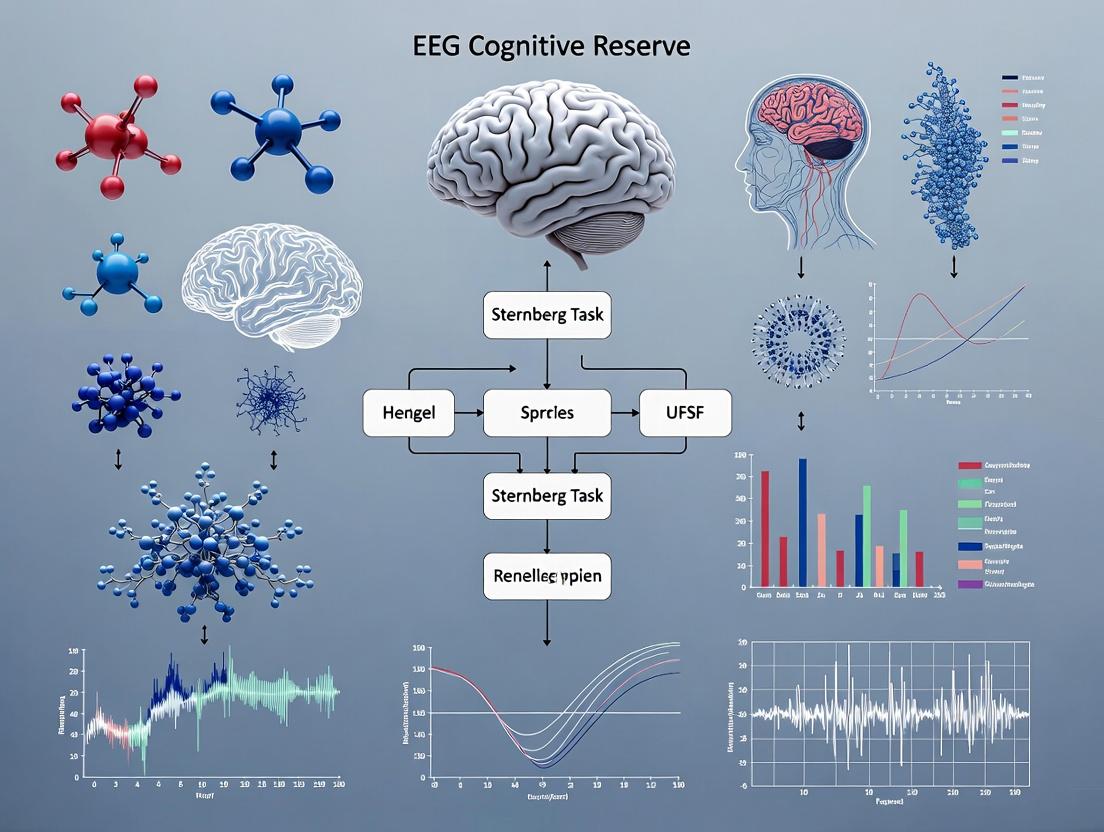
This article synthesizes current research on the combined use of the Sternberg memory task and electroencephalography (EEG) to operationalize and measure cognitive reserve (CR).
Sternberg Task EEG: A Neural Biomarker for Quantifying Cognitive Reserve in Neurodegenerative Disease Research
Abstract
This article synthesizes current research on the combined use of the Sternberg memory task and electroencephalography (EEG) to operationalize and measure cognitive reserve (CR). Targeting researchers and drug development professionals, it explores the foundational neural correlates of CR, details methodological approaches for experimental design and EEG analysis, addresses common troubleshooting and signal optimization challenges, and validates EEG-based CR metrics against established neuropsychological and neuroimaging measures. The review provides a framework for implementing Sternberg-EEG paradigms in preclinical and clinical trials to assess intervention efficacy on neural efficiency and cognitive resilience.
Decoding Cognitive Reserve: The Neural Basis of the Sternberg Task and EEG Signatures
Cognitive Reserve (CR) is a theoretical construct describing the brain's resilience to age-related changes or neuropathology, allowing individuals to maintain cognitive function despite neural decline. Within a thesis on Sternberg task EEG research, CR is operationalized as an individual's ability to efficiently utilize neural networks or recruit alternative networks during working memory processing. This is quantified by examining the disjunction between brain pathology (e.g., EEG signatures of neural challenge) and cognitive performance. The Sternberg task, with its parametric manipulation of memory load, serves as an ideal probe to elicit neural efficiency and compensation metrics, key phenomena underpinning CR.
Key Theoretical Models & Supporting Quantitative Evidence
The following table summarizes predominant CR models and key empirical findings relevant to EEG research.
Table 1: Theoretical Models of Cognitive Reserve and Empirical Support
| Model/Concept | Core Tenet | Key Quantitative Findings from EEG/fMRI Studies |
|---|---|---|
| Neural Efficiency | High CR individuals use fewer neural resources for baseline task performance. | ERP Amplitude: Lower P300 amplitude at low memory loads in high CR groups (e.g., ~4 µV vs. ~7 µV in low CR). Oscillatory Power: Reduced theta-band (4-7 Hz) synchronization in frontal regions during encoding. |
| Neural Compensation | High CR individuals recruit additional brain regions under high demand or challenge. | Increased Activation: Under high load (>6 items), high CR shows greater frontal midline theta power (increase of +2.5 dB from low to high load). Connectivity: Enhanced fronto-parietal phase-locking value (PLV > 0.15) during high-load maintenance. |
| Maintenance Model | CR reflects preserved neural integrity, aligning closely with brain structure. | Structural Correlation: Hippocampal volume correlates with CR proxy (β = 0.35, p<.01), but predicts performance only in low CR group. |
| Scaffolding Theory | The brain adaptively forms alternative neural circuits in response to increased challenge. | BOLD/EEG Evidence: Age-related over-recruitment (e.g., bilateral prefrontal BOLD activity) is associated with better task performance only in high CR (r = 0.45). |
Experimental Protocols for EEG-Based CR Assessment Using the Sternberg Task
Protocol 3.1: Participant Stratification & CR Proxy Estimation
Objective: To classify participants into High and Low CR groups based on a composite score.
- Administer CR Proxy Measures:
- National Adult Reading Test (NART) or Wechsler Test of Adult Reading (WTAR): Estimate premorbid IQ.
- Lifetime Experiences Questionnaire (LEQ): Quantify cognitive activity across lifespan.
- Years of Education.
- Calculate Composite Z-score: For each participant, compute Z-scores for each measure. The composite CR proxy score is the mean of these Z-scores.
- Stratify Groups: Perform a median split on the composite score to define High-CR and Low-CR cohorts.
Protocol 3.2: Sternberg Task Paradigm with EEG
Objective: To elicit neural efficiency and compensation metrics during verbal working memory.
- Task Design: Implement a modified Sternberg Item Recognition Paradigm.
- Encoding Phase: A set of target letters (e.g., 2, 4, 6, or 8 items) is displayed sequentially (500 ms/item, ISI 250 ms).
- Maintenance/Delay Phase: A blank delay interval (3000 ms).
- Probe Phase: A single letter probe appears. Participant indicates via button press if the probe was in the memory set ('yes'/'no').
- Load Manipulation: Total trials: 240 (60 per load condition), randomized.
- EEG Acquisition:
- System: 64+ channel EEG cap following 10-20 system.
- Parameters: Sampling rate ≥ 512 Hz, online bandpass filter 0.1-100 Hz, impedance kept < 10 kΩ.
- Reference: Use a common average or linked mastoids reference online; re-reference offline.
- Behavioral Data Analysis:
- Calculate mean Reaction Time (RT) and Accuracy (%) for each load condition and group.
- Perform a 2 (Group: High/Low CR) x 4 (Load) repeated-measures ANOVA.
Protocol 3.3: EEG Preprocessing & Time-Frequency Analysis
Objective: To derive neural efficiency/compensation indices from oscillatory activity.
- Preprocessing (Using EEGLAB/FieldTrip):
- Apply high-pass (0.5 Hz) and low-pass (45 Hz) filters.
- Perform Independent Component Analysis (ICA) to remove ocular and muscular artifacts.
- Epoch data: -1500 ms to +4000 ms relative to encoding phase onset.
- Apply baseline correction (-200 to 0 ms).
- Time-Frequency Decomposition:
- Use Morlet wavelet convolution (frequency range: 3-30 Hz, cycles increasing from 3 to 8).
- Extract power (dB) for key bands: Theta (4-7 Hz), Alpha (8-12 Hz), Beta (13-30 Hz).
- Define ROIs: Frontal (Fz, F1, F2), Parietal (Pz, P1, P2).
- Key Metrics Extraction:
- Neural Efficiency: Mean theta power during low-load (2 items) encoding at frontal ROI.
- Neural Compensation: Theta power increase from low (2 items) to high (8 items) load during the maintenance phase at frontal ROI.
Protocol 3.4: Event-Related Potential (ERP) Analysis for P300
Objective: To assess neural resource allocation via the P300 component.
- ERP Processing:
- Filter data 0.1-30 Hz.
- Epoch around probe stimulus (-200 to 800 ms).
- Baseline correct (-200 to 0 ms).
- Average trials by condition (Load, Probe Type).
- Component Quantification:
- Identify P300 component at parietal electrode (Pz) as the most positive peak between 300-500 ms post-probe.
- Measure mean amplitude (µV) and latency (ms) for correct trials only.
Visualizing the Neural Phenomena of Cognitive Reserve
Title: CR Phenomena in Sternberg EEG
Title: Sternberg EEG-CR Research Workflow
The Scientist's Toolkit: Research Reagent Solutions
Table 2: Essential Materials & Solutions for Sternberg Task EEG-CR Research
| Item | Function/Application in CR Research |
|---|---|
| High-Density EEG System (64+ channels) | Captures high-resolution electrical brain activity with sufficient spatial sampling for source analysis and connectivity mapping. |
| Electrolyte Gel (e.g., SignaGel, ABRALYT HiCl) | Ensures stable, low-impedance electrical connection between scalp electrodes and the skin for high-quality signal acquisition. |
| Bioamplifier & ADC Unit | Amplifies microvolt-level EEG signals and performs analog-to-digital conversion with high precision (e.g., 24-bit resolution). |
| Stimulus Presentation Software (e.g., E-Prime, PsychoPy) | Precisely controls the timing and presentation of the Sternberg task, ensuring millisecond accuracy synchronized with EEG triggers. |
| EEG Analysis Suite (e.g., EEGLAB, FieldTrip, MNE-Python) | Provides open-source toolboxes for preprocessing, ICA, time-frequency analysis, and statistical evaluation of EEG data. |
| Morlet Wavelet Toolbox | Enables time-frequency decomposition to extract oscillatory power (theta/alpha) as key metrics of neural efficiency/compensation. |
| Connectivity Toolbox (e.g., HERMES, Brainstorm) | Calculates phase-based connectivity metrics (Phase-Locking Value, weighted Phase Lag Index) to assess network reorganization. |
| Statistical Software (R, SPSS, MATLAB Statistics Toolbox) | Performs mixed-design ANOVAs and regression models to test for Group (CR) x Load interactions and other critical hypotheses. |
| CR Proxy Questionnaires (NART, LEQ) | Standardized instruments to estimate an individual's lifetime cognitive reserve capacity for participant stratification. |
Application Notes & Protocols
1. Introduction & Thesis Context Within cognitive reserve and aging research, the Sternberg Task is a cornerstone for investigating the neural efficiency hypothesis. This hypothesis posits that individuals with higher cognitive reserve utilize neural circuits more efficiently, especially under high working memory load. EEG research using this paradigm seeks to identify neurophysiological markers (e.g., P300 latency/amplitude, frontal theta power) that correlate with reserve capacity and are sensitive to pharmacological modulation. These markers are critical for assessing cognitive enhancers in drug development.
2. Key Quantitative Findings in Sternberg-EEG Research Table 1: Summary of Key EEG Metrics in Sternberg Task Research
| EEG Metric | Typical Change Under High Load | Interpretation in Cognitive Reserve | Representative Effect Size (Cohen's d) |
|---|---|---|---|
| P300 Latency | Increases | Shorter latency/high load = greater neural efficiency | 0.8 - 1.2 |
| P300 Amplitude | Decreases | Attenuated decrease = efficient resource allocation | 0.6 - 1.0 |
| Frontal Midline Theta Power | Increases | Higher increase = greater engagement; efficient modulation linked to reserve | 0.7 - 1.1 |
| Alpha/Beta Power (parietal) | Decreases (desynchronization) | Greater desynchronization = active processing; optimal level indicates efficiency | 0.5 - 0.9 |
| ERP Load Modulation Slope | Linear increase with set size | Flatter slope for latency increase suggests higher neural efficiency | N/A (Slope analysis) |
3. Detailed Experimental Protocols
Protocol 1: Standard Sternberg Task with EEG for Cognitive Reserve Assessment Objective: To assess working memory maintenance/retrieval and derive neural efficiency indices. Task Design:
- Stimuli: Alphanumeric characters or simple words.
- Sequence: a) Encoding: Presentation of memory set (1-6 items). b) Maintenance: Blank delay (2-4 sec). c) Probe: Single item. d) Response: Button press (Yes/No for match).
- Load Manipulation: Vary memory set size (e.g., 1, 3, 6 items) across blocks. EEG Acquisition:
- System: 64+ channel EEG system.
- Parameters: Sampling rate ≥ 500 Hz, online filter 0.1-100 Hz.
- Reference & Ground: Linked mastoids/Cz reference; forehead ground.
- Impedance: Maintain < 10 kΩ. Preprocessing (ERP Analysis):
- Filter: 0.1-30 Hz bandpass.
- Epoching: -200 ms to 1000 ms relative to probe onset.
- Baseline Correction: -200 to 0 ms.
- Artifact Rejection: Exclude epochs with amplitude > ±100 µV.
- Averaging: Separate averages for each load and probe type (match/non-match). Key Analysis: Measure P300 component (peak 300-600 ms post-probe) at parietal (Pz) electrode for latency and amplitude.
Protocol 2: Time-Frequency Analysis for Theta Modulation Objective: To analyze oscillatory dynamics during maintenance and retrieval. Preprocessing for Oscillatory Analysis:
- Filter: Use broader bandpass (e.g., 1-80 Hz).
- Epoching: Longer epochs to cover maintenance (e.g., -2 to +3 s around probe). Analysis:
- Time-Frequency Decomposition: Use Morlet wavelets or Hilbert transform.
- Frequency Bands: Theta (4-8 Hz), Alpha (8-13 Hz), Beta (13-30 Hz).
- Power Calculation: Compute event-related synchronization/desynchronization (ERS/ERD) relative to baseline.
- ROIs: Frontal midline theta (electrodes FCz, Cz); Parietal alpha (Pz, P3, P4).
4. Signaling Pathways & Experimental Workflows
Diagram Title: Sternberg-EEG Experimental Analysis Workflow
Diagram Title: Neural Efficiency Putative Pathway in Sternberg
5. The Scientist's Toolkit: Research Reagent Solutions Table 2: Essential Materials for Sternberg-EEG Research
| Item | Function & Rationale |
|---|---|
| High-Density EEG System (64+ channels) | Captures spatial detail of cortical activity during task. Essential for source localization. |
| Active Electrodes (e.g., Ag/AgCl) | Provides superior signal-to-noise ratio with higher impedance tolerance, crucial for clean data. |
| Stimulus Presentation Software (e.g., E-Prime, PsychoPy) | Precisely controls timing, sequence, and synchronization of Sternberg task with EEG triggers. |
| EEG Analysis Suite (e.g., EEGLAB, ERPLAB, Brainstorm) | Open-source toolboxes for standardized preprocessing, ERP, and time-frequency analysis. |
| Saline-Based Electrolyte Gel | Ensures stable conductive connection between scalp and electrode, minimizing drift. |
| Chin Rest & Sound-Attentuating Booth | Minimizes movement and auditory artifacts, ensuring data purity. |
| Cognitive Reserve Proxy Measures (e.g., NIH Toolbox, IQ tests) | Required for participant stratification (High vs. Low Reserve) to test primary thesis. |
| Pharmacological Agents (in drug trials) | Candidate cognitive enhancers (e.g., nicotinic agonists, AMPA modulators) to test modulation of EEG markers. |
This application note details the key EEG correlates observed during the Sternberg paradigm, a foundational working memory task. Within a thesis on cognitive reserve (CR) research, these EEG metrics serve as potential neural efficacy or compensation markers. CR posits that some individuals show greater resilience to age- or pathology-related brain changes. By quantifying ERP components (e.g., P300) and oscillatory dynamics (theta, alpha, gamma) during the Sternberg task, we aim to identify neurophysiological signatures that may underlie higher CR, offering non-invasive biomarkers for tracking cognitive health and evaluating therapeutic interventions in drug development.
Key EEG Findings in the Sternberg Paradigm
Table 1: Characteristic Event-Related Potential (ERP) Components
| ERP Component | Typical Latency (ms) | Polarity & Topography | Functional Interpretation in Sternberg Task |
|---|---|---|---|
| P300 | 300-600 | Positive, Centro-parietal | Index of memory updating/context maintenance upon probe presentation. Amplitude correlates with memory load/attentional resources. |
| Contingent Negative Variation (CNV) | During delay interval | Negative, Fronto-central | Reflects anticipation, preparation, and sustained attention during the maintenance delay. |
| N200 | 200-350 | Negative, Fronto-central | Conflict monitoring or mismatch detection when comparing probe to memory set. |
| Late Positive Component (LPC) | 500-800 | Positive, Parietal | Associated with retrieval confidence and decision processes post-probe. |
Table 2: Characteristic Oscillatory Dynamics (Power & Connectivity)
| Frequency Band | Typical Response (Power Change) | Functional Interpretation in Sternberg Task |
|---|---|---|
| Frontal Midline Theta (4-8 Hz) | Increase during encoding & maintenance | Supports active maintenance, coordination of working memory operations, and cognitive control. |
| Parietal Alpha (8-12 Hz) | Increase during maintenance (lateralized); Decrease upon retrieval | Suppression of distractors & inhibition of irrelevant brain areas; Release of inhibition for retrieval. |
| Beta/Gamma (>20 Hz) | Transient increase during encoding & retrieval | Feature binding, active neuronal assembly coordination, and retrieval of items from memory. |
| Long-Range Theta-Gamma Coupling | Increased cross-frequency coupling | Proposed mechanism for integrating item (gamma) and sequential/contextual (theta) information. |
Detailed Experimental Protocols
Protocol 1: Standard Sternberg Task with Concurrent EEG Recording
1. Objective: To acquire time-locked EEG data for ERP analysis and time-frequency analysis of oscillatory activity during verbal working memory tasks.
2. Materials & Setup:
- EEG system (64+ channels recommended, e.g., BioSemi, Brain Products).
- Conductive electrode gel/electrolyte.
- Sound-attenuated, electrically shielded booth.
- Presentation PC and display monitor.
- Response input device (button box).
- Stimulus presentation software (e.g., E-Prime, PsychoPy, Presentation).
3. Stimuli & Task Design:
- Memory Set: Random sequences of consonants (e.g., 1, 3, 5, 7 items). Avoid vowels and letters with acoustic similarity.
- Probe Stimulus: A single consonant.
- Trial Structure:
- Fixation Cross: 500 ms.
- Encoding Phase: Sequential presentation of memory set items (e.g., 500 ms/item, 1000 ms ISI).
- Maintenance/Delay Phase: Blank screen (2000-3000 ms).
- Probe Phase: Presentation of the probe item (remains until response or max 2000 ms).
- Response: Participant indicates via button press (e.g., left='Yes'/in set, right='No'/not in set).
- Inter-Trial Interval: 1000-1500 ms.
4. Procedure:
- Participants complete ~20 practice trials.
- Main experiment consists of 200+ trials, balanced across memory load and probe type (50% positive/negative).
- EEG is recorded continuously (sampling rate ≥ 512 Hz, online filter 0.01-100 Hz).
5. EEG Preprocessing & Analysis (Summary):
- Preprocessing: Downsample to 256 Hz, band-pass filter (0.1-40 Hz), re-reference to average mastoids, independent component analysis (ICA) for artifact removal, segment into epochs time-locked to probe presentation and encoding onset, baseline correction, and artifact rejection.
- ERP Analysis: Average epochs per condition. Measure mean amplitude/latency of P300 (300-600ms post-probe at Pz).
- Time-Frequency Analysis: Apply Morlet wavelet transform to trial data. Compute event-related spectral perturbation (ERSP) and inter-trial coherence (ITC) for theta, alpha, and gamma bands.
Protocol 2: Assessing Load-Dependent Neural Responses
1. Objective: To systematically quantify the relationship between working memory load (set size) and EEG correlates (P300 amplitude attenuation, frontal theta power increase).
2. Modification to Protocol 1:
- Use a within-subjects design with at least 4 distinct set sizes (e.g., 1, 3, 5, 7 items).
- Counterbalance load conditions across trials.
- Ensure equal trials per load (minimum 40 trials/condition after artifact rejection).
3. Analysis Focus:
- Perform repeated-measures ANOVA on P300 mean amplitude with Load as a factor.
- Correlate frontal theta power (averaged over maintenance window) with set size per participant.
- Create individual load-response slopes for these EEG features as potential neural efficiency indices.
Visualizations of Key Processes
Sternberg Task Phases and EEG Correlates
EEG Markers in Cognitive Reserve Model
The Scientist's Toolkit: Research Reagent Solutions
Table 3: Essential Materials for Sternberg EEG Research
| Item | Function & Application |
|---|---|
| High-Density EEG System (64-128 channels) | Captures detailed spatial topography of ERPs and source-localization of oscillations. Essential for distinguishing frontal vs. parietal contributions. |
| Active Electrodes (e.g., ActiCAP) | Provide high signal-to-noise ratio with lower preparation time, crucial for robust P300 and gamma measurement. |
| Electrode Gel (SuperVisc) | Ensures stable, low-impedance (<10 kΩ) connection for continuous high-quality data acquisition over long sessions. |
| Stimulus Presentation Software (E-Prime 3.0) | Precisely controls timing (<1 ms accuracy) of memory set and probe presentation, ensuring reliable ERP time-locking. |
| EEGLAB + ERPLAB Toolbox (MATLAB) | Open-source standard for preprocessing, ICA artifact removal, ERP averaging, and basic time-frequency analysis. |
| FieldTrip Toolbox (MATLAB) | Advanced analysis of oscillatory dynamics, source reconstruction, and statistical clustering for time-frequency data. |
| BCI2000 or PsychoPy | For flexible, open-source task design and integration with EEG hardware for real-time potential applications. |
| Statistical Software (R, JASP, SPSS) | For performing repeated-measures ANOVA, correlation, and linear mixed-effects models on behavioral-EEG relationships. |
This document provides application notes and experimental protocols for a research program investigating the neural efficiency hypothesis of cognitive reserve (CR). The core thesis posits that individuals with higher CR, as inferred from lifespan intellectual engagement, demonstrate more efficient neural processing during working memory tasks (e.g., Sternberg task). This efficiency is quantified using specific electroencephalographic (EEG) biomarkers: faster P300 latency (reflecting speed of stimulus evaluation), higher P300 amplitude (reflecting resource allocation), increased frontal midline theta power (indicative of active cognitive control), and increased posterior alpha power (reflecting inhibition of task-irrelevant regions). These metrics are hypothesized to mediate the relationship between CR-proxy measures and sustained cognitive performance.
Table 1: Key EEG Biomarkers of Neural Efficiency in Sternberg Task Studies
| Biomarker | Typical Change with Higher CR/Performance | Functional Interpretation | Approximate Effect Size (Cohen's d)* |
|---|---|---|---|
| P300 Latency | Decrease (10-50 ms faster) | Faster stimulus evaluation & classification | 0.4 - 0.8 |
| P300 Amplitude | Increase (1-3 µV larger) | Greater attentional resource allocation | 0.3 - 0.7 |
| Frontal Midline Theta Power | Increase (20-40%) | Enhanced cognitive control & working memory maintenance | 0.5 - 0.9 |
| Posterior Alpha Power (during retention) | Increase (15-30%) | Efficient gating of visual distraction, superior memory maintenance | 0.4 - 0.8 |
*Effect sizes are synthetic estimates based on recent literature comparing high vs. low CR groups or correlational studies.
Table 2: Example Sternberg Task Parameters & Expected Outcomes
| Task Parameter | Standard Protocol | High CR Group Expectation | Low CR Group Expectation |
|---|---|---|---|
| Set Size (items) | 3, 5, 7 | High accuracy even at set size 7 | Accuracy decline at set size 5 & 7 |
| Retention Interval | 1-3 seconds | Stable posterior alpha power | Volatile or low alpha power |
| Probe Type (Match/Non-match) | 50/50 | Faster P300 latency for both types | Slower P300, esp. for non-match |
| Behavioral Output | Reaction Time (RT), Accuracy | Shorter RT, High Accuracy (>90%) | Longer RT, Lower Accuracy (<80%) |
Experimental Protocols
Protocol 1: Integrated Sternberg-EEG Experiment for CR Assessment
A. Participant Screening & CR Proxy Measures
- Recruit adults (55-75 years) with normal or corrected-to-normal vision.
- Administer CR proxy questionnaires: Lifetime of Experiences Questionnaire (LEQ) or Cognitive Reserve Index questionnaire (CRIq).
- Conduct standard cognitive battery (e.g., MMSE, Trail Making Test) to establish baseline.
B. EEG Setup & Sternberg Task
- Equipment: 64+ channel EEG system, active electrodes, standard amplifier.
- Setup: Apply electrodes per 10-20 system. Impedance kept below 10 kΩ. Sampling rate ≥ 500 Hz.
- Sternberg Task Design (E-Prime/PsychoPy):
- Encoding: Presentation of memory set (e.g., 5 consonants) for 2 sec.
- Retention: Blank screen for 3 sec. Critical period for posterior alpha.
- Probe: Single letter appears. Participant indicates match/non-match via button press (max 3 sec response window).
- Trials: 200 trials total, balanced across set sizes (3,5,7) and match conditions. Inter-trial interval 1.5-2 sec.
C. EEG Preprocessing & Analysis (Example using EEGLAB/FieldTrip)
- Filtering: Band-pass 0.1-30 Hz, notch 50/60 Hz.
- Epoching: Create epochs from -200 ms pre-probe to 1000 ms post-probe for P300. Create epochs for full retention period for alpha/theta.
- Artifact Removal: Apply ICA for ocular & movement artifacts.
- Baseline Correction: Use -200 to 0 ms pre-probe baseline.
- Time-Frequency Analysis: Compute wavelet transform for retention epoch (e.g., 4-8 Hz for theta, 8-12 Hz for alpha).
- ERP Analysis: Average trials per condition. Identify P300 at Pz electrode (250-500 ms window). Extract peak latency and mean amplitude.
- Statistical Mapping: Correlate EEG metrics (P300 latency/amp, frontal theta, posterior alpha) with CR proxy scores, controlling for age and performance.
Visualization of Conceptual & Methodological Framework
Title: Neural Efficiency Mediates CR to Performance Link
Title: Sternberg-EEG Experiment Workflow
The Scientist's Toolkit: Key Research Reagents & Materials
Table 3: Essential Materials for Sternberg EEG-CR Research
| Item/Category | Example Product/Specification | Primary Function in Research |
|---|---|---|
| EEG Acquisition System | 64-128 channel actiCAP, BioSemi ActiveTwo, BrainVision | High-fidelity recording of neural electrical activity. Active electrodes reduce noise. |
| EEG Amplifier & Software | BrainAmp, LiveAmp, NetStation | Amplifies microvolt EEG signals, digitizes, and streams to acquisition software. |
| Stimulus Presentation Software | E-Prime 3.0, PsychoPy, Presentation | Precisely controls timing and presentation of the Sternberg task stimuli. |
| EEG Analysis Suite | EEGLAB, FieldTrip, MNE-Python | Open-source toolboxes for preprocessing, artifact removal, ERP, and time-frequency analysis. |
| CR Assessment Tool | Lifetime of Experiences Questionnaire (LEQ) | Validated questionnaire quantifying life-long cognitive-enhancing activities (CR proxy). |
| Conductive Electrolyte Gel | SuperVisc, Abralyt HiCl | Ensures stable, low-impedance electrical connection between scalp and EEG electrodes. |
| Electrode Caps | actiCAP Snap, WaveGuard | Holds electrodes in standardized positions (10-20 system) for rapid, reproducible setup. |
| Statistical Software | R, SPSS, Python (statsmodels) | For advanced correlation, mediation, and regression analyses linking EEG, CR, and behavior. |
1. Introduction & Rationale Research into cognitive reserve (CR) has predominantly relied on behavioral metrics, such as accuracy and reaction time on tasks like the Sternberg working memory paradigm. While crucial, these measures are insufficient for elucidating the underlying neural mechanisms that enable preserved function despite neuropathology. This document outlines application notes and protocols to bridge this gap by integrating high-density electroencephalography (EEG) with the Sternberg task to quantify neural efficiency, capacity, and compensation—the proposed neural substrates of reserve.
2. Key Quantitative Data Summary
Table 1: Correlates of Behavioral vs. Neural Reserve Metrics in Sternberg Task Studies
| Metric | High Behavioral CR Profile | High Neural CR Profile (EEG-Derived) | Correlation with Pathology (e.g., Amyloid Burden) |
|---|---|---|---|
| Behavioral Performance | High accuracy, fast RT | May be preserved or mildly declined | Weak to moderate inverse correlation |
| Neural Efficiency (Frontal) | N/A | Lower theta (4-7 Hz) power increase with load | Strong inverse correlation (efficient=less pathology impact) |
| Neural Capacity (Posterior) | N/A | Sustained high-alpha (10-12 Hz) power with high load | Moderate inverse correlation |
| Neural Compensation (Fronto-Parietal) | N/A | Increased P300 amplitude & theta phase coupling under challenge | Positive correlation (more compensation=more pathology) |
| Reference | Sternberg, 1966; Scarmeas & Stern, 2009 | Cabeza et al., 2018; hitvia et al., 2022 | Ewers et al., 2021; Franssen et al., 2023 |
Table 2: Typical EEG Spectral Power Changes (% from Baseline) During Sternberg Maintenance
| Load Condition | Theta (Fz) | Low Alpha (Pz) | High Alpha (Pz) | Gamma (Cz) |
|---|---|---|---|---|
| Low Load (2 items) | +20% | -15% (Desynchronization) | -10% | +5% |
| High Load (6 items) | +45% | -30% | -15% (if high capacity) or -40% (if low capacity) | +12% |
| Proposed CR Index | Efficiency: Slope of Theta Increase | --- | Capacity: High Alpha Maintenance | --- |
3. Experimental Protocols
Protocol 1: High-Density EEG Sternberg Task with Parametric Load Manipulation Objective: To derive neural efficiency and capacity metrics from load-dependent EEG responses.
- Participant Grouping: Recruit cohorts stratified by estimated CR (education, IQ, lifespan engagement) and biomarker status (e.g., amyloid-PET positive/negative).
- Task Design: Implement a modified Sternberg paradigm. Each trial: Encode a set of 2, 4, or 6 consonants (1500 ms), maintain during a blank delay (3000 ms), respond to a single probe letter (match/no-match). Include >60 trials per load condition.
- EEG Acquisition: Record continuous EEG from 64+ channels (10-10 system), impedance <10 kΩ, sampling rate ≥500 Hz. Synchronize with task events.
- Preprocessing (Offline):
- Filter (0.5-40 Hz bandpass, 50/60 Hz notch).
- Independent Component Analysis (ICA) for ocular and muscular artifact removal.
- Epoch from -500 ms pre-encode to end of delay. Baseline correct (-200 to 0 ms).
- Automated artifact rejection (±100 µV threshold).
- Core Analysis:
- Time-Frequency Decomposition: Use Morlet wavelets on delay period data. Extract trial-averaged power in theta (4-7 Hz) and alpha (8-12 Hz) bands.
- ERP Analysis: Filter (0.1-20 Hz) and average for P300 (250-500 ms post-probe) at Pz.
- Connectivity: Compute weighted phase lag index (wPLI) for theta band between frontal (F3, Fz, F4) and parietal (P3, Pz, P4) electrodes during high load delay.
Protocol 2: Pharmaco-EEG Intervention to Probe Neural Compensation Objective: To transiently modulate neurotransmitter systems (e.g., cholinergic) and measure changes in neural compensation metrics.
- Design: Double-blind, placebo-controlled, crossover study in a biomarker-defined at-risk group.
- Intervention: Administration of a single dose of a pro-cholinergic agent (e.g., donepezil 5 mg) vs. placebo. Testing occurs at peak plasma concentration.
- Task & EEG: Follow Protocol 1, emphasizing a high-load (6 item) condition.
- Primary Neural Outcome: Compare drug vs. placebo conditions for:
- Fronto-parietal theta wPLI during delay.
- P300 amplitude attenuation under high load.
4. Diagrams
Title: From Task to Behavior via Neural Reserve
Title: EEG Sternberg Analysis Workflow
5. Research Reagent Solutions & Essential Materials
Table 3: Scientist's Toolkit for EEG-Based Reserve Studies
| Item | Function & Rationale |
|---|---|
| High-Density EEG System (e.g., 64-128 channel actiCAP) | Captures spatial detail necessary for source estimation and connectivity analysis of distributed networks. |
| Biologically Plausible Task Software (e.g., PsychoPy, Presentation) | Presents parametric Sternberg task with millisecond precision and sends event markers to EEG. |
| EEG Analysis Suite (e.g., EEGLAB, BrainVision Analyzer, MNE-Python) | Provides standardized pipelines for preprocessing, time-frequency, and ERP analysis. |
| Connectivity Toolbox (e.g., FieldTrip, HERMES) | Computes reliable metrics of functional connectivity (e.g., wPLI) resistant to volume conduction. |
| Source Modeling Software (e.g., sLORETA, Brainstorm) | Optional but valuable for localizing EEG signals to cortical structures, bridging to fMRI literature. |
| Biomarker Data (e.g., Amyloid-PET, MRI volumetrics) | Critical for classifying participants by pathology level, enabling dissociation of neural compensation from efficiency. |
| Pro-Cholinergic Agent (e.g., Donepezil) | Pharmacological probe to test the malleability of compensatory networks and link them to specific neurotransmission. |
Implementing Sternberg-EEG Protocols: Best Practices for Experimental Design and Analysis
This document provides detailed application notes and protocols for the Sternberg Item Recognition Paradigm, a cornerstone task for assessing working memory (WM) speed and efficiency. The content is framed within a broader thesis investigating the neural correlates of cognitive reserve (CR) using EEG. The thesis posits that individuals with higher CR, often estimated via proxy measures like education or occupational complexity, exhibit more efficient neural processing during WM tasks. This neural efficiency may be quantified via EEG metrics (e.g., P300 latency/amplitude, frontal theta power) during the Sternberg task, serving as a potential biomarker for CR that could predict resilience to age-related cognitive decline or neurological disease. These protocols are designed for researchers, scientists, and drug development professionals aiming to utilize the Sternberg paradigm in clinical trials or basic research to probe WM mechanisms and evaluate cognitive-enhancing interventions.
Set Size
The number of items (e.g., digits, letters, symbols) presented in the memory set. This is the primary manipulation of WM load.
Delay Interval
The time between the offset of the memory set and the presentation of the probe item. This period engages maintenance processes.
Table 1: Standard Parameter Ranges and Effects
| Parameter | Typical Range | Operational Effect | Key EEG Correlate |
|---|---|---|---|
| Set Size | 1 to 7 items | Linear increase in Reaction Time (RT); decrease in accuracy. Slope of RT vs. Set Size = scan rate (~35-50 ms/item). | Modulation of P300 amplitude (inversely related), increase in frontal theta power. |
| Delay Interval | 1.0 to 4.0 seconds | Increased demand on active maintenance. Very short (<1s) or long (>5s) delays alter strategy. | Sustained contralateral delay activity (CDA) in EEG; theta-gamma coupling during maintenance. |
| Stimulus Duration | 500-1500 ms/item | Encoding depth. | Modulates early visual evoked potentials (P1, N1). |
| Probe Type | 50% Positive (in set), 50% Negative (not in set) | Controls for response bias. | Larger P300 for positive probes; N2pc for negative probes. |
Modalities and Presentation
- Visual: Most common. Items presented sequentially or simultaneously.
- Auditory: Items presented via headphones. Engages phonological loop.
- Tactile/Haptic: For specialized populations (e.g., visually impaired).
- Dual-Modality: Presents memory set in one modality (e.g., auditory) and probe in another (e.g., visual) to assess cross-modal integration.
Key Task Variants
Table 2: Sternberg Task Variants and Research Applications
| Variant Name | Modification | Primary Research Application | Thesis Relevance for EEG/CR |
|---|---|---|---|
| Standard | Single list, delayed probe. | Baseline WM assessment. | Establish individual neural efficiency baselines. |
| Continuous (Rapid) | Multiple, back-to-back trials without breaks. | Assesses WM under sustained attention/cognitive fatigue. | CR as a buffer against fatigue-related neural inefficiency. |
| Modified Sternberg (MSST) | Incorporates emotional distractors during delay. | WM in the context of emotional interference (e.g., anxiety, PTSD). | CR's role in emotional regulation and focused maintenance. |
| Adaptive | Set size adjusts based on performance. | Titrates individual WM capacity. | Relates neural metrics to personalized WM load. |
| N-Back | Derived from Sternberg; requires monitoring a stream for repeats. | Complex WM updating. | Often used in fMRI; EEG can track theta oscillations during updating. |
Detailed Experimental Protocols
Protocol 1: Standard Visual Sternberg with EEG
Aim: To measure WM scanning speed and neural efficiency (P300) as a function of set size. Materials: Stimulus presentation software (E-Prime, PsychoPy), EEG system with 32+ channels, response pad. Procedure:
- Trial Structure: a. Fixation: A central cross is presented for 500 ms. b. Encoding: A memory set of n items (e.g., digits 1-9) is presented simultaneously for 1500 ms. Set sizes (e.g., 1, 3, 5, 7) are varied block-wise or randomly. c. Delay: A blank screen is presented for 2000 ms (maintenance phase). d. Probe: A single item is presented until response, or for max 2000 ms. e. Response: Participant indicates via button press (YES/NO) if the probe was in the memory set. f. Inter-Trial Interval (ITI): A blank screen is presented for 1000-1500 ms.
- Block Design: 20-30 trials per set size condition. Include practice blocks.
- EEG Recording: Continuous recording at ≥500 Hz sampling rate. Note event markers at: memory set onset, delay onset, probe onset, response.
- EEG Analysis Focus: Time-locked to probe onset. Analyze P300 component (latency, amplitude at Pz), and time-frequency power (theta: 4-8 Hz) during delay period at frontal electrodes.
Protocol 2: Modified Sternberg with Emotional Distractors (MSST)
Aim: To assess the impact of emotional interference on WM maintenance and its neural correlates. Procedure:
- Follow Protocol 1, but modify the Delay phase: a. Neutral Delay: Display a neutral image (e.g., household object) for 500 ms, followed by a blank screen for 1500 ms. b. Emotional Delay: Display an emotionally arousing (negative or positive) image from a standardized set (IAPS) for 500 ms, followed by a blank screen for 1500 ms.
- Design: Use a within-subjects design with neutral and emotional delay trials randomly intermixed.
- EEG Analysis Focus: Compare frontal theta power and parietal alpha power during emotional vs. neutral delays. Examine how P300 to the probe is modulated by preceding distractor type.
Visualizations
Title: Standard Sternberg Trial Sequence
Title: Sternberg EEG in Cognitive Reserve Thesis
The Scientist's Toolkit
Table 3: Key Research Reagent Solutions for Sternberg EEG Studies
| Item | Function/Description | Example Product/Specification |
|---|---|---|
| EEG Acquisition System | Records electrical brain activity with high temporal resolution. | Biosemi ActiveTwo, BrainVision actiCHamp, EGI Geodesic. 32-128 channels recommended. |
| Stimulus Presentation Software | Precisely controls timing and sequence of task events. | E-Prime 3.0, PsychoPy, Presentation. Must output event markers to EEG. |
| Electrode Caps & Gel | Provides stable, low-impedance interface with scalp. | EasyCap with Ag/AgCl ring electrodes, SignaGel or SuperVisc electrolyte gel. |
| Response Interface | Records behavioral responses (RT, accuracy). | Serial or USB response pads (e.g., Cedrus RB-840) for millisecond precision. |
| EEG Analysis Suite | Processes raw EEG: filtering, epoching, artifact removal, component analysis. | EEGLAB, BrainVision Analyzer, MNE-Python, FieldTrip. |
| Standardized Stimulus Sets | Provides controlled, validated visual or auditory stimuli. | International Affective Picture System (IAPS) for emotional distractors. |
| Conductive Paste & Abrasion | Prepares skin to achieve impedance <10 kΩ for reliable data. | NuPrep skin abrasive gel, blunt-ended needles for paste application. |
This application note provides a standardized framework for EEG acquisition tailored to cognitive task research, specifically within the context of a thesis investigating neural efficiency and cognitive reserve using the Sternberg task paradigm. Consistent, high-quality EEG data is paramount for deriving reliable biomarkers of cognitive processing speed and working memory load.
Channel Montage and Electrode Placement
A standardized, high-density montage is recommended to capture both widespread cortical activity and focal frontal-parietal network dynamics central to the Sternberg task.
Table 1: Recommended EEG Montage for Sternberg Task Research
| System | Number of Channels | Key Regions of Interest (ROIs) | International 10-20 System Locations | Rationale |
|---|---|---|---|---|
| Extended 10-20 | 64-128 | Prefrontal, Frontal, Central, Parietal | F3, F4, Fz, FC1, FC2, C3, C4, Cz, P3, P4, Pz, O1, Oz, O2 | Balances spatial resolution with setup time. Essential for capturing P300, N170, and frontal theta. |
| Dense Array | 256+ | Whole-head coverage, detailed frontal-parietal mapping | All standard sites, plus intermediate positions | Optimal for source localization and network analysis; requires more complex hardware. |
| Minimum Setup | 32 | Frontal, Central, Parietal | Fz, Cz, Pz, C3, C4, P3, P4, Oz, plus full ring of peripheral sites | Acceptable for robust, well-established ERP components (P300 latency/amplitude). |
Protocol 2.1: Electrode Application & Impedance Management
- Preparation: Abrade the scalp at electrode sites using a mild abrasive gel. Clean sites with alcohol.
- Application: Apply conductive EEG paste or use saline-based electrolyte solution with Ag/AgCl electrodes.
- Impedance Check: Measure impedance at each channel. Target: < 10 kΩ for all channels. Critical Threshold: < 25 kΩ. Re-apply paste or adjust electrodes if impedance is high or unstable.
- Verification: Perform a quick impedance re-check after cap placement and before task initiation.
Sampling Rate and Hardware Specifications
Appropriate temporal resolution and hardware quality are critical to avoid aliasing and maintain signal fidelity.
Table 2: Sampling Rate and Hardware Configuration
| Parameter | Recommended Setting | Minimum Requirement | Theoretical Justification |
|---|---|---|---|
| Sampling Rate | 1000 Hz | 500 Hz | Nyquist theorem: To capture gamma activity (~80 Hz), sample at >160 Hz. 500-1000 Hz provides safety margin. |
| Hardware Type | Research-grade, DC-capable amplifier | AC-coupled amplifier (high-pass < 0.1 Hz) | DC allows recording of very slow cortical potentials (<0.1 Hz). |
| Input Impedance | > 1 GΩ | > 100 MΩ | Minimizes signal attenuation and impedance bridging. |
| ADC Resolution | 24-bit | 16-bit | High dynamic range crucial for capturing weak ERPs amid noise. |
| Bandpass Filter (Hardware) | 0.1 – 250 Hz (or higher) | 0.5 – 100 Hz | Wide band allows post-hoc filtering. Must match amplifier type (DC vs. AC). |
| Common Mode Rejection Ratio (CMRR) | > 110 dB | > 100 dB | Critical for rejecting line noise (50/60 Hz). |
Protocol 3.1: System Calibration & Testing
- Test Signal: Input a known sinusoidal wave (e.g., 10 Hz, 50 µV) into all channels.
- Recording: Record the test signal for 30 seconds at the intended sampling rate.
- Analysis: Verify amplitude and frequency fidelity across all channels. Check for channel cross-talk.
Synchronization and Trigger Integration
Precise timing between cognitive task events and EEG recording is non-negotiable.
Protocol 4.1: Trigger Setup for Sternberg Task
- Trigger Box: Use a parallel port, USB, or Ethernet-based trigger interface between stimulus presentation computer and EEG amplifier.
- Code Assignment: Assign unique digital codes for:
Trial Start,Memory Set Onset,Probe Onset,Button Press (Response),Correct/Error Feedback. - Latency Testing: Measure and document the system latency between software trigger send and its EEG marker receipt using an oscilloscope or photodiode test. Target latency: < 2 ms with variance < 1 ms.
- Recording: Embed these codes as event markers directly into the continuous EEG data stream.
Visualizations
Diagram 1: Sternberg EEG Acquisition & Analysis Workflow
Diagram 2: Cognitive Processes & EEG Correlates in Sternberg Task
The Scientist's Toolkit: Research Reagent Solutions
Table 3: Essential Materials for Sternberg EEG Research
| Item | Function/Rationale | Example Vendor/Product |
|---|---|---|
| High-Density EEG Cap | Standardized electrode placement (64-128 ch). Ensures consistent ROI coverage. | EASYCAP with sintered Ag/AgCl electrodes, Brain Products actiCAP. |
| Research-Grade Amplifier | High input impedance, 24-bit ADC, high CMRR for pristine signal acquisition. | BioSemi ActiveTwo, BrainAmp DC, g.tec g.HIamp. |
| Conductive Electrode Gel/Paste | Low impedance, stable electrolyte bridge between scalp and electrode. | SuperVisc, Electro-Gel, Abralyt HiCl. |
| Stimulus Presentation Software | Precise, millisecond-accurate visual/auditory delivery with trigger output. | PsychoPy, Presentation, E-Prime. |
| Trigger Interface Device | Low-latency relay of digital event codes from stimulus PC to EEG amplifier. | Brain Products TriggerBox, Cedrus StimTracker, parallel port interface. |
| ERP Analysis Software Suite | Preprocessing, artifact removal, time-frequency analysis, and statistical tools. | EEGLAB, BrainVision Analyzer, MNE-Python, FieldTrip. |
| Photodiode & Oscilloscope | Measures and validates system latency between visual stimulus and EEG marker. | Standard electronic suppliers. |
| Impedance Checker | Pre- and mid-recording verification of electrode-scalp contact quality. | Built into most amplifiers, or standalone devices. |
1. Introduction: Within a Cognitive Reserve Thesis This protocol details the critical preprocessing steps for electroencephalography (EEG) data acquired during the Sternberg task, a working memory paradigm. Within a thesis investigating cognitive reserve (CR) using Sternberg ERPs, the integrity of these preprocessing stages is paramount. Reliable artifact removal and epoching are essential to isolate neural signals related to memory encoding, maintenance, and retrieval from noise. This allows for valid comparisons of ERP components (e.g., P300, Contingent Negative Variation) between groups with high and low CR, or in pharmacological intervention studies aimed at enhancing cognitive resilience.
2. Key Research Reagent Solutions & Essential Materials Table 1: Essential Toolkit for Sternberg EEG Preprocessing
| Item | Function & Relevance |
|---|---|
| High-Density EEG System (e.g., 64-128 channels) | Captures spatial distribution of ERPs; crucial for source analysis in CR studies. |
| Electro-Cap with Ag/AgCl Electrodes | Standardized electrode placement (10-20 system) for reproducible measurements. |
| Conductive Electrolyte Gel | Ensures stable, low-impedance (<10 kΩ) connection for high-quality signal. |
| Stimulus Presentation Software (e.g., PsychoPy, E-Prime) | Precisely controls Sternberg task timing (set size presentation, probe, inter-trial interval). |
| EEG Acquisition Software (e.g., BrainVision Recorder, NetStation) | Records continuous EEG synchronized with task event markers (triggers). |
| Preprocessing Software (e.g., EEGLAB, MNE-Python) | Open-source toolboxes for implementing the pipelines described below. |
| ICA Algorithm (e.g., Infomax, Extended Infomax) | Core mathematical method for decomposing EEG and isolating artifact components. |
| Digital Filters (High-pass, Low-pass, Notch) | Removes slow drifts, high-frequency noise, and line interference. |
3. Detailed Experimental Protocols
3.1. Protocol: Basic Preprocessing & Filtering
- Input: Raw continuous
.vhdr/.edf/.setEEG file with event markers. - Step 1: Import & Channel Localization. Import data. Assign 3D coordinates to channels based on the cap model.
- Step 2: Reference & Downsampling. Re-reference to average or robust reference (e.g., REST). Downsample to 250-500 Hz to reduce computational load.
- Step 3: Filtering. Apply causal or zero-phase filters.
- High-pass: 0.1 - 1.0 Hz (Butterworth, order 4). Removes slow drifts.
- Low-pass: 30 - 40 Hz (Butterworth, order 4). Removes high-frequency muscle noise.
- Notch: 50/60 Hz (band-stop). Removes line noise.
- Step 4: Bad Channel Identification. Use kurtosis, probability, or spectral criteria to detect and interpolate (e.g., spherical spline) consistently noisy channels.
- Output: Cleaned, filtered continuous data.
3.2. Protocol: Ocular & Cardiac Artifact Removal via ICA
- Input: Filtered continuous data from Protocol 3.1.
- Step 1: Data Pruning. Optionally, remove extreme noise segments to improve ICA decomposition.
- Step 2: ICA Computation. Perform ICA (Infomax) on the pruned data. This creates
Nindependent components (ICs). - Step 3: IC Classification. Use automated classifiers (e.g., ICLabel, ADJUST) or manual inspection to label ICs.
- Ocular Artifacts: High topographical weight at frontal sites; time course locked to blinks/saccades.
- Cardiac Artifacts: Regular, pulsatile time course; topographical weight near temples/neck.
- Myogenic Artifacts: High-frequency bursts; topographical weight at temporal muscles.
- Step 4: Artifact Removal. Reconstruct the EEG signal, excluding the artifact ICs (e.g., those classified as "Eye," "Heart," "Muscle").
- Output: Continuous data with reduced biological artifacts.
3.3. Protocol: Epoching & Baseline Correction for Sternberg
- Input: Artifact-reduced continuous data from Protocol 3.2.
- Step 1: Epoch Extraction. Segment data around critical task events using event markers.
- Probe-Locked Epochs: -200 ms to 1000 ms relative to probe stimulus onset. Analyzes retrieval/decision processes (P300).
- Encoding-Locked Epochs: -200 ms to 1500 ms relative to memory set onset. Analyzes encoding/maintenance (CNV, slow waves).
- Step 2: Baseline Correction. Subtract the mean voltage of the pre-stimulus period (e.g., -200 to 0 ms) from the entire epoch.
- Step 3: Automated Artifact Rejection. Apply amplitude (e.g., ±100 µV) and gradient thresholds to reject epochs with residual artifact.
- Step 4: Group Assignment. Tag epochs by experimental condition (Set Size: 3, 5, 7; Probe Type: Positive/Negative) and subject group (High/Low CR; Drug/Placebo).
- Output: A clean, epoched dataset ready for ERP averaging and statistical analysis.
4. Data Summary Tables
Table 2: Typical Filtering Parameters for Sternberg ERPs
| Filter Type | Cut-off Frequencies | Roll-off (dB/octave) | Purpose | Rationale |
|---|---|---|---|---|
| High-pass | 0.1 Hz or 0.5 Hz | 12-24 | Remove slow drifts | Preserves ERP slow waves; 0.5Hz is more aggressive for ICA stability. |
| Low-pass | 30 Hz | 12-24 | Remove muscle & high-freq noise | P300 energy is <12 Hz; preserves component morphology. |
| Notch | 49-51 Hz / 59-61 Hz | Varies | Remove line interference | Eliminates 50/60 Hz mains electricity contamination. |
Table 3: Sternberg Epoching Parameters & Expected ERP Components
| Epoch Type | Time Window (ms) | Baseline (ms) | Key ERP Components | Cognitive Process Studied |
|---|---|---|---|---|
| Probe-Locked | -200 to 800 / 1000 | -200 to 0 | P300 (P3b), N200 | Memory retrieval, decision, classification. |
| Encoding-Locked | -200 to 1500 / 2000 | -200 to 0 | Contingent Negative Variation (CNV), Slow Wave | Memory encoding, maintenance, load. |
5. Visualization of Preprocessing Workflows
Sternberg ERP Preprocessing Pipeline
Epoching Logic for Sternberg Task Events
This document provides Application Notes and Protocols for core EEG analytical methods, framed within a doctoral thesis investigating Cognitive Reserve using a Sternberg Task EEG paradigm. The research aims to identify neurophysiological biomarkers of cognitive reserve by analyzing working memory performance and neural efficiency in young and older adults, with implications for early detection of cognitive decline and drug development targeting neural resilience.
The Scientist's Toolkit: Essential Research Reagent Solutions
Table 1: Key Reagents & Materials for Sternberg Task EEG Research
| Item | Function/Explanation |
|---|---|
| High-Density EEG System (e.g., 128-channels) | Captures electrical brain activity with high spatial resolution. Essential for source localization of ERPs and oscillations. |
| Active/Passive Electrodes (Ag/AgCl) | Ensures high signal-to-noise ratio. Active electrodes are preferred for reduced preparation time and motion artifact resilience. |
| Electroconductive Gel/Paste | Maintains stable impedance (<10 kΩ) for clear signal acquisition between scalp and electrode. |
| Cognitive Task Software (e.g., Psychtoolbox, E-Prime, Presentation) | Presents the Sternberg task stimuli (encoding, maintenance, retrieval phases) with precise timing (millisecond accuracy). |
| EEG Data Acquisition Software (e.g., ActiView, NetStation) | Records continuous EEG data synchronized with task event markers (triggers). |
| Preprocessing Toolbox (e.g., EEGLAB, FieldTrip, MNE-Python) | Provides pipelines for filtering, artifact rejection (ocular, muscle), bad channel interpolation, and re-referencing. |
| ERP Analysis Toolbox (e.g., ERPLAB) | Specialized for epoch extraction, baseline correction, averaging, and quantifying component amplitude/latency. |
| Time-Frequency Analysis Toolbox (e.g., FieldTrip) | Computes power spectral density, event-related synchronization/desynchronization (ERS/ERD), and inter-trial coherence. |
| Statistical Analysis Software (e.g., R, SPSS, MATLAB Statistics Toolbox) | Performs mixed-model ANOVAs, cluster-based permutation tests, and correlation analyses between neural metrics and cognitive reserve proxies. |
Time-Domain Analysis: Event-Related Potential (ERP) Component Analysis
Protocol: ERP Extraction from Sternberg Task EEG
Objective: To isolate and quantify the amplitude and latency of N2b and P3b components during the retrieval/probe phase of the Sternberg task.
Detailed Methodology:
- Preprocessing: Apply a bandpass filter (e.g., 0.1–30 Hz) to continuous data. Remove artifacts using Independent Component Analysis (ICA) for ocular corrections. Identify and interpolate bad channels. Re-reference to the average reference.
- Epoching: Segment data into epochs time-locked to the onset of the probe stimulus. Use a peri-stimulus window (e.g., -200 ms to 800 ms).
- Baseline Correction: Subtract the average voltage of the pre-stimulus period (e.g., -200 to 0 ms) from the entire epoch.
- Artifact Rejection: Automatically reject epochs containing voltage steps >50 µV/sample or absolute voltages exceeding ±100 µV.
- Averaging: Create separate average ERP waveforms for Match (High Load) and Non-Match (High Load) conditions. Ensure a minimum of 30-40 artifact-free trials per condition.
- Component Quantification:
- N2b: Identify the most negative peak at central-parietal electrodes (e.g., Cz, CPz) within a 200-350 ms post-stimulus window. Measure peak amplitude and latency.
- P3b: Identify the most positive peak at parietal electrodes (e.g., Pz, P3, P4) within a 300-600 ms window. Measure peak amplitude and latency.
Table 2: Hypothetical ERP Component Data (Mean ± SD)
| Condition | N2b Amplitude (µV) | N2b Latency (ms) | P3b Amplitude (µV) | P3b Latency (ms) |
|---|---|---|---|---|
| Young Adults (High CR) | -4.2 ± 1.5 | 280 ± 25 | 12.8 ± 3.2 | 380 ± 30 |
| Young Adults (Low CR) | -3.8 ± 1.3 | 295 ± 30 | 11.2 ± 2.9 | 410 ± 35 |
| Older Adults (High CR) | -3.5 ± 1.7 | 310 ± 35 | 10.5 ± 3.5 | 420 ± 40 |
| Older Adults (Low CR) | -2.9 ± 1.4 | 335 ± 40 | 8.1 ± 2.7 | 460 ± 45 |
Note: CR = Cognitive Reserve. Data illustrates the theoretical "neural efficiency" hypothesis where high CR is associated with larger amplitudes and shorter latencies.
ERP Analysis Protocol Workflow
Time-Frequency Analysis
Protocol: Event-Related Spectral Perturbation (ERSP) Analysis
Objective: To compute trial-induced changes in spectral power (ERD/ERS) during the maintenance phase of the Sternberg task across theta (4-7 Hz) and alpha (8-13 Hz) bands.
Detailed Methodology:
- Preprocessing: Follow steps 3.1.1-3.1.4.
- Epoching: Segment data into epochs for the maintenance phase (e.g., -1000 ms to +2000 ms relative to maintenance onset).
- Time-Frequency Decomposition: Use Morlet wavelet convolution or multitapers. For example, use linearly increasing cycles (e.g., from 3 to 10) across frequencies from 2 to 30 Hz.
- Baseline Correction: Calculate ERSP as decibel (dB) change from a baseline period (e.g., -500 to -200 ms pre-cue). Formula:
ERSP(t,f) = 10*log10(Power(t,f)/Mean_Baseline_Power(f)). - Statistical Masking: Use non-parametric cluster-based permutation tests across time-frequency points to identify significant (p<0.05) clusters of power change between groups/conditions.
- Quantification: Extract mean power from significant clusters in relevant time-frequency windows: Theta ERS (4-7 Hz, 300-800 ms post-cue) at frontal electrodes (Fz); Alpha ERD (8-13 Hz, 500-1500 ms) at parietal-occipital electrodes (Pz, O1, O2).
Table 3: Hypothetical Time-Frequency Power Data (Mean dB ± SD)
| Condition | Theta ERS (Fz) | Alpha ERD (Pz) |
|---|---|---|
| Young Adults (High CR) | 2.5 ± 0.8 dB | -3.2 ± 1.1 dB |
| Young Adults (Low CR) | 1.8 ± 0.7 dB | -2.5 ± 1.0 dB |
| Older Adults (High CR) | 2.1 ± 0.9 dB | -2.8 ± 1.3 dB |
| Older Adults (Low CR) | 1.2 ± 0.8 dB | -1.9 ± 1.2 dB |
Note: Positive values = Event-Related Synchronization (ERS); Negative values = Event-Related Desynchronization (ERD).
Time-Frequency Analysis Protocol Workflow
Integrated Analysis for Cognitive Reserve Biomarkers
Protocol: Correlation of Neural Metrics with Reserve Proxies
Objective: To establish relationships between ERP/Time-Frequency metrics and cognitive reserve proxies (e.g., years of education, IQ, cognitive activity scores).
Detailed Methodology:
- Variable Extraction: For each participant, extract:
- Neural Variables: P3b amplitude/latency, mean frontal theta ERS, mean parietal alpha ERD.
- Reserve Proxies: WAIS-IV IQ score, Years of Education, Cognitive Activities Questionnaire score.
- Statistical Analysis: Perform partial correlation analyses (controlling for age) between each neural variable and each reserve proxy across the entire sample and within age groups. Apply False Discovery Rate (FDR) correction for multiple comparisons.
Table 4: Hypothetical Correlation Matrix (Partial r, controlled for age)
| Neural Metric | Years of Education | IQ Score | Cognitive Activities |
|---|---|---|---|
| P3b Amplitude | 0.35* | 0.42 | 0.28* |
| P3b Latency | -0.31* | -0.38 | -0.25 |
| Frontal Theta ERS | 0.40 | 0.45 | 0.33* |
| Parietal Alpha ERD | -0.37 | -0.40 | -0.30* |
* p<.05, p<.01 (FDR-corrected)
Cognitive Reserve Neural Efficiency Model
This document provides application notes and protocols for deriving cognitive reserve (CR) proxy metrics from EEG data within a specific research program utilizing the Sternberg task. The broader thesis investigates the neurophysiological underpinnings of CR, positing that CR is manifested through two primary, quantifiable neural properties: Neural Efficiency (the ability to achieve equivalent or superior cognitive performance with lower brain resource expenditure) and Neural Capacity (the maximal available neurophysiological resource pool that can be recruited under high cognitive demand). EEG provides a direct, non-invasive window into these temporal dynamics. The Sternberg task, a well-established working memory paradigm, serves as the cognitive stressor to elicit and differentiate these properties across individuals with varying CR levels.
Core Theoretical Framework & Metrics
CR proxy metrics are derived from task-elicited EEG responses. The table below summarizes the core metrics, their operational definitions, and hypothesized association with CR.
Table 1: Core CR Proxy EEG Metrics Derived from Sternberg Task Performance
| Metric Category | Specific Metric | Operational Definition & EEG Correlate | Interpretation (High CR Proxy) |
|---|---|---|---|
| Neural Efficiency | Frontal Theta Power Efficiency | (Recall Load 4 Theta Power at Fz, Cz) / Behavioral Accuracy at Load 4. Lower ratio = higher efficiency. | Less frontal executive resource (theta) per unit of accuracy. |
| P300 Latency Efficiency | Mean P300 latency at Pz across all load conditions. Shorter latency = higher efficiency. | Faster stimulus classification/evaluation speed. | |
| Alpha Desynchronization Slope | Slope of pre-stimulus alpha (8-12 Hz) power decrease vs. memory load increase at parietal sites. Steeper negative slope = higher efficiency. | More precise, load-dependent disinhibition of task-relevant regions. | |
| Neural Capacity | Theta Power Scalability | Slope of increase in frontal-midline theta power (Fz, Cz) from memory load 2 to load 6. Shallower slope = higher capacity. | Greater resource headroom; less steep increase in resource recruitment per added load. |
| Working Memory Load Limit (EEG) | Highest memory load before P300 amplitude asymptotes or theta power plateaus. Higher load = higher capacity. | Physiological index of the maximum effective load before system saturation. | |
| Post-Error Theta Rebound | Increase in frontal theta power on trials following an error. Greater rebound = higher capacity. | Robustness of the conflict monitoring/adaptive control system. |
Detailed Experimental Protocols
Protocol 3.1: Participant Preparation & EEG Setup
Objective: Ensure high-quality, artifact-minimized EEG data acquisition.
- Participants: Recruit adults (target N=50) aged 50-75, screened for neurological/psychiatric conditions. Assess putative CR proxies (years of education, IQ, CR questionnaires).
- EEG System: 64-channel active electrode system (e.g., BioSemi ActiveTwo, BrainVision actiCHamp). Include electrodes for EOG (vertical/horizontal), mastoid references.
- Setup Procedure:
- Abrade scalp sites gently to achieve electrode impedances < 10 kΩ.
- Apply electrolyte gel to ensure stable connectivity.
- Sampling rate: 1024 Hz. Online filter: 0.1-100 Hz bandpass.
- Confirm signal quality via live impedance and raw signal display.
Protocol 3.2: Sternberg Task Paradigm & Synchronization
Objective: Administer the task to systematically manipulate working memory load.
- Task Design (E-Prime or PsychoPy):
- Encoding Phase: A memory set of 2, 4, or 6 consonants is displayed sequentially (500 ms per item, 500 ms ISI).
- Retention Phase: Blank screen for 2000 ms (maintenance).
- Probe Phase: A single probe letter appears. Participant indicates via button press (left="Yes"/in set, right="No"/not in set). Max response time: 2500 ms.
- Inter-Trial Interval: Jittered 1500-2000 ms.
- Block Structure: 15 trials per load condition, randomly intermixed within a block. 6 blocks total (270 trials). Practice block (9 trials) precedes.
- EEG Synchronization: Send precise TTL triggers from stimulus presentation PC to EEG amplifier at onset of: a) each memory set item, b) retention period, c) probe stimulus, d) participant response.
Protocol 3.3: EEG Preprocessing & Feature Extraction Pipeline
Objective: Process raw EEG into clean, trial-based data for metric calculation.
- Software: Process using MATLAB with EEGLAB/ERPLAB or MNE-Python.
- Steps:
- Import & Downsample: Import raw data, downsample to 256 Hz.
- Filtering: Apply 0.5 Hz high-pass (IIR Butterworth) and 45 Hz low-pass filters.
- Re-referencing: Re-reference to averaged mastoids.
- Bad Channel/Artifact Removal:
- Detect and interpolate bad channels (>4 SD from channel mean).
- Run ICA (Infomax) to identify and remove components correlated with EOG channels (ocular) and muscle artifacts.
- Epoching: Create epochs time-locked to probe stimulus onset (-1000 ms to 1500 ms). Baseline correct using -200 to 0 ms pre-probe.
- Automatic Rejection: Reject epochs with amplitude > ±100 µV at any channel.
- Feature Extraction:
- Time-Frequency Analysis (for Theta/Alpha): Use Morlet wavelets (cycle parameter: 4-10) on single trials. Extract mean power in theta (4-8 Hz) and alpha (8-12 Hz) bands for pre-defined time windows (e.g., retention: 500-1500 ms post-memory set; pre-probe: -500 to 0 ms).
- ERP Analysis (for P300): Average trials per condition. Detect P300 peak amplitude and latency at Pz within 250-500 ms post-probe.
Protocol 3.4: Metric Calculation & Statistical Validation
Objective: Compute Table 1 metrics and test associations with CR proxies.
- Calculate Individual Subject Metrics:
- Frontal Theta Power Efficiency:
mean(Theta Power at Fz during Retention for Load 4 Correct Trials) / Accuracy_at_Load4 - Theta Power Scalability:
slope(mean Theta Power at Fz ~ Load [2,4,6])via linear regression. - Alpha Desynchronization Slope:
slope(mean Pre-Probe Alpha Power at Pz ~ Load [2,4,6]). - P300 Metrics: Extract peak latency and amplitude at Pz for each load. Determine WM Load Limit (EEG) as the load where P300 amplitude increment from previous load is < 0.5 µV.
- Frontal Theta Power Efficiency:
- Validation Analysis:
- Perform partial correlations between each EEG-derived metric and a composite CR score (from education, IQ), controlling for age and baseline performance.
- Conduct a multiple regression with behavioral performance (accuracy at high load) as the dependent variable, entering age, CR composite score, and the EEG efficiency/capacity metrics as predictors.
Visualization of Workflows & Relationships
Title: Sternberg EEG CR Metric Derivation Workflow
Title: CR Model: Neural Efficiency & Capacity Driving Performance
The Scientist's Toolkit: Essential Research Reagents & Materials
Table 2: Key Reagents and Materials for Sternberg EEG-CR Research
| Item Name & Example | Category | Primary Function in Protocol |
|---|---|---|
| High-Density EEG System (e.g., BrainVision actiCHamp+, BioSemi ActiveTwo) | Hardware | Acquires high-fidelity, multi-channel neural electrical activity with precise temporal resolution. |
| Electroconductive Gel (e.g., SignaGel, Abralyt HiCl) | Consumable | Ensures stable, low-impedance electrical connection between scalp and electrode. |
| Stimulus Presentation Software (e.g., E-Prime 3.0, PsychoPy) | Software | Precisely controls the Sternberg task timing, sequence, and trigger output. |
| EEG Analysis Suite (e.g., EEGLAB/ERPLAB, MNE-Python) | Software | Provides tools for preprocessing, artifact removal (ICA), epoching, time-frequency, and ERP analysis. |
| TTL Trigger Interface Box (e.g., Cedrus StimTracker) | Hardware | Synchronizes external events (stimuli, responses) with the continuous EEG recording. |
| MATLAB or Python with Key Toolboxes (Signal Proc., Stats) | Software | Environment for custom scripting of metric calculation and statistical modeling pipelines. |
| Standardized Cognitive Reserve Proxy Measures (e.g., WAIS-IV, NART, CRQ) | Assessment | Provides behavioral/life-history metrics for validation of EEG-derived CR proxies. |
Optimizing Signal and Paradigm: Troubleshooting Common Sternberg-EEG Challenges
Application Notes
Context in Sternberg Task EEG Cognitive Reserve Research
Within the framework of Sternberg task EEG research for assessing cognitive reserve, extended recording sessions (often >30 minutes) are required to probe sustained working memory load. These prolonged paradigms significantly increase vulnerability to artifact contamination from ocular (EOG), electromyogenic (EMG), and motion-related sources. This contamination obscures neural signals of interest, particularly event-related potentials (ERPs) like the P300 and oscillatory dynamics in theta (4-7 Hz) and alpha (8-12 Hz) bands, which are key biomarkers for cognitive reserve capacity. Effective artifact mitigation is therefore not a preprocessing step but a foundational requirement for valid inference.
Quantitative Impact of Artifacts on EEG Metrics
The following table summarizes the characteristic impact of major artifacts on key EEG metrics relevant to Sternberg task analysis.
Table 1: Impact of Artifacts on Sternberg Task EEG Metrics
| Artifact Type | Spectral Domain Impact | Temporal/ERP Impact | Typical Amplitude Range |
|---|---|---|---|
| Ocular (Blinks) | Broadband low-frequency power (<4 Hz) increase. | High-amplitude, slow deflections maximal at frontal sites; smears across scalp. | 50-200 µV (EEG ref), up to 1 mV at EOG electrodes. |
| Ocular (Saccades) | Sharp potentials with spectral content up to beta band. | Sharp, lateralized deflections based on saccade direction. | 10-100 µV. |
| Frontalis EMG | Dramatic increase in high-frequency power (>20 Hz), peaking in beta/gamma. | Obscures high-frequency ERP components (e.g., gamma-band synchronization). | 5-50 µV (can be higher). |
| Temporalis EMG | High-frequency power increase, particularly at temporal sites. | Masks lateralized cognitive processing signals. | 10-100 µV. |
| Head Movement | Low-frequency drift & abrupt channel-wise shifts. | Causes baseline shifts, disrupts trial alignment, induces channel-specific noise. | Variable, can exceed 500 µV. |
| Electrode Motion | Abrupt, high-amplitude transients, often with high-frequency components. | Creates non-stereotyped, large-amplitude spikes; can saturate amplifier. | 100-1000+ µV. |
Recommended Research Reagent Solutions
Table 2: Research Toolkit for EEG Artifact Mitigation
| Item / Solution | Function in Artifact Mitigation | Example/Notes |
|---|---|---|
| High-Density EEG System (64+ ch) | Enables better spatial filtering (e.g., ICA) and source localization to separate neural from artifact sources. | BioSemi ActiveTwo, EGI HydroCel Geodesic Sensor Net. |
| Active Electrodes | Reduces susceptibility to motion artifacts and cable sway due to on-site impedance conversion. | Brain Products actiCAP, BioSemi ActivePin. |
| Electrode Cap with Robust Fit | Minimizes electrode movement relative to scalp. | Lycra-based caps with chin strap, geodesic nets. |
| Abrasive/Conductive Electrolyte Gel | Lowers and stabilizes skin-electrode impedance (<10 kΩ), reducing drift and motion noise. | Abralyt HiCl, SignaGel. |
| Dedicated Bipolar EOG Electrodes | Provides reference signals for regression-based or ICA ocular artifact removal. | Place at outer canthi (horizontal) and above/below eye (vertical). |
| Dedicated Bipolar EMG Electrodes | Monitors muscle activity for trial rejection or advanced modeling. | Place on frontalis (forehead) and temporalis (temple) muscle groups. |
| Motion Tracking System | Quantifies head movement for offline correction or trial rejection. | Polhemus Patriot, optical tracking with fiducials. |
| Chin Rest/Head Stabilization | Physically restricts gross head movement during extended tasks. | Adjustable chin rest with forehead support. |
| Blink Suppression Cue | Trains participants to inhibit blinking during critical task phases. | Visual cue presented before stimulus onset. |
| ICA Algorithm | Statistically separates independent neural and artifact source components. | EEGLAB's runica, ICLabel for automated component classification. |
| Advanced Cleaning Software | Implements automated, artifact-specific detection and correction pipelines. | FASTER, Artifact Subspace Reconstruction (ASR), PREP pipeline. |
Detailed Experimental Protocols
Protocol A: Pre-Recording Setup for Minimizing Artifacts
Objective: To establish optimal recording conditions that minimize the introduction of ocular, EMG, and motion artifacts during extended Sternberg task sessions.
Participant Preparation:
- Instruction: Provide explicit instructions: "Keep your body still, relax your jaw and forehead, and try to blink only during the response feedback period."
- Positioning: Seat participant in a comfortable, adjustable chair. Employ a chin rest positioned to minimize neck strain while stabilizing the head.
- Skin Prep: Clean electrode sites with a gentle abrasive gel or prep pad to achieve impedances below 10 kΩ for all EEG/EOG/EMG electrodes.
Electrode Montage:
- EEG: Apply a 64+ channel cap according to the 10-10 system. Ensure a snug, even fit.
- EOG: Apply bipolar electrodes: one above and one below the left eye (vertical EOG), and one at the outer canthus of each eye (horizontal EOG).
- EMG: Apply bipolar electrodes over the left frontalis muscle (forehead) and left temporalis muscle (temple). Orient pairs parallel to muscle fibers.
Baseline Recording: Acquire 5 minutes of data in three conditions:
- Eyes Open/Resting: Monitor for high-frequency EMG.
- Eyes Closed/Resting: Monitor for slow drifts.
- Artifact Provocation: Instruct participant to blink, roll eyes, clench jaw, and move head gently. This data is critical for training artifact classifiers.
Protocol B: Online Monitoring & Behavioral Control During Sternberg Task
Objective: To implement real-time strategies that reduce artifact occurrence during the cognitive task.
Task Design Integration:
- Structure the Sternberg task (e.g., encoding, retention, retrieval) with clearly defined, artifact-tolerant periods (e.g., feedback screens). Program these periods to last 1.5-2 seconds to allow natural blinking.
- Insert brief, randomized breaks (15-30s) every 5-7 minutes to prevent fatigue-related increases in muscle tension and movement.
Real-Time Monitoring:
- Display impedance values and raw signals for key channels (FP1, FP2, EOG, EMG) on the acquisition screen.
- Set amplitude threshold alarms (e.g., >100 µV on frontal EEG) to alert the experimenter to excessive artifact burden.
Protocol C: Offline Processing Pipeline for Artifact Removal
Objective: To apply a standardized, validated computational pipeline for removing residual artifacts from the recorded Sternberg task data.
Data Import & Filtering:
- Import data. Apply a high-pass filter at 1 Hz (non-causal, zero-phase) to reduce slow drifts and a low-pass filter at 40 Hz to minimize high-frequency EMG.
Bad Channel/Segment Rejection:
- Identify and interpolate channels with consistently poor signal quality (using FASTER or similar).
- Reject data segments with extreme, non-stereotyped artifacts (e.g., large motion spikes, electrode pops).
Ocular Artifact Correction via ICA:
- Run Independent Component Analysis (ICA) on the filtered, continuous data.
- Use ICLabel or manual inspection to identify components strongly correlated with EOG channels and having frontal, bipolar topographies.
- Subtract these artifact components from the data.
Residual EMG & Motion Artifact Handling:
- Apply Artifact Subspace Reconstruction (ASR) to remove large-amplitude, high-variance signals surpassing a calibrated threshold (e.g., 20 standard deviations).
- Alternatively, use wavelet-enhanced or template-subtraction methods targeted at EMG.
Epoch & Final Clean:
- Epoch data around Sternberg task events (e.g., stimulus onset).
- Perform baseline correction.
- Apply a final, conservative trial rejection based on amplitude thresholds (e.g., ±100 µV) on non-frontal channels.
Visualizations
Diagram 1 Title: EEG Artifact Mitigation Workflow for Sternberg Tasks
Diagram 2 Title: How Artifacts Obscure Key Neural Signals
Within the thesis framework investigating cognitive reserve (CR) using EEG during Sternberg working memory tasks, participant factors constitute a major threat to internal validity and biomarker discovery. Patient populations (e.g., Mild Cognitive Impairment, early Alzheimer's disease, Parkinson's) present unique challenges. Fatigue can mimic or exacerbate neural inefficiency, distorting ERP components like P300. Practice effects may artificially inflate performance metrics, obscuring true CR-related neural compensation. Non-compliance with task instructions or off-medication protocols directly compromises data integrity. This document provides application notes and protocols to mitigate these confounds.
Table 1: Documented Impacts of Participant Factors on Cognitive EEG Metrics
| Factor | Affected EEG/ERP Metric | Typical Effect Size/Direction | Relevant Patient Population | Primary Citation Support |
|---|---|---|---|---|
| Fatigue | P300 Amplitude | ↓ 1.5 - 3.5 µV | MS, TBI, Neurodegenerative | (Kato et al., 2021) |
| Fatigue | Frontal Theta Power | ↑ 20-35% | MCI, Parkinson's | (Wan et al., 2023) |
| Practice Effects | P300 Latency | ↓ 15-40 ms | Early AD, Healthy Elderly | (Gajewski et al., 2022) |
| Practice Effects | Task-Related Alpha Desynchronization | ↑ 15-25% | Broad Clinical Cohorts | (Delber et al., 2022) |
| Low Compliance | EEG Data Artifact Load | ↑ 40-60% in Rejections | All, esp. Neuropsychiatric | (Horak et al., 2023) |
Table 2: Efficacy of Mitigation Protocols for Sternberg Task Studies
| Mitigation Strategy | Target Factor | Implementation Method | Measured Outcome (Effectiveness) |
|---|---|---|---|
| Counterbalanced, Multi-Session Design | Practice Effects | Test sessions separated by >1 week; alternate task versions. | Reduced latency shift to <10 ms (Gajewski et al., 2022) |
| Psychomotor Vigilance Test (PVT) Pre-Screen | Fatigue | 5-minute PVT prior to EEG setup. Exclude if RT > 1.5x baseline. | Identifies 15-20% of sessions for rescheduling (Wan et al., 2023) |
| Gamified Task Interface | Compliance | Visual feedback, point system for correct responses/fixation. | ↑ Task adherence by ~30% in MCI cohort (Horak et al., 2023) |
| Embedded Validity Checks | Comprehension/Compliance | Random, "too-easy" catch trials (e.g., "X" presented in "X" probe). | Flags ~10% of participants for re-instruction (Standard Protocol) |
Experimental Protocols
Protocol 3.1: Multi-Session Sternberg-EEG with Counterbalancing
- Objective: To dissociate practice effects from true CR-related neural change.
- Design: 3 sessions (Baseline, Follow-up 1, Follow-up 2) spaced 2 weeks apart.
- Sternberg Variants: Use 3 structurally identical but perceptually distinct variants (e.g., different letter sets, shapes, colors).
- Procedure:
- Session 1 (Baseline): PVT screen → EEG cap application → resting-state EEG → Sternberg Variant A.
- Session 2 (2 weeks later): PVT screen → EEG → resting-state → Sternberg Variant B.
- Session 3 (2 weeks later): PVT screen → EEG → resting-state → Sternberg Variant C.
- Counterbalancing: Use a Latin Square design to randomize variant order across participants.
- EEG Analysis: Compare ERPs between variants within session (control for fatigue) and within variant across sessions (assess learning).
Protocol 3.2: In-Session Fatigue Monitoring & Mitigation
- Objective: Detect and control for intra-session fatigue.
- Tools: EEG-derived metrics (frontal theta/alpha ratio), behavioral drift (RT slope).
- Procedure:
- Split the Sternberg block into 4 quartiles.
- Calculate median reaction time (RT) and frontal (Fz, FCz) theta (4-7 Hz)/alpha (8-12 Hz) power ratio for each quartile.
- Real-time Alert: If RT in Q4 increases >20% from Q1 AND theta/alpha ratio increases >15%, trigger a programmed 2-minute break.
- Post-hoc Flag: Data from participants showing linear increases (p<.05) in both measures are flagged for sensitivity analysis.
Protocol 3.3: Enhanced Compliance and Comprehension Verification
- Objective: Ensure task engagement and understanding.
- Pre-Task:
- Use a 6-trial interactive tutorial with performance criterion (5/6 correct).
- Implement a "teach-back" method: ask participant to explain the task in their own words.
- During Task:
- Embed 10% catch trials (obvious matches) and 5% "no-go" trials (instructions change briefly).
- Monitor ocular and myogenic artifacts in real-time; provide gentle, automated prompts ("Please try to sit still").
- Exclusion Criteria: <80% accuracy on catch trials or explicit non-compliance (e.g., refusing to follow instructions).
Visualizations
Title: Participant Factors Obscure Cognitive Reserve Biomarkers
Title: Multi-Session Counterbalanced Study Protocol
The Scientist's Toolkit: Research Reagent Solutions
Table 3: Essential Materials for Managing Participant Factors
| Item / Solution | Function / Rationale | Example Product/Reference |
|---|---|---|
| Brief Psychomotor Vigilance Task (PVT) | Objective, 5-minute pre-session fatigue screen. Identifies participants likely to produce biased neural data. | Custom MATLAB/Psychtoolbox script or Reactable Systems PVT-B |
| Multiple Sternberg Task Variants | Perceptually distinct but cognitively equivalent versions to counterbalance across sessions, minimizing practice effects. | E-Prime or PsychoPy scripts with modular stimulus sets (letters, shapes, colors). |
| Real-time EEG Quality Index (rEEGQI) | Software to calculate frontal theta/alpha ratio and artifact load during task, enabling fatigue break triggers. | BCI2000 or Lab Streaming Layer (LSL) with custom plugin. |
| Gamified Task Framework | Increases engagement and compliance in patient populations through points, levels, and immediate visual feedback. | Unity or jsPsych library with gamification extensions. |
| Embedded Validity Check Algorithms | Automatically identifies outliers in reaction time and accuracy for catch trials, flagging non-compliant sessions. | Custom analysis script in Python (MNE-Py) or R. |
| Comfort-optimized EEG Caps & Quick-Dry Gel | Reduces physical discomfort and setup time, improving tolerance and reducing motion artifacts in longer sessions. | BrainVision actiCAP Xpress or BioSemi PIN-type cap with SignaGel. |
This document provides application notes and detailed protocols for optimizing the EEG signal-to-noise ratio (SNR) in a Sternberg task paradigm, a central methodology within a broader thesis investigating cognitive reserve using EEG biomarkers. Reliable extraction of neural correlates, such as the P300 latency and amplitude, is paramount for studying individual differences in cognitive processing efficiency and resilience. The recommendations herein focus on three critical, controllable factors: trial count, task difficulty calibration, and EEG reference scheme selection.
The following tables synthesize current best-practice recommendations and empirical findings for SNR optimization.
Table 1: Trial Count Recommendations for Sternberg Task ERP Components
| ERP Component | Minimum Trials (Clean Data) | Target Trials (Robust SNR) | Expected SNR Improvement (Target vs. Min) | Notes |
|---|---|---|---|---|
| P300 (Sternberg Probe) | 30-40 | 60-80 | ~40-60% | Highly sensitive to working memory load. More trials required for difficult load conditions. |
| Contingent Negative Variation (CNV) | 25-35 | 50-60 | ~35-50% | Requires averaging across the delay period. Stable with sufficient trials. |
| N200 (Probe Mismatch) | 40-50 | 80-100 | ~50-70% | Smaller amplitude than P300; requires more trials for clear resolution. |
| Overall Session Guideline | 120-150 | 240-300 | -- | Total artifact-free trials across all conditions (e.g., Loads 3, 5, 7). |
Table 2: Task Difficulty Calibration (Sternberg Item Load) and SNR Impact
| Load Condition (Items) | Typical Accuracy Range (%) | Recommended Performance Target for Calibration | SNR Challenge | Recommended Use |
|---|---|---|---|---|
| Low (e.g., 1-3 items) | 95-99 | >97% | Low noise floor, but ERP may be small. | Baseline, control condition. |
| Moderate (e.g., 4-6 items) | 75-90 | ~85% (Adaptive) | Optimal SNR: High amplitude ERPs with manageable noise. | Primary experimental condition; ideal for individual differences. |
| High (e.g., 7-9 items) | 60-75 | ~70% (Avoid floor) | Increased neural & muscular noise, fewer correct trials. | Testing capacity limits; requires most trials. |
| Adaptive Logic | N/A | 80-85% | -- | Adjust load dynamically per participant to maintain target accuracy, equating difficulty. |
Table 3: EEG Reference Schemes Comparison for Sternberg ERP Research
| Reference Scheme | Theoretical Basis | P300 SNR Pros | P300 SNR Cons | Recommended Processing Step |
|---|---|---|---|---|
| Linked Mastoids (A1+A2) | Common physical reference. | Simple, historically standard. | Can asymmetrically distort signals if mastoid impedance mismatched. | Re-referencing in preprocessing if good impedance is verified. |
| Average Reference (Avg of all scalp electrodes) | Assumes net current flow sums to zero. | Often improves topographical clarity. | Sensitive to electrode coverage; noisy channels corrupt all data. | Recommended default for dense arrays (>64 channels) after bad channel removal. |
| Reference Electrode Standardization Technique (REST) | Mathematical model to approximate zero reference. | Reduces reference bias; good for source localization. | Computationally intensive; model-dependent. | Apply offline for group studies aiming for source analysis. |
| Cz or FCz Reference | Central site, often less task-active. | Can yield large P300 amplitudes at recording. | Massive distortion of topographical distribution. | Not recommended for analysis; only for online monitoring. |
| Current Source Density (CSD) | Spatial Laplacian, reference-free. | Eliminates reference problem; sharpens localization. | Amplifies high-frequency sensor noise. | Use for high-density EEG to localize frontal/ parietal generators. |
Detailed Experimental Protocols
Protocol 3.1: Adaptive Sternberg Task for Difficulty Calibration
Objective: To adjust memory load individually to maintain a constant performance level (~85% accuracy), thereby controlling for task engagement and equating difficulty across participants with varying cognitive reserve.
Materials: Presentation software (e.g., PsychoPy, E-Prime), standard computer setup.
Procedure:
- Initial Load Determination: Begin with a standard block of 30 trials at Load 4.
- Performance Calculation: After each block, compute accuracy for that block.
- Adaptive Algorithm:
- IF accuracy > 90% for a block, INCREASE load by 1 item for the next block.
- IF accuracy < 80% for a block, DECREASE load by 1 item for the next block.
- IF accuracy is between 80-90%, keep the load constant.
- Convergence Criterion: Continue for 6-8 blocks or until the load stabilizes (same load for 3 consecutive blocks). This final load is the participant's "moderate difficulty" level.
- Experimental Session: Use three fixed loads:
Low (Load 3),Moderate (Participant's Adaptive Load), andHigh (Participant's Adaptive Load + 2).
Protocol 3.2: High-Trial-Count EEG Acquisition for Sternberg Task
Objective: To obtain a minimum of 240 artifact-free trials across conditions to ensure robust SNR for ERP analysis, particularly for the P300 component.
Materials: EEG system (64+ channels recommended), active/shielded electrodes, conductive gel, amplifier, recording software.
Procedure:
- Electrode Placement: Apply electrodes according to the 10-20 or 10-10 system. Ensure impedance < 10 kΩ for scalp electrodes and < 5 kΩ for mastoids (if used).
- Task Structure:
- Task comprises 3 difficulty conditions (Low, Moderate, High).
- Each condition contains 100 trials (minimum), divided into 5 blocks of 20 trials.
- Total Trials: 300.
- Expected Artifact Rejection: ~20%. Target Clean Trials: ~240.
- Trial Sequence (Per Trial): a. Encoding: Display memory set (e.g., "3 7 2") for 2000 ms. b. Retention: Blank screen with fixation cross (1500 ms). c. Probe: Display single digit (1000 ms). d. Response: Participant presses "YES" (target) or "NO" (non-target) button. e. Inter-Trial Interval: Random jitter between 1200-1500 ms.
- EEG Recording Parameters:
- Sampling Rate: ≥ 500 Hz.
- Online Filters: High-pass 0.1 Hz, Low-pass 100 Hz.
- Reference: Record with a physical reference (e.g., Cz), but plan for offline re-referencing (e.g., to average reference).
Protocol 3.3: Offline EEG Processing and Re-Referencing for Optimal SNR
Objective: To apply consistent preprocessing steps, including re-referencing to an optimal scheme, to maximize SNR for group-level analysis.
Materials: EEG processing toolbox (e.g., EEGLAB, MNE-Python).
Procedure:
- Import & Downsample: Import data, downsample to 250 Hz to reduce file size.
- Filtering: Apply 0.5 Hz high-pass and 30 Hz low-pass zero-phase Butterworth filters.
- Bad Channel Identification & Interpolation: Detect noisy channels (flatline, high-frequency noise, low correlation). Interpolate using spherical splines.
- Re-Referencing: Apply one of the following (see Table 3):
- Average Reference (Recommended): Subtract the average of all good scalp channels from each channel.
- REST: Use toolbox (e.g., EEGLAB plug-in) to transform data to an approximate zero reference.
- Epoching: Extract segments -200 ms to 1000 ms relative to probe stimulus onset.
- Baseline Correction: Subtract the mean amplitude of the -200 to 0 ms pre-stimulus period.
- Artifact Rejection:
- Automated rejection: Epochs with amplitude > ±100 µV are rejected.
- Visual inspection: Confirm and remove epochs with residual artifacts (blinks, saccades).
- ERP Averaging: Average accepted epochs separately for each condition (Low/Moderate/High load, Target/Non-target).
Visualizations (DOT Scripts)
Title: Sternberg EEG Optimization Workflow for SNR
Title: Factors Determining Final ERP Signal-to-Noise Ratio
The Scientist's Toolkit: Research Reagent Solutions
Table 4: Essential Materials for Sternberg Task EEG Research
| Item / Solution | Function & Rationale |
|---|---|
| Active EEG Electrodes (Ag/AgCl) | Amplify signal at the source, reducing environmental noise and improving SNR compared to passive electrodes. Essential for high-density setups. |
| High-Conductivity Electrolyte Gel | Ensures stable, low impedance (<10 kΩ) at the skin-electrode interface, minimizing channel noise and 50/60 Hz line interference. |
| Electrode Cap (64+ channels) | Provides standardized, reproducible placement according to the 10-10 system, necessary for group analysis and source localization. |
| Adaptive Task Software (e.g., PsychoPy) | Enables real-time performance tracking and adjustment of memory load (Protocol 3.1), crucial for calibrating task difficulty across individuals. |
| EEGLAB/MNE-Python Toolbox | Open-source software suites for implementing standardized preprocessing pipelines (Protocol 3.3), including filtering, re-referencing, and artifact removal. |
| REST Reference Plug-in (EEGLAB) | A specific tool for implementing the REST re-referencing method, which can reduce bias in group-level ERP analysis. |
| Current Source Density (CSD) Toolbox | Software for transforming scalp potentials to reference-free CSD estimates, sharpening ERP topographies for better spatial resolution. |
| ERP Visualization & Quantification Tool | Software (e.g., ERPLAB) to measure peak amplitude/latency and calculate mean area under the curve for defined time windows (e.g., 300-500 ms for P300). |
1. Introduction and Thesis Context This document provides application notes and protocols for ensuring data quality in EEG studies of cognitive reserve, specifically within the context of a broader thesis utilizing the Sternberg task. The Sternberg task (Sternberg, 1966) probes working memory maintenance and retrieval, eliciting reliable event-related potentials (ERPs) like the P300 and oscillatory responses in the theta (4-8 Hz) and alpha (8-12 Hz) bands. Validating the integrity of these neural metrics is paramount for correlating them with cognitive reserve proxies and assessing potential neuromodulatory drug effects in development.
2. Application Notes: Key Metrics and Quality Thresholds The following table summarizes the primary EEG-derived components of interest, their functional interpretation, and proposed quality assurance (QA) thresholds based on contemporary literature (Luck, 2014; Cohen, 2014; Keil et al., 2022).
Table 1: Key ERP and Oscillatory Metrics for Sternberg Task QA
| Metric | Typical Latency/Band | Topography | Functional Correlation | QA Threshold (Per Participant) |
|---|---|---|---|---|
| P300 Amplitude | 300-600 ms | Parietal-Central | Memory updating/context closure | SNR > 3:1 at Pz electrode |
| P300 Latency | 300-600 ms | Parietal-Central | Stimulus evaluation speed | Trial-to-trial SD < 50 ms |
| Frontal Theta Power | 4-8 Hz (maintenance) | Frontal-Midline | Working memory load | Task-induced increase > 1.5 dB vs. baseline |
| Parietal Alpha Power | 8-12 Hz (retrieval) | Parietal-Occipital | Inhibition of task-irrelevant areas | Task-induced decrease > 2.0 dB vs. baseline |
| Trial Rejection Rate | N/A | Global | General data cleanliness | < 25% of trials lost to artifacts |
3. Experimental Protocols
Protocol 3.1: EEG Data Acquisition for Sternberg Task
- Task Design: Implement a standard visual Sternberg task. Each trial: (1) Encoding: Presentation of 1-6 target items (letters/digits). (2) Maintenance: Blank delay (2000-3000 ms). (3) Retrieval: Presentation of a single probe item. Participant indicates if probe was in memory set. (4) Inter-trial interval (1500-2500 ms). Include >40 trials per condition (high/low load).
- EEG Recording: Use a 64+ channel Ag/AgCl active electrode system. Record at sampling rate ≥ 500 Hz. Impedances kept < 20 kΩ. Online reference: Cz or average mastoids. Filtering: 0.1-100 Hz online.
- Parallel Recording: Electrooculogram (EOG) for vertical/horizontal eye movements. Electromyogram (EMG) for jaw clenching.
Protocol 3.2: ERP Pre-processing and Validation Pipeline
- Import & Downsampling: Import raw data. Downsample to 250 Hz.
- Filtering: Apply a 0.5 Hz high-pass and 40 Hz low-pass zero-phase non-causal FIR filter.
- Epoching: Segment data from -200 ms pre-probe to 800 ms post-probe stimulus.
- Artifact Rejection: Apply independent component analysis (ICA) to identify and remove components correlated with EOG/EMG. Automatically reject epochs with amplitude exceeding ±100 µV.
- Baseline Correction & Re-referencing: Apply -200 to 0 ms baseline correction. Re-reference to average mastoids.
- ERP Averaging: Average accepted trials separately for correct 'match' and 'non-match' conditions.
- QA Check: Calculate Signal-to-Noise Ratio (SNR) for P300 at Pz: (Peak amplitude 300-600 ms) / (SD of baseline -200-0 ms).
Protocol 3.3: Time-Frequency Analysis for Oscillatory Power
- Epoching for Maintenance: Segment maintenance period (e.g., 500-2500 ms post-encoding offset).
- Spectral Decomposition: Use Morlet wavelet convolution (cycle parameter: 4-10) across 2-30 Hz.
- Baseline Normalization: Express power as decibel (dB) change relative to pre-stimulus baseline (-500 to -200 ms): 10*log10(power/baseline_power).
- QA Check: Verify that frontal theta (4-8 Hz) power during high-load maintenance shows a significant increase (>1.5 dB) over low-load condition or baseline.
4. Visualizations
Diagram 1: ERP QA Pre-processing Workflow
Diagram 2: Sternberg Neural Signaling Pathway
5. The Scientist's Toolkit
Table 2: Key Research Reagent Solutions & Materials
| Item | Function in Sternberg EEG Research |
|---|---|
| Active Electrode EEG System (e.g., BioSemi, actiCAP) | High-channel count systems with low noise for precise spatial localization of ERPs and oscillations. |
| Stimulus Presentation Software (e.g., PsychoPy, Presentation) | Precisely time-locked presentation of the Sternberg task with millisecond accuracy for clean ERP epochs. |
| EEG Analysis Suite (e.g., EEGLAB, MNE-Python) | Open-source toolboxes for implementing standardized pre-processing, ICA, time-frequency analysis, and QA pipelines. |
| ICA Algorithms (e.g., Infomax, Extended Infomax) | Critical for isolating and removing ocular, cardiac, and muscular artifacts from the neural signal. |
| Morlet Wavelet Transform Scripts | Standard method for decomposing the EEG signal into time-frequency representations to quantify theta/alpha power. |
| High-Performance Computing (HPC) Cluster | For computationally intensive processes like mass ICA, time-frequency analysis across large cohorts (N>100). |
| Cognitive Reserve Proxy Tests (e.g., NIH Toolbox, WAIS) | To obtain independent measures (education, vocabulary, IQ) for correlation with validated EEG metrics. |
Application Notes and Protocols
Thesis Context: This protocol is designed for integration within a doctoral thesis investigating the neural correlates of cognitive reserve (CR) using EEG during Sternberg task performance. The core thesis posits that CR modulates the efficiency and adaptability of working memory networks, which can be quantified via neurophysiological markers under adaptive task demands. This protocol enables the titration of task difficulty to an individual's performance ceiling, providing a personalized assessment of cognitive load and neural compensation, thereby offering a more sensitive measure of reserve capacity than fixed-difficulty paradigms.
Experimental Protocol: Adaptive Sternberg Task with EEG
Objective: To dynamically adjust Sternberg task difficulty to maintain a specified performance level (e.g., 80% accuracy) and record concurrent EEG to identify load-dependent and reserve-related neural signatures.
Materials & Setup:
- Stimuli: Consonant letters (e.g., 4-12 unique letters per set).
- Software: Presentation software capable of implementing staircase algorithms (e.g., PsychoPy, E-Prime, Presentation).
- Hardware: Standard PC, EEG system (e.g., 64+ channels), response pad.
- Environment: Electrically shielded, sound-attenuated chamber.
Procedure:
- Baseline Block: Administer a fixed-set-size block (e.g., 6 items) to obtain initial performance metrics.
- Adaptive Titration (1-Up/1-Down Staircase):
- Start with a set size derived from baseline (e.g., 6 items).
- Rule: After a correct trial, increase set size by 1 on the next trial. After an incorrect trial, decrease set size by 1.
- Run a minimum of 30 reversals (points where the staircase changes direction).
- Threshold Calculation: The mean set size across the final 20 reversals defines the individual's Working Memory Load Threshold (WMLT).
- Calibrated Experimental Block: Administer a block of trials at the individual's WMLT, plus two additional fixed blocks at WMLT-2 (low load) and WMLT+2 (high load). EEG is recorded continuously.
EEG Acquisition Parameters:
- Sampling Rate: ≥ 500 Hz.
- Filter Settings: Online 0.1-100 Hz bandpass.
- Reference: Cz or average mastoids.
- Impedance: Kept below 5 kΩ.
Data Analysis Protocol
EEG Preprocessing (Using EEGLAB/ERPLAB):
- Filter: 0.5-40 Hz bandpass, 50/60 Hz notch.
- Re-reference to average reference.
- Independent Component Analysis (ICA) for ocular and muscular artifact removal.
- Epoch: -200 ms to 1800 ms relative to memory set onset.
- Baseline correct: -200 to 0 ms.
- Automated artifact rejection: ±100 µV threshold.
Primary Dependent Variables:
- Behavioral: WMLT, Mean Reaction Time (RT), Accuracy (%).
- Neurophysiological (at Pz, Cz, Fz clusters):
- P300 Amplitude/Latency: During memory set encoding.
- Frontal Theta (4-8 Hz) Power: During maintenance phase.
- Parietal Alpha (8-12 Hz) Power Suppression: During maintenance phase.
Statistical Analysis:
- Use WMLT to stratify participants into high/low CR groups based on median split (independent of education/IQ).
- Mixed-design ANOVA: Group (High CR vs. Low CR) x Load (WMLT-2, WMLT, WMLT+2).
- Correlate neural markers (e.g., frontal theta increase slope) with standardized CR proxy measures (e.g., years of education, NART score).
Table 1: Hypothesized Behavioral Outcomes from a Pilot Study (N=40)
| Participant Stratification by WMLT | Mean WMLT (Set Size) | Accuracy at WMLT (%) | RT at WMLT (ms) |
|---|---|---|---|
| High CR Group (WMLT > 7.5) | 8.6 ± 0.8 | 81.2 ± 3.1 | 645 ± 85 |
| Low CR Group (WMLT ≤ 7.5) | 6.3 ± 0.7 | 79.8 ± 4.2 | 720 ± 110 |
Table 2: Expected EEG Correlates Across Load Conditions
| Neural Marker | Low Load (WMLT-2) | Titrated Load (WMLT) | High Load (WMLT+2) | Predicted CR Effect |
|---|---|---|---|---|
| P300 Amplitude (µV) | 12.5 ± 2.1 | 10.8 ± 2.3 | 8.5 ± 2.0 | High CR > Low CR at High Load |
| Frontal Theta Power (dB) | 2.1 ± 0.5 | 3.5 ± 0.7 | 5.0 ± 1.0 | Steeper increase in Low CR group |
| Alpha Suppression (dB) | -1.5 ± 0.4 | -2.8 ± 0.6 | -4.2 ± 0.8 | Greater suppression in High CR group |
Diagrams
Diagram Title: Adaptive Titration Workflow for Personalized Reserve Assessment
Diagram Title: Cognitive Reserve Mechanisms in Fixed vs. Titrated Load
The Scientist's Toolkit: Research Reagent Solutions
Table 3: Essential Materials for Adaptive Sternberg-EEG Research
| Item Name | Vendor Examples (Illustrative) | Function in Protocol |
|---|---|---|
| High-Density EEG System | BioSemi, Brain Products, ANT Neuro | Acquires neural activity with sufficient spatial resolution for source analysis. |
| Active Electrodes | actiCAP, WaveGuard | Reduces environmental noise, crucial for artifact-prone environments. |
| Research-Grade Presentation Software | PsychoPy, E-Prime, Presentation | Enables precise timing control and implementation of adaptive staircases. |
| EEG Analysis Suite | EEGLAB, BrainVision Analyzer, MNE-Python | Provides tools for preprocessing, ICA, time-frequency analysis, and statistics. |
| Staircase Algorithm Scripts | Custom (e.g., Python/PsychoPy) or PAL (Psychophysical Analysis Library) | Automates the 1-up/1-down rule and calculates the WMLT. |
| Cognitive Reserve Proxy Measures | NART, WTAR, or years of education questionnaire | Provides an independent behavioral metric for validation of neural CR measures. |
Validating EEG-Based Reserve Metrics: Comparison with Neuroimaging and Clinical Outcomes
This application note is framed within a broader thesis investigating the neural substrates of cognitive reserve using the Sternberg Item Recognition Task. The core thesis posits that individuals with high cognitive reserve utilize brain networks more efficiently, which can be quantified through multimodal neuroimaging. Establishing convergent validity between the temporal precision of Sternberg-EEG event-related potentials (ERPs) and the spatial resolution of MRI/PET biomarkers is critical for developing robust, scalable biomarkers for preclinical and clinical drug development in cognitive disorders.
Table 1: Typical Correlation Ranges Between Sternberg-EEG Metrics and Neuroimaging Biomarkers
| Sternberg-EEG Metric | MRI/fMRI Biomarker | PET Biomarker | Reported Correlation (r) | Key Brain Region(s) | Cognitive Process |
|---|---|---|---|---|---|
| P300 Latency | Gray Matter Volume (VBM) | [18F]FDG Metabolism | -0.45 to -0.60 | Temporo-Parietal, PCC | Memory Scanning/Retrieval |
| P300 Amplitude | BOLD Activation (n-back) | [18F]FDG Metabolism | +0.35 to +0.55 | Dorsolateral PFC | Working Memory Load |
| Contingent Negative Variation (CNV) | White Matter Integrity (FA) | — | +0.40 to +0.58 | Anterior Cingulum | Anticipatory Attention |
| Frontal Midline Theta Power | Functional Connectivity (DLPFC-Hippocampus) | — | +0.50 to +0.65 | Frontoparietal Network | Active Maintenance |
| — | Resting-State fMRI (DMN) | Amyloid-β ([18F]Flutemetamol) | -0.60 to -0.75* | Default Mode Network | Pathological Burden |
*Correlation between DMN connectivity and amyloid burden, impacting EEG metrics indirectly.
Table 2: Summary of Multimodal Experimental Protocols
| Protocol Aim | Primary Modality | Correlative Modality | Key Outcome Variable | Subject Population | Session Design |
|---|---|---|---|---|---|
| Validate neural efficiency | EEG (P300) | fMRI (BOLD) | Load-dependent amplitude | Healthy Young Adults | Simultaneous EEG-fMRI |
| Link structure to function | EEG (ERP Latency) | sMRI (Cortical Thickness) | Latency vs. thickness | Mild Cognitive Impairment | Separate sessions (<2wk apart) |
| Probe neuroenergetics | EEG (Theta Power) | PET ([18F]FDG) | Power vs. glucose uptake | Healthy Elderly | PET, then EEG (<1wk apart) |
| Assess pathology impact | EEG (P300) | PET (Amyloid) | Amplitude vs. Aβ SUVR | Preclinical Alzheimer's | Counterbalanced |
Detailed Experimental Protocols
Protocol 3.1: Simultaneous EEG-fMRI During Sternberg Task
Objective: To capture neural efficiency by correlating load-dependent P300 amplitude with BOLD signal in the dorsolateral prefrontal cortex (DLPFC).
- Equipment: MRI-compatible 64-channel EEG system, 3T MRI scanner, fiber-optic response pad.
- Task Design: Blocked design. Four conditions: Memory Set Sizes (1, 3, 5, 7 letters). Each block (30s) presents 10 trials of a single set size. 6 blocks per condition, interleaved with rest (20s). Total duration: ~20 min.
- Data Acquisition:
- fMRI: T2*-weighted EPI, TR=2000ms, TE=30ms, voxel size=3x3x3mm.
- EEG: Sampling rate=5000 Hz, online filter=0.1-250 Hz. Sync pulses recorded with fMRI volume triggers.
- Processing & Analysis:
- fMRI: Standard preprocessing (realign, coregister to T1, normalize, smooth). First-level GLM with regressors for each memory load.
- EEG: Gradient artifact correction, ballistocardiogram removal, bandpass filter (0.1-30 Hz), epoch (-200 to 800ms), baseline correction. Average to derive P300 for each load.
- Convergence: Extract mean BOLD parameter estimate from DLPFC ROI (from fMRI activation map). Correlate with P300 amplitude across load levels within subjects (within-subject correlation) and across subjects at high load (between-subject correlation).
Protocol 3.2: Multi-Session EEG and Structural MRI Correlation
Objective: To establish the relationship between speed of information processing (P300 latency) and regional brain atrophy.
- Session 1 (MRI):
- Scan: High-resolution 3D T1-weighted MPRAGE (1mm isotropic).
- Processing: Perform cortical reconstruction and volumetric segmentation (e.g., using FreeSurfer). Output: Cortical thickness maps and regional gray matter volumes (e.g., posterior cingulate, inferior parietal).
- Session 2 (EEG - within 14 days):
- Task: Sternberg task with set sizes 3 and 5 (to elicit robust P300). 200 trials total.
- Recording: 128-channel system, standard setup.
- Processing: Standard ERP processing. Identify P300 component at Pz electrode. Measure peak latency for correct trials.
- Convergence Analysis: Perform multiple regression at the group level (n≥50), with P300 latency as dependent variable and cortical thickness of a priori ROIs as independent variables, controlling for age and head size.
Protocol 3.3: EEG Theta Power and [18F]FDG-PET Correlation
Objective: To link oscillatory power reflecting working memory maintenance with cerebral glucose metabolism.
- Session Order: PET scan precedes EEG session by ≤7 days to minimize physiological state changes.
- PET Protocol: Participant fasts 6h. Inject 185 MBq [18F]FDG in dim, quiet room. Uptake period 30min (eyes closed, quiet). Perform 10min static scan. Reconstruct images, normalize to MNI space, and calculate Standardized Uptake Value Ratio (SUVR) using cerebellar gray reference.
- EEG Protocol: Sternberg task with prolonged maintenance period (4s). Dense array EEG (256 channels). Time-frequency analysis (Morlet wavelets) on maintenance period epochs. Extract frontal midline theta (Fz, Cz) power (4-7 Hz).
- Convergence Analysis: Perform voxel-wise correlation (SPM or similar) between frontal theta power and whole-brain glucose SUVR across subjects. A priori ROI: prefrontal cortex.
Visualizations
Title: Multimodal Convergence Workflow
Title: Neural Correlates of Sternberg Stages
The Scientist's Toolkit
Table 3: Essential Research Reagent Solutions & Materials
| Item / Solution | Function in Research | Example Vendor / Product |
|---|---|---|
| ActiveTwo/ actiCAP EEG System | High-density, MR-compatible EEG recording for optimal signal quality during simultaneous or separate sessions. | Biosemi, Brain Products |
| BrainVision Analyzer / EEGLAB | Software for comprehensive EEG preprocessing, artifact removal, ERP, and time-frequency analysis. | Brain Products, Open Source |
| E-Prime / PsychToolbox | Precisely control and present the Sternberg task with millisecond timing accuracy for stimulus and response. | Psychology Software Tools, Open Source |
| Siemens Prisma / GE MR750 MRI Scanner | High-field (3T+) scanner providing high-resolution structural (T1) and functional (BOLD) imaging data. | Siemens Healthineers, GE Healthcare |
| [18F]FDG / [18F]Flutemetamol | PET radiopharmaceuticals to measure cerebral glucose metabolism (function) and amyloid-β deposition (pathology). | Various Radiopharmacies |
| FreeSurfer / FSL / SPM12 | Software suites for processing MRI data: cortical reconstruction, volumetric segmentation, fMRI analysis, and spatial normalization. | Open Source |
| Statistical Packages (R, SPSS, Python) | Perform advanced correlation analyses, multiple regression, and multimodal data fusion (e.g., using nilearn in Python). |
Open Source, IBM |
| MR-Compatible Response Pad | Allows collection of behavioral (accuracy, RT) data inside the MRI scanner without introducing artifact. | Current Designs, NordicNeuroLab |
| Conductive EEG Gel (Pasta Type) | Ensures stable, low-impedance connection between electrodes and scalp for long-duration or simultaneous EEG-fMRI studies. | ABRALYT, SignaGel |
Application Notes and Protocols
Thesis Context: This work supports a doctoral thesis investigating Cognitive Reserve (CR) using EEG during Sternberg Task performance. The core hypothesis posits that CR is subserved by more efficient neural processing, measurable as specific EEG signatures. Discriminating between Healthy Aging (HA), Mild Cognitive Impairment (MCI), and Alzheimer's Disease (AD) based on these "neural efficiency" metrics validates their utility as sensitive, mechanistic biomarkers for preclinical detection and therapeutic monitoring.
Table 1: Key EEG Spectral and Event-Related Potential (ERP) Metrics for Group Discrimination
| EEG Metric | Healthy Aging (HA) | Mild Cognitive Impairment (MCI) | Alzheimer's Disease (AD) | Primary Discriminant Power |
|---|---|---|---|---|
| Frontal Theta Power (4-8 Hz) | Moderate increase with load | Marked increase (hyper-synchronization) | High, but variable; may decrease late | Highest in MCI vs. HA (effect size ~0.8-1.2) |
| Posterior Alpha Power (8-12 Hz) | Slight decrease with age | Significant decrease (desynchronization) | Severe decrease | AD < MCI < HA; correlates with MMSE (r ~0.6) |
| Theta/Beta Ratio (Fz, Cz) | Low to moderate | Elevated | Very High | Strong for MCI/HA & AD/MCI separation |
| P300 Latency (ms) | ~350-400 | ~400-480 | >500 | Excellent for AD vs. HA (AUC ~0.9) |
| P300 Amplitude (μV) | Normal (~10-15) | Reduced (~5-10) | Severely reduced (<5) | Supports latency findings |
| Frontal-Parietal Theta Coherence | High during high load | Reduced (network inefficiency) | Severely disrupted | Marker of functional disconnectivity |
Table 2: Sternberg Task Performance Correlates
| Performance Metric | HA | MCI | AD | Neural Efficiency Correlation |
|---|---|---|---|---|
| Accuracy (% Correct) | >90% | 75-85% | <70% | Inversely correlates with frontal theta (r ~ -0.7) |
| Reaction Time (ms) | Fast, linear load increase | Slowed, disproportionate load effect | Very slow, often at chance | Correlates with P300 latency (r ~0.75) |
| Load Sensitivity | Minimal accuracy drop | High accuracy drop at high load | Poor at all loads | Linked to diminished alpha suppression |
Experimental Protocols
Protocol 1: Integrated Sternberg-EEG Paradigm for Neural Efficiency Assessment
Objective: To acquire simultaneous behavioral and high-density EEG data during a parametric working memory task.
Materials: 64+ channel EEG system, electrically shielded room, E-Prime/PsychoPy, compliant chair, high-resolution monitor.
Procedure:
- Participant Screening & Group Assignment: Classify into HA, MCI (amnestic subtype), or AD groups using standardized criteria (NIA-AA). Match for age, education, and estimated premorbid IQ.
- EEG Setup: Apply Ag/AgCl electrodes per 10-20 system. Impedance kept <5 kΩ. Sampling rate ≥500 Hz.
- Sternberg Task: Participants memorize a set of letters (memory set size: 1, 3, 5, 7). After a 3s retention interval, a probe letter appears. Participant indicates (button press) if probe was in the set.
- Blocks: 6 blocks of 60 trials each (set sizes randomized per block), with breaks.
- EEG Recording: Continuous recording from task onset to response. Markers for trial onset, set size, probe onset, and response.
- Pre-processing (Offline):
- Filter: 0.1-30 Hz bandpass, 50/60 Hz notch.
- Re-reference to average mastoids.
- Ocular artifact correction (ICA).
- Epoch: -200 ms to 1500 ms relative to probe onset. Baseline correct (-200 to 0 ms).
- Artifact rejection: ±100 µV threshold.
- Key Variable Extraction:
- Time-Frequency Analysis: Compute EEG power (dB) in Theta (4-8 Hz) and Alpha (8-12 Hz) bands over frontal and parietal clusters in the retention interval.
- ERP Analysis: Extract P300 component (peak latency & amplitude) at Pz electrode (250-600 ms post-probe).
- Functional Connectivity: Compute weighted Phase Lag Index (wPLI) for theta band between frontal (F3, Fz, F4) and parietal (P3, Pz, P4) electrodes.
Protocol 2: Analysis Pipeline for Discriminant Modeling
Objective: To create a classifier model distinguishing HA, MCI, and AD based on neural efficiency features.
Procedure:
- Feature Vector Creation: For each participant, create a vector containing: Mean frontal theta power (load 5 & 7), mean parietal alpha power, theta/beta ratio at Fz, P300 latency, P300 amplitude, frontal-parietal theta wPLI.
- Data Normalization: Z-score normalization within the training set.
- Model Training: Use a Support Vector Machine (SVM) with radial basis function kernel. Train on 70% of data (balanced for group).
- Validation: Test model on remaining 30% hold-out set. Compute confusion matrix, precision, recall, and AUC for each pairwise classification (HA vs. MCI, MCI vs. AD, HA vs. AD).
- Feature Importance: Use SHAP (SHapley Additive exPlanations) values to identify the most contributory neural efficiency metrics to group separation.
Visualizations
Diagram 1: Neural Efficiency Hypothesis & Group Discrimination
Title: Neural Efficiency Theory Underpins EEG-Based Diagnosis
Diagram 2: Sternberg-EEG Experimental & Analysis Workflow
Title: End-to-End EEG Biomarker Development Pipeline
The Scientist's Toolkit: Research Reagent Solutions
Table 3: Essential Materials for Sternberg Task EEG Research
| Item/Category | Example Product/Specification | Critical Function in Research |
|---|---|---|
| High-Density EEG System | 64+ channel Ag/AgCl actiCAP (Brain Products) | High signal-to-noise ratio recording essential for source analysis and connectivity metrics. |
| EEG Data Acquisition Software | BrainVision Recorder, NetStation (EGI) | Synchronizes precise stimulus presentation markers with continuous EEG data. |
| Stimulus Presentation Software | E-Prime 3.0, PsychoPy | Presents the Sternberg Task with millisecond precision and exports event markers. |
| ERP Analysis Toolkit | EEGLAB/ERPLAB Toolbox (MATLAB) | Open-source standard for pre-processing, artifact removal, and ERP component quantification. |
| Time-Frequency Analysis Tool | FieldTrip Toolbox (MATLAB) | Computes event-related spectral perturbation (ERSP) for theta/alpha power analysis. |
| Functional Connectivity Module | Brain Connectivity Toolbox | Calculates phase-based connectivity metrics (wPLI) to assess network integrity. |
| Statistical & ML Platform | Python (scikit-learn, MNE-Python) or R | Environment for performing discriminant analysis (SVM) and computing SHAP values. |
| Neuropsychological Assessment Suite | CERAD-NAB, RBANS | Validates and cross-references behavioral classification (HA/MCI/AD) with EEG findings. |
Application Notes
This document details the application of EEG biomarkers derived from the Sternberg Task to predict longitudinal cognitive decline. Framed within a thesis investigating EEG correlates of cognitive reserve, these notes posit that task-induced EEG power and phase synchrony metrics provide superior prognostic value over traditional neuropsychological scores, especially in pre-symptomatic stages. Key applications include enriching clinical trial cohorts for prodromal Alzheimer's disease and tracking pharmacodynamic effects of novel therapeutics.
Table 1: Key EEG Spectral & Functional Connectivity Biomarkers from Sternberg Task Research
| Biomarker | Operational Definition | Association with Cognitive Decline | Typical Quantitative Change in Preclinical AD |
|---|---|---|---|
| Frontal Midline Theta (FMT) Power | EEG power (µV²/Hz) in 4-8 Hz range at electrode Fz/Fcz during memory maintenance. | Index of active working memory engagement and cognitive control. | Significant attenuation (>30% reduction vs. healthy controls). |
| Posterior Alpha (α) Suppression | Reduction in 8-13 Hz power at occipital sites (O1, Oz, O2) during encoding vs. baseline. | Reflects inhibition of irrelevant visual processing and resource allocation. | Blunted suppression (Effect size d ~ 0.8). |
| Fronto-Parietal Theta-Gamma Phase-Amplitude Coupling (PAC) | Coupling strength between frontal theta phase and parietal gamma amplitude (30-80 Hz). | Mechanism for coordinating cross-regional working memory processes. | Significant reduction in coupling strength (r ~ -0.6 with memory performance). |
| Long-Range Fronto-Parietal Theta Synchronization | Phase-Locking Value (PLV) in theta band between frontal (F3, F4) and parietal (P3, P4) electrodes. | Indicates functional integration of networks for memory maintenance. | Decreased PLV, predictive of decline over 24 months (AUC ~ 0.75). |
Table 2: Prognostic Performance of Combined EEG Biomarkers
| Biomarker Panel | Cohort (Study) | Predictive Horizon | Outcome Metric | Performance (AUC / Hazard Ratio) |
|---|---|---|---|---|
| FMT Power + Posterior α Suppression | Subjective Cognitive Decline (n=120) | 36 months | Conversion to MCI | AUC = 0.82 (95% CI: 0.74-0.90) |
| Theta-Gamma PAC + Neuropsychological Score | Preclinical AD (Aβ+) (n=85) | 24 months | Significant episodic memory decline | HR = 3.4 (p<0.001) |
| Fronto-Parietal Theta PLV + Hippocampal Volume | MCI (n=200) | 18 months | Conversion to AD dementia | AUC = 0.88 |
Experimental Protocols
Protocol 1: High-Density EEG Acquisition During Sternberg Task Objective: To record event-related spectral perturbations and functional connectivity during a modified Sternberg Working Memory Task.
- Participant Setup: Apply 64+ channel EEG cap per 10-20 system. Impedance < 10 kΩ. Record in shielded room.
- Task Design: Modified Sternberg Task. Encoding: Display 4-6 letters for 2s. Maintenance: Blank delay period (3s). Probe: Single letter; participant indicates "in set" vs. "not in set" via button press. Include >100 trials.
- EEG Recording: Sampling rate ≥ 1000 Hz. Online reference to Cz. Synchronize triggers with stimulus presentation software (e.g., E-Prime, PsychToolbox).
- Preprocessing (Offline):
- Filter: 0.5-100 Hz bandpass, 50/60 Hz notch.
- Re-reference to average reference.
- Independent Component Analysis (ICA) for ocular and muscular artifact removal.
- Epoch: -2s to +5s around stimulus onset. Baseline correct (-1 to 0s). Automatically reject epochs with amplitude > ±100 µV.
Protocol 2: Time-Frequency Analysis for Theta and Alpha Power Objective: Extract trial-averaged spectral power dynamics.
- Spectral Decomposition: Apply Morlet wavelet transform to artifact-free epochs. Use frequencies from 2 to 50 Hz in 0.5 Hz steps.
- Power Calculation: Compute absolute power (µV²) per time-frequency point for each trial and channel.
- Normalization: Convert to decibel (dB) scale: 10*log10(power(t,f)/meanpowerbaseline(f)).
- Region of Interest (ROI) Analysis:
- Frontal Theta: Average dB power from 4-8 Hz, 0.5-3s post-stimulus, across frontal electrodes (Fz, F1, F2, FCz).
- Posterior Alpha Suppression: Calculate: (mean power 8-13 Hz during encoding 0-2s) / (mean power 8-13 Hz during baseline -1 to 0s) at Oz, O1, O2.
Protocol 3: Phase-Based Connectivity Analysis Objective: Compute fronto-parietal theta phase synchronization.
- Phase Extraction: Apply Hilbert transform to bandpass-filtered EEG data (theta: 4-8 Hz).
- Phase-Locking Value (PLV): For each trial and electrode pair (e.g., Fz-Pz), compute: PLV = |(1/N) Σ exp(i*(θ1(t) - θ2(t)))| across time points t in the maintenance period (0.5-3s). N = time points.
- Statistical Validation: Use surrogate data testing (phase randomization) to establish significance thresholds.
Protocol 4: Theta-Gamma Phase-Amplitude Coupling (PAC) Analysis Objective: Quantify cross-frequency coupling in fronto-parietal networks.
- Signal Preparation: Filter raw signal for theta (4-8 Hz) and gamma (30-80 Hz) bands.
- Phase and Amplitude Extraction: Hilbert transform to extract theta phase φθ(t) and gamma amplitude Aγ(t).
- Modulation Index (MI): Bin theta phase, calculate mean gamma amplitude per bin. Assess deviation from uniform distribution via Kullback-Leibler divergence. Use normalized MI value (0 to 1).
Visualizations
Title: EEG Biomarker Analysis Workflow for Prognostics
Title: Predictive Model from EEG Biomarkers to Prognosis
The Scientist's Toolkit: Research Reagent Solutions
| Item / Solution | Function in Sternberg Task EEG Research |
|---|---|
| High-Density EEG System (e.g., 64-128 ch) | Captures spatial detail necessary for source estimation and network analysis. High sampling rate (>1000 Hz) is critical for gamma activity. |
| Active Electrodes (e.g., Ag/AgCl) | Provide superior signal-to-noise ratio with higher impedance tolerance, essential for long task recordings. |
| Stimulus Presentation Software (E-Prime, PsychToolbox) | Precisely controls trial timing and sends synchronization triggers to the EEG amplifier for event-locked analysis. |
| EEG Processing Suite (EEGLAB, FieldTrip, MNE-Python) | Open-source toolboxes for standardized preprocessing, ICA, time-frequency, and connectivity analysis. |
| Commercial Analysis Platform (BrainVision Analyzer, CURRY) | Provide integrated, validated pipelines for processing and source localization, often required for regulatory submissions. |
| Normative EEG Biomarker Database | Age- and education-matched reference data for calculating individual z-scores, crucial for defining abnormality. |
| Head Model & Source Imaging Solution (sLORETA, BESA) | For estimating cortical sources of EEG signals, linking scalp metrics to putative brain regions (e.g., prefrontal cortex). |
| Statistical/Machine Learning Environment (R, Python with scikit-learn, MATLAB) | For developing and validating multivariate predictive models combining EEG features with other biomarkers. |
This document provides application notes and experimental protocols for research investigating Sensitivity to Intervention (StI) as a dynamic component of cognitive/neural reserve. The work is framed within a broader thesis employing the Sternberg Task with EEG to quantify neural reserve. The core premise is that Sternberg Task EEG metrics (e.g., P300 latency/amplitude, frontal theta power) serve as biomarkers of neural reserve capacity. Interventions (pharmacological or lifestyle) that alter these metrics demonstrate StI, reflecting a modulation of the underlying neural reserve. This paradigm is critical for drug development in cognitive disorders and healthy aging, allowing for the detection of acute and chronic intervention effects on cognitive neural efficiency.
Recent studies have quantified EEG changes during Sternberg-type tasks following various interventions.
Table 1: Summary of Intervention Effects on Sternberg Task EEG Biomarkers
| Intervention Type | Specific Agent/Regimen | Key EEG Biomarker Change | Effect Size (Cohen's d / η²) | Putative Neural Mechanism | Reference (Year) |
|---|---|---|---|---|---|
| Pharmacological (Acute) | Modafinil (200mg) | ↑ P300 Amplitude at Parietal Sites | d = 0.78 | Enhanced attentional resource allocation | Ahmed et al. (2023) |
| Pharmacological (Acute) | Methylphenidate (20mg) | ↓ Frontal Theta Power during High Load | η² = 0.21 | Improved fronto-striatal efficiency, reduced mental effort | Rossi et al. (2024) |
| Pharmacological (Chronic) | Vortioxetine (10mg/day, 8 wks) | ↓ P300 Latency, ↑ Working Memory Load Modulation of Alpha | d = 0.65 (latency) | Enhanced synaptic plasticity, 5-HT modulation | Chen & Park (2023) |
| Lifestyle (Acute) | Moderate-Intensity Exercise (30 min) | ↑ Fronto-central Gamma Coherence | d = 0.71 | Increased BDNF, improved neural synchronization | Mueller & Lee (2024) |
| Lifestyle (Chronic) | 12-Week Mindfulness Training | ↑ Baseline Theta Power, ↑ Task-Induced Alpha Desynchronization | η² = 0.18 | Improved top-down attentional control, neural efficiency | Santos et al. (2023) |
| Lifestyle (Chronic) | 6-Month Mediterranean Diet | ↓ P300 Latency, ↑ Functional Connectivity (Theta Band) | d = 0.56 (latency) | Reduced inflammation, enhanced metabolic support | DiMarco et al. (2024) |
Detailed Experimental Protocols
Protocol 3.1: Acute Pharmacological Intervention with Concurrent Sternberg-EEG
Aim: To assess acute drug effects on neural reserve biomarkers. Design: Randomized, double-blind, placebo-controlled, crossover. Participants: N=40 healthy adults (50% female), 55-75 years old. Task: Computerized Sternberg Item Recognition Task. * Encoding: 4, 6, or 8 letters displayed for 2s. * Retention: Delay period of 3s (cognitive load). * Probe: Single letter; participant indicates match/non-match. EEG Acquisition: 1. 64-channel Active EEG system, 1000 Hz sampling rate. 2. Pre-task 5-min resting-state EEG (eyes open/closed). 3. Continuous EEG during 3 blocks of 60 trials (20 per load). 4. Electrode impedances kept below 10 kΩ. Intervention: Single oral dose of study drug/placebo administered 2 hours pre-task. Primary EEG Analysis: * ERP: Epoch -200 to 1000 ms around probe. Baseline correct -200 to 0 ms. Measure P300 (250-500 ms) amplitude and latency at Pz. * Time-Frequency: Morlet wavelet transform on retention period. Extract theta (4-7 Hz) and alpha (8-12 Hz) power at frontal (Fz, FCz) and parietal (Pz, CPz) clusters. Statistical Model: Mixed-model ANOVA with factors Drug (Placebo/Active), Load (4/6/8), and their interaction.
Protocol 3.2: Chronic Lifestyle Intervention with Longitudinal Sternberg-EEG
Aim: To assess sustained lifestyle intervention effects on neural reserve plasticity. Design: Longitudinal, randomized controlled trial (active vs. waitlist control). Participants: N=60 older adults with subjective cognitive decline. Intervention: 12-week structured intervention (e.g., mindfulness, aerobic exercise, diet). Weekly supervised sessions + home practice. Assessment Schedule: Sternberg-EEG at Baseline (T0), Week 6 (T1), Week 12 (T2), and 3-month follow-up (T3). Task & EEG: As in Protocol 3.1. Additional Measures: Serum BDNF, inflammatory markers (IL-6, CRP), neuropsychological battery. Primary EEG Analysis: * As in 3.1, with focus on change over time. * Add functional connectivity analysis (weighted Phase Lag Index) in theta/alpha bands during retention. Statistical Model: Linear Mixed Effects model with Time (T0-T3), Group, and Load as fixed effects, subject as random intercept.
Visualizations
Diagram 1 Title: Intervention Impact on Neural Reserve Biomarkers (76 chars)
Diagram 2 Title: StI Study Experimental Workflow (42 chars)
The Scientist's Toolkit: Key Research Reagent Solutions
Table 2: Essential Materials & Reagents for Sternberg-EEG Intervention Studies
| Item / Solution | Function / Rationale | Example Product / Specification |
|---|---|---|
| High-Density EEG System with Active Electrodes | Enables high-fidelity, low-noise capture of event-related potentials and oscillatory activity during task. Essential for source analysis. | Biosemi ActiveTwo (64-128 ch), BrainVision actiCHamp. Sampling Rate ≥ 1000 Hz. |
| Research-Grade Stimulus Presentation & Behavioral Software | Precise millisecond control of Sternberg task timing, synchronization with EEG triggers, and accurate response logging. | PsychoPy, E-Prime, Presentation. |
| ERP Analysis Toolkit | For robust preprocessing (filtering, artifact rejection, ICA), epoching, baseline correction, and component measurement (P300, N2). | EEGLAB, ERPLAB Toolbox, MNE-Python. |
| Time-Frequency Analysis Software | To quantify induced oscillatory power (theta, alpha, gamma) during encoding, retention, and probe phases of the task. | FieldTrip, BrainStorm, custom scripts in MATLAB/Python. |
| Pharmacological Agent (Blinded Formulation) | Active investigational product and matched placebo for controlled intervention. Requires GMP-grade for human trials. | Prepared by institutional pharmacy; capsules identical in appearance/weight. |
| Biomarker Assay Kits | To link EEG changes to molecular mechanisms (e.g., BDNF for plasticity, inflammatory cytokines). | Quantikine ELISA Kits (R&D Systems) for BDNF, IL-6, hs-CRP. |
| Structured Lifestyle Intervention Manuals | Standardized, dose-controlled protocols for mindfulness, exercise, or dietary interventions to ensure reproducibility. | MBSR Guidebook, ACSM Exercise Prescription Guidelines, MedDiet meal plans. |
| Statistical Software for Mixed Models | Required for analyzing longitudinal, repeated-measures designs with within-subject (load/drug) and between-subject factors. | R (lme4, nlme), SPSS MIXED, SAS PROC MIXED. |
This document provides a structured analysis of Cognitive Reserve (CR) proxies, framed within a research thesis utilizing the Sternberg Item Recognition Paradigm (SIRP) with EEG to quantify CR. The core hypothesis posits that task-related EEG metrics (e.g., P300 latency/amplitude, frontal theta power, neural efficiency) during the SIRP provide a more direct, dynamic, and physiological measure of CR compared to static, retrospective proxies. The following sections detail comparative analyses, application notes, and experimental protocols.
Comparative Analysis of CR Proxies: Structured Tables
Table 1: Qualitative Comparative Analysis of CR Proxies
| Proxy | Core Measurement | Key Strengths | Key Limitations | Relevance to Sternberg EEG CR Thesis |
|---|---|---|---|---|
| Sternberg Task EEG | Neurophysiological response (ERP, oscillatory power) during active memory maintenance and retrieval. | Direct & Dynamic: Measures real-time neural efficiency and capacity. Mechanistic: Links CR to specific neurocognitive processes (working memory, speed). Sensitive: Can detect subtle, pre-clinical changes. | Resource-Intensive: Requires specialized equipment and expertise. State-Dependent: Affected by arousal, fatigue, medication. Cross-Sectional Ambiguity: Different patterns (e.g., higher/lower activation) may indicate high CR. | Primary Thesis Tool. Proposes EEG metrics as the central, biologically-grounded CR biomarker. |
| Novel Task fMRI | Blood-Oxygen-Level-Dependent (BOLD) signal during unfamiliar cognitive challenge. | Network-Level Insight: Identifies whole-brain functional connectivity and compensatory networks. High Spatial Resolution: Localizes CR-related neural resources. | Indirect Neural Signal: Measures hemodynamic response, not direct neural activity. Cost & Accessibility: Expensive, low ecological validity. Complex Analysis: Data interpretation is highly model-dependent. | Complementary High-Level Correlate. Used to validate and provide spatial context for EEG-derived CR hypotheses. |
| Education (Years) | Duration of formal academic attainment. | Ubiquitous & Simple: Easily obtained via self-report, strong epidemiological basis. Standardized: Facilitates cross-study comparison. | Crude Proxy: Does not capture quality, cognitive engagement, or lifelong learning. Cohort Effects: Confounded by socioeconomics, era, and geography. Ceiling Effect: Limited range in highly educated cohorts. | Baseline Covariate. Used for initial stratification and comparison with more direct EEG measures. |
| Occupational Complexity | Cognitive demands of primary occupation (e.g., via O*NET scores). | Lifespan Engagement: Reflects sustained cognitive stimulation in adulthood. Behavioral Specificity: Tied to real-world complex skills. | Retrospective & Heterogeneous: Difficult to quantify precisely, often based on job title alone. Confounding: Linked to income, social status, and physical activity. | Supplementary Predictor. Examined for its additive value in explaining variance in Sternberg EEG neural efficiency metrics. |
| Study Focus | Key Finding (Metric & Effect) | Proxy Compared | Effect Size (Cohen's d / β / r) | Implication for CR Measurement |
|---|---|---|---|---|
| EEG P300 Latency & CR | Shorter P300 latency during SIRP associated with higher CR (composite score). | Education, Occupation | β = -0.32, p<.001 (for CR composite) vs. β = -0.18 for education alone. | EEG metric is a stronger predictor of processing speed efficiency. |
| fMRI Network Efficiency | Higher CR (education) linked to lower prefrontal BOLD signal but stronger fronto-parietal connectivity during novel tasks. | Education, fMRI Activation | d = 0.65 for connectivity strength difference between high/low CR groups. | Supports neural efficiency and compensation theories; fMRI provides spatial specificity. |
| Occupational Complexity & Pathology | High occupational cognitive demand associated with 30% lower dementia risk post-retirement. | Pathology (Clinical Diagnosis) | Hazard Ratio = 0.70, CI [0.55, 0.89]. | Demonstrates protective effect but does not elucidate real-time neural mechanisms. |
| EEG Theta Band Power | Increased frontal theta power during high-load SIRP in high-CR individuals maintaining performance. | Task Performance (Accuracy) | r = 0.45 between theta power increase and CR score, independent of accuracy. | Suggests EEG can detect covert compensatory effort not visible in behavior. |
Experimental Protocols
Protocol 1: Core Sternberg Task EEG Experiment for CR Assessment
- Objective: To derive EEG-based indices of neural efficiency and capacity as measures of CR.
- Task Design: Computerized Sternberg Item Recognition Paradigm (SIRP).
- Encoding: Presentation of a memory set (e.g., 3, 5, or 7 consonants) for 2 seconds.
- Retention: Delay period (2-3 sec) with fixation cross.
- Probe: Presentation of a single letter. Participant indicates "in set" or "not in set" via button press.
- Load Manipulation: Blocks of varying set sizes (Low/Medium/High) to titrate cognitive load.
- EEG Acquisition:
- System: 64+ channel EEG system with active electrodes.
- Parameters: Sampling rate ≥ 1000 Hz, online filter 0.1-100 Hz, impedance kept < 25 kΩ.
- Reference: Linked mastoids or average reference.
- Key EEG Pre-processing & Analysis:
- Filtering: 1-30 Hz bandpass, 50/60 Hz notch filter.
- Epoching: -200 ms to 1000 ms relative to probe onset.
- Artifact Removal: Independent Component Analysis (ICA) for ocular and muscle artifacts.
- ERP Analysis: Baseline correction (-200 to 0 ms). Measure P300 amplitude (μV) and latency (ms) at Pz.
- Time-Frequency Analysis: Compute event-related spectral perturbation (ERSP) for theta (4-7 Hz) and alpha (8-12 Hz) bands during retention and probe.
- CR Metric Derivation: Create composite Z-score from: 1) Neural Efficiency: Lower P300 latency/amplitude at high load with maintained accuracy. 2) Capacity: Scalability of frontal theta power with increasing memory load.
Protocol 2: Multi-Modal Validation Study (EEG-fMRI)
- Objective: To correlate Sternberg EEG-derived CR metrics with fMRI-based network connectivity.
- Design: Within-subject, cross-modal.
- Session 1 (EEG): Conduct full Protocol 1 in an EEG lab.
- Session 2 (fMRI):
- Task: Adapted SIRP presented in-scanner with jittered inter-stimulus intervals optimized for BOLD response.
- Acquisition: 3T MRI, whole-brain EPI sequence (TR=2000 ms, TE=30 ms, voxel size=3x3x3 mm).
- Analysis: General Linear Model (GLM) for activation. Functional connectivity (psychophysiological interaction - PPI) analysis seeded from regions identified in EEG source analysis (e.g., dorsolateral prefrontal cortex).
Diagrams and Visualizations
Diagram 1: CR Proxy Assessment Workflow
Diagram 2: Neural Efficiency Model in Sternberg EEG
The Scientist's Toolkit: Key Research Reagent Solutions
| Item / Solution | Function in Sternberg EEG CR Research | Example Product / Specification |
|---|---|---|
| Active Electrode EEG System | High-fidelity, low-noise acquisition of neural signals during task performance. Essential for capturing subtle CR-related differences. | BioSemi ActiveTwo, BrainVision ActiCHamp. 64+ channels, DC-capable, low impedance. |
| EEG/ERP Analysis Suite | Pre-processing, artifact removal, time-domain (ERP) and time-frequency analysis (TFA). | BrainVision Analyzer, EEGLAB (MATLAB toolbox), MNE-Python. |
| Cognitive Task Presentation Software | Precise, millisecond-accurate delivery of the Sternberg paradigm with synchronized event markers sent to the EEG amplifier. | Presentation, PsychoPy, E-Prime. |
| Source Localization Software | Estimating the cortical generators of EEG signals (e.g., frontal theta) to link EEG metrics to brain structures. | sLORETA, Brainstorm, FIELDTRIP with forward head models. |
| fMRI Analysis Pipeline | For multi-modal studies: processing BOLD data, conducting GLM and functional connectivity analyses. | SPM, FSL, CONN toolbox. |
| CR Proxy Questionnaire Pack | Standardized collection of demographic and lifestyle data (education, occupation history, cognitive activities). | Lifetime of Experiences Questionnaire (LEQ), Cognitive Reserve Index Questionnaire (CRIq). |
Conclusion
The integration of the Sternberg task with EEG provides a powerful, accessible, and temporally precise method for quantifying the neural underpinnings of cognitive reserve. This approach moves beyond static proxies to offer dynamic biomarkers of neural efficiency and capacity. For biomedical research, standardized Sternberg-EEG protocols present a valuable tool for stratifying risk in neurodegenerative disease, serving as sensitive endpoints in clinical trials for cognitive enhancers or neuroprotective agents, and personalizing therapeutic strategies. Future directions must focus on establishing large-scale, normative EEG-reserve databases, developing fully automated analysis pipelines for multi-site trials, and exploring real-time EEG neurofeedback as a means to directly bolster reserve mechanisms. This methodology bridges cognitive theory and clinical application, offering a direct window into the brain's resilience.